
EQUIVALENCE CALCULATIONS UNDER INFLATION CHAPTER 4 Inflation and
- Slides: 52
EQUIVALENCE CALCULATIONS UNDER INFLATION CHAPTER 4
Inflation and Economic Analysis Ø What is inflation? Ø How do we measure inflation? . . . Ø How do we incorporate (include) the effect of inflation in equivalence calculation?
What is inflation? q Inflation is the rate of increase in the level of prices for goods and services, which affects the purchasing value of money. q A loss in the purchasing power of money over time… q The same dollar amount buys less of an item over time.
q Value of Money Earning Power How much you currently make at your place of employment plays a major part in your earning power. Purchasing power The value of a currency expressed in terms of the amount of goods or services that one unit of money can buy. q Purchasing Power Decrease in purchasing power (inflation) Increase in Purchasing Power (deflation)
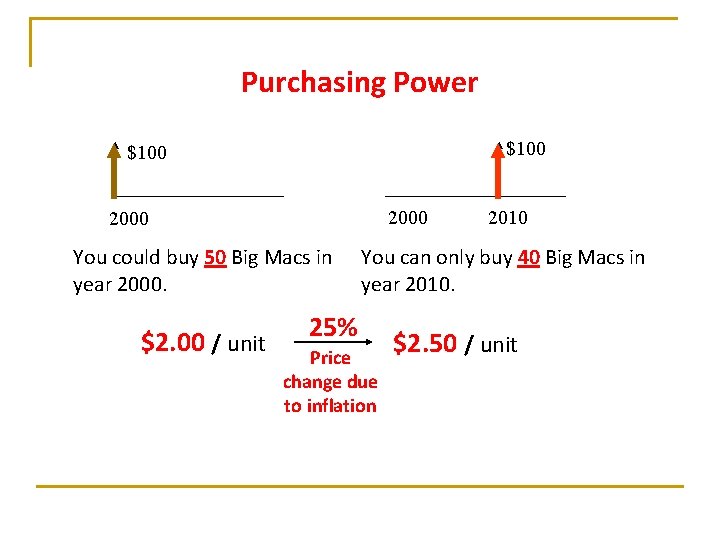
Purchasing Power $100 2000 You could buy 50 Big Macs in year 2000. $2. 00 / unit 2010 You can only buy 40 Big Macs in year 2010. 25% Price change due to inflation $2. 50 / unit
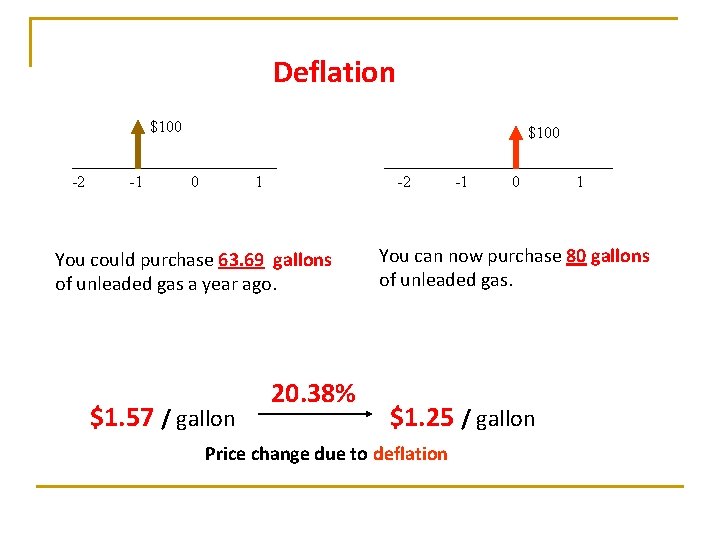
Deflation $100 -2 -1 $100 0 1 -2 You could purchase 63. 69 gallons of unleaded gas a year ago. $1. 57 / gallon 20. 38% -1 0 1 You can now purchase 80 gallons of unleaded gas. $1. 25 / gallon Price change due to deflation
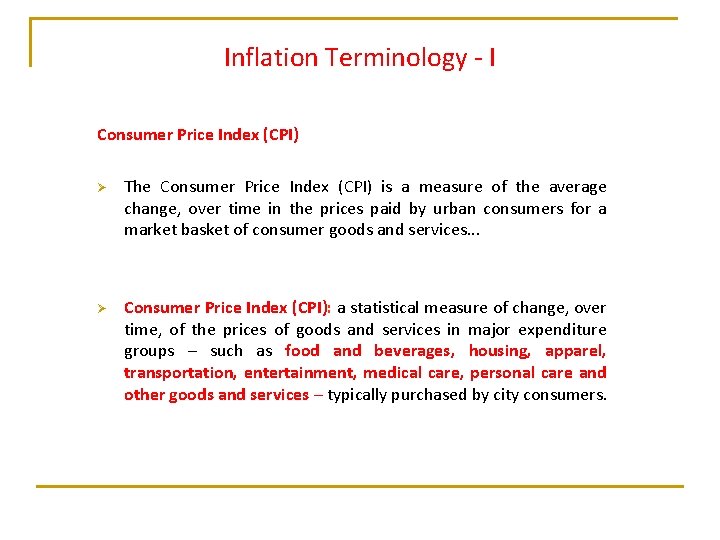
Inflation Terminology - I Consumer Price Index (CPI) Ø Ø The Consumer Price Index (CPI) is a measure of the average change, over time in the prices paid by urban consumers for a market basket of consumer goods and services. . . Consumer Price Index (CPI): a statistical measure of change, over time, of the prices of goods and services in major expenditure groups – such as food and beverages, housing, apparel, transportation, entertainment, medical care, personal care and other goods and services – typically purchased by city consumers.
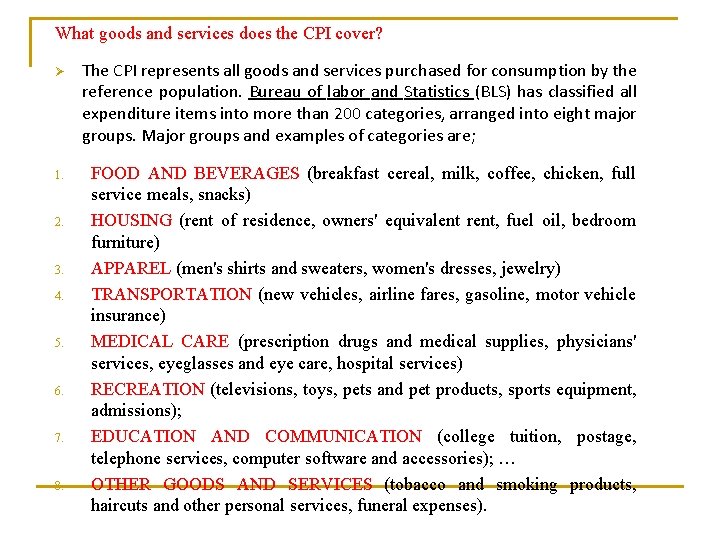
What goods and services does the CPI cover? Ø 1. 2. 3. 4. 5. 6. 7. 8. The CPI represents all goods and services purchased for consumption by the reference population. Bureau of labor and Statistics (BLS) has classified all expenditure items into more than 200 categories, arranged into eight major groups. Major groups and examples of categories are; FOOD AND BEVERAGES (breakfast cereal, milk, coffee, chicken, full service meals, snacks) HOUSING (rent of residence, owners' equivalent rent, fuel oil, bedroom furniture) APPAREL (men's shirts and sweaters, women's dresses, jewelry) TRANSPORTATION (new vehicles, airline fares, gasoline, motor vehicle insurance) MEDICAL CARE (prescription drugs and medical supplies, physicians' services, eyeglasses and eye care, hospital services) RECREATION (televisions, toys, pets and pet products, sports equipment, admissions); EDUCATION AND COMMUNICATION (college tuition, postage, telephone services, computer software and accessories); … OTHER GOODS AND SERVICES (tobacco and smoking products, haircuts and other personal services, funeral expenses).
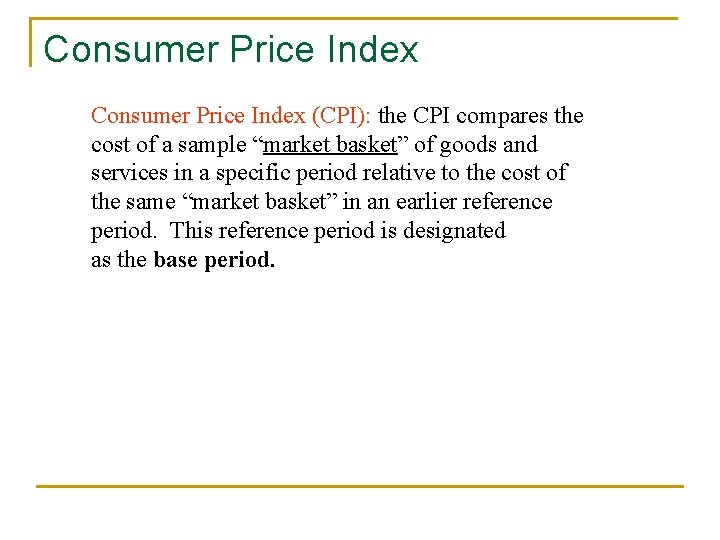
Consumer Price Index (CPI): the CPI compares the cost of a sample “market basket” of goods and services in a specific period relative to the cost of the same “market basket” in an earlier reference period. This reference period is designated as the base period.
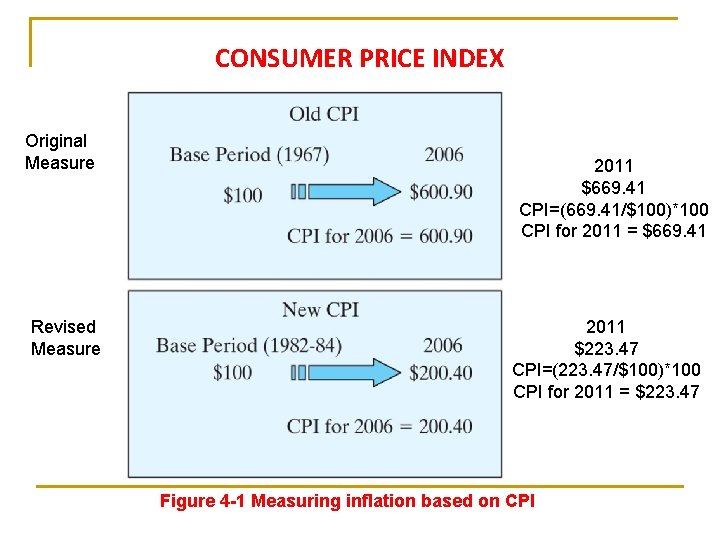
CONSUMER PRICE INDEX Original Measure Revised Measure 2011 $669. 41 CPI=(669. 41/$100)*100 CPI for 2011 = $669. 41 2011 $223. 47 CPI=(223. 47/$100)*100 CPI for 2011 = $223. 47 Figure 4 -1 Measuring inflation based on CPI
Inflation Terminology - I n Producer Price Index (PPI): a statistical measure of wholesale industrial price change, compiled monthly by the Bureau of labor and Statistics (BLS), to evaluate wholesale price levels in the economy.
Inflation Terminology - I What is the Producer Price Index (PPI)? Ø Ø Ø The Producer Price Index is a family of indexes that measures the average change, over time in the selling prices received by domestic producers of goods and services. PPIs measure price change from the perspective of the seller. This contrasts with other measures, such as the Consumer Price Index (CPI), that measure price change from the purchaser's perspective… The consumer price index is a good measure of the general price increase of consumer products. However, it is not a good measure of industrial price increases.
How Does the Producer Price Index Differ from the Consumer Price Index? Ø Ø The Producer Price Index for Finished Goods tracks the average change in prices over time of domestically produced and consumed commodities. The index is comprised of prices for both consumer goods and capital equipment, but excludes prices for services. The All Items CPI measures the average change in prices over time of goods and services purchased for personal consumption by urban U. S. families. The conceptual and definitional distinctions of the PPI and CPI are consistent with the uses of these two major economic indicators. The PPI is used to deflate revenue to measure real growth in output and the CPI is used to adjust income and expenditures for changes in the cost of living.
Inflation Terminology - I n Average Inflation Rate ( f ): a single rate that accounts for the effect of unstable yearly inflation rates over a period of several years. n General Inflation Rate ( f ): the average inflation rate calculated based on the CPI for all items in the market basket.
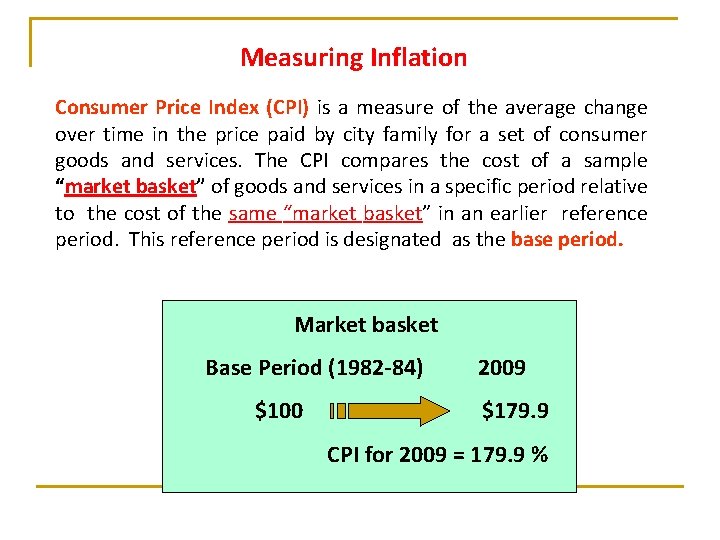
Measuring Inflation Consumer Price Index (CPI) is a measure of the average change over time in the price paid by city family for a set of consumer goods and services. The CPI compares the cost of a sample “market basket” of goods and services in a specific period relative to the cost of the same “market basket” in an earlier reference period. This reference period is designated as the base period. Market basket Base Period (1982 -84) $100 2009 $179. 9 CPI for 2009 = 179. 9 %
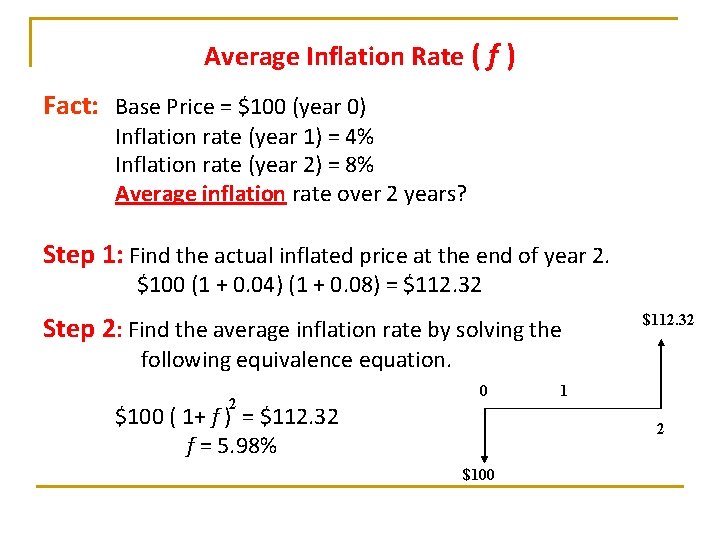
Average Inflation Rate ( f ) Fact: Base Price = $100 (year 0) Inflation rate (year 1) = 4% Inflation rate (year 2) = 8% Average inflation rate over 2 years? Step 1: Find the actual inflated price at the end of year 2. $100 (1 + 0. 04) (1 + 0. 08) = $112. 32 Step 2: Find the average inflation rate by solving the $112. 32 following equivalence equation. 2 0 $100 ( 1+ f ) = $112. 32 f = 5. 98% 1 2 $100
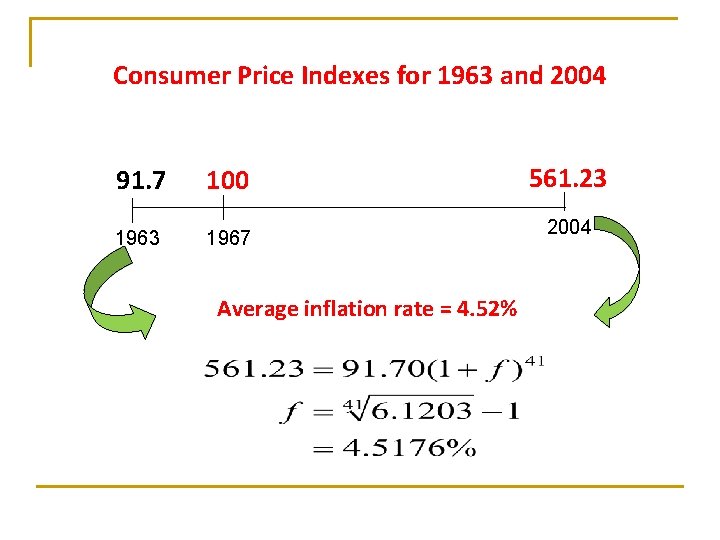
Consumer Price Indexes for 1963 and 2004 91. 7 100 1963 1967 Average inflation rate = 4. 52% 561. 23 2004
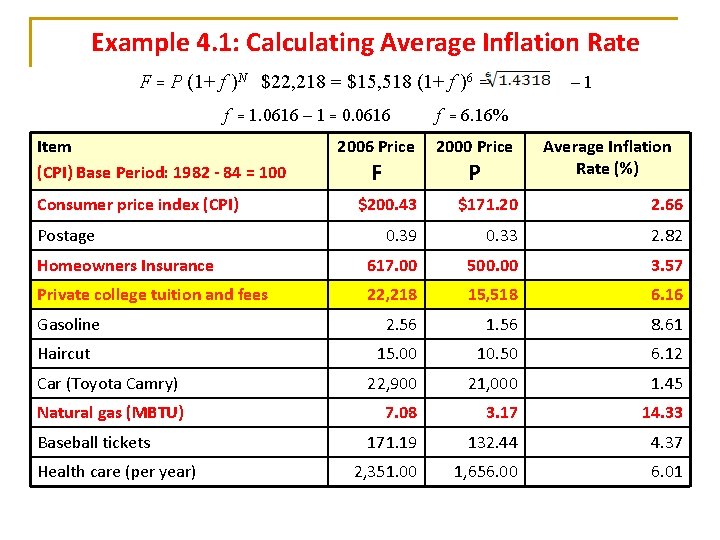
Example 4. 1: Calculating Average Inflation Rate F = P (1+ f )N $22, 218 = $15, 518 (1+ f )6 = f = 1. 0616 – 1 = 0. 0616 Item (CPI) Base Period: 1982 - 84 = 100 f = – 1 6. 16% 2006 Price 2000 Price $200. 43 $171. 20 2. 66 0. 39 0. 33 2. 82 Homeowners Insurance 617. 00 500. 00 3. 57 Private college tuition and fees 22, 218 15, 518 6. 16 Gasoline 2. 56 1. 56 8. 61 Haircut 15. 00 10. 50 6. 12 22, 900 21, 000 1. 45 7. 08 3. 17 14. 33 171. 19 132. 44 4. 37 2, 351. 00 1, 656. 00 6. 01 Consumer price index (CPI) Postage Car (Toyota Camry) Natural gas (MBTU) Baseball tickets Health care (per year) F P Average Inflation Rate (%)
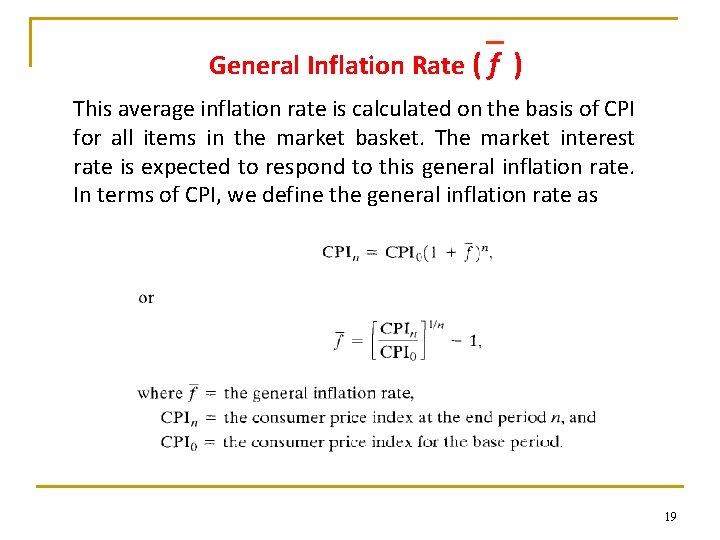
General Inflation Rate ( f ) This average inflation rate is calculated on the basis of CPI for all items in the market basket. The market interest rate is expected to respond to this general inflation rate. In terms of CPI, we define the general inflation rate as 19
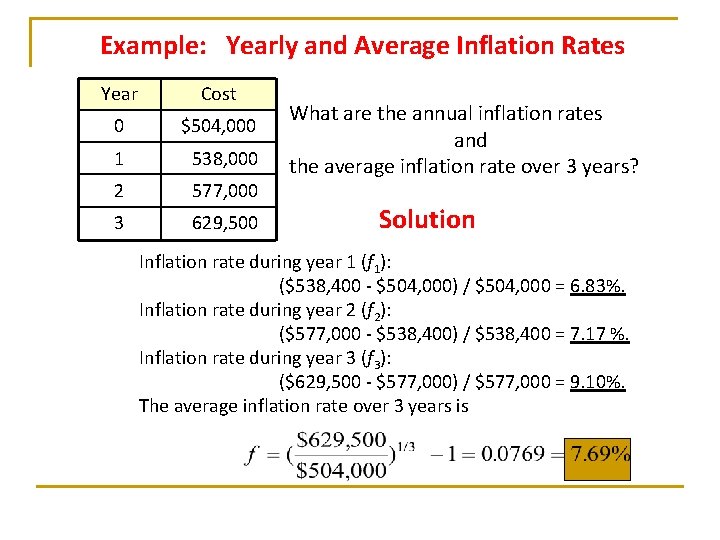
Example: Yearly and Average Inflation Rates Year Cost 0 $504, 000 1 538, 000 2 577, 000 3 629, 500 What are the annual inflation rates and the average inflation rate over 3 years? Solution Inflation rate during year 1 (f 1): ($538, 400 - $504, 000) / $504, 000 = 6. 83%. Inflation rate during year 2 (f 2): ($577, 000 - $538, 400) / $538, 400 = 7. 17 %. Inflation rate during year 3 (f 3): ($629, 500 - $577, 000) / $577, 000 = 9. 10%. The average inflation rate over 3 years is
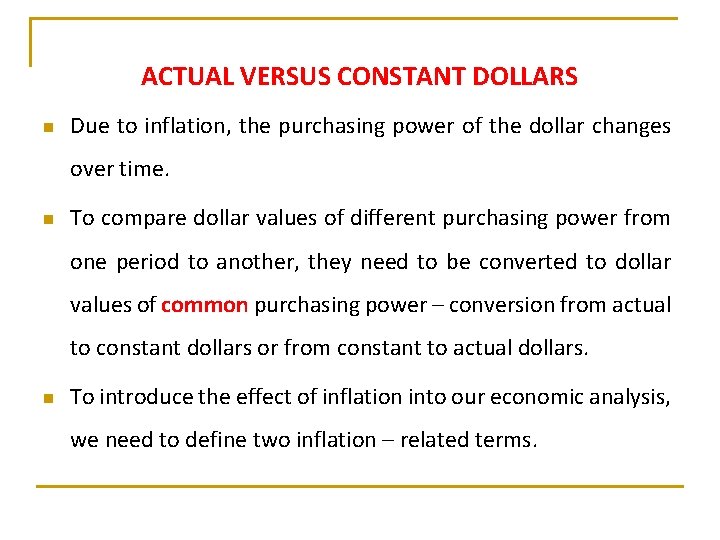
ACTUAL VERSUS CONSTANT DOLLARS n Due to inflation, the purchasing power of the dollar changes over time. n To compare dollar values of different purchasing power from one period to another, they need to be converted to dollar values of common purchasing power – conversion from actual to constant dollars or from constant to actual dollars. n To introduce the effect of inflation into our economic analysis, we need to define two inflation – related terms.
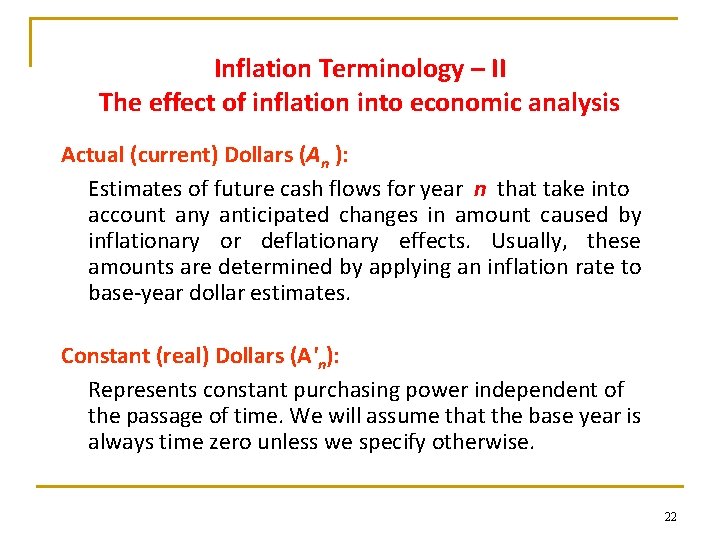
Inflation Terminology – II The effect of inflation into economic analysis Actual (current) Dollars (An ): Estimates of future cash flows for year n that take into account any anticipated changes in amount caused by inflationary or deflationary effects. Usually, these amounts are determined by applying an inflation rate to base-year dollar estimates. Constant (real) Dollars (A'n): Represents constant purchasing power independent of the passage of time. We will assume that the base year is always time zero unless we specify otherwise. 22
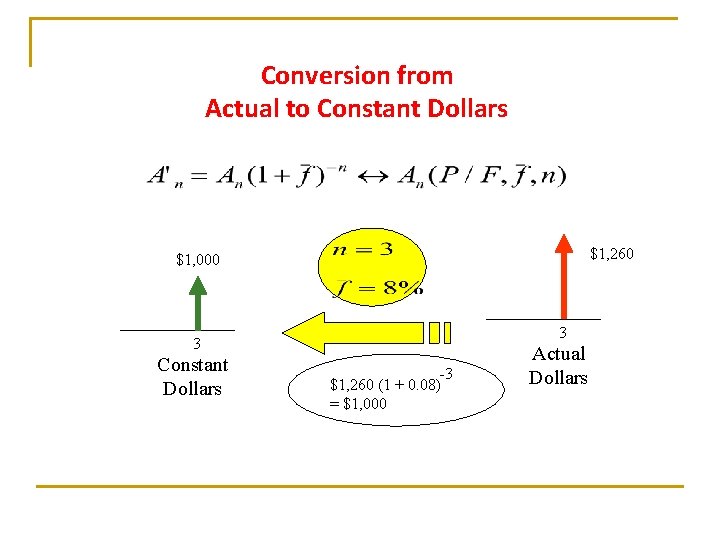
Conversion from Actual to Constant Dollars $1, 260 $1, 000 3 3 Constant Dollars -3 $1, 260 (1 + 0. 08) = $1, 000 Actual Dollars
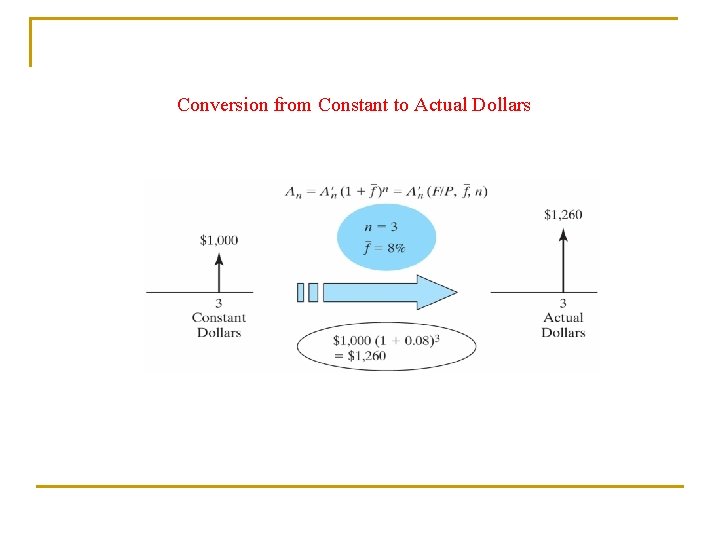
Conversion from Constant to Actual Dollars
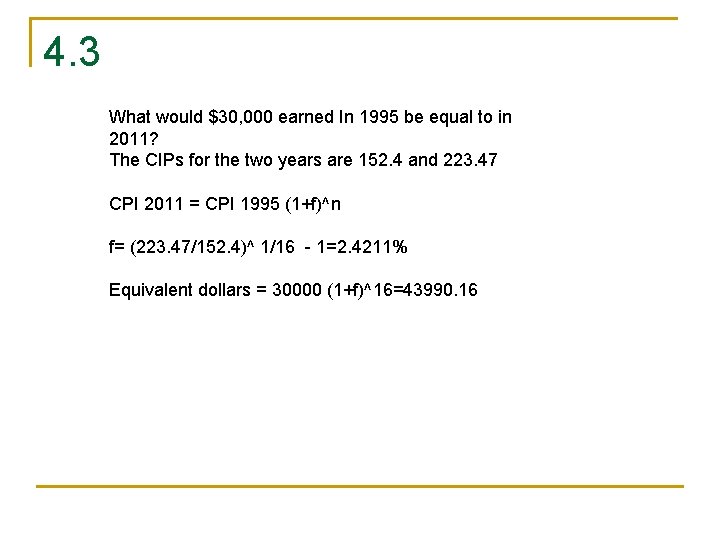
4. 3 What would $30, 000 earned In 1995 be equal to in 2011? The CIPs for the two years are 152. 4 and 223. 47 CPI 2011 = CPI 1995 (1+f)^n f= (223. 47/152. 4)^ 1/16 - 1=2. 4211% Equivalent dollars = 30000 (1+f)^16=43990. 16
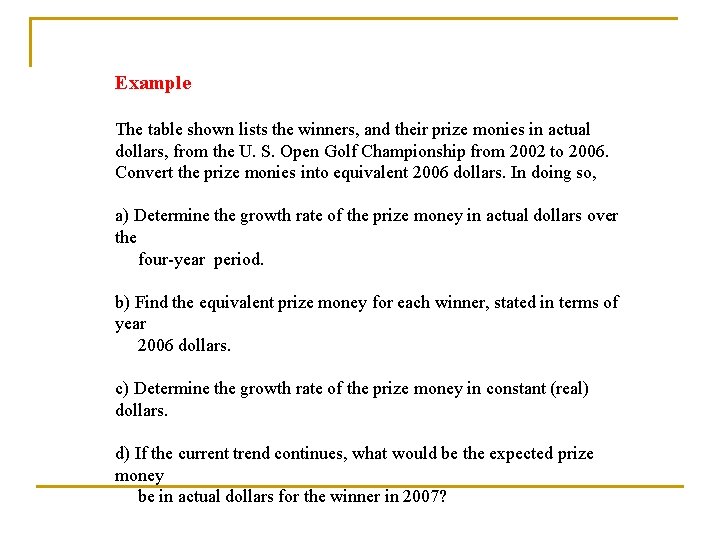
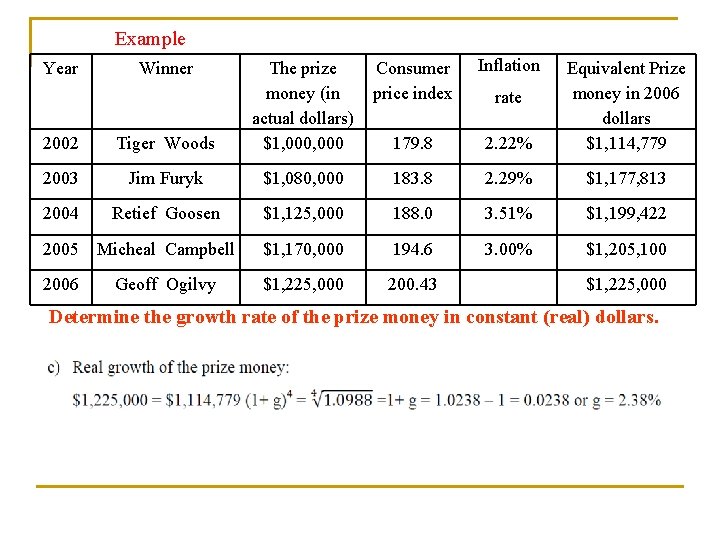
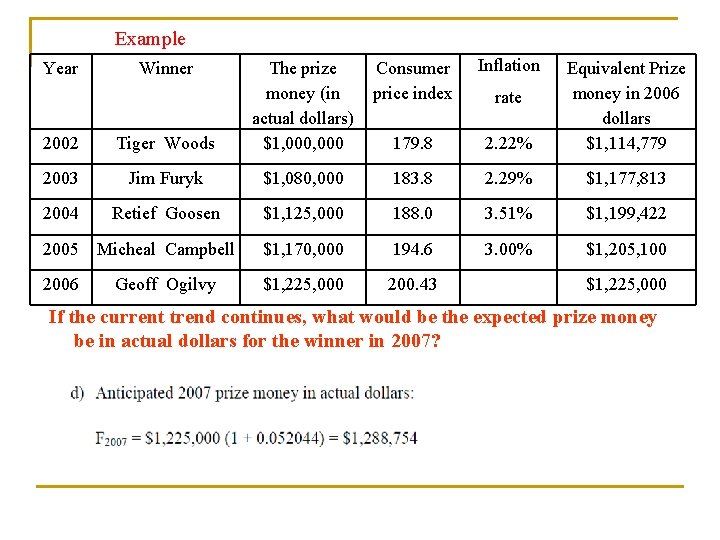
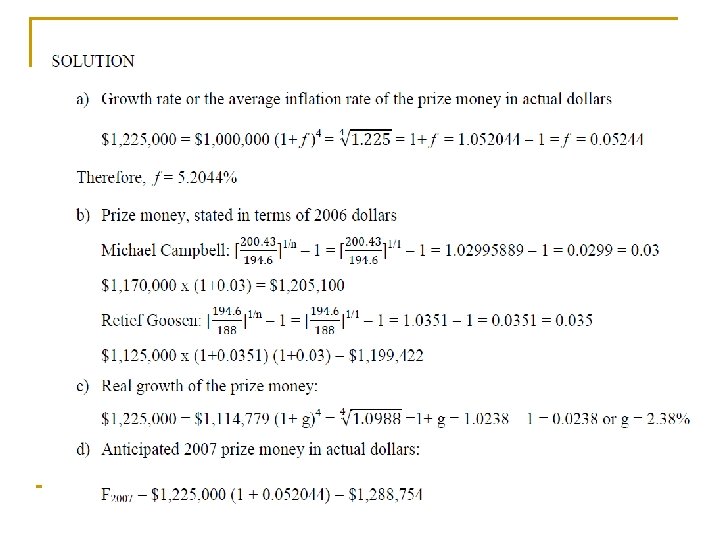
Example The table shown lists the winners, and their prize monies in actual dollars, from the U. S. Open Golf Championship from 2002 to 2006. Convert the prize monies into equivalent 2006 dollars. In doing so, a) Determine the growth rate of the prize money in actual dollars over the four-year period. b) Find the equivalent prize money for each winner, stated in terms of year 2006 dollars. c) Determine the growth rate of the prize money in constant (real) dollars. d) If the current trend continues, what would be the expected prize money be in actual dollars for the winner in 2007?
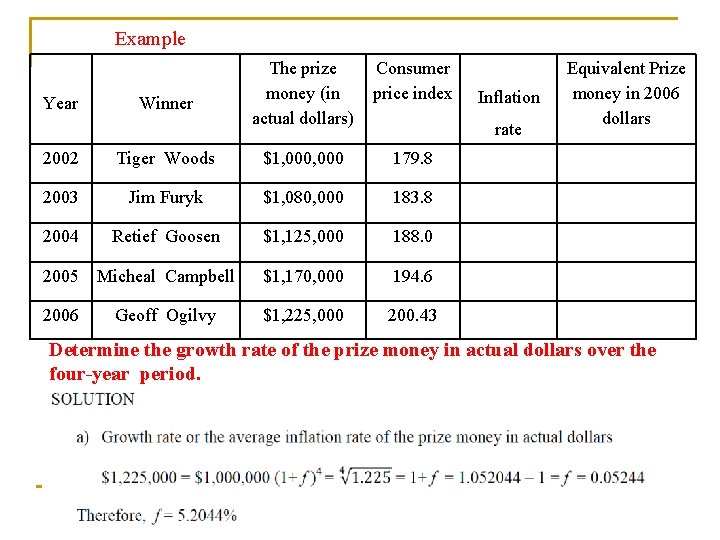
Example Year Winner The prize money (in actual dollars) Consumer price index Inflation rate 2002 Tiger Woods $1, 000 179. 8 2003 Jim Furyk $1, 080, 000 183. 8 2004 Retief Goosen $1, 125, 000 188. 0 2005 Micheal Campbell $1, 170, 000 194. 6 2006 Geoff Ogilvy $1, 225, 000 200. 43 Equivalent Prize money in 2006 dollars Determine the growth rate of the prize money in actual dollars over the four-year period.
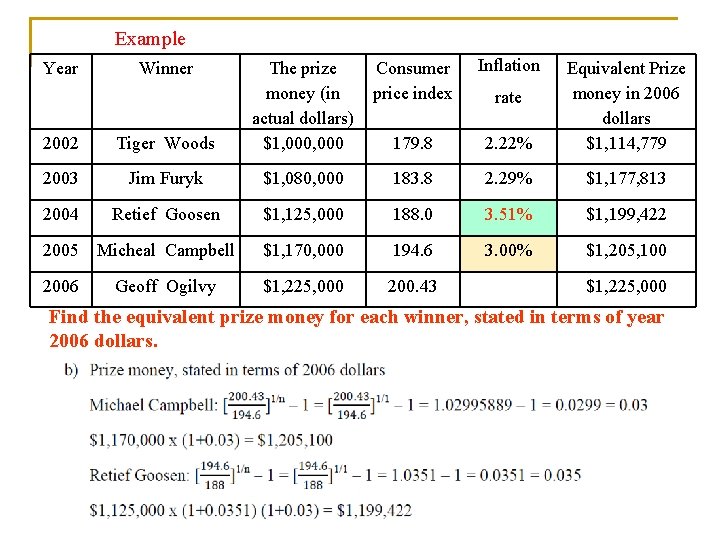
Example Year Winner Consumer price index Inflation 179. 8 2. 22% Equivalent Prize money in 2006 dollars $1, 114, 779 2002 Tiger Woods The prize money (in actual dollars) $1, 000 2003 Jim Furyk $1, 080, 000 183. 8 2. 29% $1, 177, 813 2004 Retief Goosen $1, 125, 000 188. 0 3. 51% $1, 199, 422 2005 Micheal Campbell $1, 170, 000 194. 6 3. 00% $1, 205, 100 2006 Geoff Ogilvy $1, 225, 000 200. 43 rate $1, 225, 000 Find the equivalent prize money for each winner, stated in terms of year 2006 dollars.
Example Year Winner Consumer price index Inflation 179. 8 2. 22% Equivalent Prize money in 2006 dollars $1, 114, 779 2002 Tiger Woods The prize money (in actual dollars) $1, 000 2003 Jim Furyk $1, 080, 000 183. 8 2. 29% $1, 177, 813 2004 Retief Goosen $1, 125, 000 188. 0 3. 51% $1, 199, 422 2005 Micheal Campbell $1, 170, 000 194. 6 3. 00% $1, 205, 100 2006 Geoff Ogilvy $1, 225, 000 200. 43 rate $1, 225, 000 Determine the growth rate of the prize money in constant (real) dollars.
Example Year Winner Consumer price index Inflation 179. 8 2. 22% Equivalent Prize money in 2006 dollars $1, 114, 779 2002 Tiger Woods The prize money (in actual dollars) $1, 000 2003 Jim Furyk $1, 080, 000 183. 8 2. 29% $1, 177, 813 2004 Retief Goosen $1, 125, 000 188. 0 3. 51% $1, 199, 422 2005 Micheal Campbell $1, 170, 000 194. 6 3. 00% $1, 205, 100 2006 Geoff Ogilvy $1, 225, 000 200. 43 rate $1, 225, 000 If the current trend continues, what would be the expected prize money be in actual dollars for the winner in 2007?
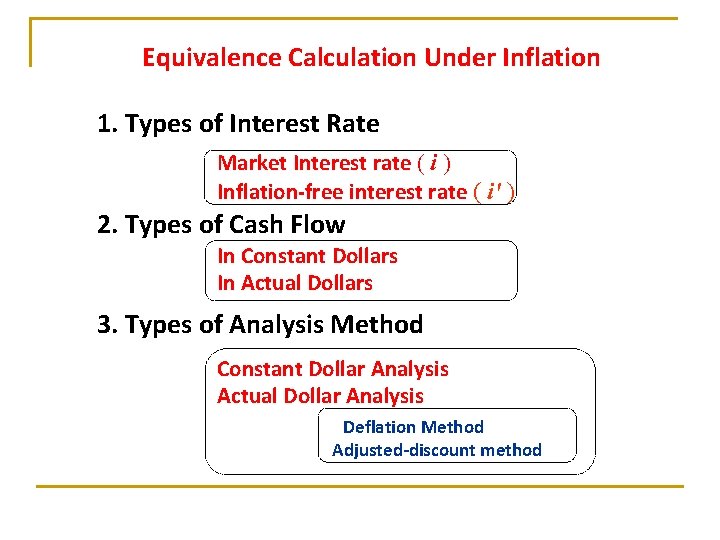
Equivalence Calculation Under Inflation 1. Types of Interest Rate Market Interest rate ( i ) Inflation-free interest rate ( i' ) 2. Types of Cash Flow In Constant Dollars In Actual Dollars 3. Types of Analysis Method Constant Dollar Analysis Actual Dollar Analysis Deflation Method Adjusted-discount method
Inflation Terminology - III n Inflation-free Interest Rate ( i' ): an estimate of the true earning power of money when the inflation effects have been removed. q This rate is known as real interest rate, and it can be computed if the market interest rate and the inflation rate are known. 33
Inflation Terminology - III n Market interest rate ( i ) known as the nominal interest rate, which takes into account the combined effects of the earning value of capital (earning power) and any anticipated inflation or deflation (purchasing power). q Most firms use a market interest rate (also known as inflation-adjusted required rate of return) in evaluating their investment projects. 34
Inflation and Cash Flow Analysis Constant Dollar analysis (A' n) (inflation free interest rate i' ) q All cash flow elements are given in constant dollars q Compute the equivalent present worth of constant dollars (A' n) in year n. q In the absence of inflationary effect, we use i' to account the earning power of the money. 35
Inflation and Cash Flow Analysis Actual Dollar Analysis (An) ( market interest rate i ) q All the cash flow elements are estimated in actual dollars. q To find the equivalent present worth of this actual dollar amount (An ) in year n. q We use two steps to convert actual dollars into equivalent present worth dollars. 36
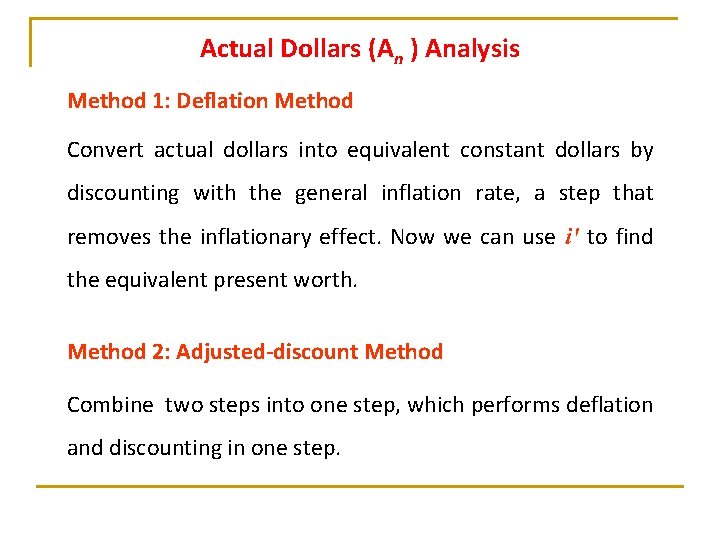
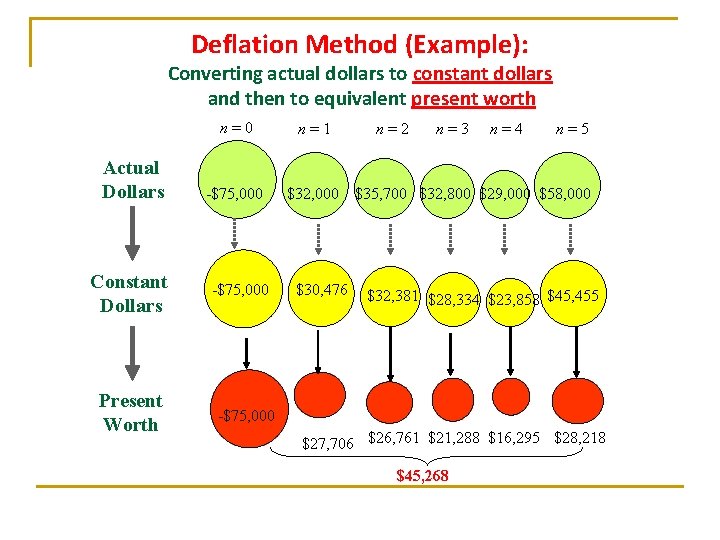
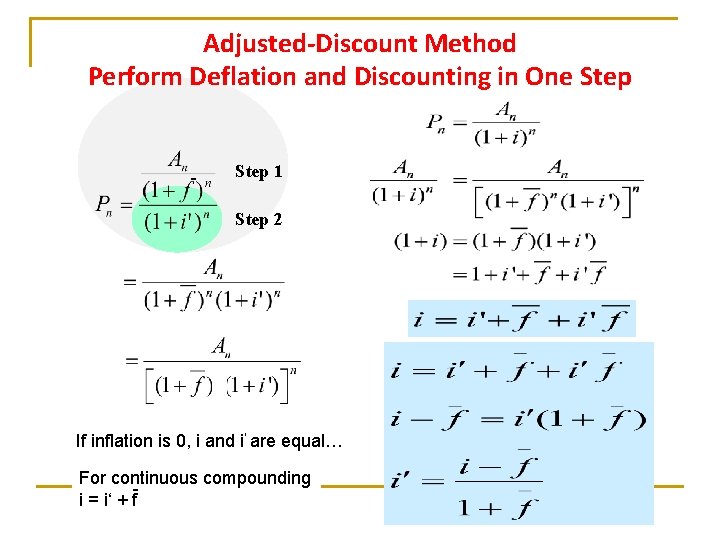
Actual Dollars (An ) Analysis Method 1: Deflation Method Convert actual dollars into equivalent constant dollars by discounting with the general inflation rate, a step that removes the inflationary effect. Now we can use i' to find the equivalent present worth. Method 2: Adjusted-discount Method Combine two steps into one step, which performs deflation and discounting in one step.
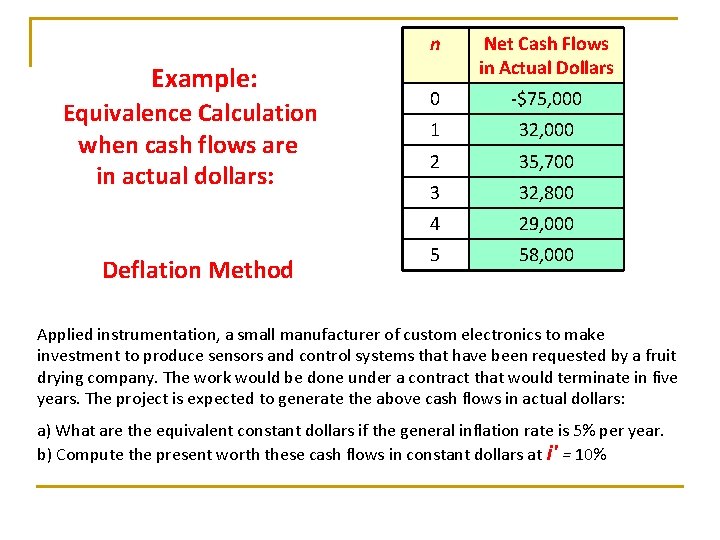
Example: Equivalence Calculation when cash flows are in actual dollars: Deflation Method n Net Cash Flows in Actual Dollars 0 -$75, 000 1 32, 000 2 35, 700 3 32, 800 4 29, 000 5 58, 000 Applied instrumentation, a small manufacturer of custom electronics to make investment to produce sensors and control systems that have been requested by a fruit drying company. The work would be done under a contract that would terminate in five years. The project is expected to generate the above cash flows in actual dollars: a) What are the equivalent constant dollars if the general inflation rate is 5% per year. b) Compute the present worth these cash flows in constant dollars at i' = 10%
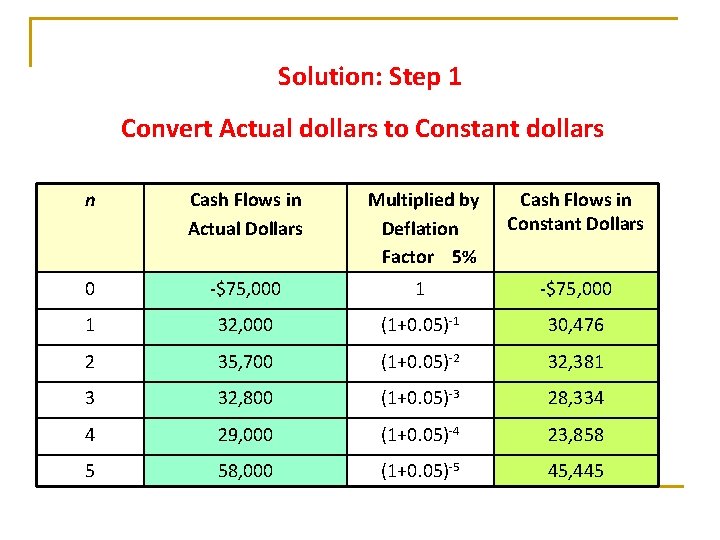
Solution: Step 1 Convert Actual dollars to Constant dollars n Cash Flows in Actual Dollars Multiplied by Deflation Factor 5% Cash Flows in Constant Dollars 0 -$75, 000 1 32, 000 (1+0. 05)-1 30, 476 2 35, 700 (1+0. 05)-2 32, 381 3 32, 800 (1+0. 05)-3 28, 334 4 29, 000 (1+0. 05)-4 23, 858 5 58, 000 (1+0. 05)-5 45, 445
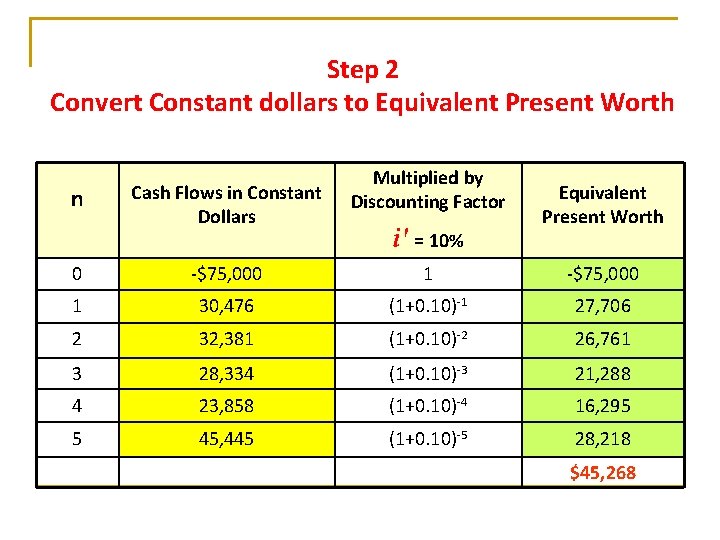
Step 2 Convert Constant dollars to Equivalent Present Worth n Cash Flows in Constant Dollars Multiplied by Discounting Factor i' = 10% Equivalent Present Worth 0 -$75, 000 1 30, 476 (1+0. 10)-1 27, 706 2 32, 381 (1+0. 10)-2 26, 761 3 28, 334 (1+0. 10)-3 21, 288 4 23, 858 (1+0. 10)-4 16, 295 5 45, 445 (1+0. 10)-5 28, 218 $45, 268
Deflation Method (Example): Converting actual dollars to constant dollars and then to equivalent present worth Actual Dollars Constant Dollars Present Worth n=0 n=1 -$75, 000 $32, 000 -$75, 000 $30, 476 n=2 n=3 n=4 n=5 $35, 700 $32, 800 $29, 000 $58, 000 $32, 381 $28, 334 $23, 858 $45, 455 -$75, 000 $27, 706 $26, 761 $21, 288 $16, 295 $28, 218 $45, 268
Adjusted-Discount Method Perform Deflation and Discounting in One Step - Step 1 Step 2 If inflation is 0, i and i‘ are equal… For continuous compounding i = i‘ + f
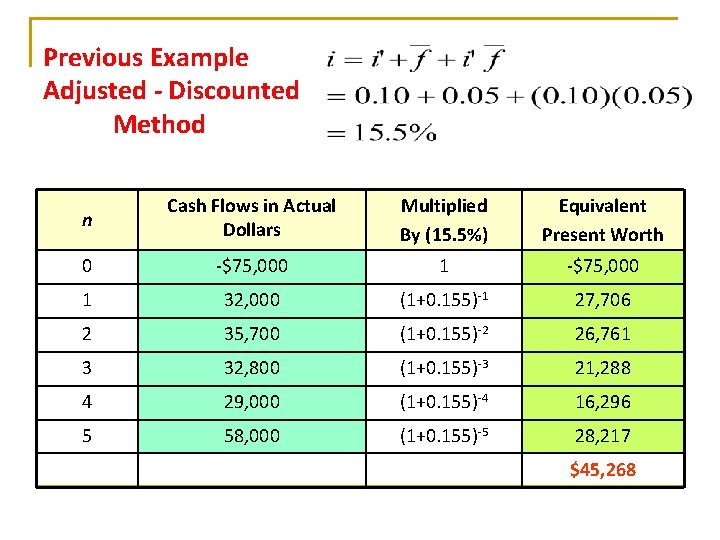
Previous Example Adjusted - Discounted Method n Cash Flows in Actual Dollars Multiplied By (15. 5%) Equivalent Present Worth 0 -$75, 000 1 32, 000 (1+0. 155)-1 27, 706 2 35, 700 (1+0. 155)-2 26, 761 3 32, 800 (1+0. 155)-3 21, 288 4 29, 000 (1+0. 155)-4 16, 296 5 58, 000 (1+0. 155)-5 28, 217 $45, 268
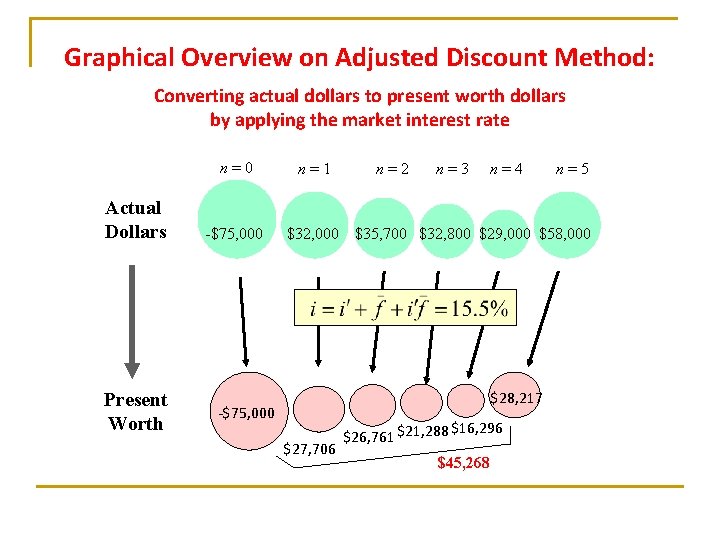
Graphical Overview on Adjusted Discount Method: Converting actual dollars to present worth dollars by applying the market interest rate Actual Dollars Present Worth n=0 n=1 -$75, 000 $32, 000 n=2 n=3 n=4 $35, 700 $32, 800 $29, 000 $58, 000 $28, 217 -$75, 000 $27, 706 n=5 $26, 761 $21, 288 $16, 296 $45, 268
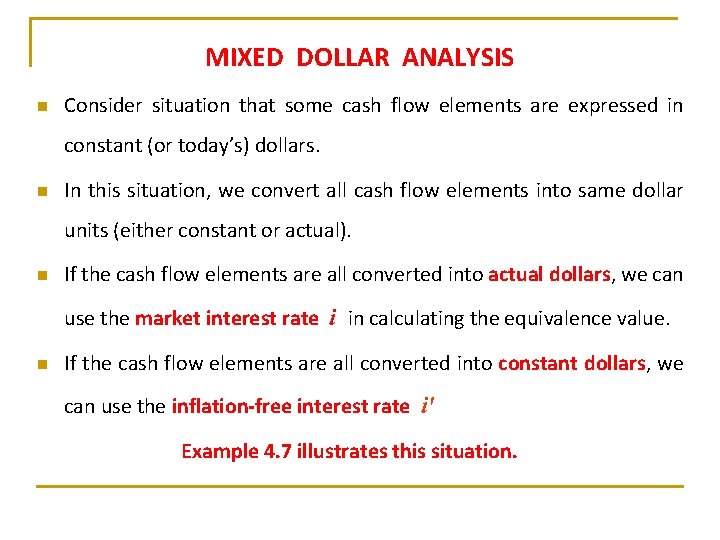
MIXED DOLLAR ANALYSIS n Consider situation that some cash flow elements are expressed in constant (or today’s) dollars. n In this situation, we convert all cash flow elements into same dollar units (either constant or actual). n If the cash flow elements are all converted into actual dollars, we can use the market interest rate i in calculating the equivalence value. n If the cash flow elements are all converted into constant dollars, we can use the inflation-free interest rate i' Example 4. 7 illustrates this situation.
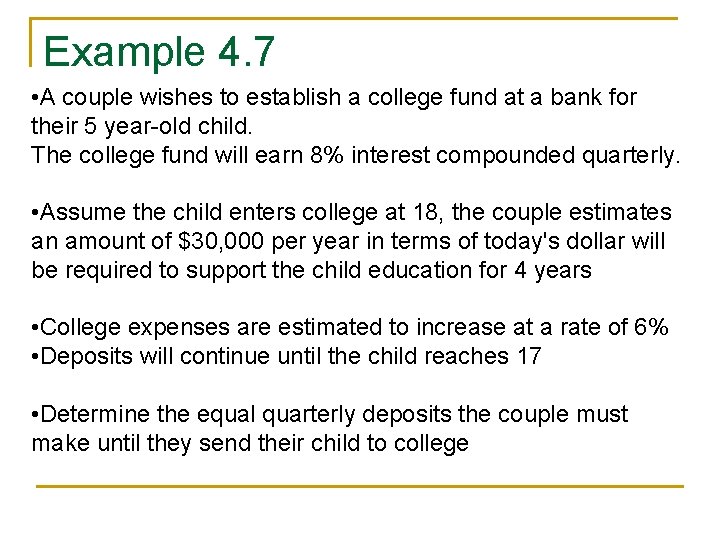
Example 4. 7 • A couple wishes to establish a college fund at a bank for their 5 year-old child. The college fund will earn 8% interest compounded quarterly. • Assume the child enters college at 18, the couple estimates an amount of $30, 000 per year in terms of today's dollar will be required to support the child education for 4 years • College expenses are estimated to increase at a rate of 6% • Deposits will continue until the child reaches 17 • Determine the equal quarterly deposits the couple must make until they send their child to college
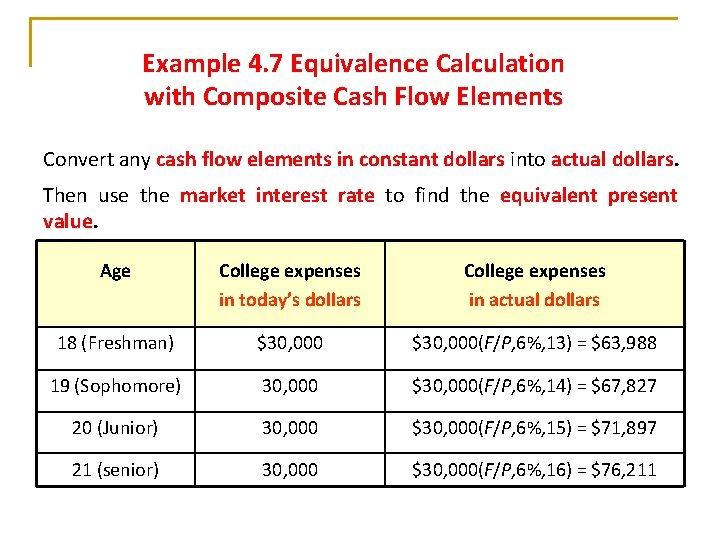
Example 4. 7 Equivalence Calculation with Composite Cash Flow Elements Convert any cash flow elements in constant dollars into actual dollars. Then use the market interest rate to find the equivalent present value. Age College expenses in today’s dollars College expenses in actual dollars 18 (Freshman) $30, 000(F/P, 6%, 13) = $63, 988 19 (Sophomore) 30, 000 $30, 000(F/P, 6%, 14) = $67, 827 20 (Junior) 30, 000 $30, 000(F/P, 6%, 15) = $71, 897 21 (senior) 30, 000 $30, 000(F/P, 6%, 16) = $76, 211
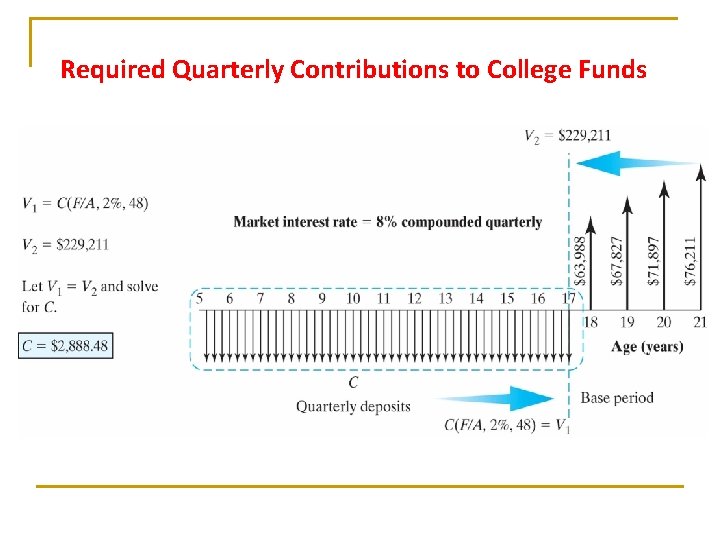
Required Quarterly Contributions to College Funds
Key Points n n n The Consumer Price Index (CPI) is a statistical measure of change, over time, of the prices of goods and services in major expenditure groups —such as food, housing, apparel, transportation, and medical care—typically purchased by urban consumers. Inflation is the term used to describe a decline in purchasing power evidenced in an economic environment of rising prices. Deflation is the opposite: An increase in purchasing power evidenced by falling prices.
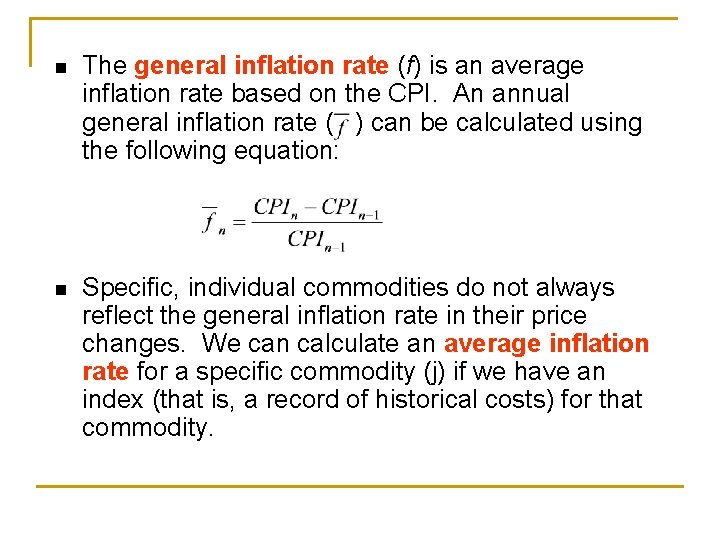
n The general inflation rate (f) is an average inflation rate based on the CPI. An annual general inflation rate ( ) can be calculated using the following equation: n Specific, individual commodities do not always reflect the general inflation rate in their price changes. We can calculate an average inflation rate for a specific commodity (j) if we have an index (that is, a record of historical costs) for that commodity.
n n Project cash flows may be stated in one of two forms Actual dollars (An): Dollars that reflect the inflation or deflation rate. Constant dollars (A’n): Year 0 (or base year) dollars Interest rates for project evaluation may be stated in one of two forms: Market interest rate (i): A rate which combines the effects of interest and inflation; used with actual dollar analysis Inflation-free interest rate (i’): A rate from which the effects of inflation have been removed; this rate is used with constant dollar analysis
n To calculate the present worth of actual dollars, we can use a two-step or a one-step process: Deflation method—two steps: 1. Convert actual dollars by deflating with the general inflation rate of 2. Calculate the PW of constant dollars by discounting at i’ Adjusted-discount method—one step 1. Compute the market interest rate. 2. Use the market interest rate directly to find the present value.