
Equivalence and Strategies Lecture 2 Dr Jacob Blakesley
Equivalence and Strategies Lecture 2 Dr Jacob Blakesley jacob. blakesley@uniroma 1. it
Practical things • Cognomi • Testi • Esame
Ferdinand Saussure • Language is made up of signs – The signifier (signifiant): the phonic component of a word – The signified (signifié): the mental concept of the word • Arbitrariness of the sign • In language there are only differences
Roman Jakobson • “Equivalence in difference is the cardinal problem of language and the pivotal concern of linguistics’ • ‘There is ordinarily no full equivalence between code-units’ • ‘the code units will be different because they belong to different sign systems or languages, which partition reality differently’
J. C. Catford • ‘The central problem of translation practice is that of finding target-language translation equivalents’
Eugene Nida • Formal equivalence • Dynamic equivalence
Formal equivalence focuses attention on the message itself, in both form and content … One is concerned that the message in the receptor language should match as closely as possible the different elements in the source language. (Nida 1964: 159)
Dynamic equivalence …the relationship between receptor and message should be substantially the same as that which existed between the original receptors and the message. (Nida 1964: 159) That is, it’s based on the principle of equivalent effect.
Werner Koller Five types of equivalence: 1. Denotative equivalence 2. Connotative equivalence 3. Text-normative equivalence 4. Pragmatic equivalence 5. Formal equivalence
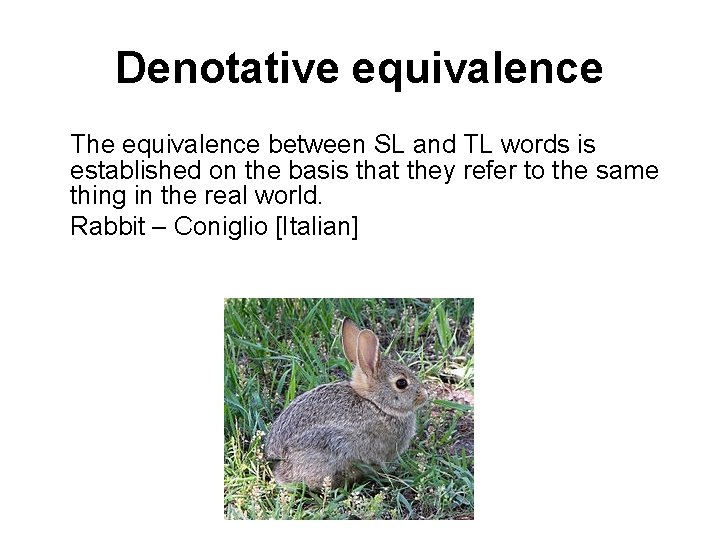
Denotative equivalence The equivalence between SL and TL words is established on the basis that they refer to the same thing in the real world. Rabbit – Coniglio [Italian]
Connotative equivalence The equivalence is established on the basis that the SL and TL words used trigger the same or similar associations in the minds of native speakers of the two languages. Bunny – Coniglietto [Italian]
Text-normative equivalence The equivalence is established on the basis that the SL and TL words chosen are used in the same or similar contexts in their respective languages.
Pragmatic equivalence The equivalence is established on the basis that the SL and TL words used have the same effect on their respective readers. It is similar to Nida’s dynamic equivalence.
Formal equivalence The equivalence is related to the form and aesthetics of the text. It includes words plays and stylistic features of the ST. It is not to be confused with Nida’s formal equivalence. Equivalence is said to be achieved if SL and TL words happen to have similar orthographic or phonological features.
Types of equivalence • One to one equivalence [Bread, pain] • One-to-many equivalence: More than one TL expressions are equivalent to a single SL expression [Bamboo -> trúc, nura, mai, vau (Vietnamese)] • One-to-part-of-one equivalence [Mouton (French) -> sheep; Mouton -> mutton]. • Nil equivalence [Privacy -> Privacy]
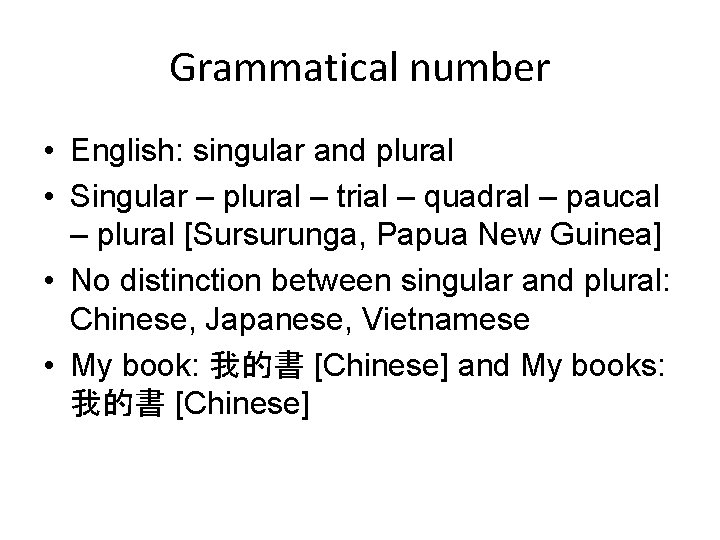
Grammatical number • English: singular and plural • Singular – plural – trial – quadral – paucal – plural [Sursurunga, Papua New Guinea] • No distinction between singular and plural: Chinese, Japanese, Vietnamese • My book: 我的書 [Chinese] and My books: 我的書 [Chinese]
Gender • Some languages have gender distinctions • English – French/Italian/Spanish – Chinese
Emily Dickinson Because I could not stop for Death – He kindly stopped for me – The Carriage held but just Ourselves – And Immortality. -Masculine – German (English) Feminine – Italian, French, Russian No gender – Chinese, Japanese, Turkish
Familiarity • Different degrees of familiarity – – – Tu/vous [French] Du/Sie [German] Informal Spanish singular: tu [Spain] Informal Spanish singular: vos [S. America] Formal Spanish singular: usted [Spain] Informal/formal plural: vosotros [Spain], ustedes [S. America]
Tense (1/2) • In Russian, Arabic, Hebrew, and Hungarian, ‘to be’ is sometimes not used in the present tense • English and other Germanic languages: no future tense. Future must be expressed through other words (will, etc. ) • Russian: no pluperfect (I had gone to the store before he came over to my house) • Chinese and Burmese: “tenseless languages”: tense given through adverbs • Lack of personal pronouns
Tense (2/2): Hopi • Hopi (Arizona, USA): • 1) timeless truths: the sun is round • 2) known or presumed events: Paris is the capital of France • 3) uncertain events: They will arrive tomorrow
Voice • Many languages have ‘passive forms’: – Latin, Greek, German, English, French • Some languages don’t have ‘passive forms’ – Tagalog; Oneida, Cree, other Native American languages
Honorifics • In Javanese, there are three different ways of saying ‘house’ according to status level of the person spoken to. • In Korean, there are six different ‘speech styles’ with related grammatical specific forms: • 1) plain style (haerache) • 2) intimate style (haeche) • 3) familiar style (hageche) • 4) semiformal style (haoche) • 5) polite style (haeyoche) • 6) deferential style (hapshoche)
Word Order • Word order – Strict (English, Chinese) – Less strict (Arabic, Eskimo, Finnish, German, Russian)
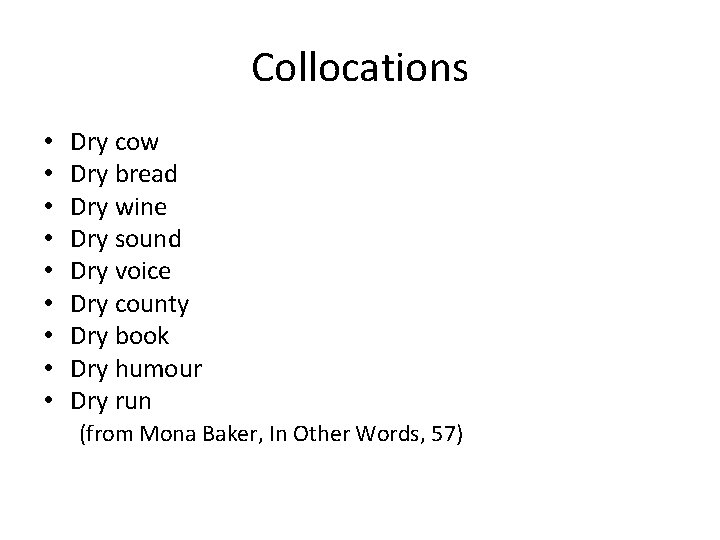
Collocations • • • Dry cow Dry bread Dry wine Dry sound Dry voice Dry county Dry book Dry humour Dry run (from Mona Baker, In Other Words, 57)
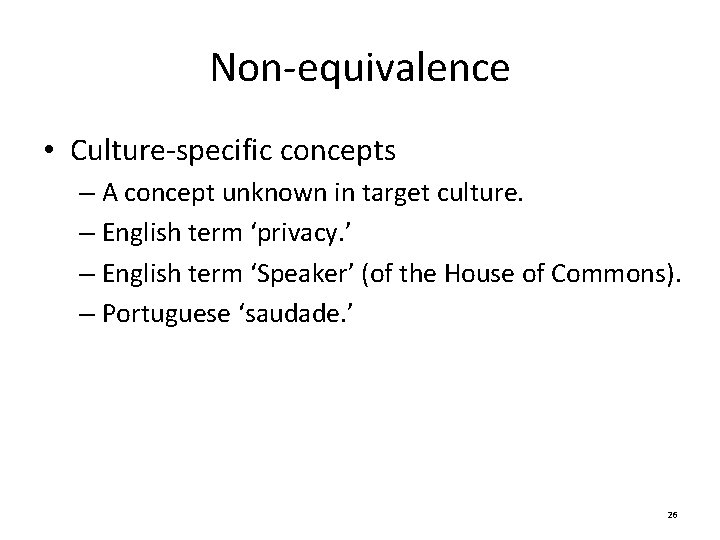
Non-equivalence • Culture-specific concepts – A concept unknown in target culture. – English term ‘privacy. ’ – English term ‘Speaker’ (of the House of Commons). – Portuguese ‘saudade. ’ 26
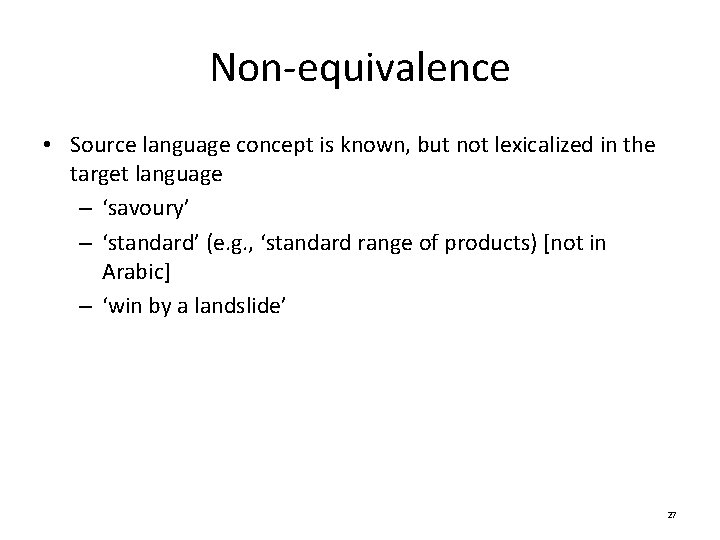
Non-equivalence • Source language concept is known, but not lexicalized in the target language – ‘savoury’ – ‘standard’ (e. g. , ‘standard range of products) [not in Arabic] – ‘win by a landslide’ 27
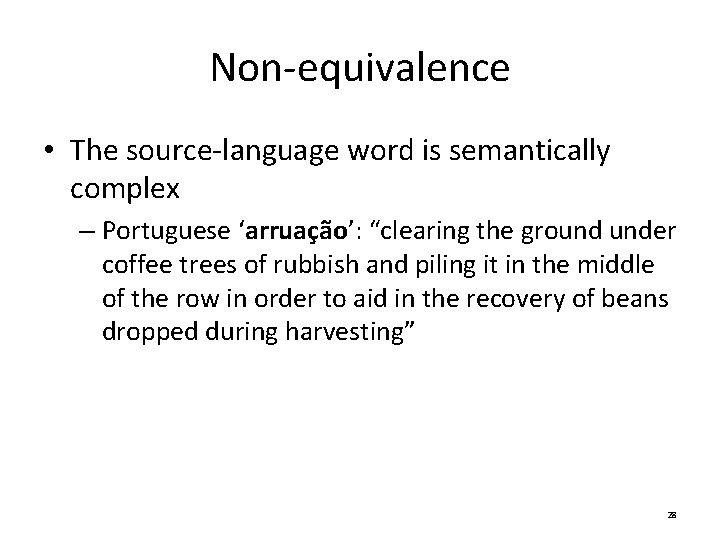
Non-equivalence • The source-language word is semantically complex – Portuguese ‘arruação’: “clearing the ground under coffee trees of rubbish and piling it in the middle of the row in order to aid in the recovery of beans dropped during harvesting” 28
Non-equivalence • The source and target languages make different distinctions in meaning – Indonesian makes a distinction between going out in the rain without the knowledge that it is raining (kehujanan) and going out in the rain with the knowledge that it is raining (hujanan). 29
Non-equivalence • The target language lacks a specific term -More categories of a word in one language than another (e. g. , all the words in English for ‘house’ or ‘article’) 30
Non-equivalence • Differences in expressive meaning – The source language word may be neutral – e. g. , homosexual, while the target language word, e. g. , in Arabic, is pejorative. 31
Non-equivalence • Differences in form – Suffixes, prefixes • “translationese” • “boyish” (smile) 32
Non-equivalence • Differences in frequency and purpose of using specific forms – ‘ing’ form in English, which is less used in other languages. 33
Non-equivalence • Loan words, false friends – College/colegio [Spanish] – Sympathetic/sympathique [French] 34
Mona Baker’s taxonomy ‘Translation by a more general word Translation by a more neutral word Translation by cultural substitution Translation using a loan word Translation by paraphrase using a related word Translation by paraphrase using non-related words • Translation by omission’ • • • – Mona Baker, In Other Words (Routledge, 1992), 26 -42.
Strategies against non-equivalence • Translation by a more general word – Orbit -> revolve [back translation in Spanish] – Shampoo -> wash [back translation in Arabic] 36
Strategies against non-equivalence • Translation by a more neutral / less expressive word – Mumbles -> suggests [back translation in Italian] 37
Strategies against non-equivalence • Translation by cultural substitute – Cream tea -> pastry [back translation in Italian] 38
Strategies against non-equivalence • Translation using a loan word – Cornish Cream tea -> Cream tea [German] 39
Strategies against non-equivalence • Translation using paraphrase – Creamy -> that resembles cream [Arabic] 40
Strategies against non-equivalence • Translation by paraphrase using unrelated words – Affidavit -> written communication supported by an oath [Arabic] 41
Strategies against non-equivalence • Translation by omission 42
Andrew Chesterman’s taxonomy of strategies (‘techniques’) • Syntactic strategies • Semantic strategies • Pragmatic strategies
Andrew Chesterman’s Syntactic strategies • • • Literal translation Loan, calque Transposition Unit shift Phrase structure change Clause structure change Sentence structure change Cohesion change Level shift Scheme change
Syntactic strategies • Literal translation – ‘maximally close to the SL form, but nevertheless grammatical’ (Chesterman, 92) • Loan, calque Übermensch translated as ‘Superman’
Syntactic strategies • Transposition (Vinay-Darbelnet) – ‘any change of word-class, e. g. , from noun to verb’ (Chesterman, 93) • Unit shift (Catford) – When the ST unit is translated as a different unit in the TT; units are ‘morphemes, word, phrase, clause, sentence, paragraph’ (Chesterman, 93)
Syntactic strategies • Phrase structure change – Changes at the level of the phrase, including number, definiteness and modification in the noun phrase, and person, tense and mood in the verb phrase. The unit itself may remain unchanged, i. e. an ST phrase may still correspond to a TT phrase, but its internal structure changes’ (Chesterman, 93) • Clause structure change – Active vs. passive, transitive v. intransitive verbs, etc.
Syntactic strategies • Sentence structure change – Changes between main and sub-clause status, etc. • Cohesion change – Something that affects intra-textual reference, ellipsis, substitution, pronominalization, repetition, connectors.
Syntactic strategies • Level shift – This includes phonology, morphology, syntax, and lexis. A phrase can become a sentence, for example • Scheme change – Parallelism, alliteration, metrical rhythm. Either kept, changed, eliminated, or added.
Semantic strategies • • • Synonymy Antonomy Hyponomy Converse Abstraction change Distribution change Emphasis change Paraphrase Trope change Other semantic changes
Semantic strategies • Synonymy • Using a similar word to avoid repetition, for example • Antonomy • Translating a negative with a negation
Semantic strategies • Hyponomy • Choosing a specific word, instead of a more general word, or vice versa: e. g. , airlines, instead of companies in the original text • Converse • Choosing verbal structures from opposite perspective: e. g. , buy versus sell
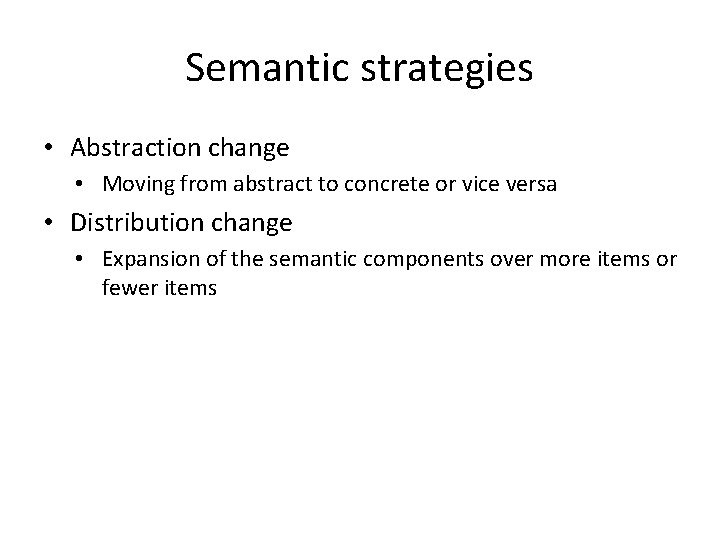
Semantic strategies • Abstraction change • Moving from abstract to concrete or vice versa • Distribution change • Expansion of the semantic components over more items or fewer items
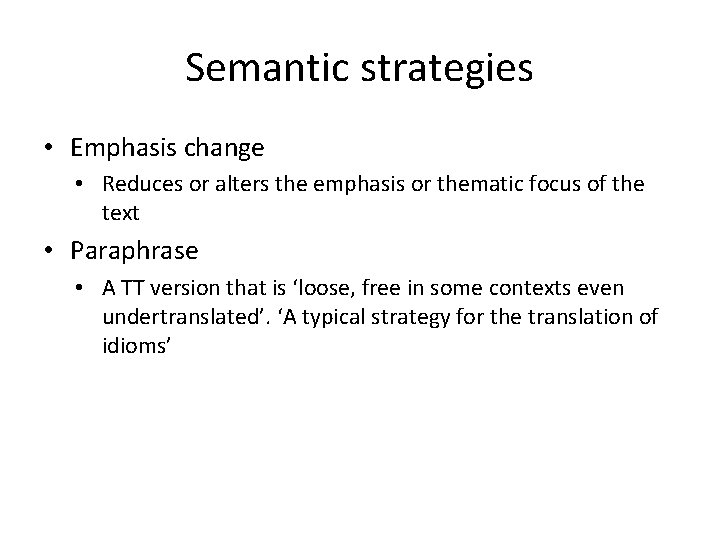
Semantic strategies • Emphasis change • Reduces or alters the emphasis or thematic focus of the text • Paraphrase • A TT version that is ‘loose, free in some contexts even undertranslated’. ‘A typical strategy for the translation of idioms’
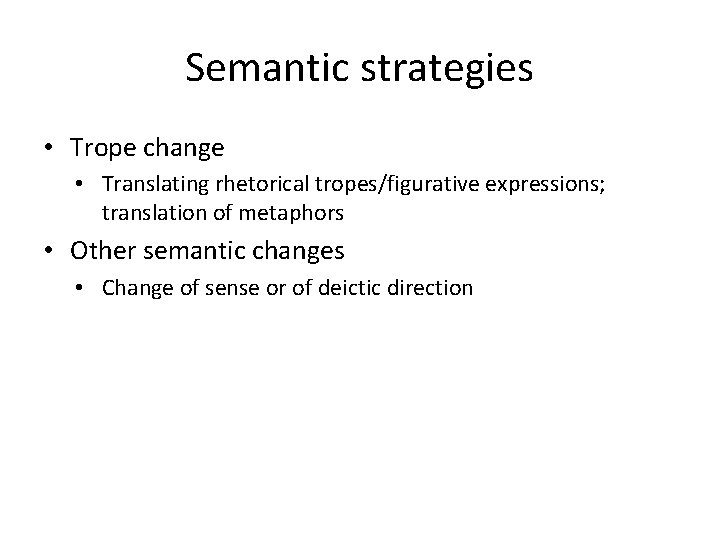
Semantic strategies • Trope change • Translating rhetorical tropes/figurative expressions; translation of metaphors • Other semantic changes • Change of sense or of deictic direction
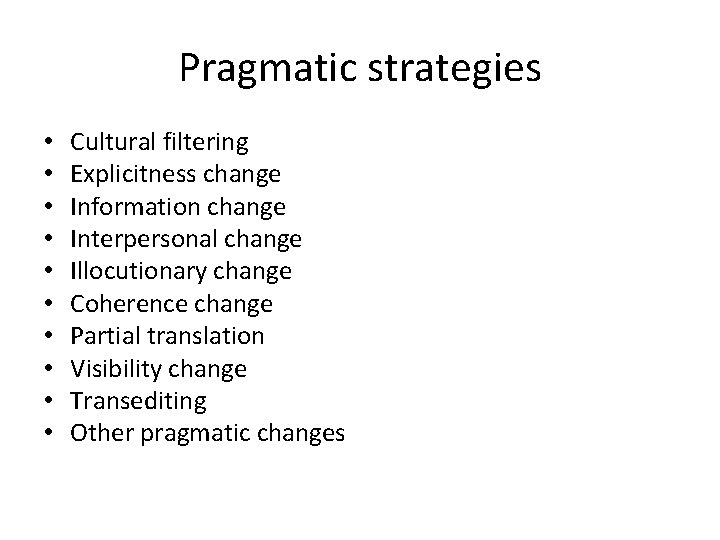
Pragmatic strategies • • • Cultural filtering Explicitness change Information change Interpersonal change Illocutionary change Coherence change Partial translation Visibility change Transediting Other pragmatic changes
Pragmatic strategies • Cultural filtering – Naturalization, domestication, adaptation. – Opposite is ‘exoticization, foreignization or estrangement’ (Chesterman, 104). • Explicitness change – More explicit or less explicit in translation. – ‘Explicitness is well known to be one of the most common translatorial strategies’ (Chesterman, 105)
Pragmatic strategies • Information change – ‘addition of new (non-inferable) information which is deemed to be relevant to the TT readership but which is not present in the ST, or the omission of ST information deemed to be irrelevant’ (Chesterman, 106) • Interpersonal change – ‘anything that involves a change in the relationship between text/author and reader’ (Chesterman, 106)
Pragmatic strategies • Illocutionary change – E. g. , Changing from direct to indirect speech • Coherence change – Changing the logical arrangement of information in the text
Pragmatic strategies • Partial translation – E. g. , Translation of the sound only • Visibility change – Intrusion or foregrounding of the translatorial presence
Pragmatic strategies • Transediting – Extensive editing of the original text by the translator • Other pragmatic changes – Layout changes, changes in dialect
Strategies • • Free translation Idiomatic translation Functional translation Literal translation – Word-for-word – Sentence by sentence – Interlinear
Strategies • • Source-oriented translation Target-oriented translation Foreignizing Exoticizing Naturalization Localization Domestication
Antoine Berman’s 12 deforming tendencies • • • Rationalization Clarification Expansion Ennoblement and popularization Qualitative impoverishment Quantitative impoverishment The destruction of rhythm The destruction of underlying networks of signification The destruction of linguistic patternings The destruction of vernacular networks The destruction of expressions and idioms The effacement of the superimposition of languages – Antoine Berman, ‘Translation and the trials of the foreign’, in The Translation Studies Reader, ed. Lawrence Venuti, 240 -254.
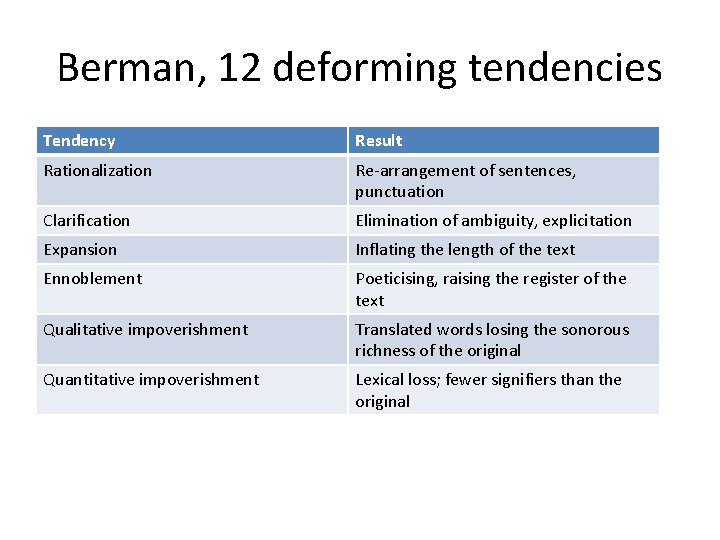
Berman, 12 deforming tendencies Tendency Result Rationalization Re-arrangement of sentences, punctuation Clarification Elimination of ambiguity, explicitation Expansion Inflating the length of the text Ennoblement Poeticising, raising the register of the text Qualitative impoverishment Translated words losing the sonorous richness of the original Quantitative impoverishment Lexical loss; fewer signifiers than the original
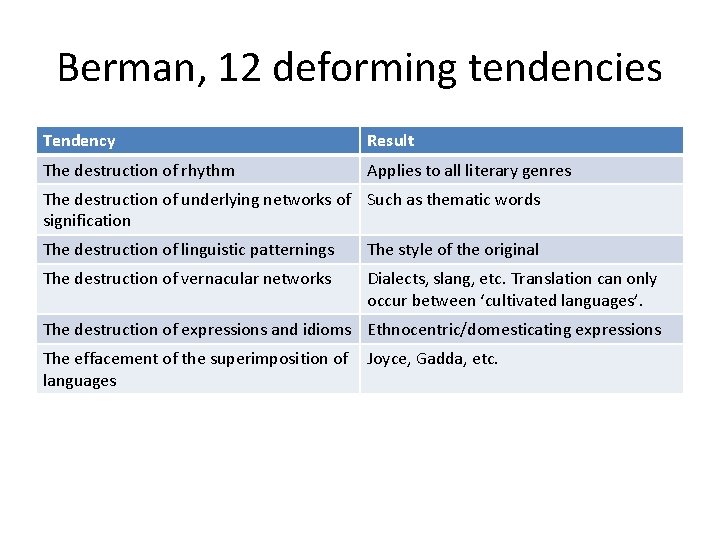
Berman, 12 deforming tendencies Tendency Result The destruction of rhythm Applies to all literary genres The destruction of underlying networks of Such as thematic words signification The destruction of linguistic patternings The style of the original The destruction of vernacular networks Dialects, slang, etc. Translation can only occur between ‘cultivated languages’. The destruction of expressions and idioms Ethnocentric/domesticating expressions The effacement of the superimposition of Joyce, Gadda, etc. languages
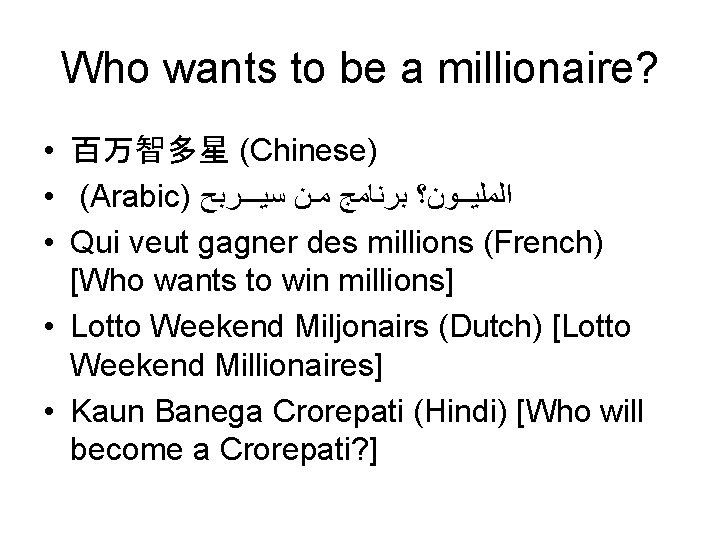
Who wants to be a millionaire? • 百万智多星 (Chinese) • (Arabic) ﺳﻴـــﺮﺑﺢ ﻣـﻦ ﺑﺮﻧﺎﻣﺞ ﺍﻟﻤﻠﻴــﻮﻥ؟ • Qui veut gagner des millions (French) [Who wants to win millions] • Lotto Weekend Miljonairs (Dutch) [Lotto Weekend Millionaires] • Kaun Banega Crorepati (Hindi) [Who will become a Crorepati? ]
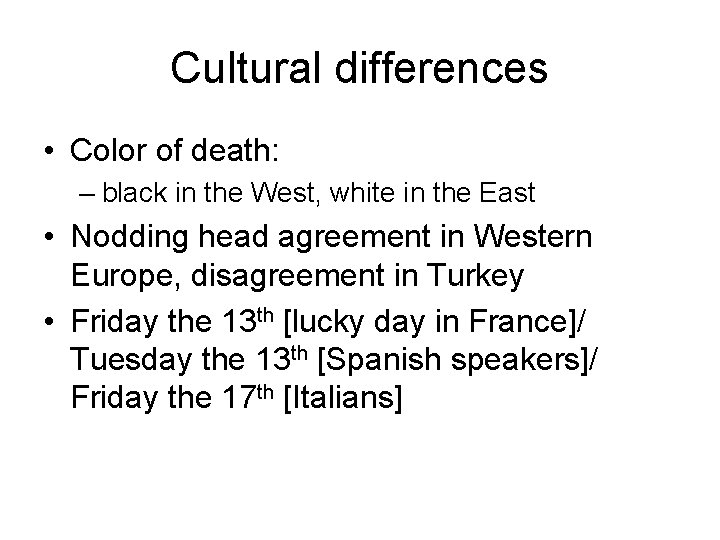
Cultural differences • Color of death: – black in the West, white in the East • Nodding head agreement in Western Europe, disagreement in Turkey • Friday the 13 th [lucky day in France]/ Tuesday the 13 th [Spanish speakers]/ Friday the 17 th [Italians]
Tricky words • Time flies like an arrow; fruit flies like a banana. • This gobbledygook is pure kitsch. • culaccino • menefreghista • celodurismo • qualunquismo • Meriggiare pallido e assorto
Gideon Toury: the ‘equivalence postulate’ • ‘the question to be asked in the actual study of translations (especially in the comparative analysis of ST and TT) is not whether the two texts are equivalent (from a certain aspect), but what type and degree of translation equivalence they reveal’. – Gideon Toury, 1980, 47
- Slides: 70