
Equity Security Equity Markets Chapter 8 Debt vs

Equity Security & Equity Markets Chapter 8
Debt vs. Equity Debt: � Contractual , obligation � The Issuer can be sued for default of payments Equity: � Right to eliminate dividends, even on preferred shares � Can’t be sued for reduction or elimination of dividends
Equity Issue of shares is the result of incorporation � Originally - IPO (Initial public offering) There are 2 general classes of corporate shares: � Preferred shares � Common shares
Equity Preferred shares: � Preferential dividends � Or liquidation treatment � Generally, voting right is suspended � Many offer a fixes Dividend per quarter indefinitely � Often cumulative Common shares: � Residual claimants in the firm
Equity � Dividends – generally is the only direct payment between a firm and its shareholders. 4 dates associated with dividends: � Declaration date � Ex-dividend date � Record date � Payment date
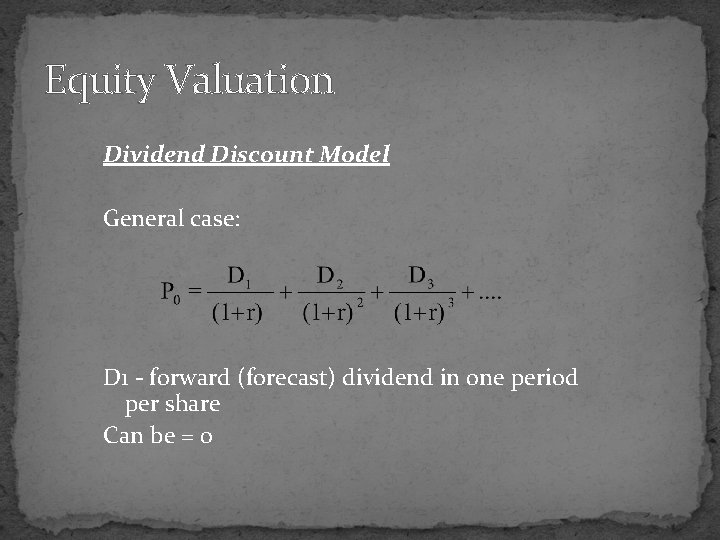
Equity Valuation Dividend Discount Model General case: D 1 - forward (forecast) dividend in one period per share Can be = 0
Constant Growth DDM Also known as Gordon Growth Model (1962). Appropriate for : � larger, � profitable, � mature, � dividend paying companies
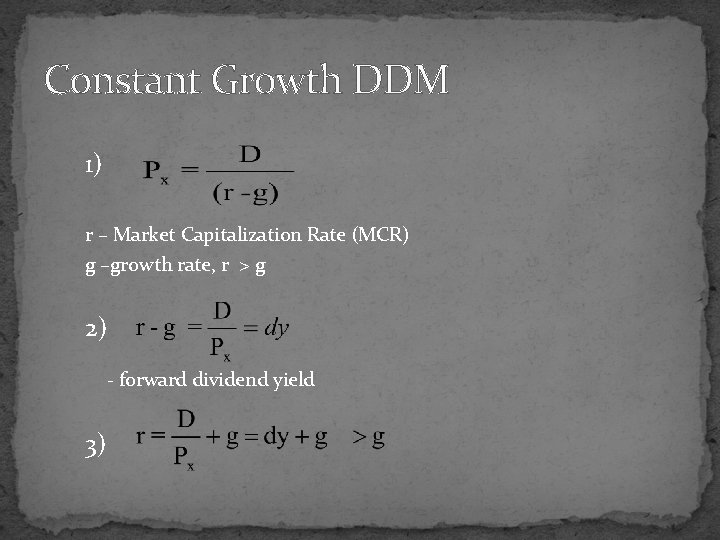
Constant Growth DDM 1) r – Market Capitalization Rate (MCR) g –growth rate, r > g 2) - forward dividend yield 3)
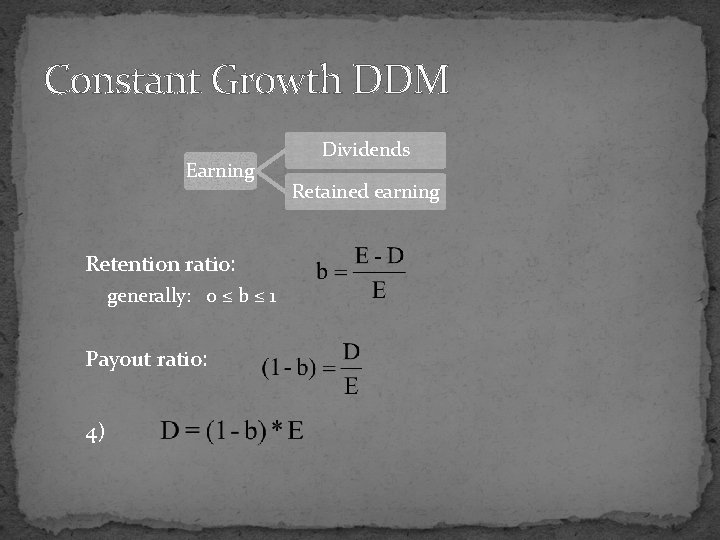
Constant Growth DDM Earning Retention ratio: generally: 0 ≤ b ≤ 1 Payout ratio: 4) Dividends Retained earning
Constant Growth DDM Growth: Almost all corporate characteristics grow at g: � Dividends � Earning � Book value of Asset (BVA) � Book value of Equity (BE) � Debt � Sales � Share price The principal exception to this list is your Wealth. � the expected growth rate in your wealth per year per share – is expected ROR = r = MCR =D/P +g > g
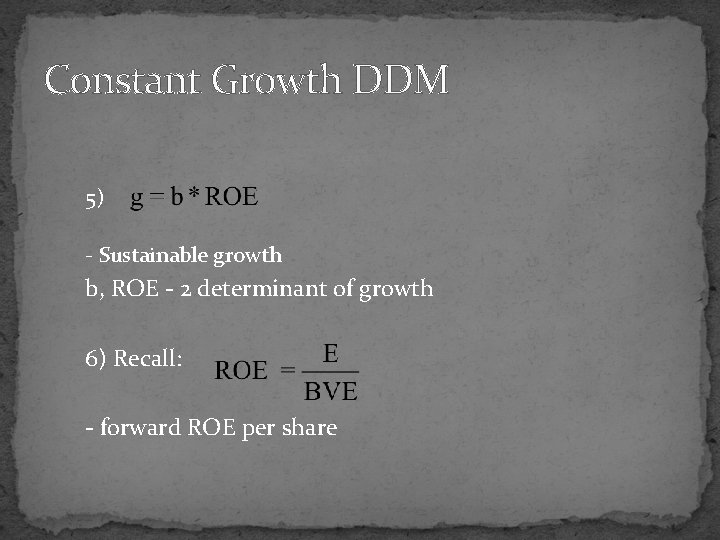
Constant Growth DDM 5) - Sustainable growth b, ROE - 2 determinant of growth 6) Recall: - forward ROE per share
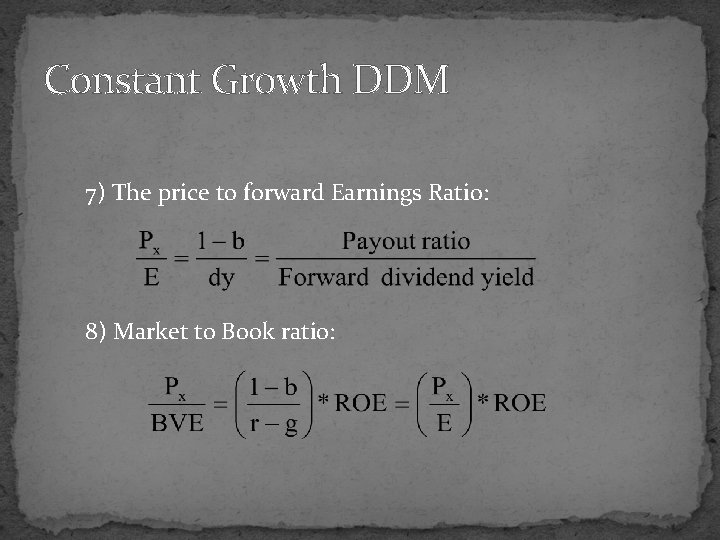
Constant Growth DDM 7) The price to forward Earnings Ratio: 8) Market to Book ratio:
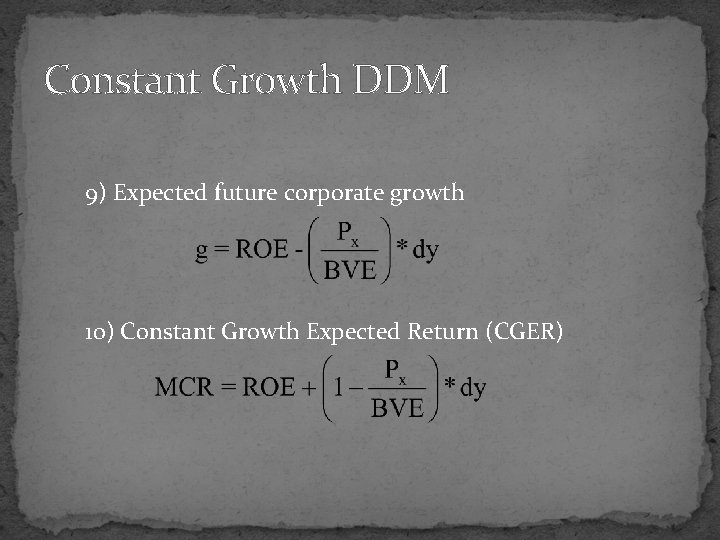
Constant Growth DDM 9) Expected future corporate growth 10) Constant Growth Expected Return (CGER)
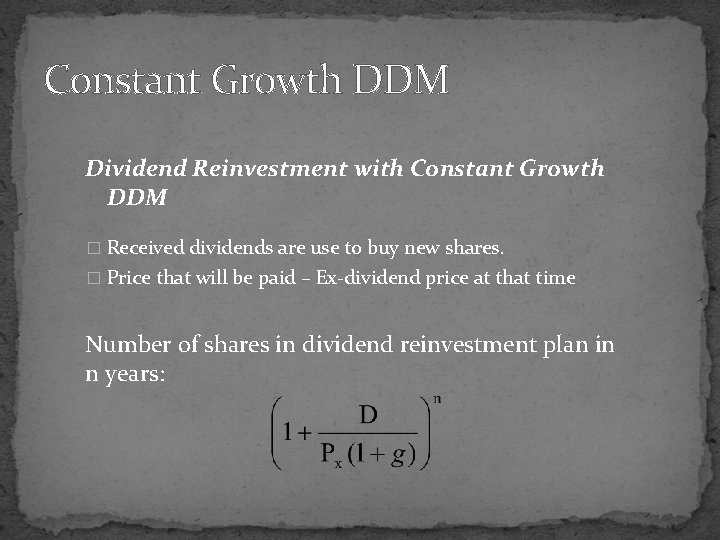
Constant Growth DDM Dividend Reinvestment with Constant Growth DDM � Received dividends are use to buy new shares. � Price that will be paid – Ex-dividend price at that time Number of shares in dividend reinvestment plan in n years:
New Share Issue 1) Public companies: a) General cash offer b) Rights issue 2) Private companies: a) New equity issue
New Share Issue Rights offering � In the rights offering the firm sells new shares to the existing shareholders (in the first instance). � Existing shareholders can maintain their fractional ownership if they increase $ investment or � they can sell their rights, then their fractional ownership falls & $ investment decreases.
Rights offering Characteristics: � 1 right given by the firm per 1 share to existing shareholders (not sold) - Always � Often it takes more than 1 right to buy a new share & cash (primary market price) � You have this right (not the obligation) ~ 3 weeks (general)
Rights offering 3 important share prices: � P – original secondary market price � E – exercise price �– subscription price �- strike price � Ex – Ex-rights share price (share of old + new when they all are traded together) = new price& cash (primary market price)
Rights offering You are not worse off as long as you do one of 2 things: � Sell rights (fractional ownership falls + $ investment falls): � Exercise the rights (maintain fractional ownership by increasing $ investment)
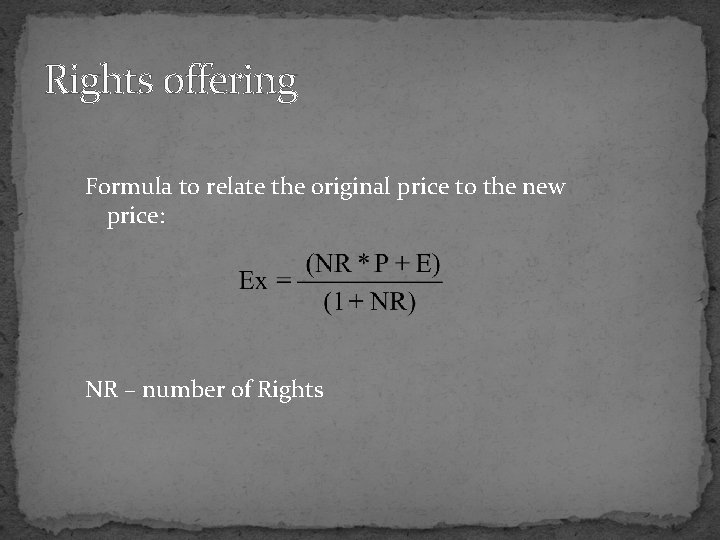
Rights offering Formula to relate the original price to the new price: NR – number of Rights
The hypothesis of Capital Market Efficiency (CME) (Informational Efficiency & Market Efficiency) Definition: • Information is widely & cheaply available to all investors and • all relevant information is reflected in share price Note: • CME is a hypothesis and not a statement of fact • The bulk of the empirical evidence is consistent rather than inconsistent with CME.
The hypothesis of Capital Market Efficiency Two principal aspect of CME: • Hard to beat the “market” • Hard to do worse that the market Conclusion: • Diversify • Do not overtrade
- Slides: 22