
Equitable Mathematics Acceleration Practices Diana Kolhoff Mathematics Education
Equitable Mathematics Acceleration Practices Diana Kolhoff Mathematics Education Consultant, Long Island www. mathampton. com
Agenda �Who are we? �What do we want? �What are we doing now (and why are we doing it)? �Is it working? �What has changed and how can we adapt? �What’s next?

Introductions: �Diana Kolhoff Mathematics Educational Consultant & K-12 Instructional Coach �Dr. Ellen M. Stegman Director of Mathematics and Business Levittown Public Schools

Introductions �Name �District �Role

What do we want? �Practice planning with the END in mind. �What are our goals and objectives for ALL our students? �curriculum and instruction �policies and practices

Why do we accelerate? Pathway to Calculus Parental Request ~ “Honors” In the name of Equity Increase Graduation Rate Appropriate for the Student
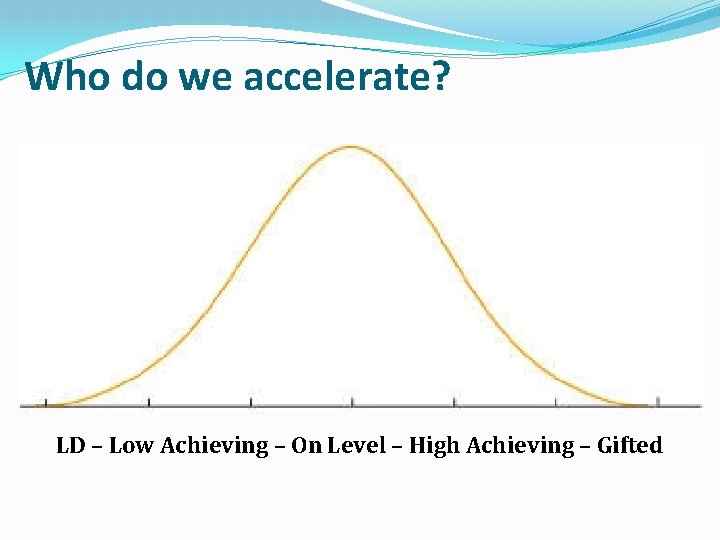
Who do we accelerate? LD – Low Achieving – On Level – High Achieving – Gifted
True or False: �Some people are naturally good at math, some are not. �Certain students have more math potential than others due to their innate abilities. �A student’s math potential can be determined at an early age. �Students must learn and do math quickly to be successful in math.
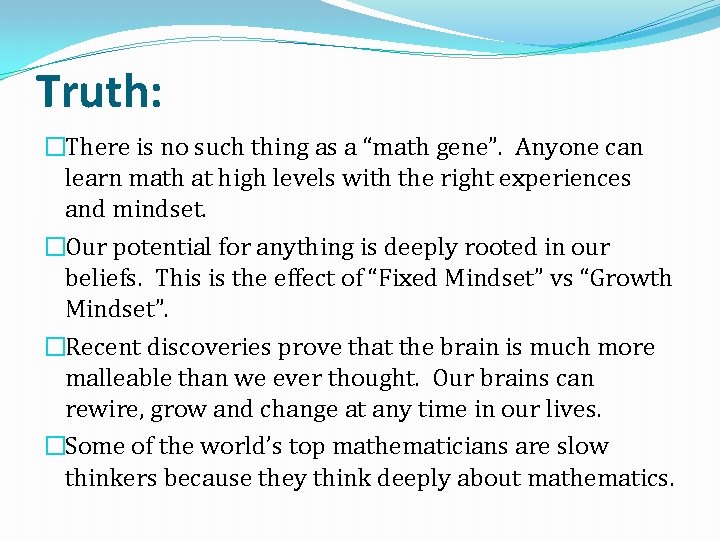
Truth: �There is no such thing as a “math gene”. Anyone can learn math at high levels with the right experiences and mindset. �Our potential for anything is deeply rooted in our beliefs. This is the effect of “Fixed Mindset” vs “Growth Mindset”. �Recent discoveries prove that the brain is much more malleable than we ever thought. Our brains can rewire, grow and change at any time in our lives. �Some of the world’s top mathematicians are slow thinkers because they think deeply about mathematics.

Current practice in the field Acceleration Model based on 2005 Standards ACCELERATED TRACK 6 7 A 1 G A 2 Pre. Calc AP Calc Grade 8 standards may not be adequately addressed

But Why Calculus? Calculus Mathematical Association of America and the National Council of Teachers of Mathematics have taken the position that the goal of a K-12 mathematics curriculum shouldn't be to get students through calculus but to give students a strong foundation in mathematics that will prepare them for a range of college majors.
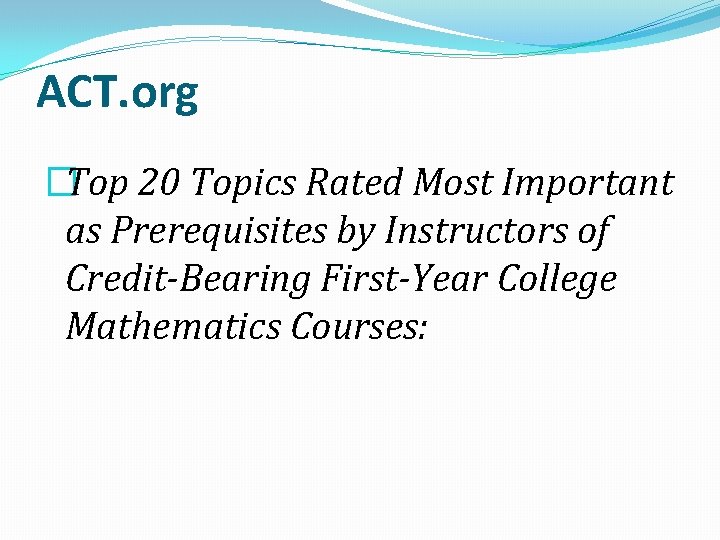
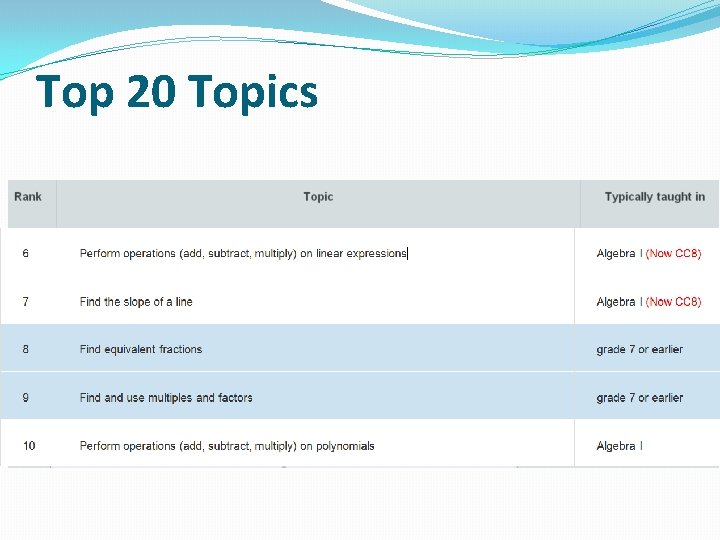
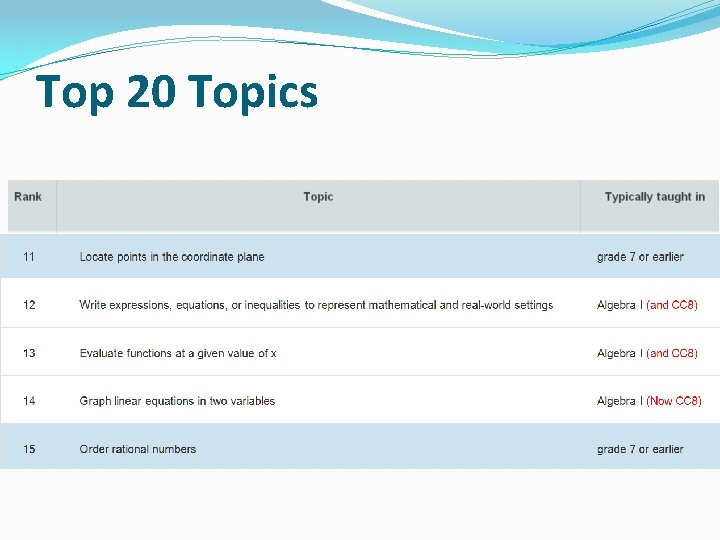
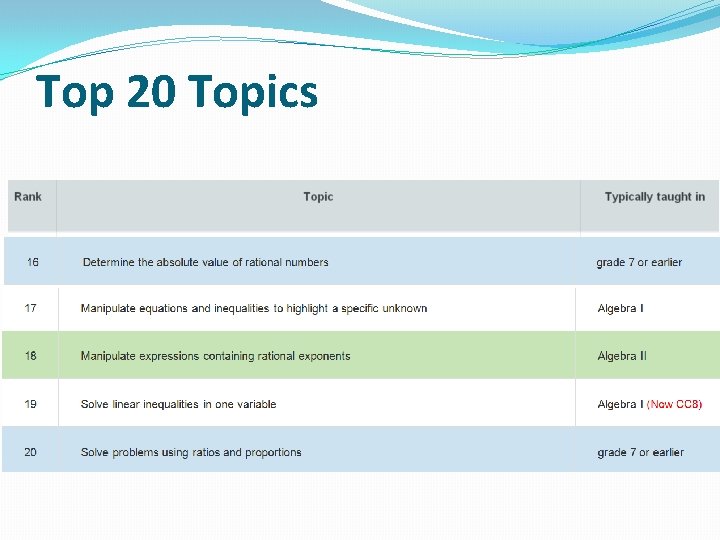
ACT. org �Top 20 Topics Rated Most Important as Prerequisites by Instructors of Credit-Bearing First-Year College Mathematics Courses:

Top 20 Topics
Top 20 Topics
Top 20 Topics
Top 20 Topics

The vast majority of math topics rated as the most important pre-requisites for college readiness are taught in middle school grades 6, 7, and 8.

What About Careers? �Calculus in the workforce? �Physicists �Engineers �Statistics in the workforce? �All Sciences �Research and Development �Business �Marketing and Advertising �Wall Street �Education �Consumers and Citizens……
Was it working? Elaine Zseller, Ph. D Program Supervisor Data Analysis and Curriculum Support Nassau BOCES
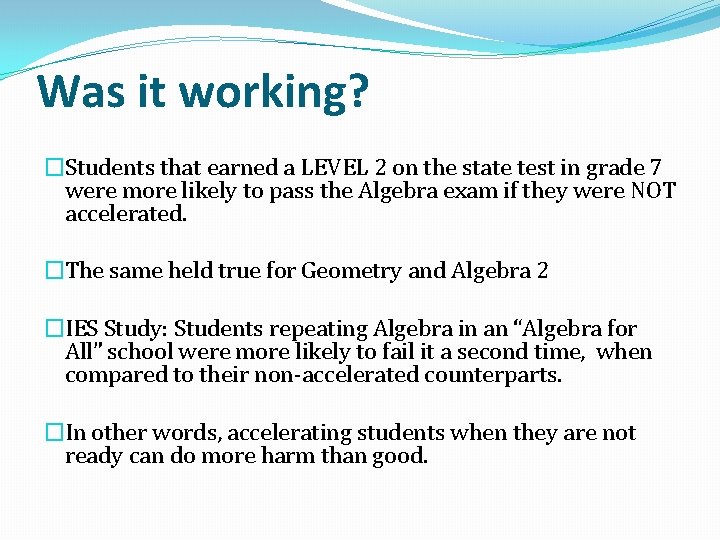
Was it working? �Students that earned a LEVEL 2 on the state test in grade 7 were more likely to pass the Algebra exam if they were NOT accelerated. �The same held true for Geometry and Algebra 2 �IES Study: Students repeating Algebra in an “Algebra for All” school were more likely to fail it a second time, when compared to their non-accelerated counterparts. �In other words, accelerating students when they are not ready can do more harm than good.
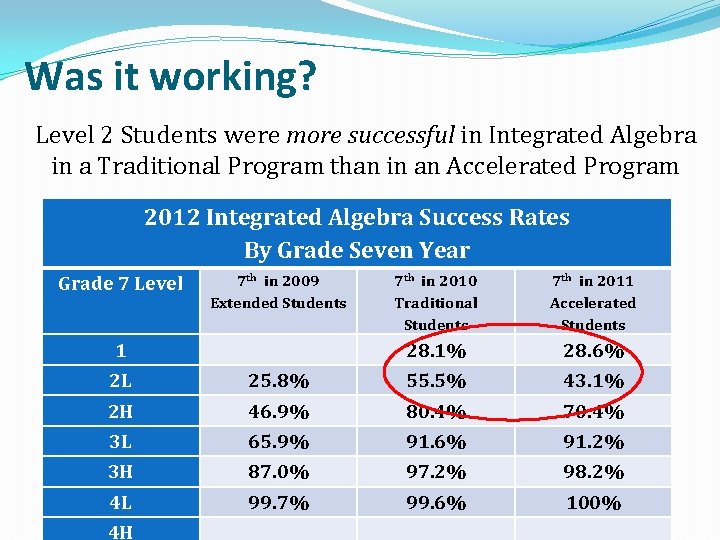
Was it working? Level 2 Students were more successful in Integrated Algebra in a Traditional Program than in an Accelerated Program 2012 Integrated Algebra Success Rates By Grade Seven Year Grade 7 Level 7 th in 2009 Extended Students 1 7 th in 2010 Traditional Students 7 th in 2011 Accelerated Students 28. 1% 28. 6% 2 L 25. 8% 55. 5% 43. 1% 2 H 46. 9% 80. 4% 70. 4% 3 L 65. 9% 91. 6% 91. 2% 3 H 87. 0% 97. 2% 98. 2% 4 L 99. 7% 99. 6% 100% 4 H
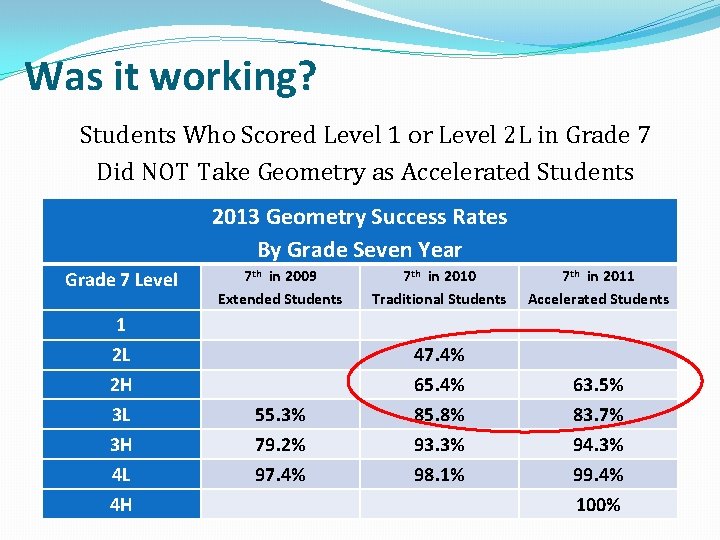
Was it working? Students Who Scored Level 1 or Level 2 L in Grade 7 Did NOT Take Geometry as Accelerated Students 2013 Geometry Success Rates By Grade Seven Year Grade 7 Level 1 2 L 2 H 3 L 3 H 4 L 4 H 7 th in 2009 Extended Students 7 th in 2010 Traditional Students 55. 3% 79. 2% 97. 4% 47. 4% 65. 4% 85. 8% 93. 3% 98. 1% 7 th in 2011 Accelerated Students 63. 5% 83. 7% 94. 3% 99. 4% 100%
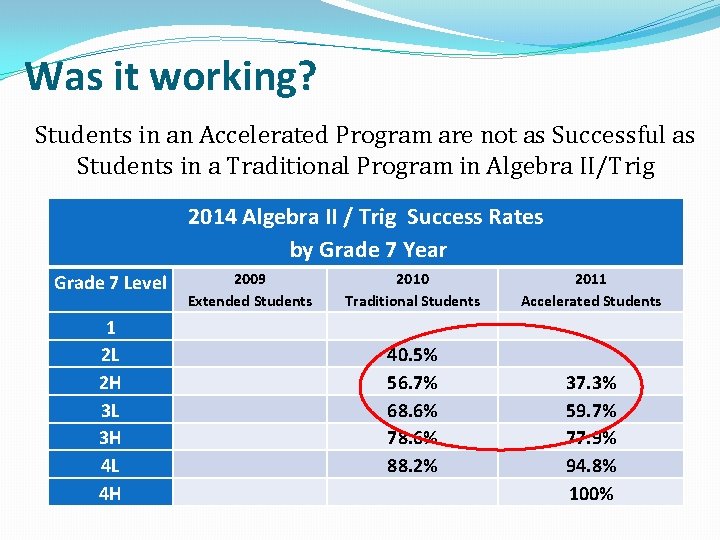
Was it working? Students in an Accelerated Program are not as Successful as Students in a Traditional Program in Algebra II/Trig 2014 Algebra II / Trig Success Rates by Grade 7 Year Grade 7 Level 1 2 L 2 H 3 L 3 H 4 L 4 H 2009 Extended Students 2010 Traditional Students 40. 5% 56. 7% 68. 6% 78. 6% 88. 2% 2011 Accelerated Students 37. 3% 59. 7% 77. 9% 94. 8% 100%

CC Algebra 1 Passing (3 or better)
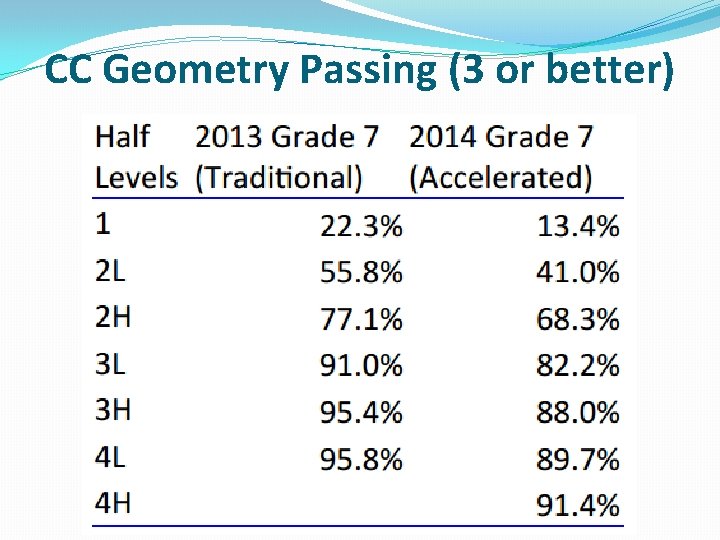
CC Geometry Passing (3 or better)
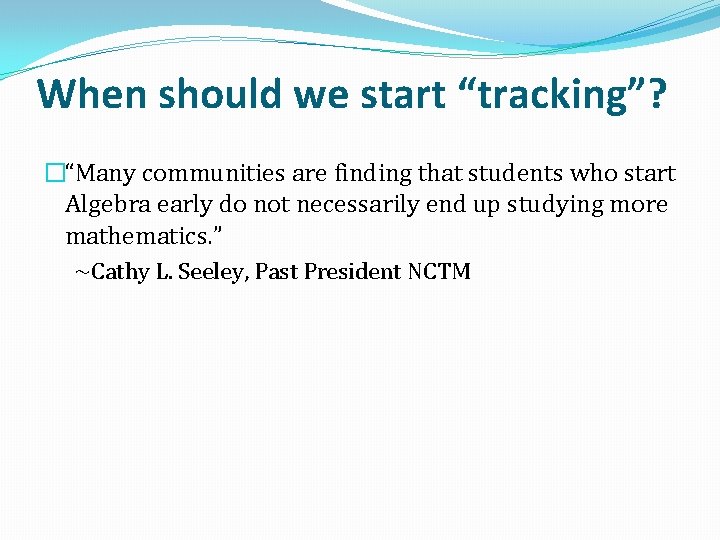
When should we start “tracking”? �“Many communities are finding that students who start Algebra early do not necessarily end up studying more mathematics. ” ~Cathy L. Seeley, Past President NCTM
When do we accelerate? At what grade is the decision made? And who makes it? What if we make the wrong decision? Accelerate when Inappropriate Discouraged Students Must Repeat “Watering Down” effect Don’t Accelerate when Appropriate Missed Opportunity for Student Difficult to Get Back on Track

Traditional acceleration: A Brief History: Districts had increasingly offered Algebra in Grade 8. The Common Core Learning Standards have a tight progression of standards, without redundancy in grade 8.

A Shift:
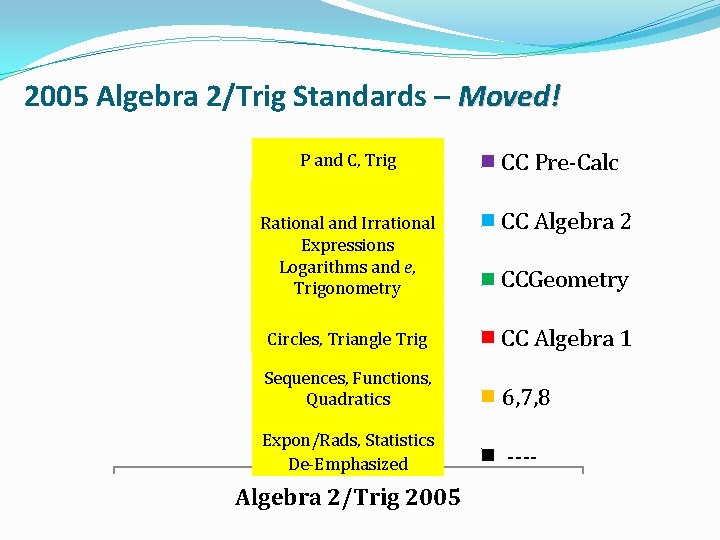
2005 Algebra 2/Trig Standards – Moved! P and C, Trig 12% CC Pre-Calc Rational and Irrational Expressions 44% and e, Logarithms Trigonometry CC Algebra 2 Circles, Triangle Trig 7% CC Algebra 1 Sequences, Functions, 23% Quadratics 6, 7, 8 Expon/Rads, 8% Statistics De-Emphasized ---- Algebra 2/Trig 2005 CCGeometry
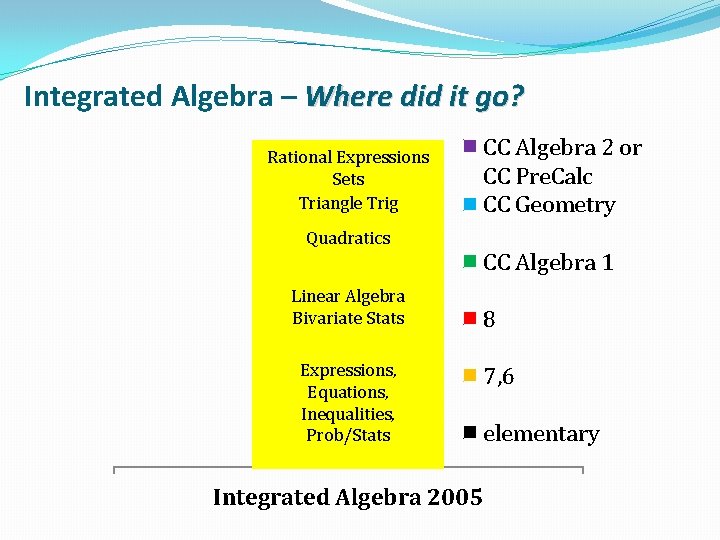
Integrated Algebra – Where did it go? Rational Expressions 8% Sets 3% Trig Triangle Quadratics 18% Linear Algebra 28% Bivariate Stats Expressions, Equations, 37% Inequalities, Prob/Stats CC Algebra 2 or CC Pre. Calc CC Geometry CC Algebra 1 8 7, 6 elementary Integrated Algebra 2005
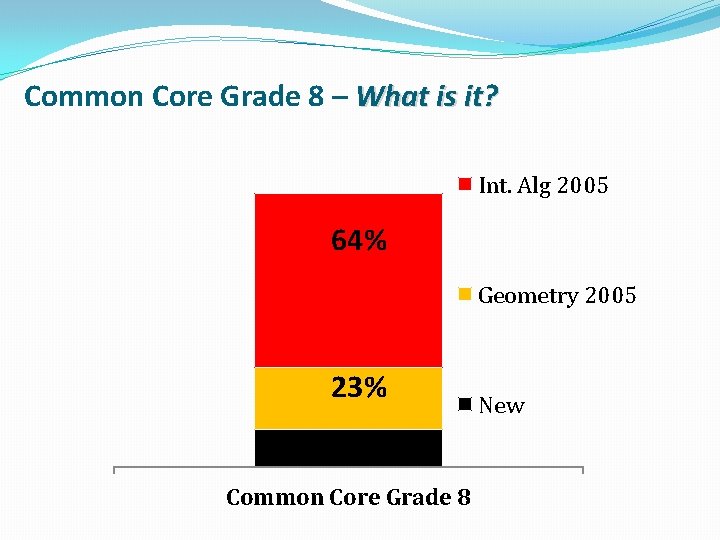
Common Core Grade 8 – What is it? Int. Alg 2005 64% Geometry 2005 23% Common Core Grade 8 New
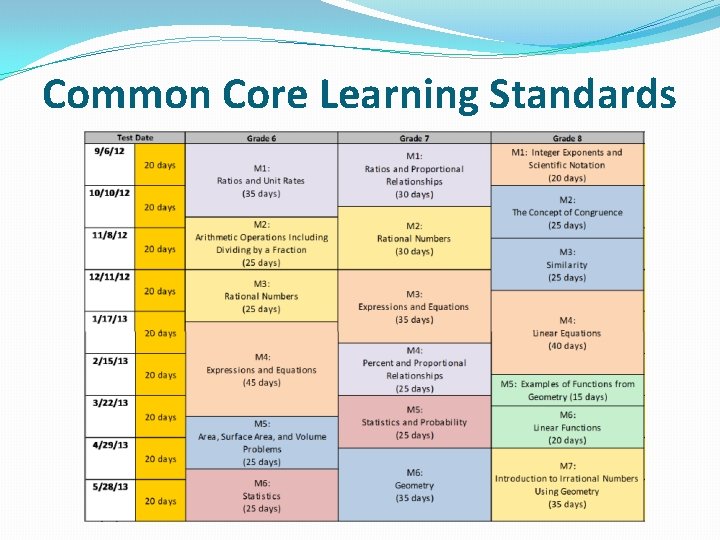
Common Core Learning Standards

Common Core Learning Standards
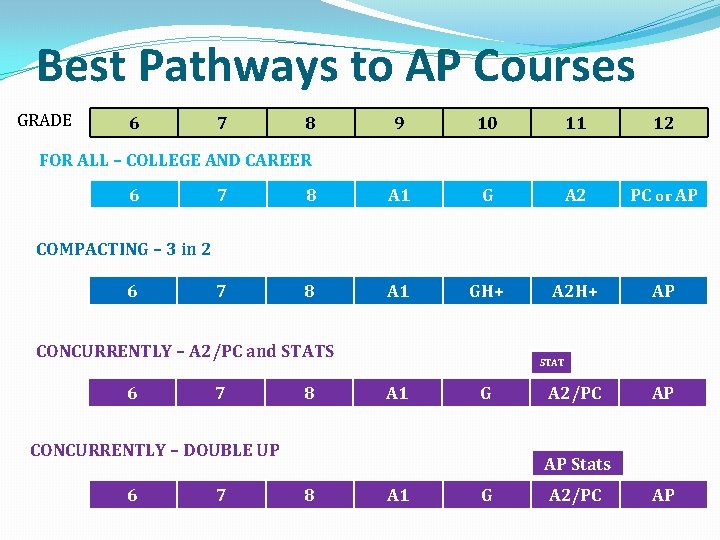
Best Pathways to AP Courses GRADE 6 7 8 9 10 11 12 FOR ALL – COLLEGE AND CAREER 6 7 8 A 1 G A 2 PC or AP 7 8 A 1 GH+ A 2 H+ AP COMPACTING – 3 in 2 6 CONCURRENTLY – A 2/PC and STATS 6 7 8 STAT A 1 G CONCURRENTLY – DOUBLE UP 6 7 A 2/PC AP AP Stats 8 A 1 G A 2/PC AP

Would we be the first? �Massachusetts Department of Education �San Francisco Bay Area Schools Joining the Conversation: Levittown �New York School Districts East Meadow �Sewanhaka Jericho �Bedford Port Jefferson �North Salem East Williston �Ossining Hewlett-Woodmere Connetquot �Putnam Valley Southold �South Huntington East Islip Eastport South-Manor Harborfields

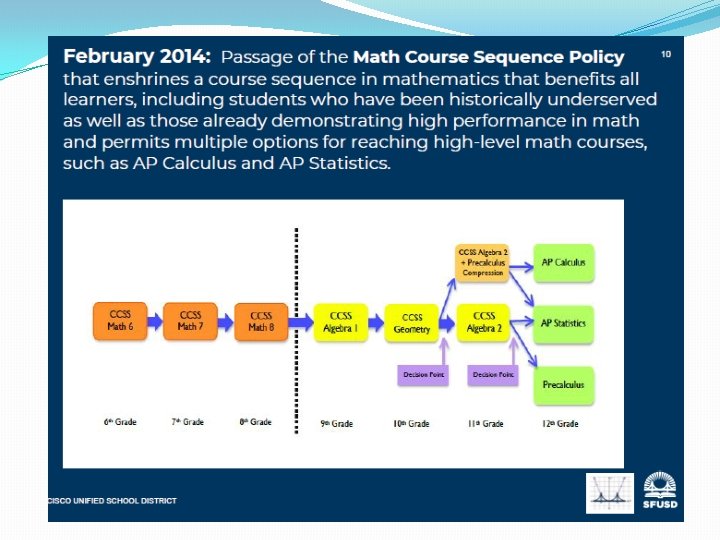

Is it working?

Is it working?
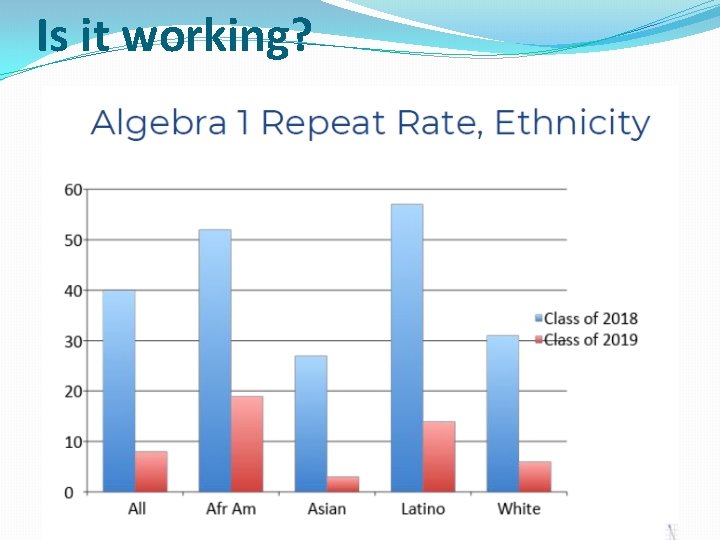
Is it working?

Is it working?
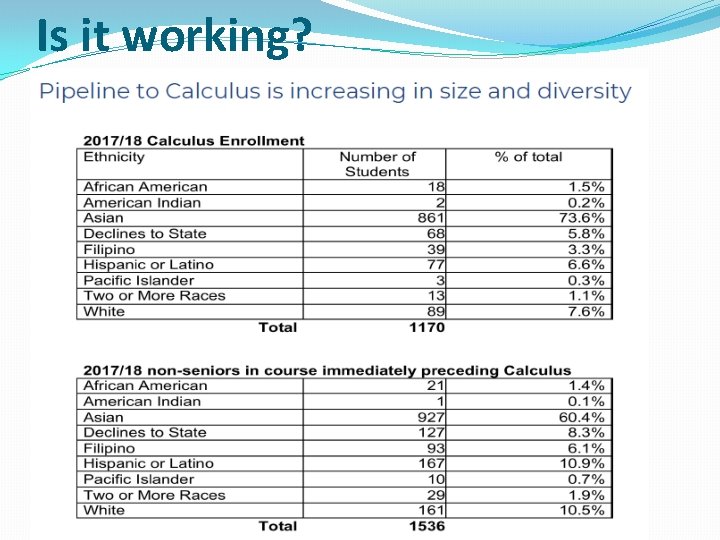
Is it working?

Is it working?

Is it working?
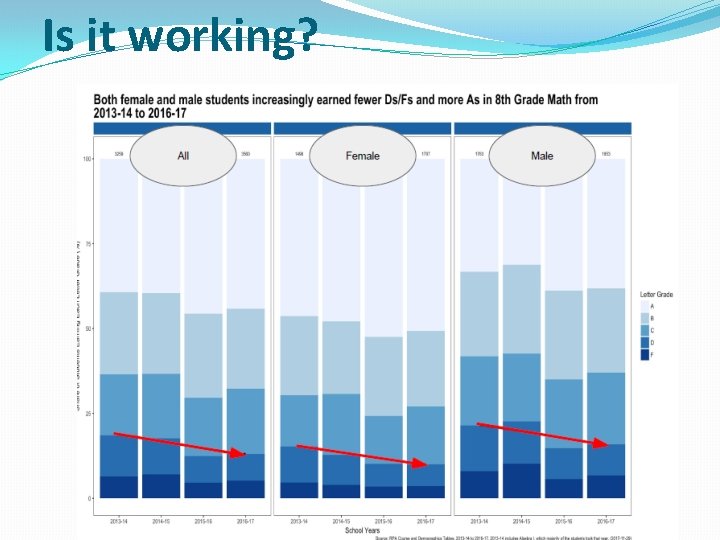
Is it working?
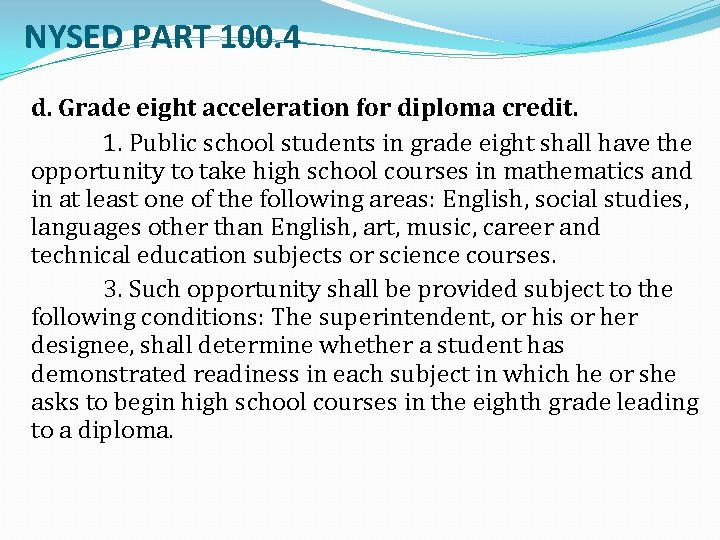
NYSED PART 100. 4 d. Grade eight acceleration for diploma credit. 1. Public school students in grade eight shall have the opportunity to take high school courses in mathematics and in at least one of the following areas: English, social studies, languages other than English, art, music, career and technical education subjects or science courses. 3. Such opportunity shall be provided subject to the following conditions: The superintendent, or his or her designee, shall determine whether a student has demonstrated readiness in each subject in which he or she asks to begin high school courses in the eighth grade leading to a diploma.
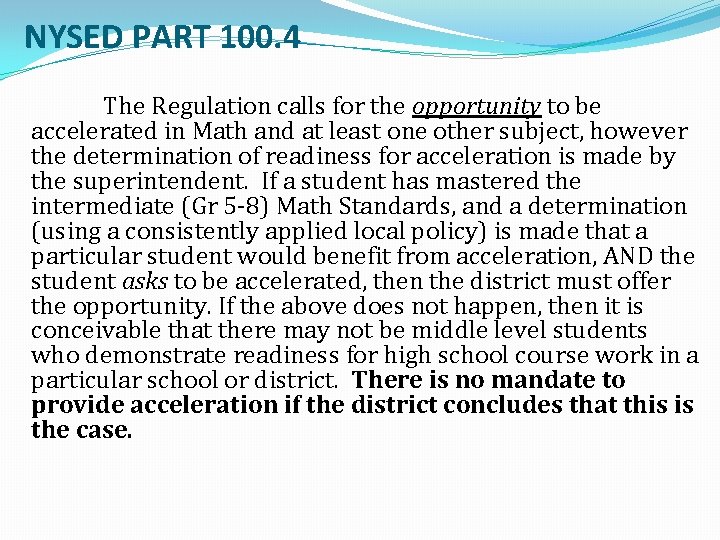
NYSED PART 100. 4 The Regulation calls for the opportunity to be accelerated in Math and at least one other subject, however the determination of readiness for acceleration is made by the superintendent. If a student has mastered the intermediate (Gr 5 -8) Math Standards, and a determination (using a consistently applied local policy) is made that a particular student would benefit from acceleration, AND the student asks to be accelerated, then the district must offer the opportunity. If the above does not happen, then it is conceivable that there may not be middle level students who demonstrate readiness for high school course work in a particular school or district. There is no mandate to provide acceleration if the district concludes that this is the case.
Next: Reflection Questions �What is our number one priority outcome? �What is the most equitable way to get there? �What model will work best in my community? �How will I engage and inform my stakeholders?

Thank YOU! Diana Kolhoff Mathematics Education Consultant, Long Island VISIT: www. mathampton. com EMAIL: mathampton@gmail. com
- Slides: 50