
Equipment Capability Measurement An Integrated Approach John Moore
Equipment Capability Measurement - An Integrated Approach John Moore Principal Consultant, CORDA Ltd Rob Laker Analyst, CORDA Ltd John Roe DD (Capability), DEC(UWB) © CORDA Ltd 2003. All rights reserved
Overview 1. Equipment Capability Management in the UK Mo. D 2. Towards an Integrated Capability Evaluation Process 3. Integrated Capability Evaluation: Implementation 4. Summary & Conclusions 2 © CORDA Ltd 2003. All rights reserved

1. Equipment Capability Management in the UK Mo. D l Equipment Capability l Capability Management l The Capability Audit l Equipment Prioritisation l Issues 3 © CORDA Ltd 2003. All rights reserved
Equipment Capability: Definition “The capacity afforded by an equipment to a unit or force element to perform a task in a given environmental or operational context. l – Together with manning, force generation and training. It contributes to Military Capability” Source: Director Equipment Plan, UK Mo. D 6 © CORDA Ltd 2003. All rights reserved
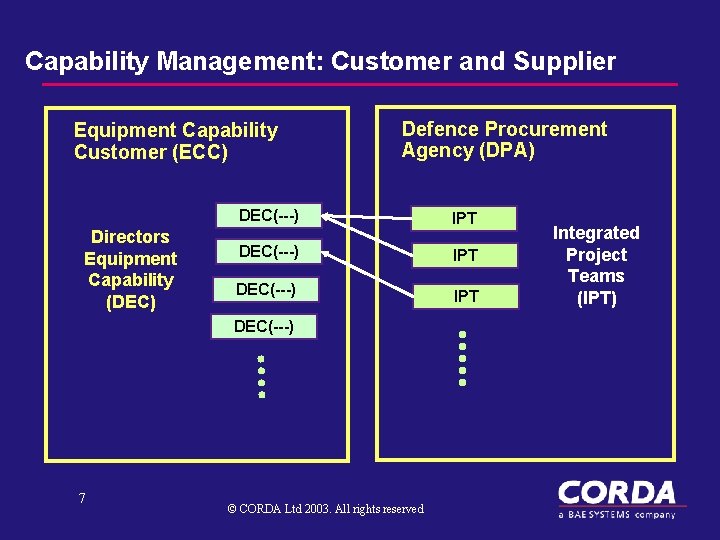
Capability Management: Customer and Supplier Equipment Capability Customer (ECC) Directors Equipment Capability (DEC) Defence Procurement Agency (DPA) DEC(---) IPT DEC(---) 7 © CORDA Ltd 2003. All rights reserved Integrated Project Teams (IPT)
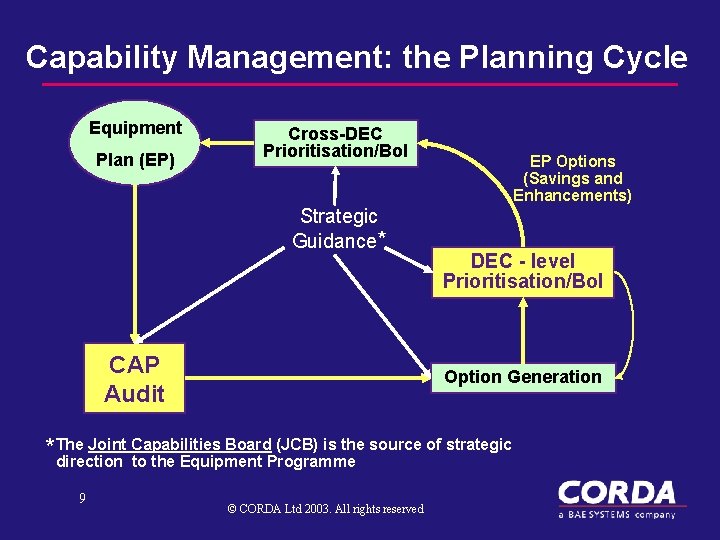
Capability Management: the Planning Cycle Equipment Plan (EP) Cross-DEC Prioritisation/Bo. I Strategic Guidance* CAP Audit EP Options (Savings and Enhancements) DEC - level Prioritisation/Bo. I Option Generation *The Joint Capabilities Board (JCB) is the source of strategic direction to the Equipment Programme 9 © CORDA Ltd 2003. All rights reserved
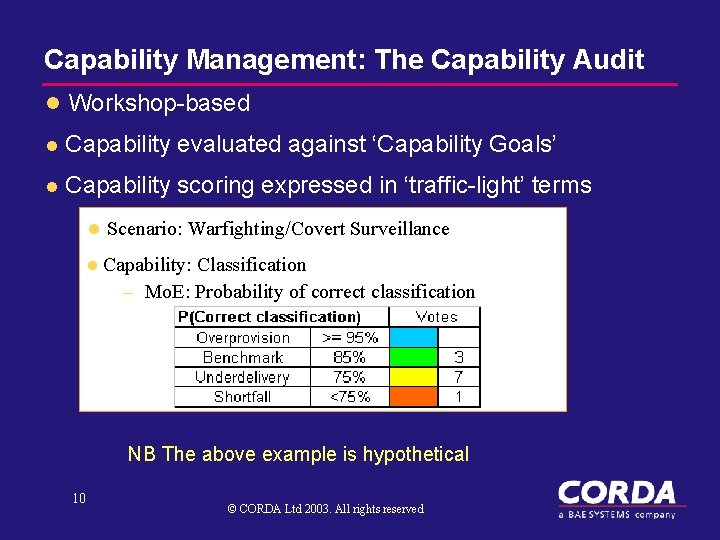
Capability Management: The Capability Audit l Workshop-based l Capability evaluated against ‘Capability Goals’ l Capability scoring expressed in ‘traffic-light’ terms l Scenario: Warfighting/Covert Surveillance l Capability: Classification – Mo. E: Probability of correct classification NB The above example is hypothetical 10 © CORDA Ltd 2003. All rights reserved

Capability Audit: The Capability Tree 11 NB The above example is hypothetical © CORDA Ltd 2003. All rights reserved
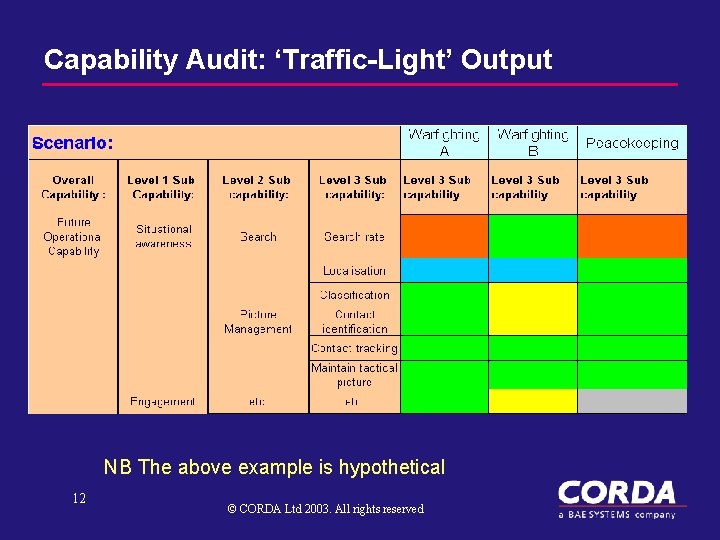
Capability Audit: ‘Traffic-Light’ Output NB The above example is hypothetical 12 © CORDA Ltd 2003. All rights reserved
Capability Management: Equipment Prioritisation l Based on Decision Conferencing – Using Multiple-Criteria Decision Analysis (MCDA) technique l Workshops at DEC and JCB level 13 © CORDA Ltd 2003. All rights reserved
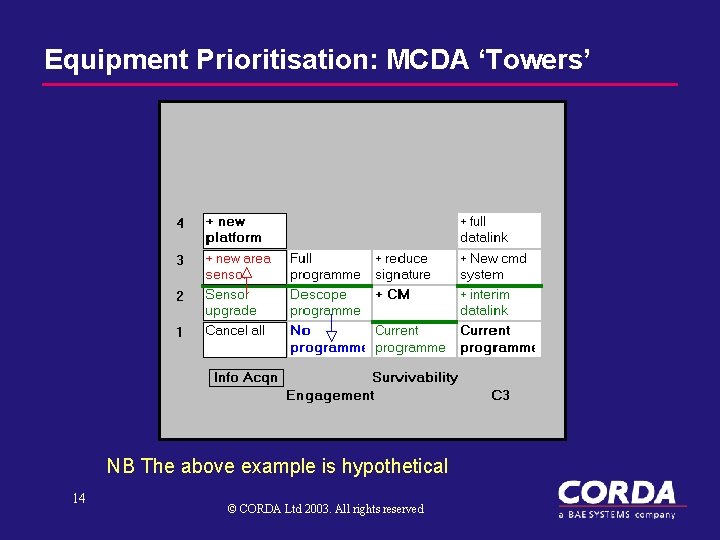
Equipment Prioritisation: MCDA ‘Towers’ NB The above example is hypothetical 14 © CORDA Ltd 2003. All rights reserved
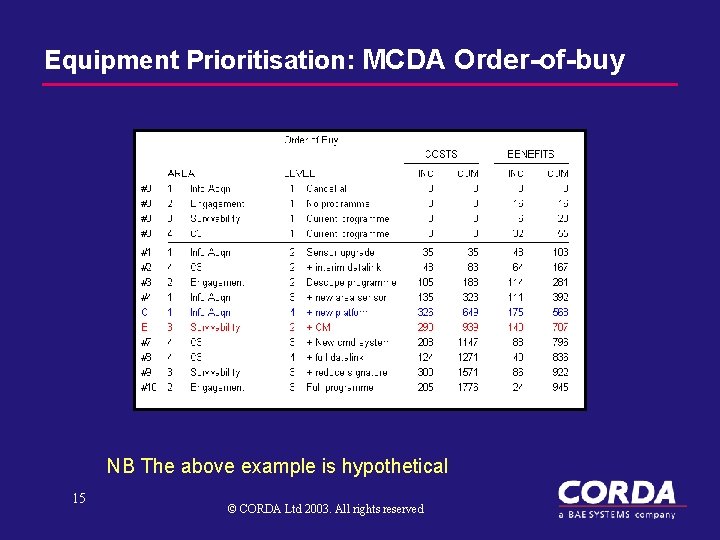
Equipment Prioritisation: MCDA Order-of-buy NB The above example is hypothetical 15 © CORDA Ltd 2003. All rights reserved
Capability Evaluation: Issues l Linkage between Audit and Prioritisation – Audit outputs are disaggregated … – … but MCDA inputs are highly aggregated l Process relies on MCDA technique for ‘what-ifs’ – Can’t capture synergies and redundancies – Can’t cope with large variability of costs – Can’t cope with strong linkages between towers – MCDA scores have no real-world meaning 16 © CORDA Ltd 2003. All rights reserved
2. Towards an Integrated Capability Evaluation Process l Common framework for Audit and Bo. I processes l Quantitative capability scoring l Consistent rules for combining and trading-off scores l Capture synergies and highlight capability gaps l Output: – common scale for all levels of capability – easily interpreted in real-world terms 17 © CORDA Ltd 2003. All rights reserved
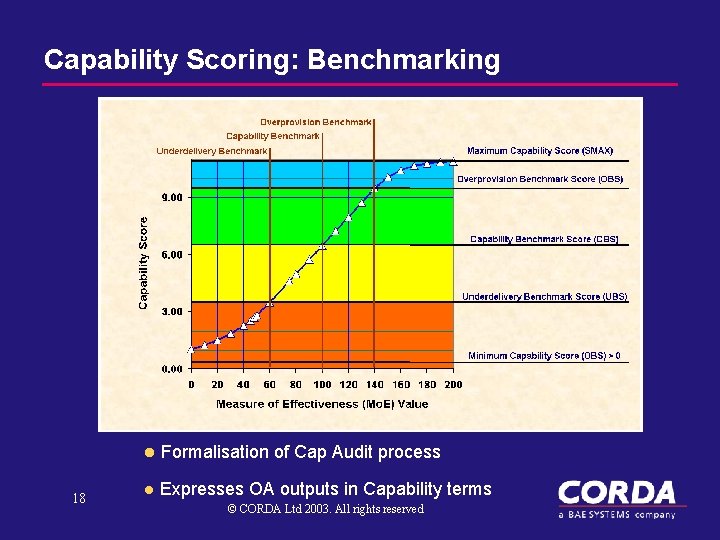
Capability Scoring: Benchmarking l Formalisation of Cap Audit process 18 l Expresses OA outputs in Capability terms © CORDA Ltd 2003. All rights reserved
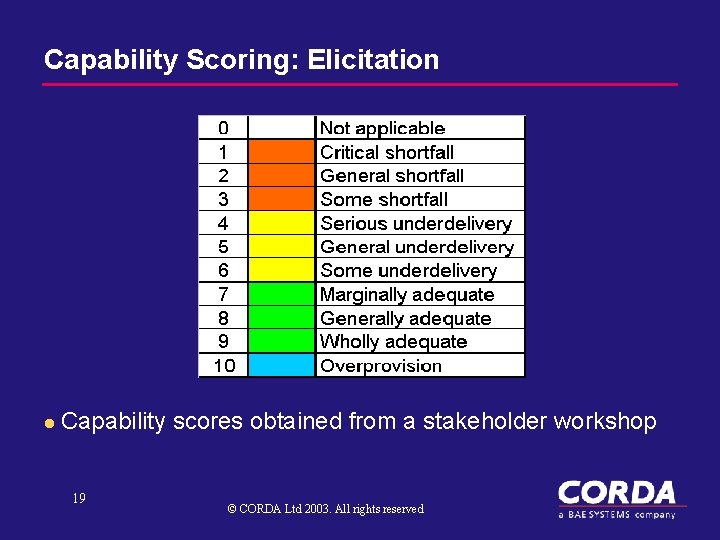
Capability Scoring: Elicitation l Capability scores obtained from a stakeholder workshop 19 © CORDA Ltd 2003. All rights reserved
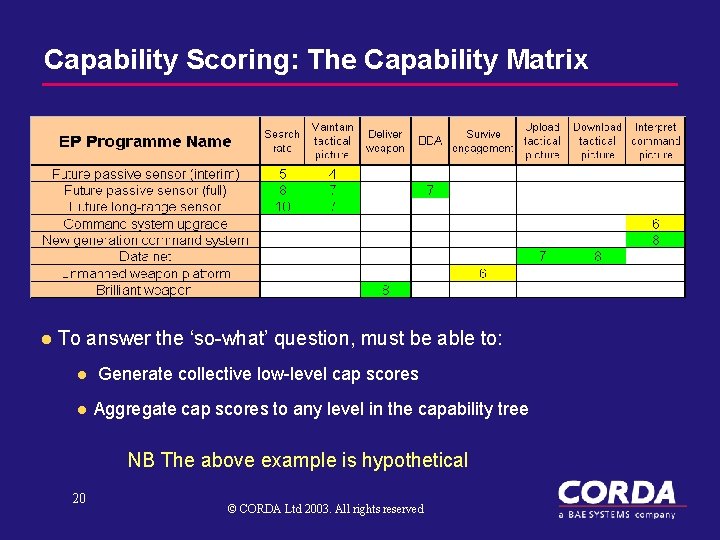
Capability Scoring: The Capability Matrix l To answer the ‘so-what’ question, must be able to: l l Generate collective low-level cap scores Aggregate cap scores to any level in the capability tree NB The above example is hypothetical 20 © CORDA Ltd 2003. All rights reserved
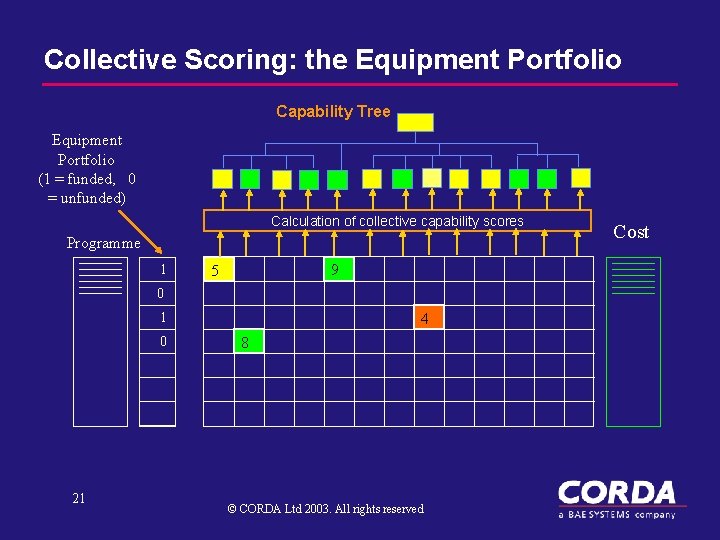
Collective Scoring: the Equipment Portfolio Capability Tree Equipment Portfolio (1 = funded, 0 = unfunded) Calculation of collective capability scores Programme 1 9 5 0 1 0 21 4 8 © CORDA Ltd 2003. All rights reserved Cost
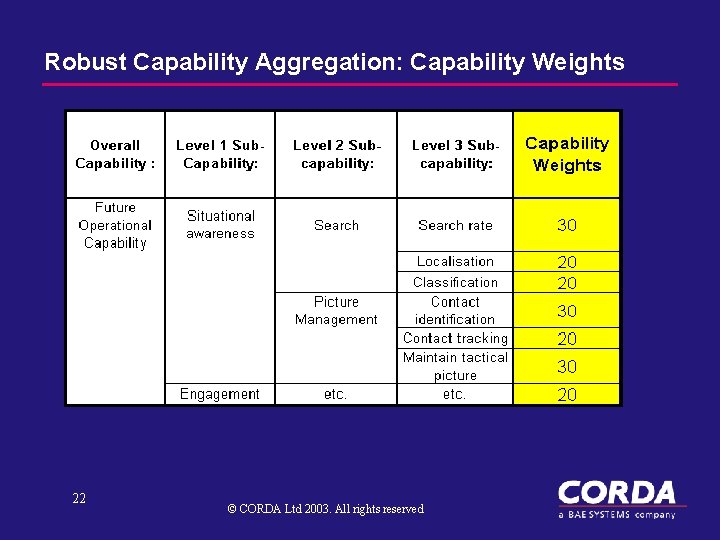
Robust Capability Aggregation: Capability Weights 22 © CORDA Ltd 2003. All rights reserved
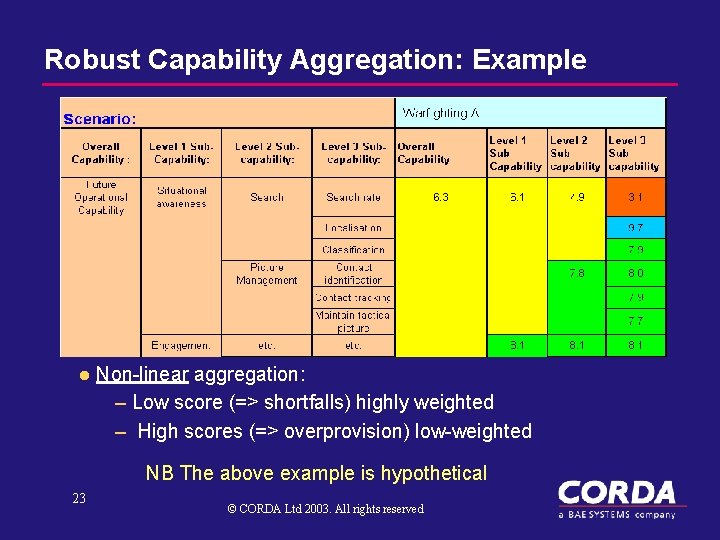
Robust Capability Aggregation: Example l Non-linear aggregation: – Low score (=> shortfalls) highly weighted – High scores (=> overprovision) low-weighted NB The above example is hypothetical 23 © CORDA Ltd 2003. All rights reserved
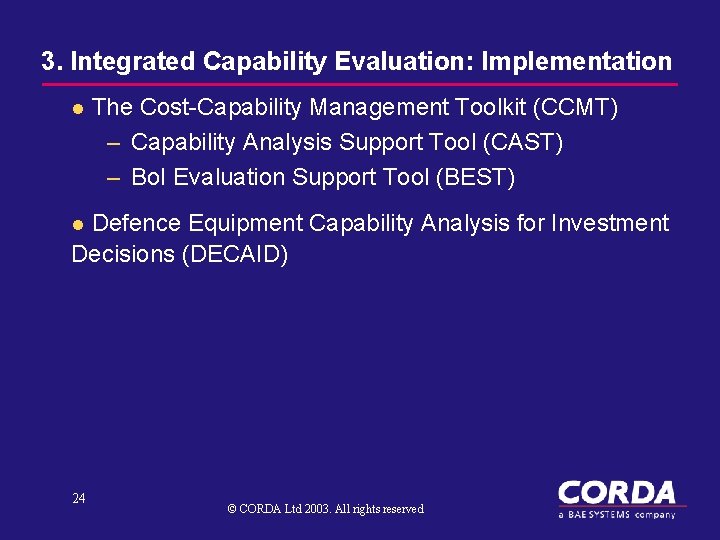
3. Integrated Capability Evaluation: Implementation l The Cost-Capability Management Toolkit (CCMT) – Capability Analysis Support Tool (CAST) – Bo. I Evaluation Support Tool (BEST) Defence Equipment Capability Analysis for Investment Decisions (DECAID) l 24 © CORDA Ltd 2003. All rights reserved
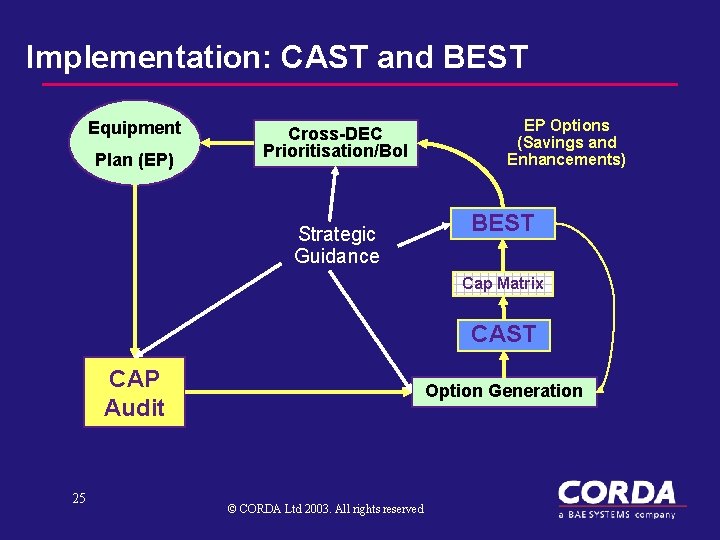
Implementation: CAST and BEST Equipment Plan (EP) Cross-DEC Prioritisation/Bo. I Strategic Guidance EP Options (Savings and Enhancements) BEST Cap Matrix CAST CAP Audit 25 Option Generation © CORDA Ltd 2003. All rights reserved
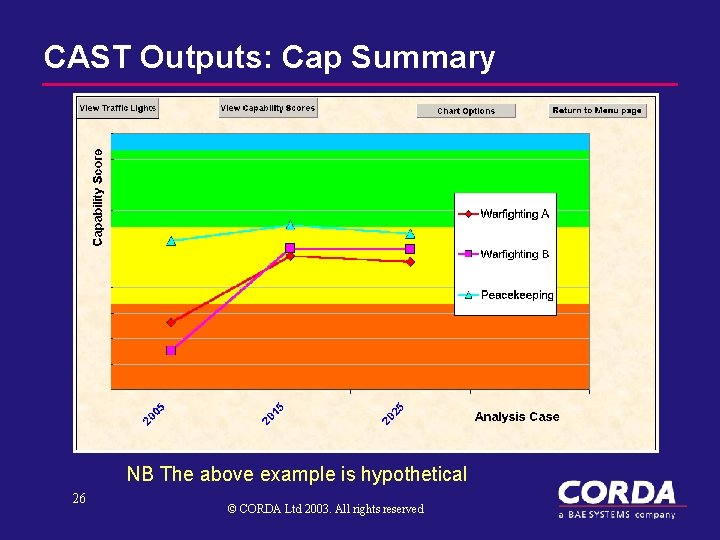
CAST Outputs: Cap Summary NB The above example is hypothetical 26 © CORDA Ltd 2003. All rights reserved
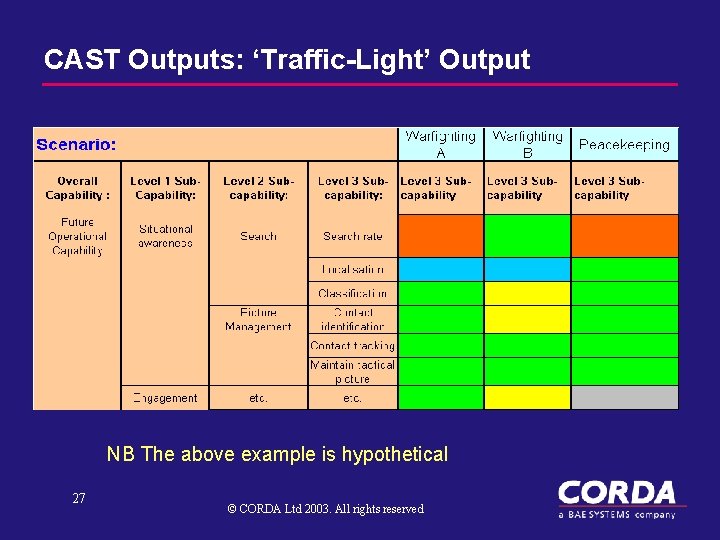
CAST Outputs: ‘Traffic-Light’ Output NB The above example is hypothetical 27 © CORDA Ltd 2003. All rights reserved
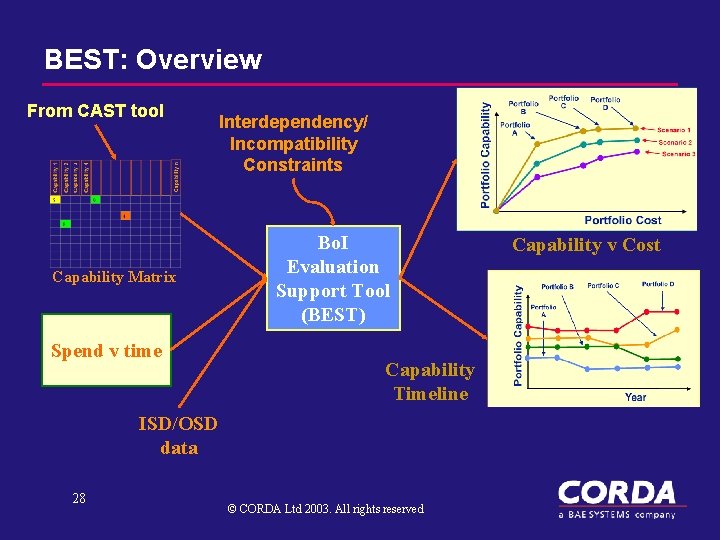
BEST: Overview From CAST tool Interdependency/ Incompatibility Constraints Capability Matrix Spend v time Bo. I Evaluation Support Tool (BEST) Capability Timeline ISD/OSD data 28 © CORDA Ltd 2003. All rights reserved Capability v Cost
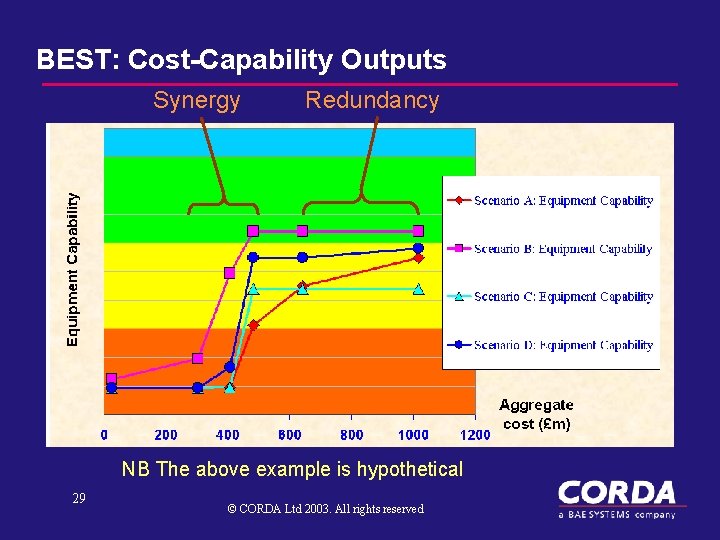
BEST: Cost-Capability Outputs Synergy Redundancy NB The above example is hypothetical 29 © CORDA Ltd 2003. All rights reserved
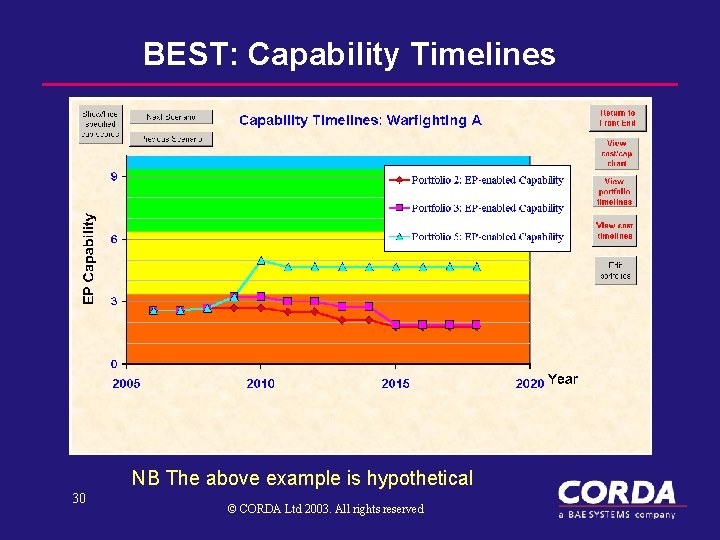
BEST: Capability Timelines NB The above example is hypothetical 30 © CORDA Ltd 2003. All rights reserved
The successor to CCMT: DECAID l DECAID – Defence Equipment Capability Analysis for Investment Decisions l Integrated capability tool combining functions of CAST and BEST l Development now in progress, for delivery October 2003 31 © CORDA Ltd 2003. All rights reserved
DECAID - Requirements l Integrate CAST and BEST – remove inconsistencies and redundancies l Increase usability l Improved functionality l Increase maintainability 32 © CORDA Ltd 2003. All rights reserved
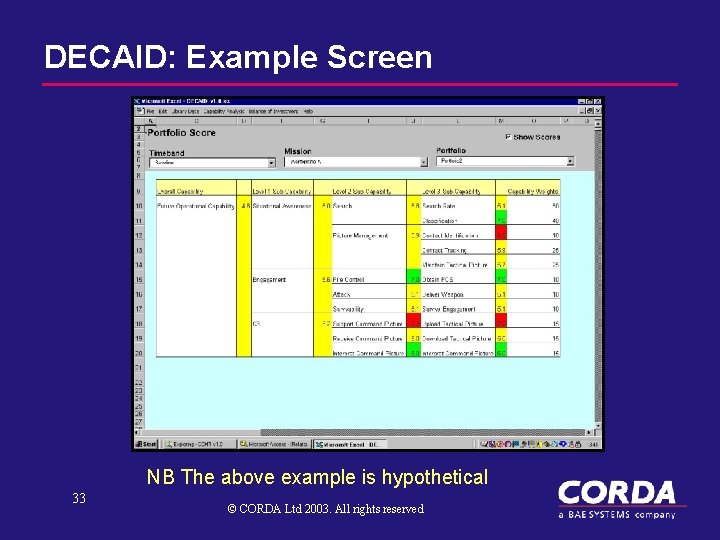
DECAID: Example Screen NB The above example is hypothetical 33 © CORDA Ltd 2003. All rights reserved
4. Summary & conclusions Integration of capability evaluation processes is crucial to progress in capability management l – both in Mo. D and in Industry l Off-the-shelf solutions are not adequate l CCMT & DECAID represent a radical solution l CCMT & DECAID represent a general solution “This process is three years ahead of anything that other DECs are doing” Comment at a DEC(UWB) BEST workshop, May 2003 34 © CORDA Ltd 2003. All rights reserved
- Slides: 31