
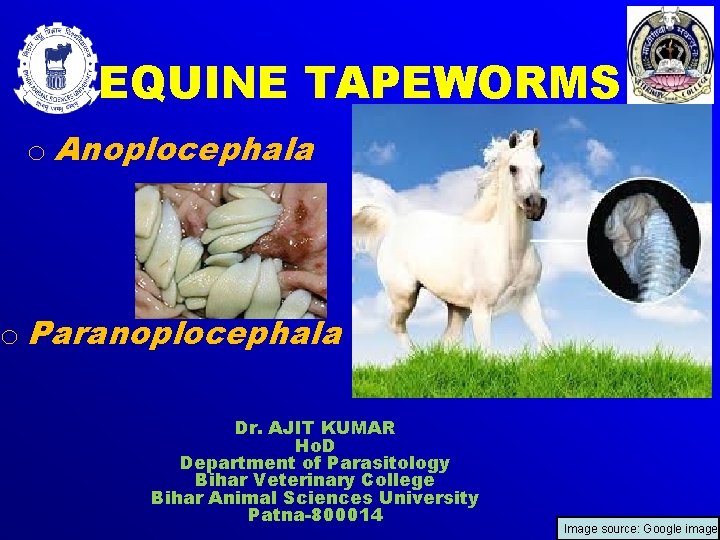
EQUINE TAPEWORMS o Anoplocephala o Paranoplocephala Dr AJIT

- Slides: 8
EQUINE TAPEWORMS o Anoplocephala o Paranoplocephala Dr. AJIT KUMAR Ho. D Department of Parasitology Bihar Veterinary College Bihar Animal Sciences University Patna-800014 Image source: Google image
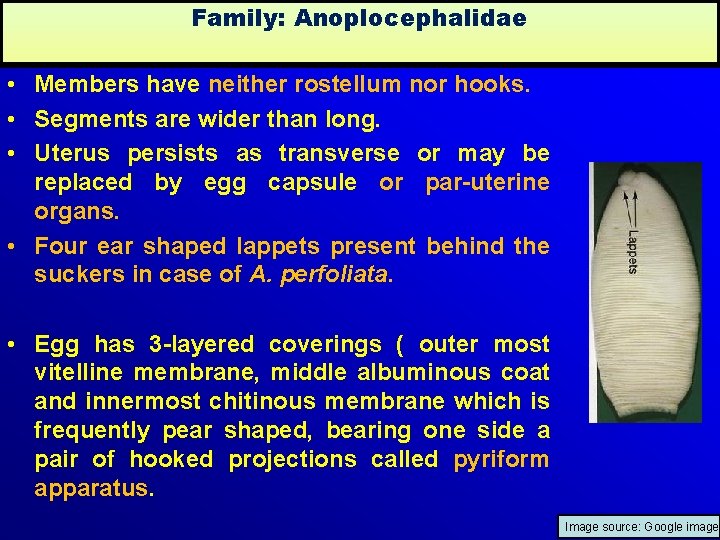
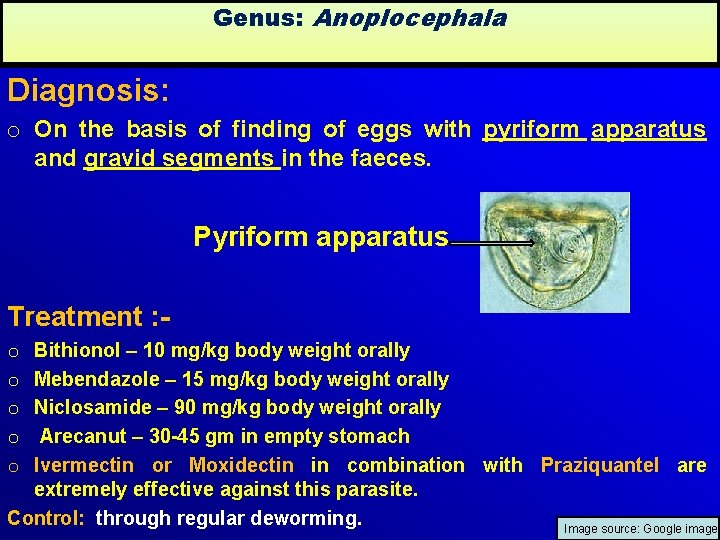
Family: Anoplocephalidae • Members have neither rostellum nor hooks. • Segments are wider than long. • Uterus persists as transverse or may be replaced by egg capsule or par-uterine organs. • Four ear shaped lappets present behind the suckers in case of A. perfoliata. • Egg has 3 -layered coverings ( outer most vitelline membrane, middle albuminous coat and innermost chitinous membrane which is frequently pear shaped, bearing one side a pair of hooked projections called pyriform apparatus. Image source: Google image
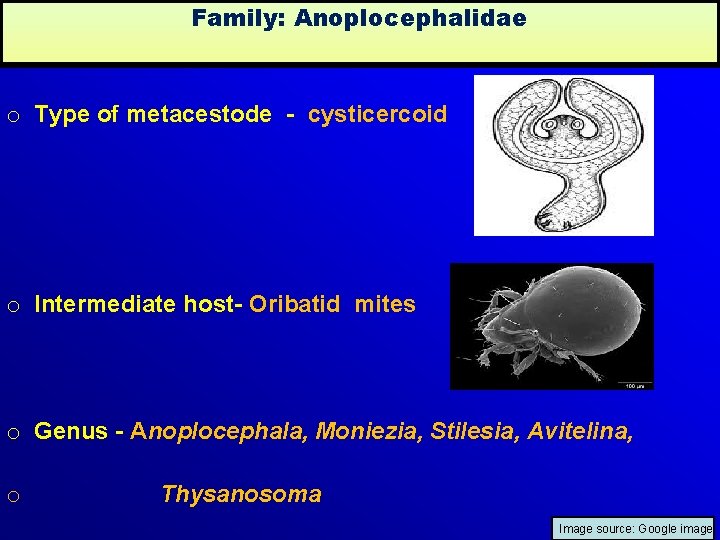
Family: Anoplocephalidae o Type of metacestode - cysticercoid o Intermediate host- Oribatid mites o Genus - Anoplocephala, Moniezia, Stilesia, Avitelina, o Thysanosoma Image source: Google image
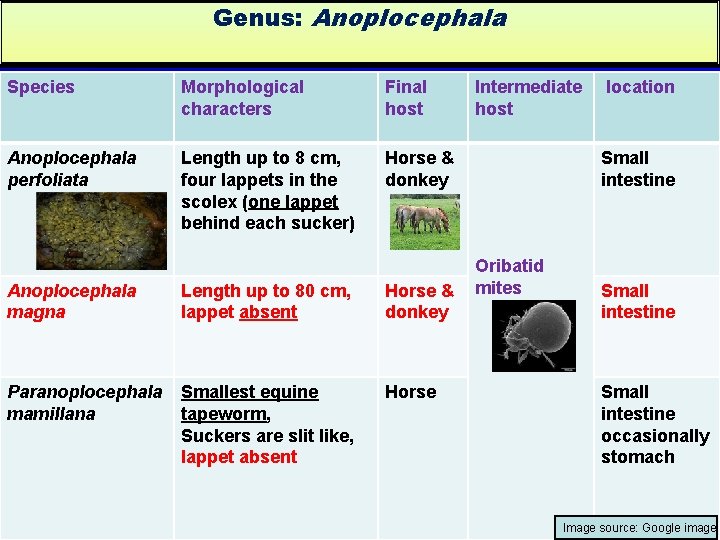
Genus: Anoplocephala Species Morphological characters Final host Anoplocephala perfoliata Length up to 8 cm, four lappets in the scolex (one lappet behind each sucker) Horse & donkey Anoplocephala magna Length up to 80 cm, lappet absent Horse & donkey Paranoplocephala mamillana Smallest equine tapeworm, Suckers are slit like, lappet absent Horse Intermediate host location Small intestine Oribatid mites Small intestine occasionally stomach Image source: Google image
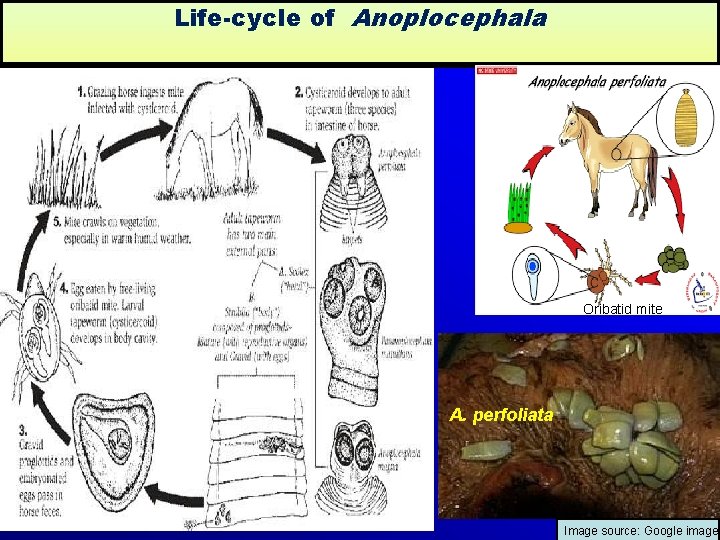
Life-cycle of Anoplocephala Life-cycle : Oribatid mite A. perfoliata Image source: Google image
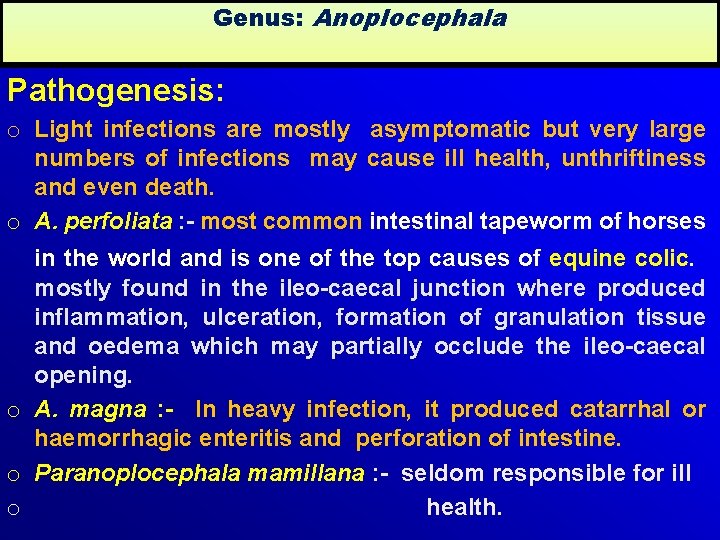
Genus: Anoplocephala Pathogenesis: o Light infections are mostly asymptomatic but very large numbers of infections may cause ill health, unthriftiness and even death. o A. perfoliata : - most common intestinal tapeworm of horses in the world and is one of the top causes of equine colic. mostly found in the ileo-caecal junction where produced inflammation, ulceration, formation of granulation tissue and oedema which may partially occlude the ileo-caecal opening. o A. magna : - In heavy infection, it produced catarrhal or haemorrhagic enteritis and perforation of intestine. o Paranoplocephala mamillana : - seldom responsible for ill o health.
Genus: Anoplocephala Diagnosis: o On the basis of finding of eggs with pyriform apparatus and gravid segments in the faeces. Pyriform apparatus Egg Treatment : Bithionol – 10 mg/kg body weight orally Mebendazole – 15 mg/kg body weight orally Niclosamide – 90 mg/kg body weight orally Arecanut – 30 -45 gm in empty stomach Ivermectin or Moxidectin in combination with Praziquantel are extremely effective against this parasite. Control: through regular deworming. Image source: Google image o o o
THANK YOU