
Equine Senses Physical Parameters How did horses survive




- Slides: 22
Equine Senses
Physical Parameters �How did horses survive over the years? • Hiding • Running away �Tools developed in the past are • Evident in the reactions of the horse today
Physical Parameters What are these tools? �Sight and Skin Sensitivity �Hearing and Smell �Reflex for Flight �Memory and Gregarious Nature �Ability to feel ground vibrations
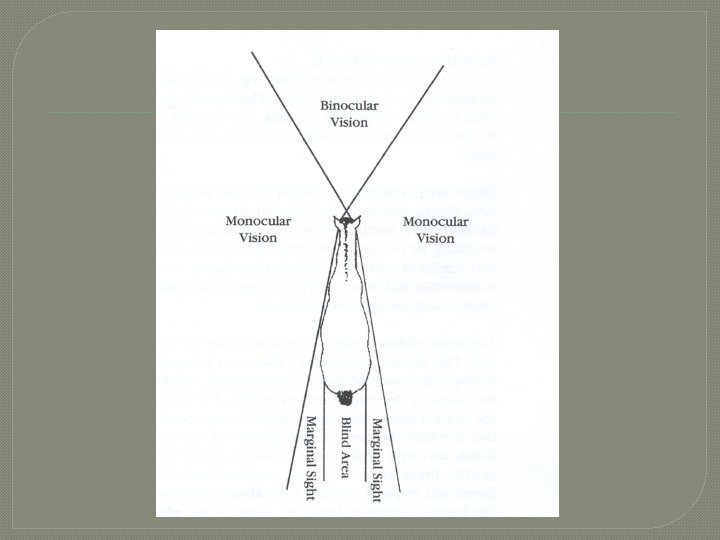
Sight � Eyes set wide on head � Monocular vs. Binocular Vision • Monocular Vision: • Why was this vision developed? �To protect from predators �Allowed to see danger from either side �Without turning its head
Sight �Binocular Vision: • Used to judge distances • Typically not as good as its monocular vision • Some horses have better binocular vision �Why? �Their eyes are set closer together
Sight �Some have to learn to develop binocular vision through training • Examples: �Rope horse following cattle at correct distance �Teaching a barrel horse to judge distance to the barrel �Teaching a jumper how to approach
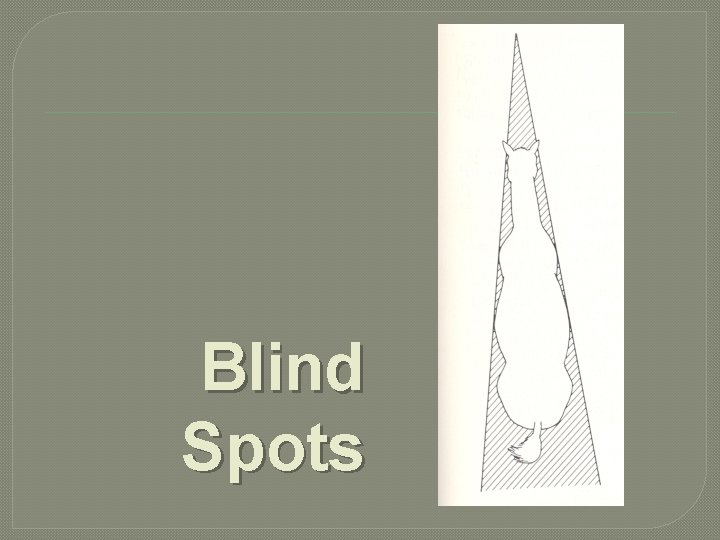
Facts About Vision � Blind spots • Where? �Directly behind its hindquarters � Can’t see directly below its head �Must lower its head to • See far away
Facts About Vision � Must raise its head to see? • Close objects � If object is closer than __, can’t see with its binocular vision • 4 feet �Takes time to • Dark spaces adjust eyesight to
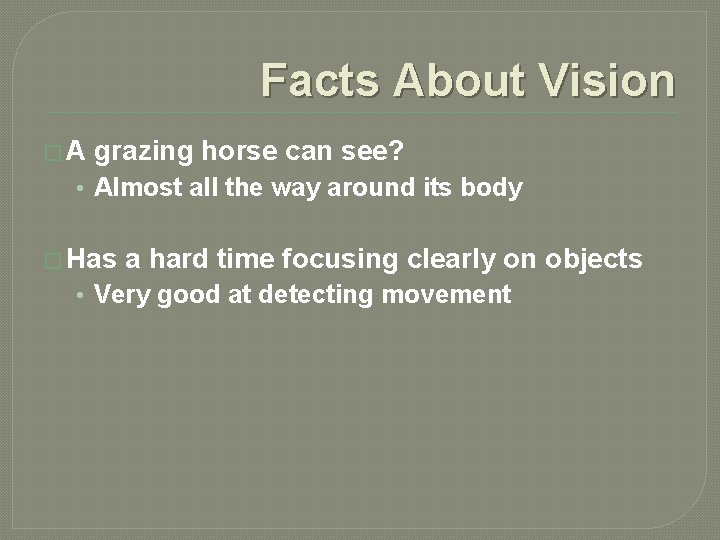
Facts About Vision �A grazing horse can see? • Almost all the way around its body � Has a hard time focusing clearly on objects • Very good at detecting movement
Blind Spots
Touch � Do horses have a keen sense of touch? � Sense of touch is very important in riding • Rider’s hands through the touch of the bit • Rider’s legs on the ribs • Important that the rider remains soft
Touch � Where are the most sensitive areas? • Eyes, ears, and nose • Withers, ribs, flanks, and legs � Fearful of anything touching flanks
Hearing � Do horses have a good sense of hearing? • Excellent � Much better than sight • Eyes and ears are always working together � First ears will point toward the sound then • Horse will try to see what it is
Smell � Sense of smell? • Good � Stallions can identify mares in heat from great distances � Research trials have found • Horse can return home from up to five miles when hauled
Smell �Young horses may • Like to smell saddles �Smell may dictate grazing habits • Does this prevent consumption of poisonous plants?
Flight Reflex � Quick reflexes and panic • Characterized the prehistoric horse � Endowed with an extensive system of ligaments which permit them to what? • Sleep while standing � Will panic into flight without much consideration of such an action
Flight Reflex � Young � As horse especially will try to flee horses get older • Most tend to become desensitized � Careful management and good horsemanship skills should be used
Memory � Considered to have memories • Second only to elephants � In wild, if an attack came at a certain place • The herd avoided that spot in the future � Horses are creatures of habit • Creatures of laziness?
Memory � Memory and temperament are linked to? • Breeding � Well-trained horse never forgets its training • Neither does a poorly trained one � Bad habits should be • Corrected before they become fixed
Memory � Performance on intelligence tests have • Not been outstanding �However, able to complete complex things routinely when trained � What can they not associate with? • Overeating
Gregarious Nature � Gregarious by nature • Banding together � Wild horses were safer from attack � Still seen in zebras in Africa � Can be used to the benefit of trainers