
EQUILIBRIUM What Is Equilibrium l Consider mixing the
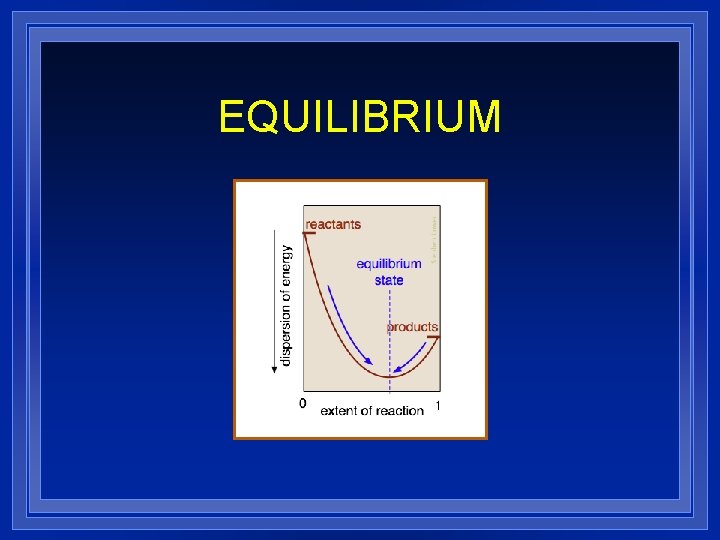
EQUILIBRIUM
What Is Equilibrium? l Consider mixing the reactants nitrogen gas (N 2) and hydrogen gas (H 2). l When reactants are put together the forward reaction starts. l Since there are no products there is no reverse reaction.
What Is Equilibrium? l As the forward reaction proceeds the reactants are used up so the forward reaction slows. l The products build up, and the reverse reaction speeds up.
Equilibrium l Eventually you reach a point where the reverse reaction is going as fast as the forward reaction. l This is dynamic equilibrium.
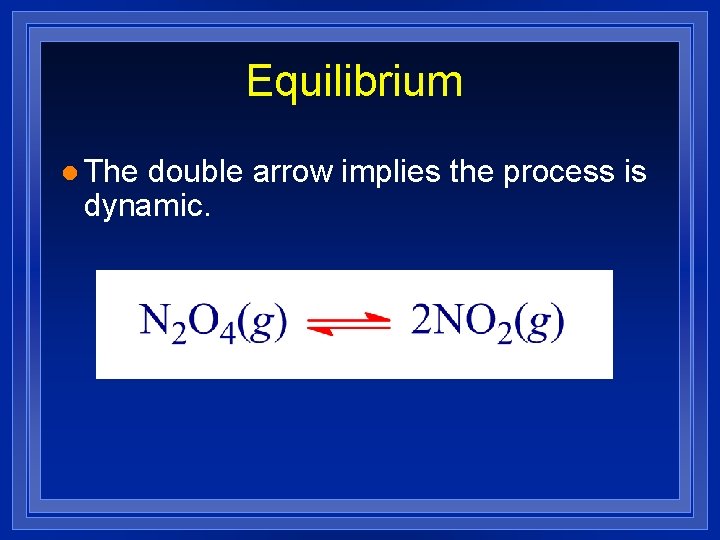
Equilibrium l The double arrow implies the process is dynamic.
Equilibrium l The rate of the forward reaction is equal to the rate of the reverse reaction. l The concentration of products and reactants stays the same, but the reaction is still running.
Equilibrium l Catalysts speed up both the forward and reverse reactions.
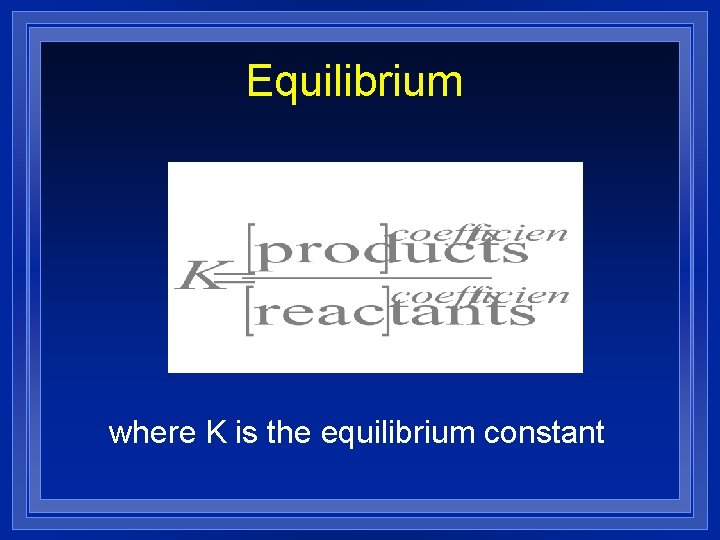
Equilibrium where K is the equilibrium constant
Equilibrium • • • Note that the equilibrium constant expression has products over reactants. Coefficients become exponents. Square brackets [ ] mean concentration/molarity (moles/liter).
Equilibrium • • Pure liquids and pure solids are omitted from the equation! Pure liquids and solids have a fixed concentration which will always be constant, so there is no need to include that in the equilibrium constant expressions.
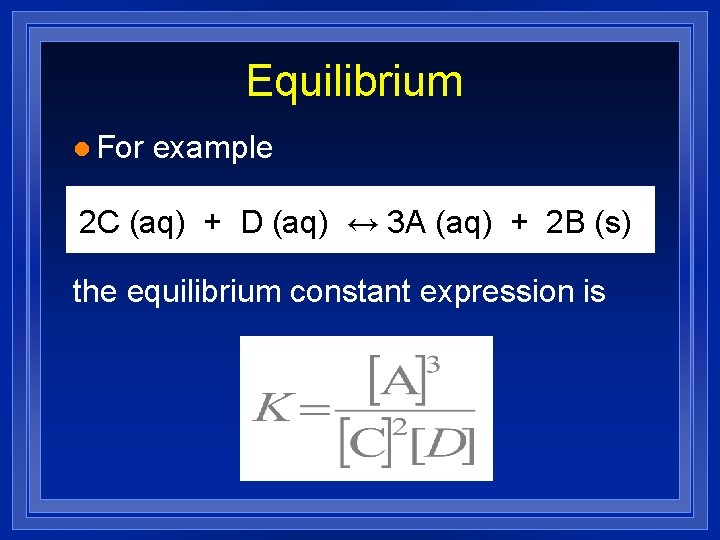
Equilibrium l For example 2 C (aq) + D (aq) ↔ 3 A (aq) + 2 B (s) the equilibrium constant expression is
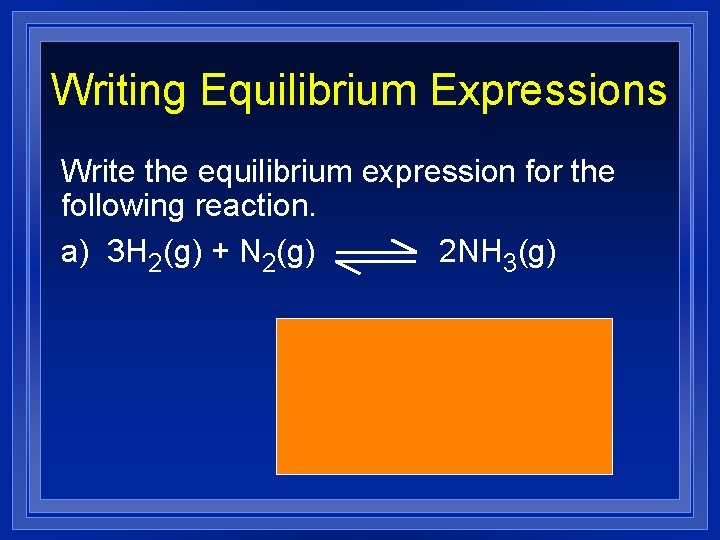
Writing Equilibrium Expressions Write the equilibrium expression for the following reaction. a) 3 H 2(g) + N 2(g) 2 NH 3(g) K = [NH 3]2 [H 2]3 [N 2]
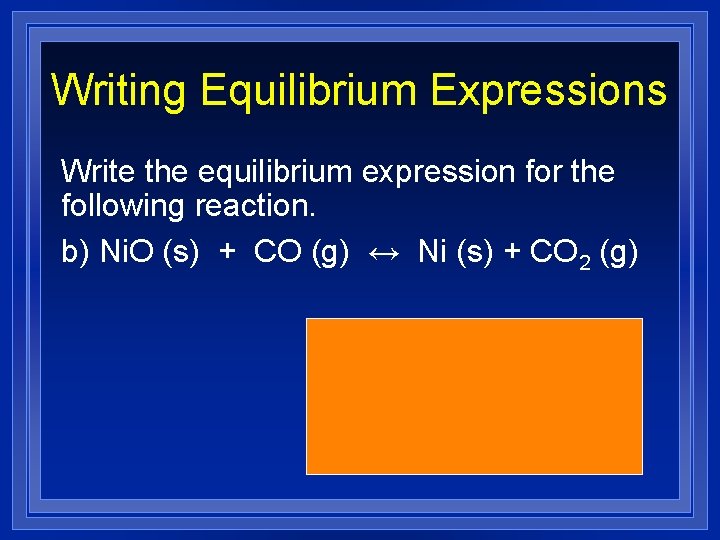
Writing Equilibrium Expressions Write the equilibrium expression for the following reaction. b) Ni. O (s) + CO (g) ↔ Ni (s) + CO 2 (g) K = [CO 2] [CO]
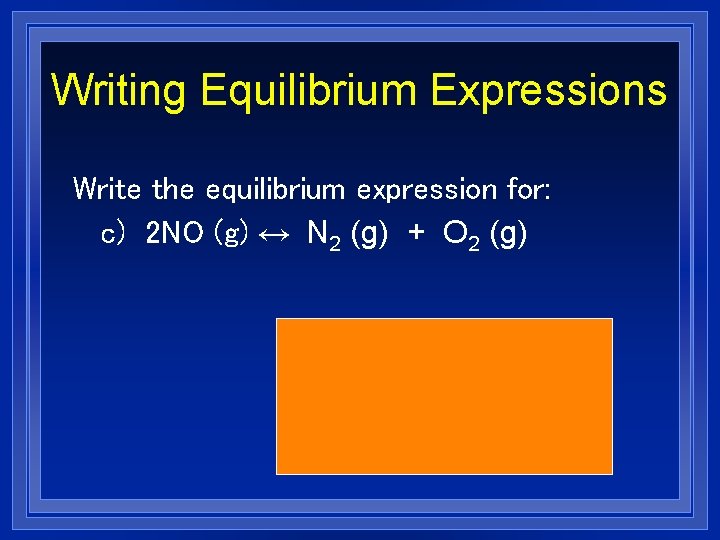
Writing Equilibrium Expressions Write the equilibrium expression for: c) 2 NO (g) ↔ N 2 (g) + O 2 (g) K = [N 2] [O 2] [NO]2
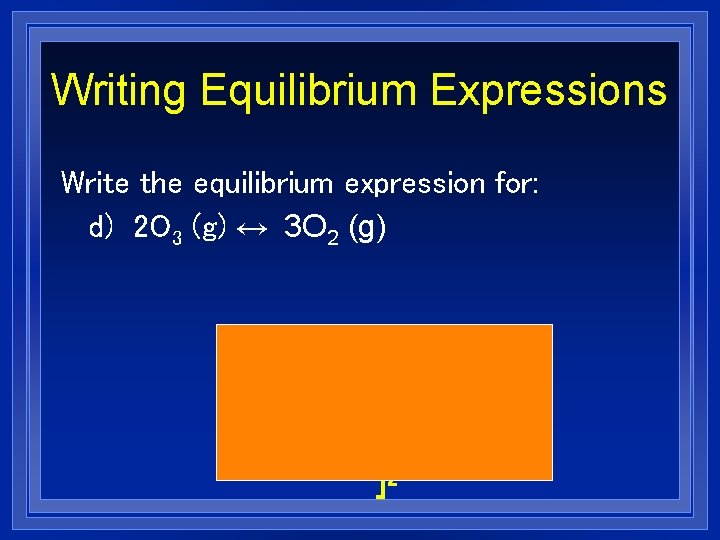
Writing Equilibrium Expressions Write the equilibrium expression for: d) 2 O 3 (g) ↔ 3 O 2 (g) K = [ O ]3 2 [O 3 ]2
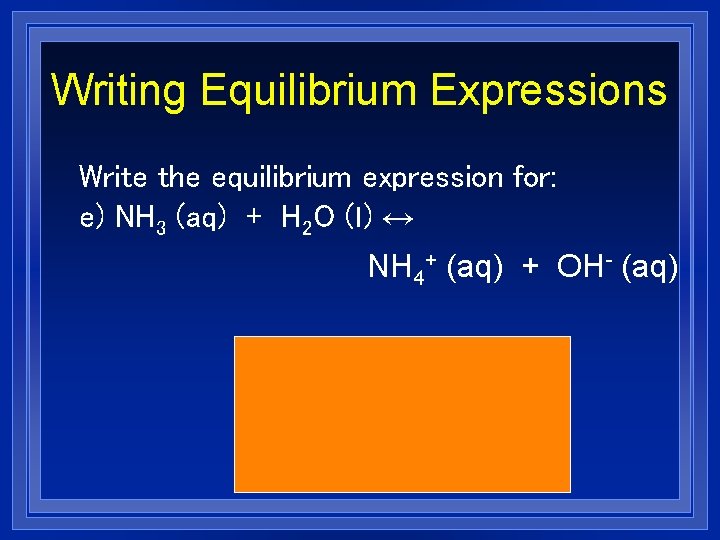
Writing Equilibrium Expressions Write the equilibrium expression for: e) NH 3 (aq) + H 2 O (l) ↔ NH 4+ (aq) + OH- (aq) K = [NH 4+] [OH-] [NH 3]
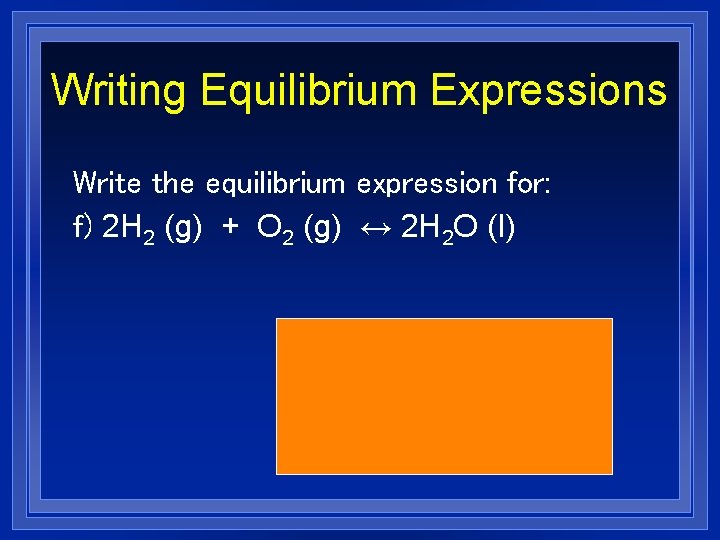
Writing Equilibrium Expressions Write the equilibrium expression for: f) 2 H 2 (g) + O 2 (g) ↔ 2 H 2 O (l) K = 1 [H 2]2 [O 2]
Le Châtelier’s Principle Regaining Equilibrium
Le Châtelier’s Principle l If something is changed in a system at equilibrium, the system will respond to relieve the stress until a new equilibrium is established. l Three types of stress can be applied.
Changing Concentration l Adding a reactant or product shifts the equilibrium away from the increase. l Removing a reactant or product shifts the equilibrium towards the decrease.
Changing Concentration 1) Consider the reaction X + Y ↔ A + B l If the concentration of X is increased, the reaction will shift to the _____. right
Changing Concentration 2) Consider the reaction X + Y ↔ A + B l If the concentration of Y is decreased, the reaction will shift to the _____. left
Changing Concentration 3) Consider the reaction X + Y ↔ A + B l If the concentration of A is increased, the reaction will shift to the _____. left
Changing Concentration 4) Consider the reaction X + Y ↔ A + B l If the concentration of B is decreased, the reaction will shift to the _____. right
Changing Temperature l Reactions either require or release heat. l For an endothermic reaction, H > 0 and heat can be considered as a reactant. l For an exothermic reaction, H < 0 and heat can be considered as a product.
Changing Temperature l Adding heat (i. e. increasing the temperature) favors away from the increase. l Removing heat (i. e. decreasing the temperature) favors toward the increase.
Changing Temperature 5) Consider the reaction 2 SO 2 + O 2 ↔ 2 SO 3 + heat If the temperature is decreased, the reaction will shift to the _____. right
Changing Temperature 6) Consider the reaction N 2 + O 2 + heat ↔ 2 NO If the temperature is decreased, the reaction will shift to the _____. left
Changing Temperature 7) Consider the reaction 2 SO 2 + O 2 ↔ 2 SO 3 ΔH is negative If the temperature is increased, the reaction will shift to the _____. left
Changing Temperature 8) Consider the reaction N 2 + O 2 ↔ 2 NO ΔH is positive If the temperature is increased, the reaction will shift to the _____. right
Changes in Pressure l An increase in pressure favors the direction that has fewer moles of gas. l A decrease in pressure favors the direction that has the greatest moles of gas. l In a reaction with the same number of product and reactant moles of gas, pressure has no effect.
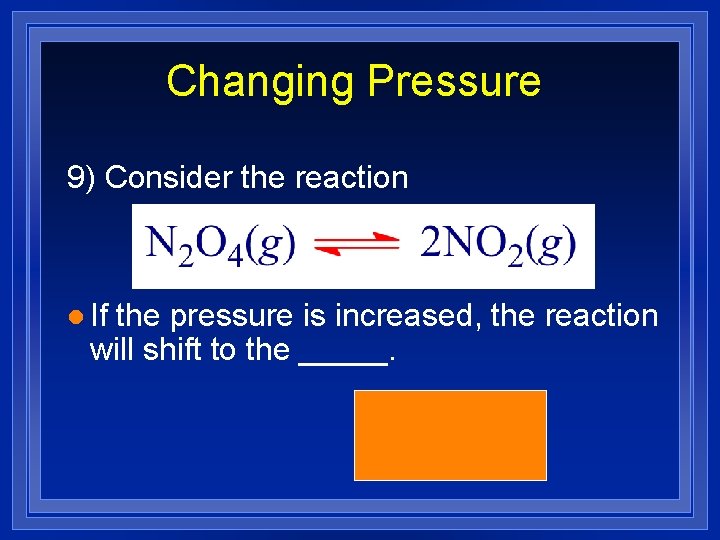
Changing Pressure 9) Consider the reaction l If the pressure is increased, the reaction will shift to the _____. left
Changing Pressure 10) Consider the reaction 2 H 2(g) + O 2(g) ↔ 2 H 2 O(g) l If the pressure is decreased, the reaction will shift to the _____. left
Changing Pressure 11) Consider the reaction CO 2 (g) + H 2 (g) + heat ↔ CO (g) + H 2 O (g) l If the pressure is decreased, the reaction will shift to the _____. No shift
Adding a Catalyst l If a catalyst is added, the reaction will NOT shift. l Equilibrium will only be reached sooner.
Altering the Yield l The yield of a product will be increased if the reaction shifts to the product side (the forward reaction).
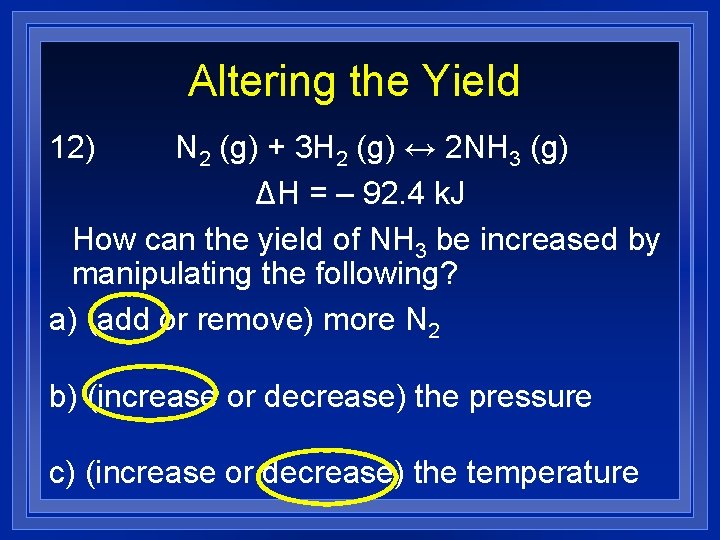
Altering the Yield 12) N 2 (g) + 3 H 2 (g) ↔ 2 NH 3 (g) ΔH = – 92. 4 k. J How can the yield of NH 3 be increased by manipulating the following? a) (add or remove) more N 2 b) (increase or decrease) the pressure c) (increase or decrease) the temperature
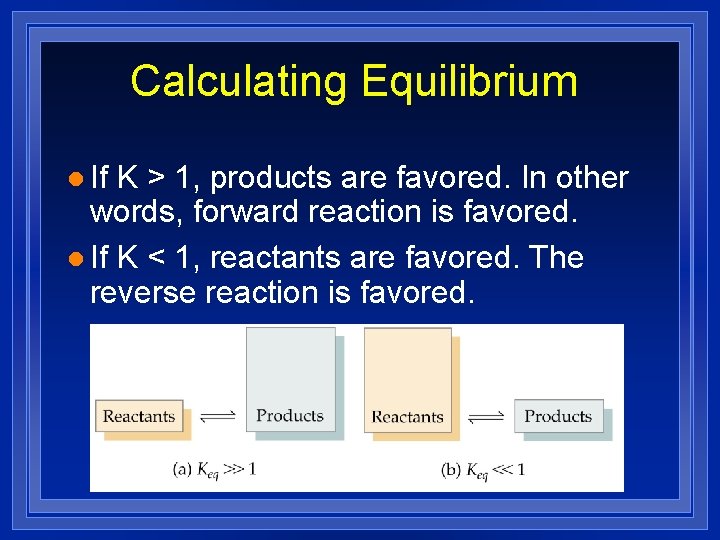
Calculating Equilibrium l If K > 1, products are favored. In other words, forward reaction is favored. l If K < 1, reactants are favored. The reverse reaction is favored.
Calculating Equilibrium l K, the equilibrium constant, it is only affected by temperature. l K increases when a temperature change favors the products (the forward reaction). l K decreases when a temperature change favors the reactants (the reverse reaction).
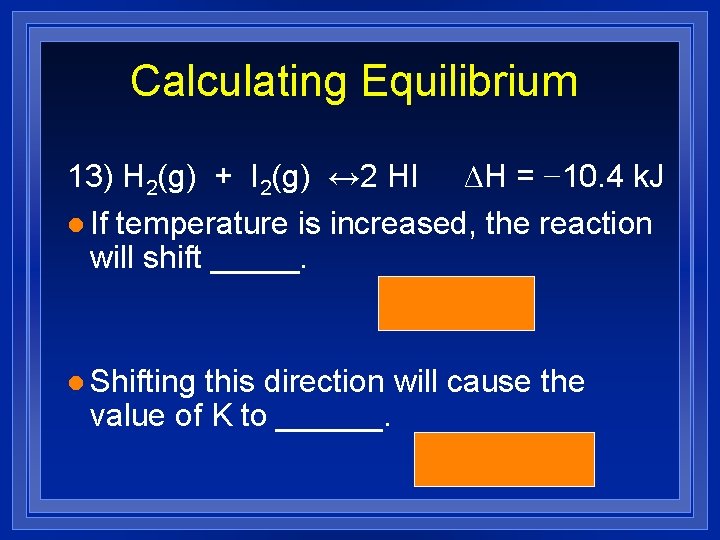
Calculating Equilibrium 13) H 2(g) + I 2(g) ↔ 2 HI ΔH = − 10. 4 k. J l If temperature is increased, the reaction will shift _____. left l Shifting this direction will cause the value of K to ______. decrease
Le Chatelier and Entropy l Entropy (S) is a measure of the disorder or randomness of the particles that make up a system. l A transformation (shift) will not proceed in any direction that reduces the amount of total entropy.
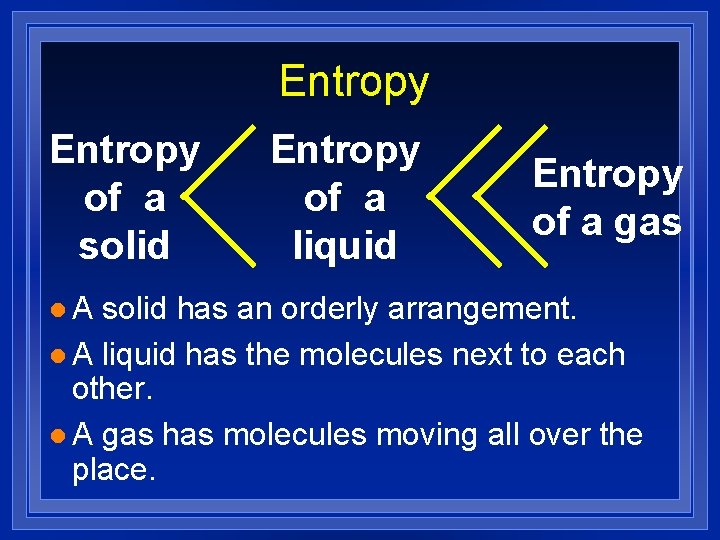
Entropy of a solid l. A Entropy of a liquid Entropy of a gas solid has an orderly arrangement. l A liquid has the molecules next to each other. l A gas has molecules moving all over the place.
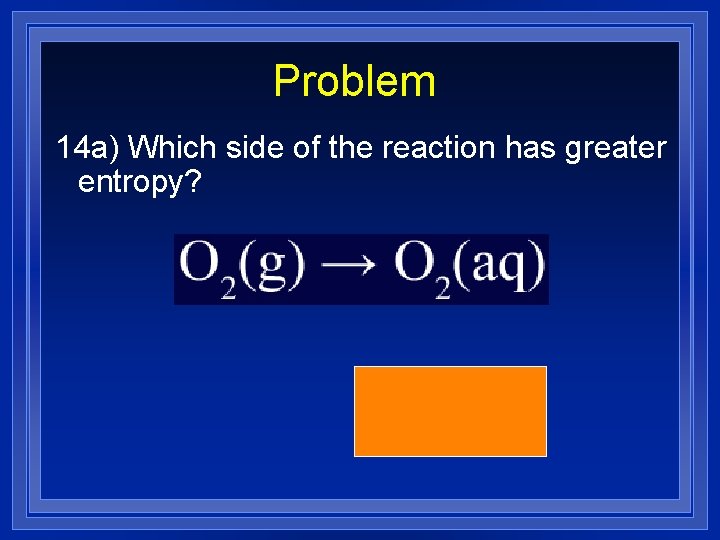
Problem 14 a) Which side of the reaction has greater entropy? (left)
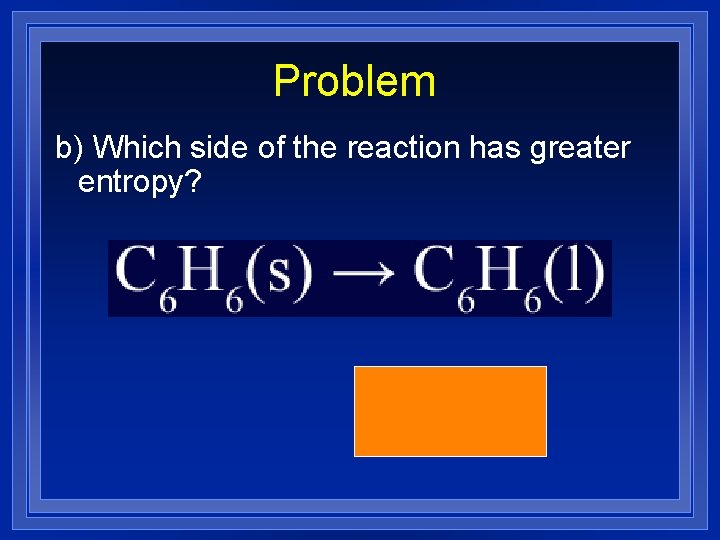
Problem b) Which side of the reaction has greater entropy? (right)
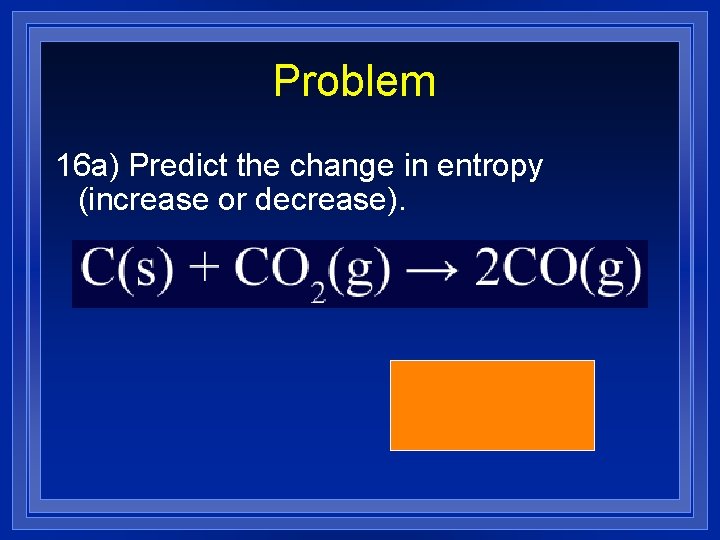
Problem 16 a) Predict the change in entropy (increase or decrease). (increase)
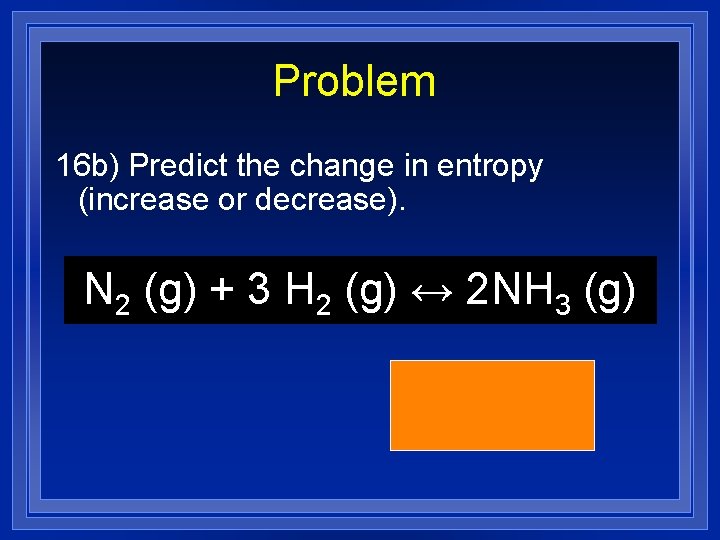
Problem 16 b) Predict the change in entropy (increase or decrease). N 2 (g) + 3 H 2 (g) ↔ 2 NH 3 (g) (decrease)
- Slides: 46