
Equilibrium states Let f M M continuous transformation
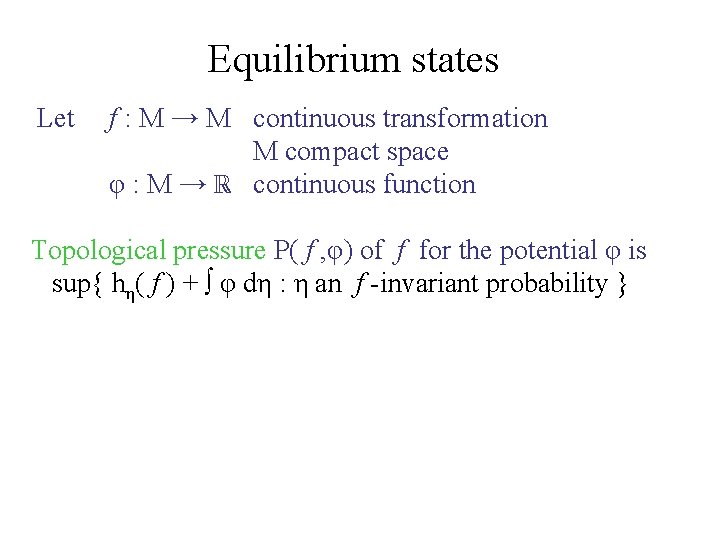
Equilibrium states Let f : M → M continuous transformation M compact space φ : M → continuous function Topological pressure P( f , φ) of f for the potential φ is sup{ hη( f ) + ∫ φ dη : η an f -invariant probability }

Equilibrium states Let f : M → M continuous transformation M compact space φ : M → continuous function Topological pressure P( f , φ) of f for the potential φ is sup{ hη( f ) + ∫ φ dη : η an f -invariant probability } Equilibrium state of f for φ is an f -invariant probability µ on M such that hµ ( f ) + ∫ φ dµ = P( f , φ) Rem: If φ = 0 then P( f , φ) = htop( f ) topological entropy. Equilibrium states are the measures of maximal entropy.

Fundamental Questions: • Existence and uniqueness of equilibrium states • Ergodic and geometric properties • Dynamical implications
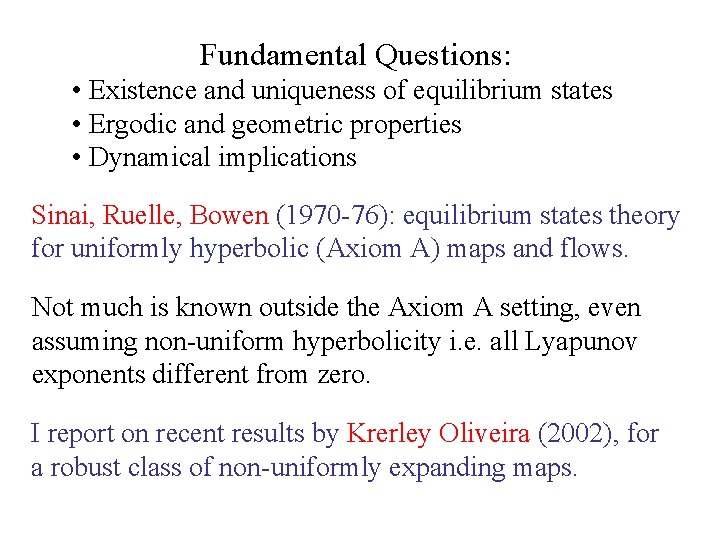
Fundamental Questions: • Existence and uniqueness of equilibrium states • Ergodic and geometric properties • Dynamical implications Sinai, Ruelle, Bowen (1970 -76): equilibrium states theory for uniformly hyperbolic (Axiom A) maps and flows. Not much is known outside the Axiom A setting, even assuming non-uniform hyperbolicity i. e. all Lyapunov exponents different from zero. I report on recent results by Krerley Oliveira (2002), for a robust class of non-uniformly expanding maps.
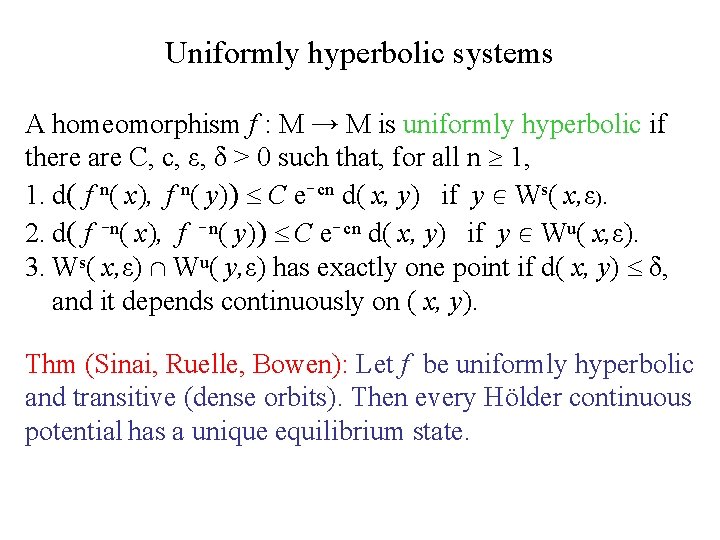
Uniformly hyperbolic systems A homeomorphism f : M → M is uniformly hyperbolic if there are C, c, ε, δ > 0 such that, for all n 1, 1. d( f n( x), f n( y)) C e cn d( x, y) if y Ws( x, ε). 2. d( f n( x), f n( y)) C e cn d( x, y) if y Wu( x, ε). 3. Ws( x, ε) Wu( y, ε) has exactly one point if d( x, y) δ, and it depends continuously on ( x, y). Thm (Sinai, Ruelle, Bowen): Let f be uniformly hyperbolic and transitive (dense orbits). Then every Hölder continuous potential has a unique equilibrium state.
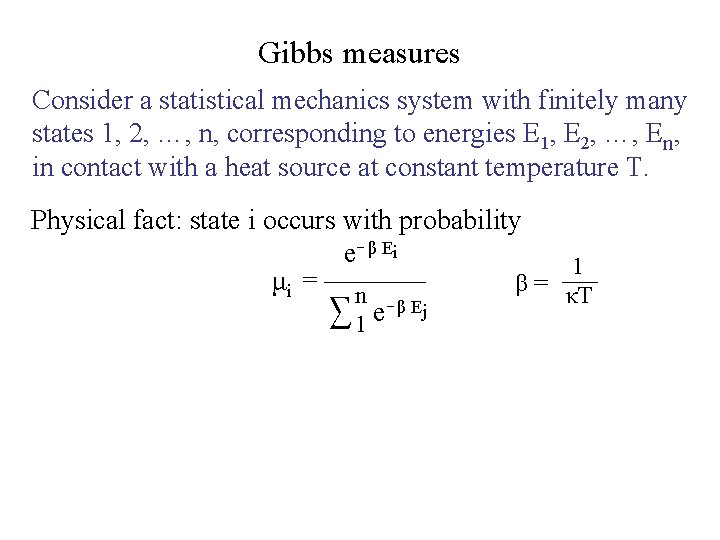
Gibbs measures Consider a statistical mechanics system with finitely many states 1, 2, …, n, corresponding to energies E 1, E 2, …, En, in contact with a heat source at constant temperature T. Physical fact: state i occurs with probability e β Ei 1 μi = n β= κT β E 1 e j
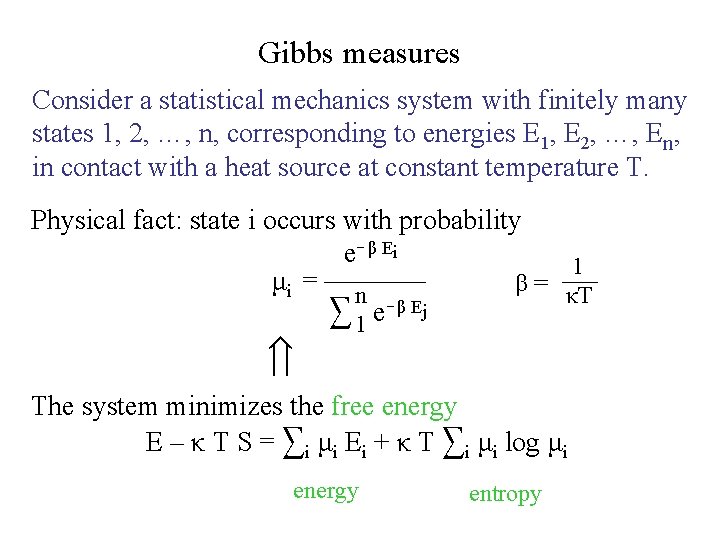
Gibbs measures Consider a statistical mechanics system with finitely many states 1, 2, …, n, corresponding to energies E 1, E 2, …, En, in contact with a heat source at constant temperature T. Physical fact: state i occurs with probability e β Ei 1 μi = n β= κT β E 1 e j The system minimizes the free energy E – κ T S = i μi Ei + κ T i μi log μi energy entropy
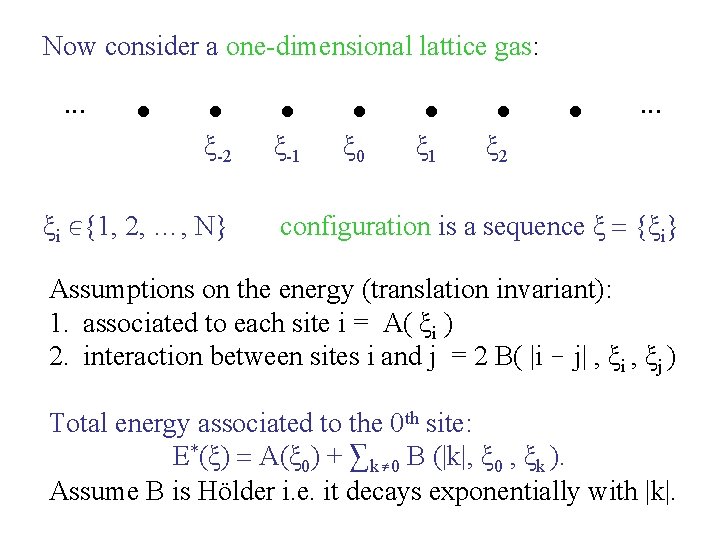
Now consider a one-dimensional lattice gas: ξ-2 ξi {1, 2, …, N} ξ-1 ξ 0 ξ 1 ξ 2 configuration is a sequence ξ {ξi} Assumptions on the energy (translation invariant): 1. associated to each site i = A( ξi ) 2. interaction between sites i and j = 2 B( |i j| , ξi , ξj ) Total energy associated to the 0 th site: E*(ξ) A(ξ 0) + k 0 B (|k|, ξ 0 , ξk ). Assume B is Hölder i. e. it decays exponentially with |k|.
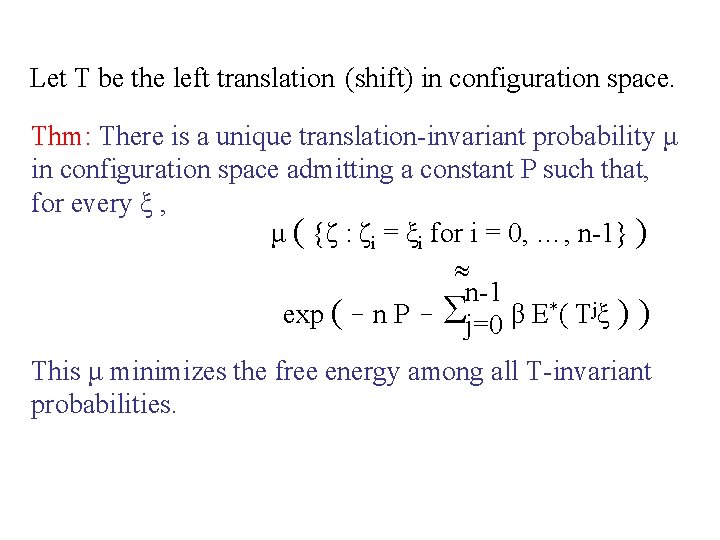
Let T be the left translation (shift) in configuration space. Thm: There is a unique translation-invariant probability μ in configuration space admitting a constant P such that, for every ξ , μ ( {ζ : ζi = ξi for i = 0, …, n-1} ) n-1 exp ( n P Σj=0 β E*( Tjξ ) ) This μ minimizes the free energy among all T-invariant probabilities.
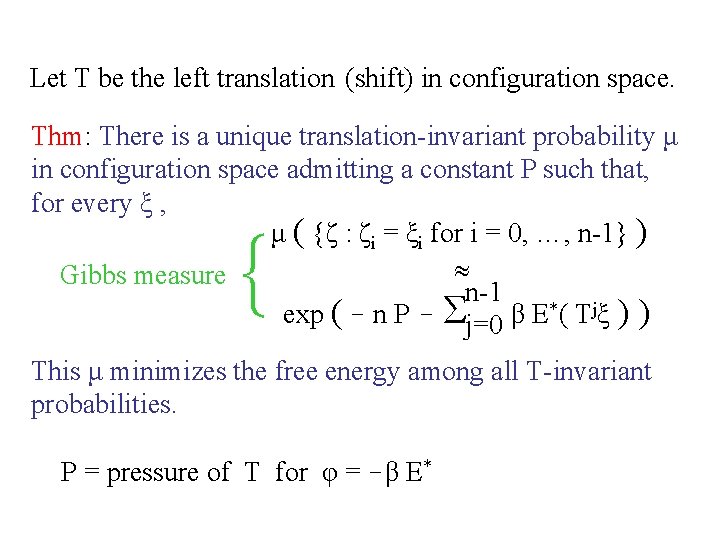
Let T be the left translation (shift) in configuration space. Thm: There is a unique translation-invariant probability μ in configuration space admitting a constant P such that, for every ξ , μ ( {ζ : ζi = ξi for i = 0, …, n-1} ) Gibbs measure n-1 exp ( n P Σj=0 β E*( Tjξ ) ) { This μ minimizes the free energy among all T-invariant probabilities. P = pressure of T for φ = β E*
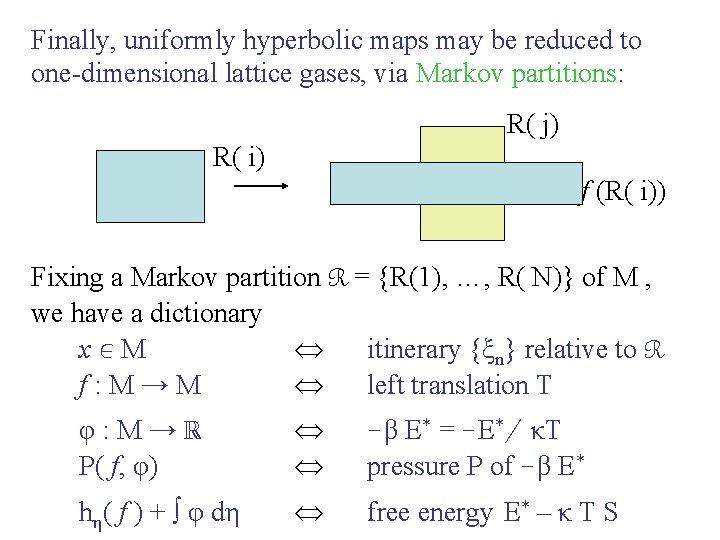
Finally, uniformly hyperbolic maps may be reduced to one-dimensional lattice gases, via Markov partitions: R( j) R( i) f (R( i)) Fixing a Markov partition R = {R(1), …, R( N)} of M , we have a dictionary x M itinerary {ξn} relative to R f: M→M left translation T φ: M→ P( f, φ) β E* = E* κT pressure P of β E* hη( f ) + ∫ φ dη free energy E* – κ T S
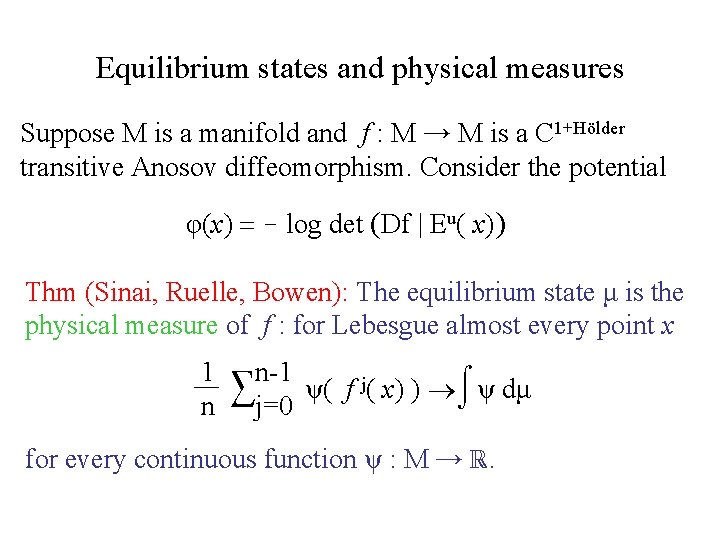
Equilibrium states and physical measures Suppose M is a manifold and f : M → M is a C 1+Hölder transitive Anosov diffeomorphism. Consider the potential φ(x) log det (Df | Eu( x)) Thm (Sinai, Ruelle, Bowen): The equilibrium state μ is the physical measure of f : for Lebesgue almost every point x 1 n n-1 j=0 ψ( f j( x) ) ψ dμ for every continuous function ψ : M → .

For non hyperbolic (non Axiom A) systems: • Markov partitions are not known to exist in general • When they do exist, Markov partitions often involve infinitely many subsets lattices with infinitely many states. Bressaud, Bruin, Buzzi, Keller, Maume, Sarig, Schmitt, Urbanski, Yuri, … : unimodal maps, piecewise expanding maps (1 D and higher), finite and countable state lattices, measures of maximal entropy. Assuming non-uniform hyperbolicity, there has been progress concerning physical measures:

Physical measures for non-hyperbolic maps Thm (Alves, Bonatti, Viana): Let f : M → M be a C 2 local diffeomorphism non-uniformly expanding lim 1 n n-1 j=0 log || Df ( f j(x)) 1 || < c < 0 ( all Lyapunov exponents are strictly positive) at Lebesgue almost every point x M.
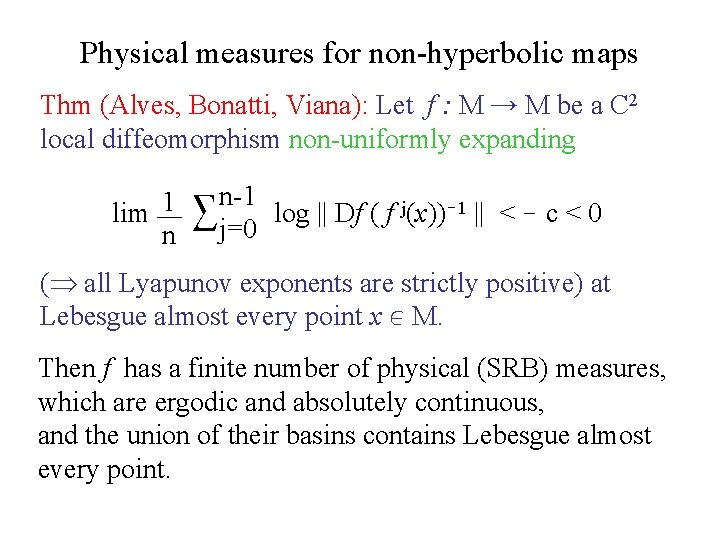
Physical measures for non-hyperbolic maps Thm (Alves, Bonatti, Viana): Let f : M → M be a C 2 local diffeomorphism non-uniformly expanding lim 1 n n-1 j=0 log || Df ( f j(x)) 1 || < c < 0 ( all Lyapunov exponents are strictly positive) at Lebesgue almost every point x M. Then f has a finite number of physical (SRB) measures, which are ergodic and absolutely continuous, and the union of their basins contains Lebesgue almost every point.
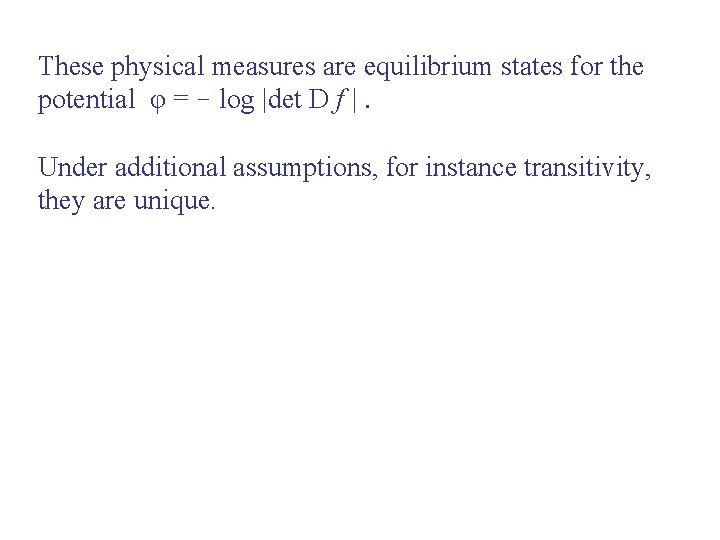
These physical measures are equilibrium states for the potential φ = log |det D f |. Under additional assumptions, for instance transitivity, they are unique.
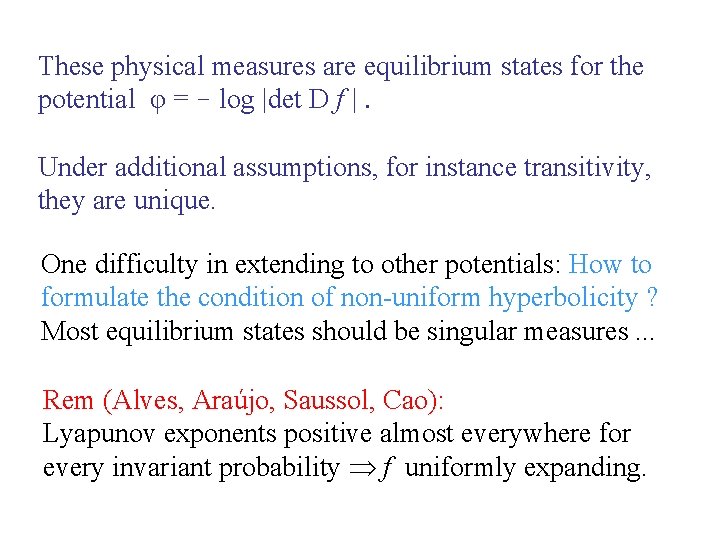
These physical measures are equilibrium states for the potential φ = log |det D f |. Under additional assumptions, for instance transitivity, they are unique. One difficulty in extending to other potentials: How to formulate the condition of non-uniform hyperbolicity ? Most equilibrium states should be singular measures. . . Rem (Alves, Araújo, Saussol, Cao): Lyapunov exponents positive almost everywhere for every invariant probability f uniformly expanding.
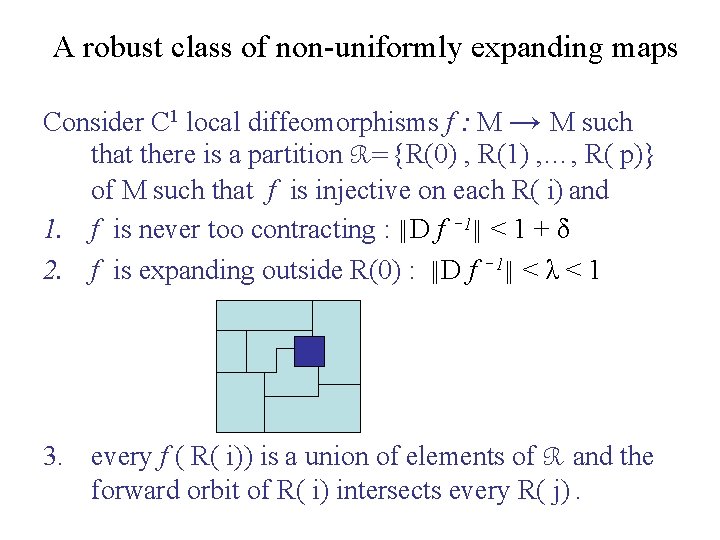
A robust class of non-uniformly expanding maps Consider C 1 local diffeomorphisms f : M → M such that there is a partition R={R(0) , R(1) , …, R( p)} of M such that f is injective on each R( i) and 1. f is never too contracting : D f 1 < 1 + δ 2. f is expanding outside R(0) : D f 1 < λ < 1 3. every f ( R( i)) is a union of elements of R and the forward orbit of R( i) intersects every R( j).
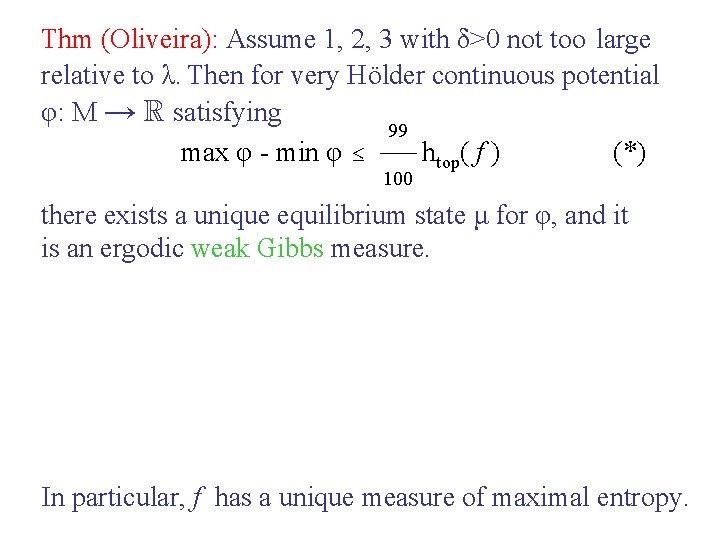
Thm (Oliveira): Assume 1, 2, 3 with δ>0 not too large relative to λ. Then for very Hölder continuous potential φ: M → satisfying 99 max φ - min φ htop( f ) (*) 100 there exists a unique equilibrium state μ for φ, and it is an ergodic weak Gibbs measure. In particular, f has a unique measure of maximal entropy.
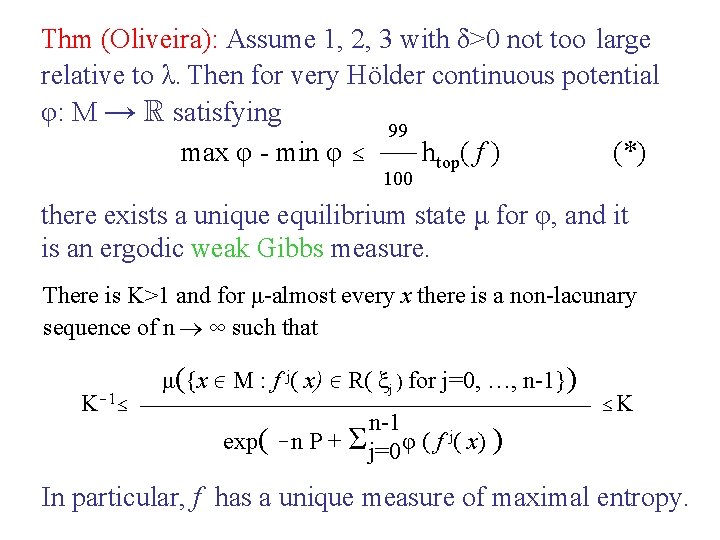
Thm (Oliveira): Assume 1, 2, 3 with δ>0 not too large relative to λ. Then for very Hölder continuous potential φ: M → satisfying 99 max φ - min φ htop( f ) (*) 100 there exists a unique equilibrium state μ for φ, and it is an ergodic weak Gibbs measure. There is K>1 and for μ-almost every x there is a non-lacunary sequence of n such that K 1 μ({x M : f j( x) R( ξj ) for j=0, …, n-1}) n-1 exp( n P + Σ j=0 φ ( f j( x) ) K In particular, f has a unique measure of maximal entropy.
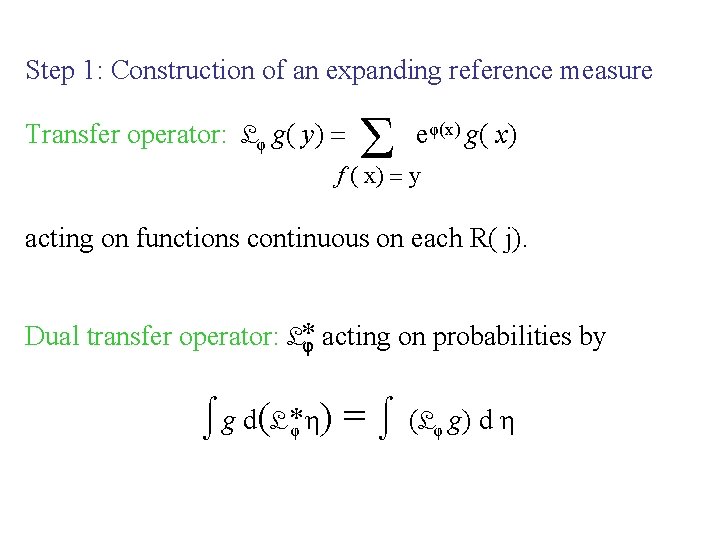
Step 1: Construction of an expanding reference measure Transfer operator: Lφ g( y) Σ eφ(x) g( x) f ( x) y acting on functions continuous on each R( j). Dual transfer operator: L*φ acting on probabilities by g d(L *φ η) = (Lφ g) d η
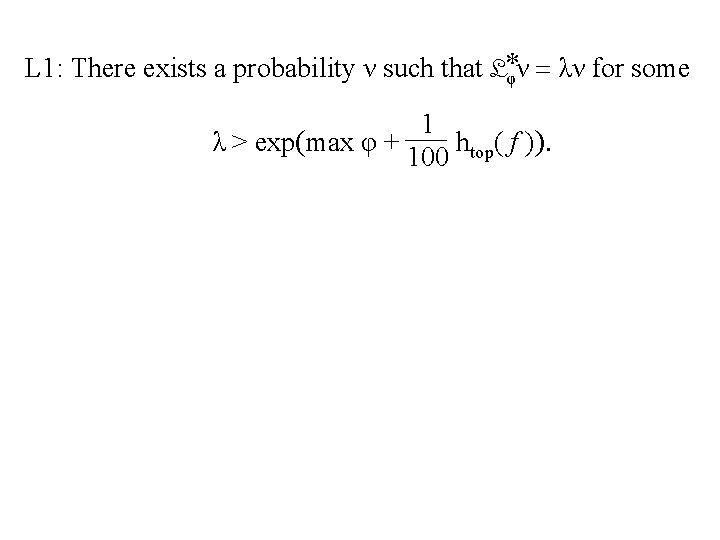
L 1: There exists a probability ν such that L*φν λν for some 1 λ > exp(max φ + htop( f )). 100
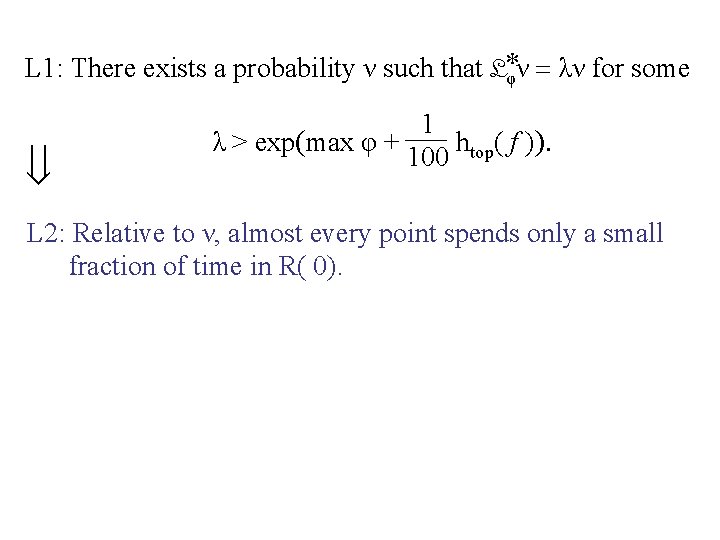
L 1: There exists a probability ν such that L*φν λν for some 1 λ > exp(max φ + htop( f )). 100 L 2: Relative to ν, almost every point spends only a small fraction of time in R( 0).
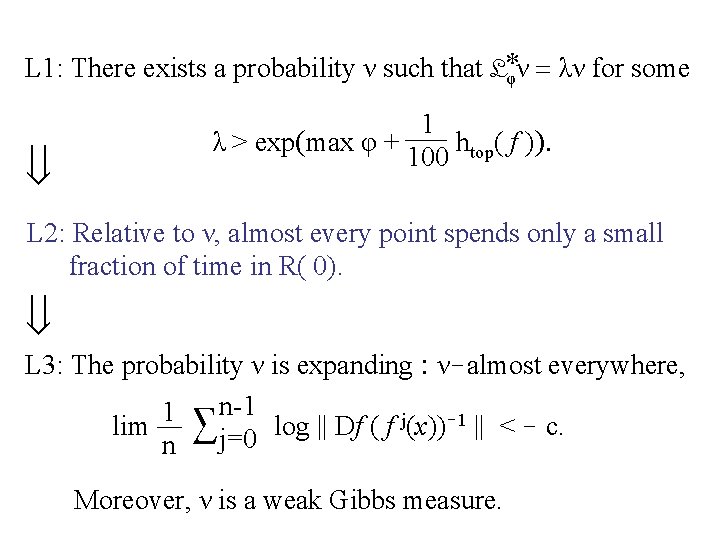
L 1: There exists a probability ν such that L*φν λν for some 1 λ > exp(max φ + htop( f )). 100 L 2: Relative to ν, almost every point spends only a small fraction of time in R( 0). L 3: The probability ν is expanding : ν almost everywhere, n-1 1 lim j=0 log || Df ( f j(x)) 1 || < c. n Moreover, ν is a weak Gibbs measure.
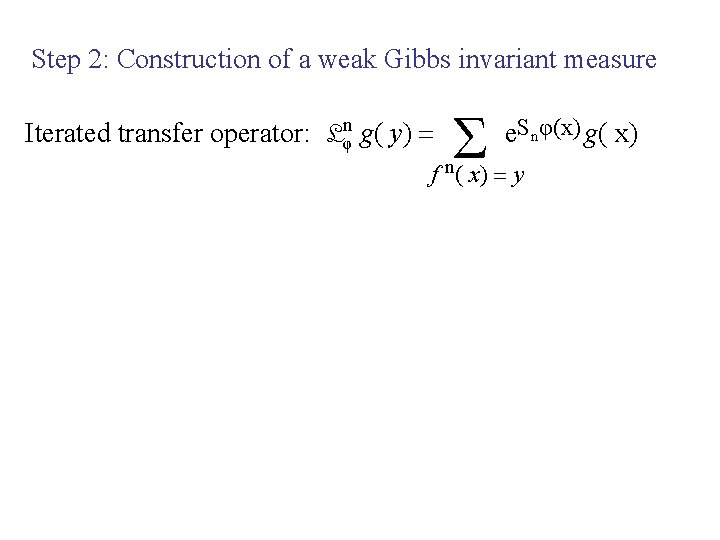
Step 2: Construction of a weak Gibbs invariant measure Iterated transfer operator: Lφn g( y) Σ e. Snφ(x) g( x) f n ( x) y
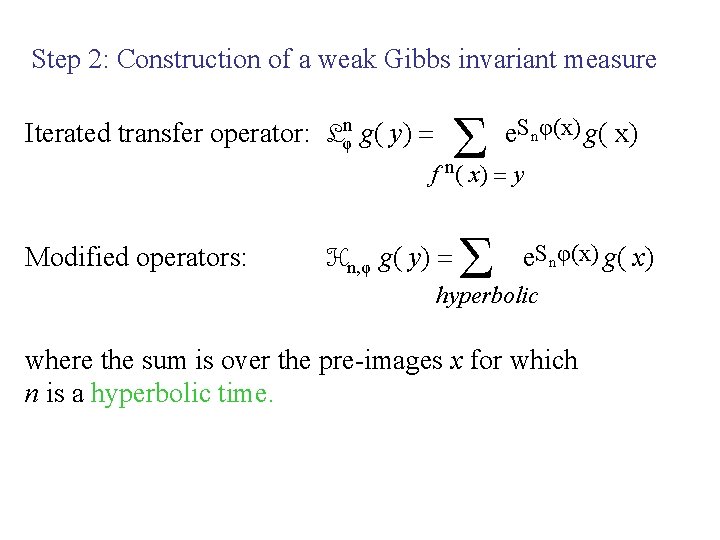
Step 2: Construction of a weak Gibbs invariant measure Σ Iterated transfer operator: Lφn g( y) e. Snφ(x) g( x) f n ( x) y Modified operators: Hn, φ g( y) Σ e. Snφ(x) g( x) hyperbolic where the sum is over the pre-images x for which n is a hyperbolic time.
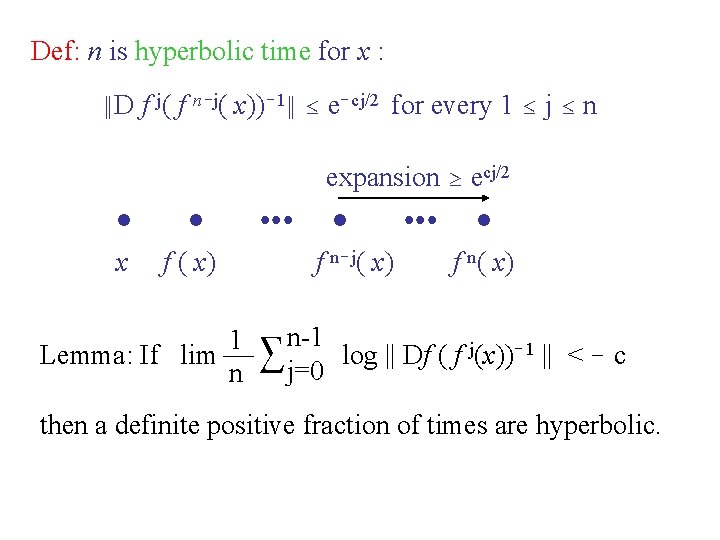
Def: n is hyperbolic time for x : D f j( f n j( x)) 1 e cj/2 for every 1 j n ● ● x f ( x) 1 Lemma: If lim n expansion ecj/2 ● ● f n j( x) f n( x) n-1 j=0 log || Df ( f j(x)) 1 || < c then a definite positive fraction of times are hyperbolic.
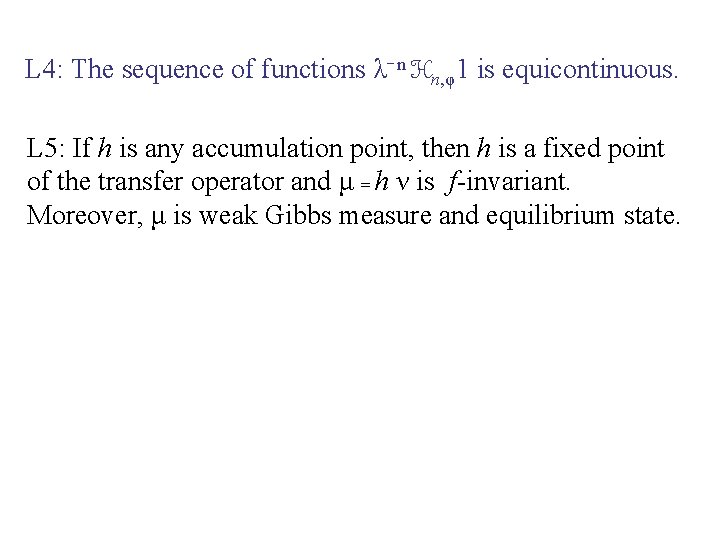
L 4: The sequence of functions λ n Hn, φ1 is equicontinuous. L 5: If h is any accumulation point, then h is a fixed point of the transfer operator and μ h ν is f-invariant. Moreover, μ is weak Gibbs measure and equilibrium state.
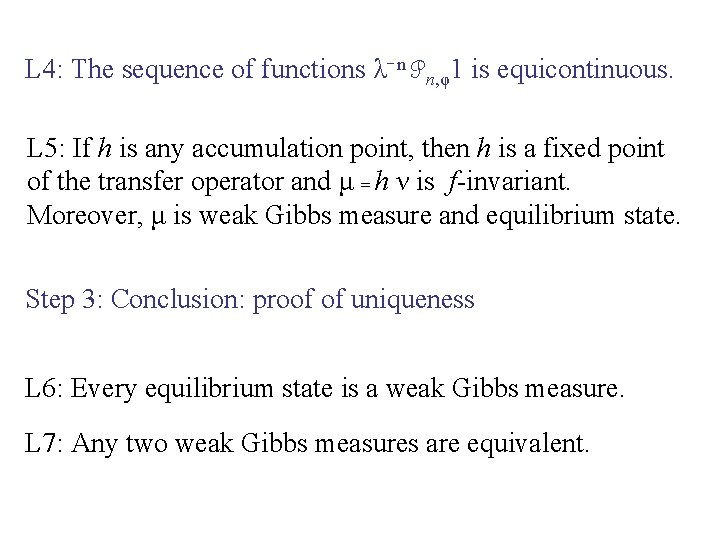
L 4: The sequence of functions λ n Pn, φ1 is equicontinuous. L 5: If h is any accumulation point, then h is a fixed point of the transfer operator and μ h ν is f-invariant. Moreover, μ is weak Gibbs measure and equilibrium state. Step 3: Conclusion: proof of uniqueness L 6: Every equilibrium state is a weak Gibbs measure. L 7: Any two weak Gibbs measures are equivalent.
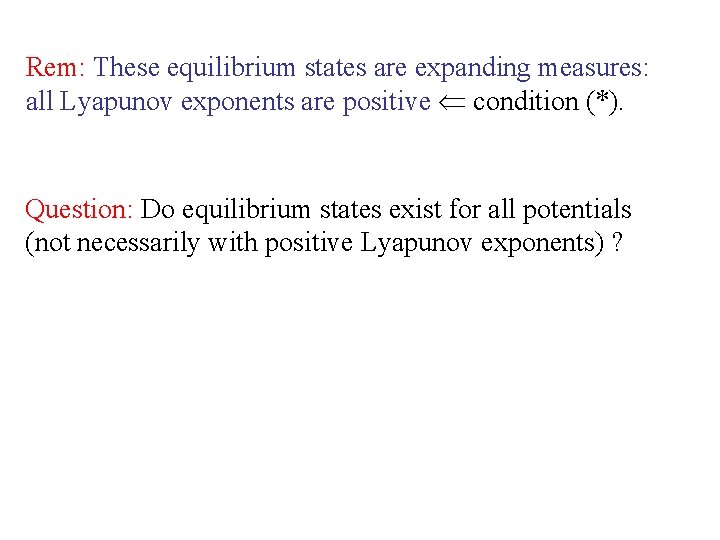
Rem: These equilibrium states are expanding measures: all Lyapunov exponents are positive condition (*). Question: Do equilibrium states exist for all potentials (not necessarily with positive Lyapunov exponents) ?
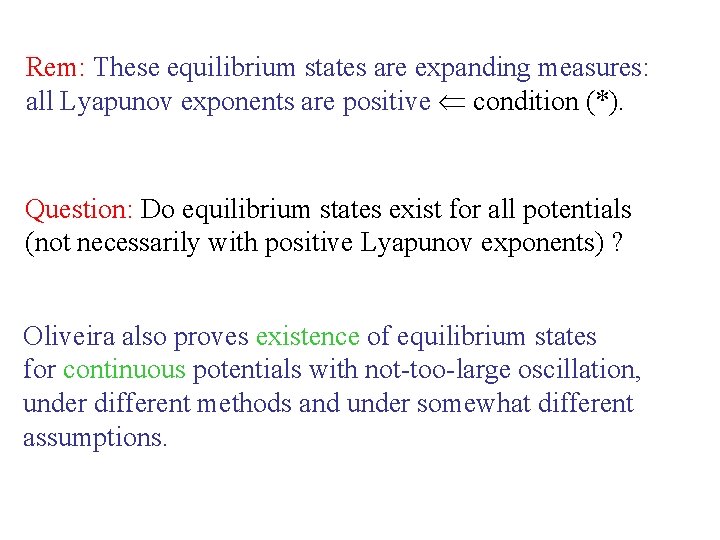
Rem: These equilibrium states are expanding measures: all Lyapunov exponents are positive condition (*). Question: Do equilibrium states exist for all potentials (not necessarily with positive Lyapunov exponents) ? Oliveira also proves existence of equilibrium states for continuous potentials with not-too-large oscillation, under different methods and under somewhat different assumptions.
- Slides: 31