
Equilibrium Reaction Quotient Q and ICE Tables The
Equilibrium Reaction Quotient – Q and ICE Tables
The Reaction Quotient If a reaction mixture containing both reactants and products is not at equilibrium, how can we determine in which direction it will proceed? The answer is to compare the current concentration ratios to the equilibrium constant. The concentration ratio of the products (raised to the power of their coefficients) to the reactants (raised to the power of their coefficients) is called the reaction quotient, Q.
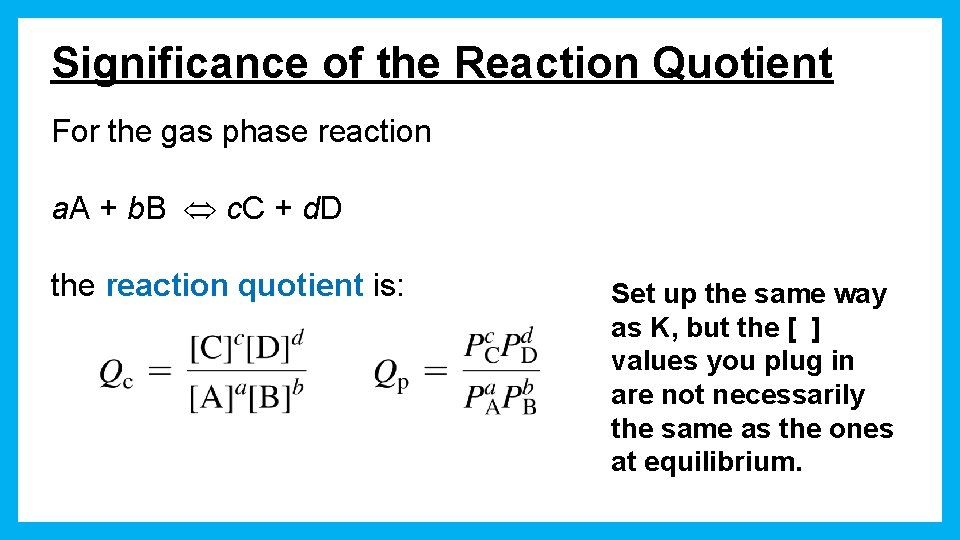
Significance of the Reaction Quotient For the gas phase reaction a. A + b. B Û c. C + d. D the reaction quotient is: Set up the same way as K, but the [ ] values you plug in are not necessarily the same as the ones at equilibrium.
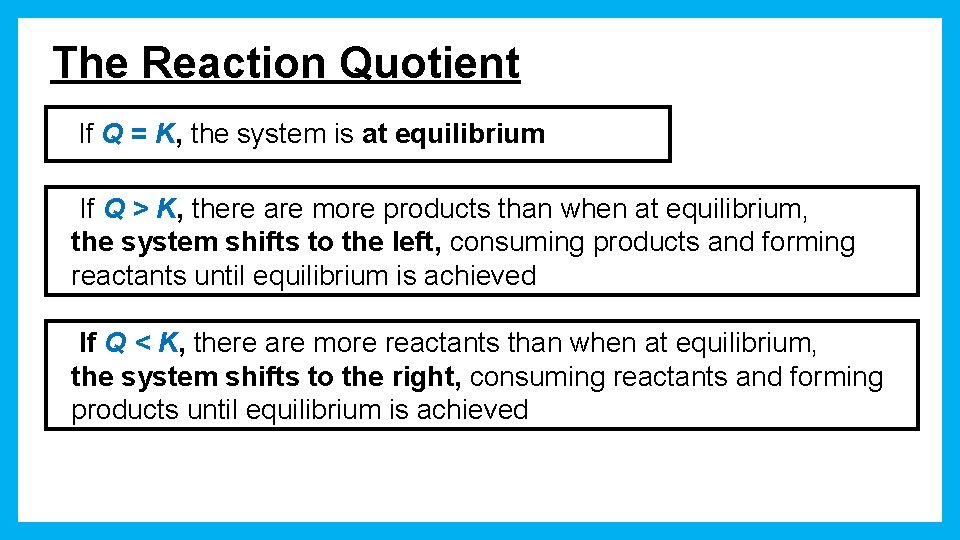
The Reaction Quotient If Q = K, the system is at equilibrium If Q > K, there are more products than when at equilibrium, the system shifts to the left, consuming products and forming reactants until equilibrium is achieved If Q < K, there are more reactants than when at equilibrium, the system shifts to the right, consuming reactants and forming products until equilibrium is achieved
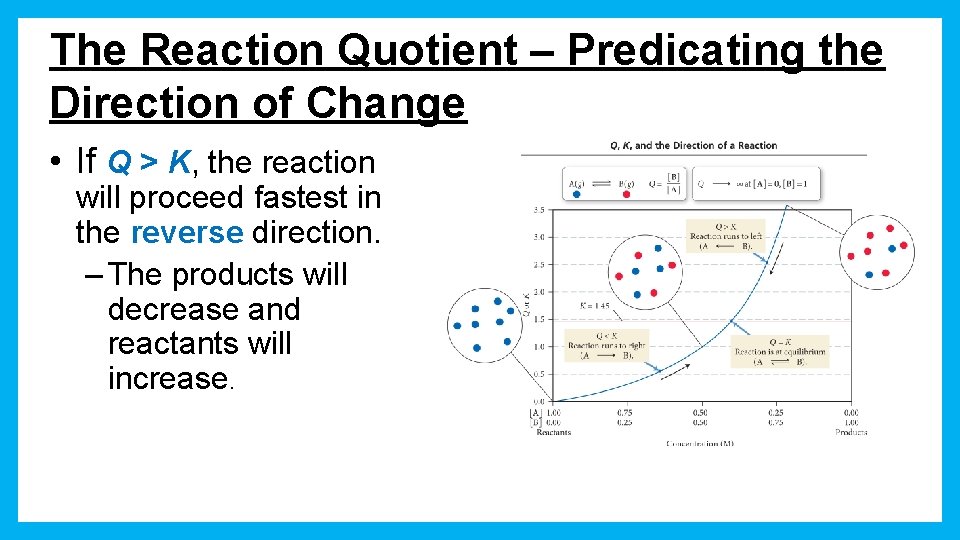
The Reaction Quotient – Predicating the Direction of Change • If Q > K, the reaction will proceed fastest in the reverse direction. – The products will decrease and reactants will increase.
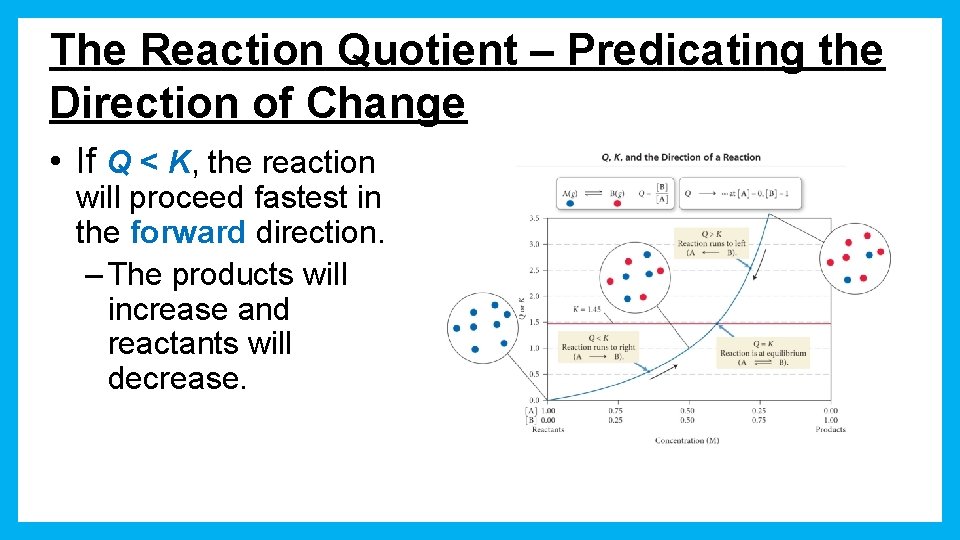
The Reaction Quotient – Predicating the Direction of Change • If Q < K, the reaction will proceed fastest in the forward direction. – The products will increase and reactants will decrease.
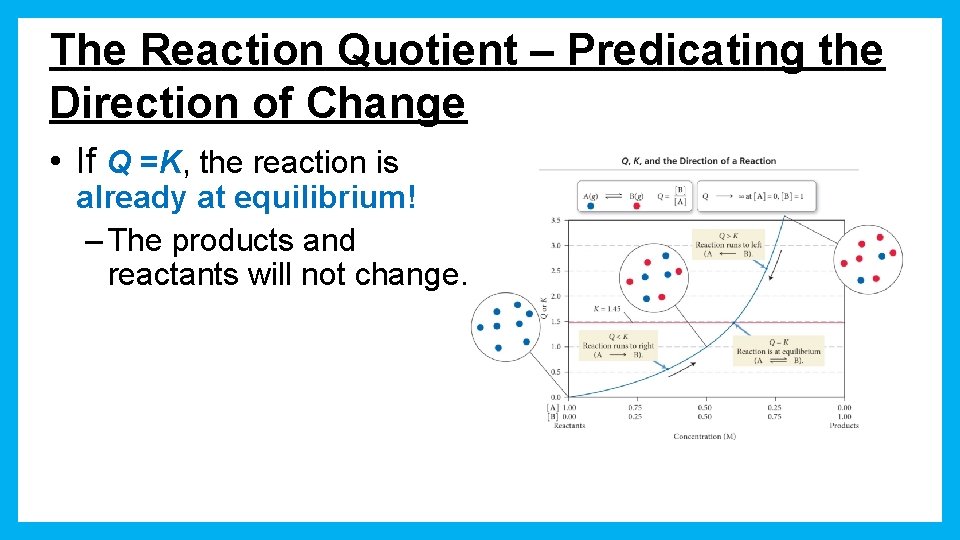
The Reaction Quotient – Predicating the Direction of Change • If Q =K, the reaction is already at equilibrium! – The products and reactants will not change.
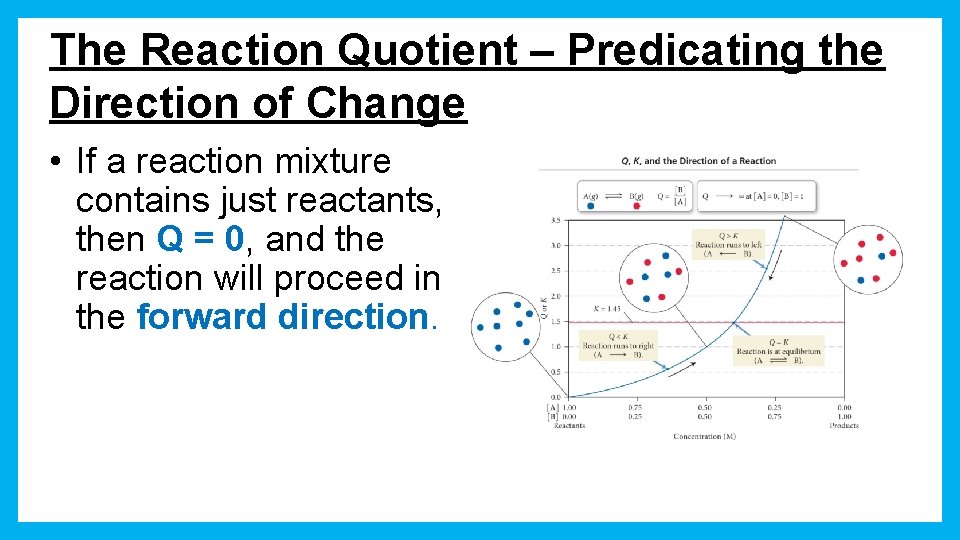
The Reaction Quotient – Predicating the Direction of Change • If a reaction mixture contains just reactants, then Q = 0, and the reaction will proceed in the forward direction.
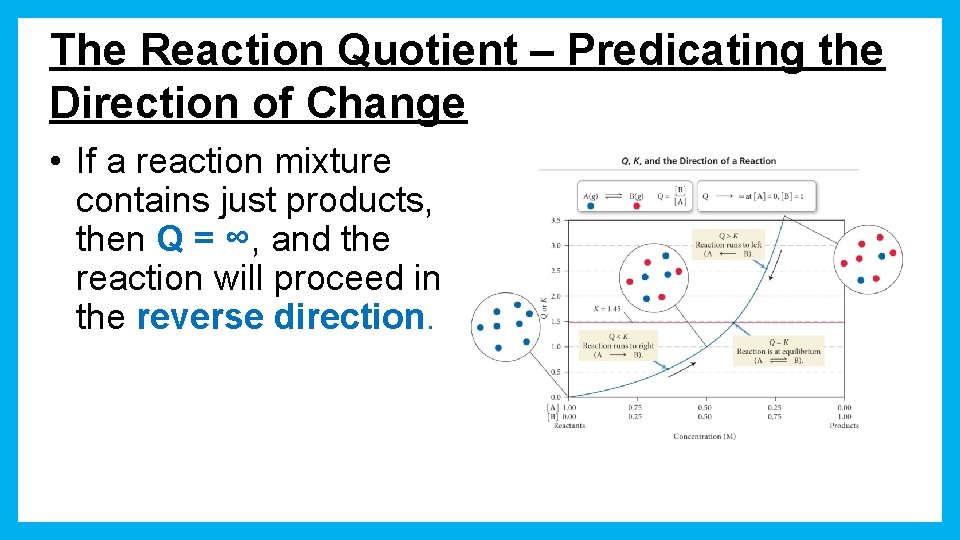
The Reaction Quotient – Predicating the Direction of Change • If a reaction mixture contains just products, then Q = ∞, and the reaction will proceed in the reverse direction.
Solving for Equilibrium Concentrations Consider this reaction at some temperature: H 2 O(g) + CO(g) H 2(g) + CO 2(g) K = 2. 0 Assume you start with 8 molecules of H 2 O and 6 molecules of CO. How many molecules of H 2 O, CO, H 2, and CO 2 are present at equilibrium? Here, we learn about “ICE” – one the most important problem solving technique in the year. You will use it a lot!
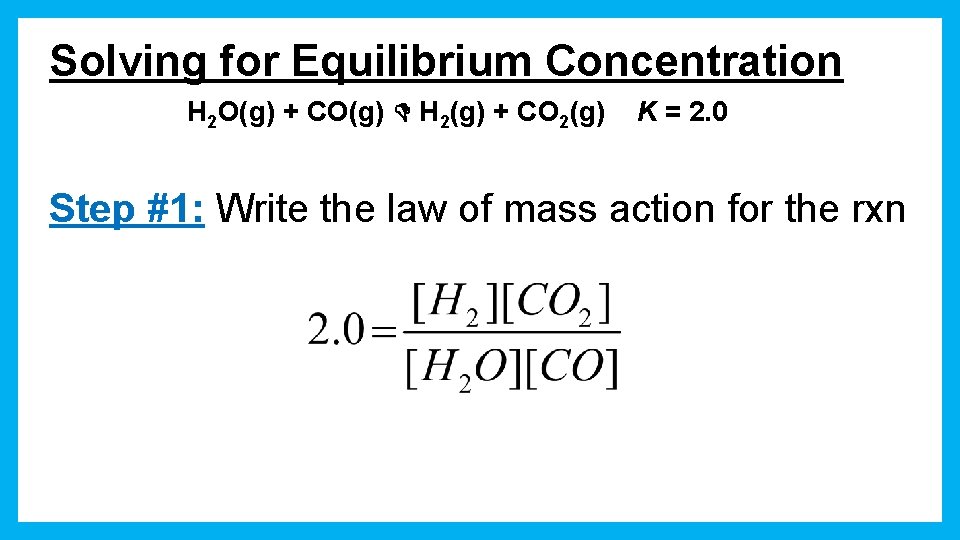
Solving for Equilibrium Concentration H 2 O(g) + CO(g) H 2(g) + CO 2(g) K = 2. 0 Step #1: Write the law of mass action for the rxn
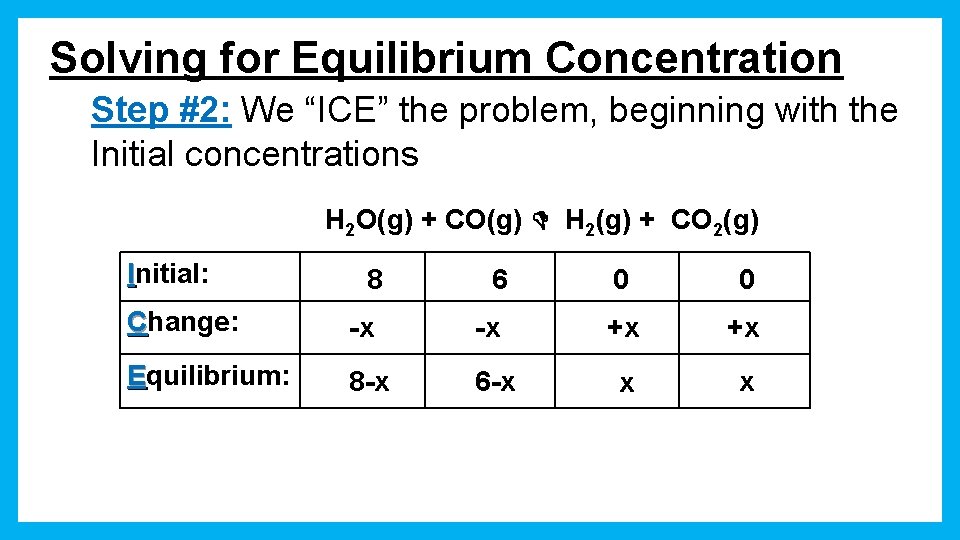
Solving for Equilibrium Concentration Step #2: We “ICE” the problem, beginning with the Initial concentrations H 2 O(g) + CO(g) H 2(g) + CO 2(g) Initial: 8 6 0 0 Change: -x -x +x +x Equilibrium: 8 -x 6 -x x x
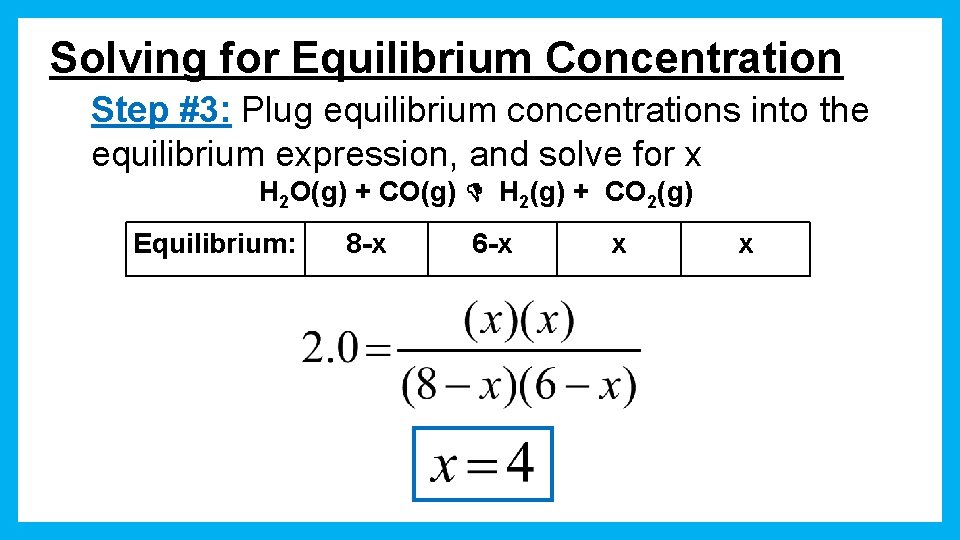
Solving for Equilibrium Concentration Step #3: Plug equilibrium concentrations into the equilibrium expression, and solve for x H 2 O(g) + CO(g) H 2(g) + CO 2(g) Equilibrium: 8 -x 6 -x x x
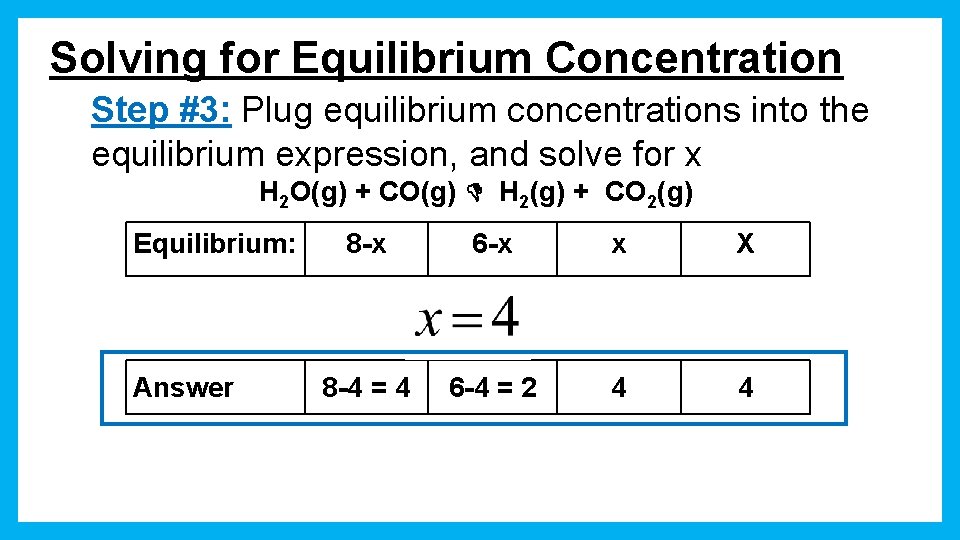
Solving for Equilibrium Concentration Step #3: Plug equilibrium concentrations into the equilibrium expression, and solve for x H 2 O(g) + CO(g) H 2(g) + CO 2(g) Equilibrium: Answer 8 -x 6 -x x X 8 -4 = 4 6 -4 = 2 4 4
Some of These Can Get Really Tricky… • Quadratic Equations • Perfect squares • Approximations – Remember the 5% rule from Honors Chemistry ? ? • Crazy substitutions and rearrangements But the concept is always the same! You HAVE to practice to see crazy examples!
- Slides: 15