
Equilibrium of the firm under Perfect Competition According
Equilibrium of the firm under: Perfect Competition According to Boulding “Perfectly competitive market is a situation where large number of buyers and sellers are engaged in the purchase and sale of identically similar commodities, who are in close contact with one another and who buy and sell freely among themselves. ”
Characteristics of Perfect competition 1. 2. 3. 4. 5. 6. 7. 8. Large Number of Buyers and Sellers Existence of Homogeneous Product Free Entry and Exit of Firms Buyers and Sellers have full Knowledge of market Mobility of Factors of Production Non-Existence of Transport Costs Non-existence of Government Restrictions Non-existence of Price Control
Equilibrium of the firm under perfect competition (Short run) The Equilibrium of the firm can be discussed in terms of : • Total cost and Total Revenue (TC/TR) • Marginal Cost and Marginal Revenue (MC/MR)
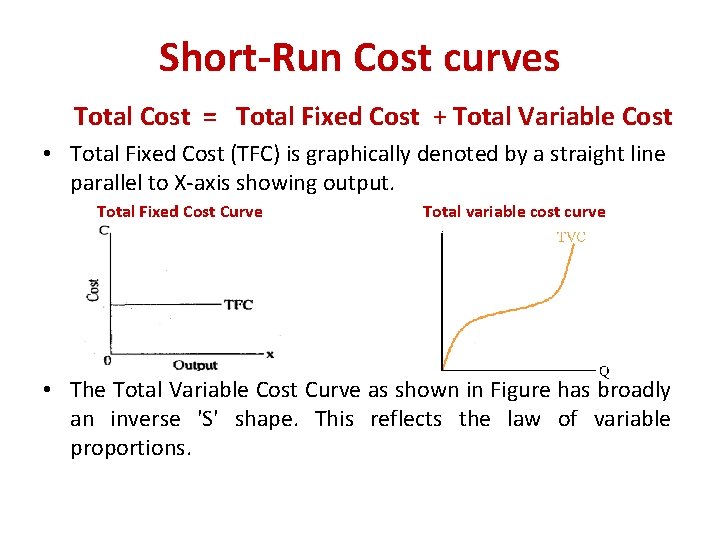
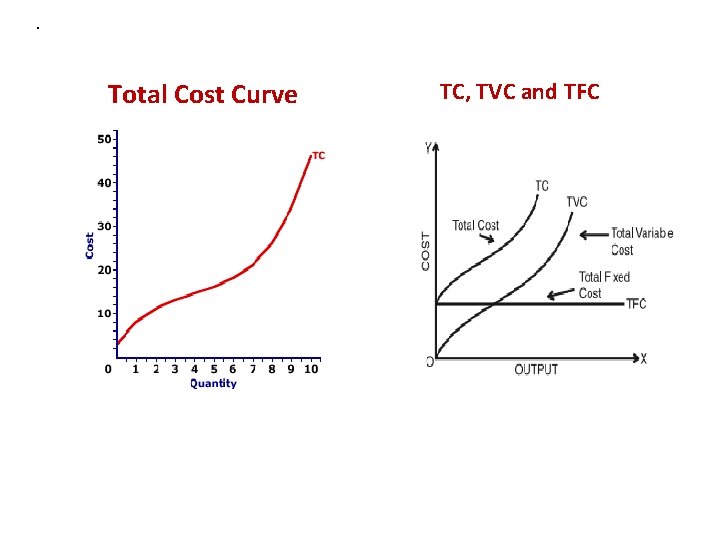
Short-Run Cost curves Total Cost = Total Fixed Cost + Total Variable Cost • Total Fixed Cost (TFC) is graphically denoted by a straight line parallel to X-axis showing output. Total Fixed Cost Curve Total variable cost curve • The Total Variable Cost Curve as shown in Figure has broadly an inverse 'S' shape. This reflects the law of variable proportions.
. Total Cost Curve TC, TVC and TFC
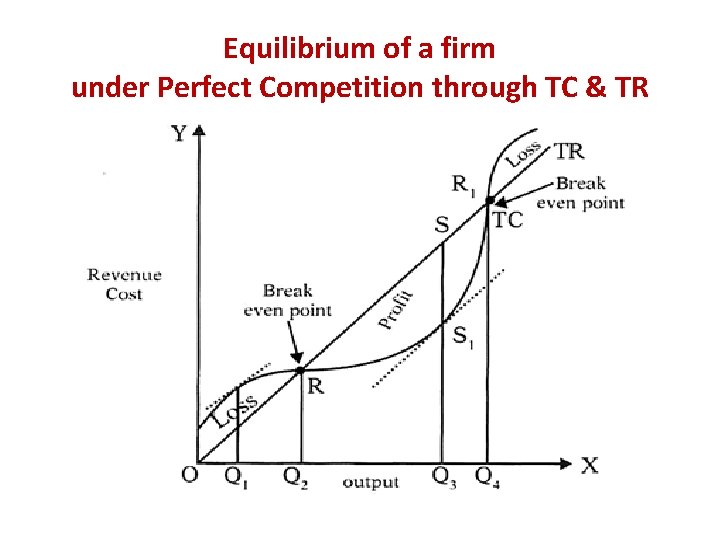
Equilibrium of a firm under Perfect Competition through TC & TR
Equilibrium of a firm under perfect competition through MC & MR • To maximize profits, a firm should produce and sell up to the point at which the MR=MC • Beyond the point of equality of marginal cost and marginal revenue the firm will experience losses • Thus, the main condition of firm's equilibrium is that the firm should stop at the point of equality of marginal cost and marginal revenue.
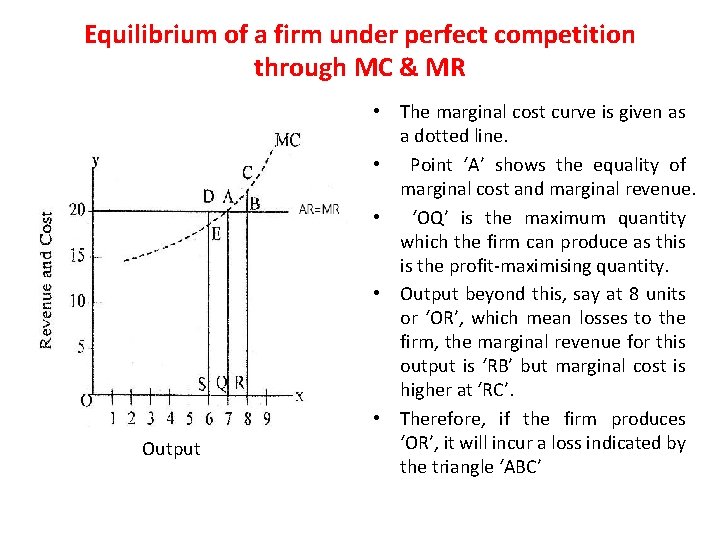
Equilibrium of a firm under perfect competition through MC & MR Output • The marginal cost curve is given as a dotted line. • Point ‘A’ shows the equality of marginal cost and marginal revenue. • ‘OQ’ is the maximum quantity which the firm can produce as this is the profit-maximising quantity. • Output beyond this, say at 8 units or ‘OR’, which mean losses to the firm, the marginal revenue for this output is ‘RB’ but marginal cost is higher at ‘RC’. • Therefore, if the firm produces ‘OR’, it will incur a loss indicated by the triangle ‘ABC’
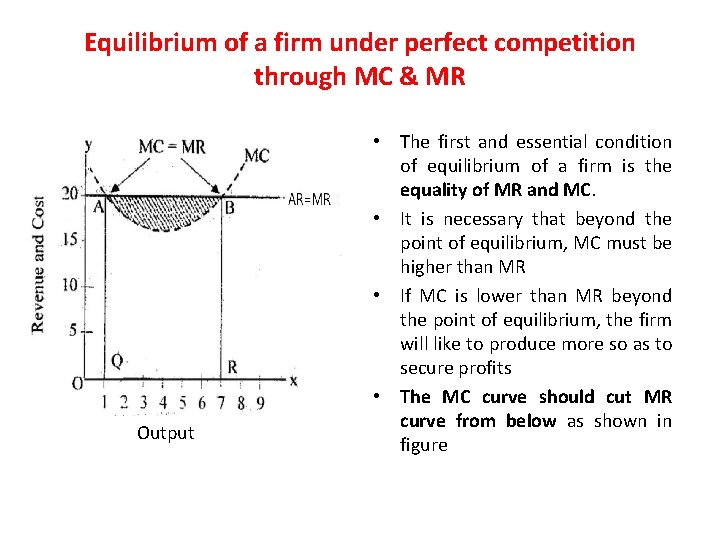
Equilibrium of a firm under perfect competition through MC & MR Output • The first and essential condition of equilibrium of a firm is the equality of MR and MC. • It is necessary that beyond the point of equilibrium, MC must be higher than MR • If MC is lower than MR beyond the point of equilibrium, the firm will like to produce more so as to secure profits • The MC curve should cut MR curve from below as shown in figure
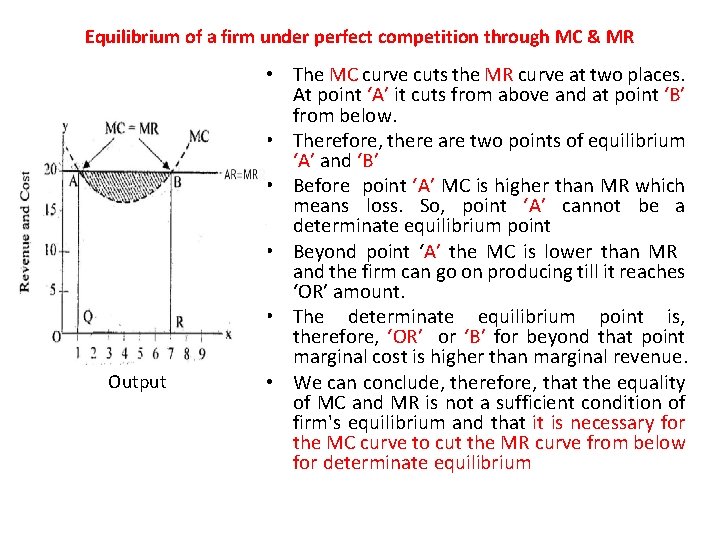
Equilibrium of a firm under perfect competition through MC & MR Output • The MC curve cuts the MR curve at two places. At point ‘A’ it cuts from above and at point ‘B’ from below. • Therefore, there are two points of equilibrium ‘A’ and ‘B’ • Before point ‘A’ MC is higher than MR which means loss. So, point ‘A’ cannot be a determinate equilibrium point • Beyond point ‘A’ the MC is lower than MR and the firm can go on producing till it reaches ‘OR’ amount. • The determinate equilibrium point is, therefore, ‘OR’ or ‘B’ for beyond that point marginal cost is higher than marginal revenue. • We can conclude, therefore, that the equality of MC and MR is not a sufficient condition of firm's equilibrium and that it is necessary for the MC curve to cut the MR curve from below for determinate equilibrium
Different Cost Conditions: Equilibrium of the Firm under perfect competition in short run • The short run equilibrium of firms when they are working under different cost conditions • Difference in the quality of raw materials used by the various firms, • Differences in production techniques, • Differences in efficiency of managers employed by them, • Differences in the size of plants built by them and • Differences in the ability of the entrepreneurs themselves account for the differences in costs of the various firms
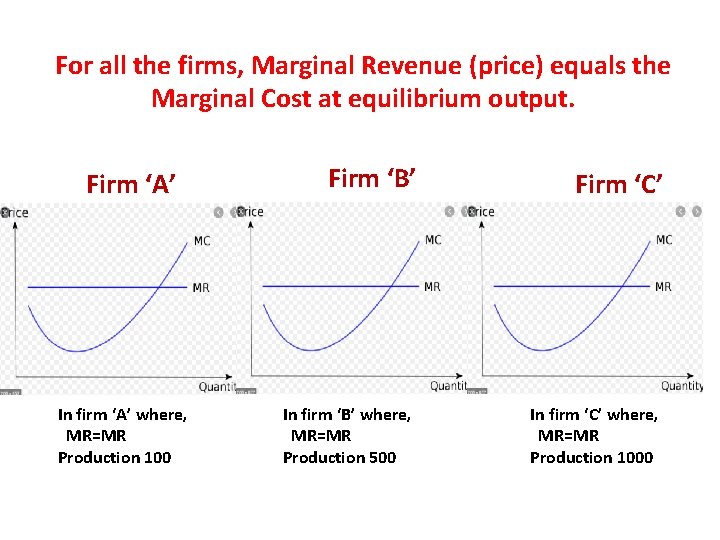
For all the firms, Marginal Revenue (price) equals the Marginal Cost at equilibrium output. Firm ‘A’ In firm ‘A’ where, MR=MR Production 100 Firm ‘B’ Firm ‘C’ In firm ‘B’ where, MR=MR Production 500 In firm ‘C’ where, MR=MR Production 1000
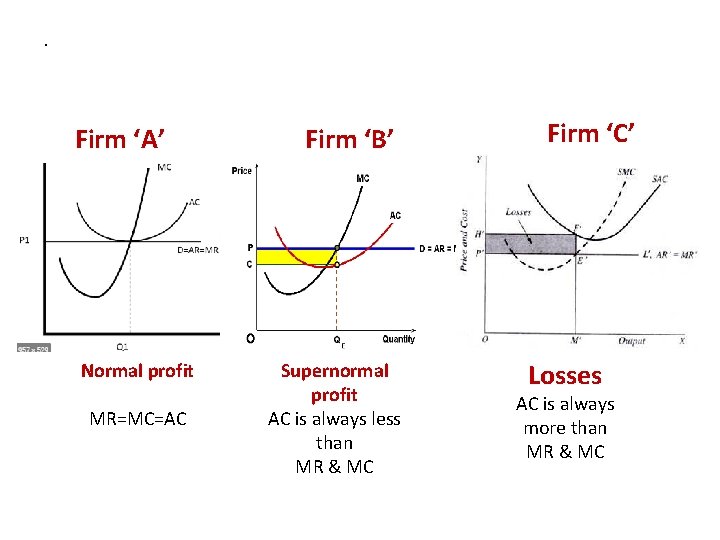
. Firm ‘A’ Normal profit MR=MC=AC Firm ‘B’ Supernormal profit AC is always less than MR & MC Firm ‘C’ Losses AC is always more than MR & MC
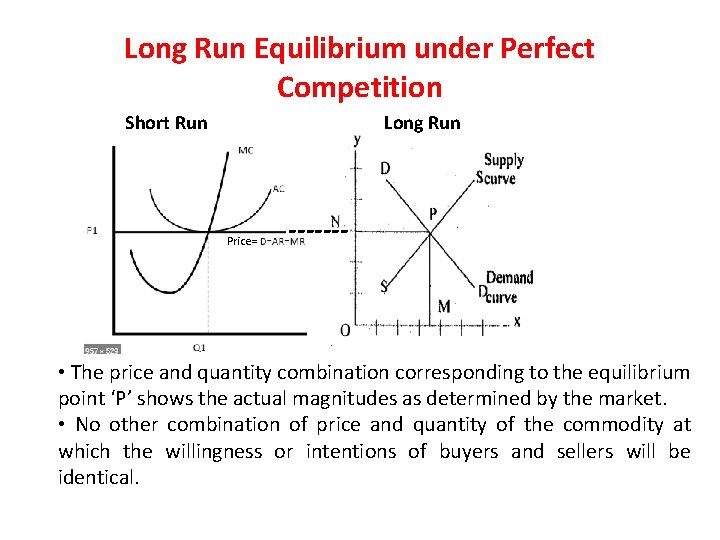
Long Run Equilibrium under Perfect Competition Short Run Long Run Price= ------- • The price and quantity combination corresponding to the equilibrium point ‘P’ shows the actual magnitudes as determined by the market. • No other combination of price and quantity of the commodity at which the willingness or intentions of buyers and sellers will be identical.
- Slides: 14