
Equilibrium K Equilibrium Constant Capitalized Equilibrium Constant Even
Equilibrium K – Equilibrium Constant (Capitalized!)
Equilibrium Constant Even though the concentrations of reactants and products are not equal at equilibrium, there is a relationship between them. Law of Mass Action or also Equilibrium Expression – The relationship between the chemical equation and the concentrations of reactants and products is called the
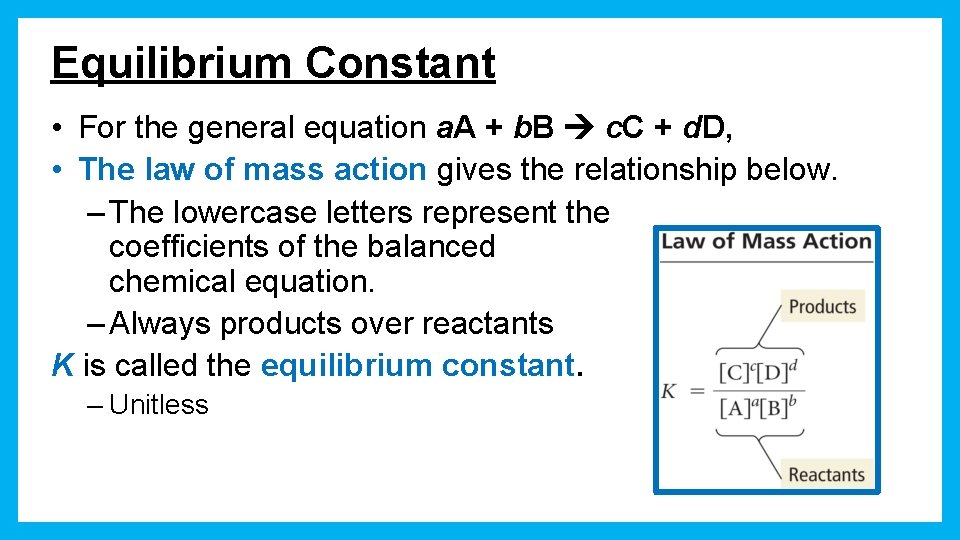
Equilibrium Constant • For the general equation a. A + b. B c. C + d. D, • The law of mass action gives the relationship below. – The lowercase letters represent the coefficients of the balanced chemical equation. – Always products over reactants K is called the equilibrium constant. – Unitless
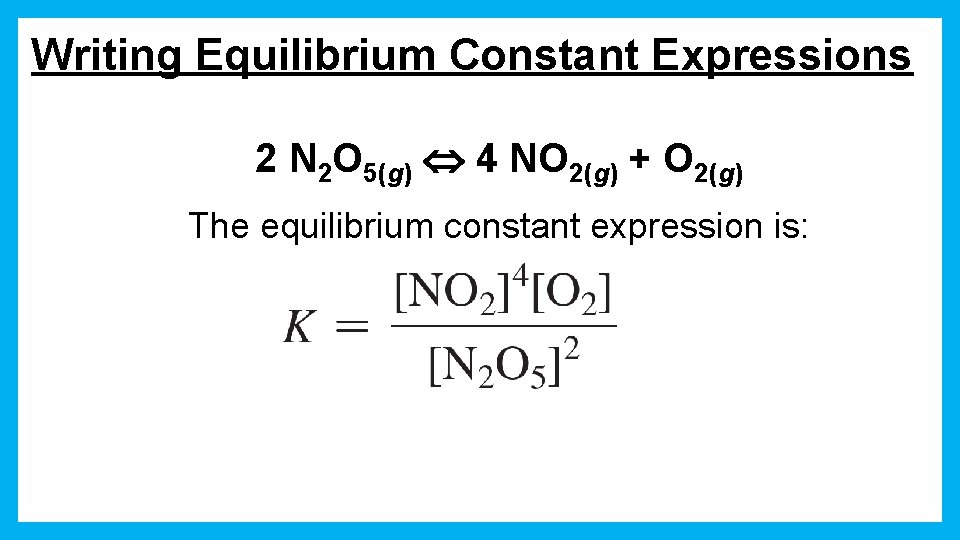
Writing Equilibrium Constant Expressions 2 N 2 O 5(g) 4 NO 2(g) + O 2(g) The equilibrium constant expression is:
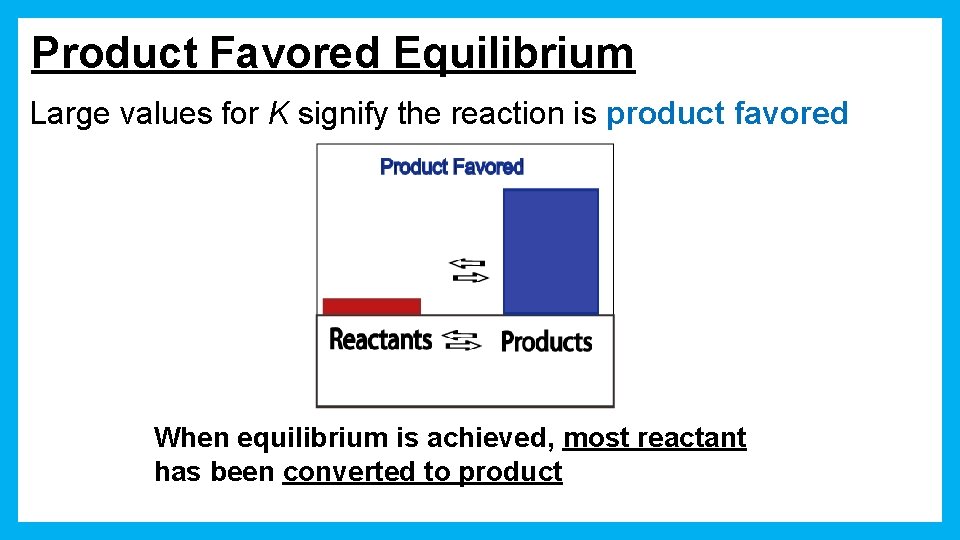
Product Favored Equilibrium Large values for K signify the reaction is product favored When equilibrium is achieved, most reactant has been converted to product
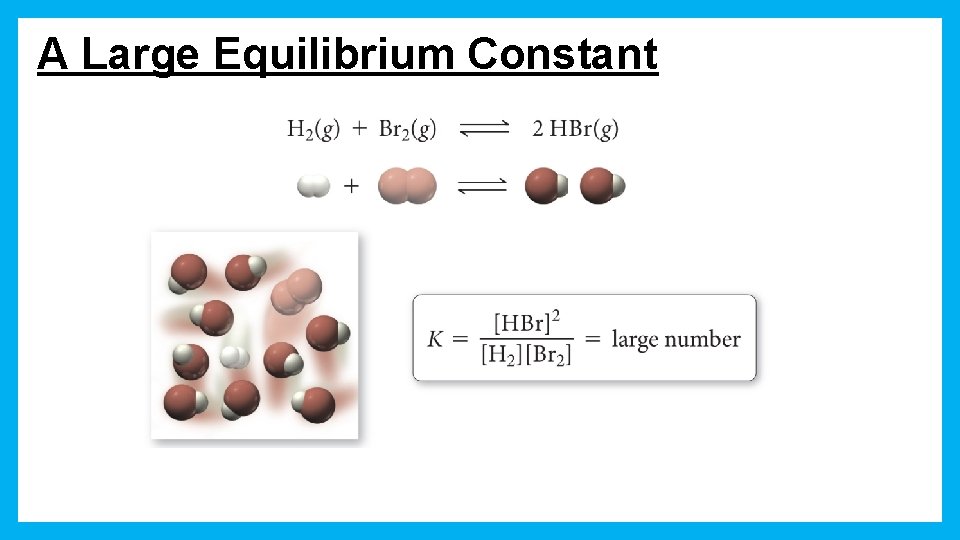
A Large Equilibrium Constant
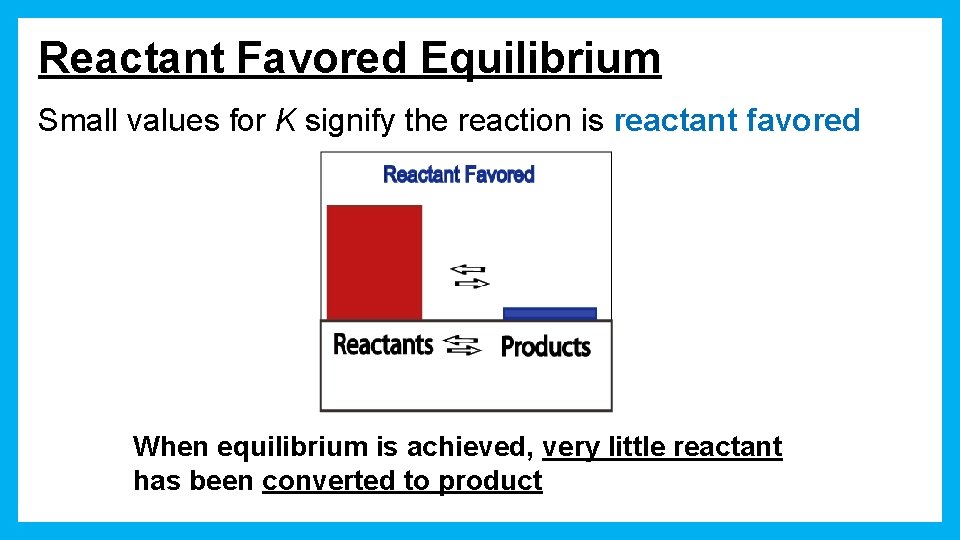
Reactant Favored Equilibrium Small values for K signify the reaction is reactant favored When equilibrium is achieved, very little reactant has been converted to product
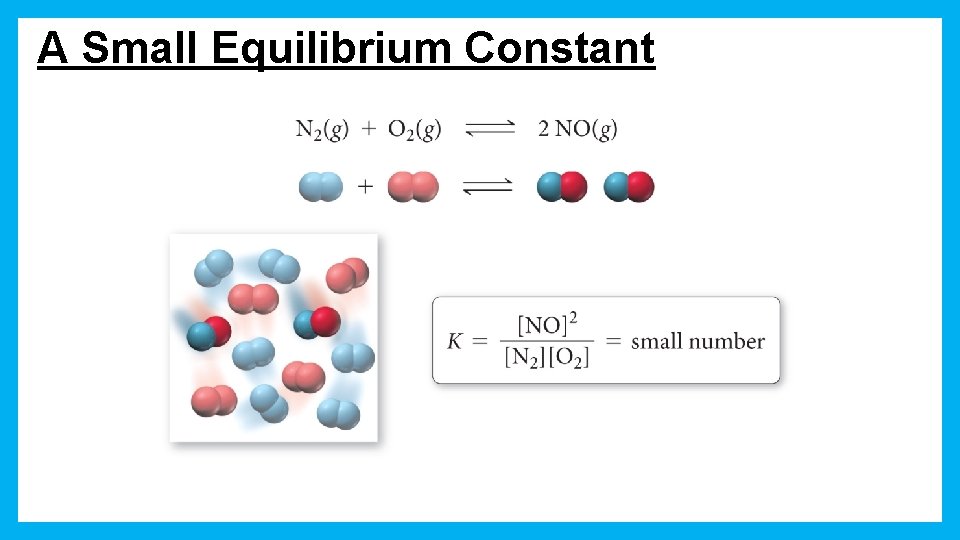
A Small Equilibrium Constant
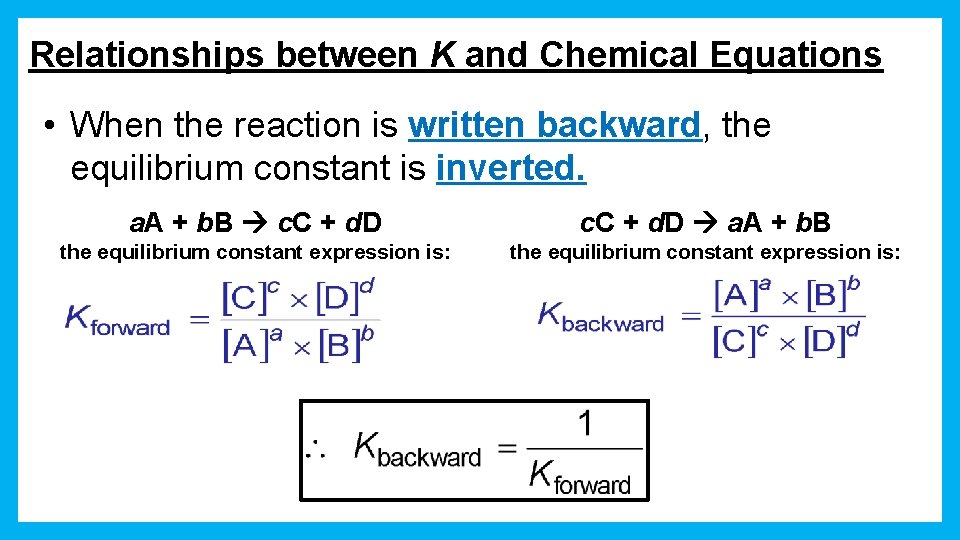
Relationships between K and Chemical Equations • When the reaction is written backward, the equilibrium constant is inverted. a. A + b. B c. C + d. D a. A + b. B the equilibrium constant expression is:
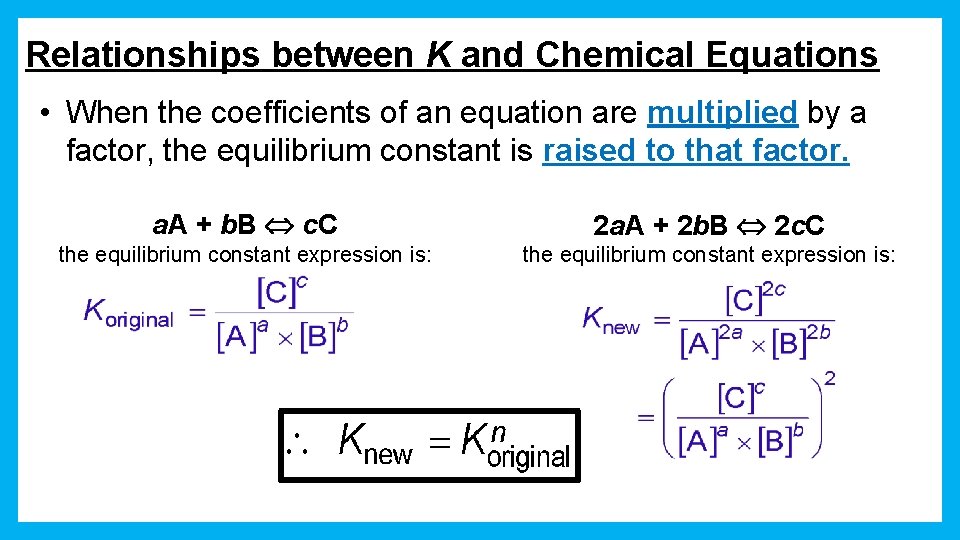
Relationships between K and Chemical Equations • When the coefficients of an equation are multiplied by a factor, the equilibrium constant is raised to that factor. a. A + b. B c. C 2 a. A + 2 b. B 2 c. C the equilibrium constant expression is:
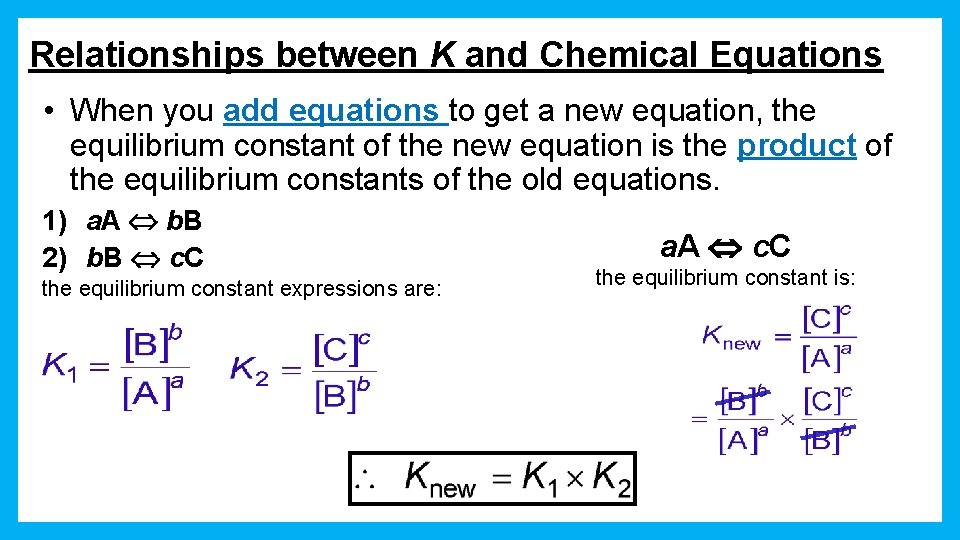
Relationships between K and Chemical Equations • When you add equations to get a new equation, the equilibrium constant of the new equation is the product of the equilibrium constants of the old equations. 1) a. A b. B 2) b. B c. C the equilibrium constant expressions are: a. A c. C the equilibrium constant is:
![Equilibrium Constants for Rxns Involving Gases • The [ ]s of a gas in](http://slidetodoc.com/presentation_image_h2/58df25739833edc91486048f0ab9ff80/image-12.jpg "Equilibrium Constants for Rxns Involving Gases • The [ ]s of a gas in")
Equilibrium Constants for Rxns Involving Gases • The [ ]s of a gas in a mixture is proportional to its partial pressure. • Therefore, K can be expressed as the ratio of the partial pressures of the gases. a. A(g) + b. B(g) c. C(g) + d. D(g) the equilibrium constant expressions are: or
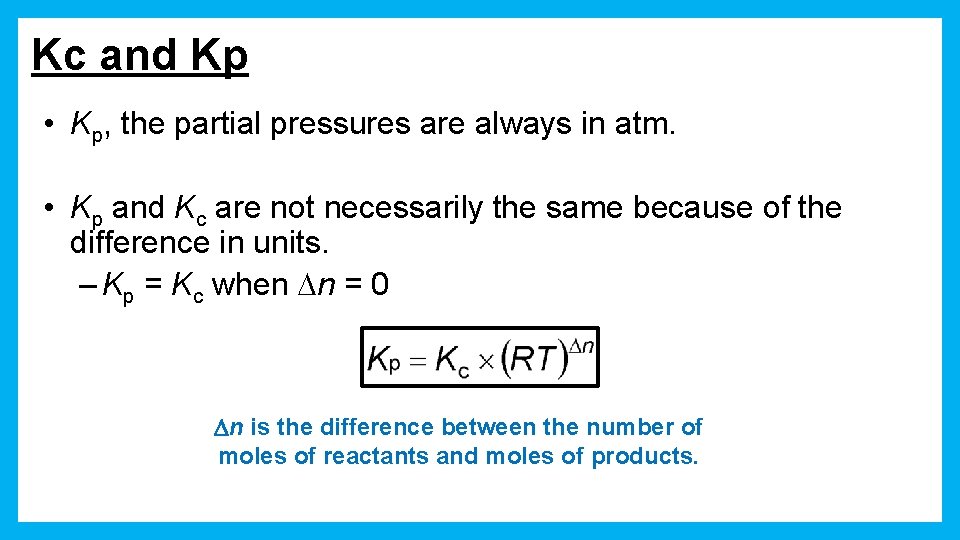
Kc and Kp • Kp, the partial pressures are always in atm. • Kp and Kc are not necessarily the same because of the difference in units. – Kp = Kc when Dn = 0 Dn is the difference between the number of moles of reactants and moles of products.
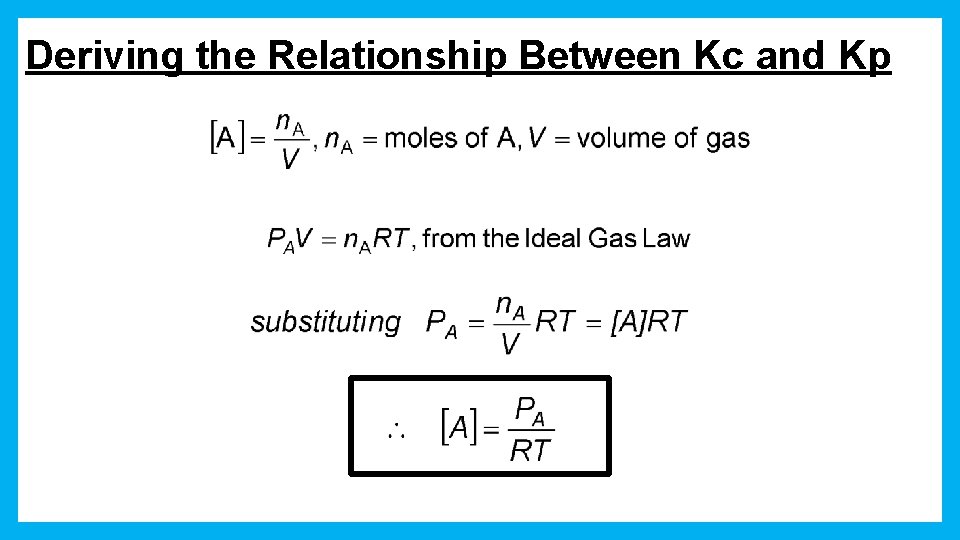
Deriving the Relationship Between Kc and Kp
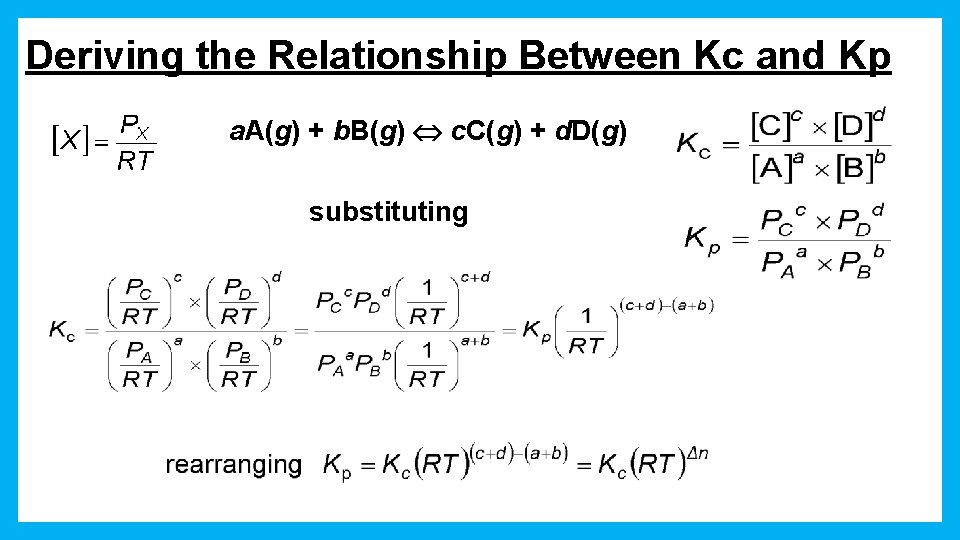
Deriving the Relationship Between Kc and Kp a. A(g) + b. B(g) c. C(g) + d. D(g) substituting
![Heterogeneous Equilibria • [ ]s of pure solids and pure liquids do not change](http://slidetodoc.com/presentation_image_h2/58df25739833edc91486048f0ab9ff80/image-16.jpg "Heterogeneous Equilibria • [ ]s of pure solids and pure liquids do not change")
Heterogeneous Equilibria • [ ]s of pure solids and pure liquids do not change during the course of a reaction. • Because their [ ]s don’t change, solids and liquids are not included in the equilibrium constant expression is as follows:
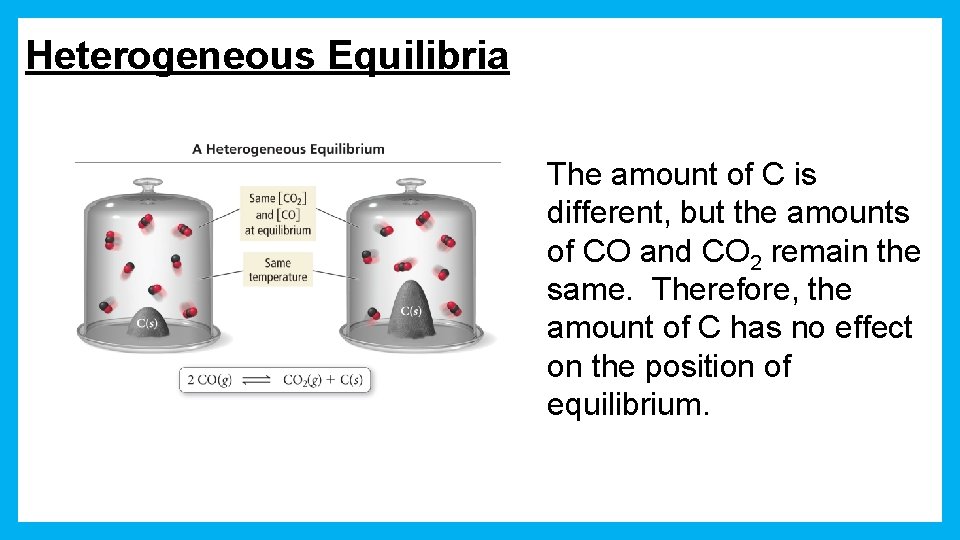
Heterogeneous Equilibria The amount of C is different, but the amounts of CO and CO 2 remain the same. Therefore, the amount of C has no effect on the position of equilibrium.
- Slides: 17