
Equilibrium in Perfect Competition Lecture 6 The perfectly

Equilibrium in Perfect Competition Lecture 6
The perfectly competitive markets �All sellers in a market will be perfectly competitive if: � 1. a large amount of buyers and sellers, each is small relative to the industry supply, takes the price of its output as given and unaffected by the amount it sells (a price taker) � 2. perfect knowledge, buyers and sellers are well informed about price, no production secrets � 3. the product is homogeneous (identical), � 4. firms can leave and enter the industry freely
Perfectly competitive market as an extreme case �Markets which satisfy all the conditions for perfect competition: markets for agricultural products, for most stocks and bonds traded on WSE �Perfectly competitive markets – an ideal to which other types of markets can be compared �Good tool to learn about the various forms of imperfect competition
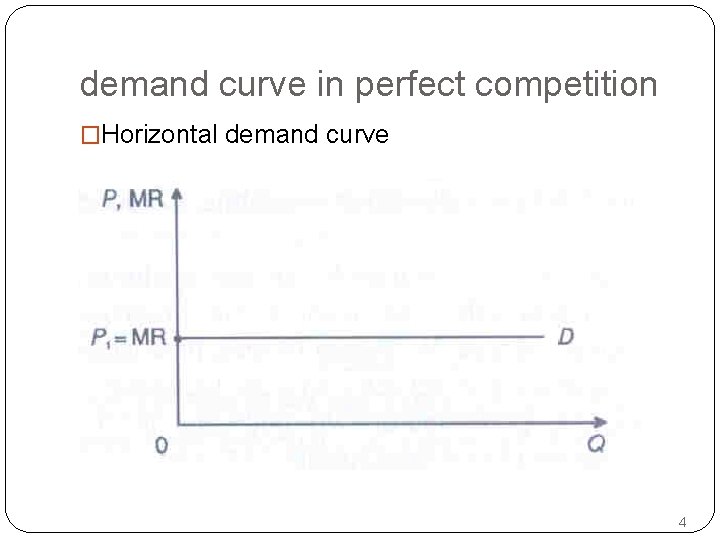
demand curve in perfect competition �Horizontal demand curve 4
The firm’s short run supply decision �The level of output that maximizes profit: marginal condition MC=MR=P; �P=MC, a firm should compare price and average variable cost; if P ≥ AVC decision to produce, if P<AVC decision to shut down �Fixed costs do not affect MC or AVC in the short run �General principle: sunk costs are sunk
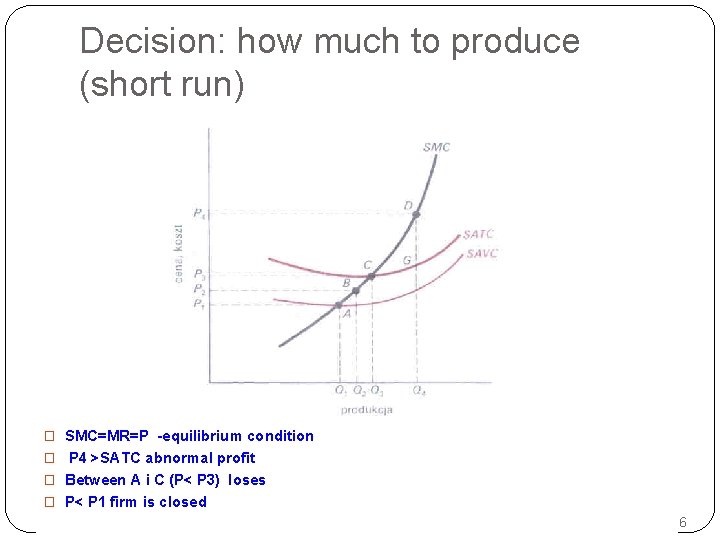
Decision: how much to produce (short run) � SMC=MR=P -equilibrium condition � P 4 >SATC abnormal profit � Between A i C (P< P 3) loses � P< P 1 firm is closed 6
The firm’s short run supply curve �The portion of the marginal cost curve above the AVC curve �Short run price below minimum AVC shutdown price �If the market price below shutdown price supply=0 �Break-even price = minimum ATC: long run equilibrium: no economic (abnormal) profit, firms realize normal profit only, no incentives to enter or to leave the industry �But any change of the supply or the demand at the industry level will change the price and shift the firm equilibrium point
The market’s short-run supply curve �The sum of output supplied to the market at each price �The short run – all the output must come from firms that are already in operation �Shifts of short run supply curves: change in costs of production shifts market supply curves � changes in the prices of fixed inputs no effect on supply �Change in the price of a variable factor shifts firm’s and market’s supply curve �Changes in the amounts of fixed inputs and new technology shift the short run supply curve as well
Dairy price supports �The government fixes a support price (minimum price) to protect dairy farmers’ incomes �Support price> the equilibrium price �The quantity supplied at the support price> quantity demanded �Government guarantees to buy the excess �An effect: the government dairy mountain: growing value of dairy products owned by the government. Long run - strong productivity growth - the supply curve shifts rapidly to the right; the demand curve shifts very slow to the right (price elasticity of the demand)
Long run supply curves �First step, decision to operate, optimal output level: P=LMC �Second step, P≥LAC �P<LAC decision to leave the industry �The long run supply curve of a firm: the portion of its LMC curve above minimum LAC �Long run break-even price -minimum LAC �At any price> break-even price firm receives abnormal (economic) profit
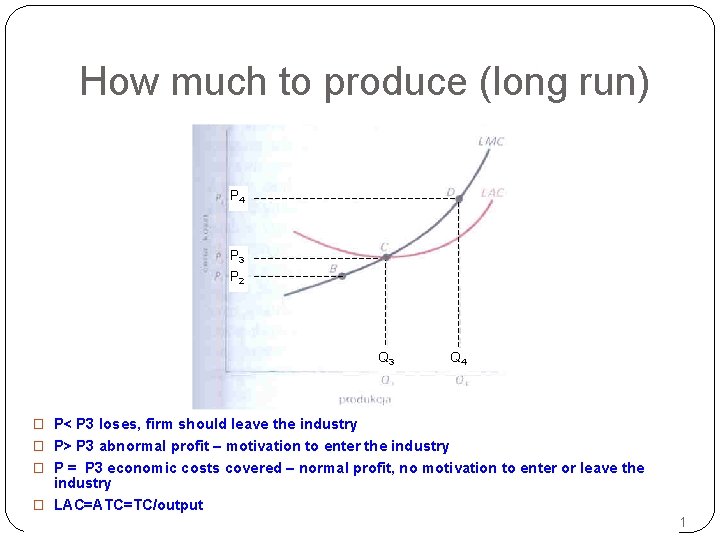
How much to produce (long run) P 4 P 3 P 2 Q 3 Q 4 � P< P 3 loses, firm should leave the industry � P> P 3 abnormal profit – motivation to enter the industry � P = P 3 economic costs covered – normal profit, no motivation to enter or leave the industry � LAC=ATC=TC/output 11
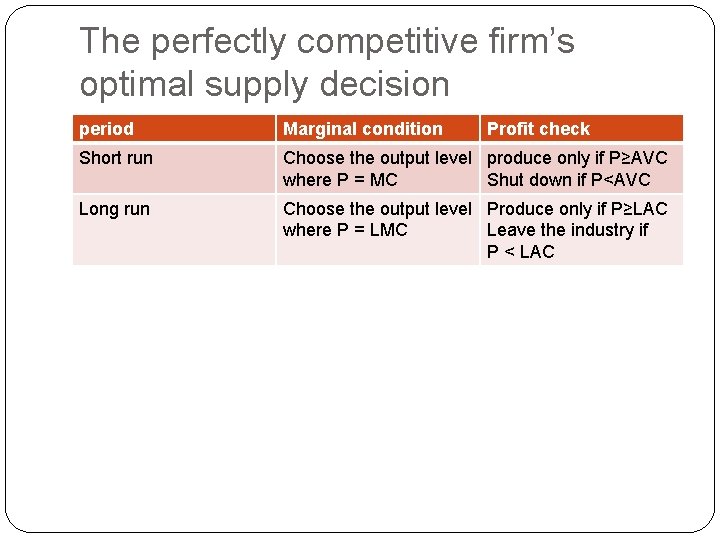
The perfectly competitive firm’s optimal supply decision period Marginal condition Profit check Short run Choose the output level produce only if P≥AVC where P = MC Shut down if P<AVC Long run Choose the output level Produce only if P≥LAC where P = LMC Leave the industry if P < LAC
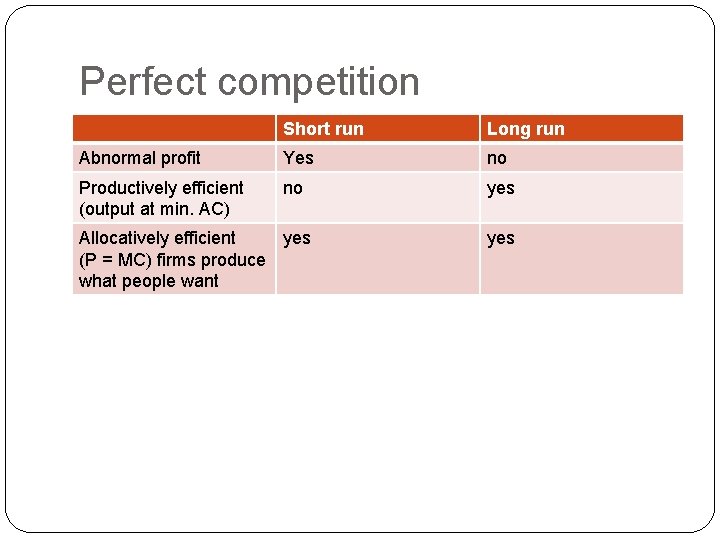
Perfect competition Short run Long run Abnormal profit Yes no Productively efficient (output at min. AC) no yes Allocatively efficient yes (P = MC) firms produce what people want yes
The industry long run supply curvemore details � The long run industry supply curve LS is flatter (more elastic) than the short run supply curve � 2 reasons: 1. long-run supply curve for each firm in industry; 2. number of firms in the industry rises when price increases � Horizontal or completely flat long run industry supply curve: all firms have identical cost conditions. At higher levels of total output more firms in the market but the long run output per firm does not change � In practice long run supply curve may slope upward because: 1. important differences in costs among actual and potential sellers – many break-even price levels; 2. the prices of the inputs may rise as total production increases. Some industries are important buyers of particular specialized inputs
Shifts of long run supply curves �Two sorts of changes shift LR supply curves: � 1. changes in the price of any input, an example: the interest rate goes up, LR supply curves shifts upward � 2. changes in technology, � new technology in use - supply curve shifts downward
The law of diminishing returns: false or true � 1. total output will diminish because additional labor units will be of lower quality than those employed before � 2. increase of output is slower because of relative lack of capital � 3. cost of 1 unit of output will grow because the diminishing labor quantity makes wages to grow � 4. further increase of output requires smaller input of labor � 5. marginal revenue of each next output unit will go down
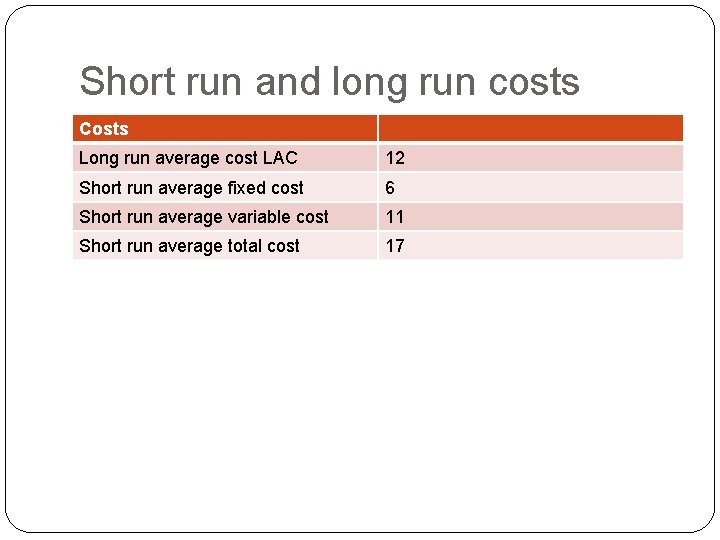
Short run and long run costs Costs Long run average cost LAC 12 Short run average fixed cost 6 Short run average variable cost 11 Short run average total cost 17
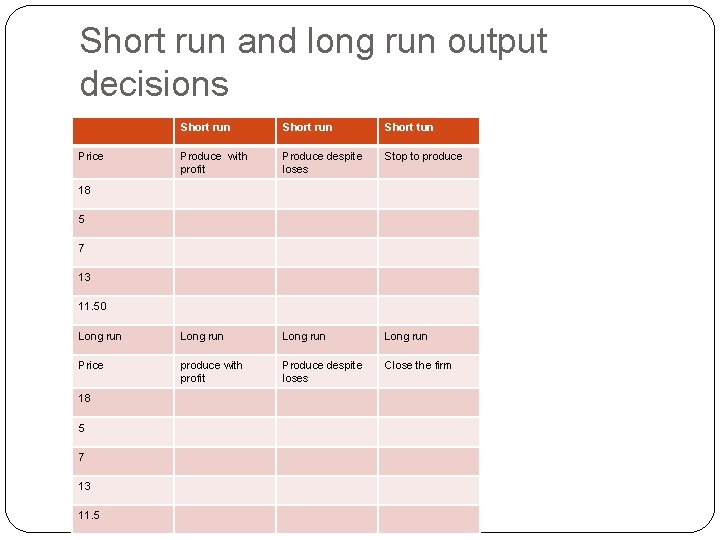
Short run and long run output decisions Short run Short tun Produce with profit Produce despite loses Stop to produce Long run Price produce with profit Produce despite loses Close the firm Price 18 5 7 13 11. 50 18 5 7 13 11. 5
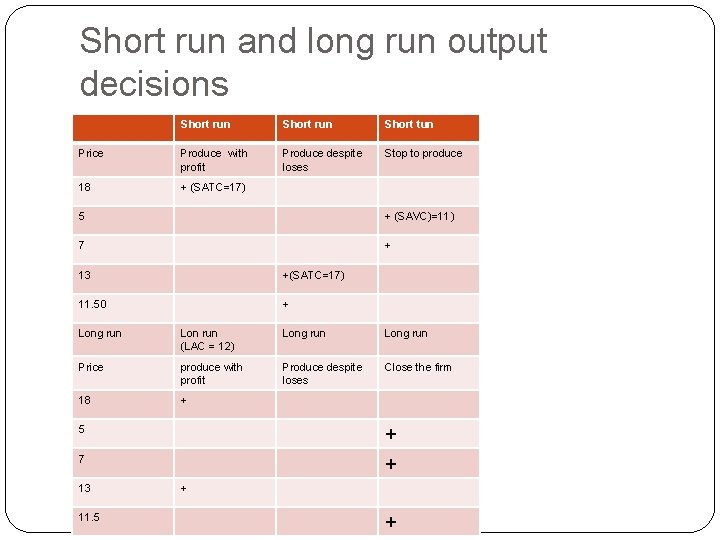
Short run and long run output decisions Short run Short tun Price Produce with profit Produce despite loses Stop to produce 18 + (SATC=17) 5 + (SAVC)=11) 7 + 13 +(SATC=17) 11. 50 + Long run Lon run (LAC = 12) Long run Price produce with profit Produce despite loses Close the firm 18 + 5 + 7 + 13 11. 5 + +
- Slides: 19