
Equilibrium Expression Keq l l Also called Mass
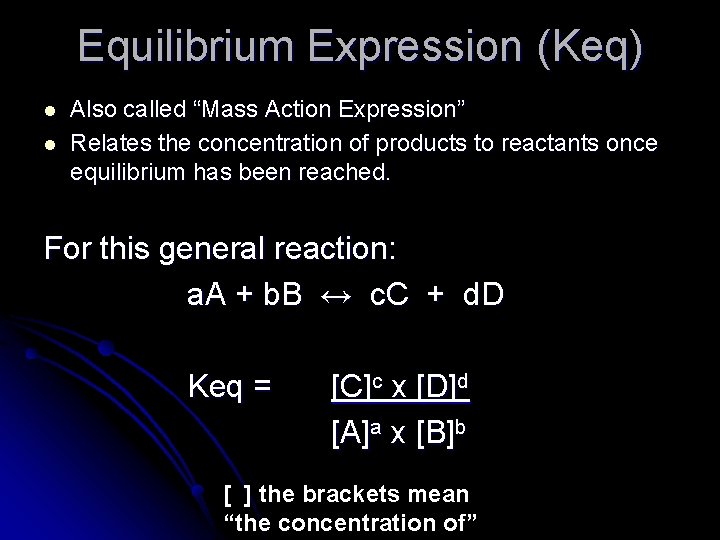
Equilibrium Expression (Keq) l l Also called “Mass Action Expression” Relates the concentration of products to reactants once equilibrium has been reached. For this general reaction: a. A + b. B ↔ c. C + d. D Keq = [C]c x [D]d [A]a x [B]b [ ] the brackets mean “the concentration of”
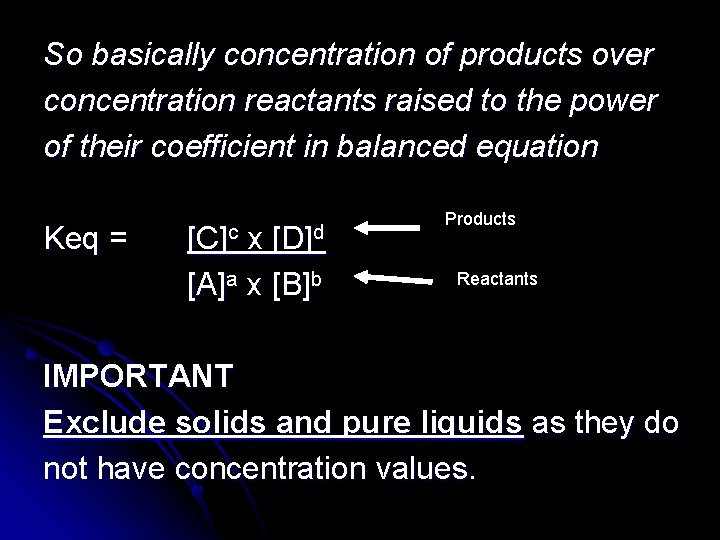
So basically concentration of products over concentration reactants raised to the power of their coefficient in balanced equation Keq = [C]c [D]d x [A]a x [B]b Products Reactants IMPORTANT Exclude solids and pure liquids as they do not have concentration values.
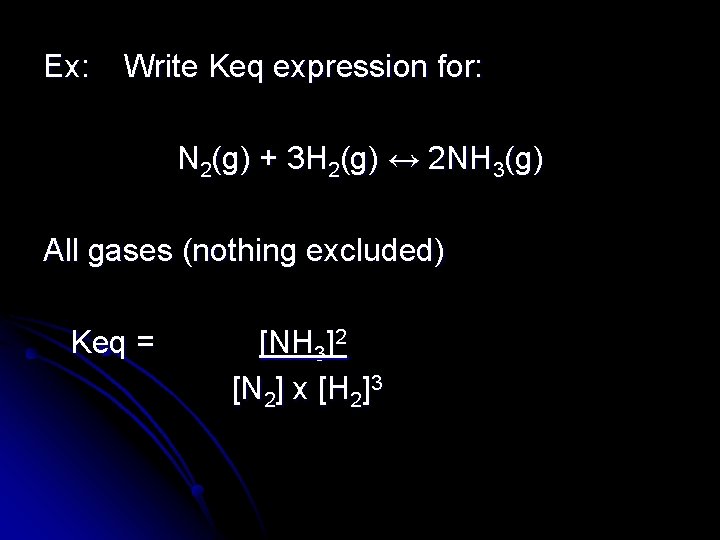
Ex: Write Keq expression for: N 2(g) + 3 H 2(g) ↔ 2 NH 3(g) All gases (nothing excluded) Keq = [NH 3]2 [N 2] x [H 2]3
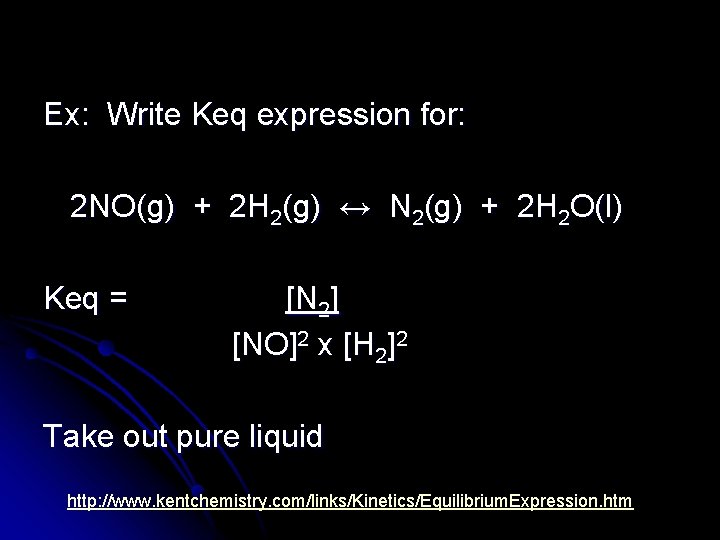
Ex: Write Keq expression for: 2 NO(g) + 2 H 2(g) ↔ N 2(g) + 2 H 2 O(l) Keq = [ N 2] [NO]2 x [H 2]2 Take out pure liquid http: //www. kentchemistry. com/links/Kinetics/Equilibrium. Expression. htm
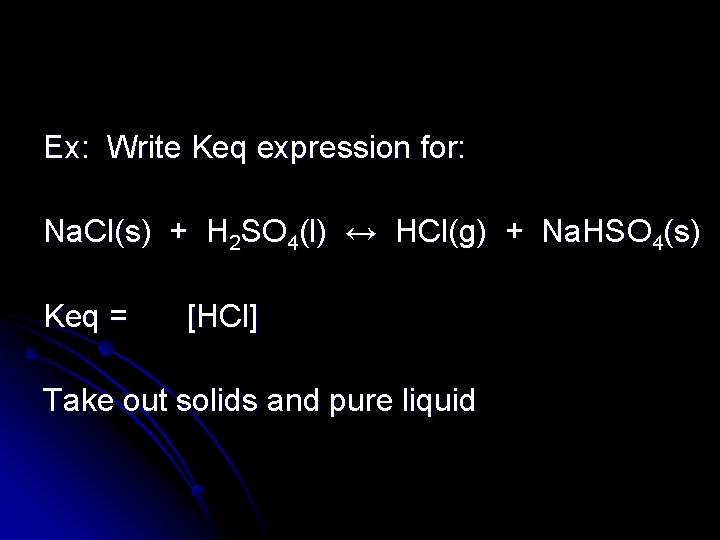
Ex: Write Keq expression for: Na. Cl(s) + H 2 SO 4(l) ↔ HCl(g) + Na. HSO 4(s) Keq = [HCl] Take out solids and pure liquid
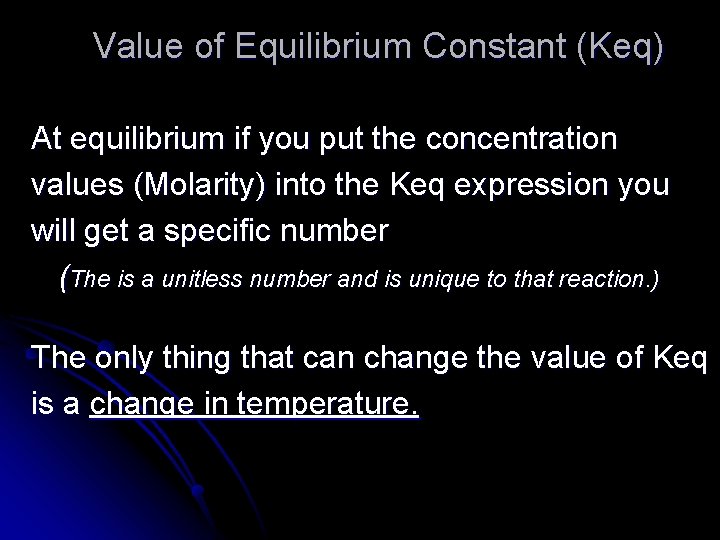
Value of Equilibrium Constant (Keq) At equilibrium if you put the concentration values (Molarity) into the Keq expression you will get a specific number (The is a unitless number and is unique to that reaction. ) The only thing that can change the value of Keq is a change in temperature.
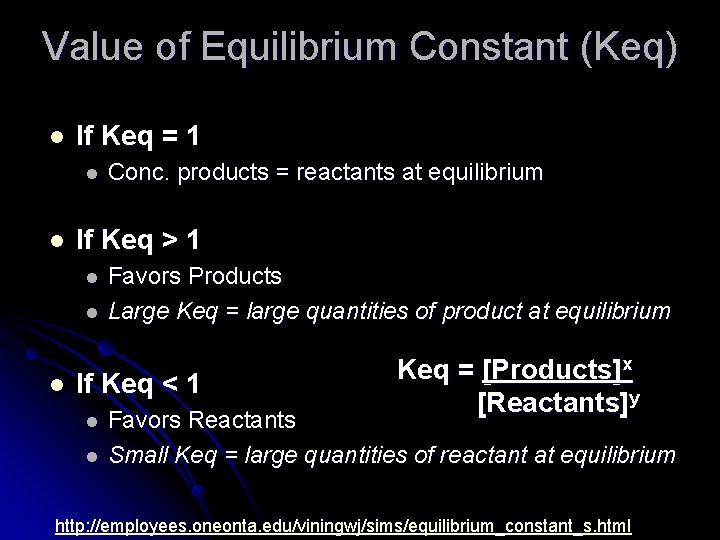
Value of Equilibrium Constant (Keq) l If Keq = 1 l l If Keq > 1 l l l Conc. products = reactants at equilibrium Favors Products Large Keq = large quantities of product at equilibrium If Keq < 1 l l Keq = [Products]x [Reactants]y Favors Reactants Small Keq = large quantities of reactant at equilibrium http: //employees. oneonta. edu/viningwj/sims/equilibrium_constant_s. html
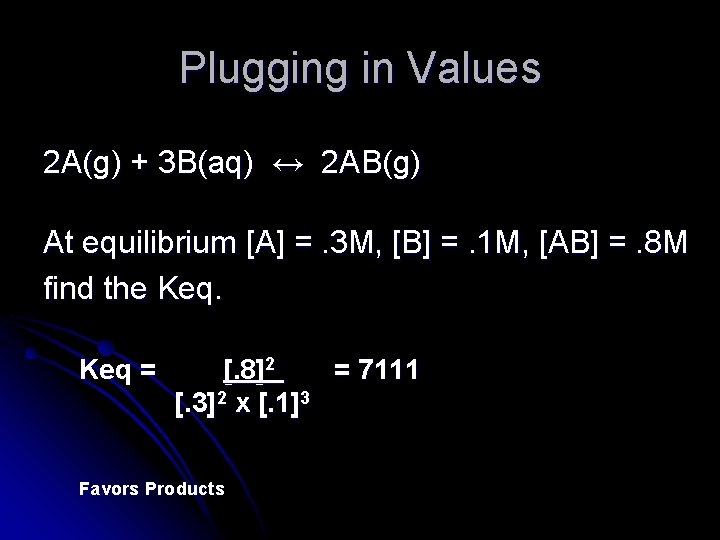
Plugging in Values 2 A(g) + 3 B(aq) ↔ 2 AB(g) At equilibrium [A] =. 3 M, [B] =. 1 M, [AB] =. 8 M find the Keq = [. 8]2 = 7111 [. 3]2 x [. 1]3 Favors Products
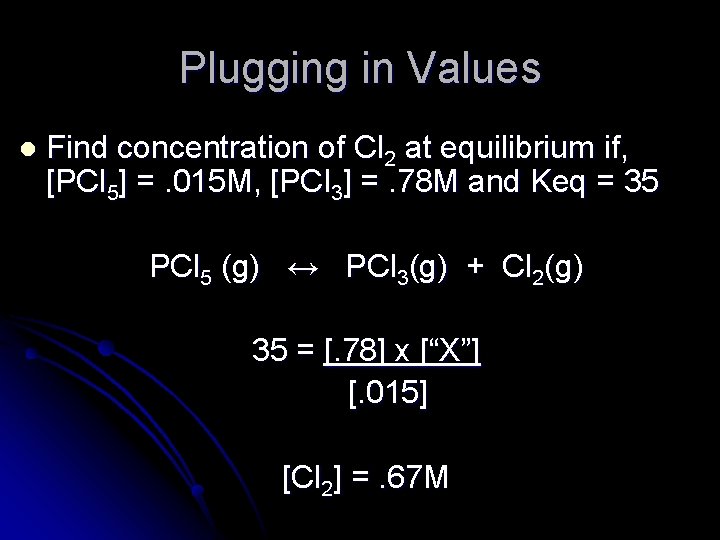
Plugging in Values l Find concentration of Cl 2 at equilibrium if, [PCl 5] =. 015 M, [PCl 3] =. 78 M and Keq = 35 PCl 5 (g) ↔ PCl 3(g) + Cl 2(g) 35 = [. 78] x [“X”] [. 015] [Cl 2] =. 67 M
Note: l The Keq value for the “reverse” reaction will be the inverse of the “forward” reaction l Products become reactants
Keq interactive l http: //glencoe. com/sites/common_assets/a dvanced_placement/chemistry_chang 10 e/ animations/kim 2 s 2_5. swf l
ICE Problems (Honors) l Keq problems where you are given INITIAL concentrations. l Use stoich ratios to find the CHANGE in concentration l Subtract this from initial concentration find the EQUILIBRIUM concentration that can then go into Keq expression http: //www. youtube. com/watch? v=rog 8 ou-Zep. E&safe=active Crash Course: Equilibrium Equations (mostly Honors) http: //www. youtube. com/watch? v=DP-v. WN 1 y. Xr. Y&safe=active
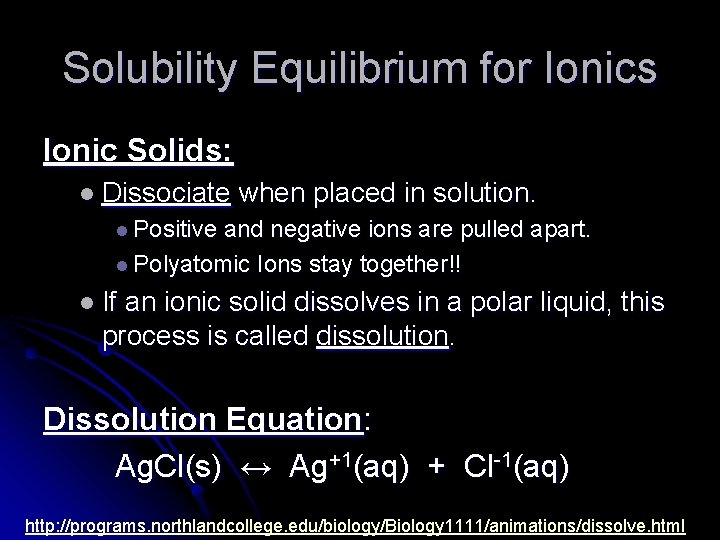
Solubility Equilibrium for Ionics Ionic Solids: l Dissociate when placed in solution. l Positive and negative ions are pulled apart. l Polyatomic Ions stay together!! l If an ionic solid dissolves in a polar liquid, this process is called dissolution. Dissolution Equation: Ag. Cl(s) ↔ Ag+1(aq) + Cl-1(aq) http: //programs. northlandcollege. edu/biology/Biology 1111/animations/dissolve. html
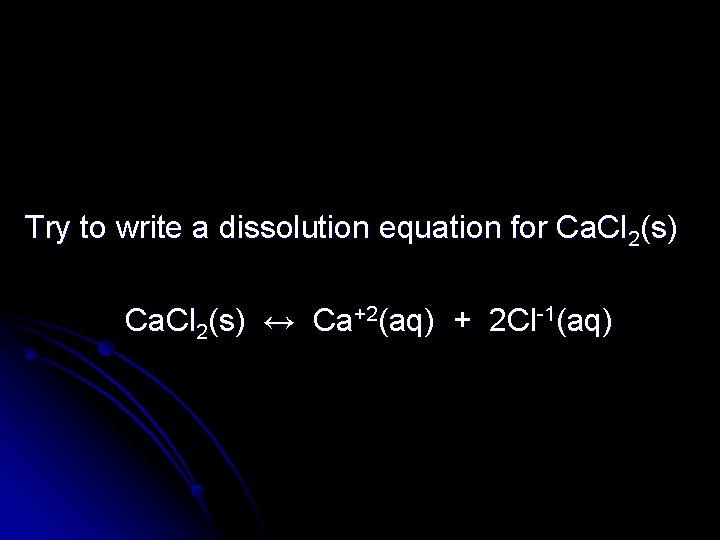
Try to write a dissolution equation for Ca. Cl 2(s) ↔ Ca+2(aq) + 2 Cl-1(aq)
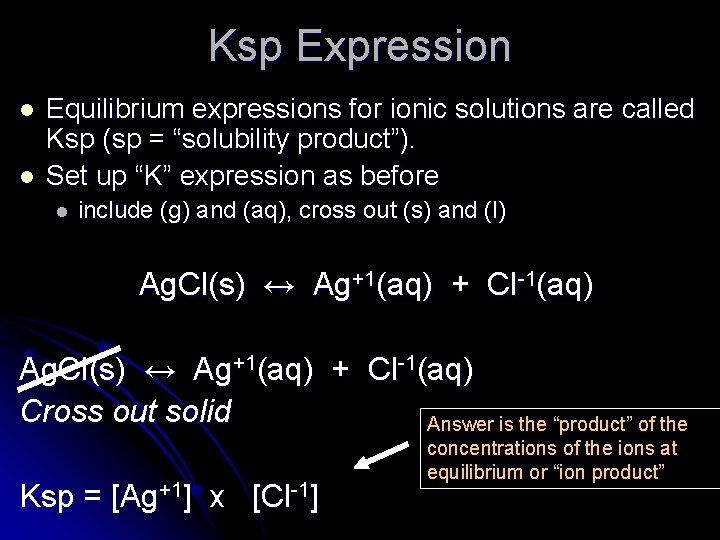
Ksp Expression l l Equilibrium expressions for ionic solutions are called Ksp (sp = “solubility product”). Set up “K” expression as before l include (g) and (aq), cross out (s) and (l) Ag. Cl(s) ↔ Ag+1(aq) + Cl-1(aq) Cross out solid Answer is the “product” of the Ksp = [Ag+1] x [Cl-1] concentrations of the ions at equilibrium or “ion product”
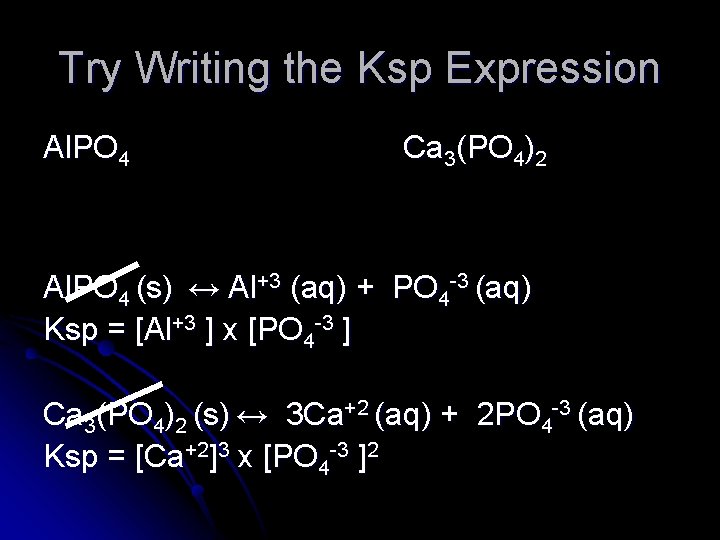
Try Writing the Ksp Expression Al. PO 4 Ca 3(PO 4)2 Al. PO 4 (s) ↔ Al+3 (aq) + PO 4 -3 (aq) Ksp = [Al+3 ] x [PO 4 -3 ] Ca 3(PO 4)2 (s) ↔ 3 Ca+2 (aq) + 2 PO 4 -3 (aq) Ksp = [Ca+2]3 x [PO 4 -3 ]2
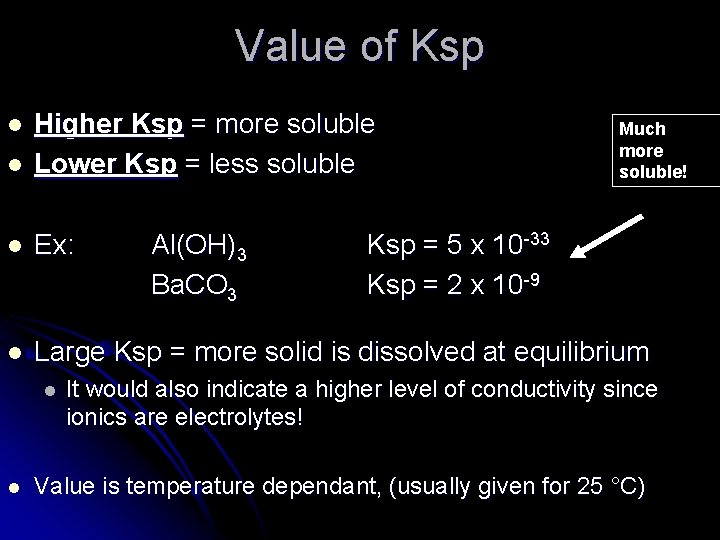
Value of Ksp l Higher Ksp = more soluble Lower Ksp = less soluble l Ex: l Large Ksp = more solid is dissolved at equilibrium l l l Al(OH)3 Ba. CO 3 Much more soluble! Ksp = 5 x 10 -33 Ksp = 2 x 10 -9 It would also indicate a higher level of conductivity since ionics are electrolytes! Value is temperature dependant, (usually given for 25 °C)
Just Read l Ionic compounds have different degrees of solubility (none are truly insoluble as it may indicate on your ref. tables), Ksp allows us to compare solubility. l This is useful when looking at how much relatively insoluble compounds will dissolve in things like drinking water or blood plasma.
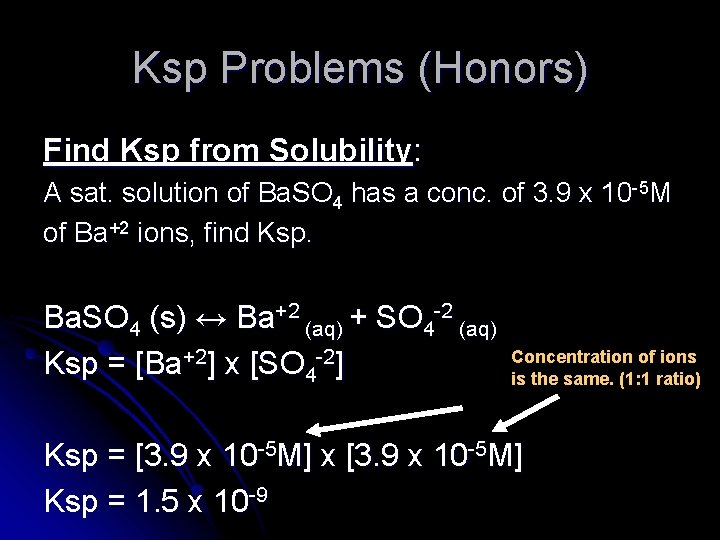
Ksp Problems (Honors) Find Ksp from Solubility: A sat. solution of Ba. SO 4 has a conc. of 3. 9 x 10 -5 M of Ba+2 ions, find Ksp. Ba. SO 4 (s) ↔ Ba+2 (aq) + SO 4 -2 (aq) Ksp = [Ba+2] x [SO 4 -2] Concentration of ions is the same. (1: 1 ratio) Ksp = [3. 9 x 10 -5 M] x [3. 9 x 10 -5 M] Ksp = 1. 5 x 10 -9
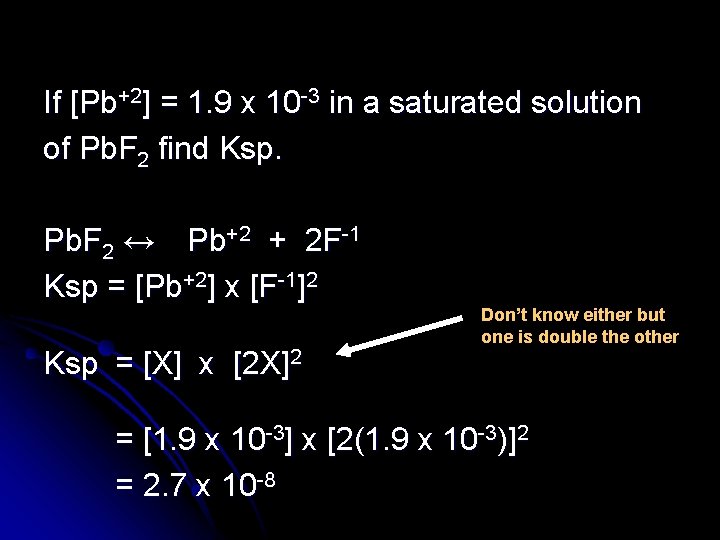
If [Pb+2] = 1. 9 x 10 -3 in a saturated solution of Pb. F 2 find Ksp. Pb. F 2 ↔ Pb+2 + 2 F-1 Ksp = [Pb+2] x [F-1]2 Ksp = [X] x [2 X]2 Don’t know either but one is double the other = [1. 9 x 10 -3] x [2(1. 9 x 10 -3)]2 = 2. 7 x 10 -8
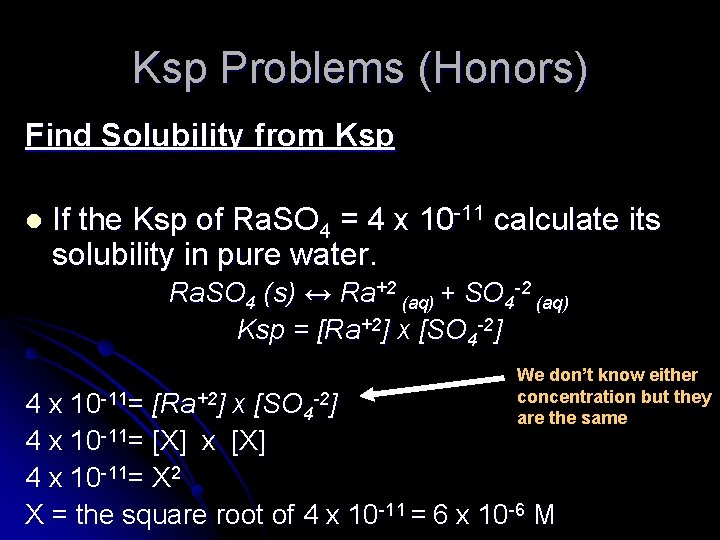
Ksp Problems (Honors) Find Solubility from Ksp l If the Ksp of Ra. SO 4 = 4 x 10 -11 calculate its solubility in pure water. Ra. SO 4 (s) ↔ Ra+2 (aq) + SO 4 -2 (aq) Ksp = [Ra+2] x [SO 4 -2] We don’t know either concentration but they are the same 4 x 10 -11= [Ra+2] x [SO 4 -2] 4 x 10 -11= [X] x [X] 4 x 10 -11= X 2 X = the square root of 4 x 10 -11 = 6 x 10 -6 M
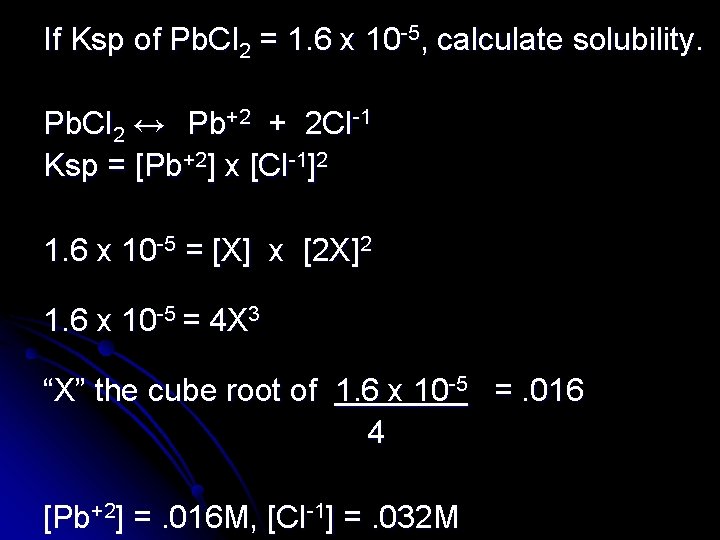
If Ksp of Pb. Cl 2 = 1. 6 x 10 -5, calculate solubility. Pb. Cl 2 ↔ Pb+2 + 2 Cl-1 Ksp = [Pb+2] x [Cl-1]2 1. 6 x 10 -5 = [X] x [2 X]2 1. 6 x 10 -5 = 4 X 3 “X” the cube root of 1. 6 x 10 -5 =. 016 4 [Pb+2] =. 016 M, [Cl-1] =. 032 M
- Slides: 22