
Equilibrium Chapter 17 Rates of reaction Different reactions
Equilibrium Chapter 17
Rates of reaction • Different reactions happen at different speeds. • There are ways to speed up or slow down a reaction. • Changing the surface area of the reactants – Powders react more quickly than “chunks” • Changing the amount/concentration of reactants – More reactant speeds up the reaction • Changing the temperature – Warmer reactions tend to go faster • Amount of rate change depends on the reaction.
Collision Theory • This theory explains how reactions happen at a molecular level. • In essence, reactant atoms/molecules collide with one another with enough force to break their bonds. • The pieces from this then reform into the product atom/molecules.
Explaining Why… • Temperature relates to the rate of motion of the particles. • Faster moving particles should collide more and more forcefully speeding up the reaction. • Higher concentration increases the chance of a collision • More surface area gives more places for collisions to take place • Which phase is the most reactive?

Relating to phase • The most reactive phase should be liquid. • Solids have particles that can only vibrate in place. Collisions will be rare. These should be the least reactive. • Gases are spaced very far apart, which will decrease the rate of collisions.
Catalysts and Inhibitors • Catalyst- something that increases the rate of a reaction without changing the products of the reaction. • Catalytic converter speeding the reaction of emissions of a car to less dangerous products • Inhibitor- something that slows or stops a reaction • -food preservatives
Catalyst example • 2 O 3 � 3 O 2 • Ozone will decompose into elemental oxygen, however this process is very slow. • Chlorine acts as a catalyst as shown in this two step reaction • 2 O 3 + 3 Cl 2� 6 Cl. O • 6 Cl. O � 3 O 2 + 3 Cl 2 • Cl. O is an intermediate, something formed in the middle of the reaction that is later consumed. • Chlorine is a catalyst because it is a reactant in the first step, but a product in the last step. So it isn’t used up during the reaction.
Ozone layer • This catalyzed reaction was the concern with the ozone layer. • Ozone in the stratosphere absorbs UV radiation from the sun. • Cl atoms (produced from CFC’s) was catalyzing the destruction of the ozone. • This is a great example of science and political groups working together to fix a problem.

Global Production of CFC’s Montreal protocol
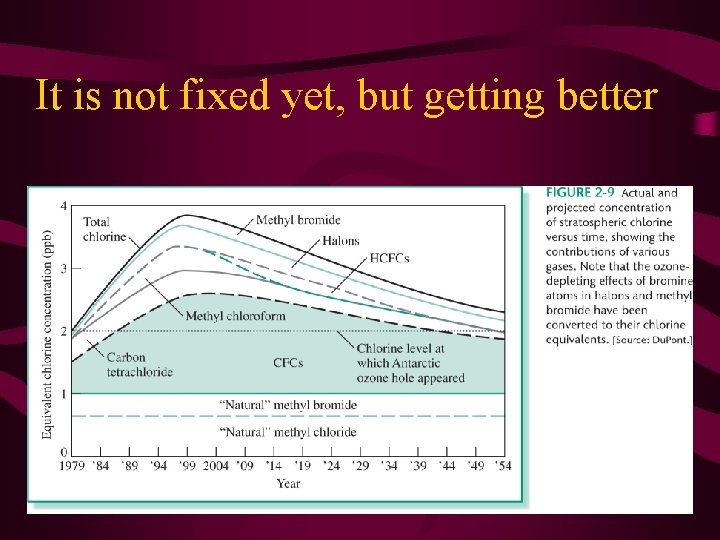
It is not fixed yet, but getting better
How a catalyst works • Our method of representing a reaction skips all of the intermediate steps. • The catalyst is reacts in these intermediate steps making certain reactions occur with less energy. • Prior to getting to product the catalyst comes out of the compound. • Inhibitors are the same but the increase the energy required for certain reactions
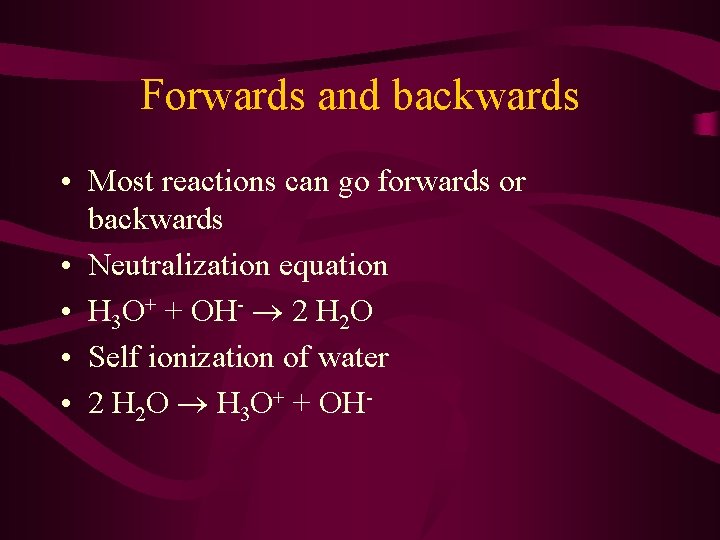
Forwards and backwards • Most reactions can go forwards or backwards • Neutralization equation • H 3 O+ + OH- 2 H 2 O • Self ionization of water • 2 H 2 O H 3 O+ + OH-
Equilibrium • In water, both of those reactions are occurring simultaneously. • Equilibrium is when the forward and backward reactions are occurring at the same rate. • This will cause a stable amount of product and reactant to be present. No net change is occurring when it is at equilibrium. (dynamic equilibrium) • The amount of product and reactant do NOT have to be equal!
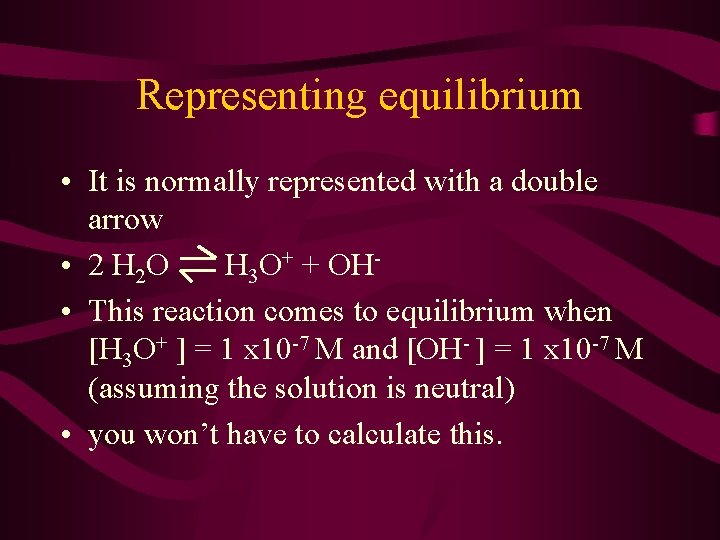
Representing equilibrium • It is normally represented with a double arrow • 2 H 2 O H 3 O+ + OH • This reaction comes to equilibrium when [H 3 O+ ] = 1 x 10 -7 M and [OH- ] = 1 x 10 -7 M (assuming the solution is neutral) • you won’t have to calculate this.
Le Châtelier’s Principle • ~whenever stress is applied to a system at equilibrium, a new equilibrium will be obtained to relieve this stress. • stress is a change in temperature, pressure, or concentration of some component. • This will change the rate of reaction of either the forward or backward reaction • So you will see an increase in the concentration of the substances on one side of the equation, and a decrease on the other. • This will “shift” the equation to the right or left.
Examples • Endothermic reactions absorb heat, i. e. they need heat to react. • If the solution is heated prior to the reaction (stress)… • It will react more quickly • So the equation will be forced to the right (product side) • If the reaction is cooled, it will be forced to the left (reactant side)
- Slides: 16