
Equilibrium and Gibbs Free Energy Main Concept When
Equilibrium and Gibbs Free Energy Main Concept: When the difference in Gibbs free energy between reactants and products (∆Gº) is much larger than thermal energy (RT), the equilibrium constant is either very small (for ∆Gº > 0) or very large (for ∆Gº < 0). When ∆Gº is comparable to thermal energy (RT), the equilibrium constant is near 1.
Equilibrium and Gibbs Free Energy Equilibrium and Free Energy Relationship Equation ΔG° vs K
- free energy change for chemical processes in which all of reactants and products are present in a standard state (as pure substances, as solutions of 1 molar concentration, or as gases at a pressure of 1 bar, or 1 atm) is given a particular symbol, ΔG°
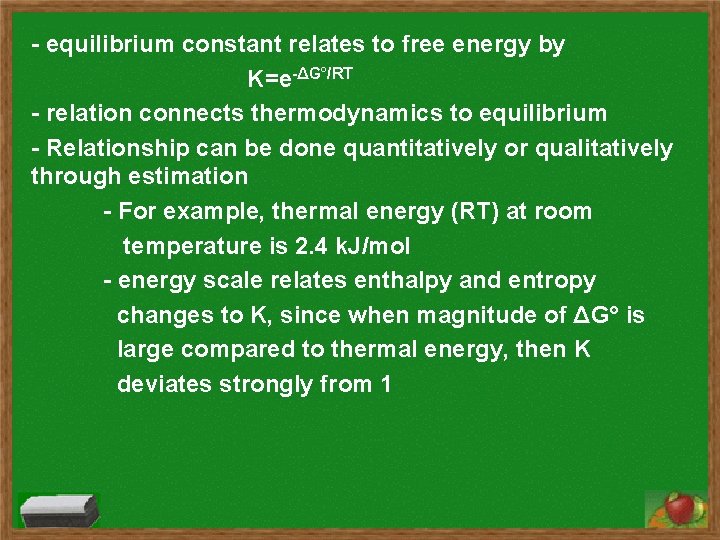
- equilibrium constant relates to free energy by K=e-ΔG°/RT - relation connects thermodynamics to equilibrium - Relationship can be done quantitatively or qualitatively through estimation - For example, thermal energy (RT) at room temperature is 2. 4 k. J/mol - energy scale relates enthalpy and entropy changes to K, since when magnitude of ΔG° is large compared to thermal energy, then K deviates strongly from 1
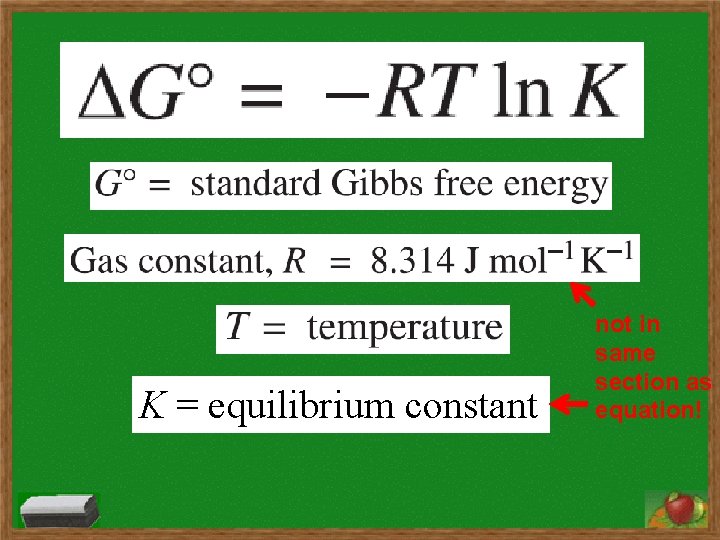
K = equilibrium constant not in same section as equation!
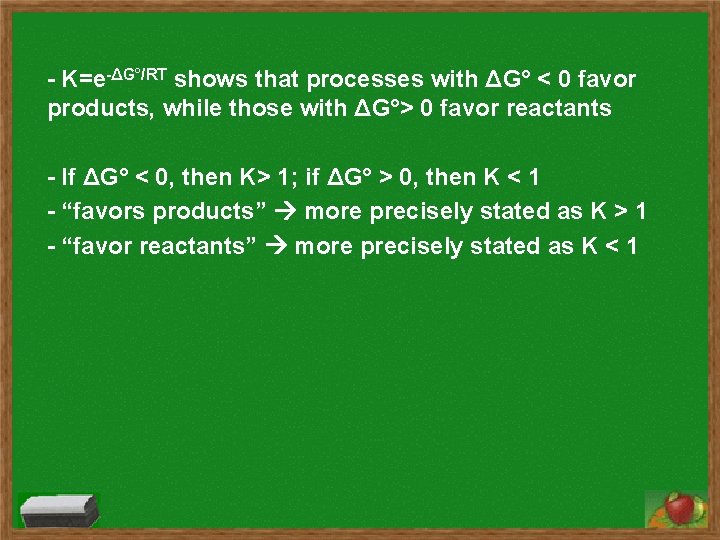
- K=e-ΔG°/RT shows that processes with ΔG° < 0 favor products, while those with ΔG°> 0 favor reactants - If ΔG° < 0, then K> 1; if ΔG° > 0, then K < 1 - “favors products” more precisely stated as K > 1 - “favor reactants” more precisely stated as K < 1
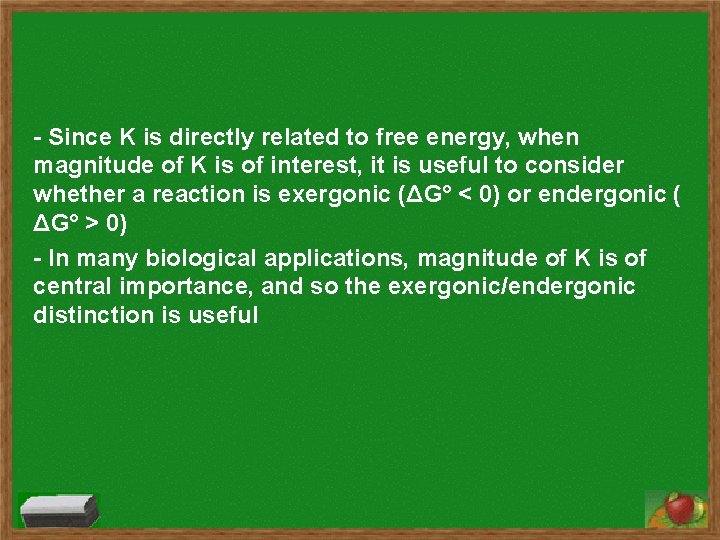
- Since K is directly related to free energy, when magnitude of K is of interest, it is useful to consider whether a reaction is exergonic (ΔG° < 0) or endergonic ( ΔG° > 0) - In many biological applications, magnitude of K is of central importance, and so the exergonic/endergonic distinction is useful
- Slides: 7