
Equilibrium A State of Dynamic Balance Reversible Reactions
Equilibrium : A State of Dynamic Balance

Reversible Reactions When a reaction results in complete conversion of reactants to products chemists say it goes to completion Not all reactions go to completion. They appear to stop because they are reversible Reversible reactions can occur in both the forward and reverse directions
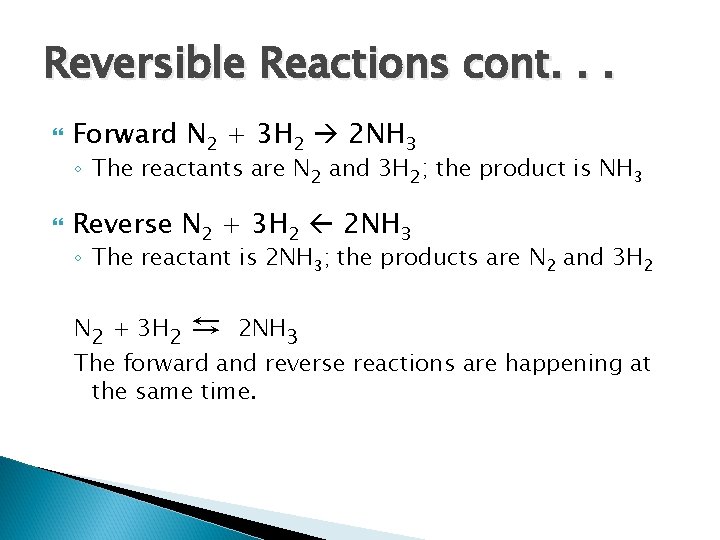
Reversible Reactions cont. . . Forward N 2 + 3 H 2 2 NH 3 ◦ The reactants are N 2 and 3 H 2; the product is NH 3 Reverse N 2 + 3 H 2 2 NH 3 ◦ The reactant is 2 NH 3; the products are N 2 and 3 H 2 N 2 + 3 H 2 ⇆ 2 NH 3 The forward and reverse reactions are happening at the same time.
Chemical Equilibrium Chemical equilibrium is a state in which the forward and reverse reactions balance each other because they take place at equal rates. ◦ Rateforward reaction = Ratereverse reaction This does not mean the concentrations of the products and reactants are the same Equilibrium is a state of action, not inaction. This process is dynamic; dynamic equilibrium.

http: //www. youtube. com/watch? v=Jsoaw. Kg u. U 6 A
Equilibrium Expression and Constant (Keq) Law of chemical equilibrium states that at a given temperature, a chemical system may reach a state in which a particular ratio of reactant and product concentrations has a constant value known as Keq or equilibrium constant.
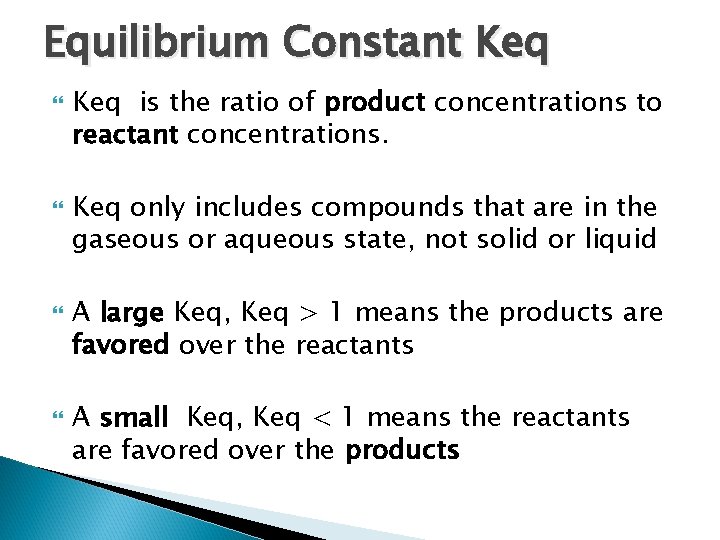
Equilibrium Constant Keq is the ratio of product concentrations to reactant concentrations. Keq only includes compounds that are in the gaseous or aqueous state, not solid or liquid A large Keq, Keq > 1 means the products are favored over the reactants A small Keq, Keq < 1 means the reactants are favored over the products

Homogenous vs. Heterogeneous Equilibrium Homogenous equilibrium means all reactants and products are in the same physical state Ex: H 2(g) + O 2(g) H 20(g) Heterogeneous equilibrium is when the reactants and products are in more than one physical state. Ex: H 2 O(g) + C(s) H 2(g) + CO(g)
![Chemical Equilibrium—Keq a. A + b. B c. C +d. D Keq products [C]c](http://slidetodoc.com/presentation_image_h2/6d262b0cf848e115cd2ab41a350d6650/image-9.jpg "Chemical Equilibrium—Keq a. A + b. B c. C +d. D Keq products [C]c")
Chemical Equilibrium—Keq a. A + b. B c. C +d. D Keq products [C]c [D]d = = reactants [A]a [B]b **only use Keq for gases and aqueous compounds, cross out all liquids and solids
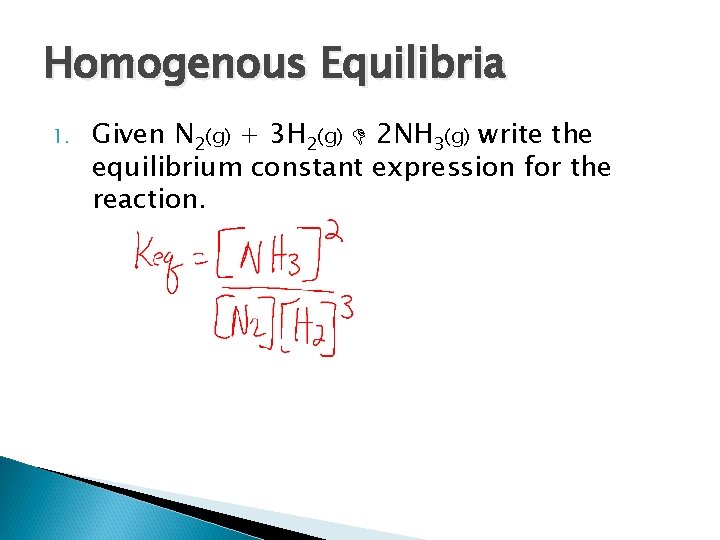
Homogenous Equilibria 1. Given N 2(g) + 3 H 2(g) 2 NH 3(g) write the equilibrium constant expression for the reaction.
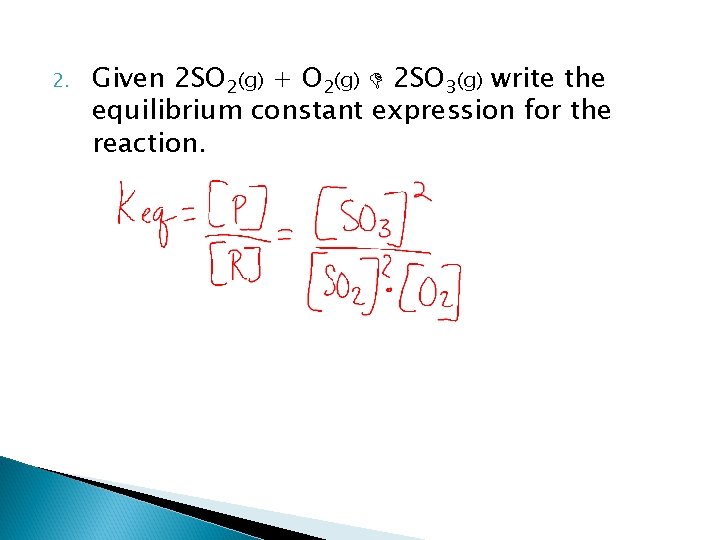
2. Given 2 SO 2(g) + O 2(g) 2 SO 3(g) write the equilibrium constant expression for the reaction.
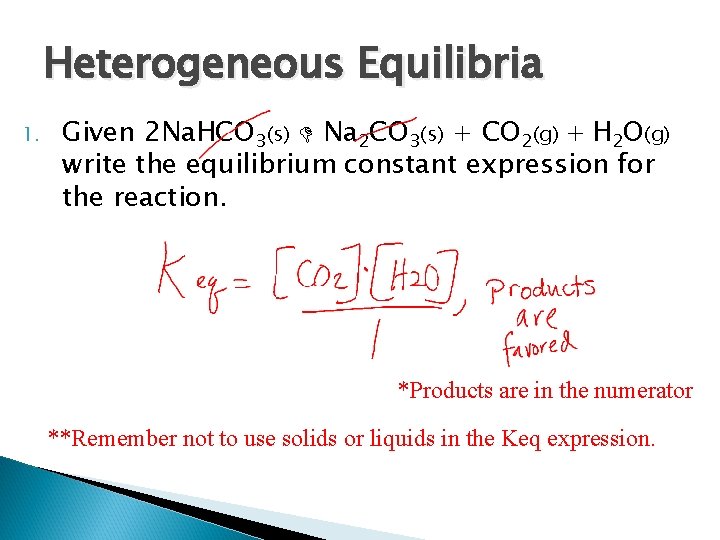
Heterogeneous Equilibria 1. Given 2 Na. HCO 3(s) Na 2 CO 3(s) + CO 2(g) + H 2 O(g) write the equilibrium constant expression for the reaction. *Products are in the numerator **Remember not to use solids or liquids in the Keq expression.
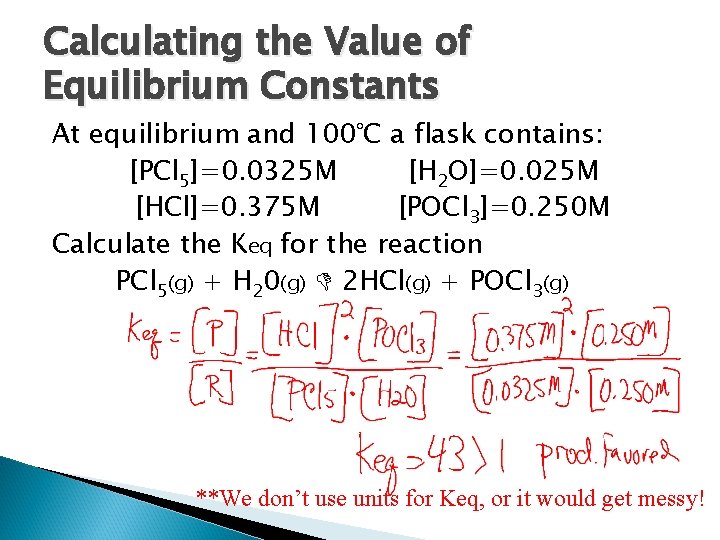
Calculating the Value of Equilibrium Constants At equilibrium and 100°C a flask contains: [PCl 5]=0. 0325 M [H 2 O]=0. 025 M [HCl]=0. 375 M [POCl 3]=0. 250 M Calculate the Keq for the reaction PCl 5(g) + H 20(g) 2 HCl(g) + POCl 3(g) **We don’t use units for Keq, or it would get messy!
- Slides: 13