
EQUATIONS OF TRANSLATIONAL MOTION If a body undergoes
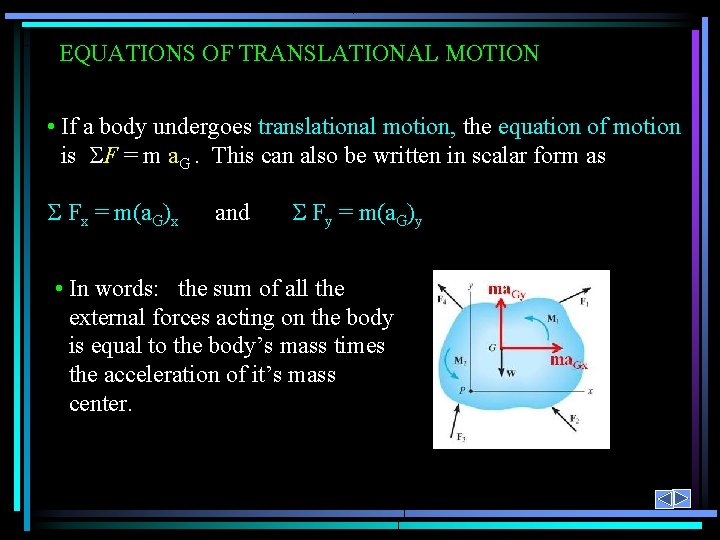
EQUATIONS OF TRANSLATIONAL MOTION • If a body undergoes translational motion, the equation of motion is F = m a. G. This can also be written in scalar form as Fx = m(a. G)x and Fy = m(a. G)y • In words: the sum of all the external forces acting on the body is equal to the body’s mass times the acceleration of it’s mass center.
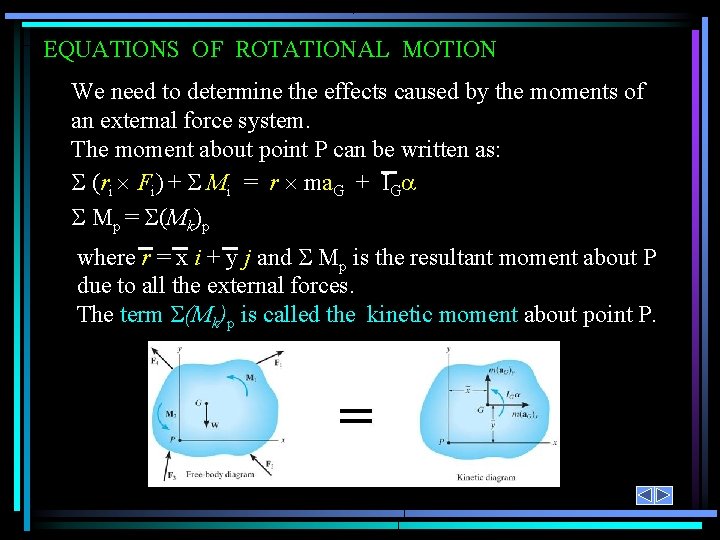
EQUATIONS OF ROTATIONAL MOTION We need to determine the effects caused by the moments of an external force system. The moment about point P can be written as: (ri Fi) + Mi = r ma. G + IG Mp = (Mk)p where r = x i + y j and Mp is the resultant moment about P due to all the external forces. The term (Mk)p is called the kinetic moment about point P.
EQUATIONS OF ROTATIONAL MOTION (continued) If point P coincides with the mass center G, this equation reduces to the scalar equation of MG = IG . In words: the resultant (summation) moment about the mass center due to all the external forces is equal to the moment of inertia about G times the angular acceleration of the body. Thus, three independent scalar equations of motion may be used to describe the general planar motion of a rigid body. These equations are: Fx = m(a. G)x Fy = m(a. G)y and MG = IG or Mp = (Mk)p
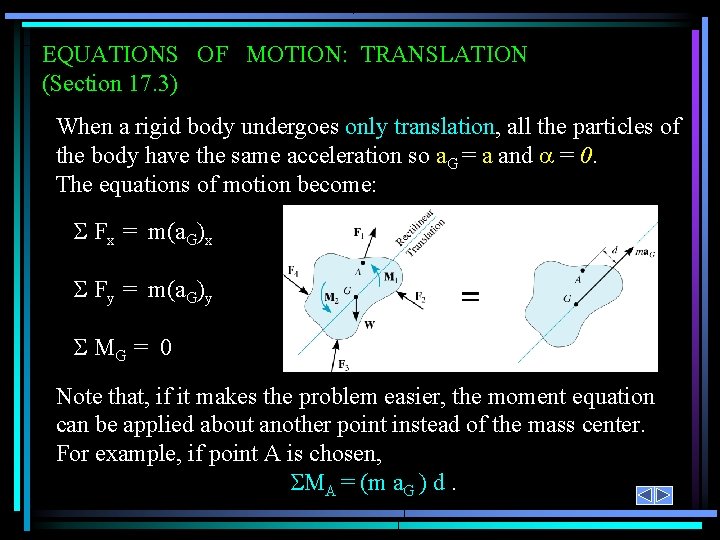
EQUATIONS OF MOTION: TRANSLATION (Section 17. 3) When a rigid body undergoes only translation, all the particles of the body have the same acceleration so a. G = a and = 0. The equations of motion become: Fx = m(a. G)x Fy = m(a. G)y MG = 0 Note that, if it makes the problem easier, the moment equation can be applied about another point instead of the mass center. For example, if point A is chosen, MA = (m a. G ) d.
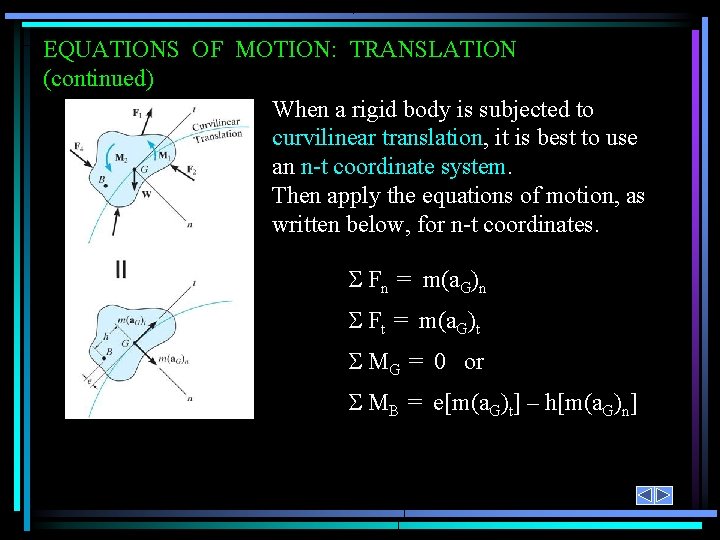
EQUATIONS OF MOTION: TRANSLATION (continued) When a rigid body is subjected to curvilinear translation, it is best to use an n-t coordinate system. Then apply the equations of motion, as written below, for n-t coordinates. Fn = m(a. G)n Ft = m(a. G)t MG = 0 or MB = e[m(a. G)t] – h[m(a. G)n]
PROCEDURE FOR ANALYSIS Problems involving kinetics of a rigid body in only translation should be solved using the following procedure: 1. Establish an (x-y) or (n-t) inertial coordinate system and specify the sense and direction of acceleration of the mass center, a. G. 2. Draw a FBD and kinetic diagram showing all external forces, couples and the inertia forces and couples. 3. Identify the unknowns. 4. Apply the three equations of motion (one set or the other): Fx = m(a. G)x Fy = m(a. G)y MG = 0 or Fn = m(a. G)n Ft = m(a. G)t MP = (Mk)P MG = 0 or MP = (Mk)P 5. Remember, friction forces always act on the body opposing the motion of the body.
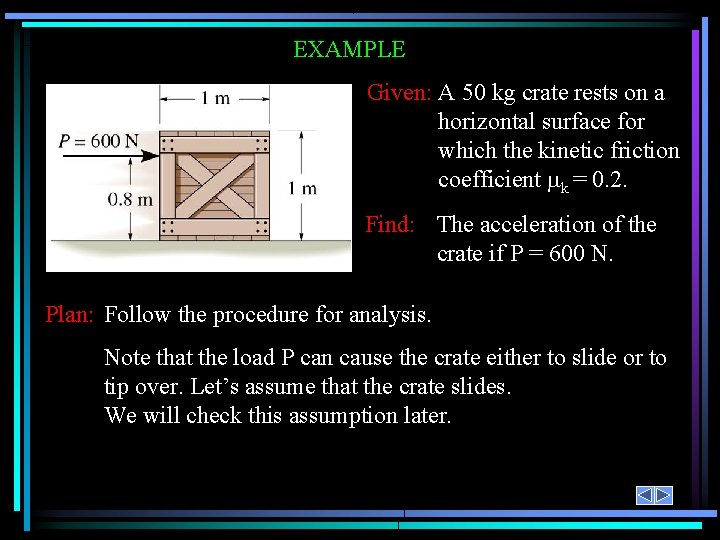
EXAMPLE Given: A 50 kg crate rests on a horizontal surface for which the kinetic friction coefficient k = 0. 2. Find: The acceleration of the crate if P = 600 N. Plan: Follow the procedure for analysis. Note that the load P can cause the crate either to slide or to tip over. Let’s assume that the crate slides. We will check this assumption later.
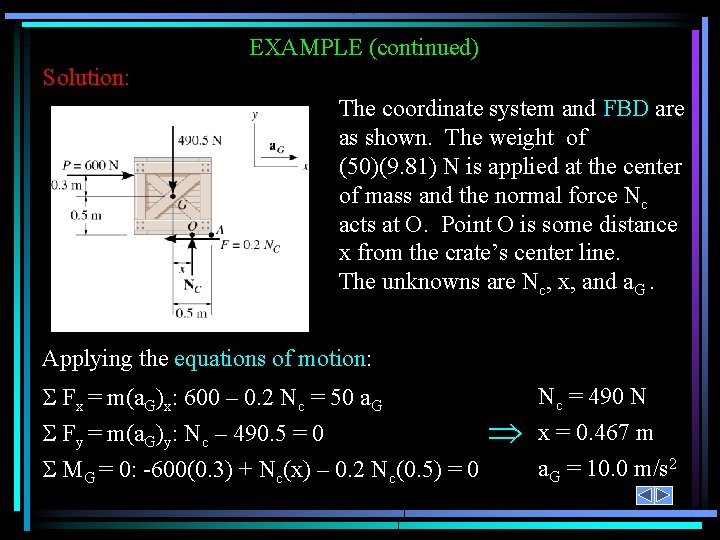
EXAMPLE (continued) Solution: The coordinate system and FBD are as shown. The weight of (50)(9. 81) N is applied at the center of mass and the normal force Nc acts at O. Point O is some distance x from the crate’s center line. The unknowns are Nc, x, and a. G. Applying the equations of motion: Fx = m(a. G)x: 600 – 0. 2 Nc = 50 a. G Fy = m(a. G)y: Nc – 490. 5 = 0 MG = 0: -600(0. 3) + Nc(x) – 0. 2 Nc(0. 5) = 0 Nc = 490 N x = 0. 467 m a. G = 10. 0 m/s 2
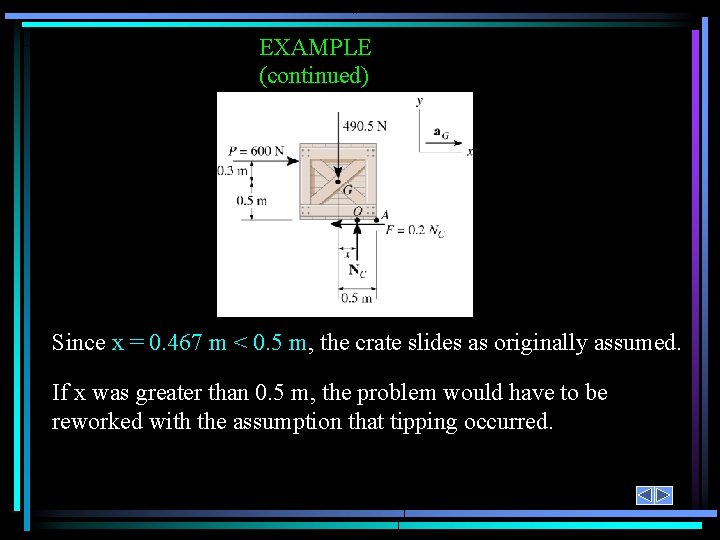
EXAMPLE (continued) Since x = 0. 467 m < 0. 5 m, the crate slides as originally assumed. If x was greater than 0. 5 m, the problem would have to be reworked with the assumption that tipping occurred.
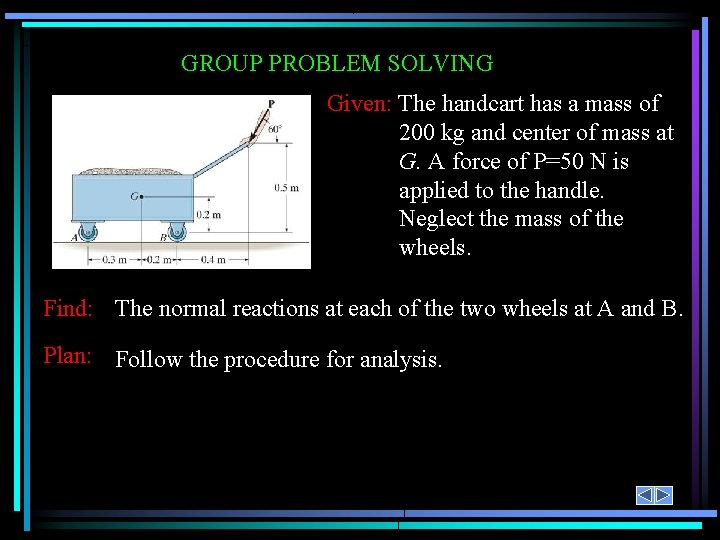
GROUP PROBLEM SOLVING Given: The handcart has a mass of 200 kg and center of mass at G. A force of P=50 N is applied to the handle. Neglect the mass of the wheels. Find: The normal reactions at each of the two wheels at A and B. Plan: Follow the procedure for analysis.
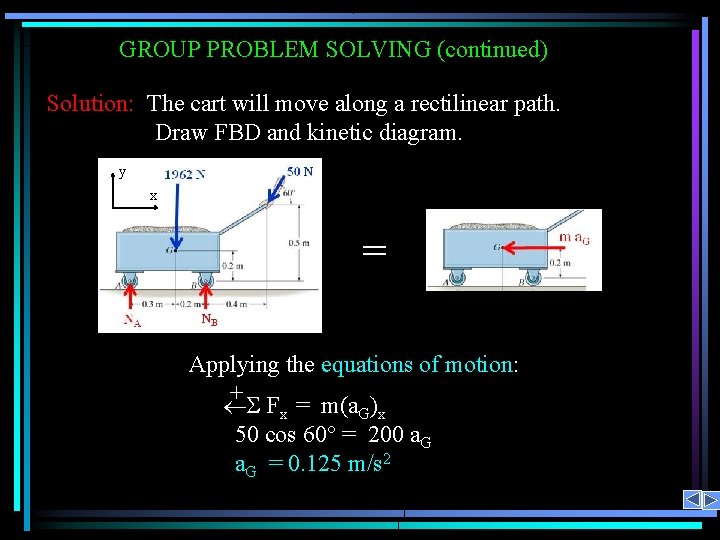
GROUP PROBLEM SOLVING (continued) Solution: The cart will move along a rectilinear path. Draw FBD and kinetic diagram. y x = Applying the equations of motion: + Fx = m(a. G)x 50 cos 60 = 200 a. G = 0. 125 m/s 2
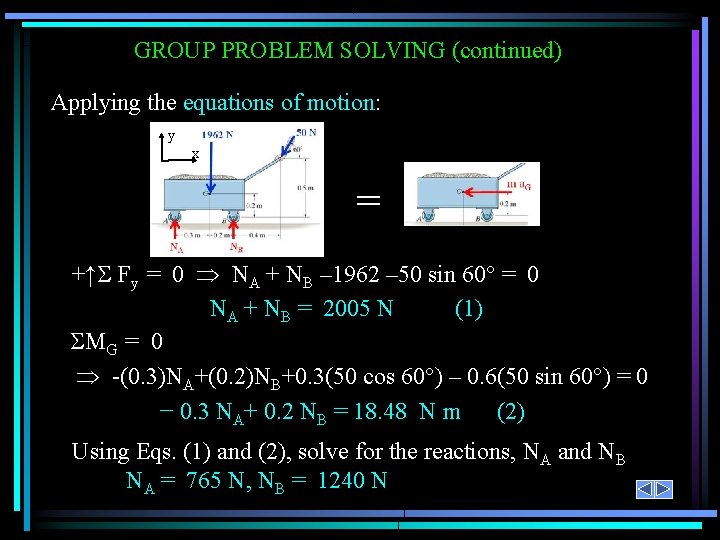
GROUP PROBLEM SOLVING (continued) Applying the equations of motion: y x = +↑ Fy = 0 NA + NB – 1962 – 50 sin 60 = 0 NA + NB = 2005 N (1) MG = 0 -(0. 3)NA+(0. 2)NB+0. 3(50 cos 60 ) – 0. 6(50 sin 60 ) = 0 − 0. 3 NA+ 0. 2 NB = 18. 48 N m (2) Using Eqs. (1) and (2), solve for the reactions, NA and NB NA = 765 N, NB = 1240 N
- Slides: 12