
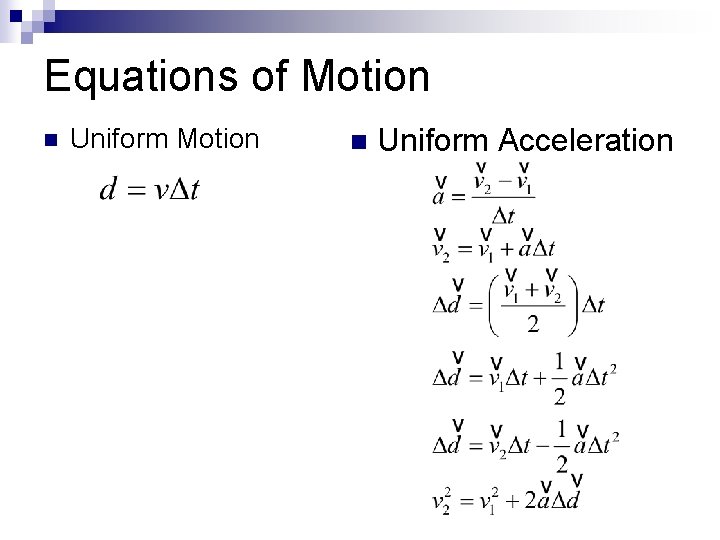
Equations of Motion Uniform Motion d distance travelled
![Uniform Motion d: distance travelled [m, km] v: speed [m/s, km/h] ∆t: length of](https://slidetodoc.com/presentation_image_h2/6567778a4d8996cb2fa3789ce23d051f/image-2.jpg "Uniform Motion d: distance travelled [m, km] v: speed [m/s, km/h] ∆t: length of")
![Uniform Acceleration Cont. (Accelerated Motion) : initial velocity [m/s] : final velocity [m/s] :](https://slidetodoc.com/presentation_image_h2/6567778a4d8996cb2fa3789ce23d051f/image-3.jpg "Uniform Acceleration Cont. (Accelerated Motion) : initial velocity [m/s] : final velocity [m/s] :")
![Uniform Acceleration Cont. (Accelerated Motion) : initial velocity [m/s] : final velocity [m/s] :](https://slidetodoc.com/presentation_image_h2/6567778a4d8996cb2fa3789ce23d051f/image-7.jpg "Uniform Acceleration Cont. (Accelerated Motion) : initial velocity [m/s] : final velocity [m/s] :")
- Slides: 11
Equations of Motion
Uniform Motion d: distance travelled [m, km] v: speed [m/s, km/h] ∆t: length of time [s, h]
Uniform Acceleration Cont. (Accelerated Motion) : initial velocity [m/s] : final velocity [m/s] : acceleration [m/s 2] : displacement [m] : length of time [s]
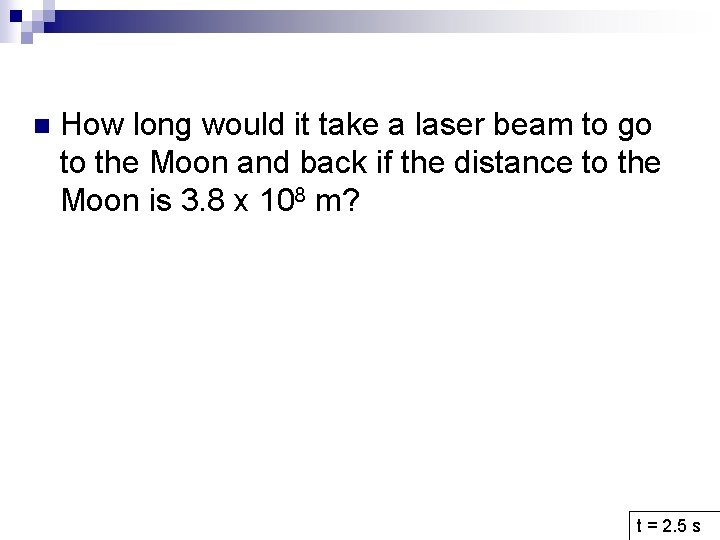
n How long would it take a laser beam to go to the Moon and back if the distance to the Moon is 3. 8 x 10⁸ m? t = 2. 5 s
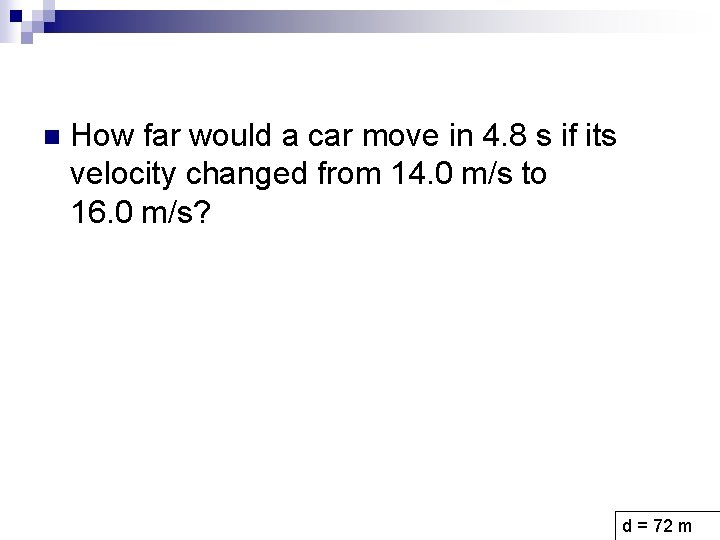
n How far would a car move in 4. 8 s if its velocity changed from 14. 0 m/s to 16. 0 m/s? d = 72 m
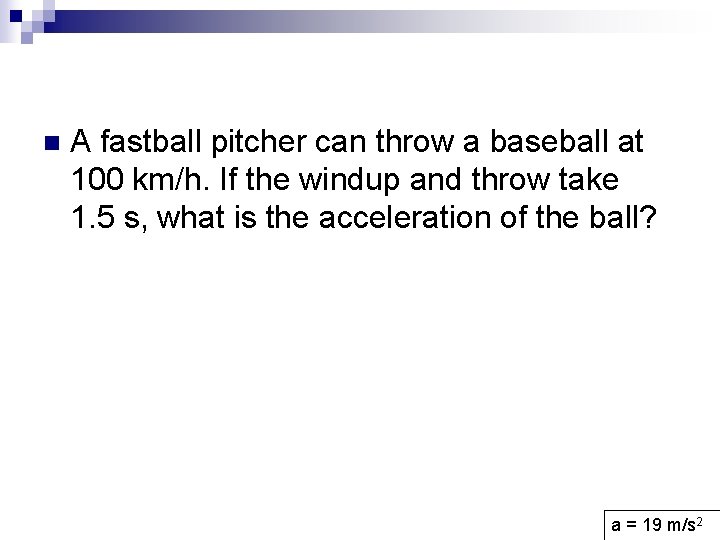
n A fastball pitcher can throw a baseball at 100 km/h. If the windup and throw take 1. 5 s, what is the acceleration of the ball? a = 19 m/s 2
Uniform Acceleration Cont. (Accelerated Motion) : initial velocity [m/s] : final velocity [m/s] : acceleration [m/s 2] : displacement [m] : length of time [s]
Equations of Motion n Uniform Acceleration
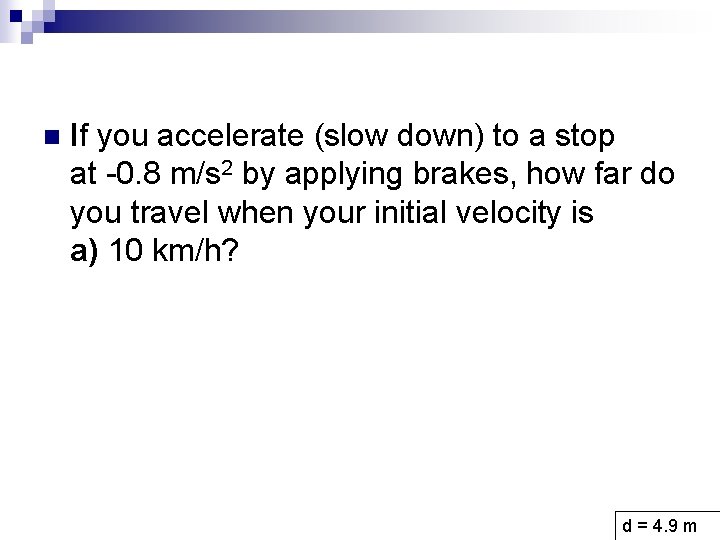
n If you accelerate (slow down) to a stop at -0. 8 m/s 2 by applying brakes, how far do you travel when your initial velocity is a) 10 km/h? d = 4. 9 m
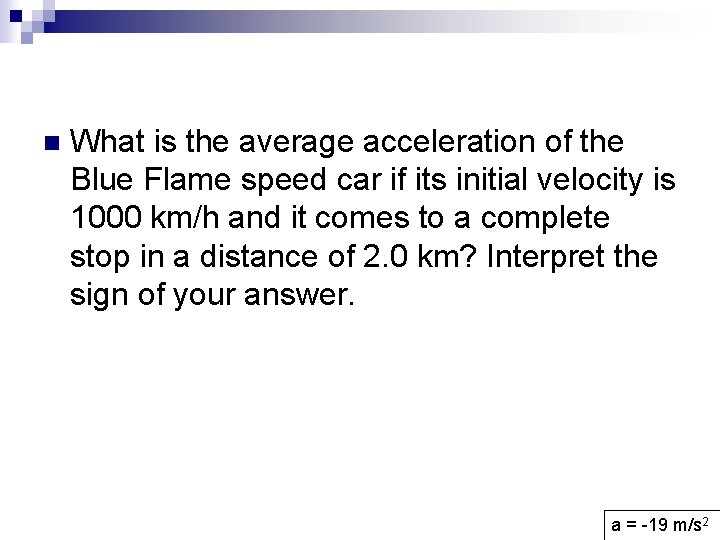
n What is the average acceleration of the Blue Flame speed car if its initial velocity is 1000 km/h and it comes to a complete stop in a distance of 2. 0 km? Interpret the sign of your answer. a = -19 m/s 2
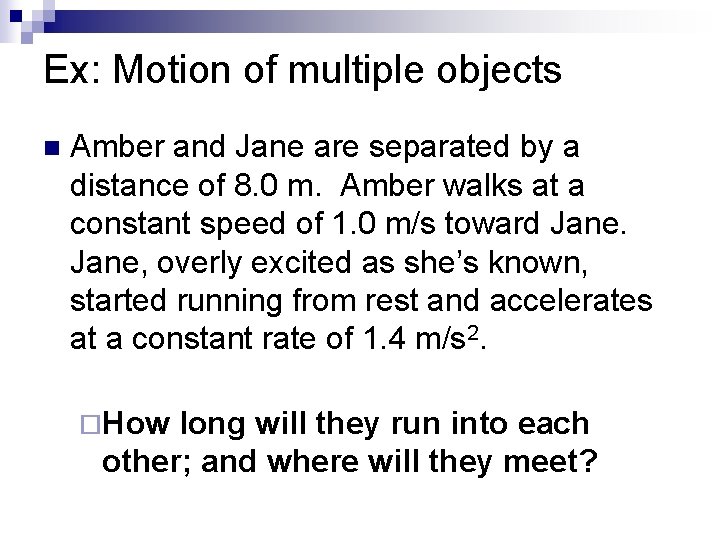
Ex: Motion of multiple objects n Amber and Jane are separated by a distance of 8. 0 m. Amber walks at a constant speed of 1. 0 m/s toward Jane, overly excited as she’s known, started running from rest and accelerates at a constant rate of 1. 4 m/s 2. ¨How long will they run into each other; and where will they meet?