
Equations formulas and identities 1 of 7 Boardworks
Equations, formulas and identities 1 of 7 © Boardworks 2012
Information 2 of 7 © Boardworks 2012
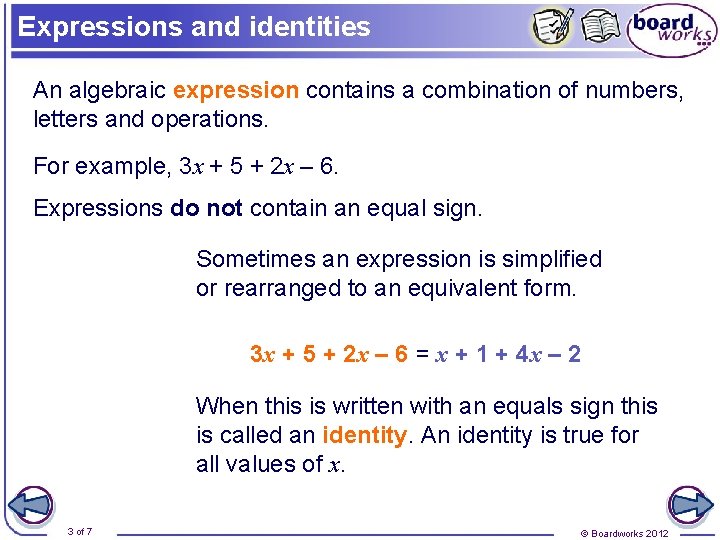
Expressions and identities An algebraic expression contains a combination of numbers, letters and operations. For example, 3 x + 5 + 2 x – 6. Expressions do not contain an equal sign. Sometimes an expression is simplified or rearranged to an equivalent form. 3 x + 5 + 2 x – 6 = x + 1 + 4 x – 2 When this is written with an equals sign this is called an identity. An identity is true for all values of x. 3 of 7 © Boardworks 2012

Equations An equation contains an equal sign linking an algebraic expression and a number, or two algebraic expressions. For example, x + 7 = 13 is an equation. An equation is true for particular values of x. Finding the value or values of the unknown that make the equation true is called solving the equation. x + 7 = 13 x=6 When solving an equation, line up the equal signs. 4 of 7 © Boardworks 2012
Identities and equations 5 of 7 © Boardworks 2012
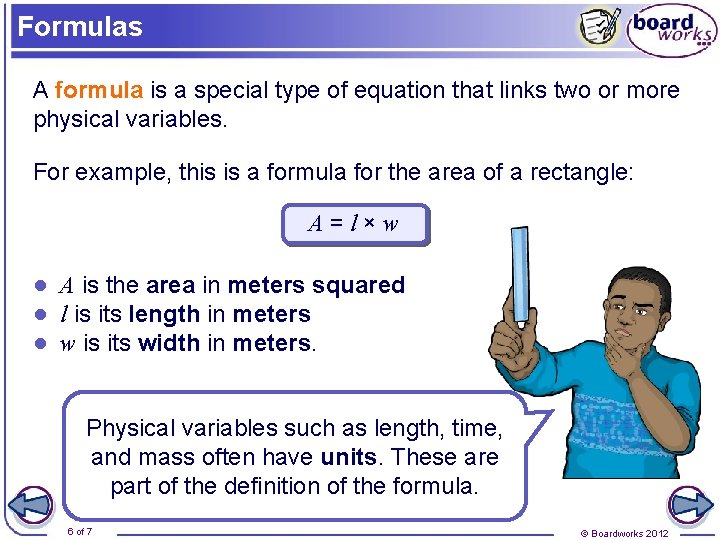
Formulas A formula is a special type of equation that links two or more physical variables. For example, this is a formula for the area of a rectangle: A=l×w ● A is the area in meters squared ● l is its length in meters ● w is its width in meters. Physical variables such as length, time, and mass often have units. These are part of the definition of the formula. 6 of 7 © Boardworks 2012
Summary 7 of 7 © Boardworks 2012
- Slides: 7