
Equations and Problem Solving Mrs Book Bellwork Value
Equations and Problem Solving Mrs. Book
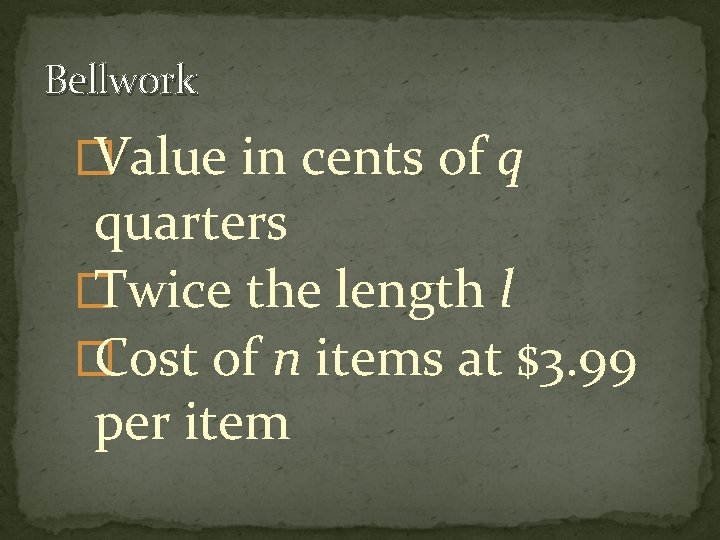
Bellwork � Value in cents of q quarters � Twice the length l � Cost of n items at $3. 99 per item
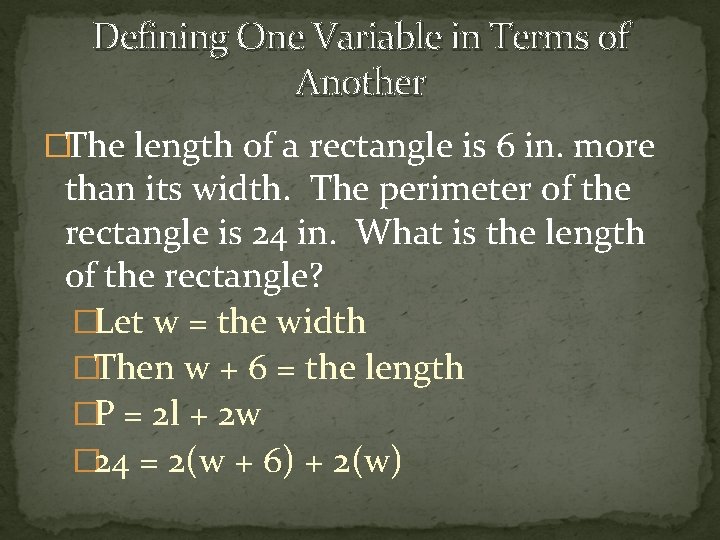
Defining One Variable in Terms of Another �The length of a rectangle is 6 in. more than its width. The perimeter of the rectangle is 24 in. What is the length of the rectangle? �Let w = the width �Then w + 6 = the length �P = 2 l + 2 w � 24 = 2(w + 6) + 2(w)
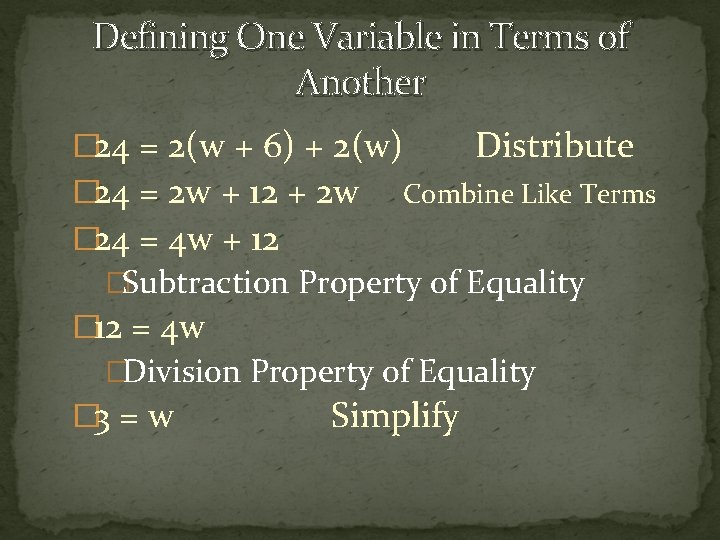
Defining One Variable in Terms of Another � 24 = 2(w + 6) + 2(w) Distribute � 24 = 2 w + 12 + 2 w Combine Like Terms � 24 = 4 w + 12 �Subtraction Property of Equality � 12 = 4 w �Division Property of Equality � 3 = w Simplify
Consecutive Integer Problem �The sum of three consecutive integers is 147. Find the integers �Let n = the first integer �Let n + 1 = the second integer �Let n + 2 = the third integer �n + (n + 1) + (n + 2) = 147
Consecutive Integer Problem �n + (n + 1) + (n + 2) = 147 �Distribute �n + 1 + n + 2 = 147 �Combine Like Terms � 3 n + 3 = 147 � 3 n = 144 �n = 48 Subtract Divide Simplify
Same-Direction Travel �A train leaves a train station at 1 pm. It travels at an average rate of 72 mi/h. A high -speed train leaves the same station an hour later. It travels at an average rate of 90 mi/h. The second train follows the same route as the first train on a track parallel to the first. In how many hours will the second train catch up with the first train?
Same-Direction Travel �Let t = the time the first train travels �Then t – 1 = the time the second train travels �Train 1 travels at 72 mi/h, so 72 t represents the distance traveled �Train 2 travels at 90 mi/h, so 90(t – 1) represents the distance traveled
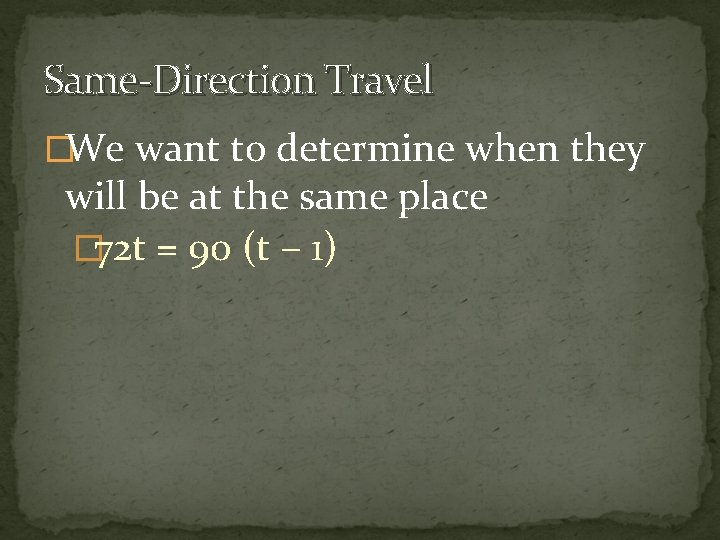
Same-Direction Travel �We want to determine when they will be at the same place � 72 t = 90 (t – 1)
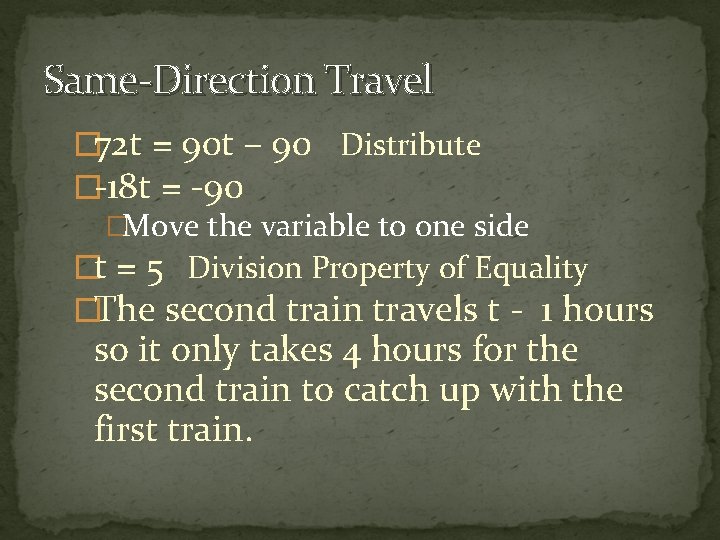
Same-Direction Travel � 72 t = 90 t – 90 Distribute �-18 t = -90 �Move the variable to one side �t = 5 Division Property of Equality �The second train travels t - 1 hours so it only takes 4 hours for the second train to catch up with the first train.
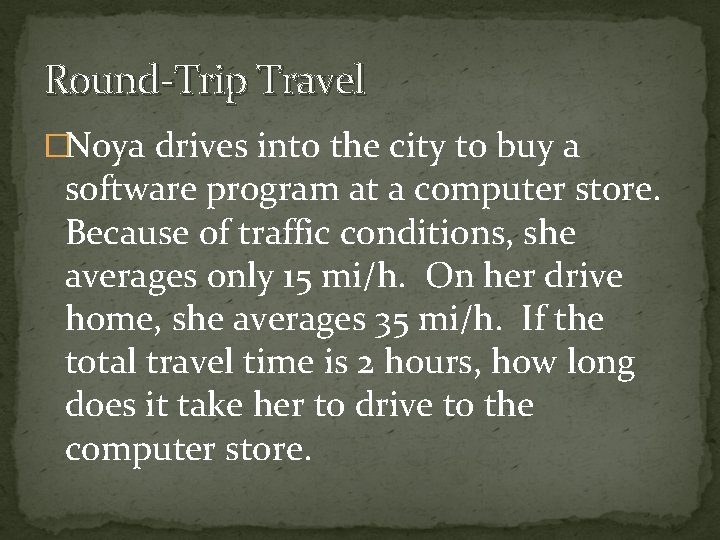
Round-Trip Travel �Noya drives into the city to buy a software program at a computer store. Because of traffic conditions, she averages only 15 mi/h. On her drive home, she averages 35 mi/h. If the total travel time is 2 hours, how long does it take her to drive to the computer store.
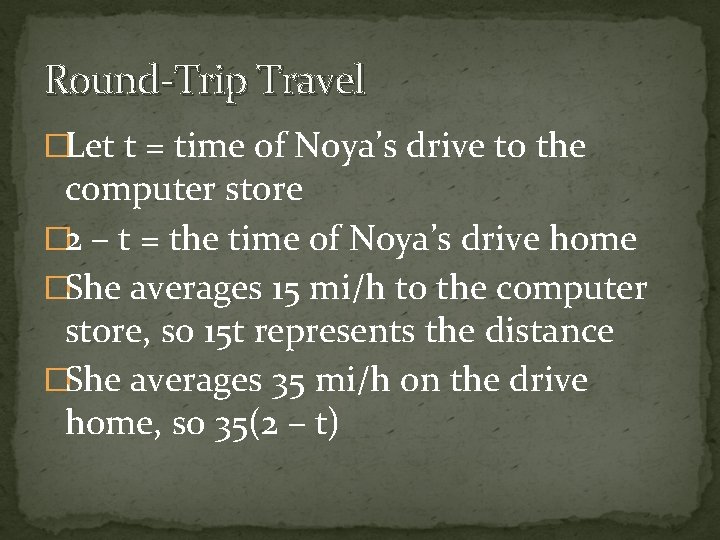
Round-Trip Travel �Let t = time of Noya’s drive to the computer store � 2 – t = the time of Noya’s drive home �She averages 15 mi/h to the computer store, so 15 t represents the distance �She averages 35 mi/h on the drive home, so 35(2 – t)
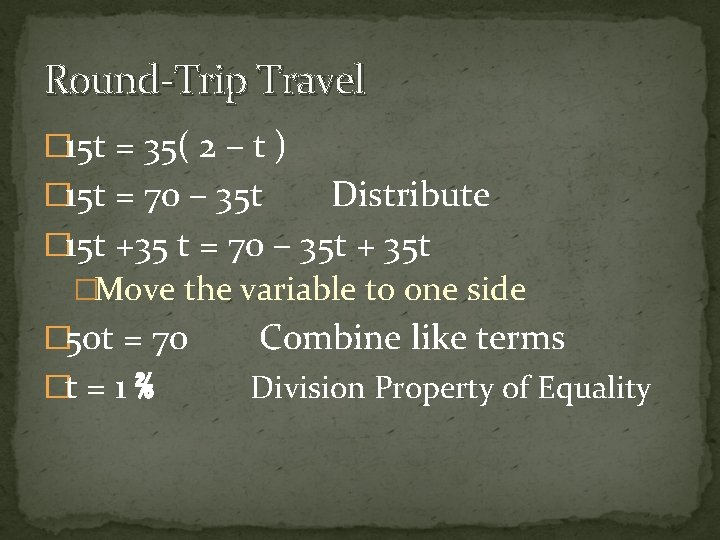
Round-Trip Travel � 15 t = 35( 2 – t ) � 15 t = 70 – 35 t Distribute � 15 t +35 t = 70 – 35 t + 35 t �Move the variable to one side � 50 t = 70 Combine like terms �t = 1 ⅖ Division Property of Equality
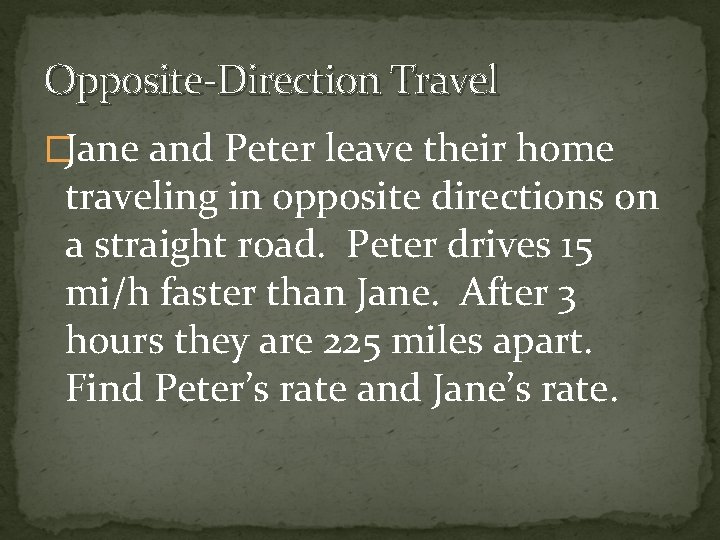
Opposite-Direction Travel �Jane and Peter leave their home traveling in opposite directions on a straight road. Peter drives 15 mi/h faster than Jane. After 3 hours they are 225 miles apart. Find Peter’s rate and Jane’s rate.
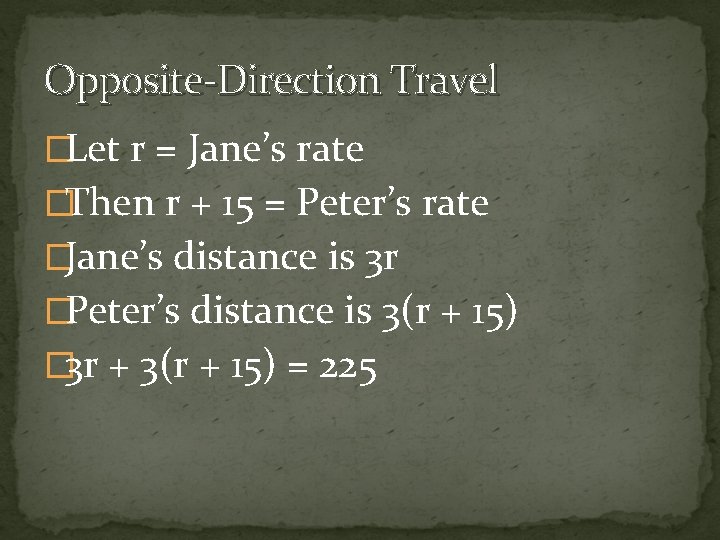
Opposite-Direction Travel �Let r = Jane’s rate �Then r + 15 = Peter’s rate �Jane’s distance is 3 r �Peter’s distance is 3(r + 15) � 3 r + 3(r + 15) = 225
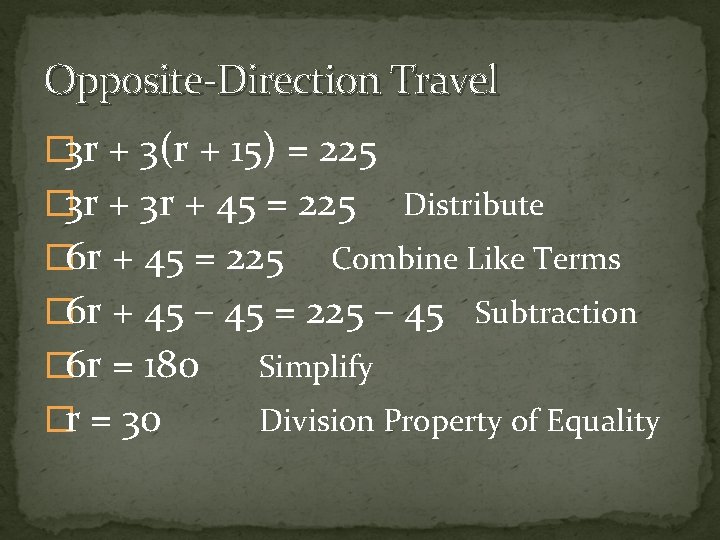
Opposite-Direction Travel � 3 r + 3(r + 15) = 225 � 3 r + 45 = 225 � 6 r + 45 = 225 Distribute Combine Like Terms � 6 r + 45 – 45 = 225 – 45 Subtraction � 6 r = 180 Simplify �r = 30 Division Property of Equality
- Slides: 16