
Equation of State of Neutron Star with Junction





- Slides: 38
Equation of State of Neutron Star with Junction Condition Approach in Starobinsky Model Workshop on Dark Physics of the Universe National Center for Theoretical Sciences Dec. 20 th, 2015 Ph. D student: Wei-Xiang Feng Advisor: Prof. Chao-Qiang Geng NTHU
Outline • Introduction • The Coupled Ordinary Equations • Junction & Boundary Conditions • Numerical Results • Buchdahl Stability Bound • Summary
Introduction
Introduction:f(R) model • Inflation model (Starobinsky model): A. A. Starobinsky “A new type of isotropic cosmological models without singularity”. Phys. Lett. B 91, 99 (1980). A. A. Starobinsky and H-J Schmidt “On general vacuum solution of fourth-order gravity”. Class. Quant. Grav. 4 (1987) • Neutron star (NS) as a laboratory to test f(R)-theory • Motivation: A. Ganguly, R. Gannouji, R. Goswami, and S. Ray “Neutron stars in Starobinsky model” 10. 1103/Phys. Rev. D. 89. 064019, ar. Xiv: 1309. 3279 v 2 [gr-qc]
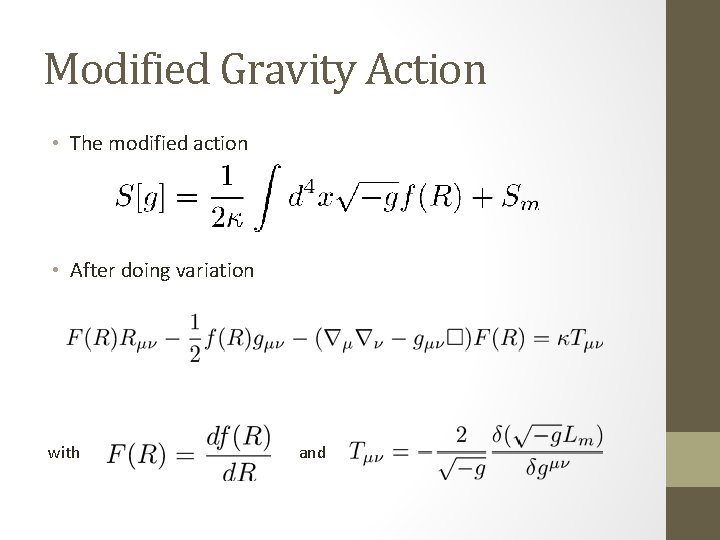
Modified Gravity Action • The modified action • After doing variation with and
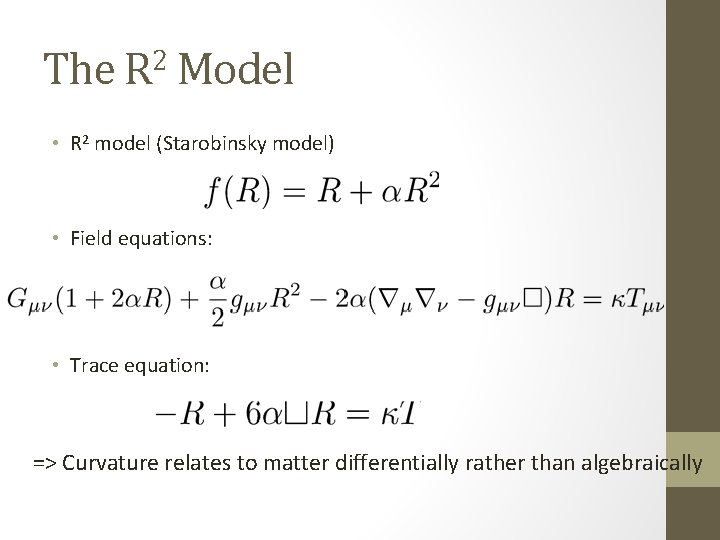
The R 2 Model • R 2 model (Starobinsky model) • Field equations: • Trace equation: => Curvature relates to matter differentially rather than algebraically
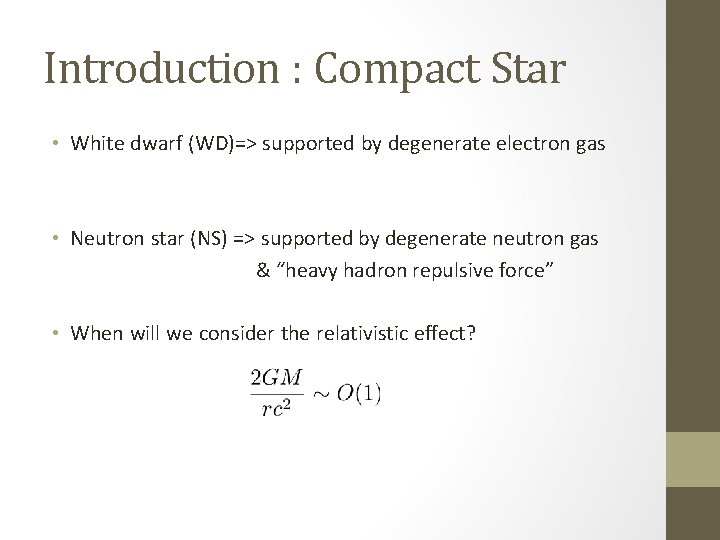
Introduction : Compact Star • White dwarf (WD)=> supported by degenerate electron gas • Neutron star (NS) => supported by degenerate neutron gas & “heavy hadron repulsive force” • When will we consider the relativistic effect?
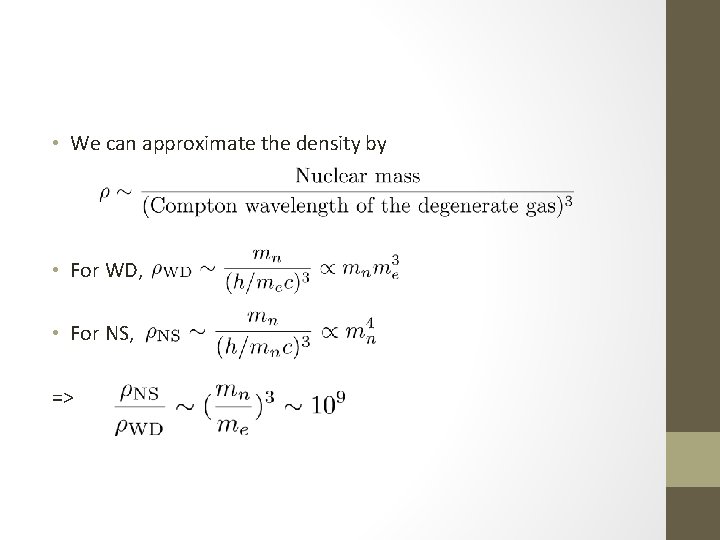
• We can approximate the density by • For WD, • For NS, =>
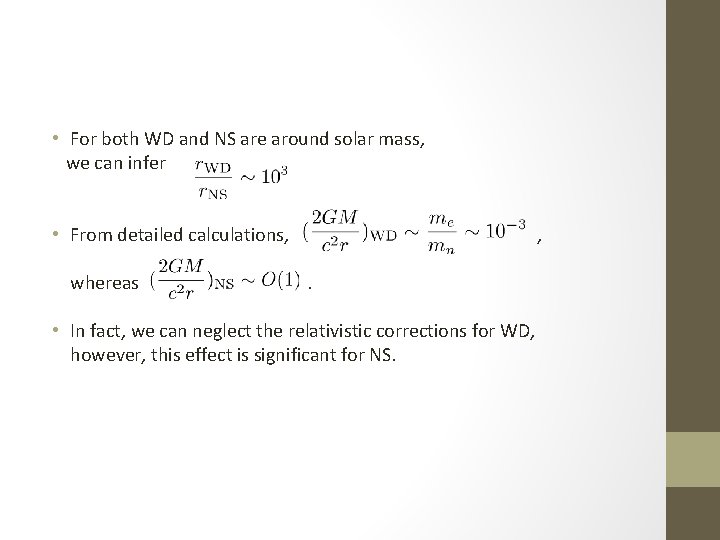
• For both WD and NS are around solar mass, we can infer • From detailed calculations, whereas , . • In fact, we can neglect the relativistic corrections for WD, however, this effect is significant for NS.
The Coupled Ordinary Equations
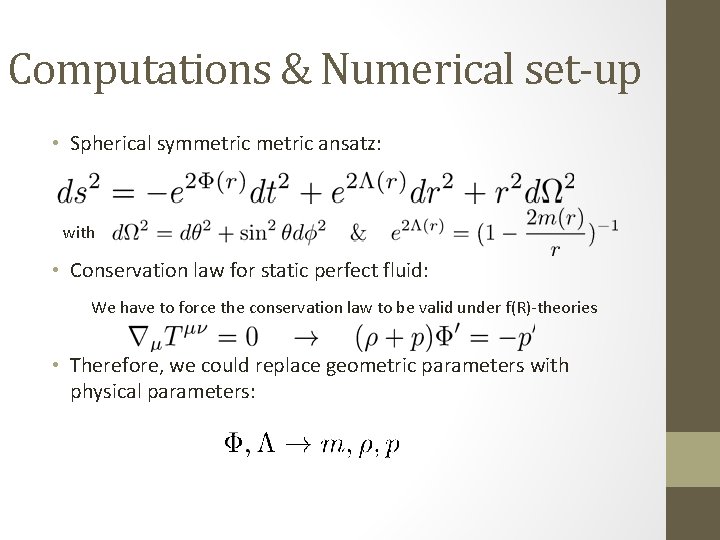
Computations & Numerical set-up • Spherical symmetric ansatz: with • Conservation law for static perfect fluid: We have to force the conservation law to be valid under f(R)-theories • Therefore, we could replace geometric parameters with physical parameters:
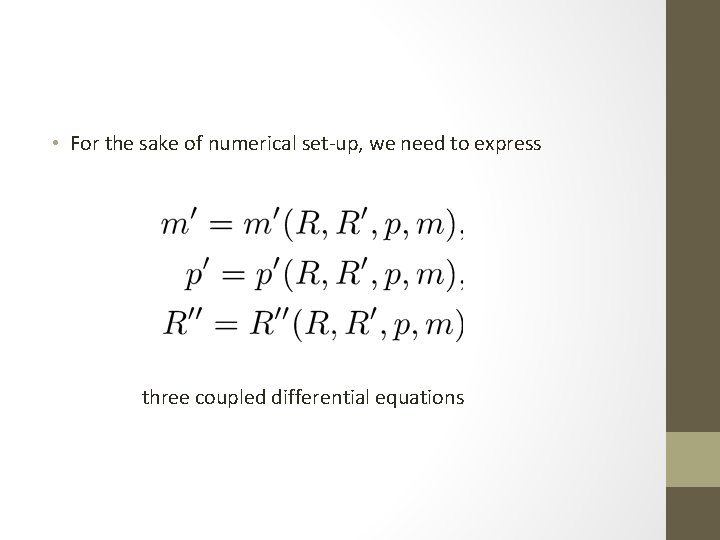
• For the sake of numerical set-up, we need to express three coupled differential equations
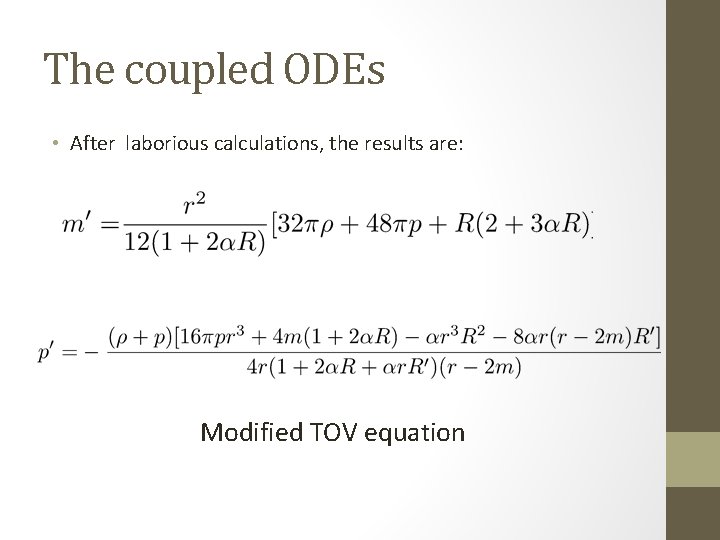
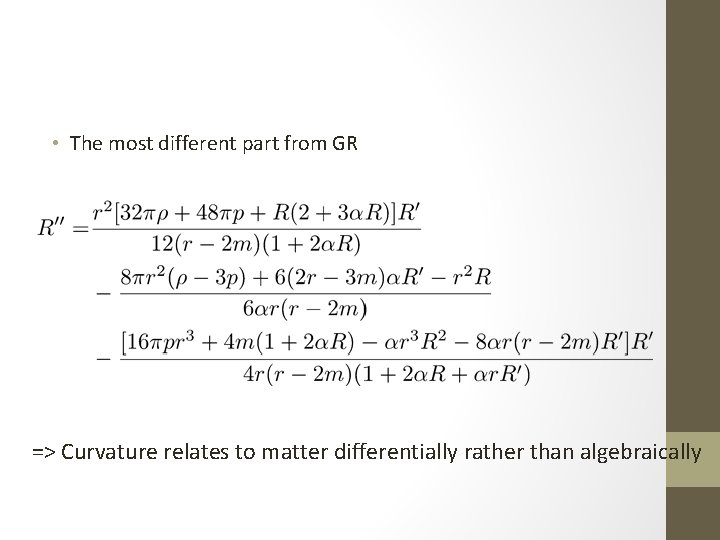
The coupled ODEs • After laborious calculations, the results are: Modified TOV equation
• The most different part from GR => Curvature relates to matter differentially rather than algebraically
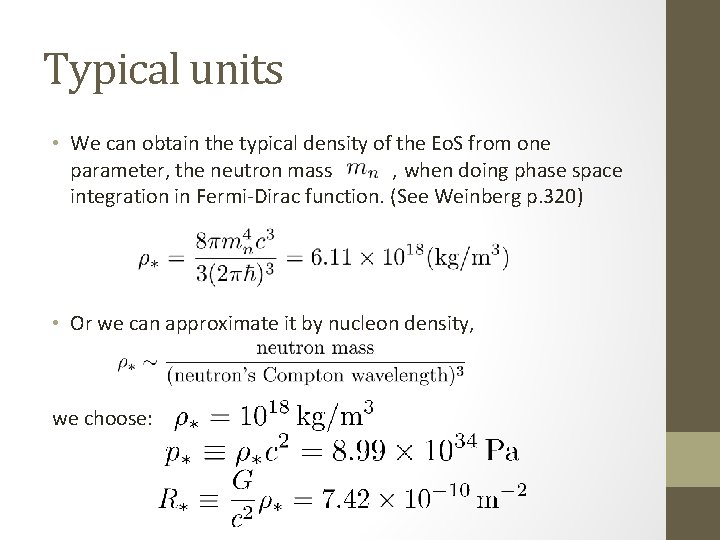
Typical units • We can obtain the typical density of the Eo. S from one parameter, the neutron mass , when doing phase space integration in Fermi-Dirac function. (See Weinberg p. 320) • Or we can approximate it by nucleon density, we choose:
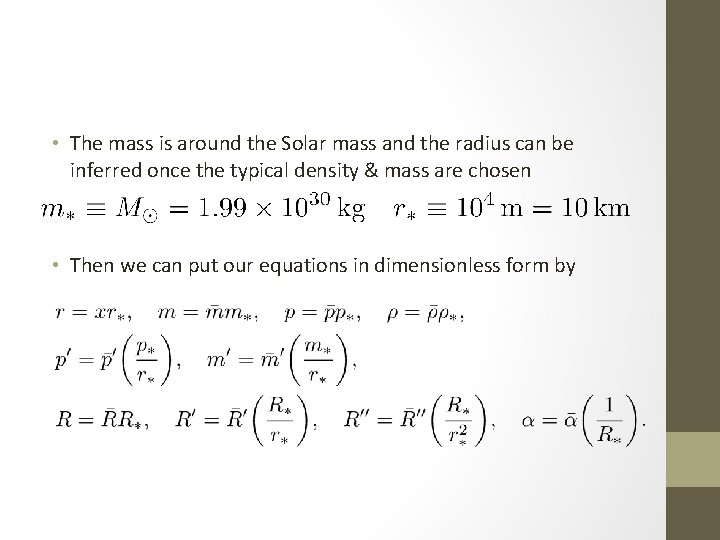
• The mass is around the Solar mass and the radius can be inferred once the typical density & mass are chosen • Then we can put our equations in dimensionless form by
Junction & Boundary Conditions
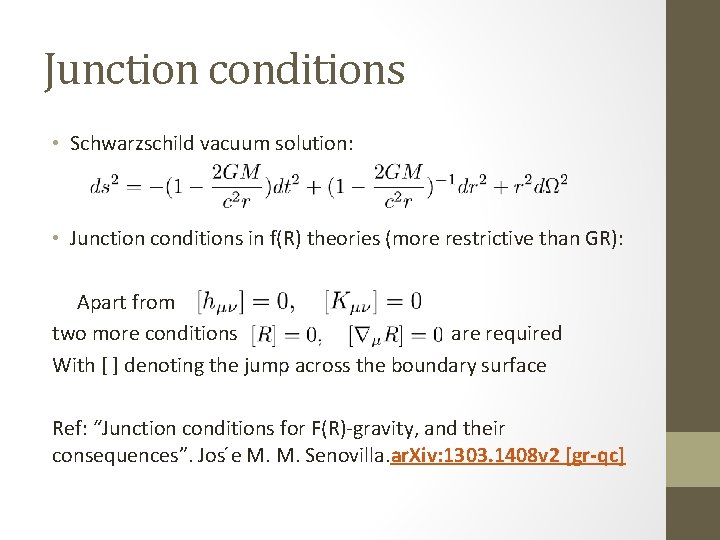
Junction conditions • Schwarzschild vacuum solution: • Junction conditions in f(R) theories (more restrictive than GR): Apart from two more conditions are required With [ ] denoting the jump across the boundary surface Ref: “Junction conditions for F(R)-gravity, and their consequences”. Jos e M. M. Senovilla. ar. Xiv: 1303. 1408 v 2 [gr-qc]
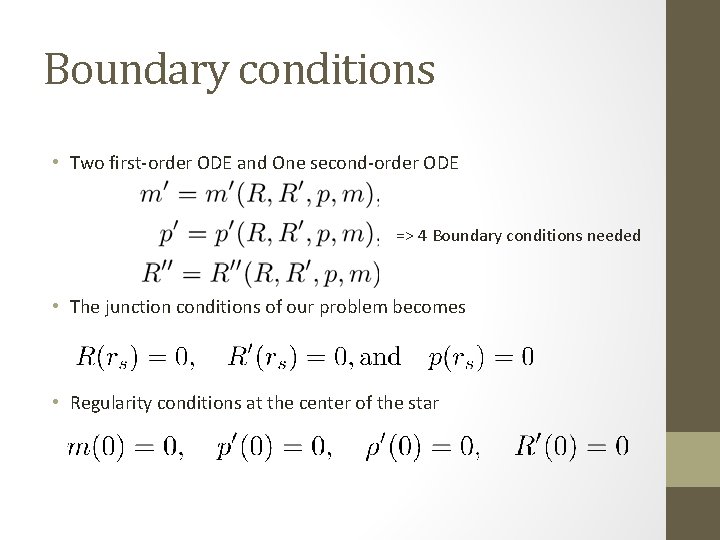
Boundary conditions • Two first-order ODE and One second-order ODE => 4 Boundary conditions needed • The junction conditions of our problem becomes • Regularity conditions at the center of the star
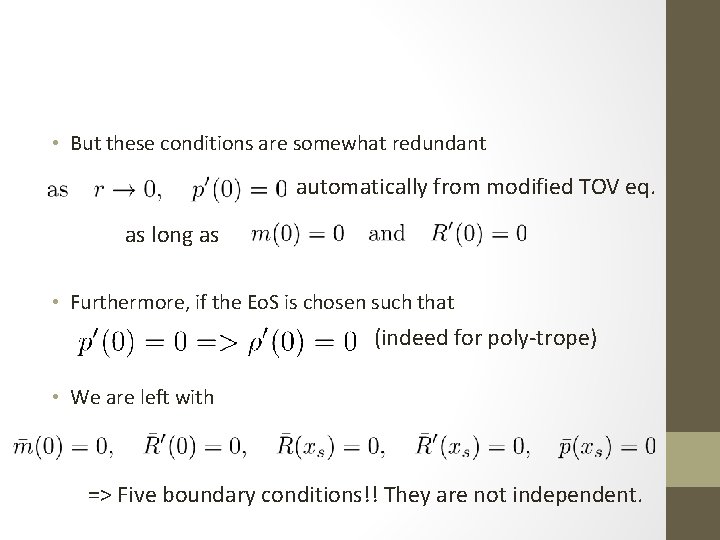
• But these conditions are somewhat redundant automatically from modified TOV eq. as long as • Furthermore, if the Eo. S is chosen such that (indeed for poly-trope) • We are left with => Five boundary conditions!! They are not independent.
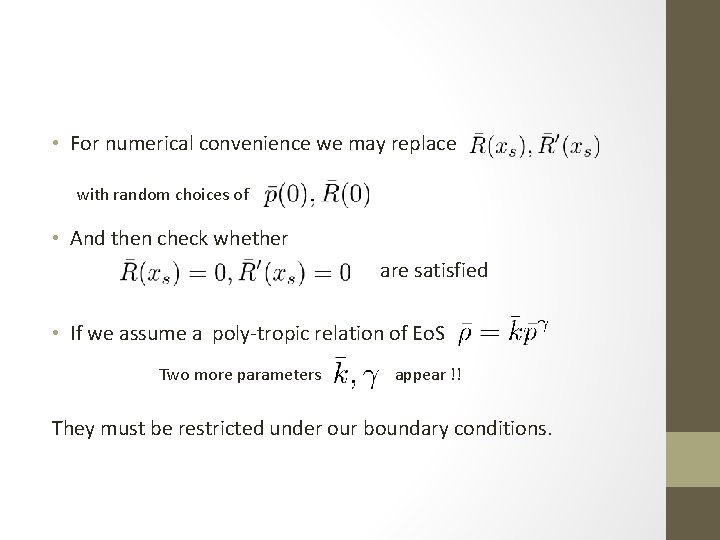
• For numerical convenience we may replace with random choices of • And then check whether are satisfied • If we assume a poly-tropic relation of Eo. S Two more parameters appear !! They must be restricted under our boundary conditions.
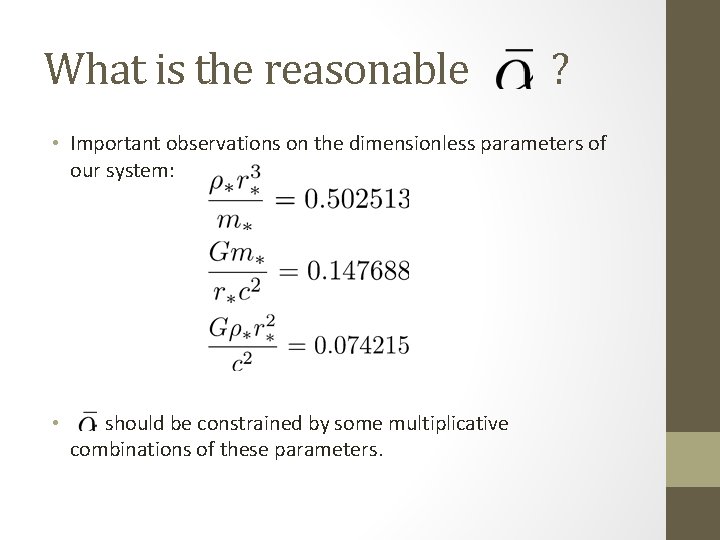
What is the reasonable ? • Important observations on the dimensionless parameters of our system: • should be constrained by some multiplicative combinations of these parameters.
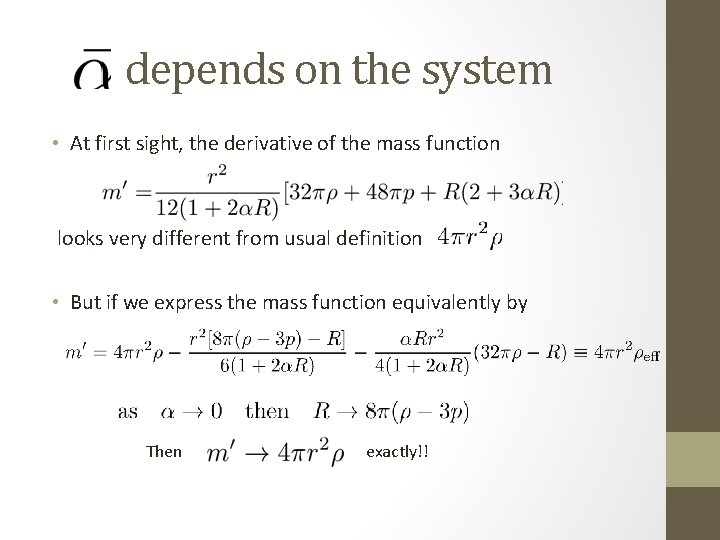
depends on the system • At first sight, the derivative of the mass function looks very different from usual definition • But if we express the mass function equivalently by Then exactly!!
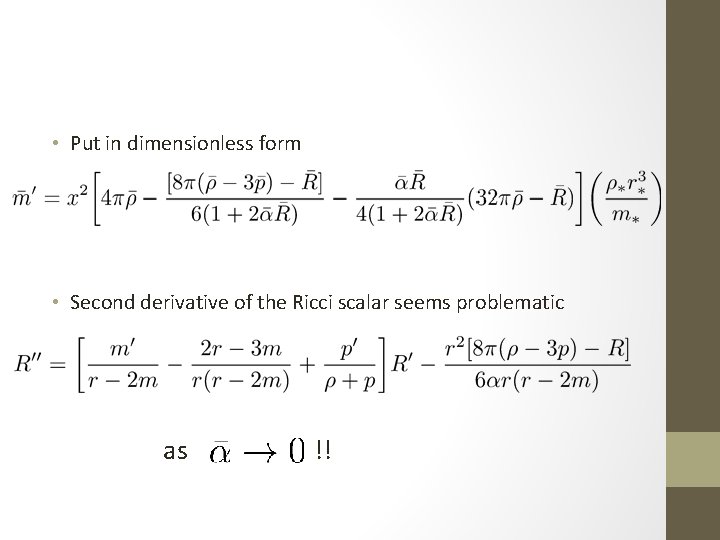
• Put in dimensionless form • Second derivative of the Ricci scalar seems problematic as !!
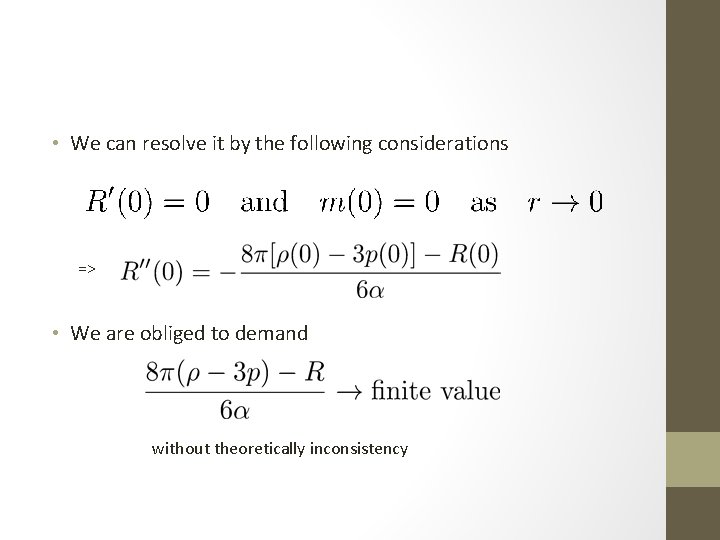
• We can resolve it by the following considerations => • We are obliged to demand without theoretically inconsistency
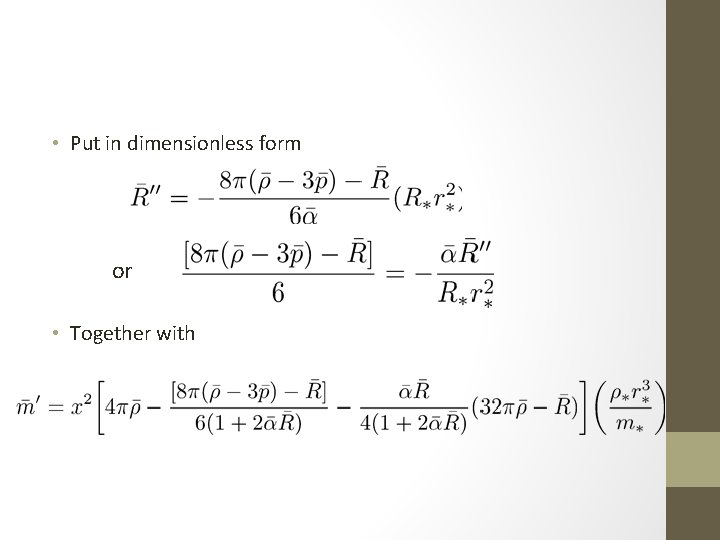
• Put in dimensionless form or • Together with
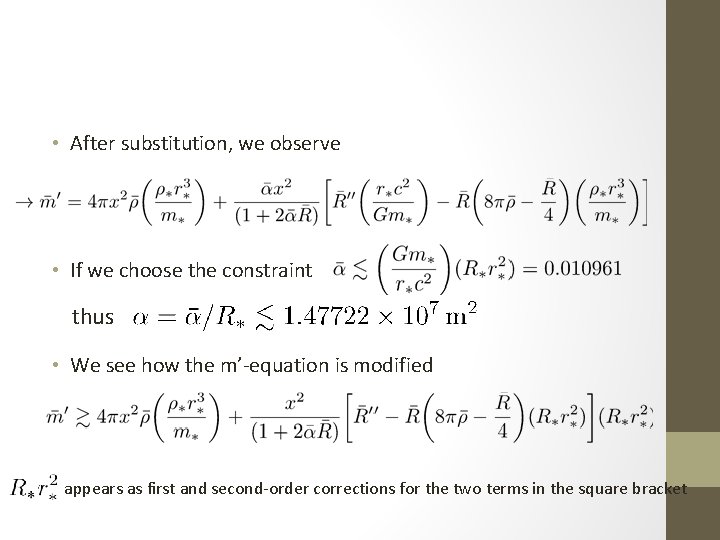
• After substitution, we observe • If we choose the constraint thus • We see how the m’-equation is modified appears as first and second-order corrections for the two terms in the square bracket
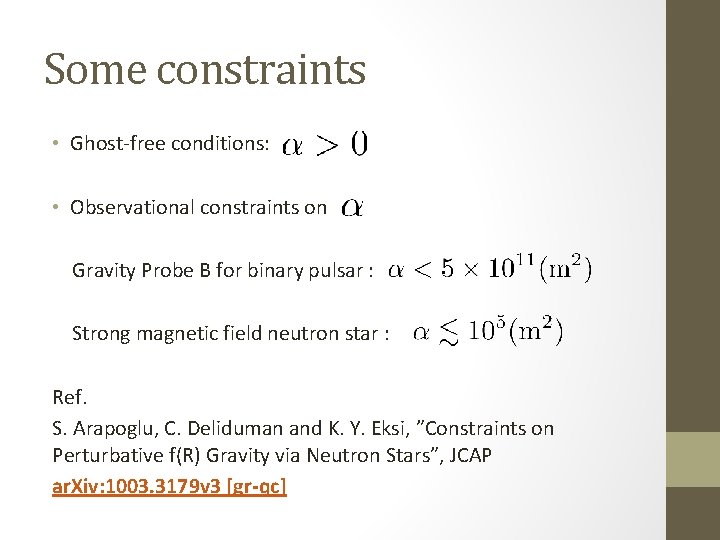
Some constraints • Ghost-free conditions: • Observational constraints on Gravity Probe B for binary pulsar : Strong magnetic field neutron star : Ref. S. Arapoglu, C. Deliduman and K. Y. Eksi, ”Constraints on Perturbative f(R) Gravity via Neutron Stars”, JCAP ar. Xiv: 1003. 3179 v 3 [gr-qc]
Numerical Results
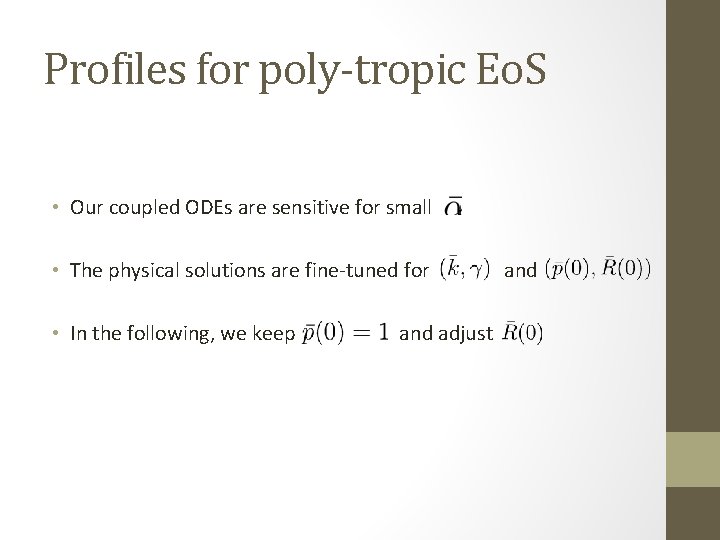
Profiles for poly-tropic Eo. S • Our coupled ODEs are sensitive for small • The physical solutions are fine-tuned for • In the following, we keep and adjust and
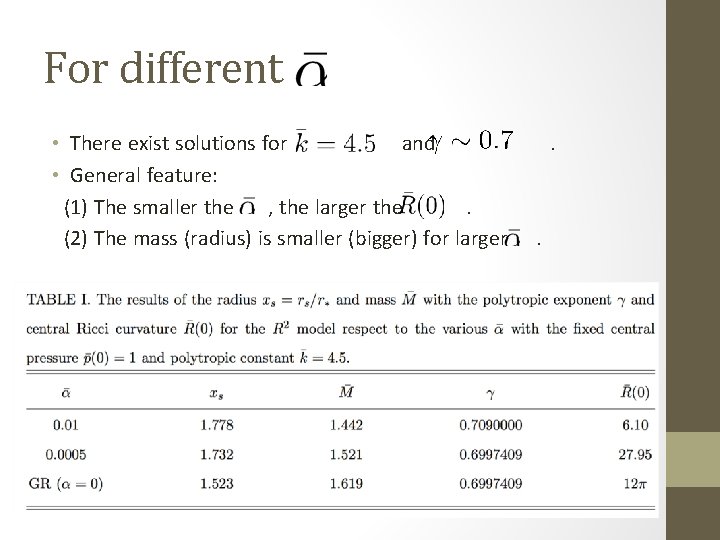
For different • There exist solutions for and • General feature: (1) The smaller the , the larger the. (2) The mass (radius) is smaller (bigger) for larger . .
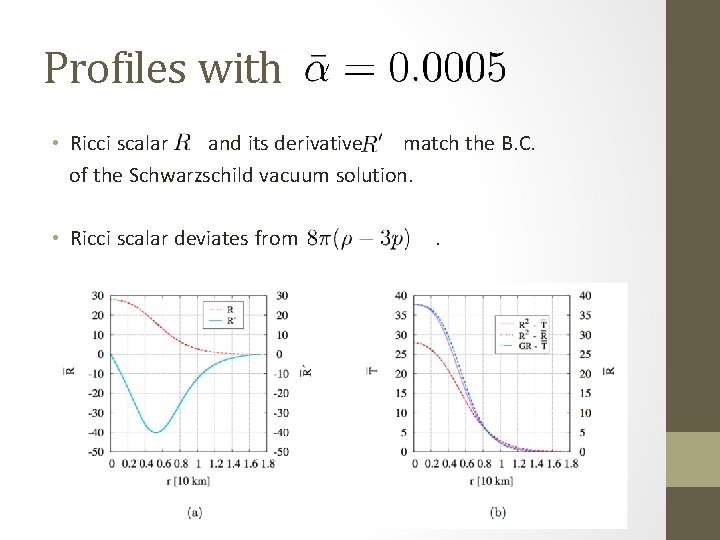
Profiles with • Ricci scalar and its derivative match the B. C. of the Schwarzschild vacuum solution. • Ricci scalar deviates from .
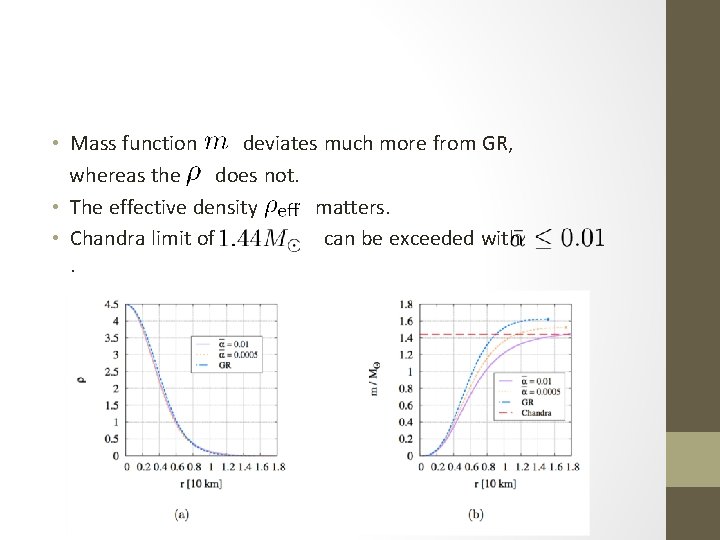
• Mass function deviates much more from GR, whereas the does not. • The effective density matters. • Chandra limit of can be exceeded with.
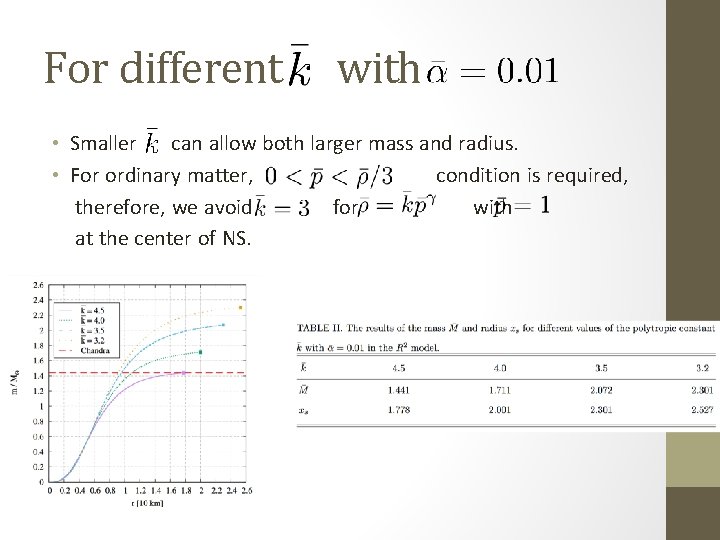
For different with • Smaller can allow both larger mass and radius. • For ordinary matter, condition is required, therefore, we avoid for with at the center of NS.
Buchdahl Stability Bound
• In GR, we have (Buchdahl stability bound) but not • Is there a corresponding relation for R 2 model? • In the R 2 model with poly-tropic Eo. S, still holds for (As we have seen from TABLE I. ) .
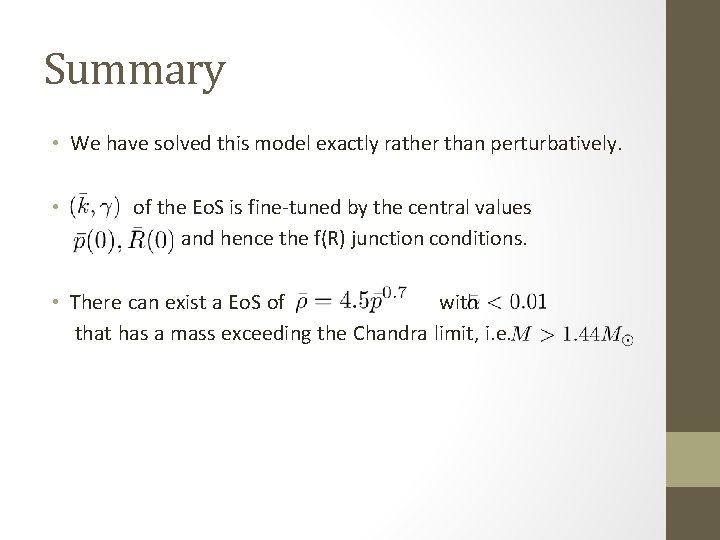
Summary • We have solved this model exactly rather than perturbatively. • of the Eo. S is fine-tuned by the central values and hence the f(R) junction conditions. • There can exist a Eo. S of with that has a mass exceeding the Chandra limit, i. e.
Thanks for your attention!!