
Equation for the microwave backscatter cross section of
Equation for the microwave backscatter cross section of aggregate snowflakes using the Self-Similar Rayleigh. Gans Approximation Robin Hogan ECMWF and Department of Meteorology, University of Reading Chris Westbrook Department of Meteorology, University of Reading Images from Tim Garrett, University of Utah
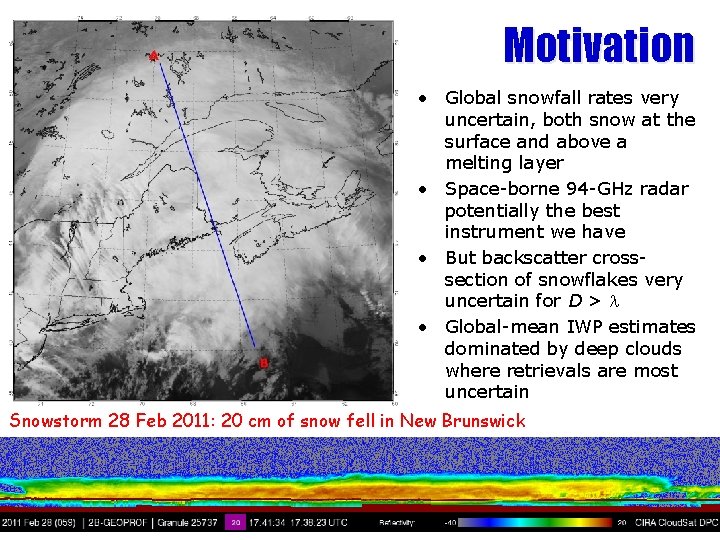
Motivation • Global snowfall rates very uncertain, both snow at the surface and above a melting layer • Space-borne 94 -GHz radar potentially the best instrument we have • But backscatter crosssection of snowflakes very uncertain for D > l • Global-mean IWP estimates dominated by deep clouds where retrievals are most uncertain Snowstorm 28 Feb 2011: 20 cm of snow fell in New Brunswick
Overview • At – – cm wavelengths: D < l Rayleigh theory applies: radar reflectivity proportional to mass squared Snowfall rates sensitive to mass-size and fallspeed-size assumptions mm wavelengths: D > l Particle shape important in addition to mass Matrosov et al (2005), Hogan et al. (2012): large ice particles can be represented by homogeneous oblate (“soft”) spheroids with aspect ratio 0. 6: characterize shape only by dimension in direction of propagation – Petty & Huang (2010), Tyynelä et al. (2011): soft spheroids underestimate backscatter: need to represent exact shape • Who’s right? – Is brute-force computation the only way (e. g. Discrete Dipole Approximation with thousands of snowflake shapes)? • This talk: an equation can be derived for cross-section because – Snowflakes have fractal structure that can be described statistically – The Rayleigh-Gans approximation is applicable
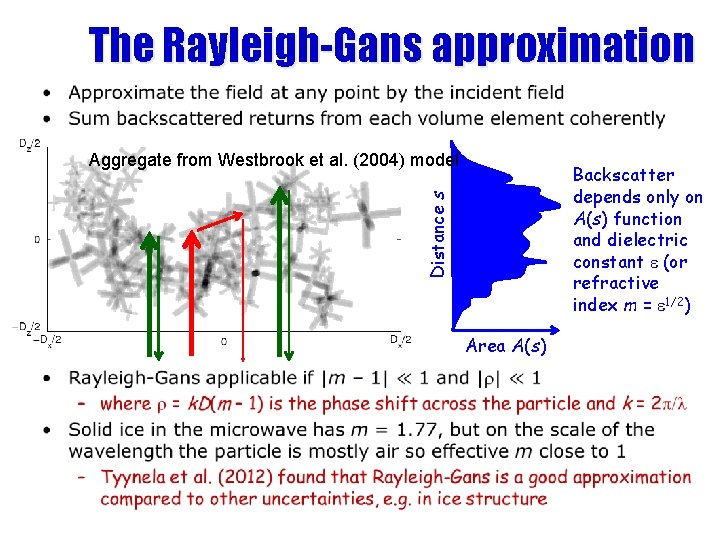
The Rayleigh-Gans approximation • Aggregate from Westbrook et al. (2004) model Distance s Backscatter depends only on A(s) function and dielectric constant e (or refractive index m = e 1/2) Area A(s)

The Rayleigh-Gans approximation • Backscatter cross-section is proportional to the power in the Fourier component of A(s) at the scale of half the wavelength • Can we parameterize A(s) and its variation? Mean structure, k = kurtosis parameter Fluctuations from the mean • where and V is the volume of ice in the particle
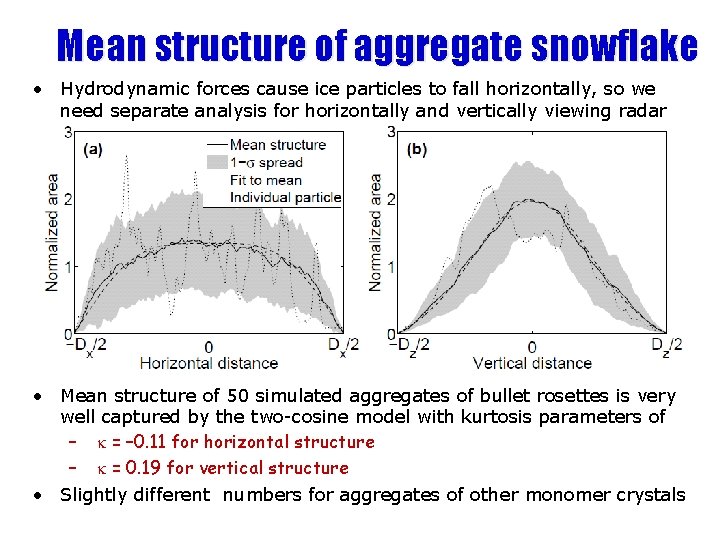
Mean structure of aggregate snowflake • Hydrodynamic forces cause ice particles to fall horizontally, so we need separate analysis for horizontally and vertically viewing radar • Mean structure of 50 simulated aggregates of bullet rosettes is very well captured by the two-cosine model with kurtosis parameters of – k = – 0. 11 for horizontal structure – k = 0. 19 for vertical structure • Slightly different numbers for aggregates of other monomer crystals
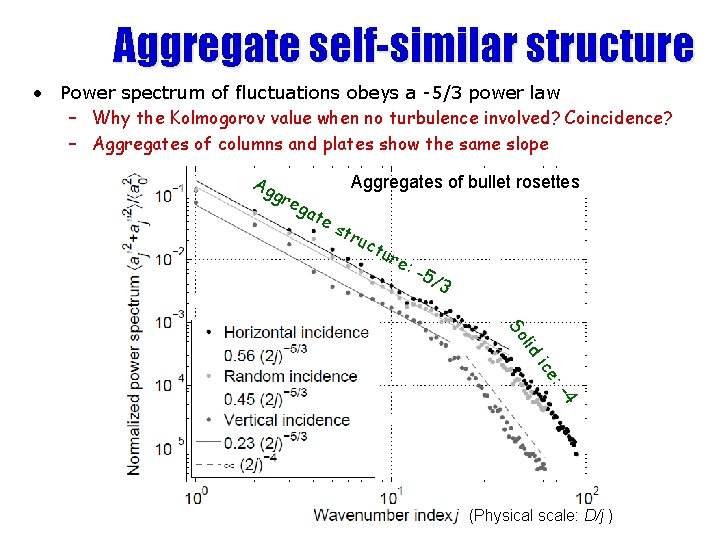
Aggregate self-similar structure • Power spectrum of fluctuations obeys a -5/3 power law – Why the Kolmogorov value when no turbulence involved? Coincidence? – Aggregates of columns and plates show the same slope Ag Aggregates of bullet rosettes gre ga te str u ctu re: -5/ 3 lid So 4 : - ice (Physical scale: D/j )
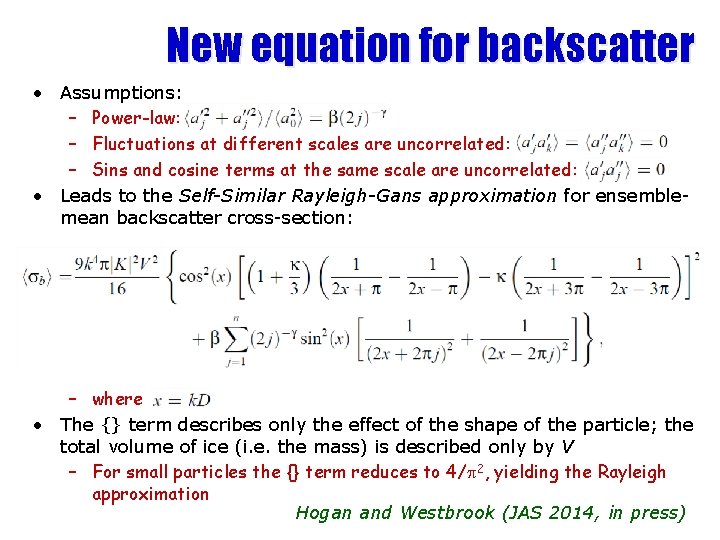
New equation for backscatter • Assumptions: – Power-law: – Fluctuations at different scales are uncorrelated: – Sins and cosine terms at the same scale are uncorrelated: • Leads to the Self-Similar Rayleigh-Gans approximation for ensemblemean backscatter cross-section: – where • The {} term describes only the effect of the shape of the particle; the total volume of ice (i. e. the mass) is described only by V – For small particles the {} term reduces to 4/p 2, yielding the Rayleigh approximation Hogan and Westbrook (JAS 2014, in press)
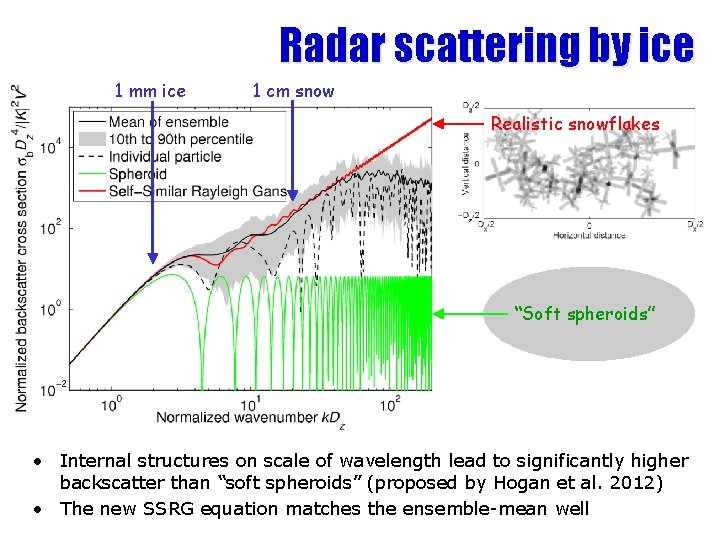
Radar scattering by ice 1 mm ice 1 cm snow Realistic snowflakes “Soft spheroids” • Internal structures on scale of wavelength lead to significantly higher backscatter than “soft spheroids” (proposed by Hogan et al. 2012) • The new SSRG equation matches the ensemble-mean well
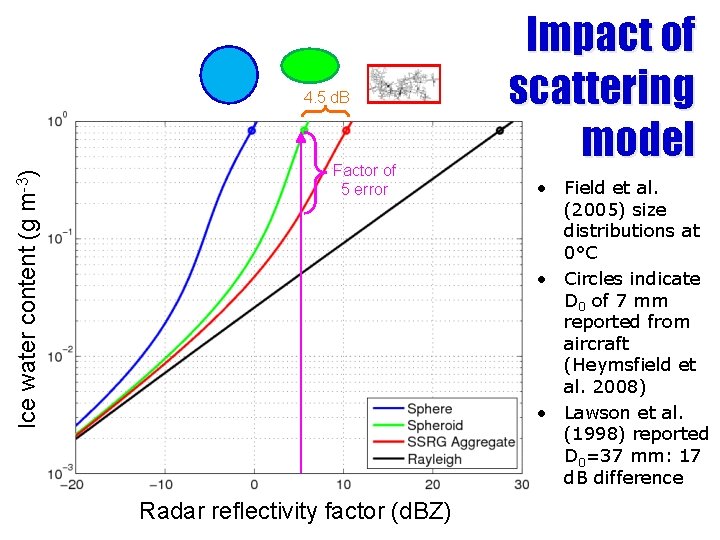
Ice water content (g m-3) 4. 5 d. B Factor of 5 error Radar reflectivity factor (d. BZ) Impact of scattering model • Field et al. (2005) size distributions at 0°C • Circles indicate D 0 of 7 mm reported from aircraft (Heymsfield et al. 2008) • Lawson et al. (1998) reported D 0=37 mm: 17 d. B difference
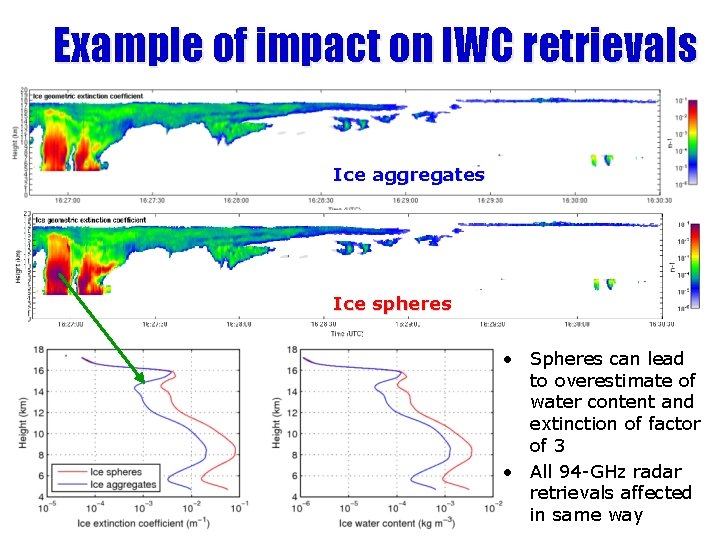
Example of impact on IWC retrievals Ice aggregates Ice spheres • Spheres can lead to overestimate of water content and extinction of factor of 3 • All 94 -GHz radar retrievals affected in same way
Summary • A new “Self-Similar Rayleigh Gans” equation has been proposed for backscatter cross-section of ice aggregates observed by radar – Far less computationally costly than DDA – The effects of shape and mass on backscattering are cleanly separated – Could also be applied to light scattering by some aerosol aggregates • New equation predicts much higher 94 -GHz backscatter for D > l than the “soft spheroid” model, which only works for D < l – Use of soft spheroids in 94 -GHz radar retrievals can lead to factor 3 -5 error in IWC and snowfall rate in thick cloud and snow • Remaining uncertainties in ice/snow retrievals – Mass-size relationship: riming increases density but Earth. CARE’s Doppler will help – Aspect ratio: difference between 0. 6 and 0. 45 around the same as difference between soft-spheroids and realistic particles – Fallspeed relationship: improved with Heymsfield & Westbrook (2010) • Aggregate structure exhibits a power law with a slope of -5/3: why? Hogan and Westbrook (JAS 2014, in press)
- Slides: 12