
Equality in Education and The Key to Solving
- Slides: 16
Equality in Education and The Key to Solving Economic Injustices
‘Nelson Mandela once said ‘Education is the most powerful weapon which you can use to change the world’
Access • the access to education alone can be problematic in who can and who cannot receive the proper education needed for a successful job. • The United Republic of Tanzania National Review in 2015, explains the major challenges that’s associated with the lack of women in the work force.
Worst World Adult Literacy • Somalia has the worst in the world adult literacy of thirty seven percent according to Somalia and American Fund for Education Organization. This statement is then backed up by the world facts book, referring to evidence due to the collapse in the economy authority in 1991, in just recent years the country was able to build its first supermarkets and gas stations.
Niger “due to multiple factors such as food insecurity, lack of industry, high population growth, a weak educational sector, and few prospects for work outside of subsistence farming and herding. ” - The world fact book
Why education is important? • -Education is very important. It teaches about health. A World at School states that educated students can make better informed choices. Education actually saves lives and builds stronger families, communities and economies. Educated students are better informed about sanitation, nutrition and immunization decisions for their children which ultimately leads to decreased child mortality rate because parents are aware of preventable diseases such as diarrhea and pneumonia. • -In fact, it is found that a child born to a literate mother is 50% more likely to survive past the age of five. • -Not allowing everyone with the equal access to education would lead to economic injustice. Education has a positive influence on economic growth and development. • - Researchers have found that if half of the 2010 high school dropouts were to graduate, they would’ve earned approximately $7. 6 billion more each year than those without a diploma. • -This shows that usually those that don’t graduate high school don’t earn nearly as much as those that do graduate. In fact, those without high school diplomas usually end up at the lowest end of the spectrum, and have a hard time saving and accumulating wealth. • -Every time a student doesn’t graduate the country losses its chance to become economically stable.
Few Countries that have discrimination Race • Receiving an education has been problematic in numerous parts of the world. There are many reasons why children aren’t able to receive the proper education they deserve. • One main reason is racial discrimination. Students don’t feel welcomed at the school therefore do worse academically because they are not comfortable to interact and their teacher questions. Because there is discrimination teachers never make an effort to put kids on track, and that’s why many kids don’t graduate nor make it to a good college Religion • Next, there is discrimination on religion. According to George M. Marsden Religious Discrimination in Academia states that certain religions are not allowed to be discussed in schools therefore, certain subjects aren’t being taught as they should be. When this happens children are missing valuable information. • The author goes on to talk about religions that aren’t allowed in certain schools, and who is to say which is right or wrong? • As witnesses we are disgusted by these things because it is wrong to not provide education to children based on their race, religion or gender.
What countries have these problems? • -According to Elite Daily these forms of discrimination on education occur in Pakistan, Nepal, Haiti, Egypt, and Guatemala. • War Zones • -We are aware that discrimination is not the only reason why children aren’t able to get an education. Another big reason why children aren’t able to go to school is because of the war that’s going on in their country. • -According to Martha Bragin, a university professor and the author of So That Our Dreams Will Not Escape us: Learning to Think Together in Time of War she discusses how children actually want to receive an education. However, they aren’t able to go to school because of the war. In fact, when children were asked to name their main priorities, attending school was at the top of the list. Because children associate school success with a hopeful future.
Recommendation In order to reduce these problems we recommend that children still practice their school work during that time of war because they say education is one of their top concerns. We hope that family members help the children with their work if they have time, which can even be the bare minimum. We just want children to learn something and to know that education is still very important. We also recommend that meetings should take place for students, teachers, parents and so they know just how important education is as well as why discrimination needs to end. We will also discuss funding so that low income students will receive the education they deserve. By taking these steps we will be able to help rise education.
The PROBLEM Huge Gap in the difference in funding for inner city schools vs. schools in thriving cities The United States have issues with the equality between educational opportunities in different neighborhoods. Only about 19% of students from urban school districts seek higher education compared to 70% of their suburban counterparts (Whitney Wright). Suburban and urban sectors of the education system are drastically different due to resources, teacher attrition rate, and lack of parental support. No Child Left Behind and The Elementary and Secondary Education Act were supposed to create equity are implemented in schools, they instead create inequality in America’s public school system. Students in certain regions remain at a disadvantage, as one district is favored based on performance over lowperforming districts (Whitney Wright).
The SOLUTION Increase a tax on alcohol and cigarettes that benefit poor schools. Create a legislation that will base the salary of congressman on the success of their schools. o This will force them to demand success and will make them want to reform the schooling system, because if it doesn’t, they will not get the lavish pay they typically receive. o This will also mean that the salary cuts from the congressmen that don’t help the educational system will go back into the school. Create a legislation that requires a set discipline for all schools to follow so all children are taught the same.
What worked? • Finland’s education system is world-known • Finland also is the most literate country in the world (100%) • Top scoring students in the PISA (Program for International Student Assessment) year after year • Finland uses a unique approach towards their students which helps them learn better, so students are happier with schooling.
What’s working? (But hurting at the same time) • South Korea is also amongst top scoring nations in the world (97. 9%) • But is also home to the highest suicide rates amongst children and youth • High pressure from parents and teachers is causing health problems that include depression, health problems and even suicide • Saturday school, 13 hour school days- second shift at tutors that ¾ of students in South Korea attend to prepare for testing that will determine their futures
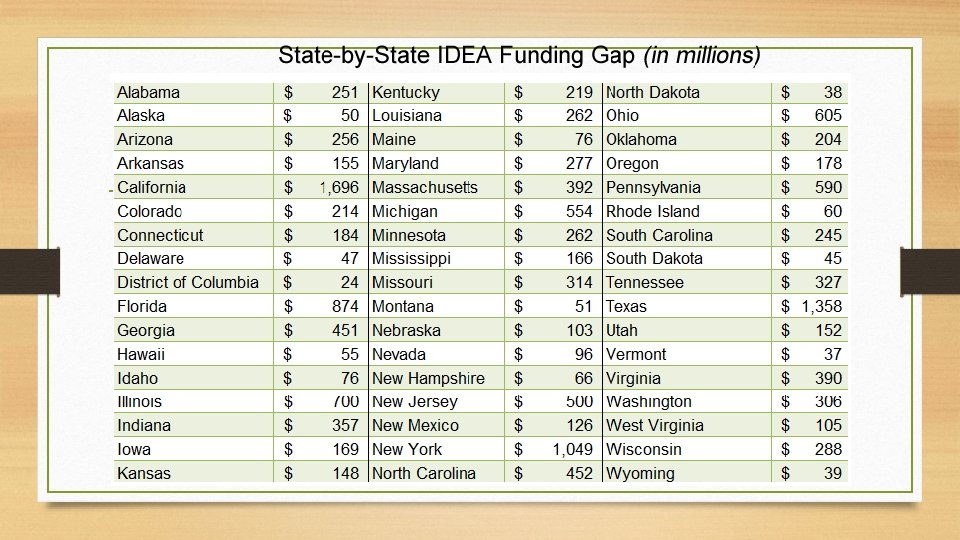
• Wright, Whitney. The Disparities between Urban and Suburban American Education Systems: A Comparative Analysis • Using Social Closure Theory. Http: //www. efc. gwu. edu/. The Educational Facilities Clearinghouse, 29 Mar. 2009. Web. • State-By-State IDEA Funding Gap (In Millions). Digital image. Ideamoneywatch. com. N. p. , n. d. Web. • Bragin, Martha. “So That Our Dreams Will Not Escape us: Learning to Think Together in Time Inquiry 32. 2 (March 2012): 115 -135. Taylors & Francis Group. of War. ” Psychoanalytic Web. 8 April 2016. • Education and Discrimination Against Girls. ” A World at School, n. d. Web. 8 April 2016. • Marsden, George M. “Religious Discrimination in Academia. ” Society 52. 1 (Feb. 2015): 19 -22. Springer. Web. 8 April 2016. • “You Won’t Believe How Many Countries Still Won’t Allow Women the Right to Education. ” Web. 8 April 2016. Elite Daily, n. d.
Chakrabarti, Reeta. "South Korea's Schools: Long Days, High Results. " BBC News. BBC, 2 Dec. 2013. Web. 18 Apr. 2016. "The Highest Literacy Rates in the World. " World. Atlas. World Atlas, n. d. Web. 18 Apr. 2016. Taylor, Adam. "26 Amazing Facts About Finland's Unorthodox Education System. " Business Insider, Inc, 14 Dec. 2011. Web. 18 Apr. 2016.