
Equality Impact Assessment Events 2016 Introductory Exercise Which
- Slides: 14
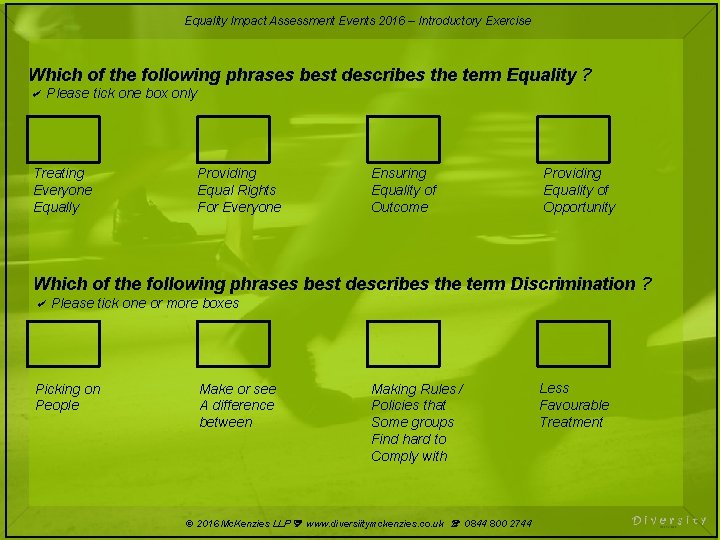
Equality Impact Assessment Events 2016 – Introductory Exercise Which of the following phrases best describes the term Equality ? Please tick one box only Treating Everyone Equally Providing Equal Rights For Everyone Ensuring Equality of Outcome Providing Equality of Opportunity Which of the following phrases best describes the term Discrimination ? Please tick one or more boxes Picking on People Make or see A difference between Making Rules / Policies that Some groups Find hard to Comply with © 2016 Mc. Kenzies LLP www. diversiitymckenzies. co. uk 0844 800 2744 Less Favourable Treatment
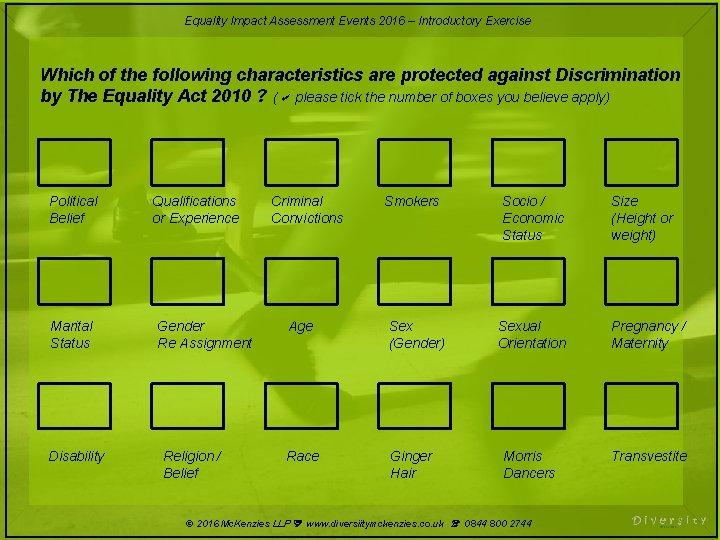
Equality Impact Assessment Events 2016 – Introductory Exercise Which of the following characteristics are protected against Discrimination by The Equality Act 2010 ? ( please tick the number of boxes you believe apply) Political Belief Marital Status Disability Qualifications or Experience Gender Re Assignment Religion / Belief Criminal Convictions Smokers Age Sex (Gender) Race Ginger Hair Socio / Economic Status Size (Height or weight) Sexual Orientation Pregnancy / Maternity Morris Dancers Transvestite © 2016 Mc. Kenzies LLP www. diversiitymckenzies. co. uk 0844 800 2744
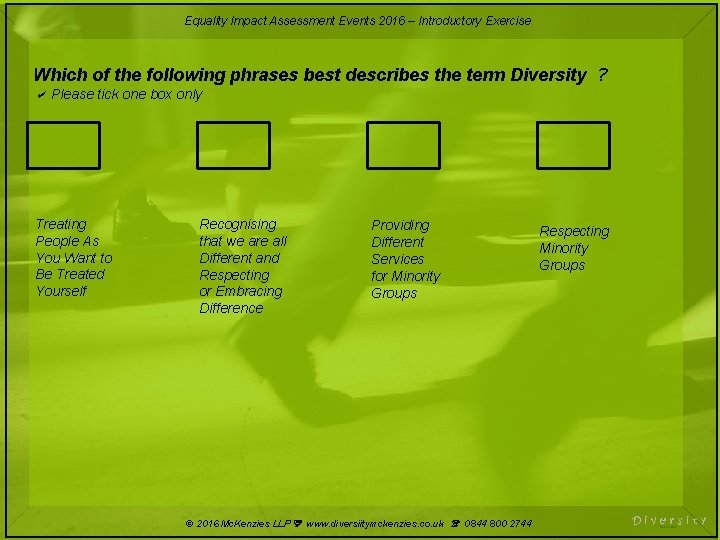
Equality Impact Assessment Events 2016 – Introductory Exercise Which of the following phrases best describes the term Diversity ? Please tick one box only Treating People As You Want to Be Treated Yourself Recognising that we are all Different and Respecting or Embracing Difference Providing Different Services for Minority Groups © 2016 Mc. Kenzies LLP www. diversiitymckenzies. co. uk 0844 800 2744 Respecting Minority Groups
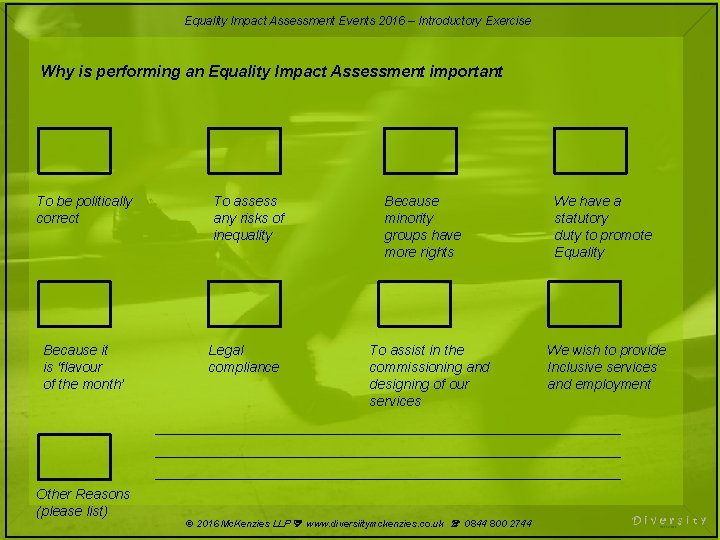
Equality Impact Assessment Events 2016 – Introductory Exercise Why is performing an Equality Impact Assessment important To be politically correct Because it is ‘flavour of the month’ Other Reasons (please list) To assess any risks of inequality Legal compliance Because minority groups have more rights To assist in the commissioning and designing of our services © 2016 Mc. Kenzies LLP www. diversiitymckenzies. co. uk 0844 800 2744 We have a statutory duty to promote Equality We wish to provide Inclusive services and employment
Equality Impact Assessment Events What is an Equality Impact Assessment ? It is a risk assessment. The aim being to identify potential risks of discrimination or adverse impact in our policies and functions. Once equality implications have been identified, steps can be taken to amend the proposed policy, project or function or amend the way in which it is currently implemented to ensure it is inclusive and does not discriminate (either deliberately or accidentally).
Why are Equality Impact Assessments Important ? Improved service delivery outcomes Facilitate the delivery of Equality objectives Legal Compliance Meet the requirements of the Public Sector Equality Duty Meet the need of our diverse residents Ensure employment practices are inclusive Identify risks of discrimination before it is identified for us Requirements of The Equality Standard Include Equality considerations in the commissioning cycle
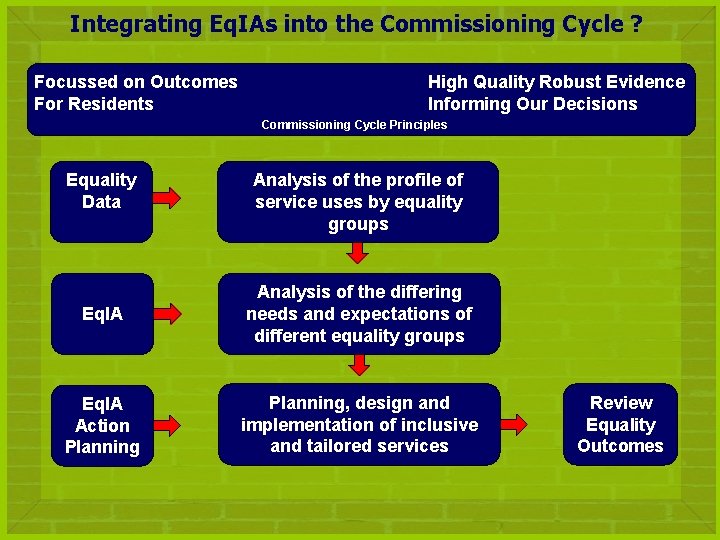
Integrating Eq. IAs into the Commissioning Cycle ? Focussed on Outcomes For Residents High Quality Robust Evidence Informing Our Decisions Commissioning Cycle Principles Equality Data Analysis of the profile of service uses by equality groups Eq. IA Analysis of the differing needs and expectations of different equality groups Eq. IA Action Planning, design and implementation of inclusive and tailored services Review Equality Outcomes
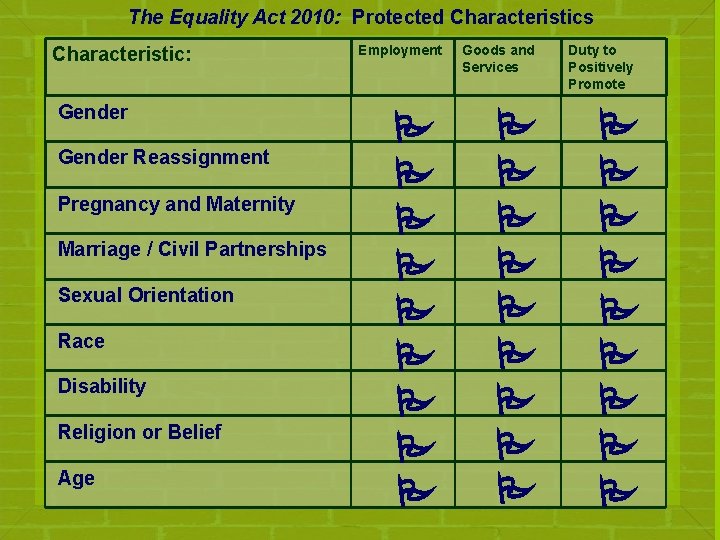
The Equality Act 2010: Protected Characteristics Characteristic: Gender Reassignment Pregnancy and Maternity Marriage / Civil Partnerships Sexual Orientation Race Disability Religion or Belief Age Employment Goods and Services Duty to Positively Promote
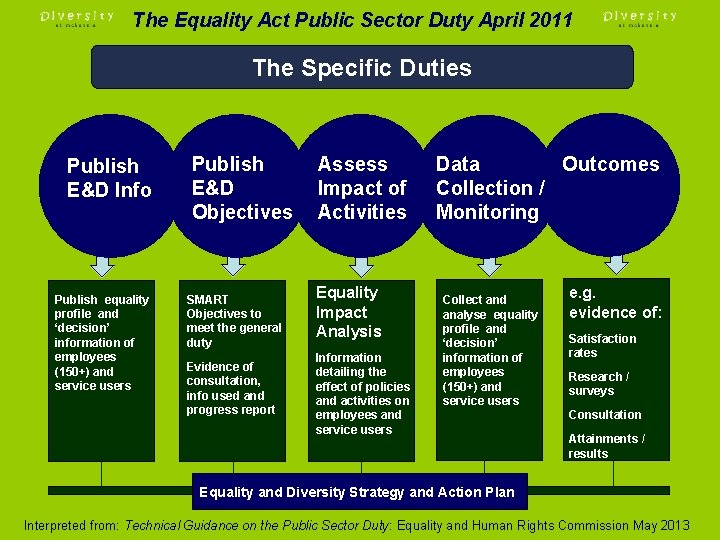
The Equality Act Public Sector Duty April 2011 The Specific Duties Publish E&D Info Publish equality profile and ‘decision’ information of employees (150+) and service users Publish E&D Objectives SMART Objectives to meet the general duty Evidence of consultation, info used and progress report Assess Impact of Activities Equality Impact Analysis Information detailing the effect of policies and activities on employees and service users Data Outcomes Collection / Monitoring Collect and analyse equality profile and ‘decision’ information of employees (150+) and service users e. g. evidence of: Satisfaction rates Research / surveys Consultation Attainments / results Equality and Diversity Strategy and Action Plan Interpreted from: Technical Guidance on the Public Sector Duty: Equality and Human Rights Commission May 2013
Equality Impact Assessment Events Essential Briefing: Direct and Indirect Discrimination
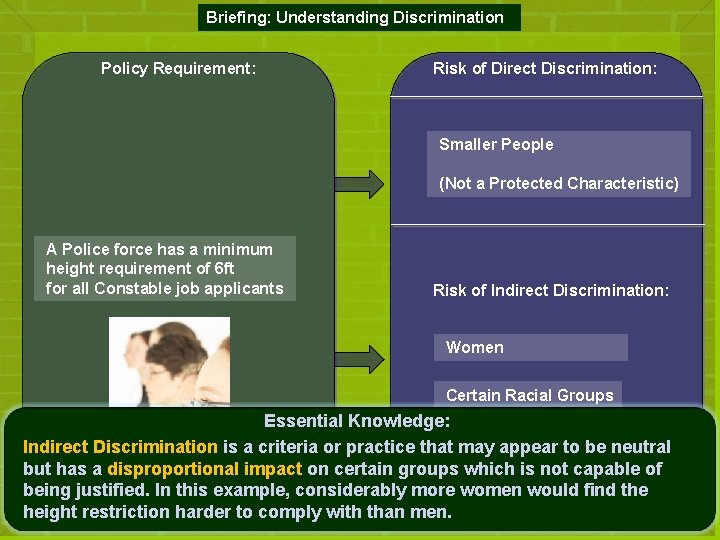
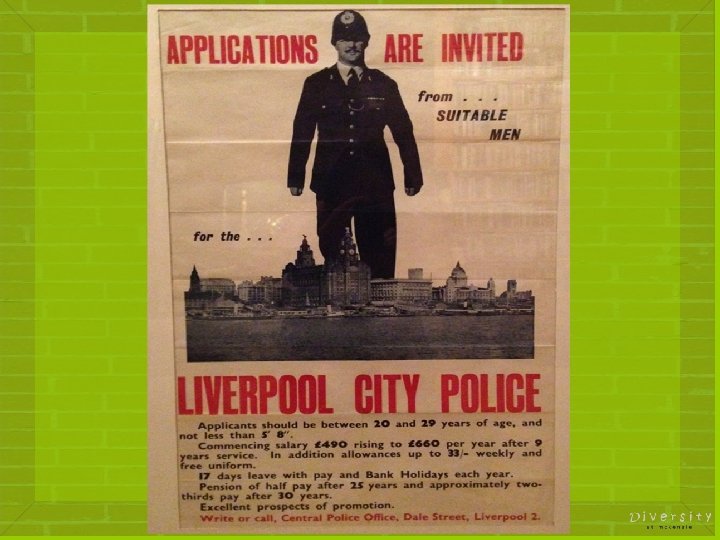
Briefing: Understanding Discrimination Policy Requirement: Risk of Direct Discrimination: Smaller People (Not a Protected Characteristic) A Police force has a minimum height requirement of 6 ft for all Constable job applicants Risk of Indirect Discrimination: Women Certain Racial Groups Essential Knowledge: Indirect Discrimination is a criteria or practice that may appear to be neutral but has a disproportional impact on certain groups which is not capable of being justified. In this example, considerably more women would find the height restriction harder to comply with than men.
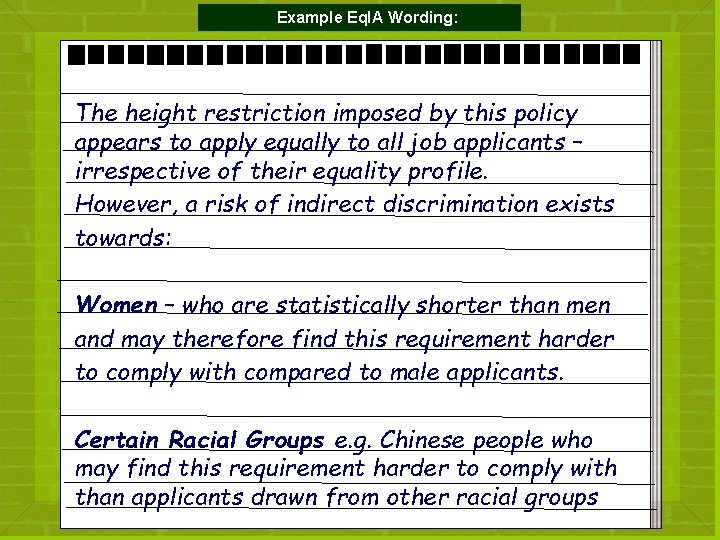
Example Eq. IA Wording: Policy Requirement: The height restriction imposed by this policy appears to apply equally to all job applicants – irrespective of their equality profile. However, a risk of indirect discrimination exists towards: Women – who are statistically shorter than men and may therefore find this requirement harder Women to comply with compared to male applicants. Certain Racial Groups e. g. Chinese people who may find this requirement harder to comply with than applicants drawn from other racial groups
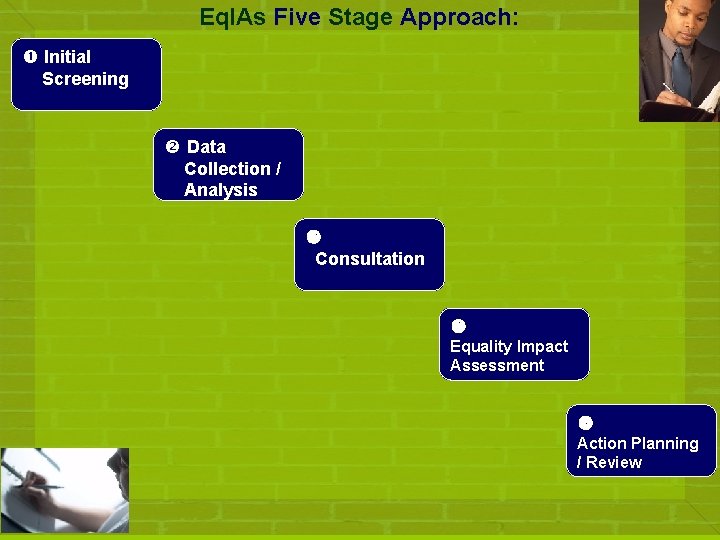
Eq. IAs Five Stage Approach: Initial Screening Data Collection / Analysis Consultation Equality Impact Assessment Action Planning / Review