
EQ How do momentum and impulse relate to


- Slides: 15
EQ: How do momentum and impulse relate to one another? Chapter 6: MOMENTUM
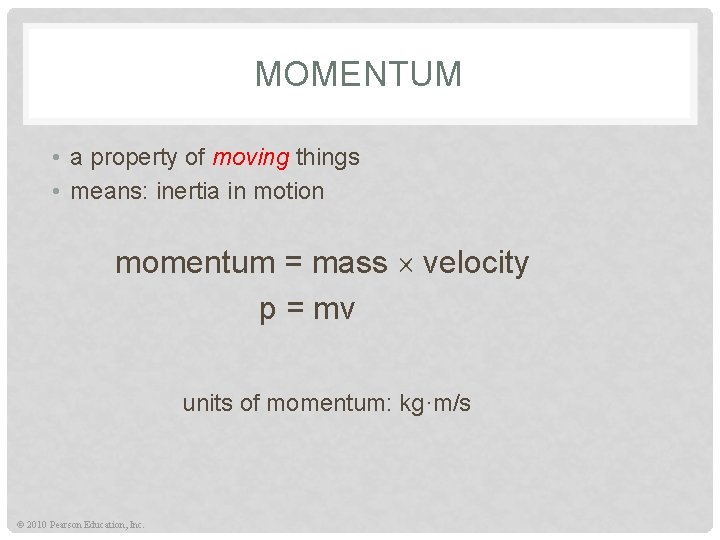
MOMENTUM • a property of moving things • means: inertia in motion momentum = mass velocity p = mv units of momentum: kg·m/s © 2010 Pearson Education, Inc.
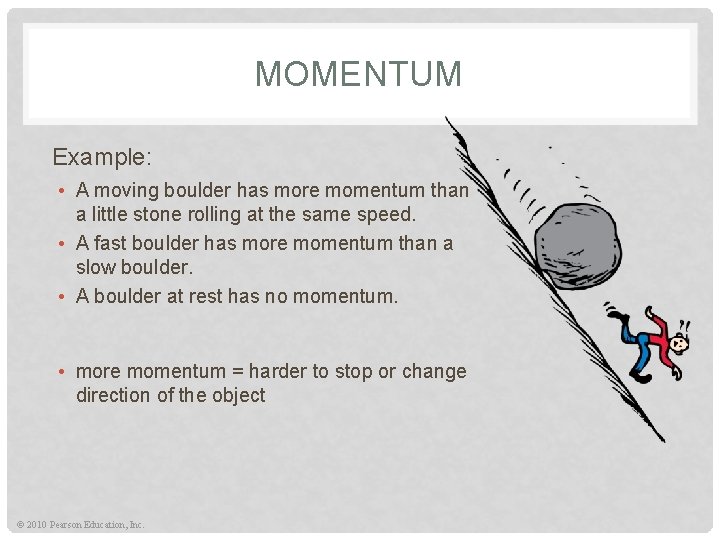
MOMENTUM Example: • A moving boulder has more momentum than a little stone rolling at the same speed. • A fast boulder has more momentum than a slow boulder. • A boulder at rest has no momentum. • more momentum = harder to stop or change direction of the object © 2010 Pearson Education, Inc.
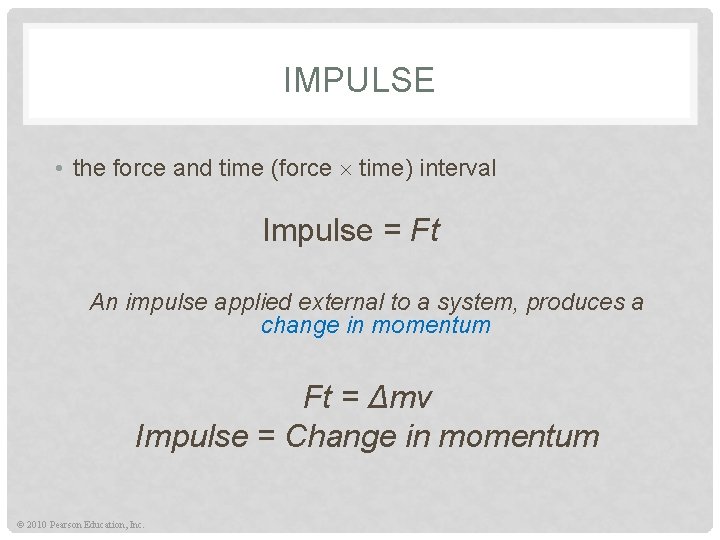
IMPULSE • the force and time (force time) interval Impulse = Ft An impulse applied external to a system, produces a change in momentum Ft = Δmv Impulse = Change in momentum © 2010 Pearson Education, Inc.
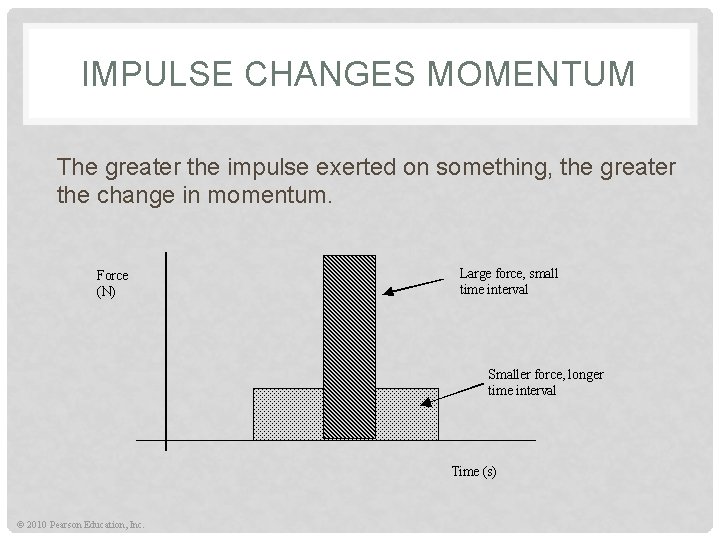
IMPULSE CHANGES MOMENTUM The greater the impulse exerted on something, the greater the change in momentum. © 2010 Pearson Education, Inc.
IMPULSE CHANGES MOMENTUM • Case 1: increasing momentum • F and t • Apply the greatest force for as long as possible and you extend the time of contact. Examples: • Golfer swings a club and follows through. • Baseball player hits a ball and follows through. © 2010 Pearson Education, Inc.
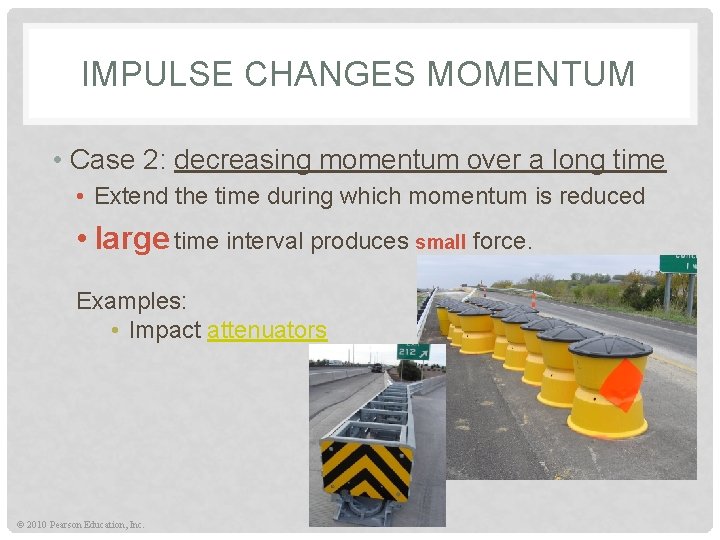
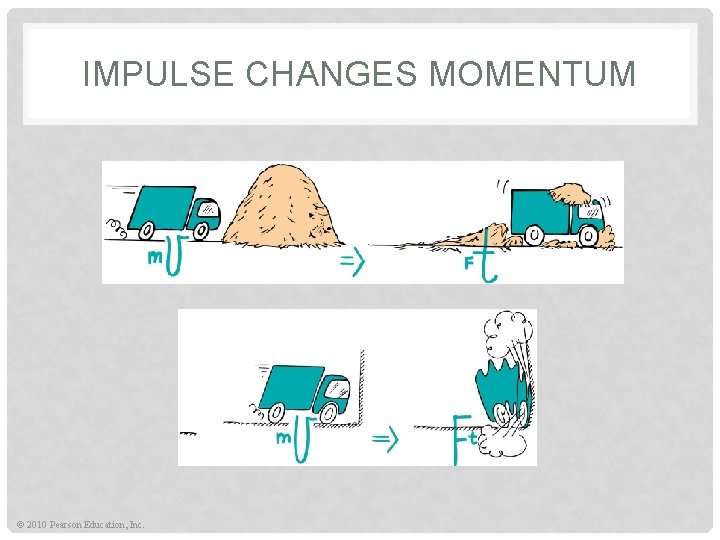
IMPULSE CHANGES MOMENTUM • Case 2: decreasing momentum over a long time • Extend the time during which momentum is reduced • large time interval produces small force. Examples: • Impact attenuators © 2010 Pearson Education, Inc.
IMPULSE CHANGES MOMENTUM © 2010 Pearson Education, Inc.
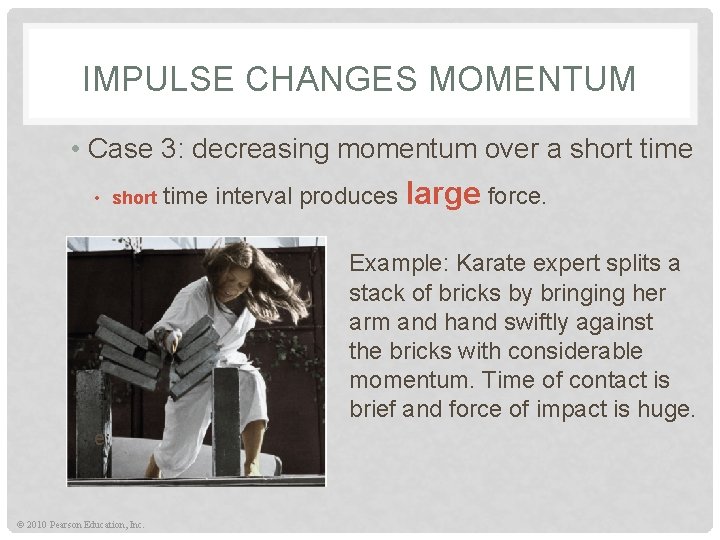
IMPULSE CHANGES MOMENTUM • Case 3: decreasing momentum over a short time • short time interval produces large force. Example: Karate expert splits a stack of bricks by bringing her arm and hand swiftly against the bricks with considerable momentum. Time of contact is brief and force of impact is huge. e: © 2010 Pearson Education, Inc.
BOUNCING Impulses are generally greater when objects bounce. Example: Catching a falling flower pot from a shelf with your hands. You provide the impulse to reduce its momentum to zero. If you throw the flower pot up again, you provide an additional impulse. This “double impulse” occurs when something bounces. © 2010 Pearson Education, Inc.
TODAY’S ESSENTIAL QUESTION How is momentum conserved in collisions? © 2010 Pearson Education, Inc.
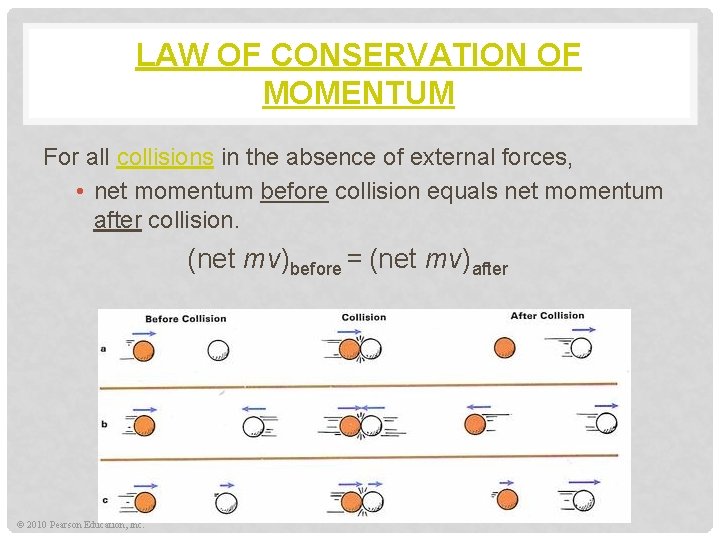
LAW OF CONSERVATION OF MOMENTUM For all collisions in the absence of external forces, • net momentum before collision equals net momentum after collision. (net mv)before = (net mv)after © 2010 Pearson Education, Inc.
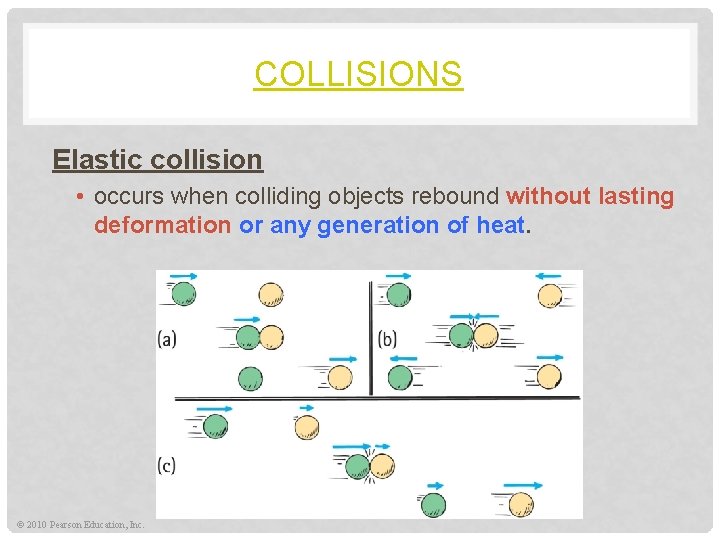
COLLISIONS Elastic collision • occurs when colliding objects rebound without lasting deformation or any generation of heat. © 2010 Pearson Education, Inc.
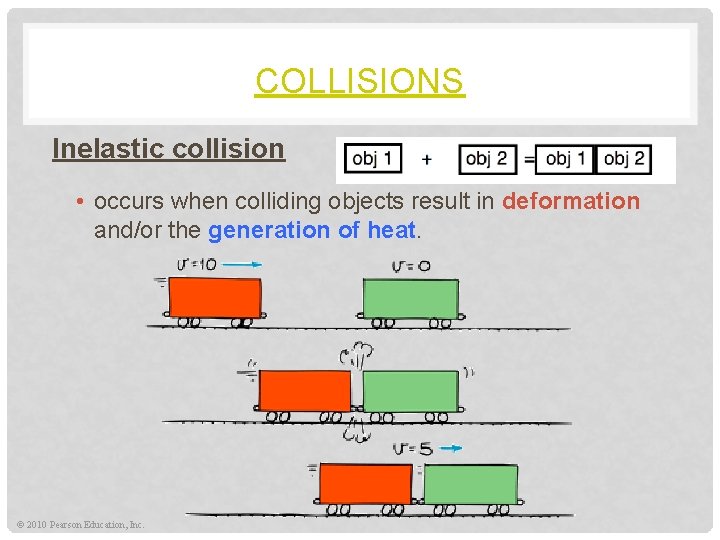
COLLISIONS Inelastic collision • occurs when colliding objects result in deformation and/or the generation of heat. © 2010 Pearson Education, Inc.
MORE COMPLICATED COLLISIONS • Sometimes the colliding objects are not moving in the same straight line. • In this case you create a parallelogram of the vectors describing each initial momentum to find the combined momentum. • Example: collision of two cars at a corner © 2010 Pearson Education, Inc.