
EPSC 210 Introductory Mineralogy Feldspars the end and
- Slides: 47
EPSC 210 Introductory Mineralogy Feldspars (the end) and Inosilicates
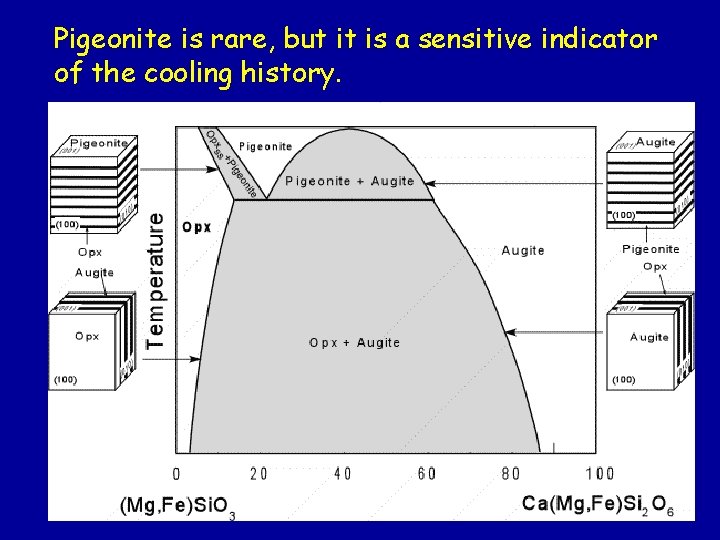
Pigeonite is rare, but it is a sensitive indicator of the cooling history.
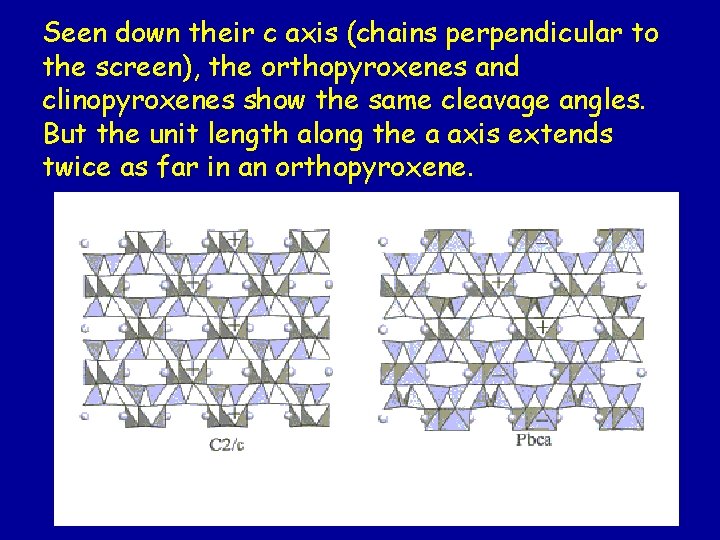
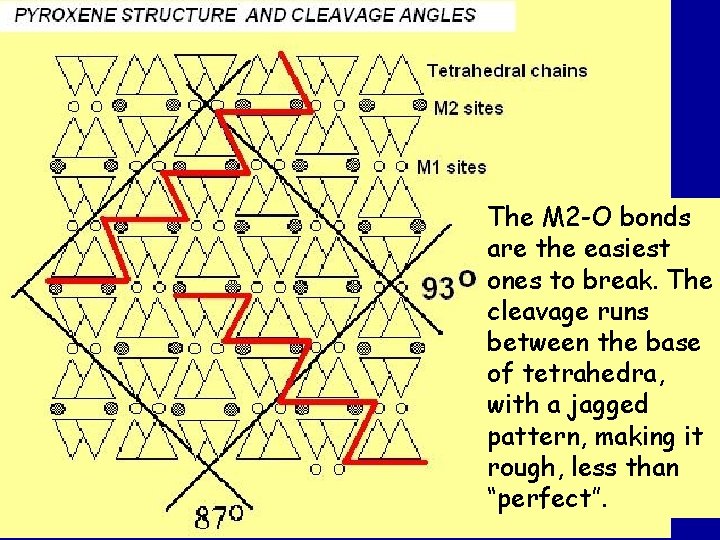
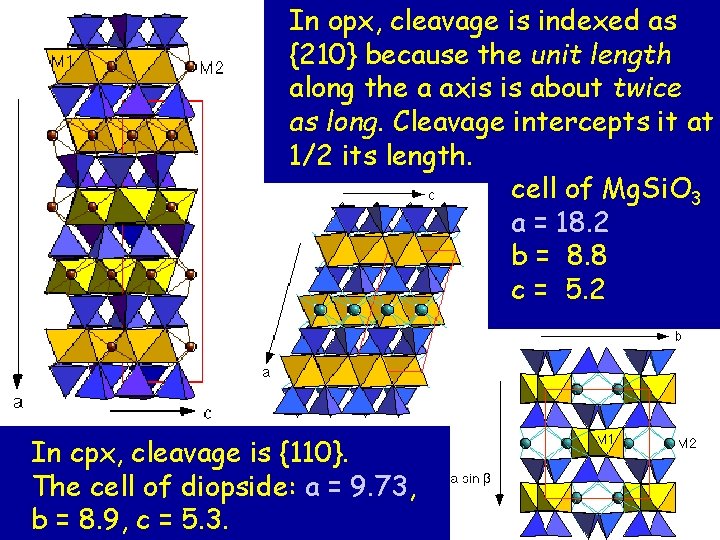
Seen down their c axis (chains perpendicular to the screen), the orthopyroxenes and clinopyroxenes show the same cleavage angles. But the unit length along the a axis extends twice as far in an orthopyroxene.
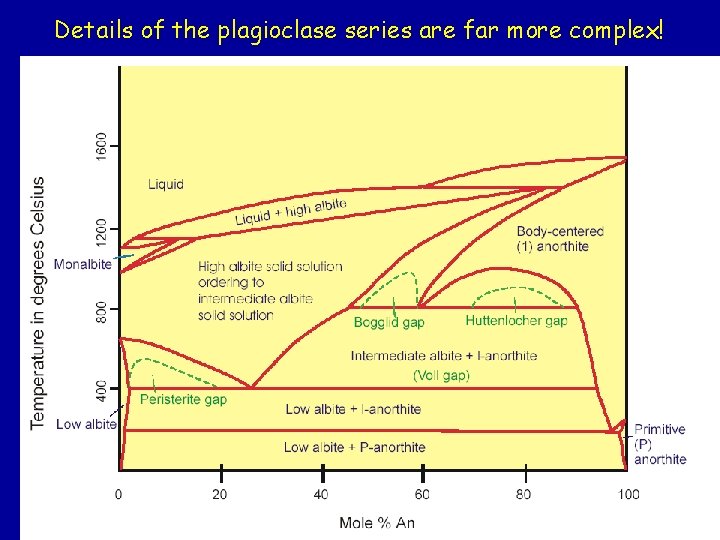
Details of the plagioclase series are far more complex!
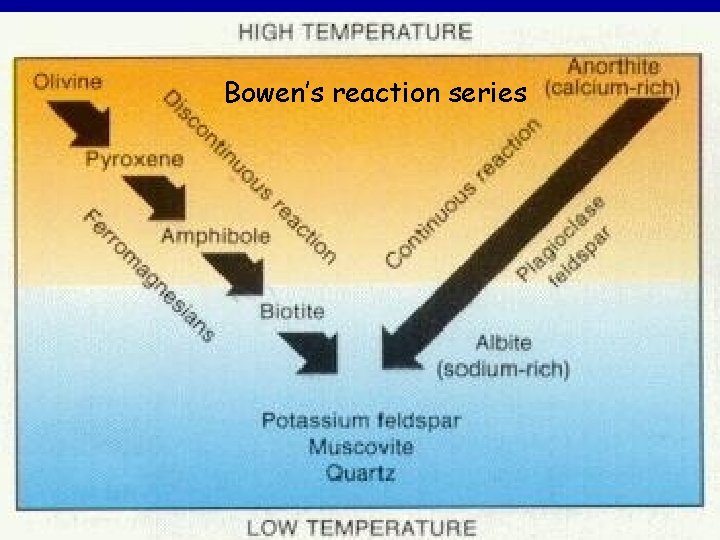
Bowen’s reaction series
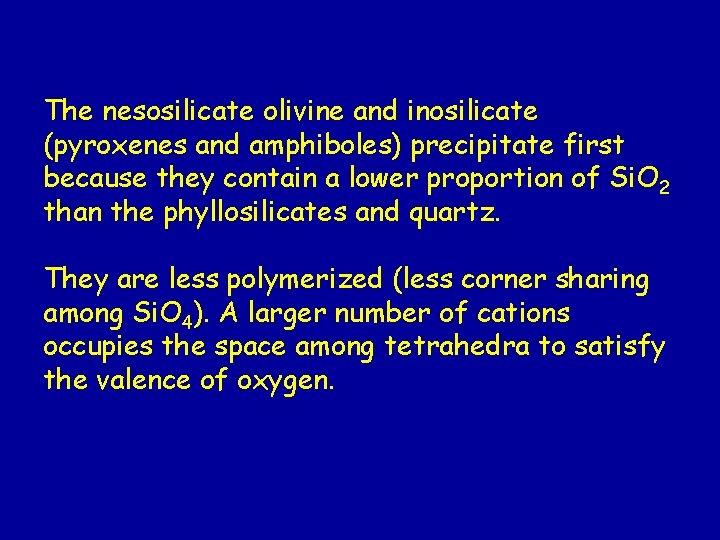
The nesosilicate olivine and inosilicate (pyroxenes and amphiboles) precipitate first because they contain a lower proportion of Si. O 2 than the phyllosilicates and quartz. They are less polymerized (less corner sharing among Si. O 4). A larger number of cations occupies the space among tetrahedra to satisfy the valence of oxygen.
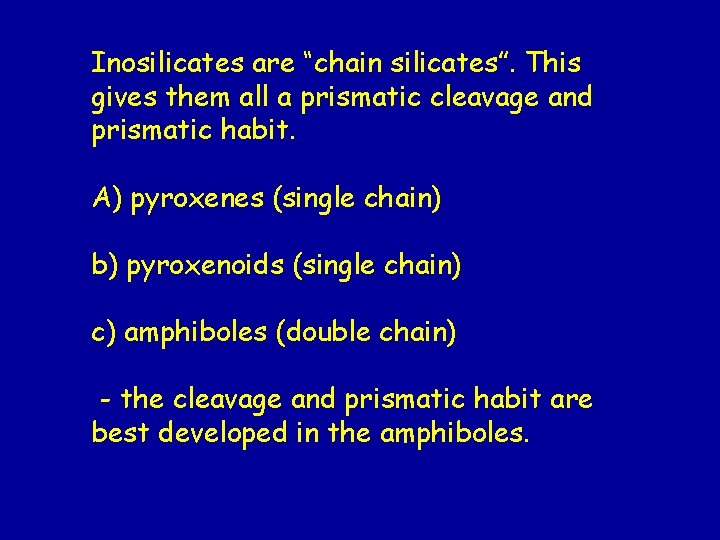
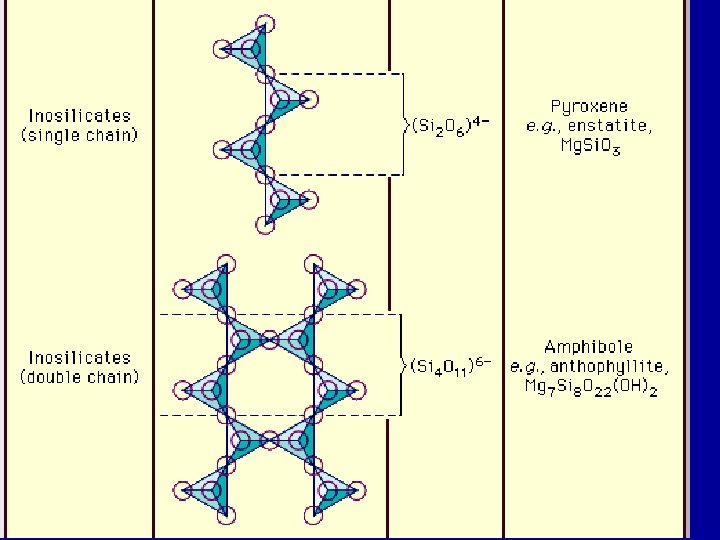
Inosilicates are “chain silicates”. This gives them all a prismatic cleavage and prismatic habit. A) pyroxenes (single chain) b) pyroxenoids (single chain) c) amphiboles (double chain) - the cleavage and prismatic habit are best developed in the amphiboles.
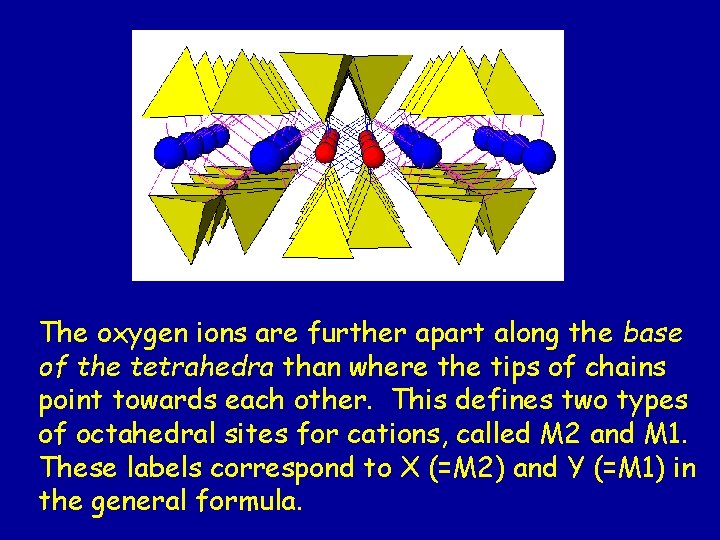
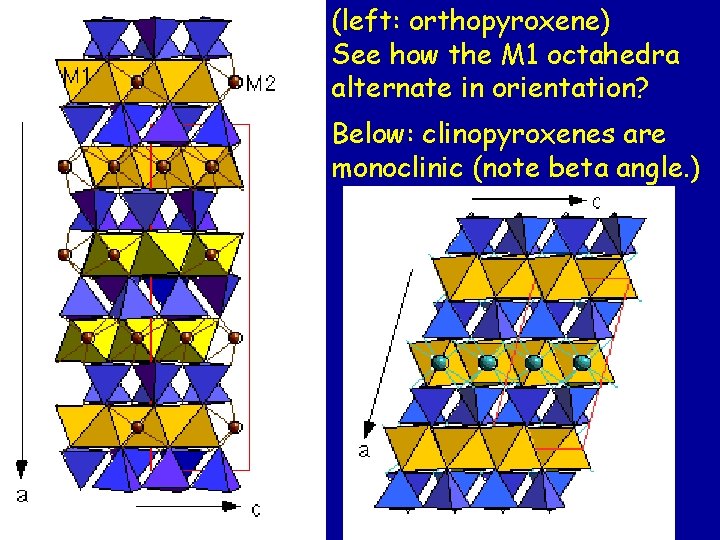
The oxygen ions are further apart along the base of the tetrahedra than where the tips of chains point towards each other. This defines two types of octahedral sites for cations, called M 2 and M 1. These labels correspond to X (=M 2) and Y (=M 1) in the general formula.
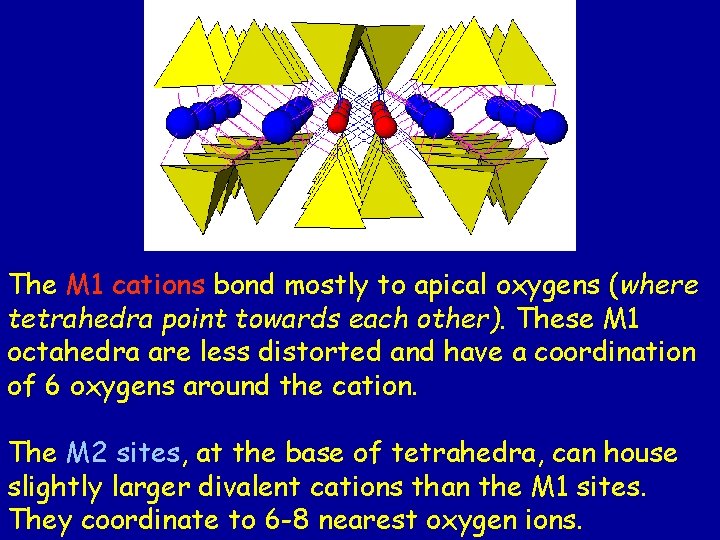
The M 1 cations bond mostly to apical oxygens (where tetrahedra point towards each other). These M 1 octahedra are less distorted and have a coordination of 6 oxygens around the cation. The M 2 sites, at the base of tetrahedra, can house slightly larger divalent cations than the M 1 sites. They coordinate to 6 -8 nearest oxygen ions.
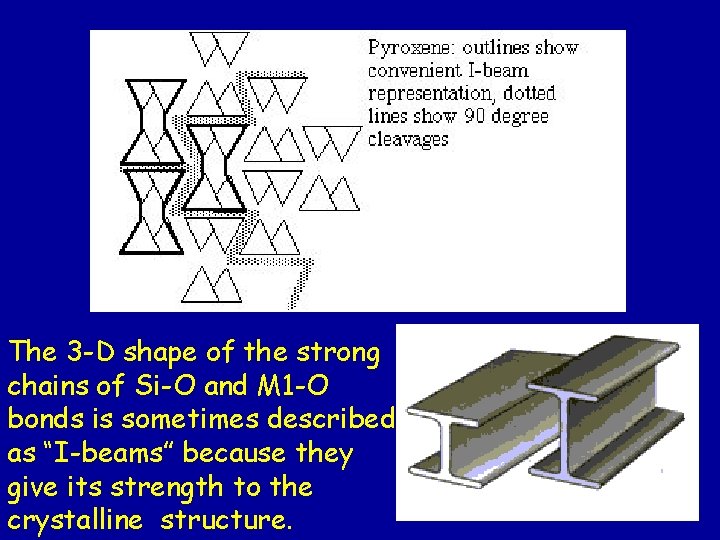
The 3 -D shape of the strong chains of Si-O and M 1 -O bonds is sometimes described as “I-beams” because they give its strength to the crystalline structure.
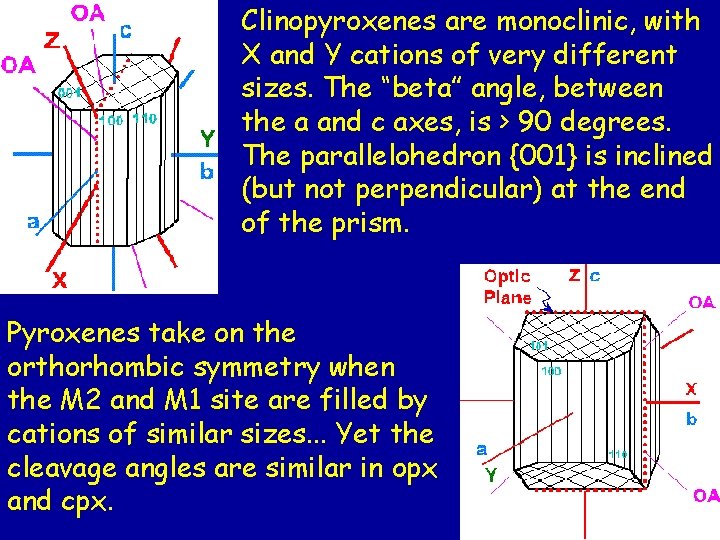
Clinopyroxenes are monoclinic, with X and Y cations of very different sizes. The “beta” angle, between the a and c axes, is > 90 degrees. The parallelohedron {001} is inclined (but not perpendicular) at the end of the prism. Pyroxenes take on the orthorhombic symmetry when the M 2 and M 1 site are filled by cations of similar sizes. . . Yet the cleavage angles are similar in opx and cpx.
(left: orthopyroxene) See how the M 1 octahedra alternate in orientation? Below: clinopyroxenes are monoclinic (note beta angle. )
The M 2 -O bonds are the easiest ones to break. The cleavage runs between the base of tetrahedra, with a jagged pattern, making it rough, less than “perfect”.
In opx, cleavage is indexed as {210} because the unit length along the a axis is about twice as long. Cleavage intercepts it at 1/2 its length. cell of Mg. Si. O 3 a = 18. 2 b = 8. 8 c = 5. 2 In cpx, cleavage is {110}. The cell of diopside: a = 9. 73, b = 8. 9, c = 5. 3.
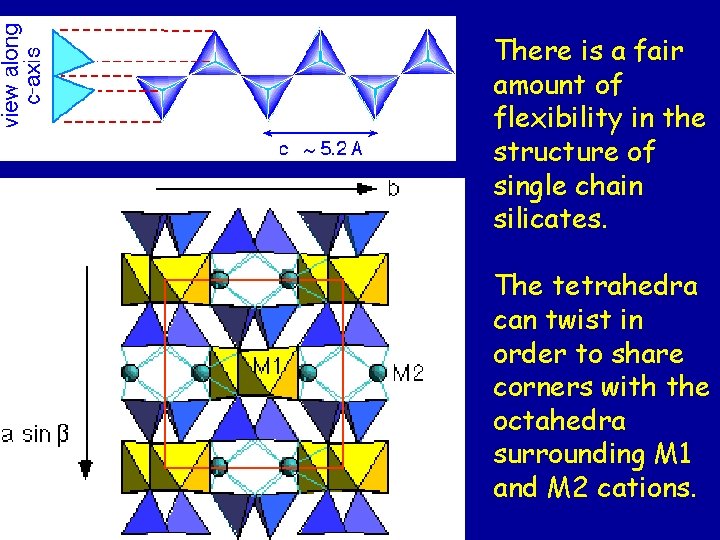
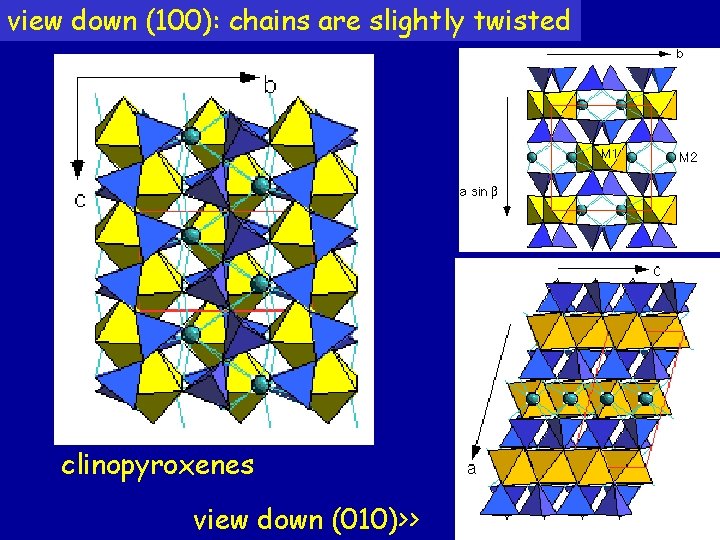
There is a fair amount of flexibility in the structure of single chain silicates. The tetrahedra can twist in order to share corners with the octahedra surrounding M 1 and M 2 cations.
view down (100): chains are slightly twisted clinopyroxenes view down (010)>>
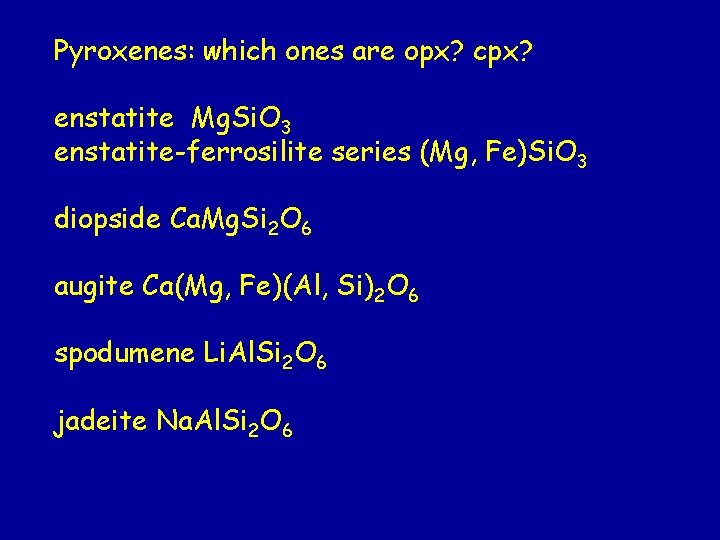
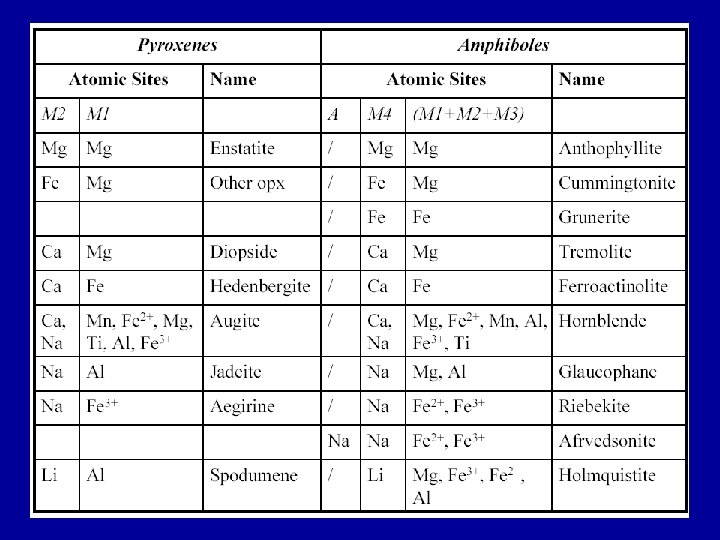
Pyroxenes: which ones are opx? cpx? enstatite Mg. Si. O 3 enstatite-ferrosilite series (Mg, Fe)Si. O 3 diopside Ca. Mg. Si 2 O 6 augite Ca(Mg, Fe)(Al, Si)2 O 6 spodumene Li. Al. Si 2 O 6 jadeite Na. Al. Si 2 O 6
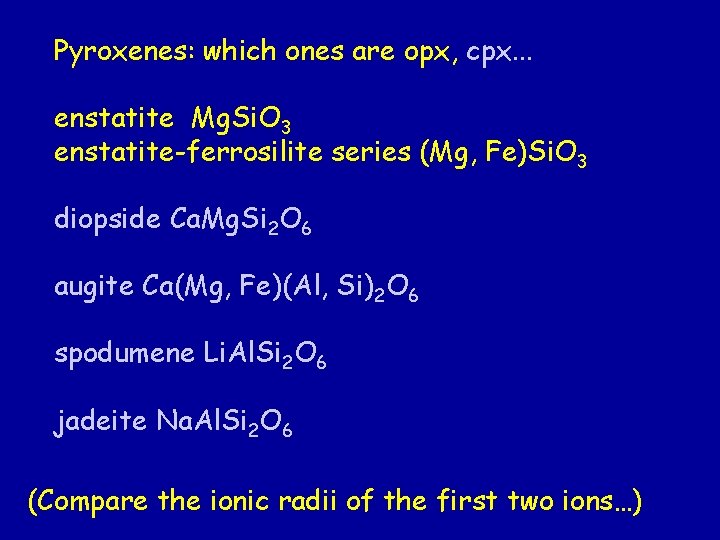
Pyroxenes: which ones are opx, cpx. . . enstatite Mg. Si. O 3 enstatite-ferrosilite series (Mg, Fe)Si. O 3 diopside Ca. Mg. Si 2 O 6 augite Ca(Mg, Fe)(Al, Si)2 O 6 spodumene Li. Al. Si 2 O 6 jadeite Na. Al. Si 2 O 6 (Compare the ionic radii of the first two ions…)
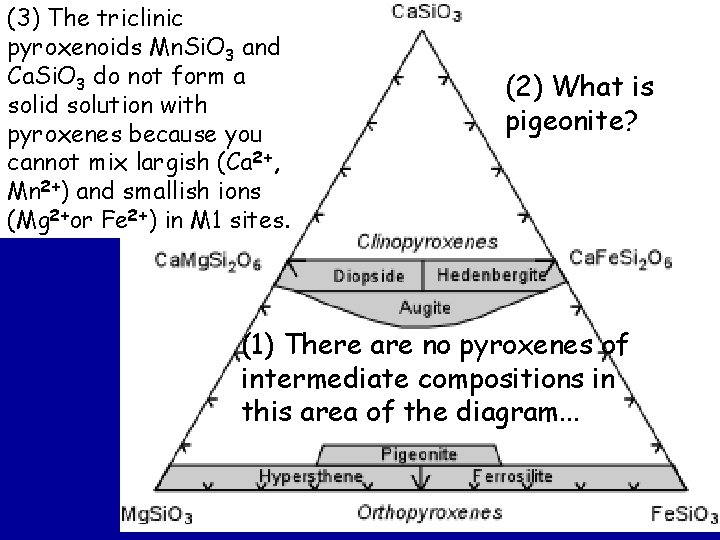
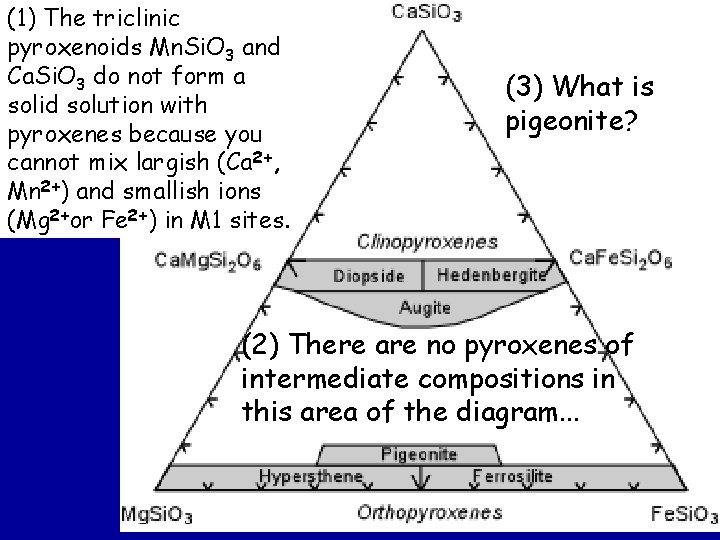
(3) The triclinic pyroxenoids Mn. Si. O 3 and Ca. Si. O 3 do not form a solid solution with pyroxenes because you cannot mix largish (Ca 2+, Mn 2+) and smallish ions (Mg 2+or Fe 2+) in M 1 sites. (2) What is pigeonite? (1) There are no pyroxenes of intermediate compositions in this area of the diagram. . .
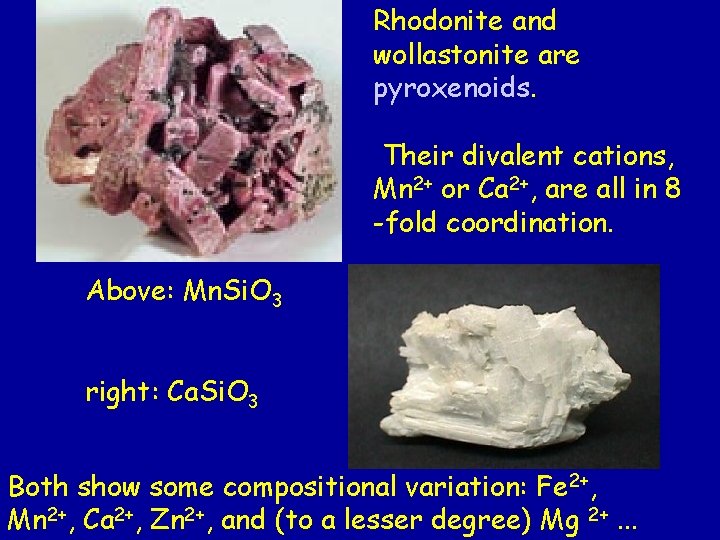
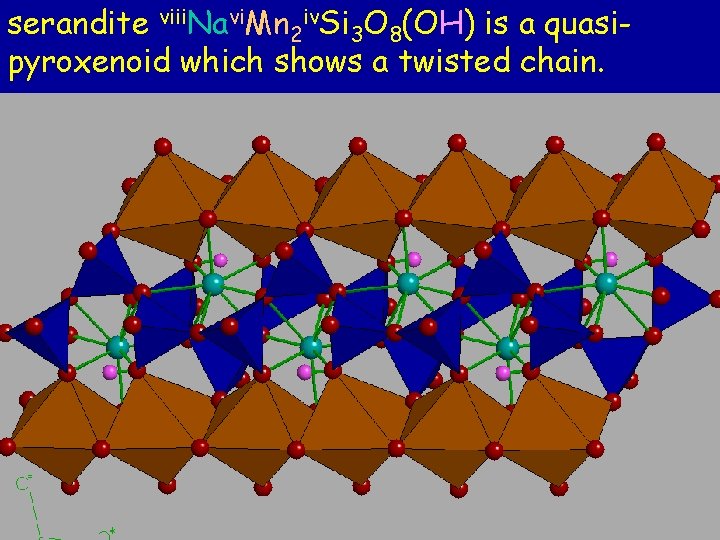
Rhodonite and wollastonite are pyroxenoids. Their divalent cations, Mn 2+ or Ca 2+, are all in 8 -fold coordination. Above: Mn. Si. O 3 right: Ca. Si. O 3 Both show some compositional variation: Fe 2+, Mn 2+, Ca 2+, Zn 2+, and (to a lesser degree) Mg 2+. . .
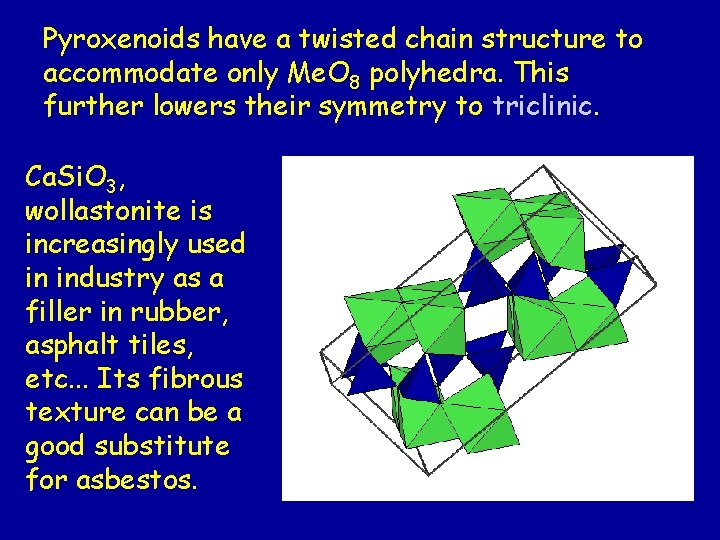
Pyroxenoids have a twisted chain structure to accommodate only Me. O 8 polyhedra. This further lowers their symmetry to triclinic. Ca. Si. O 3, wollastonite is increasingly used in industry as a filler in rubber, asphalt tiles, etc. . . Its fibrous texture can be a good substitute for asbestos.
(1) The triclinic pyroxenoids Mn. Si. O 3 and Ca. Si. O 3 do not form a solid solution with pyroxenes because you cannot mix largish (Ca 2+, Mn 2+) and smallish ions (Mg 2+or Fe 2+) in M 1 sites. (3) What is pigeonite? (2) There are no pyroxenes of intermediate compositions in this area of the diagram. . .
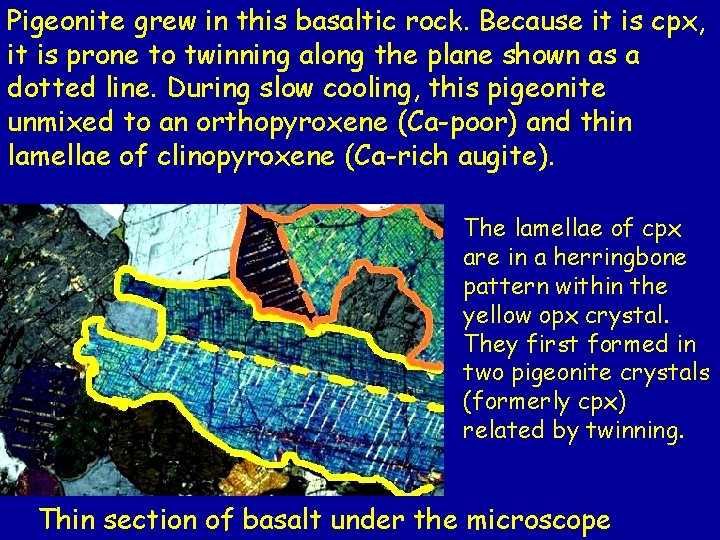
The clinopyroxene pigeonite is used as evidence of quick magmatic crystallization (often in volcanic rocks). It is only at high temperatures that M 2 sites can contain appreciable amounts of cations of different sizes such as Ca 2+ and Mg 2+. If cooling is slow, a pigeonite “unmixes” to a Ca-rich clinopyroxene and a Ca-free orthopyroxene.
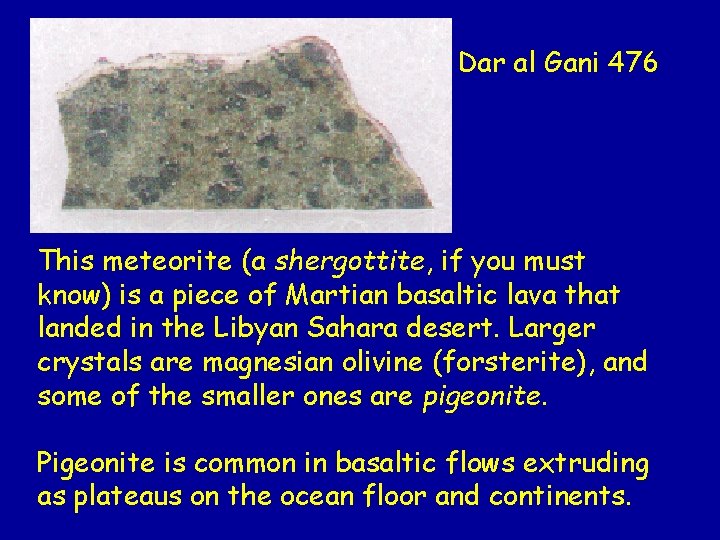
Dar al Gani 476 This meteorite (a shergottite, if you must know) is a piece of Martian basaltic lava that landed in the Libyan Sahara desert. Larger crystals are magnesian olivine (forsterite), and some of the smaller ones are pigeonite. Pigeonite is common in basaltic flows extruding as plateaus on the ocean floor and continents.
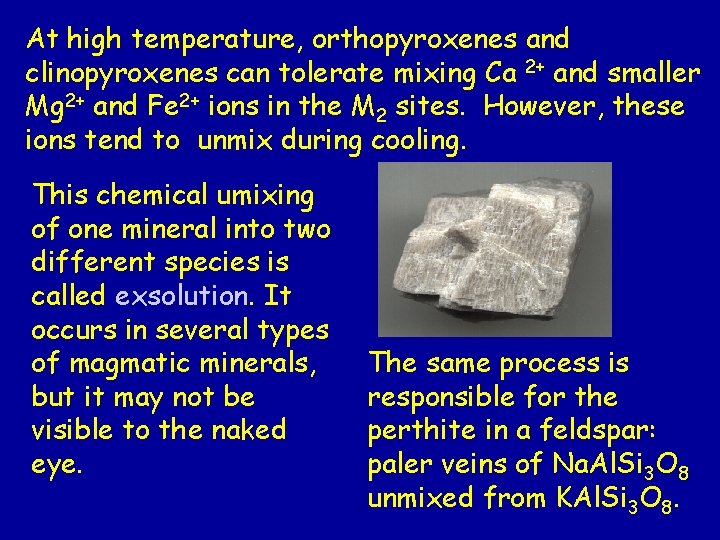
At high temperature, orthopyroxenes and clinopyroxenes can tolerate mixing Ca 2+ and smaller Mg 2+ and Fe 2+ ions in the M 2 sites. However, these ions tend to unmix during cooling. This chemical umixing of one mineral into two different species is called exsolution. It occurs in several types of magmatic minerals, but it may not be visible to the naked eye. The same process is responsible for the perthite in a feldspar: paler veins of Na. Al. Si 3 O 8 unmixed from KAl. Si 3 O 8.
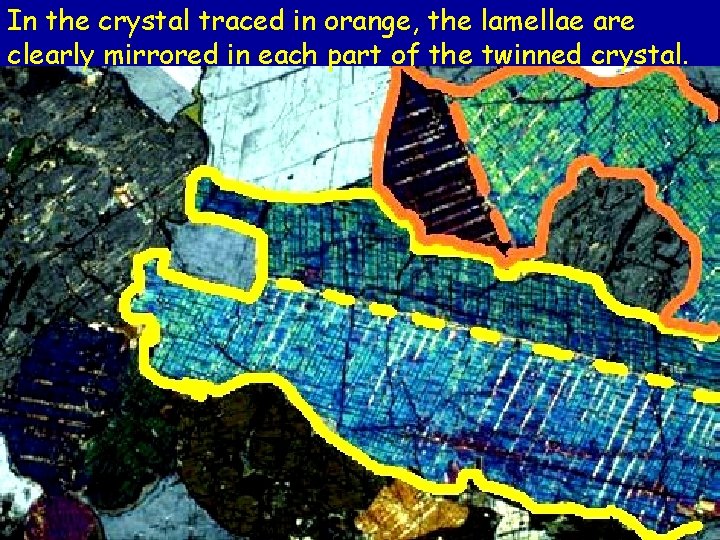
Pigeonite grew in this basaltic rock. Because it is cpx, it is prone to twinning along the plane shown as a dotted line. During slow cooling, this pigeonite unmixed to an orthopyroxene (Ca-poor) and thin lamellae of clinopyroxene (Ca-rich augite). The lamellae of cpx are in a herringbone pattern within the yellow opx crystal. They first formed in two pigeonite crystals (formerly cpx) related by twinning. Thin section of basalt under the microscope
In the crystal traced in orange, the lamellae are clearly mirrored in each part of the twinned crystal.
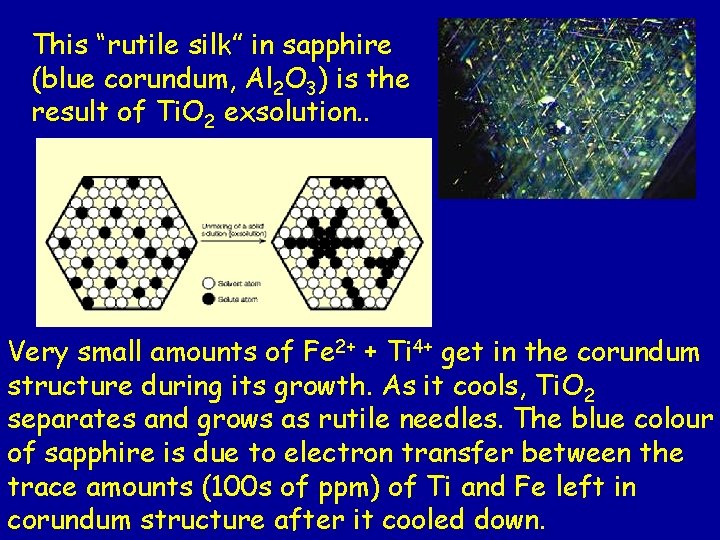
This “rutile silk” in sapphire (blue corundum, Al 2 O 3) is the result of Ti. O 2 exsolution. . Very small amounts of Fe 2+ + Ti 4+ get in the corundum structure during its growth. As it cools, Ti. O 2 separates and grows as rutile needles. The blue colour of sapphire is due to electron transfer between the trace amounts (100 s of ppm) of Ti and Fe left in corundum structure after it cooled down.
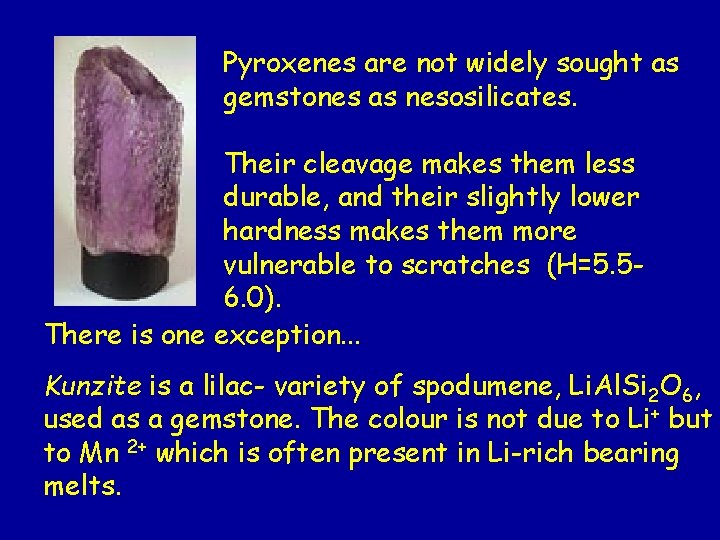
Pyroxenes are not widely sought as gemstones as nesosilicates. Their cleavage makes them less durable, and their slightly lower hardness makes them more vulnerable to scratches (H=5. 56. 0). There is one exception. . . Kunzite is a lilac- variety of spodumene, Li. Al. Si 2 O 6, used as a gemstone. The colour is not due to Li+ but to Mn 2+ which is often present in Li-rich bearing melts.
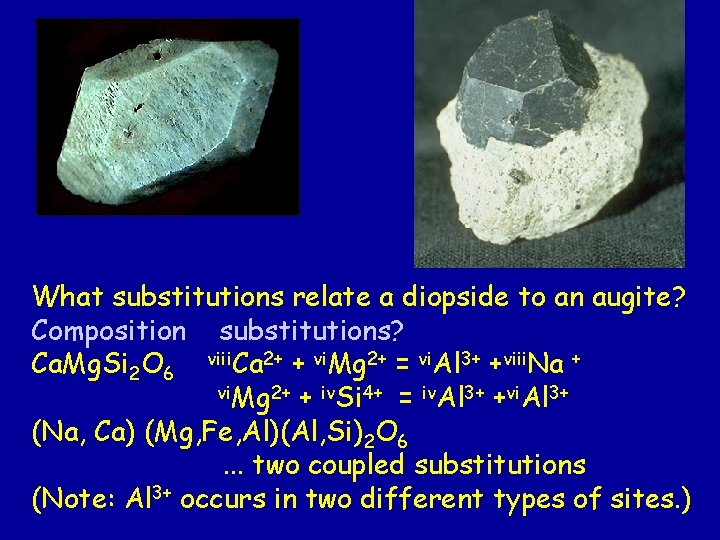
What substitutions relate a diopside to an augite? Composition substitutions? Ca. Mg. Si 2 O 6 viii. Ca 2+ + vi. Mg 2+ = vi. Al 3+ +viii. Na + vi. Mg 2+ + iv. Si 4+ = iv. Al 3+ +vi. Al 3+ (Na, Ca) (Mg, Fe, Al)(Al, Si)2 O 6. . . two coupled substitutions (Note: Al 3+ occurs in two different types of sites. )
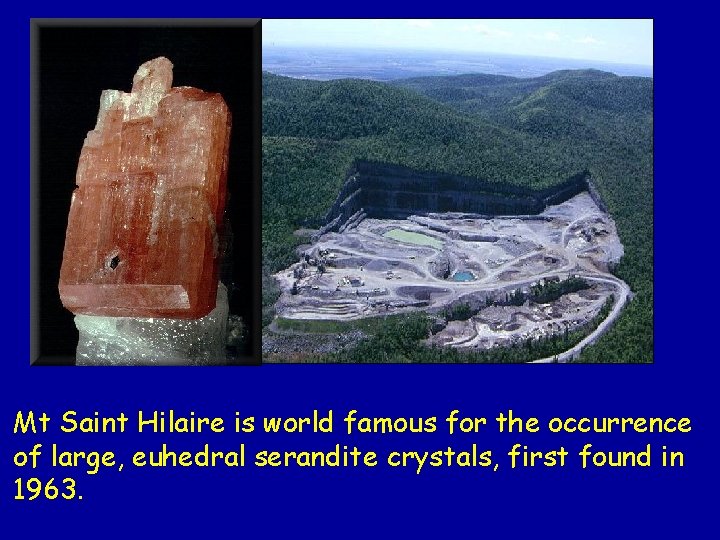
Mt Saint Hilaire is world famous for the occurrence of large, euhedral serandite crystals, first found in 1963.
serandite viii. Navi. Mn 2 iv. Si 3 O 8(OH) is a quasipyroxenoid which shows a twisted chain.
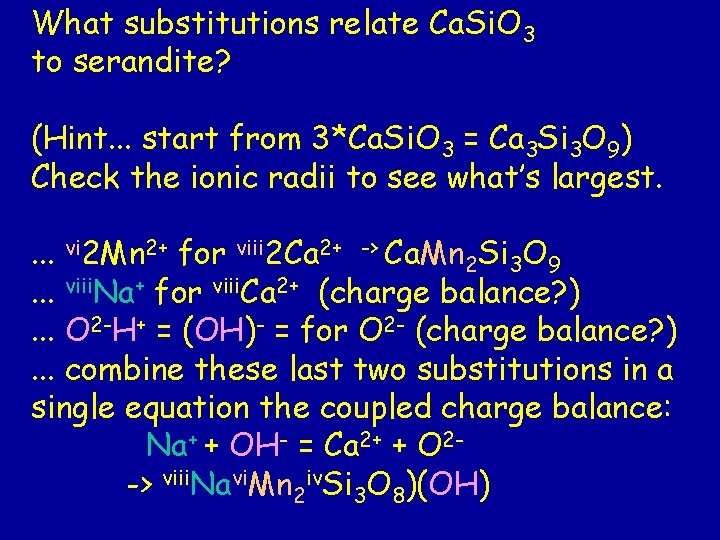
What substitutions relate Ca. Si. O 3 to serandite? (Hint. . . start from 3*Ca. Si. O 3 = Ca 3 Si 3 O 9) Check the ionic radii to see what’s largest. . vi 2 Mn 2+ for viii 2 Ca 2+ -> Ca. Mn 2 Si 3 O 9. . . viii. Na+ for viii. Ca 2+ (charge balance? ). . . O 2 -H+ = (OH)- = for O 2 - (charge balance? ). . . combine these last two substitutions in a single equation the coupled charge balance: Na+ + OH- = Ca 2+ + O 2 -> viii. Navi. Mn 2 iv. Si 3 O 8)(OH)
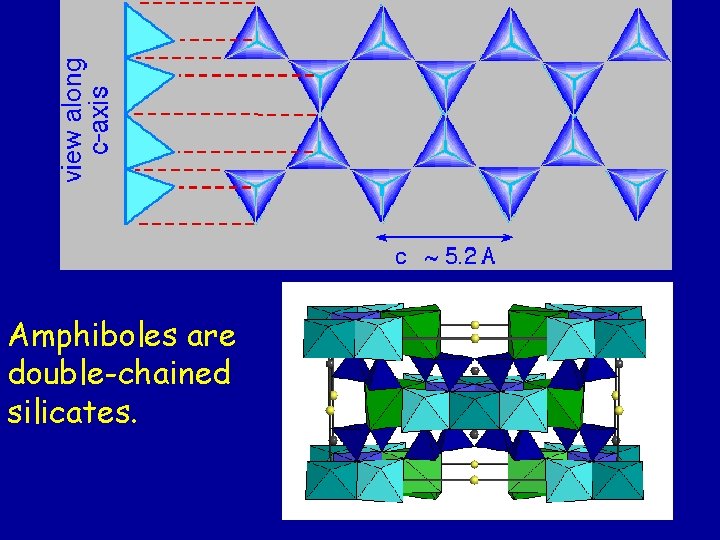
Amphiboles are double-chained silicates.
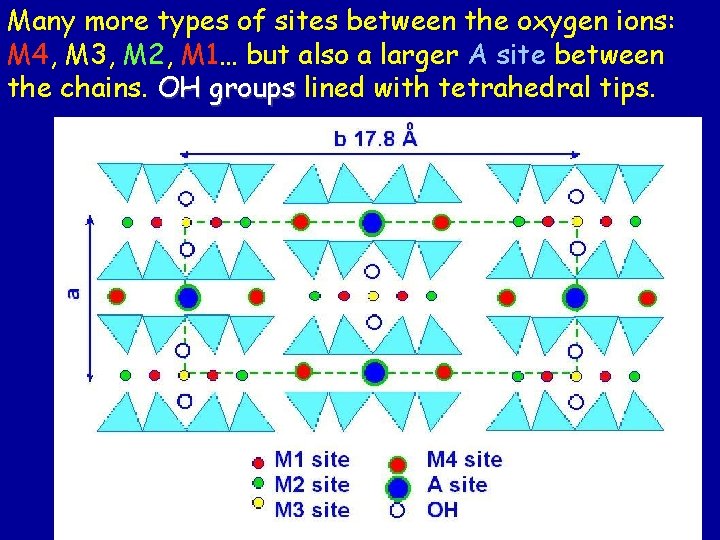
Many more types of sites between the oxygen ions: M 4, M 3, M 2, M 1… but also a larger A site between the chains. OH groups lined with tetrahedral tips.
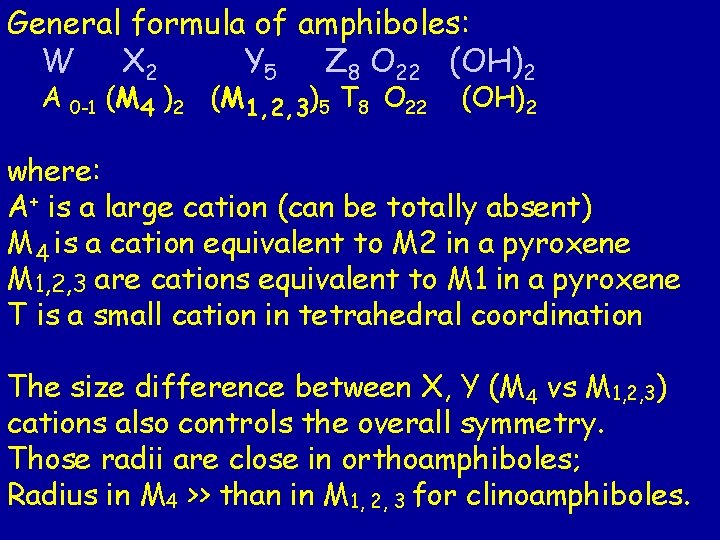
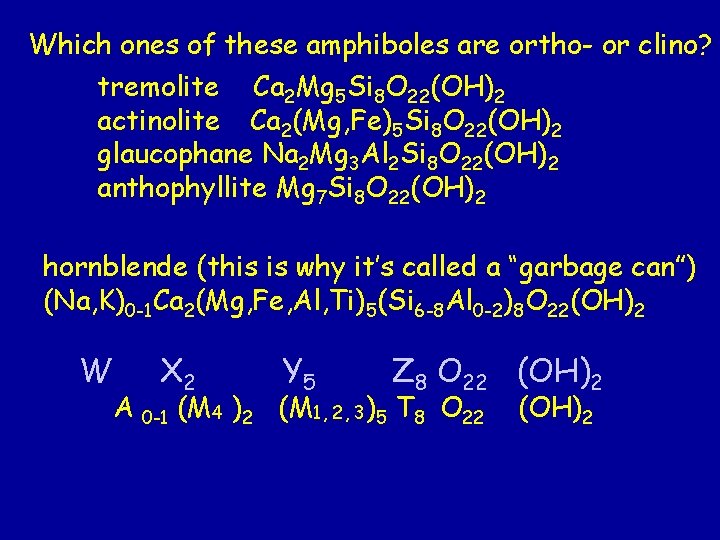
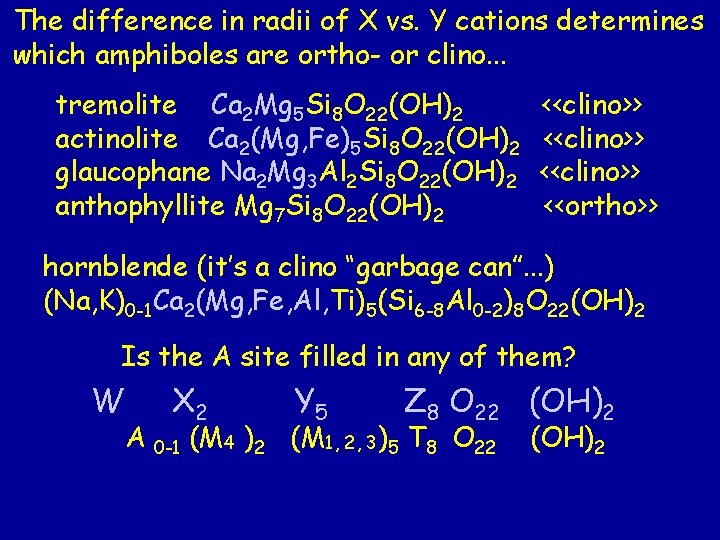
General formula of amphiboles: W X 2 Y 5 Z 8 O 22 (OH)2 A 0 -1 (M 4 )2 (M 1, 2, 3)5 T 8 O 22 (OH)2 where: A+ is a large cation (can be totally absent) M 4 is a cation equivalent to M 2 in a pyroxene M 1, 2, 3 are cations equivalent to M 1 in a pyroxene T is a small cation in tetrahedral coordination The size difference between X, Y (M 4 vs M 1, 2, 3) cations also controls the overall symmetry. Those radii are close in orthoamphiboles; Radius in M 4 >> than in M 1, 2, 3 for clinoamphiboles.
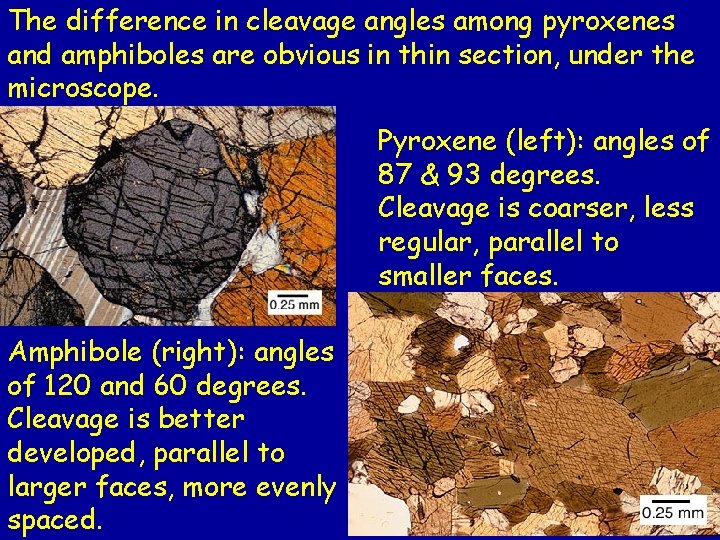
The difference in cleavage angles among pyroxenes and amphiboles are obvious in thin section, under the microscope. Pyroxene (left): angles of 87 & 93 degrees. Cleavage is coarser, less regular, parallel to smaller faces. Amphibole (right): angles of 120 and 60 degrees. Cleavage is better developed, parallel to larger faces, more evenly spaced.
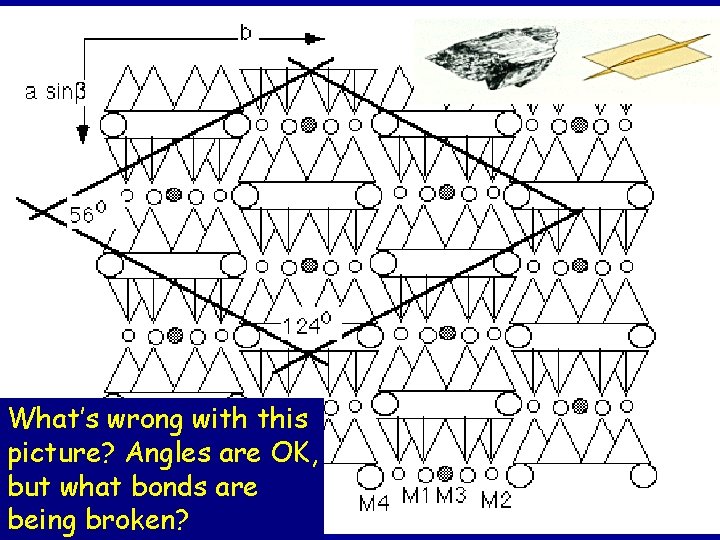
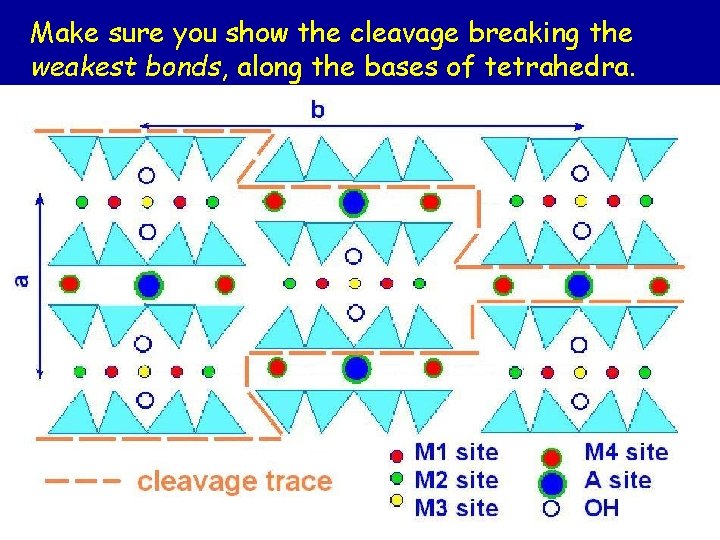
What’s wrong with this picture? Angles are OK, but what bonds are being broken?
Make sure you show the cleavage breaking the weakest bonds, along the bases of tetrahedra.
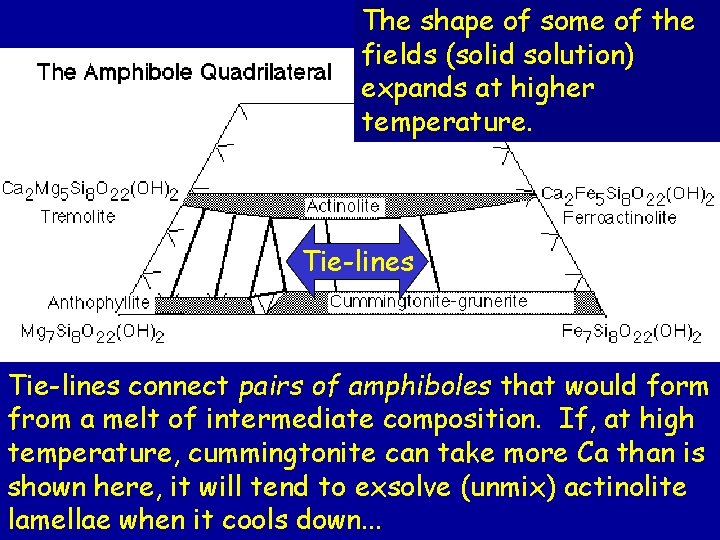
The shape of some of the fields (solid solution) expands at higher temperature. Tie-lines connect pairs of amphiboles that would form from a melt of intermediate composition. If, at high temperature, cummingtonite can take more Ca than is shown here, it will tend to exsolve (unmix) actinolite lamellae when it cools down. . .
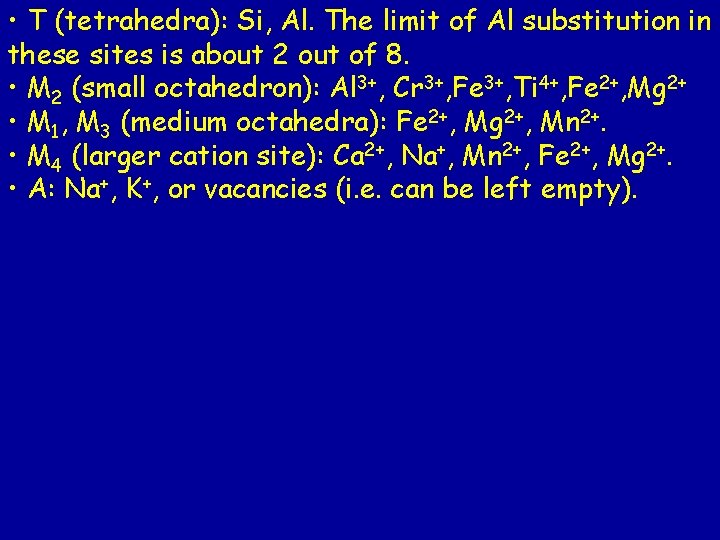
• T (tetrahedra): Si, Al. The limit of Al substitution in these sites is about 2 out of 8. • M 2 (small octahedron): Al 3+, Cr 3+, Fe 3+, Ti 4+, Fe 2+, Mg 2+ • M 1, M 3 (medium octahedra): Fe 2+, Mg 2+, Mn 2+. • M 4 (larger cation site): Ca 2+, Na+, Mn 2+, Fe 2+, Mg 2+. • A: Na+, K+, or vacancies (i. e. can be left empty).
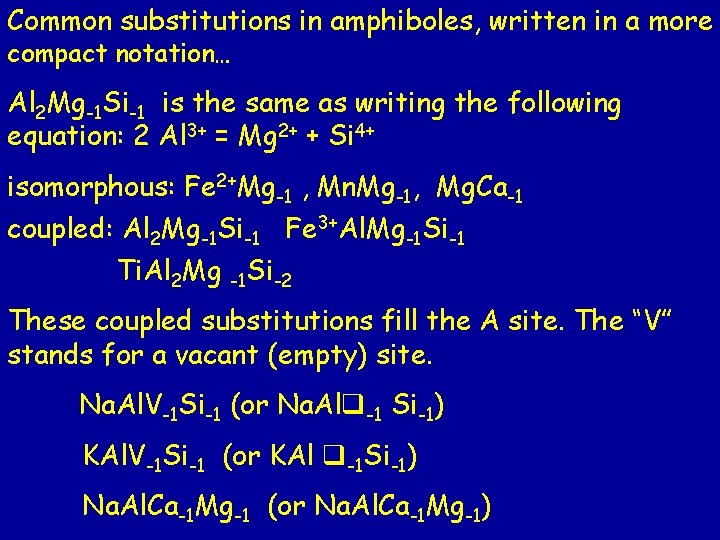
Common substitutions in amphiboles, written in a more compact notation… Al 2 Mg-1 Si-1 is the same as writing the following equation: 2 Al 3+ = Mg 2+ + Si 4+ isomorphous: Fe 2+Mg-1 , Mn. Mg-1, Mg. Ca-1 coupled: Al 2 Mg-1 Si-1 Fe 3+Al. Mg-1 Si-1 Ti. Al 2 Mg -1 Si-2 These coupled substitutions fill the A site. The “V” stands for a vacant (empty) site. Na. Al. V-1 Si-1 (or Na. Al -1 Si-1) KAl. V-1 Si-1 (or KAl -1 Si-1) Na. Al. Ca-1 Mg-1 (or Na. Al. Ca-1 Mg-1)
Which ones of these amphiboles are ortho- or clino? tremolite Ca 2 Mg 5 Si 8 O 22(OH)2 actinolite Ca 2(Mg, Fe)5 Si 8 O 22(OH)2 glaucophane Na 2 Mg 3 Al 2 Si 8 O 22(OH)2 anthophyllite Mg 7 Si 8 O 22(OH)2 hornblende (this is why it’s called a “garbage can”) (Na, K)0 -1 Ca 2(Mg, Fe, Al, Ti)5(Si 6 -8 Al 0 -2)8 O 22(OH)2 W A X 2 0 -1 Y 5 Z 8 O 22 (OH)2 (M 4 )2 (M 1, 2, 3)5 T 8 O 22 (OH)2
The difference in radii of X vs. Y cations determines which amphiboles are ortho- or clino. . . tremolite Ca 2 Mg 5 Si 8 O 22(OH)2 actinolite Ca 2(Mg, Fe)5 Si 8 O 22(OH)2 glaucophane Na 2 Mg 3 Al 2 Si 8 O 22(OH)2 anthophyllite Mg 7 Si 8 O 22(OH)2 <<clino>> <<ortho>> hornblende (it’s a clino “garbage can”. . . ) (Na, K)0 -1 Ca 2(Mg, Fe, Al, Ti)5(Si 6 -8 Al 0 -2)8 O 22(OH)2 Is the A site filled in any of them? W A X 2 0 -1 Y 5 Z 8 O 22 (OH)2 (M 4 )2 (M 1, 2, 3)5 T 8 O 22 (OH)2
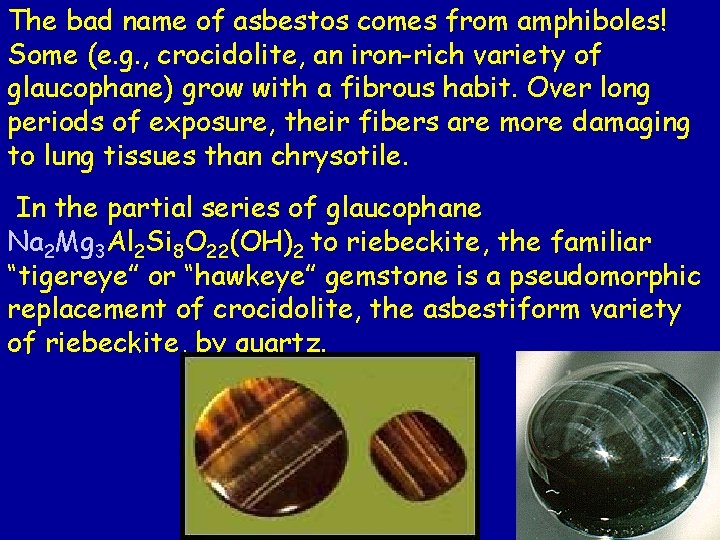
The bad name of asbestos comes from amphiboles! Some (e. g. , crocidolite, an iron-rich variety of glaucophane) grow with a fibrous habit. Over long periods of exposure, their fibers are more damaging to lung tissues than chrysotile. In the partial series of glaucophane Na 2 Mg 3 Al 2 Si 8 O 22(OH)2 to riebeckite, the familiar “tigereye” or “hawkeye” gemstone is a pseudomorphic replacement of crocidolite, the asbestiform variety of riebeckite, by quartz.