
EPRI Recommendations for NY SIR Technical Review Process
- Slides: 15
EPRI Recommendations for NY SIR Technical Review Process Tom Key, EPRI tkey@epri. com Ben York, EPRI byork@epri. com Review Comments from ITWG May 10, 2017 © 2016 Electric Power Research Institute, Inc. All rights reserved.
“Recommendations for Harmonizing Technical Review Processes for DG Connection in NY State” § Context: – Objective is a NYSERDA research report on Harmonizing Technical Review Processes. – This report does not constitute any specific change to NYSIR. § Approach: – Aims to provide and develop several ideas for ITWG in future evolution of the NYSIR, and to consider: 1. increasing population of DG 2. harmonizing technical review processes 3. emerging concepts where DG provides grid support – Before publishing, identify supporting inputs, address questions, consider different views and other ideas from the ITWG. 2 © 2016 Electric Power Research Institute, Inc. All rights reserved.
Plan for Today’s Discussion 1. Walk through report comments: – General technical review recommendations – Specific preliminary and supplemental screenings – CESIRs and reporting Appendices 2. Facilitate discussion of ITWG inputs: – Identify and confirm areas of agreement – Review areas needing further clarification and determine if there is agreement – Note unresolved points and address these areas as time permits and in the report 3. Review any action items and next steps. 3 © 2016 Electric Power Research Institute, Inc. All rights reserved.
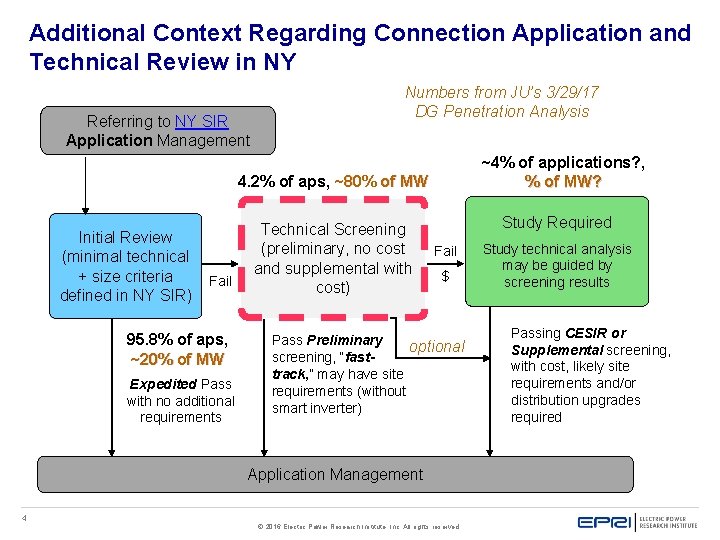
Additional Context Regarding Connection Application and Technical Review in NY Referring to NY SIR Application Management Numbers from JU’s 3/29/17 DG Penetration Analysis ~4% of applications? , % of MW? 4. 2% of aps, ~80% of MW Initial Review (minimal technical + size criteria Fail defined in NY SIR) 95. 8% of aps, ~20% of MW Expedited Pass with no additional requirements Technical Screening (preliminary, no cost and supplemental with cost) Study Required Fail $ Pass Preliminary optional screening, “fasttrack, ” may have site requirements (without smart inverter) Application Management 4 © 2016 Electric Power Research Institute, Inc. All rights reserved. Study technical analysis may be guided by screening results Passing CESIR or Supplemental screening, with cost, likely site requirements and/or distribution upgrades required
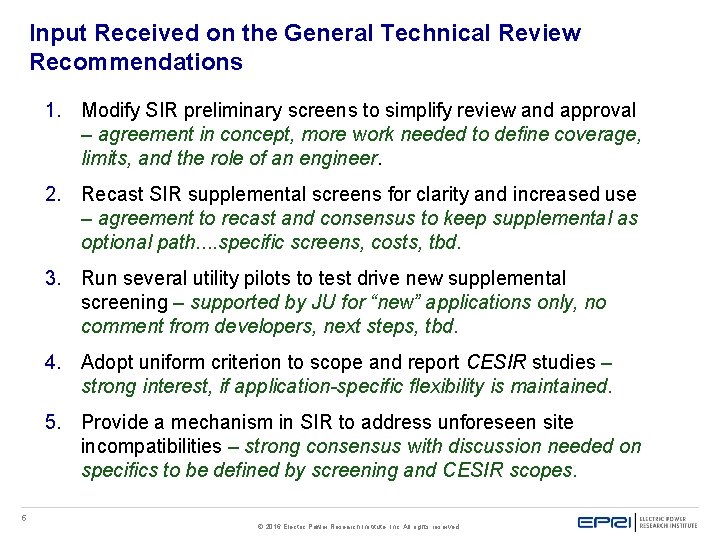
Input Received on the General Technical Review Recommendations 1. Modify SIR preliminary screens to simplify review and approval – agreement in concept, more work needed to define coverage, limits, and the role of an engineer. 2. Recast SIR supplemental screens for clarity and increased use – agreement to recast and consensus to keep supplemental as optional path. . specific screens, costs, tbd. 3. Run several utility pilots to test drive new supplemental screening – supported by JU for “new” applications only, no comment from developers, next steps, tbd. 4. Adopt uniform criterion to scope and report CESIR studies – strong interest, if application-specific flexibility is maintained. 5. Provide a mechanism in SIR to address unforeseen site incompatibilities – strong consensus with discussion needed on specifics to be defined by screening and CESIR scopes. 5 © 2016 Electric Power Research Institute, Inc. All rights reserved.
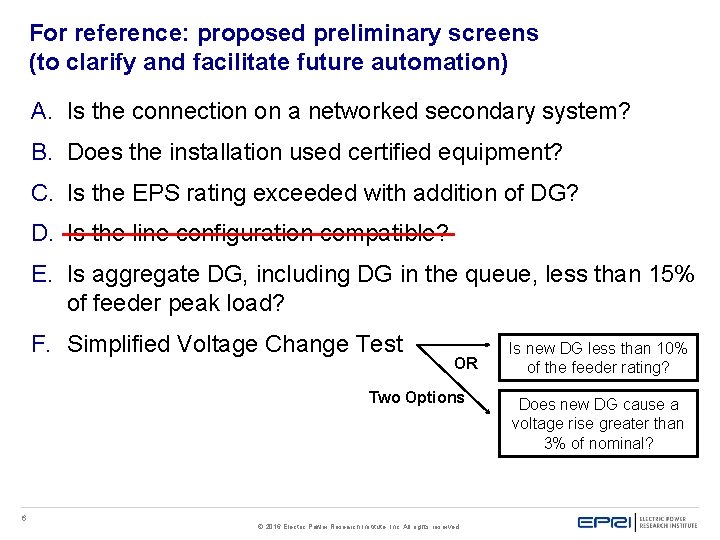
For reference: proposed preliminary screens (to clarify and facilitate future automation) A. Is the connection on a networked secondary system? B. Does the installation used certified equipment? C. Is the EPS rating exceeded with addition of DG? D. Is the line configuration compatible? E. Is aggregate DG, including DG in the queue, less than 15% of feeder peak load? F. Simplified Voltage Change Test OR Two Options 6 © 2016 Electric Power Research Institute, Inc. All rights reserved. Is new DG less than 10% of the feeder rating? Does new DG cause a voltage rise greater than 3% of nominal?
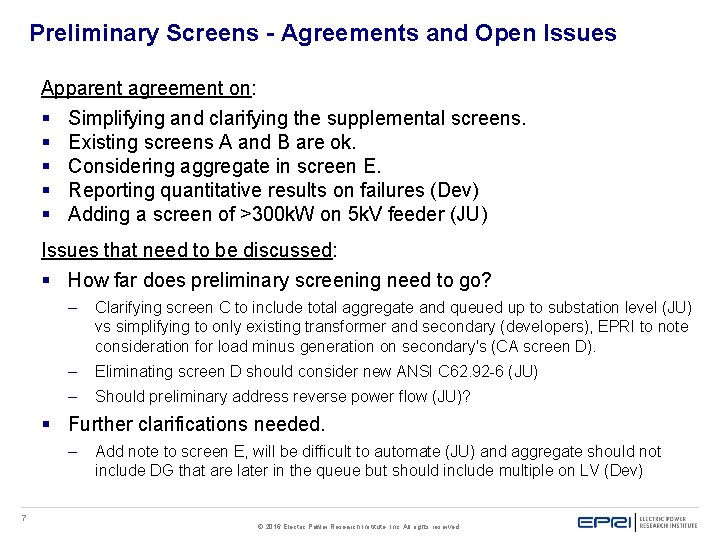
Preliminary Screens - Agreements and Open Issues Apparent agreement on: § Simplifying and clarifying the supplemental screens. § Existing screens A and B are ok. § Considering aggregate in screen E. § Reporting quantitative results on failures (Dev) § Adding a screen of >300 k. W on 5 k. V feeder (JU) Issues that need to be discussed: § How far does preliminary screening need to go? – Clarifying screen C to include total aggregate and queued up to substation level (JU) vs simplifying to only existing transformer and secondary (developers), EPRI to note consideration for load minus generation on secondary's (CA screen D). – Eliminating screen D should consider new ANSI C 62. 92 -6 (JU) – Should preliminary address reverse power flow (JU)? § Further clarifications needed. – 7 Add note to screen E, will be difficult to automate (JU) and aggregate should not include DG that are later in the queue but should include multiple on LV (Dev) © 2016 Electric Power Research Institute, Inc. All rights reserved.
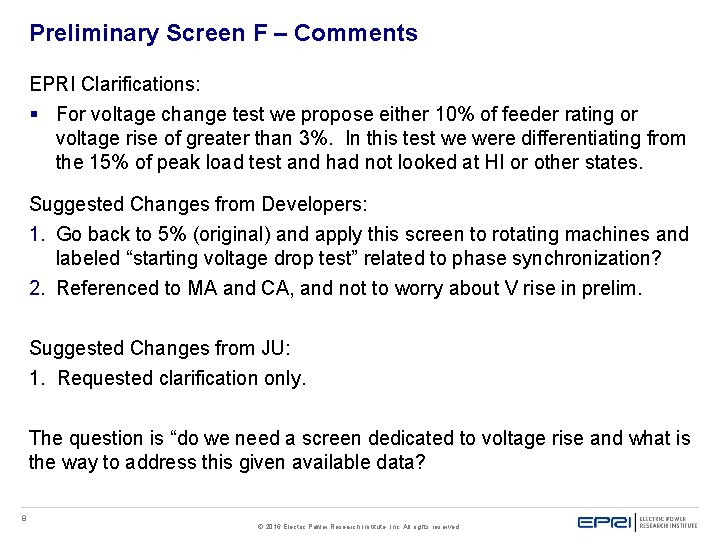
Preliminary Screen F – Comments EPRI Clarifications: § For voltage change test we propose either 10% of feeder rating or voltage rise of greater than 3%. In this test we were differentiating from the 15% of peak load test and had not looked at HI or other states. Suggested Changes from Developers: 1. Go back to 5% (original) and apply this screen to rotating machines and labeled “starting voltage drop test” related to phase synchronization? 2. Referenced to MA and CA, and not to worry about V rise in prelim. Suggested Changes from JU: 1. Requested clarification only. The question is “do we need a screen dedicated to voltage rise and what is the way to address this given available data? 8 © 2016 Electric Power Research Institute, Inc. All rights reserved.
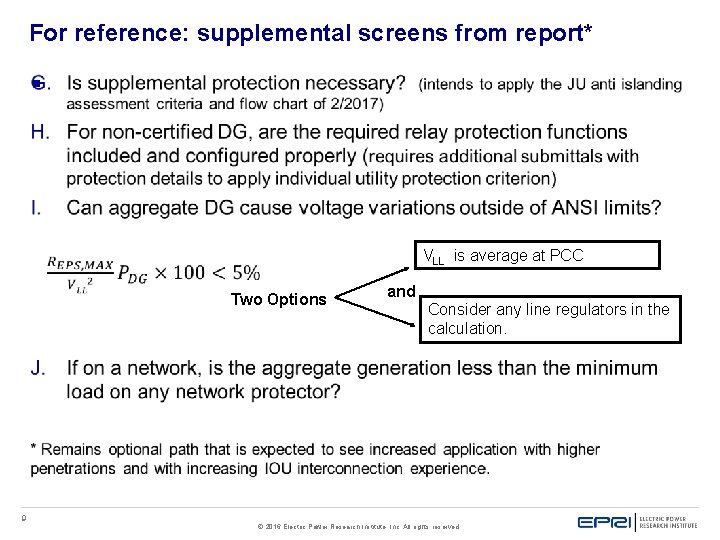
For reference: supplemental screens from report* § VLL is average at PCC Two Options 9 and Consider any line regulators in the calculation. © 2016 Electric Power Research Institute, Inc. All rights reserved.
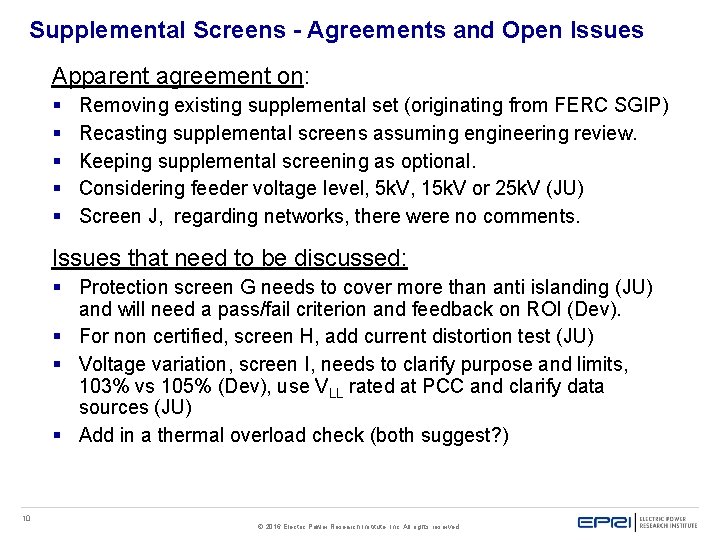
Supplemental Screens - Agreements and Open Issues Apparent agreement on: § § § Removing existing supplemental set (originating from FERC SGIP) Recasting supplemental screens assuming engineering review. Keeping supplemental screening as optional. Considering feeder voltage level, 5 k. V, 15 k. V or 25 k. V (JU) Screen J, regarding networks, there were no comments. Issues that need to be discussed: § Protection screen G needs to cover more than anti islanding (JU) and will need a pass/fail criterion and feedback on ROI (Dev). § For non certified, screen H, add current distortion test (JU) § Voltage variation, screen I, needs to clarify purpose and limits, 103% vs 105% (Dev), use VLL rated at PCC and clarify data sources (JU) § Add in a thermal overload check (both suggest? ) 10 © 2016 Electric Power Research Institute, Inc. All rights reserved.
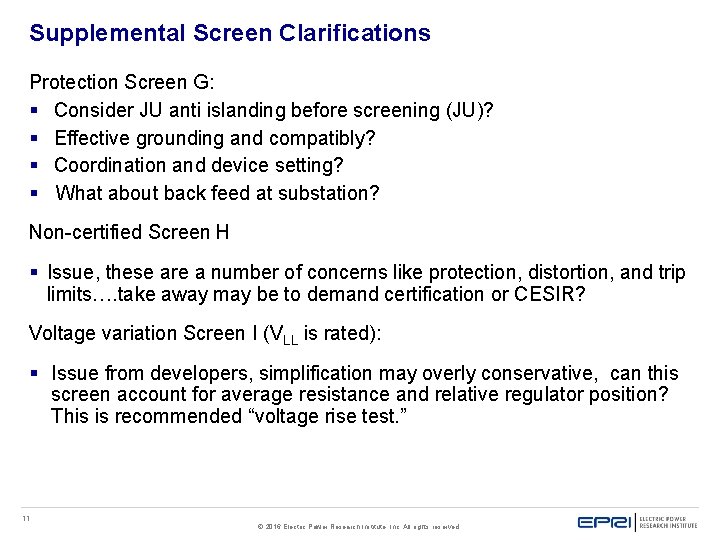
Supplemental Screen Clarifications Protection Screen G: § Consider JU anti islanding before screening (JU)? § Effective grounding and compatibly? § Coordination and device setting? § What about back feed at substation? Non-certified Screen H § Issue, these are a number of concerns like protection, distortion, and trip limits…. take away may be to demand certification or CESIR? Voltage variation Screen I (VLL is rated): § Issue from developers, simplification may overly conservative, can this screen account for average resistance and relative regulator position? This is recommended “voltage rise test. ” 11 © 2016 Electric Power Research Institute, Inc. All rights reserved.
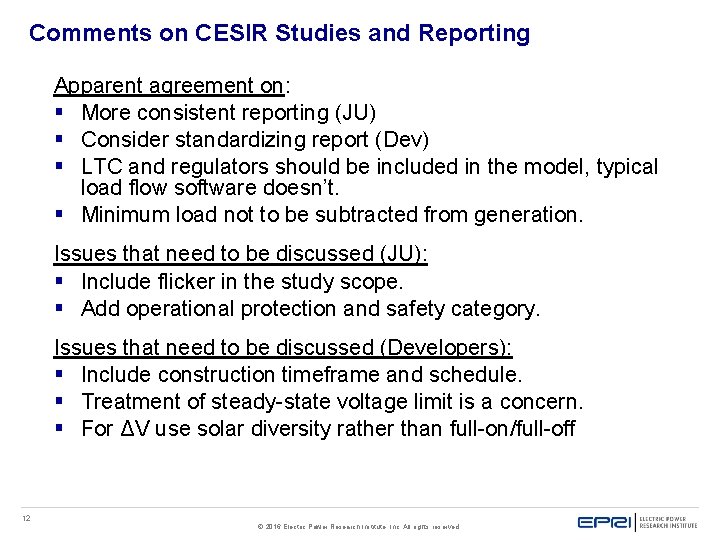
Comments on CESIR Studies and Reporting Apparent agreement on: § More consistent reporting (JU) § Consider standardizing report (Dev) § LTC and regulators should be included in the model, typical load flow software doesn’t. § Minimum load not to be subtracted from generation. Issues that need to be discussed (JU): § Include flicker in the study scope. § Add operational protection and safety category. Issues that need to be discussed (Developers): § Include construction timeframe and schedule. § Treatment of steady-state voltage limit is a concern. § For ΔV use solar diversity rather than full-on/full-off 12 © 2016 Electric Power Research Institute, Inc. All rights reserved.
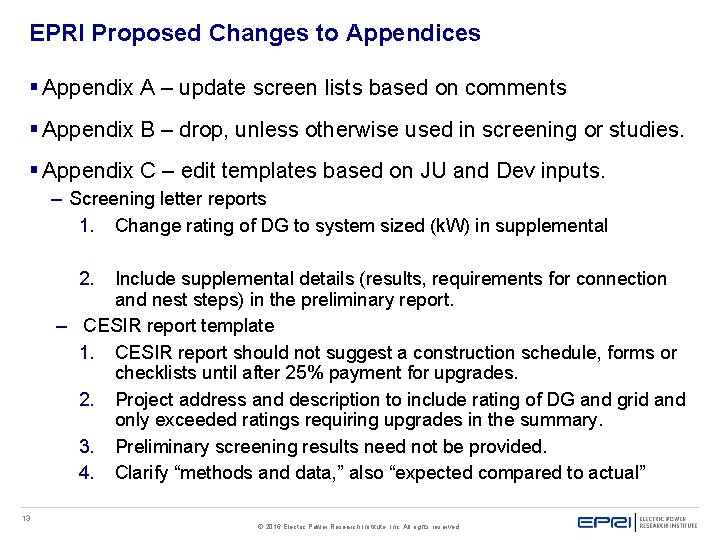
EPRI Proposed Changes to Appendices § Appendix A – update screen lists based on comments § Appendix B – drop, unless otherwise used in screening or studies. § Appendix C – edit templates based on JU and Dev inputs. – Screening letter reports 1. Change rating of DG to system sized (k. W) in supplemental 2. Include supplemental details (results, requirements for connection and nest steps) in the preliminary report. – CESIR report template 1. CESIR report should not suggest a construction schedule, forms or checklists until after 25% payment for upgrades. 2. Project address and description to include rating of DG and grid and only exceeded ratings requiring upgrades in the summary. 3. Preliminary screening results need not be provided. 4. Clarify “methods and data, ” also “expected compared to actual” 13 © 2016 Electric Power Research Institute, Inc. All rights reserved.
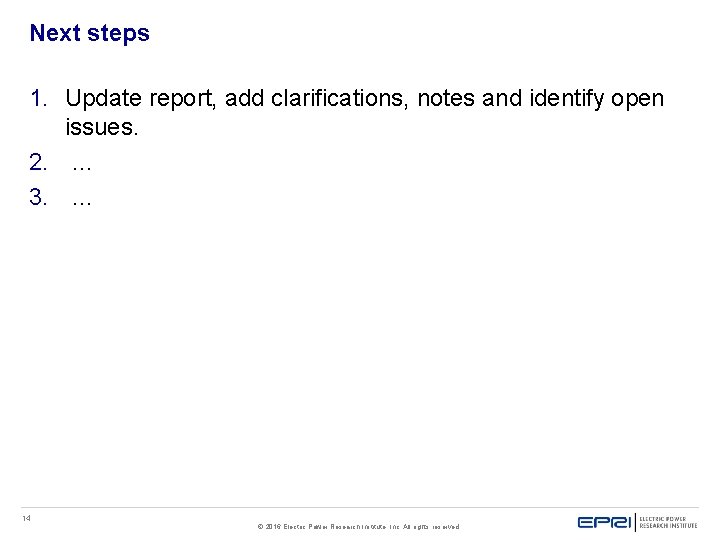
Next steps 1. Update report, add clarifications, notes and identify open issues. 2. … 3. … 14 © 2016 Electric Power Research Institute, Inc. All rights reserved.
Thanks for your input! Together…Shaping the Future of Electricity 15 © 2016 Electric Power Research Institute, Inc. All rights reserved.