
Epithelial tissue Functions Absorption Excretion Filtration Secretion Protection
Epithelial tissue • Functions – Absorption – Excretion – Filtration – Secretion – Protection – Sensory reception
Characteristics of epithelium • Cellularity – Tightly packed cells • Forms sheet • Little extracellular materials • Specialized contacts – Tight junction – Desmosomes
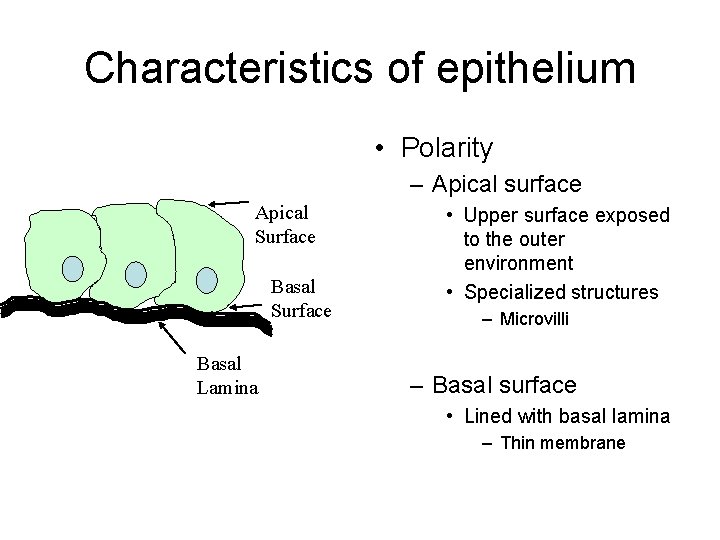
Characteristics of epithelium • Polarity – Apical surface Apical Surface Basal Lamina • Upper surface exposed to the outer environment • Specialized structures – Microvilli – Basal surface • Lined with basal lamina – Thin membrane
Characteristics of epithelium • Supported by connective tissue – Basement membrane • Basal lamina – Composed of glycoproteins • Reticular lamina – Composed of collagens – Tougher than basal lamina • Resists stretching • Define epithelial boundary
Characteristics of epithelium • Innervated – Nerve endings • Avascular – Utilizes nutrients diffused from blood vessels underlining connective tissue • Highly regenerative – Many epithelial cells are exposed to extreme external environment
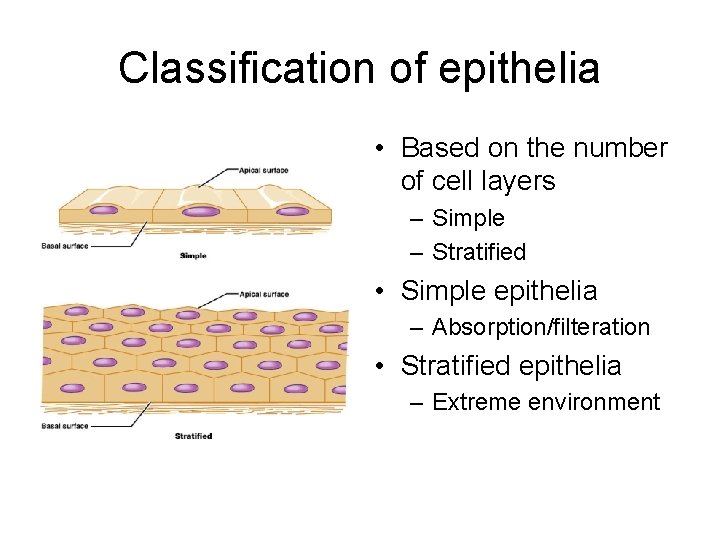
Classification of epithelia • Based on the number of cell layers – Simple – Stratified • Simple epithelia – Absorption/filteration • Stratified epithelia – Extreme environment
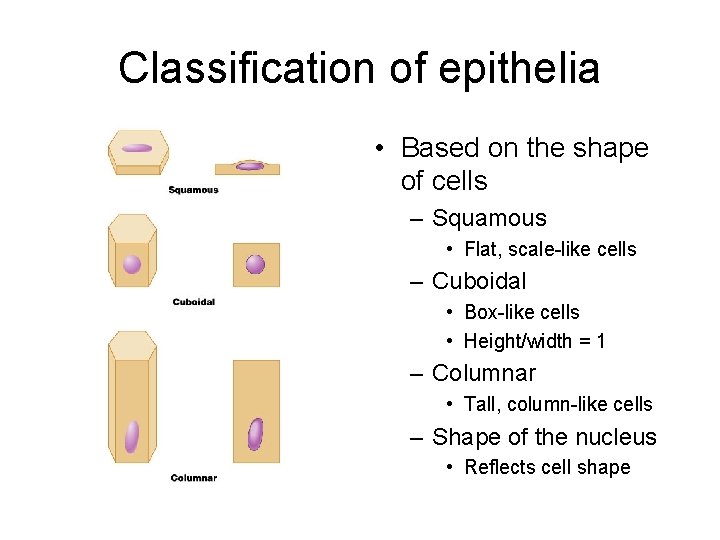
Classification of epithelia • Based on the shape of cells – Squamous • Flat, scale-like cells – Cuboidal • Box-like cells • Height/width = 1 – Columnar • Tall, column-like cells – Shape of the nucleus • Reflects cell shape
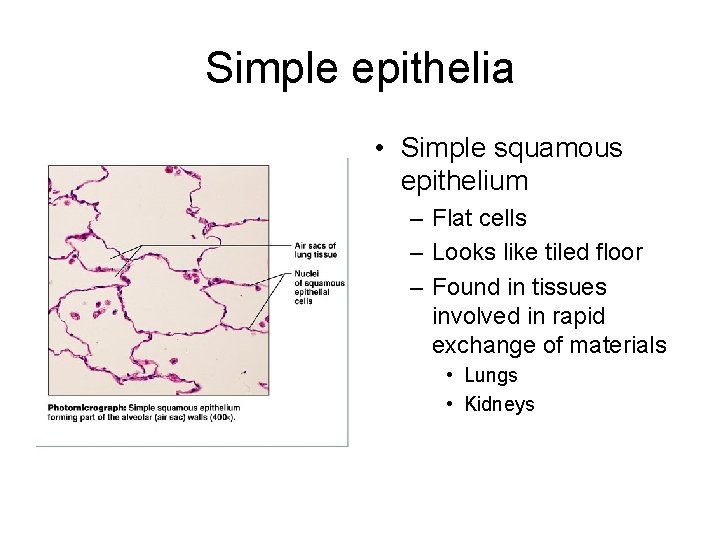
Simple epithelia • Simple squamous epithelium – Flat cells – Looks like tiled floor – Found in tissues involved in rapid exchange of materials • Lungs • Kidneys
Simple epithelia • Special simple squamous epithelia – Endothelium • Inner lining of blood vessels and lymphatic vessels • Extremely thin – Mesothelium • Membrane that covers chest and abdominal cavity and organs found in these cavities
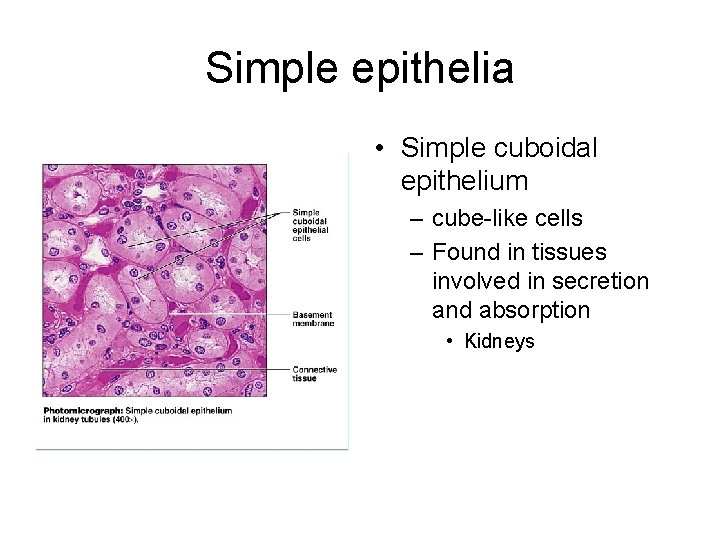
Simple epithelia • Simple cuboidal epithelium – cube-like cells – Found in tissues involved in secretion and absorption • Kidneys
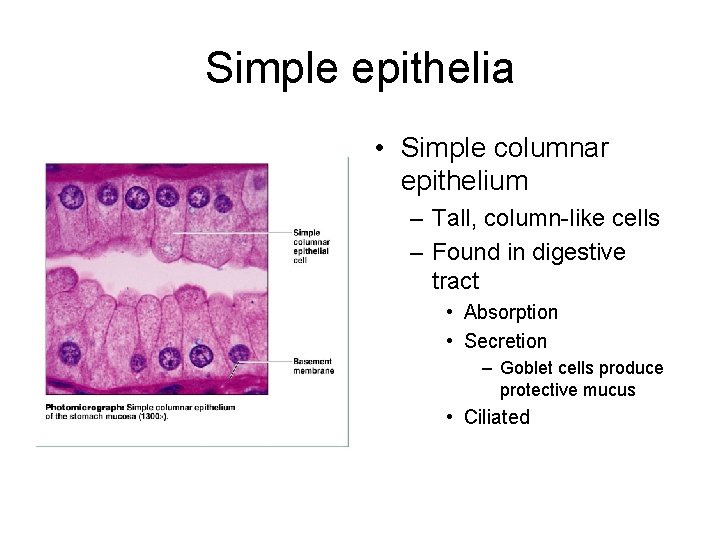
Simple epithelia • Simple columnar epithelium – Tall, column-like cells – Found in digestive tract • Absorption • Secretion – Goblet cells produce protective mucus • Ciliated
Psuedostratified columnar epithelium • Cells vary in their height – Tallest cells interact with external environment – Shorter cells serve as reserves • False appearance of stratification – Location of nuclei within the layer
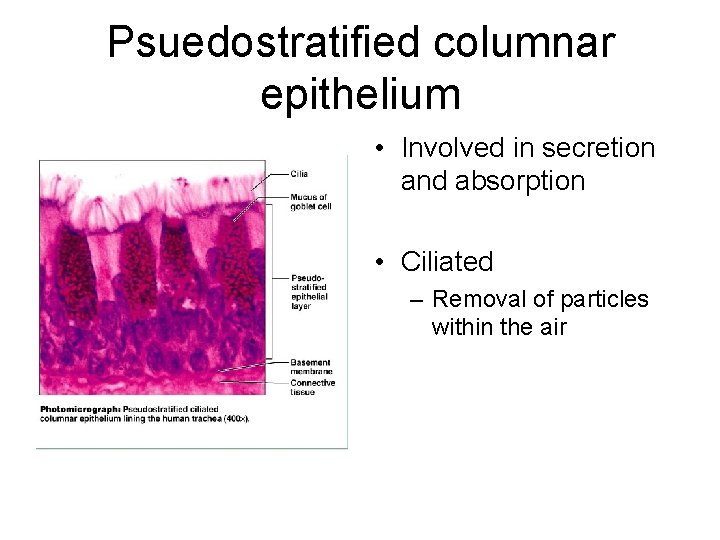
Psuedostratified columnar epithelium • Involved in secretion and absorption • Ciliated – Removal of particles within the air
Stratified epithelia • Multiple layers of cells – cells in lower layers • Replacement • More durable – Protective covering
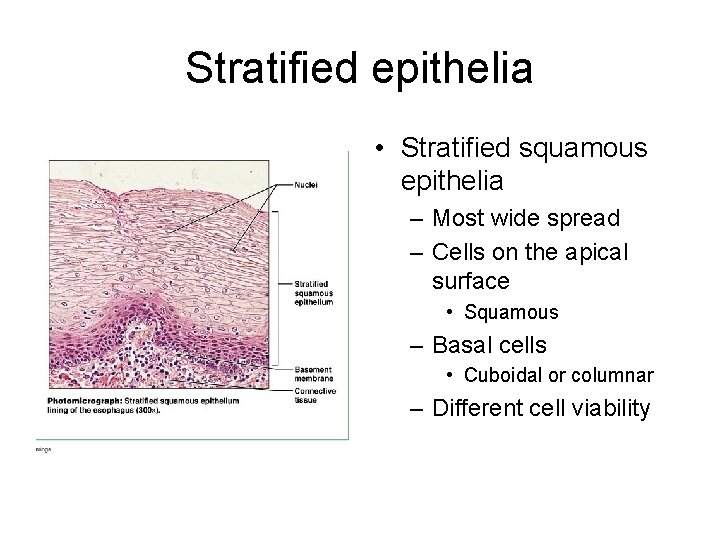
Stratified epithelia • Stratified squamous epithelia – Most wide spread – Cells on the apical surface • Squamous – Basal cells • Cuboidal or columnar – Different cell viability
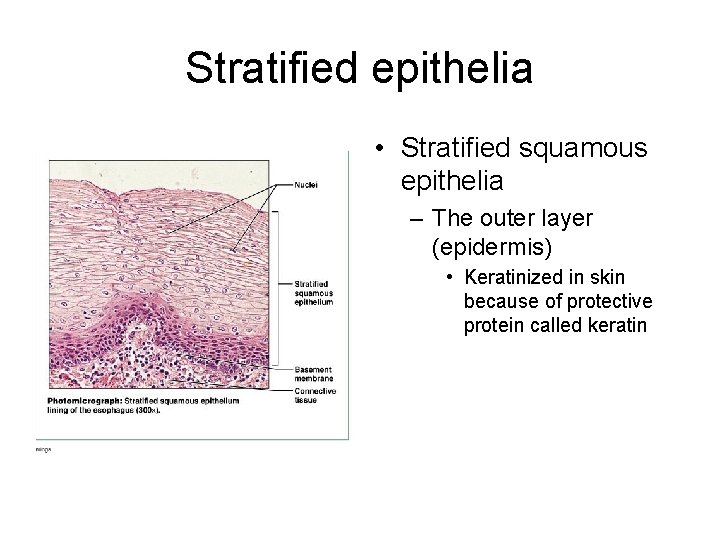
Stratified epithelia • Stratified squamous epithelia – The outer layer (epidermis) • Keratinized in skin because of protective protein called keratin
Stratified epithelia • Stratified cuboidal epithelium – Very rare • Found in large glands (sweat, mammary) • Usually contains two layers of cells • Stratified columnar epithelium – Very rare • Only its top layer contains columnar cells
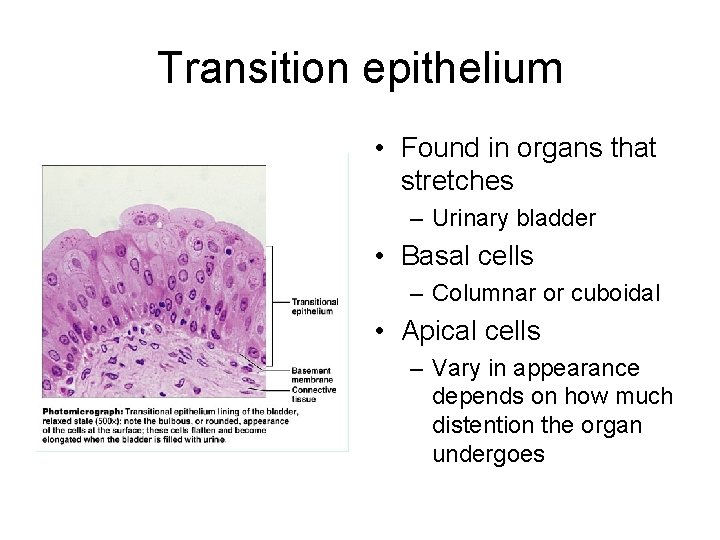
Transition epithelium • Found in organs that stretches – Urinary bladder • Basal cells – Columnar or cuboidal • Apical cells – Vary in appearance depends on how much distention the organ undergoes
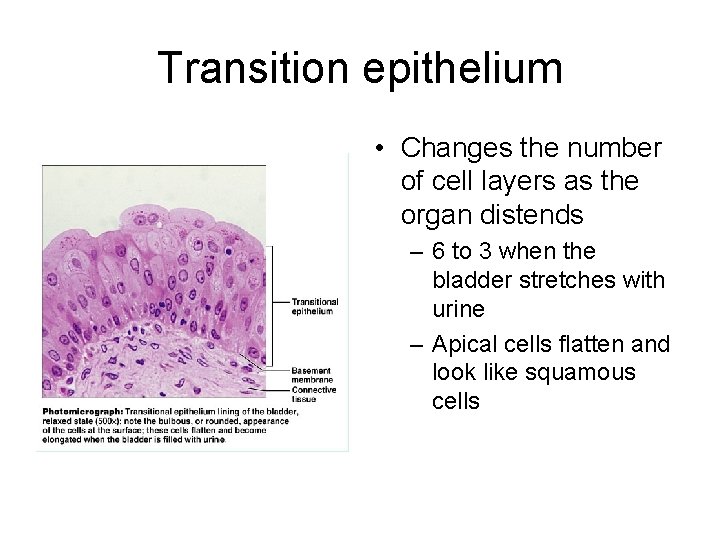
Transition epithelium • Changes the number of cell layers as the organ distends – 6 to 3 when the bladder stretches with urine – Apical cells flatten and look like squamous cells
Glandular epithelia • Glands – Composed of cells involved in production and secretion of product • Fluid-like • Proteins • Lipids – Secretion • Active process
Glandular epithelia • Glands – Location of secretion • Endocrine (within the body) • Exocrine (outside of the body) – Number of the cells that compose the gland • Unicellular • Multicellular – Ducts
- Slides: 21