
Epistemic expressions in contrast and translation Polysemyambiguity grammatical
Epistemic expressions in contrast and translation Polysemy/ambiguity, grammatical form & epistemic strength. UCCTS 2010 Carina Andersson Uppsala University
Contrast? • cross-linguistic contrast • source native language / translated language /target native language ---------------------------UCCTS 2010 Edge Hill Carina Andersson • Interface : contrastive & translation studies

• Meaning, comparison & contrast – how to analyse translation paradigms • complement to monolingual analysis – formal translation equivalents : consequences ? – monosemic translation equivalents • Source texts vs. target texts – over representation / under representation – distribution and text type • Translations UCCTS 2010 Edge Hill Carina Andersson – Translation types (fiction, non fiction, debate) – Problematic structures? – Translators idiolect ?
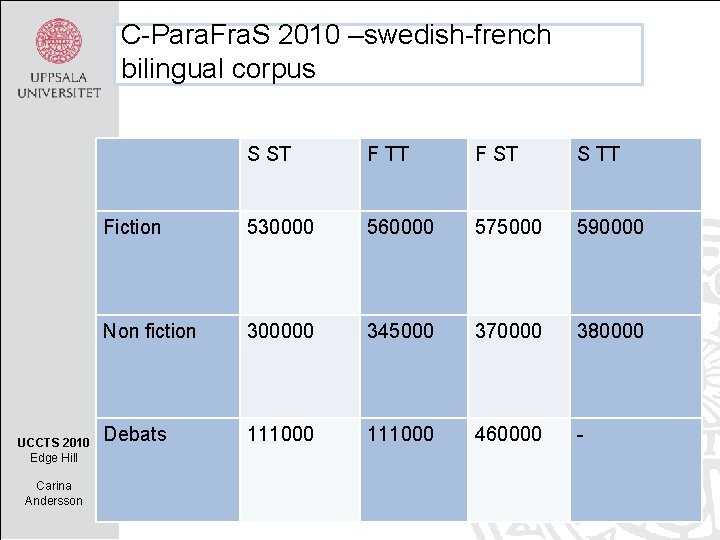
C-Para. Fra. S 2010 –swedish-french bilingual corpus UCCTS 2010 Edge Hill Carina Andersson S ST F TT F ST S TT Fiction 530000 560000 575000 590000 Non fiction 300000 345000 370000 380000 Debats 111000 460000 -
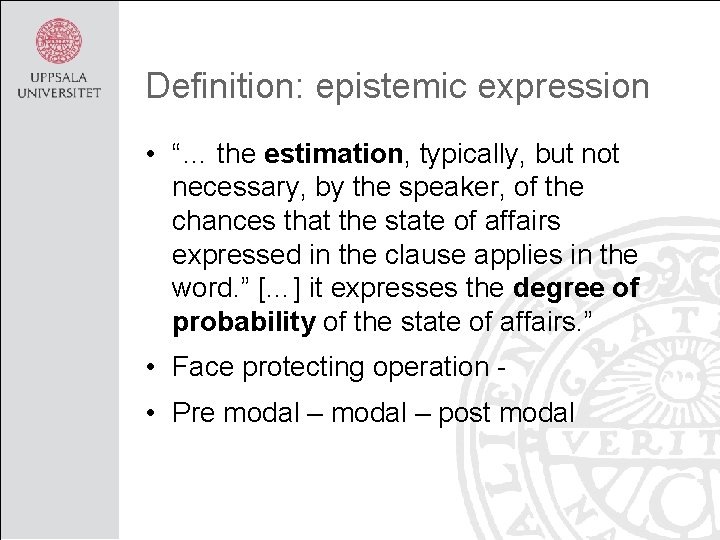
Definition: epistemic expression • “… the estimation, typically, but not necessary, by the speaker, of the chances that the state of affairs expressed in the clause applies in the word. ” […] it expresses the degree of probability of the state of affairs. ” • Face protecting operation • Pre modal – post modal
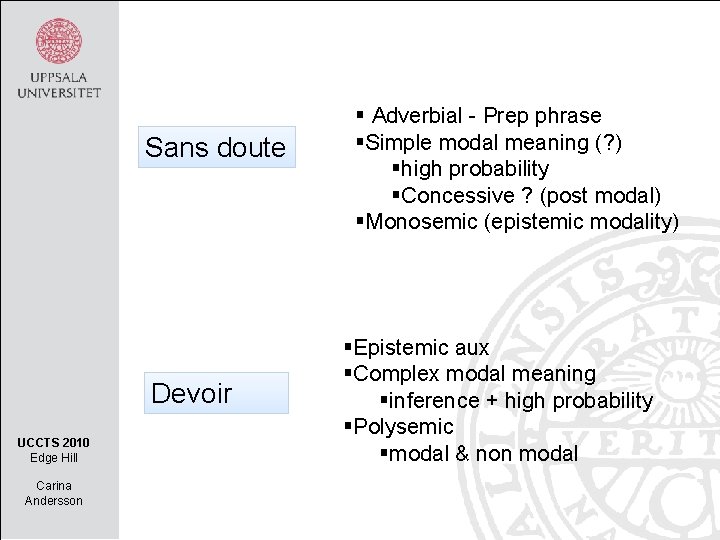
Sans doute Devoir UCCTS 2010 Edge Hill Carina Andersson § Adverbial - Prep phrase §Simple modal meaning (? ) §high probability §Concessive ? (post modal) §Monosemic (epistemic modality) §Epistemic aux §Complex modal meaning §inference + high probability §Polysemic §modal & non modal
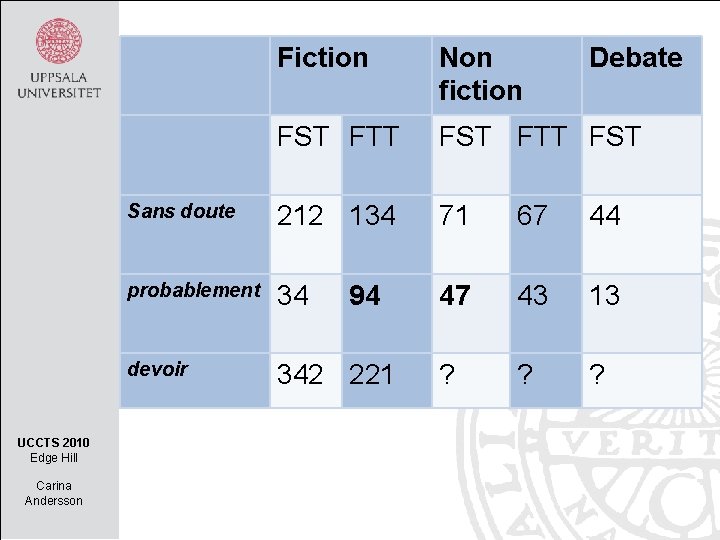
UCCTS 2010 Edge Hill Carina Andersson Fiction Non fiction FST FTT FST Sans doute 212 134 71 67 44 probablement 34 47 43 13 devoir 342 221 ? ? ? 94 Debate
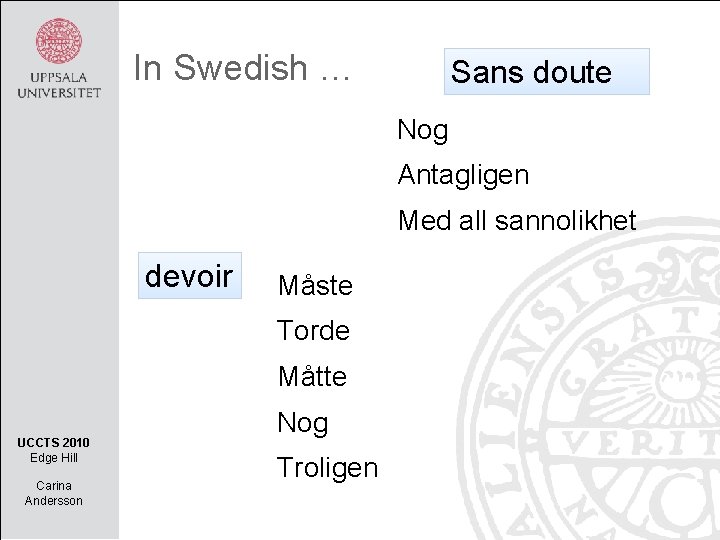
In Swedish … Sans doute Nog Antagligen Med all sannolikhet devoir Måste Torde Måtte UCCTS 2010 Edge Hill Carina Andersson Nog Troligen
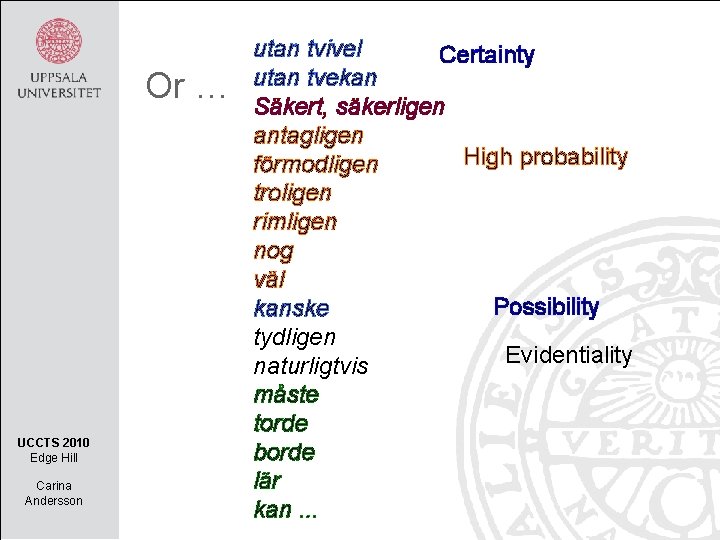
Or … UCCTS 2010 Edge Hill Carina Andersson utan tvivel Certainty utan tvekan Säkert, säkerligen antagligen High probability förmodligen troligen rimligen nog väl Possibility kanske tydligen Evidentiality naturligtvis måste torde borde lär kan. . .
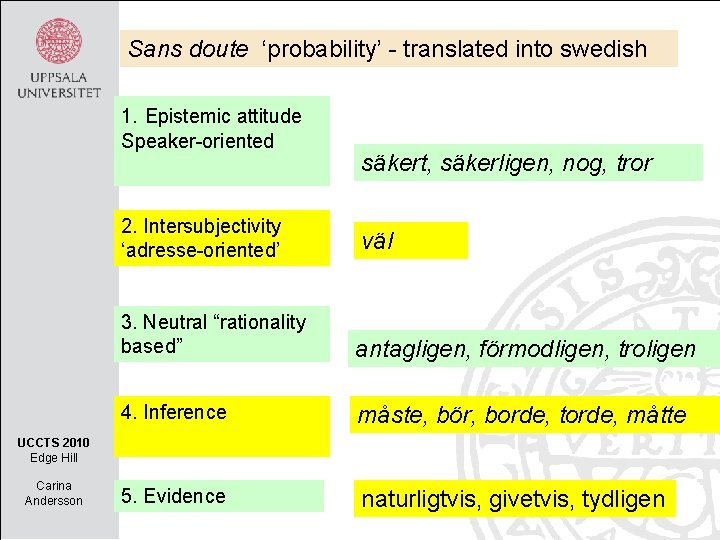
Sans doute ‘probability’ - translated into swedish 1. Epistemic attitude Speaker-oriented säkert, säkerligen, nog, tror 2. Intersubjectivity ‘adresse-oriented’ väl 3. Neutral “rationality based” antagligen, förmodligen, troligen 4. Inference måste, bör, borde, torde, måtte 5. Evidence naturligtvis, givetvis, tydligen UCCTS 2010 Edge Hill Carina Andersson

1. Sans doute [vous, cinquantième élève) ‘Probably’ (you, the fiftieth pupil] - Monsieur Muller, il y a bientôt trentecinq ans que j’enseigne, vous êtes sans doute le cinquantième élève à me faire le coup de l’ascenseur. Jag har undervisat i snart trettiofem år, monsieur Muller, och ni är säkert den femtionde eleven som försöker med hissvarianten. 2. Sans doute [elle, être au courant] ’probably [she be aware] […] il jugea plus correct de d'abord se présenter : sans doute était-elle au courant, il venait de la part de sa fille Marthe et de son gendre Etienne […] han fann det hövligare att först presentera sig: hon hade väl redan hört, han kom med hälsningar från hennes dotter Marthe och mågen Etienne […] 3. Sans doute [les lieux, dater du XVIIe] ’probably’ [building, from XVIIth] Les lieux, datant sans doute du XVIIIe ne manquait pas de grâce. Byggnaden var antagligen från 1700 talet och saknade inte charm […] 4. sans doute [entrer, d’un pas rapide] ’probably [enter, quickly] UCCTS 2010 Edge Hill Carina Andersson Une femme était entrée, et d'un pas sans En kvinna kom in i restaurangen. Hon doute rapide, car en trois photos elle avait måste ha rört sig snabbt, för bara tre traversé la salle du rez-de-chaussé […] bilder senare hade hon korsat salen och befann sig vid foten av trappan.
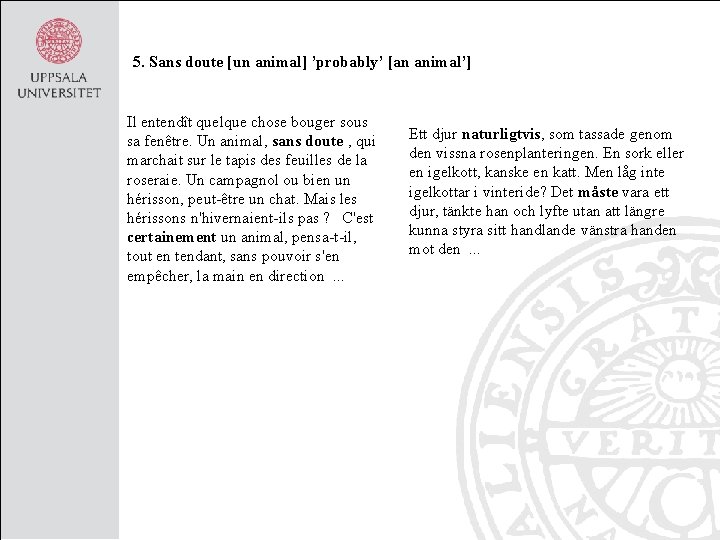
5. Sans doute [un animal] ’probably’ [an animal’] Il entendît quelque chose bouger sous sa fenêtre. Un animal, sans doute , qui marchait sur le tapis des feuilles de la roseraie. Un campagnol ou bien un hérisson, peut-être un chat. Mais les hérissons n'hivernaient-ils pas ? C'est certainement un animal, pensa-t-il, tout en tendant, sans pouvoir s'en empêcher, la main en direction . . . Ett djur naturligtvis, som tassade genom den vissna rosenplanteringen. En sork eller en igelkott, kanske en katt. Men låg inte igelkottar i vinteride? Det måste vara ett djur, tänkte han och lyfte utan att längre kunna styra sitt handlande vänstra handen mot den . . .
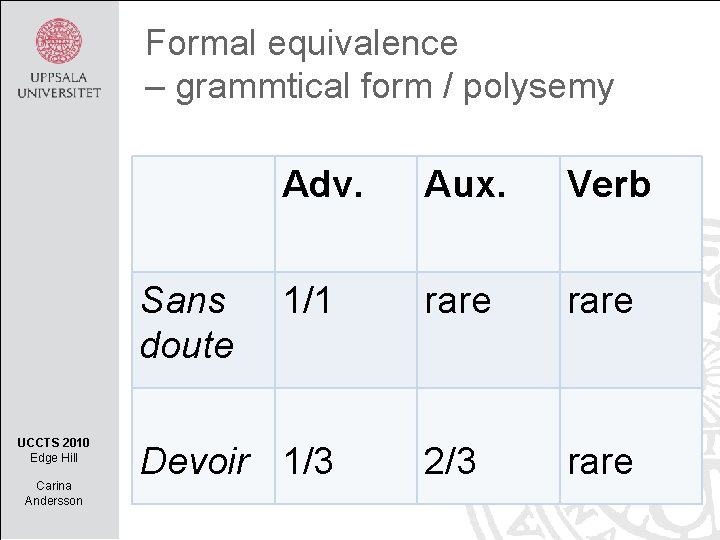
Formal equivalence – grammtical form / polysemy Sans doute UCCTS 2010 Edge Hill Carina Andersson Adv. Aux. Verb 1/1 rare 2/3 rare Devoir 1/3
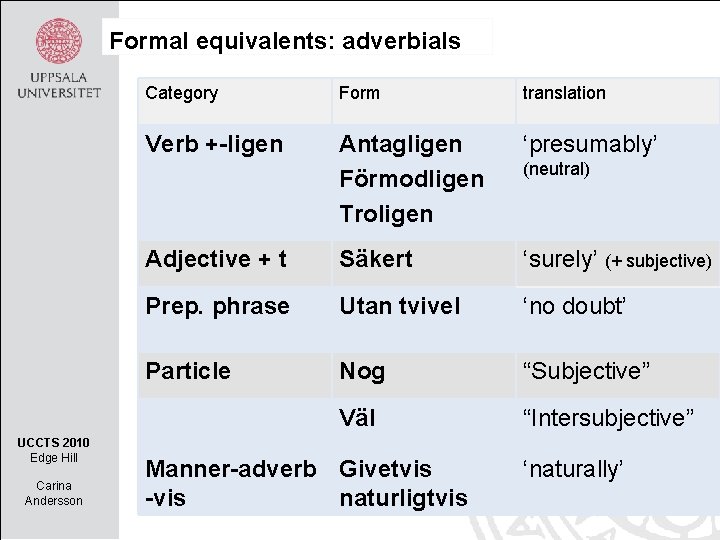
Formal equivalents: adverbials UCCTS 2010 Edge Hill Carina Andersson Category Form translation Verb +-ligen Antagligen Förmodligen Troligen ‘presumably’ Adjective + t Säkert ‘surely’ (+ subjective) Prep. phrase Utan tvivel ‘no doubt’ Particle Nog “Subjective” Väl “Intersubjective” Manner-adverb Givetvis -vis naturligtvis (neutral) ‘naturally’
Sans doute – utan tvivel/tvekan (‘no doubt’) • Only TT equivalent to sans doute • Debate : 60 % TT • Fiction/non fiction : some cases • Stronger commitment • Not recommended … • (ex. 1 -2) UCCTS 2010 Edge Hill Carina Andersson
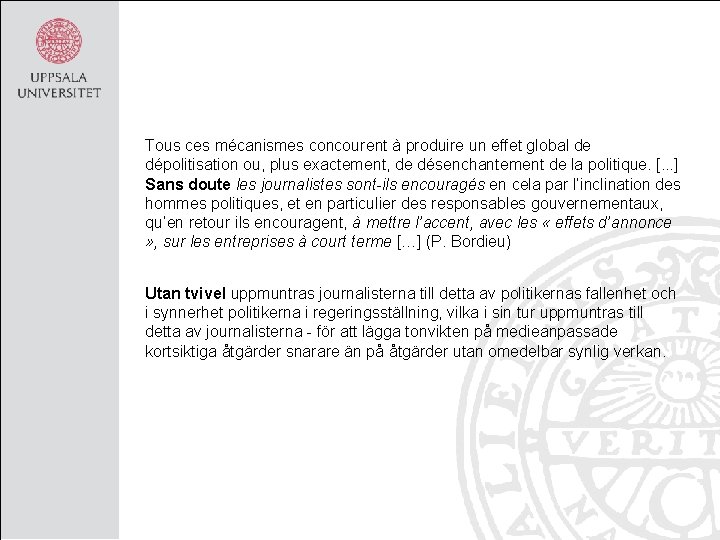
Tous ces mécanismes concourent à produire un effet global de dépolitisation ou, plus exactement, de désenchantement de la politique. [. . . ] Sans doute les journalistes sont-ils encouragés en cela par l’inclination des hommes politiques, et en particulier des responsables gouvernementaux, qu’en retour ils encouragent, à mettre l’accent, avec les « effets d’annonce » , sur les entreprises à court terme […] (P. Bordieu) Utan tvivel uppmuntras journalisterna till detta av politikernas fallenhet och i synnerhet politikerna i regeringsställning, vilka i sin tur uppmuntras till detta av journalisterna - för att lägga tonvikten på medieanpassade kortsiktiga åtgärder snarare än på åtgärder utan omedelbar synlig verkan.

Sans doute – säkert, säkerligen (‘surely’) • Mainly a source equivalent (56 cases) – target equivalence (6 cases) • Predominantly in Fiction • Säkert – slightly higher frequency in ST • Säkert in translation • mainly translated with a certainty marker: certainement, assurément, sûrement UCCTS 2010 Edge Hill Carina Andersson • Ex (3 -6)
Adverbs –ligen : ST / TT • Antagligen, förmodligen: overrepresented in TT among tr-eq to sans doute and in general • Troligen: underrepsentated in TT • Different distribution pattern in ST & TT – ST – initial position (I - 57 %; M - 37 %) • (focalized/textbinding) – TT – median position (I – 22 %; M – 43 %) UCCTS 2010 Edge Hill Carina Andersson • (ex 7 -9)
Sans doute – kanske (‘mayby’) • Mainly STT equivalent in Fiction • Fiction: 11/4, Non fiction 5/4, Debat 0 • Politeness – “hedge” • concession – “admittedly • (ex. 10 -12) UCCTS 2010 Edge Hill Carina Andersson
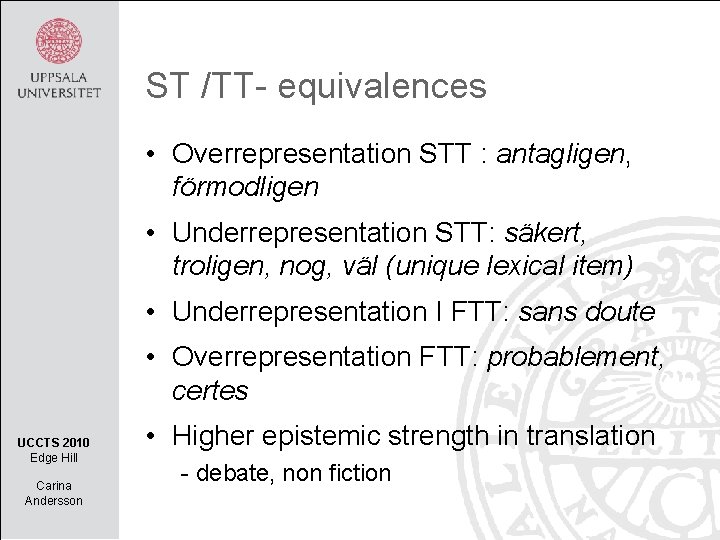
ST /TT- equivalences • Overrepresentation STT : antagligen, förmodligen • Underrepresentation STT: säkert, troligen, nog, väl (unique lexical item) • Underrepresentation I FTT: sans doute • Overrepresentation FTT: probablement, certes UCCTS 2010 Edge Hill Carina Andersson • Higher epistemic strength in translation - debate, non fiction
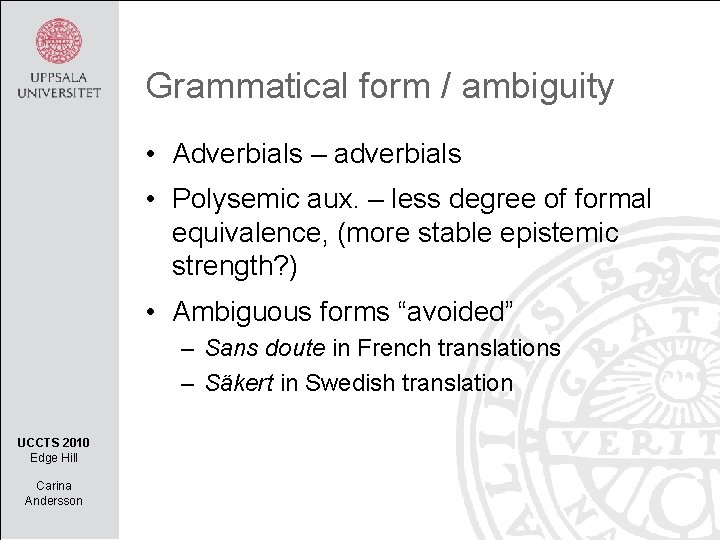
Grammatical form / ambiguity • Adverbials – adverbials • Polysemic aux. – less degree of formal equivalence, (more stable epistemic strength? ) • Ambiguous forms “avoided” – Sans doute in French translations – Säkert in Swedish translation UCCTS 2010 Edge Hill Carina Andersson
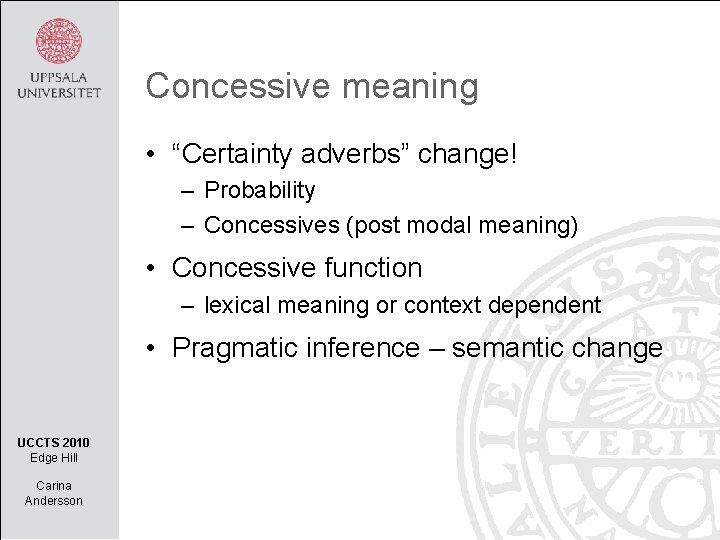
Concessive meaning • “Certainty adverbs” change! – Probability – Concessives (post modal meaning) • Concessive function – lexical meaning or context dependent • Pragmatic inference – semantic change UCCTS 2010 Edge Hill Carina Andersson
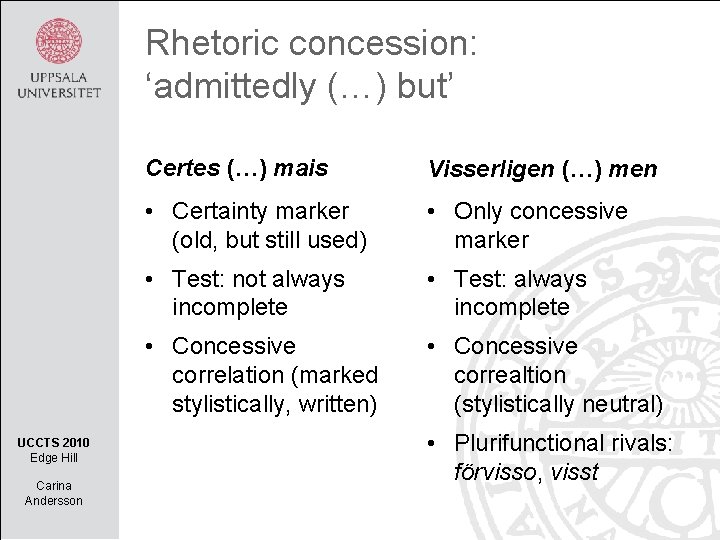
Rhetoric concession: ‘admittedly (…) but’ UCCTS 2010 Edge Hill Carina Andersson Certes (…) mais Visserligen (…) men • Certainty marker (old, but still used) • Only concessive marker • Test: not always incomplete • Test: always incomplete • Concessive correlation (marked stylistically, written) • Concessive correaltion (stylistically neutral) • Plurifunctional rivals: förvisso, visst
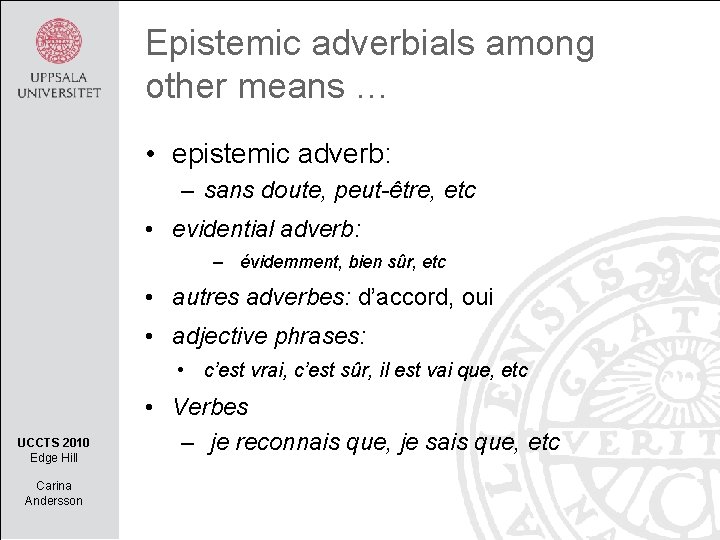
Epistemic adverbials among other means … • epistemic adverb: – sans doute, peut-être, etc • evidential adverb: – évidemment, bien sûr, etc • autres adverbes: d’accord, oui • adjective phrases: • c’est vrai, c’est sûr, il est vai que, etc UCCTS 2010 Edge Hill Carina Andersson • Verbes – je reconnais que, je sais que, etc
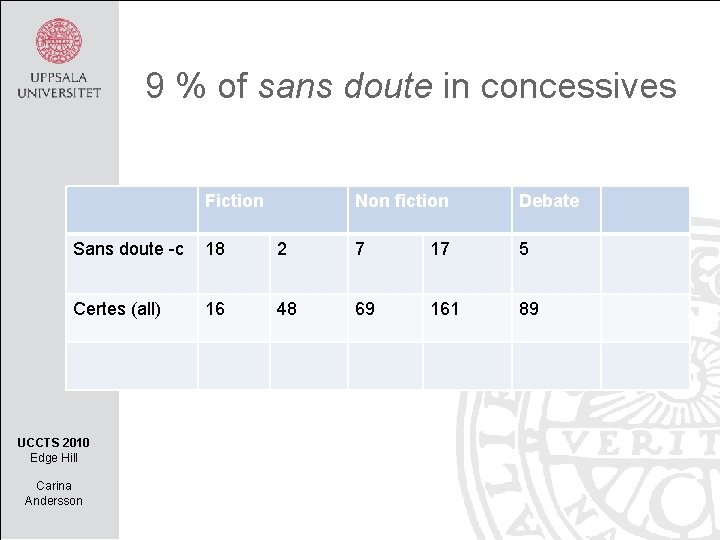
9 % of sans doute in concessives Fiction Non fiction Debate Sans doute -c 18 2 7 17 5 Certes (all) 16 48 69 161 89 UCCTS 2010 Edge Hill Carina Andersson
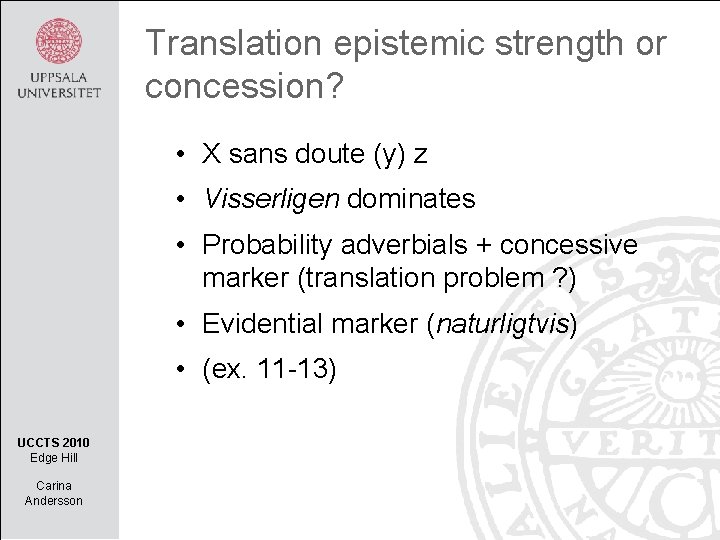
Translation epistemic strength or concession? • X sans doute (y) z • Visserligen dominates • Probability adverbials + concessive marker (translation problem ? ) • Evidential marker (naturligtvis) • (ex. 11 -13) UCCTS 2010 Edge Hill Carina Andersson
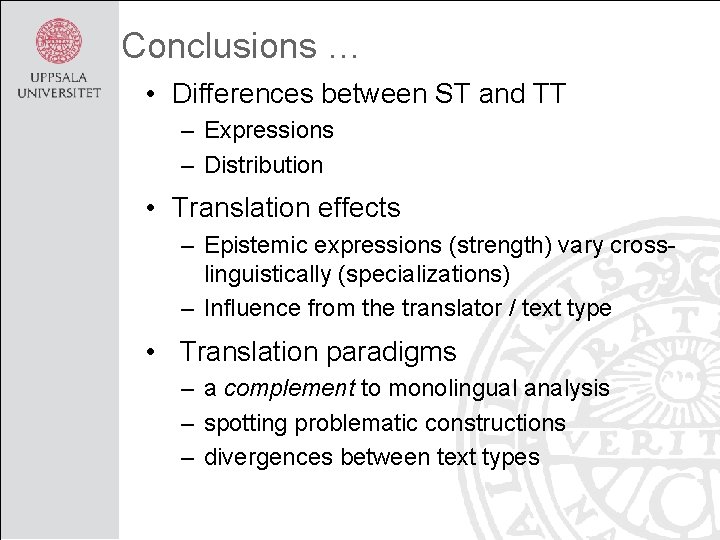
Conclusions … • Differences between ST and TT – Expressions – Distribution • Translation effects – Epistemic expressions (strength) vary crosslinguistically (specializations) – Influence from the translator / text type • Translation paradigms – a complement to monolingual analysis – spotting problematic constructions – divergences between text types
- Slides: 27