
Epipolar geometry Binocular stereo Special case cameras are
Epipolar geometry
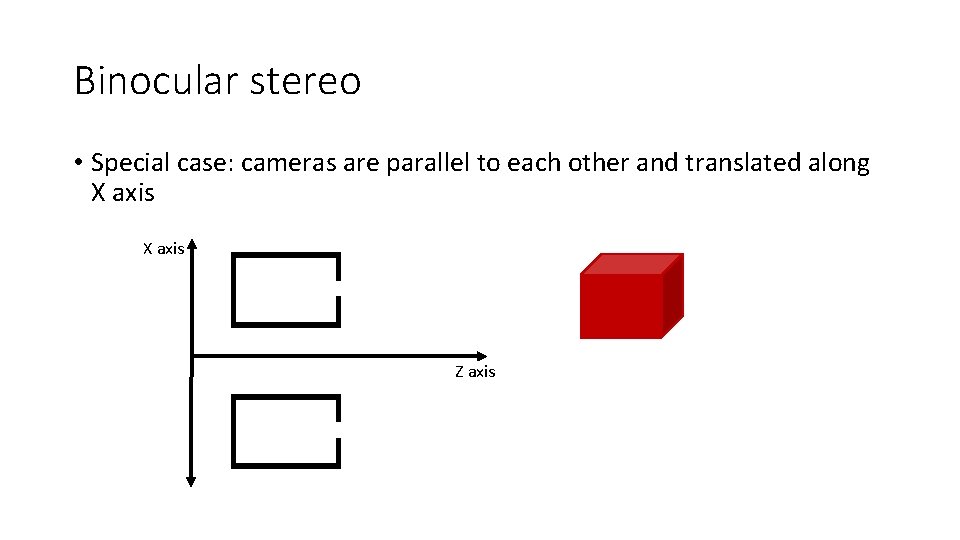
Binocular stereo • Special case: cameras are parallel to each other and translated along X axis Z axis
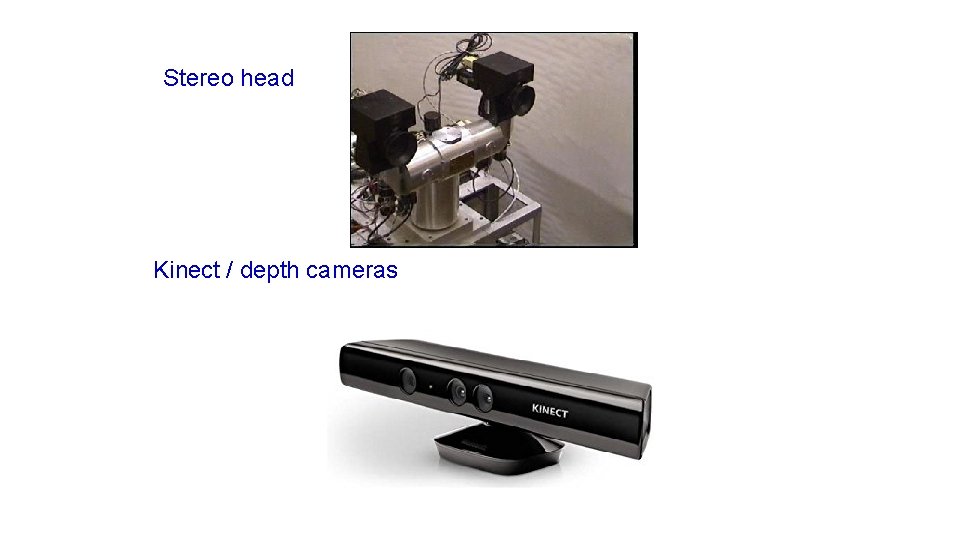
Stereo head Kinect / depth cameras

Perspective projection in rectified cameras • Without loss of generality, assume origin is at pinhole of 1 st camera X coordinate differs by tx/Z Y coordinate is the same!
Perspective projection in rectified cameras • X coordinate differs by tx/Z • That is, difference in X coordinate is inversely proportional to depth • Difference in X coordinate is called disparity • Translation between cameras (tx) is called baseline • disparity = baseline / depth
The NCC cost volume • Consider M x N image • Suppose there are D possible disparities. • For every pixel, D possible scores • Can be written as an M x N x D array • To get disparity, take max along 3 rd axis
Computing the NCC volume 1. For every pixel (x, y) 1. For every disparity d 1. 2. 3. Get normalized patch from image 1 at (x, y) Get normalized patch from image 2 at (x + d, y) Compute NCC
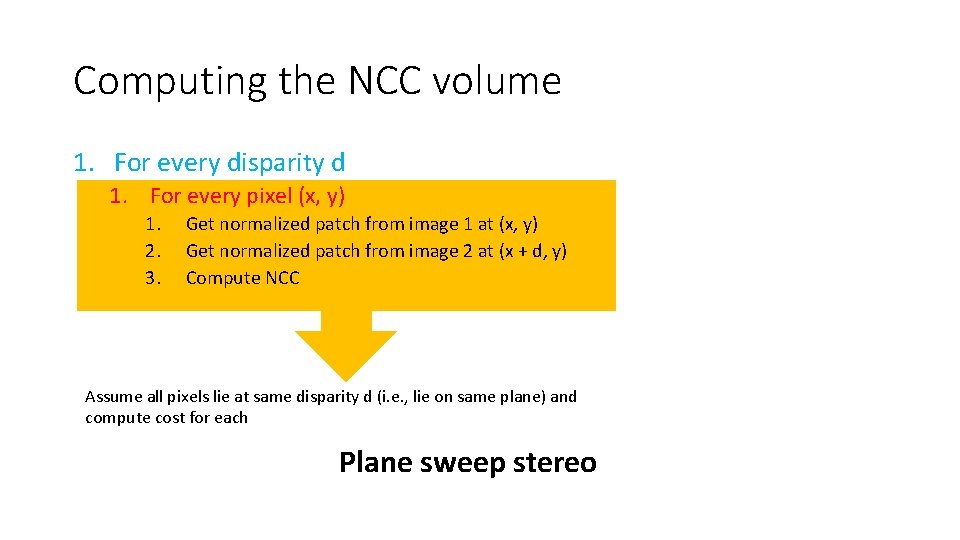
Computing the NCC volume 1. For every disparity d 1. For every pixel (x, y) 1. 2. 3. Get normalized patch from image 1 at (x, y) Get normalized patch from image 2 at (x + d, y) Compute NCC Assume all pixels lie at same disparity d (i. e. , lie on same plane) and compute cost for each Plane sweep stereo
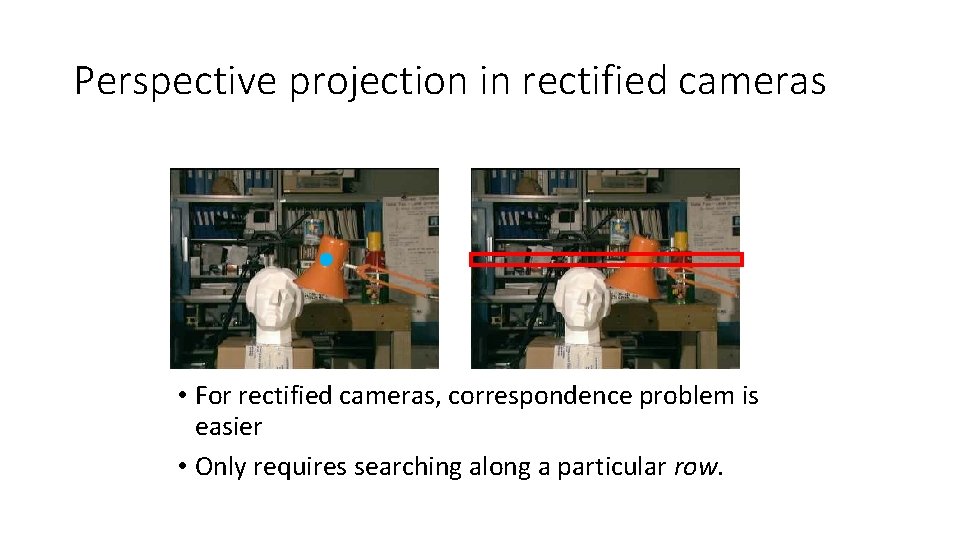
Perspective projection in rectified cameras • For rectified cameras, correspondence problem is easier • Only requires searching along a particular row.
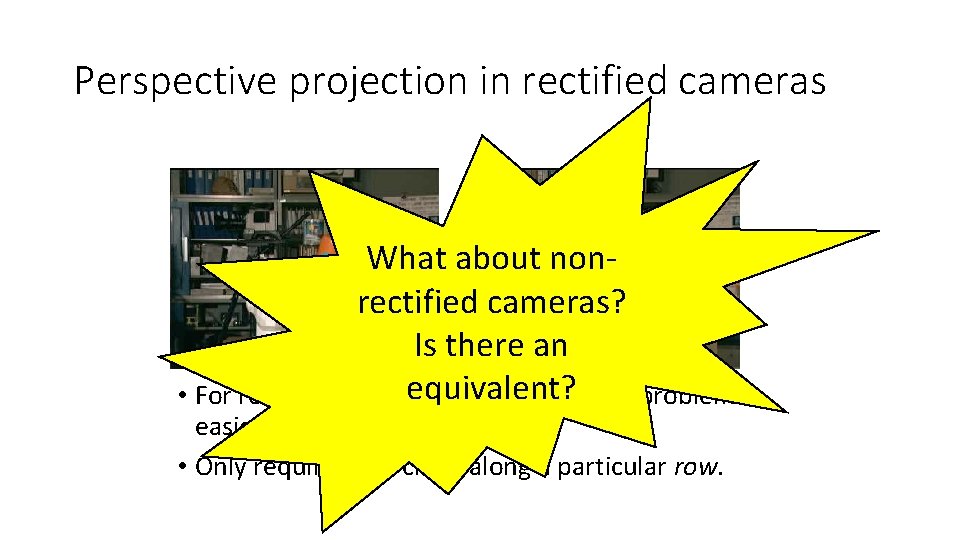
Perspective projection in rectified cameras What about nonrectified cameras? Is there an equivalent? • For rectified cameras, correspondence problem is easier • Only requires searching along a particular row.
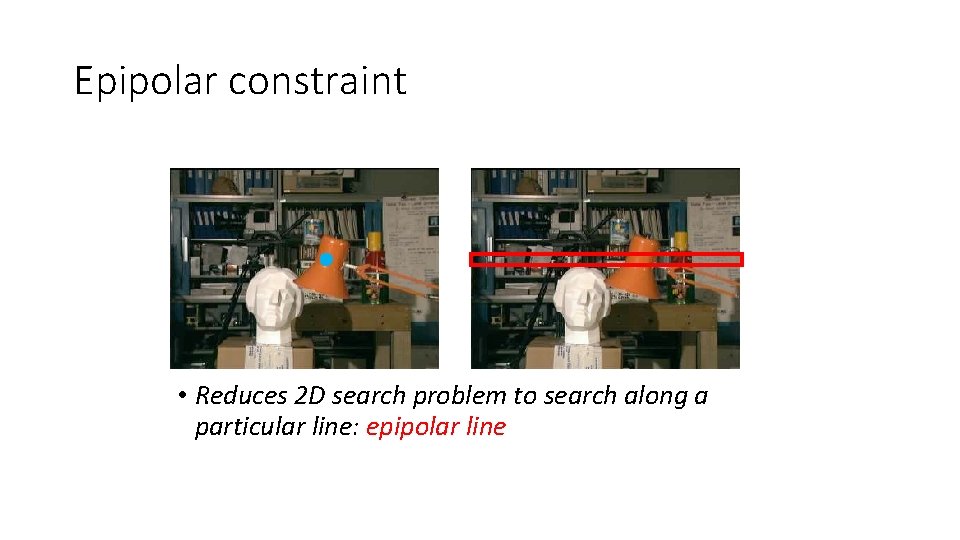
Epipolar constraint • Reduces 2 D search problem to search along a particular line: epipolar line
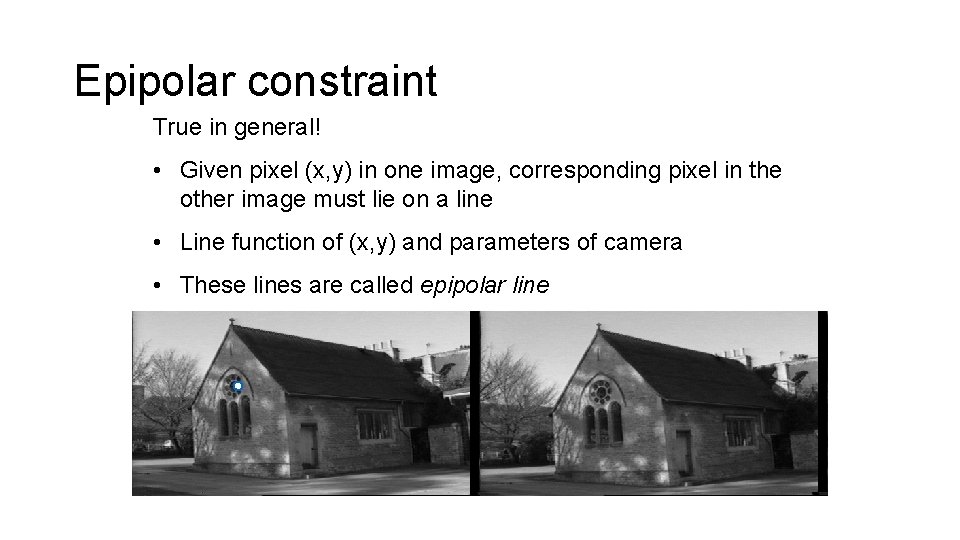
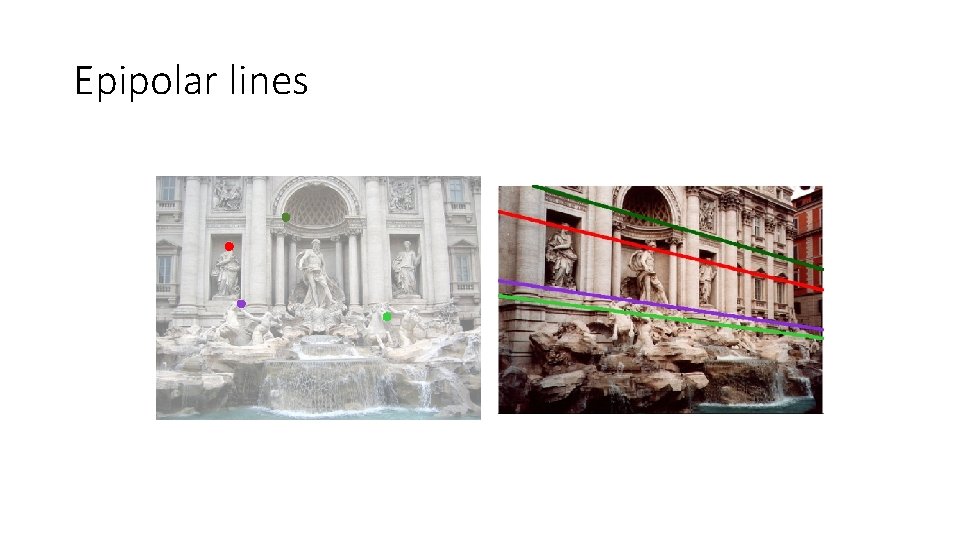
Epipolar constraint True in general! • Given pixel (x, y) in one image, corresponding pixel in the other image must lie on a line • Line function of (x, y) and parameters of camera • These lines are called epipolar line
Epipolar geometry
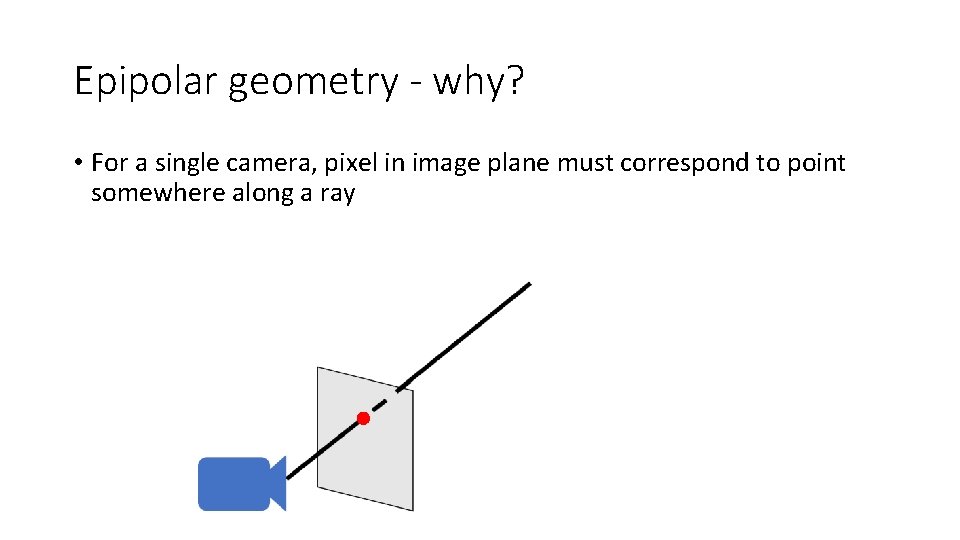
Epipolar geometry - why? • For a single camera, pixel in image plane must correspond to point somewhere along a ray
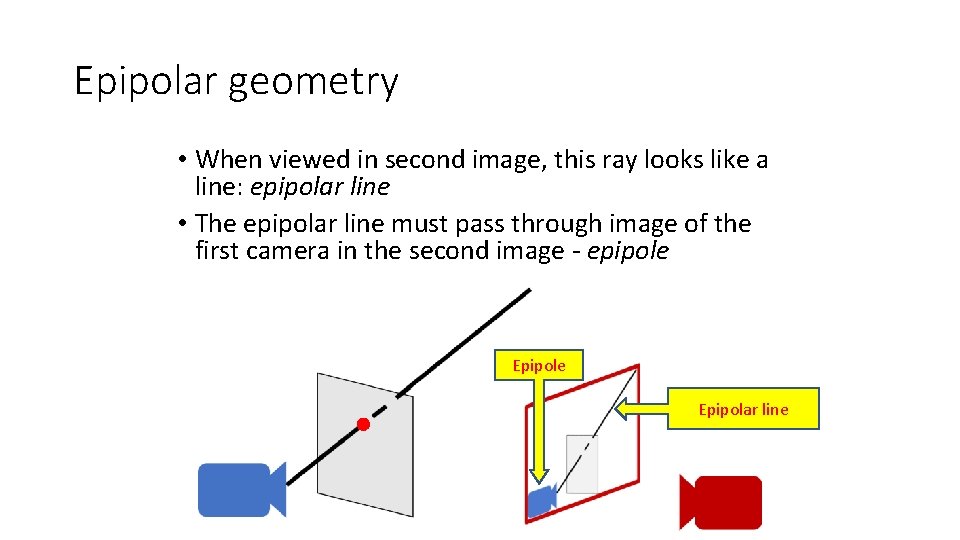
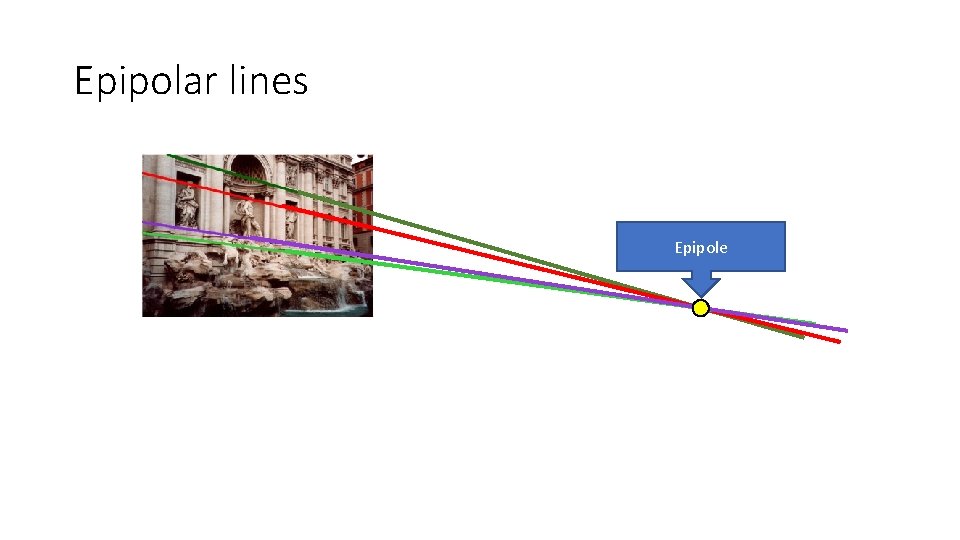
Epipolar geometry • When viewed in second image, this ray looks like a line: epipolar line • The epipolar line must pass through image of the first camera in the second image - epipole Epipolar line
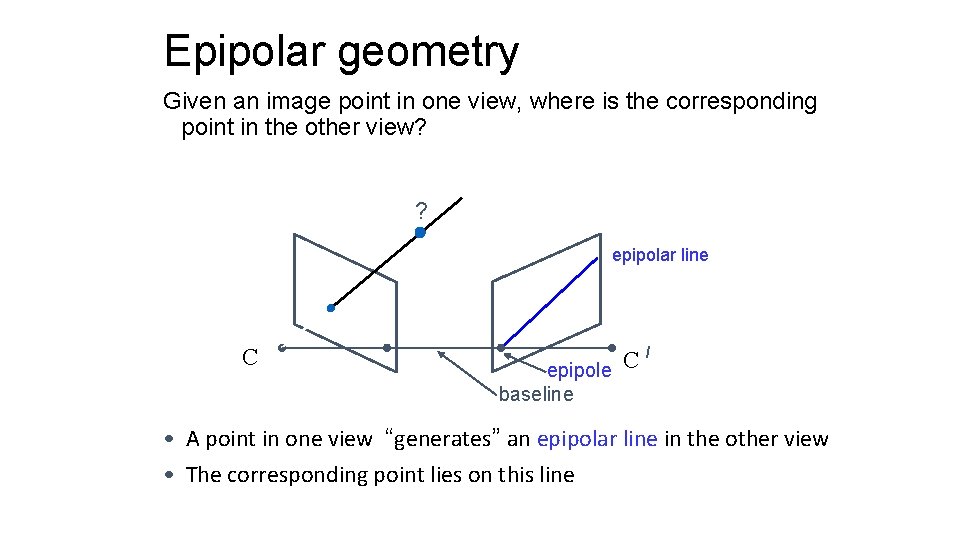
Epipolar geometry Given an image point in one view, where is the corresponding point in the other view? ? epipolar line C / C epipole baseline • A point in one view “generates” an epipolar line in the other view • The corresponding point lies on this line
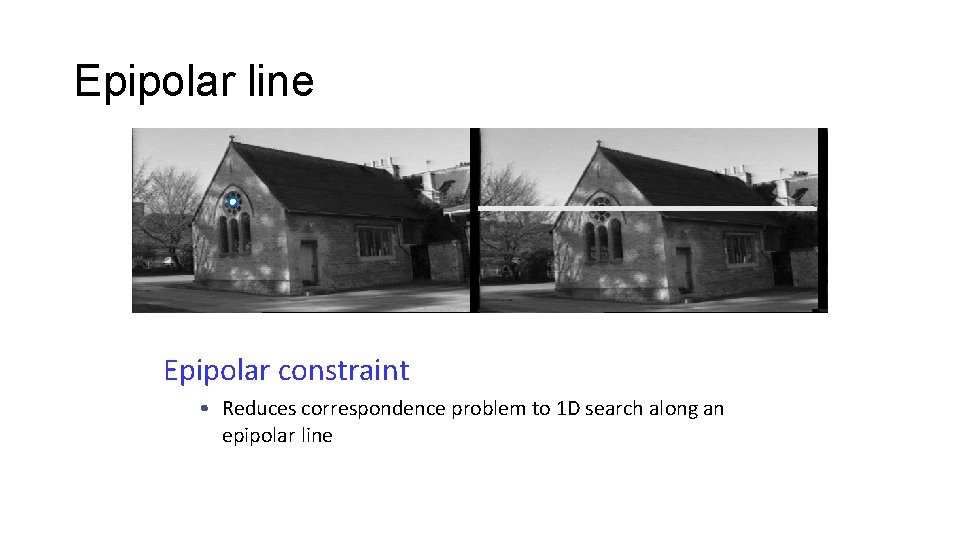
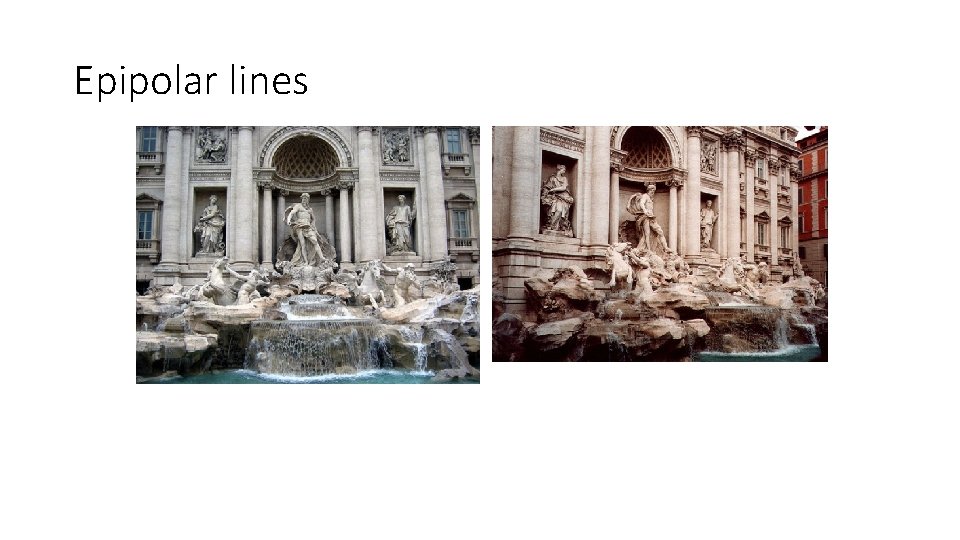
Epipolar line Epipolar constraint • Reduces correspondence problem to 1 D search along an epipolar line
Epipolar lines
Epipolar lines
Epipolar lines Epipole
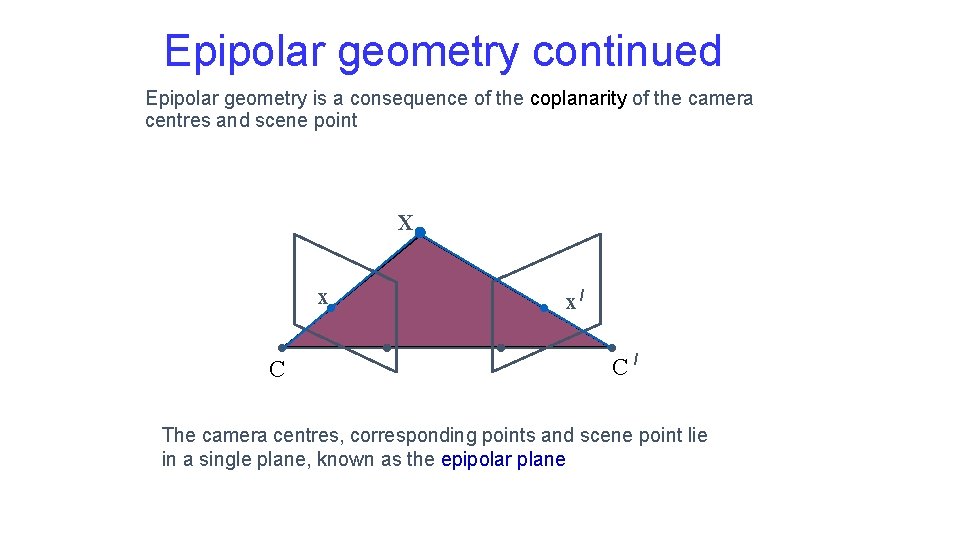
Epipolar geometry continued Epipolar geometry is a consequence of the coplanarity of the camera centres and scene point X x C x/ C/ The camera centres, corresponding points and scene point lie in a single plane, known as the epipolar plane
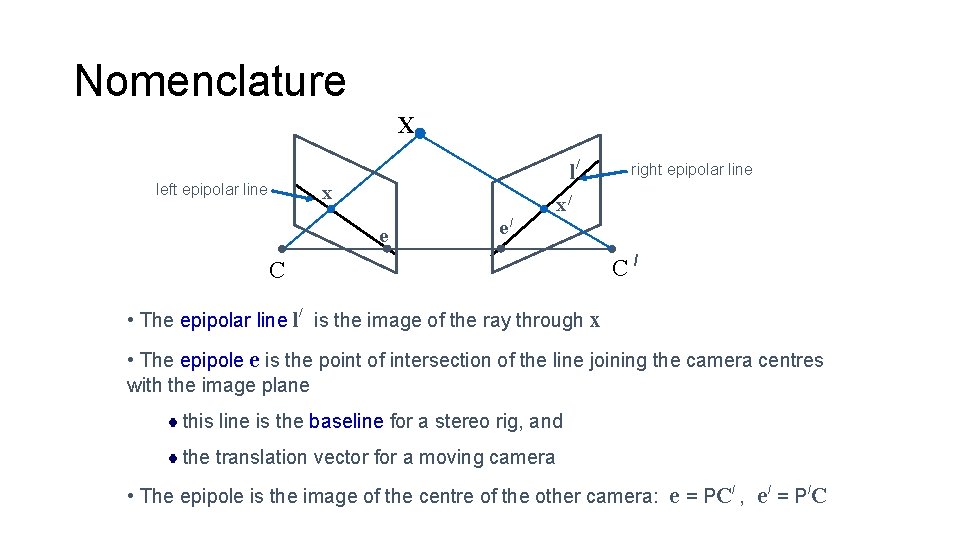
Nomenclature X left epipolar line l/ x right epipolar line x/ e e/ C C/ • The epipolar line l/ is the image of the ray through x • The epipole e is the point of intersection of the line joining the camera centres with the image plane this line is the baseline for a stereo rig, and the translation vector for a moving camera • The epipole is the image of the centre of the other camera: e = PC/ , e/ = P/C
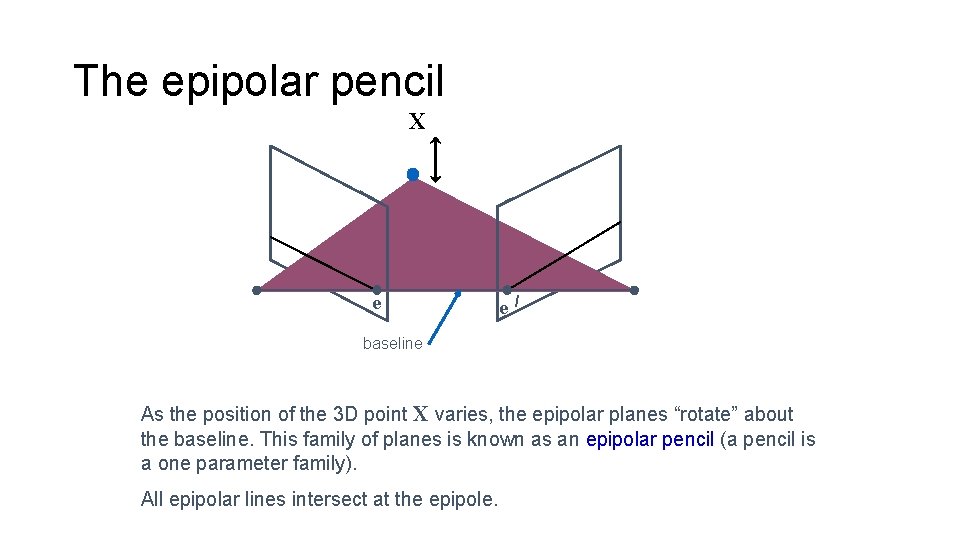
The epipolar pencil X e e / baseline As the position of the 3 D point X varies, the epipolar planes “rotate” about the baseline. This family of planes is known as an epipolar pencil (a pencil is a one parameter family). All epipolar lines intersect at the epipole.
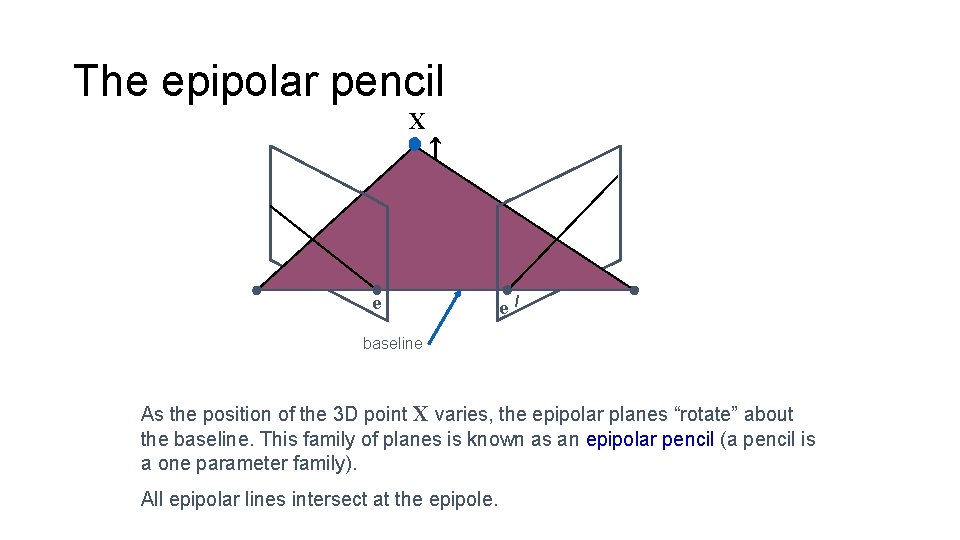
The epipolar pencil X e e / baseline As the position of the 3 D point X varies, the epipolar planes “rotate” about the baseline. This family of planes is known as an epipolar pencil (a pencil is a one parameter family). All epipolar lines intersect at the epipole.
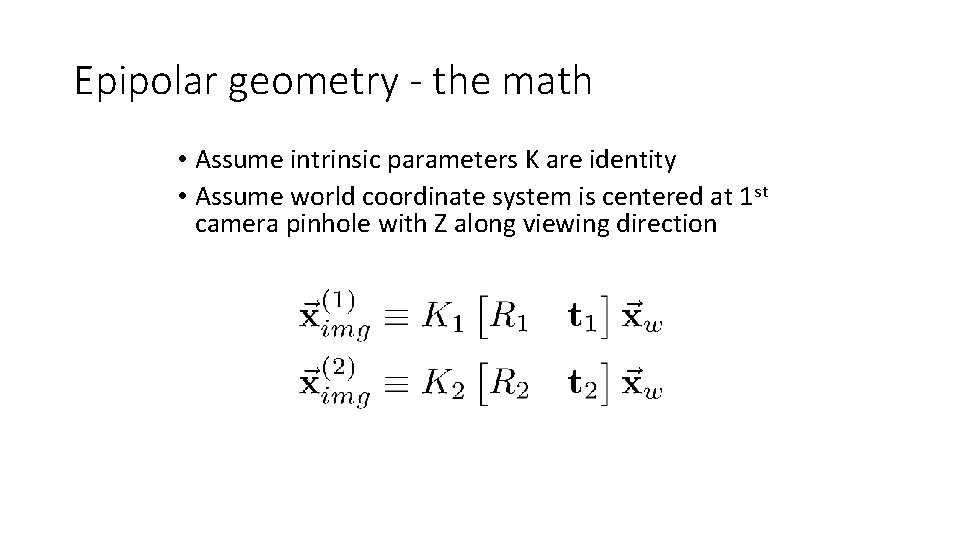
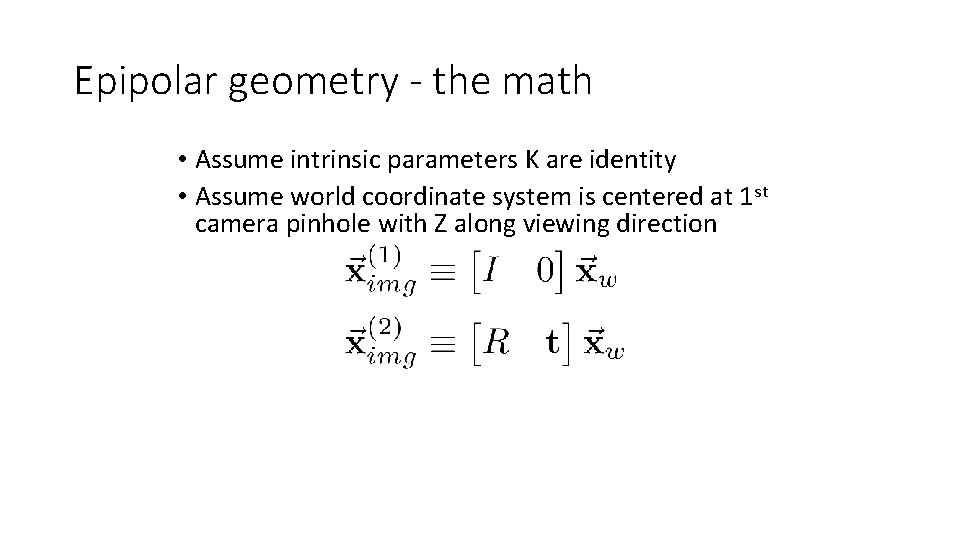
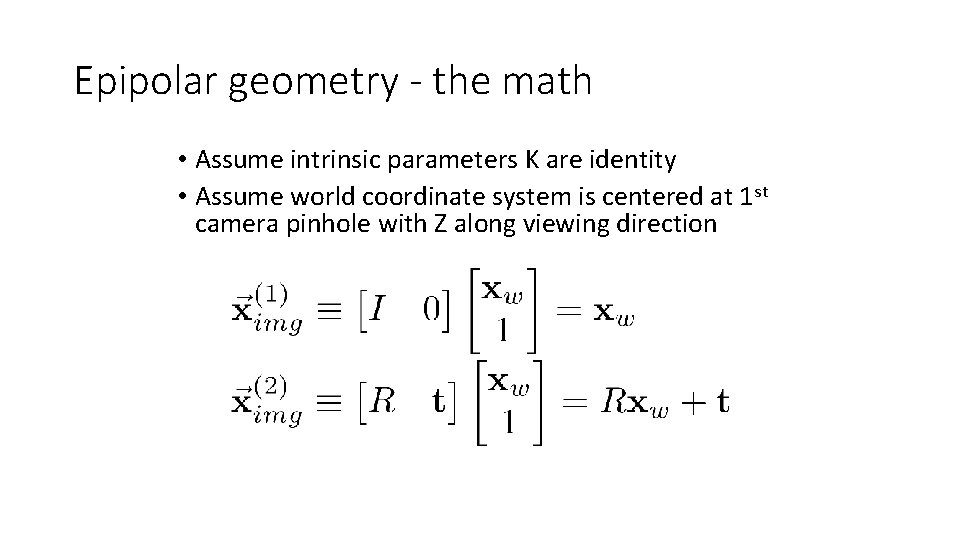
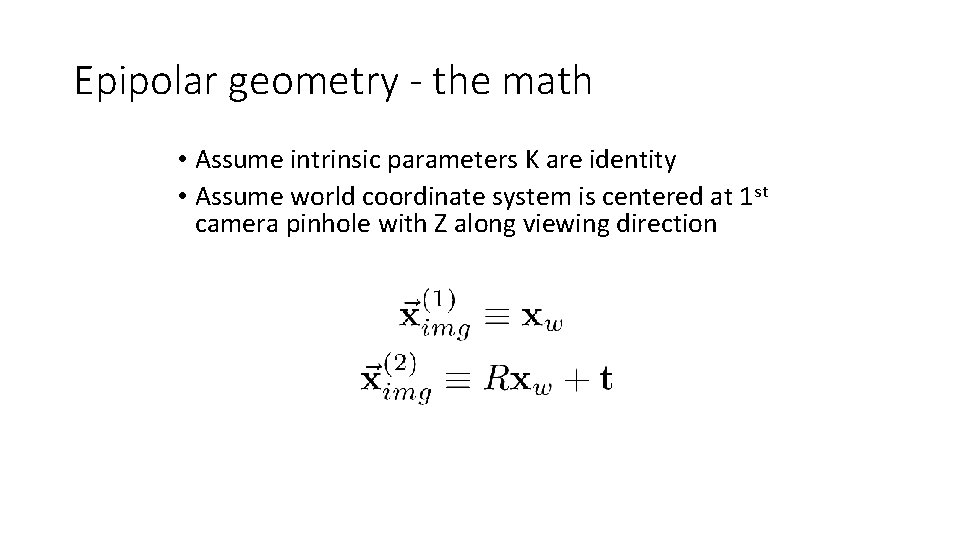
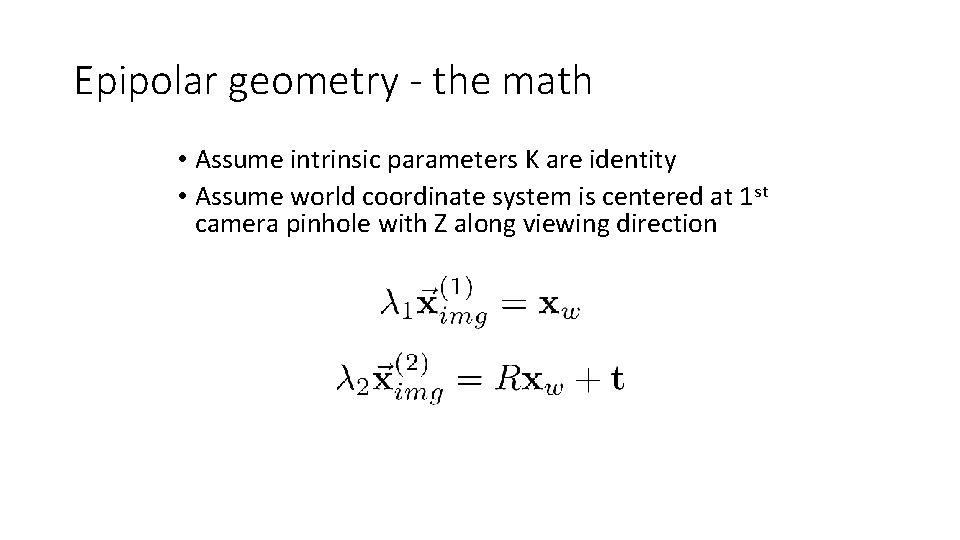
Epipolar geometry - the math • Assume intrinsic parameters K are identity • Assume world coordinate system is centered at 1 st camera pinhole with Z along viewing direction
Epipolar geometry - the math • Assume intrinsic parameters K are identity • Assume world coordinate system is centered at 1 st camera pinhole with Z along viewing direction
Epipolar geometry - the math • Assume intrinsic parameters K are identity • Assume world coordinate system is centered at 1 st camera pinhole with Z along viewing direction
Epipolar geometry - the math • Assume intrinsic parameters K are identity • Assume world coordinate system is centered at 1 st camera pinhole with Z along viewing direction
Epipolar geometry - the math • Assume intrinsic parameters K are identity • Assume world coordinate system is centered at 1 st camera pinhole with Z along viewing direction
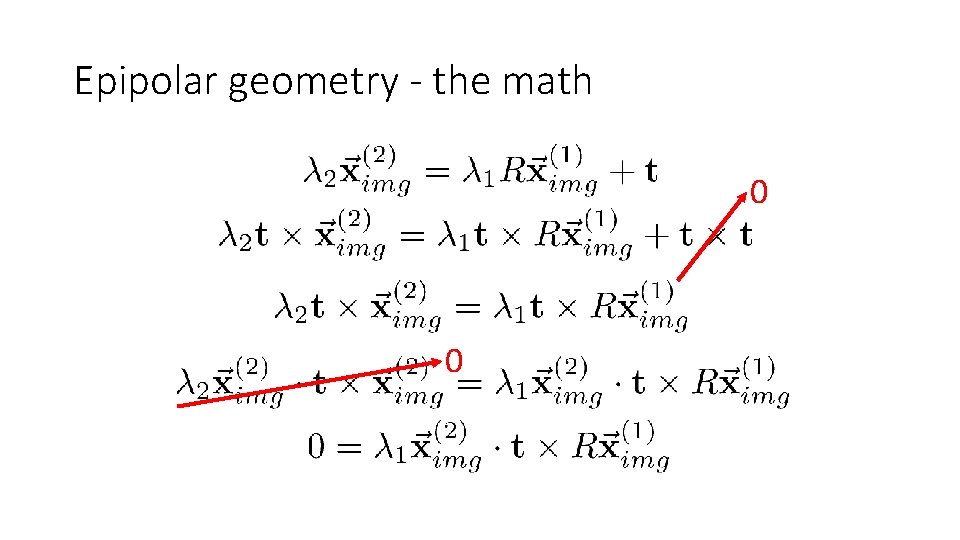
Epipolar geometry - the math 0 0
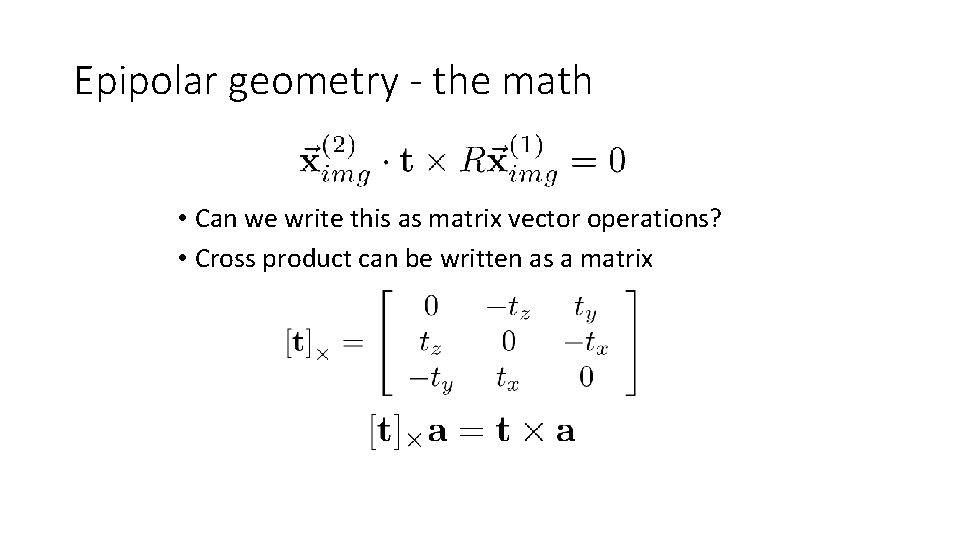
Epipolar geometry - the math • Can we write this as matrix vector operations? • Cross product can be written as a matrix
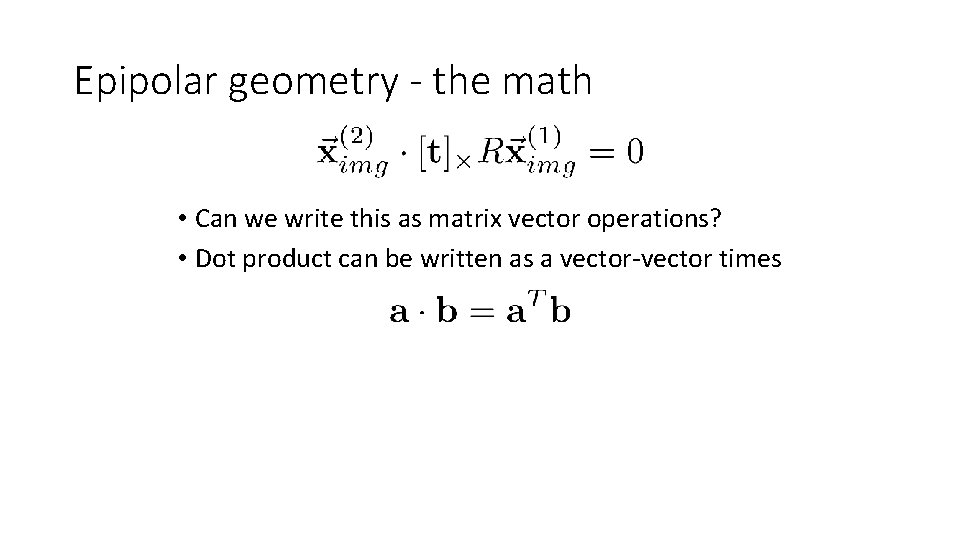
Epipolar geometry - the math • Can we write this as matrix vector operations? • Dot product can be written as a vector-vector times
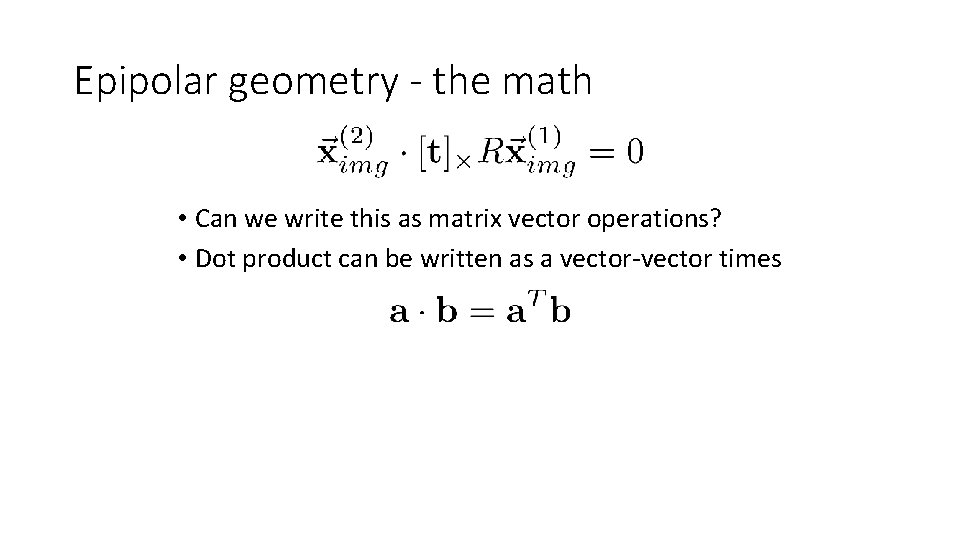
Epipolar geometry - the math • Can we write this as matrix vector operations? • Dot product can be written as a vector-vector times
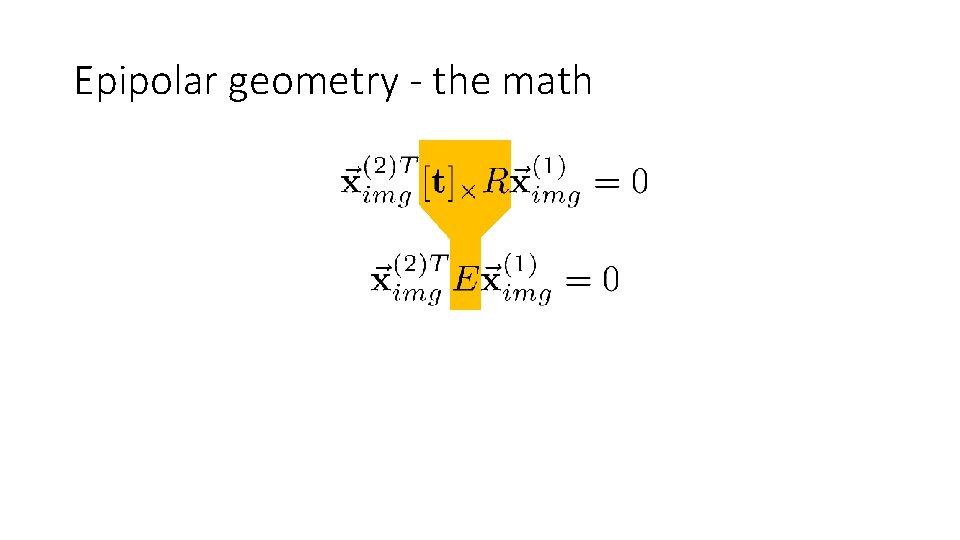
Epipolar geometry - the math
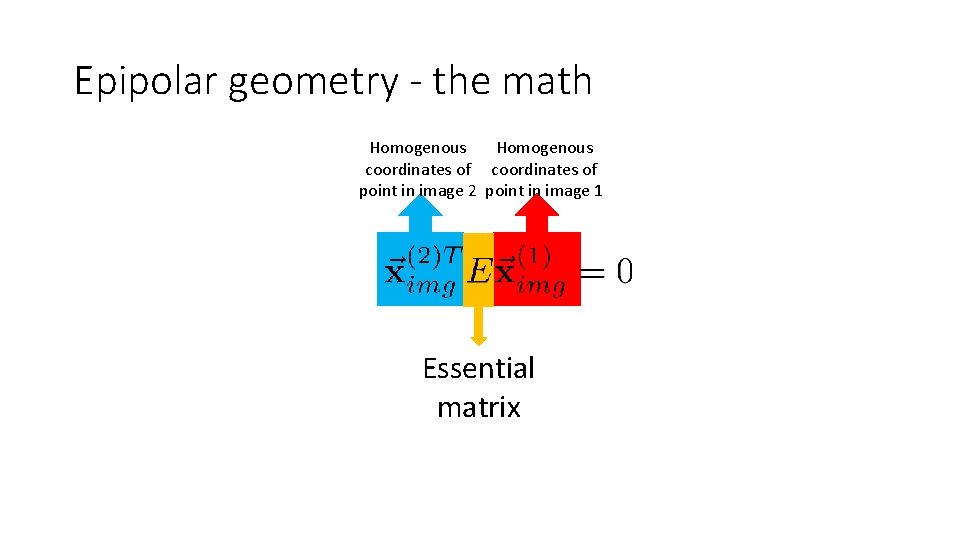
Epipolar geometry - the math Homogenous coordinates of point in image 2 point in image 1 Essential matrix
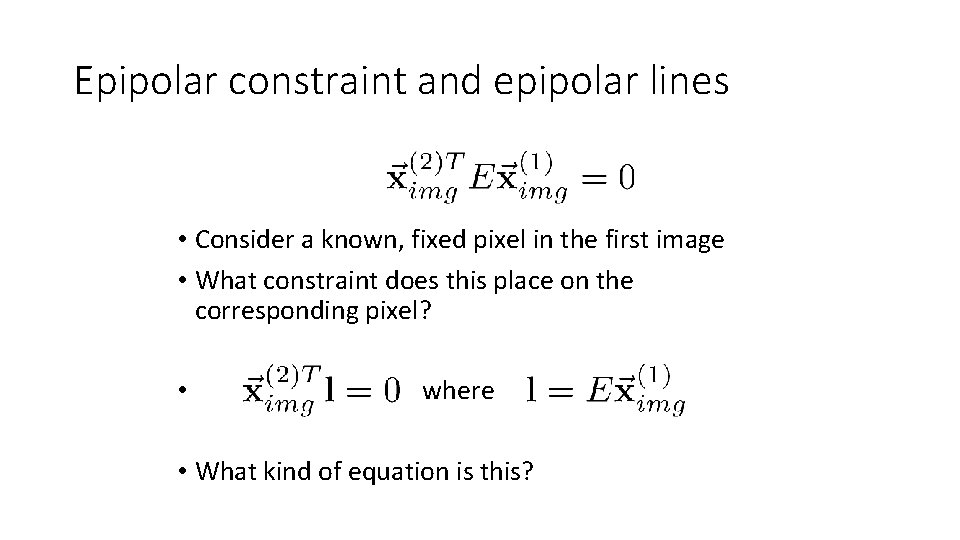
Epipolar constraint and epipolar lines • Consider a known, fixed pixel in the first image • What constraint does this place on the corresponding pixel? • where • What kind of equation is this?
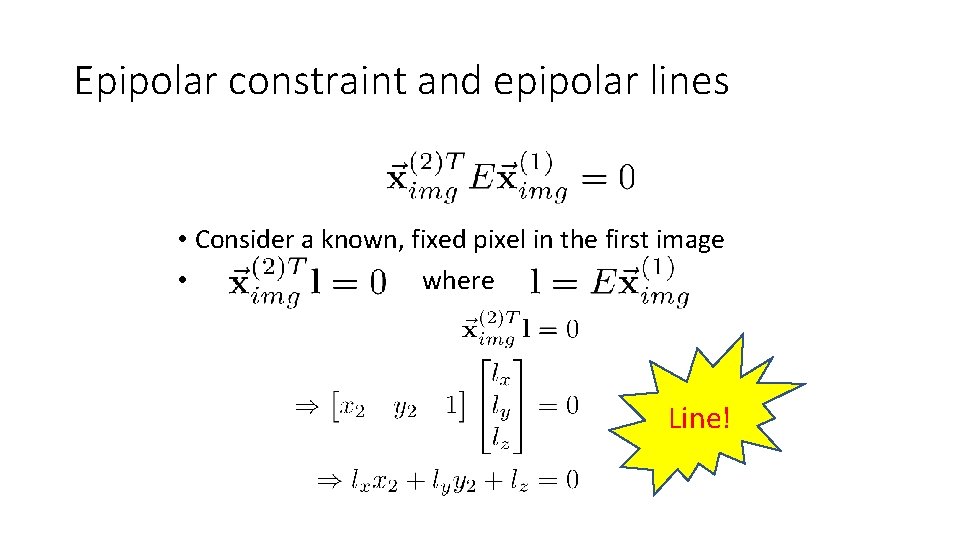
Epipolar constraint and epipolar lines • Consider a known, fixed pixel in the first image • where Line!
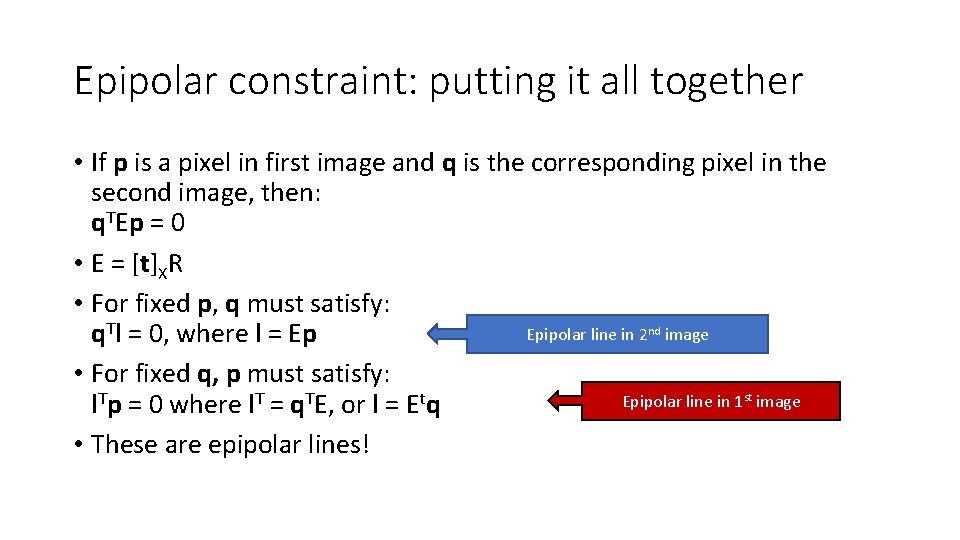
Epipolar constraint: putting it all together • If p is a pixel in first image and q is the corresponding pixel in the second image, then: q. TEp = 0 • E = [t]XR • For fixed p, q must satisfy: Epipolar line in 2 nd image q. Tl = 0, where l = Ep • For fixed q, p must satisfy: Epipolar line in 1 st image l. Tp = 0 where l. T = q. TE, or l = Etq • These are epipolar lines!
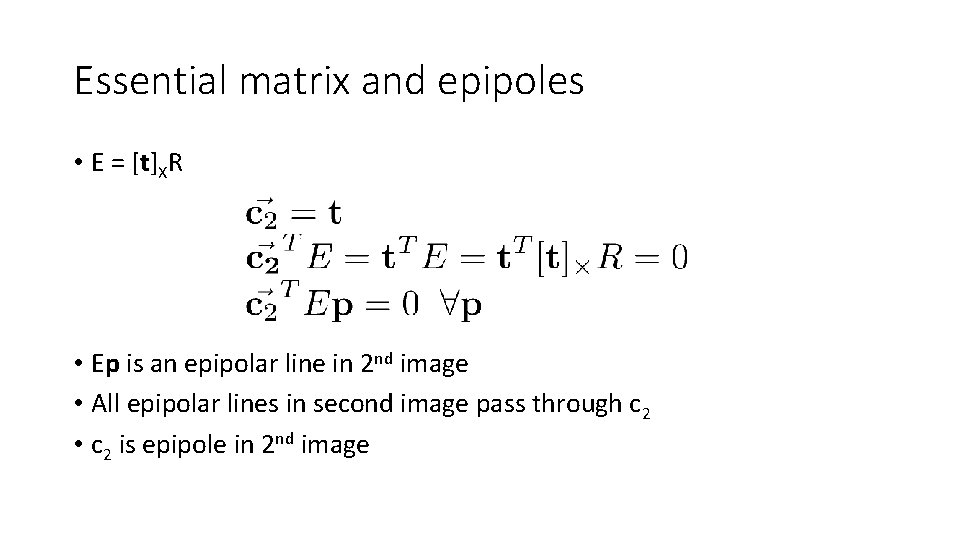
Essential matrix and epipoles • E = [t]XR • Ep is an epipolar line in 2 nd image • All epipolar lines in second image pass through c 2 • c 2 is epipole in 2 nd image
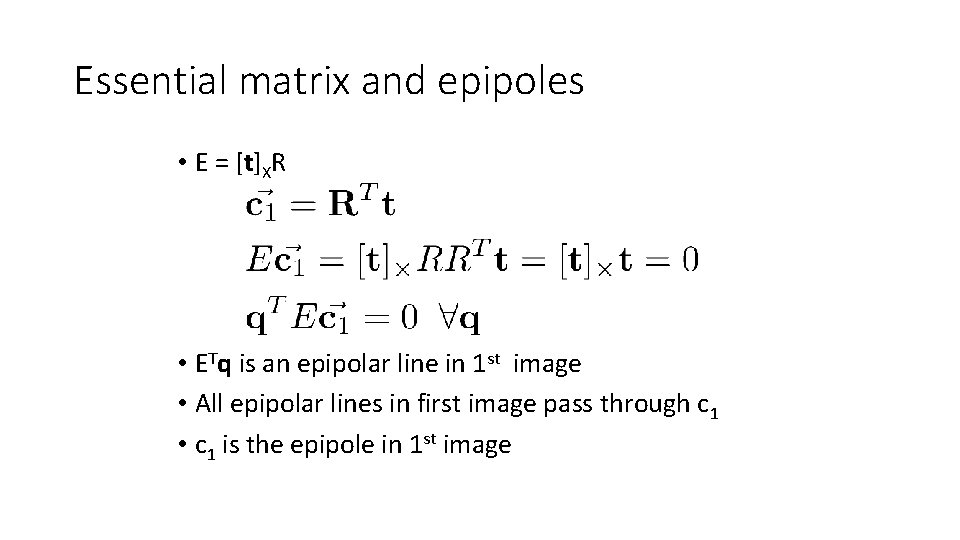
Essential matrix and epipoles • E = [t]XR • ETq is an epipolar line in 1 st image • All epipolar lines in first image pass through c 1 • c 1 is the epipole in 1 st image
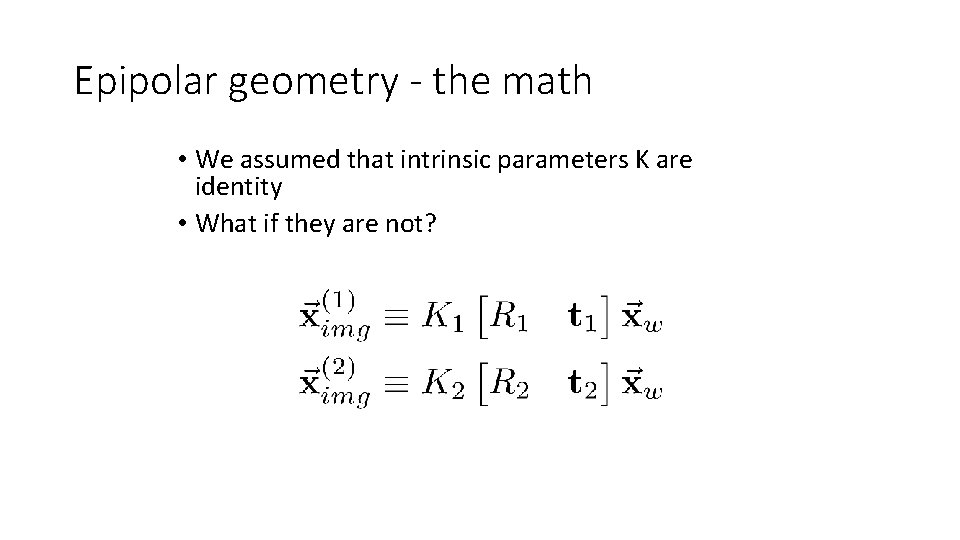
Epipolar geometry - the math • We assumed that intrinsic parameters K are identity • What if they are not?
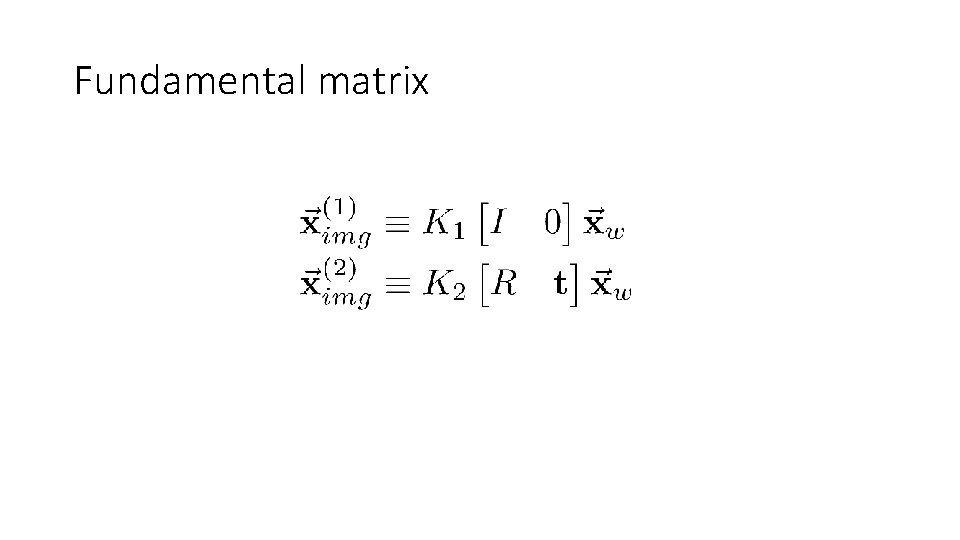
Fundamental matrix
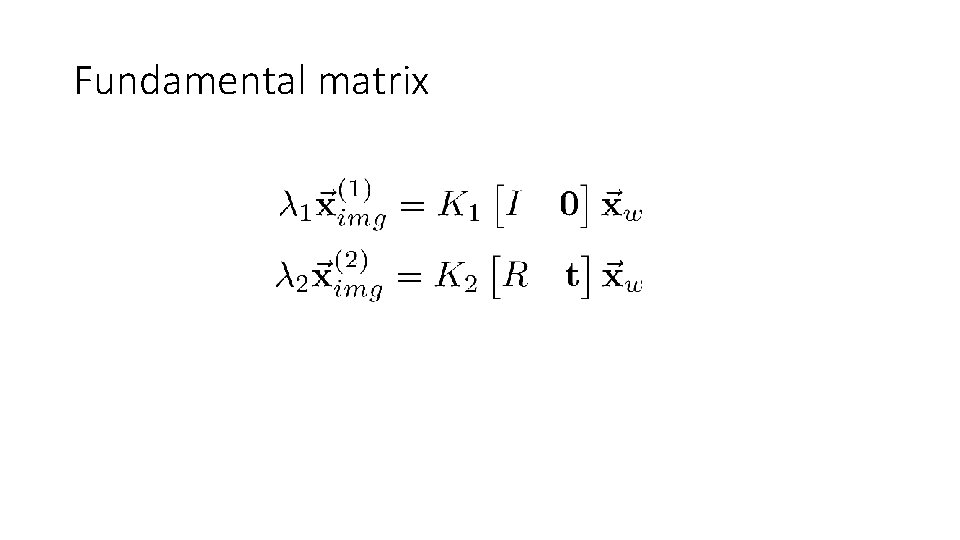
Fundamental matrix
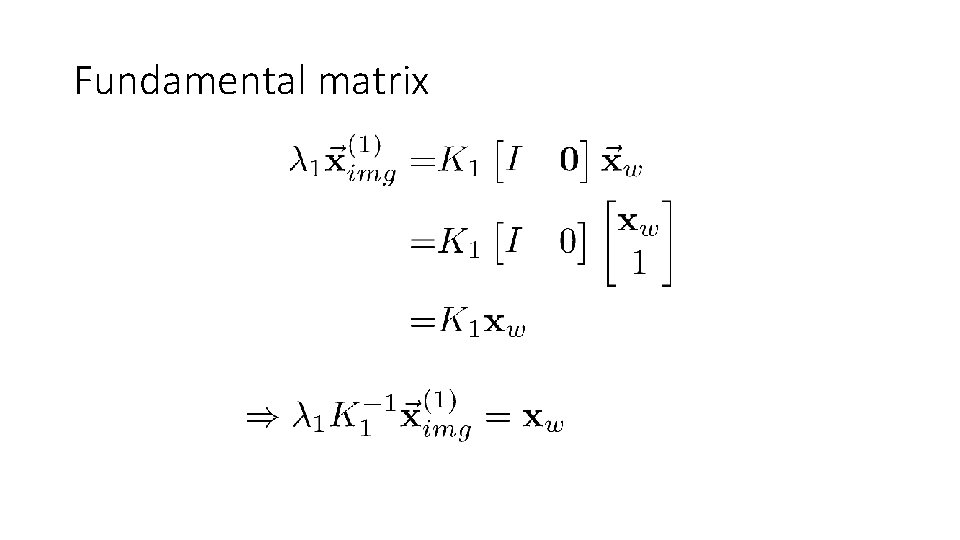
Fundamental matrix
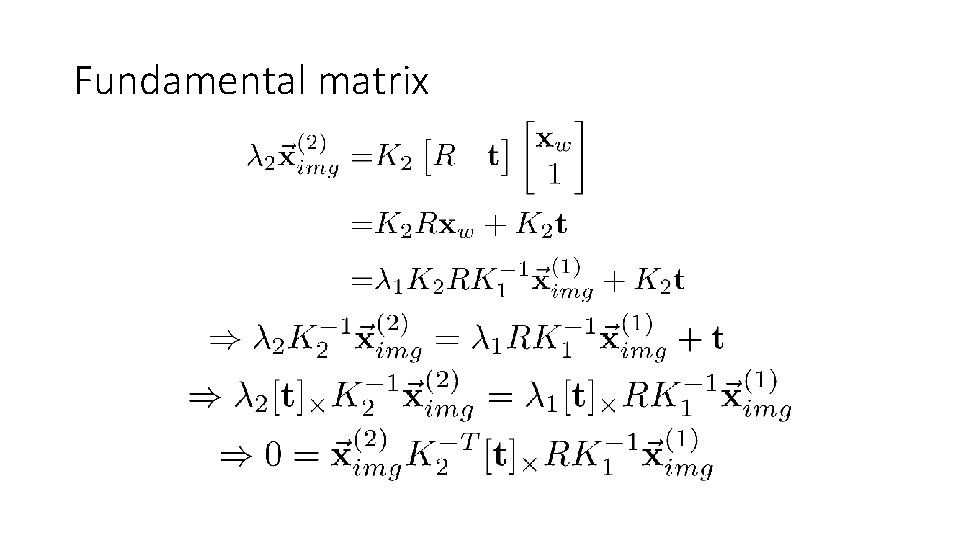
Fundamental matrix
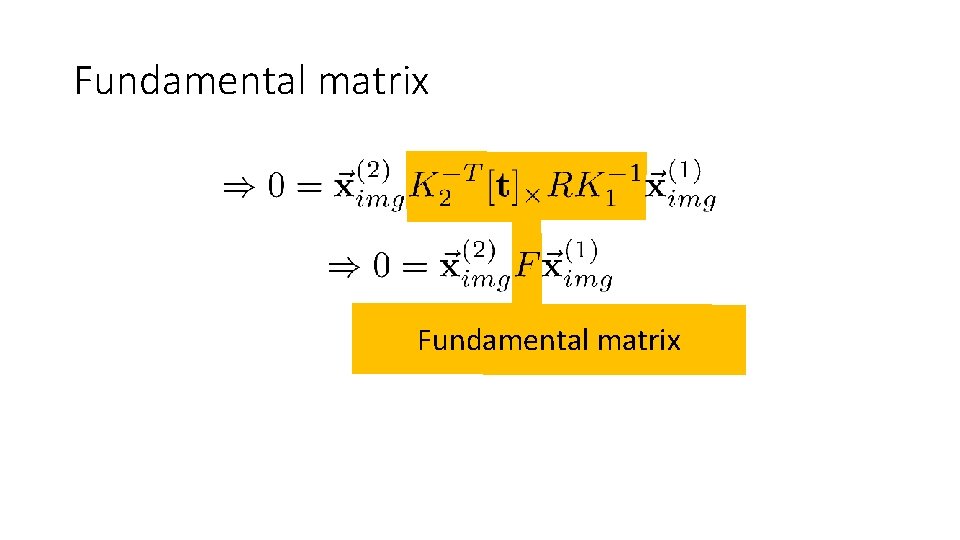
Fundamental matrix
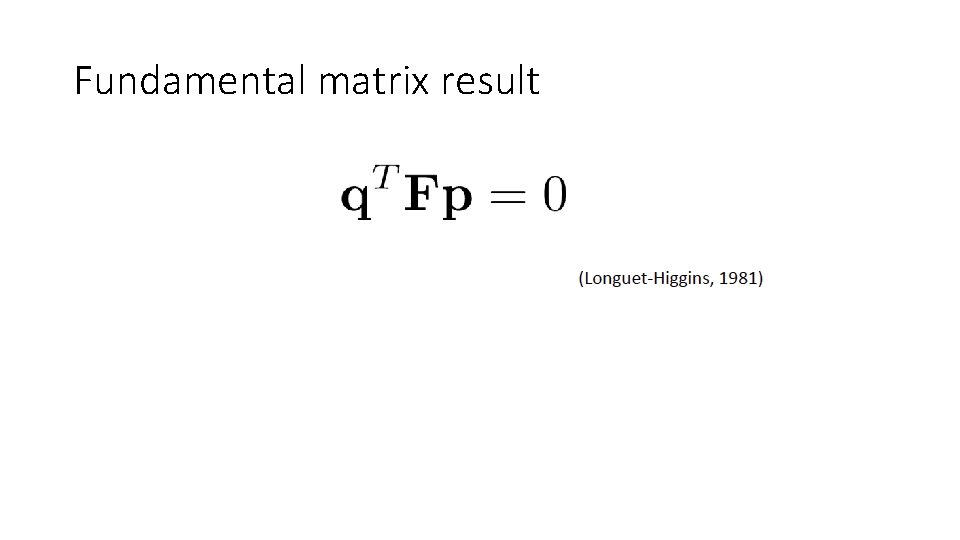
Fundamental matrix result
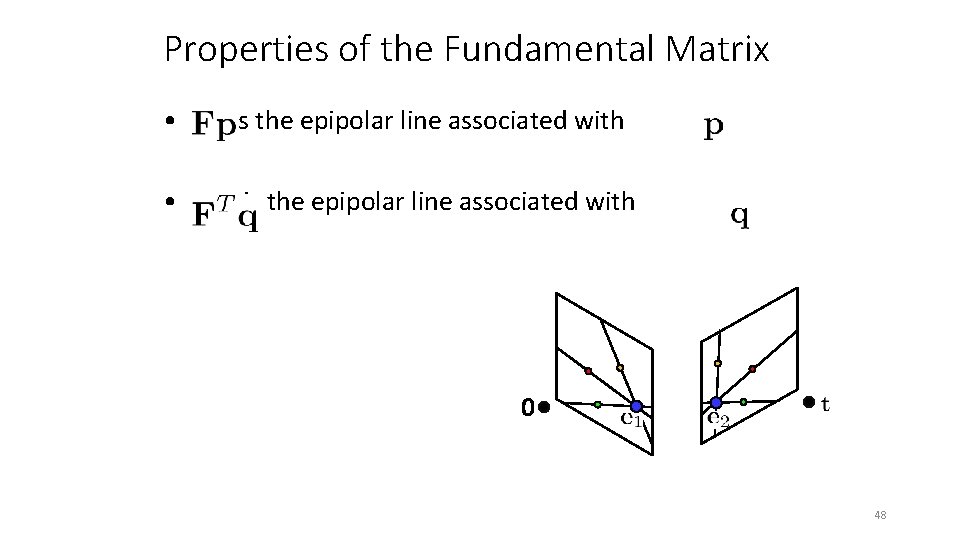
Properties of the Fundamental Matrix • • is the epipolar line associated with T is the epipolar line associated with 0 48
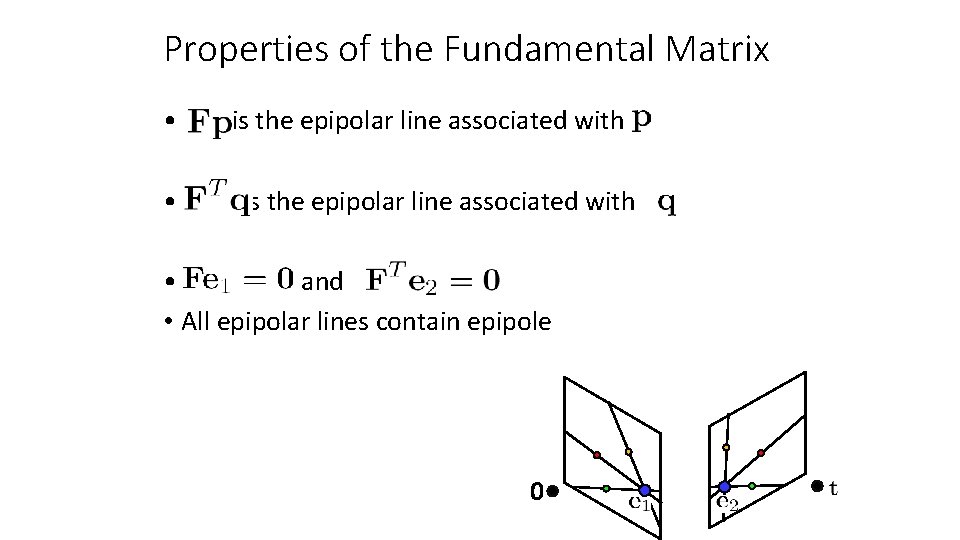
Properties of the Fundamental Matrix • • is the epipolar line associated with T is the epipolar line associated with • and • All epipolar lines contain epipole 0
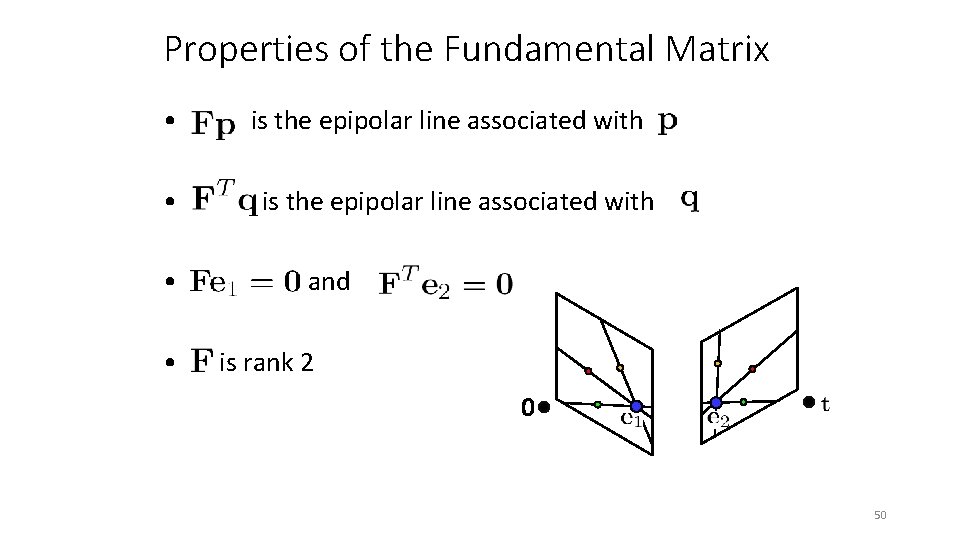
Properties of the Fundamental Matrix • • is the epipolar line associated with T is the epipolar line associated with and is rank 2 0 50
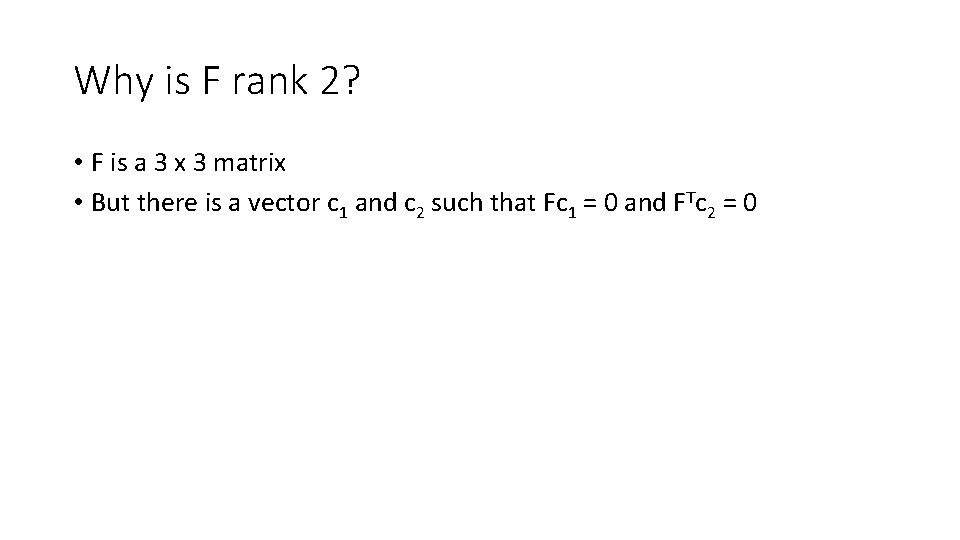
Why is F rank 2? • F is a 3 x 3 matrix • But there is a vector c 1 and c 2 such that Fc 1 = 0 and FTc 2 = 0

Fundamental matrix song
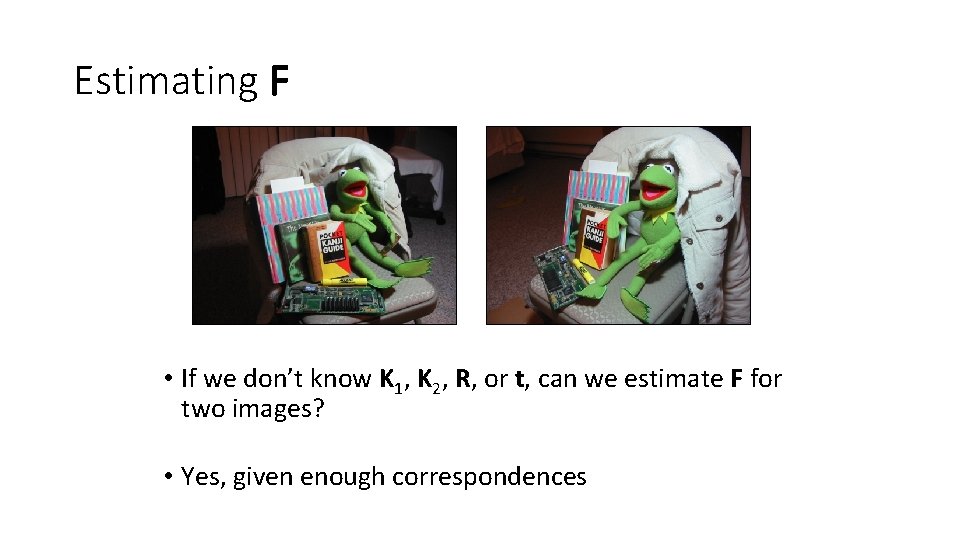
Estimating F • If we don’t know K 1, K 2, R, or t, can we estimate F for two images? • Yes, given enough correspondences
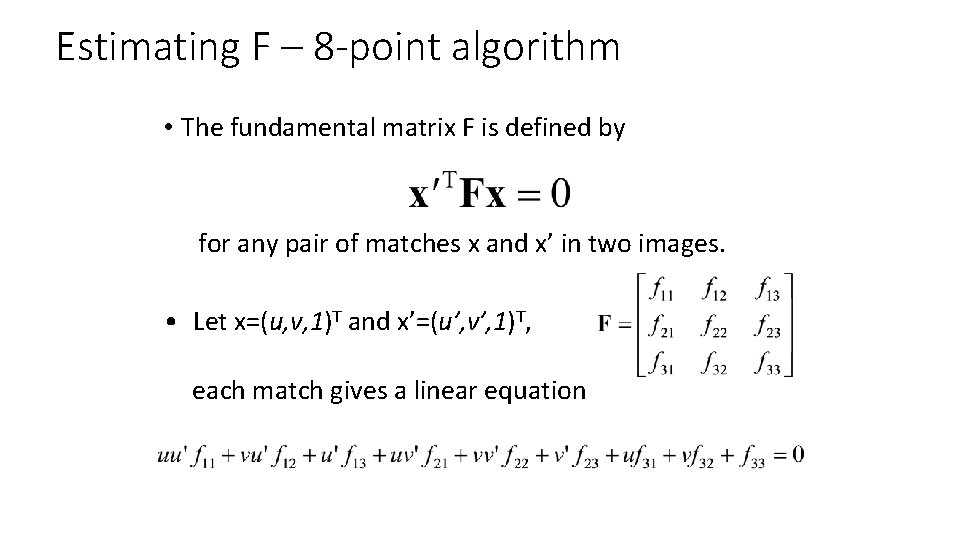
Estimating F – 8 -point algorithm • The fundamental matrix F is defined by for any pair of matches x and x’ in two images. • Let x=(u, v, 1)T and x’=(u’, v’, 1)T, each match gives a linear equation
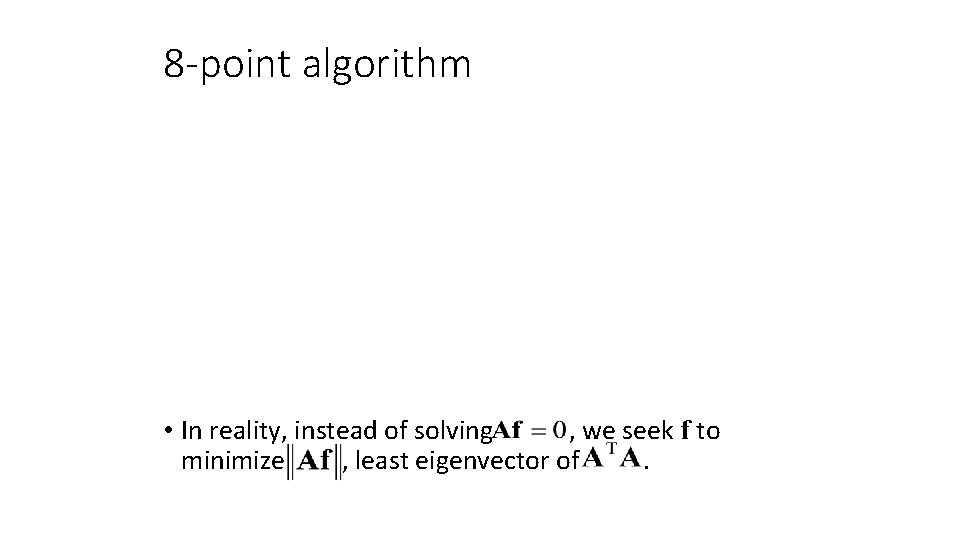
8 -point algorithm • In reality, instead of solving , we seek f to minimize , least eigenvector of.
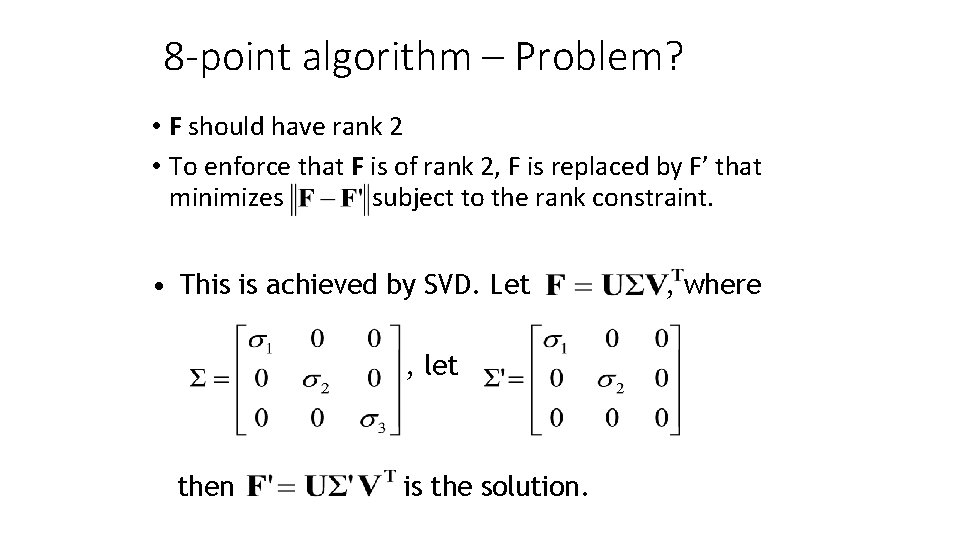
8 -point algorithm – Problem? • F should have rank 2 • To enforce that F is of rank 2, F is replaced by F’ that minimizes subject to the rank constraint. • This is achieved by SVD. Let , let then is the solution. , where
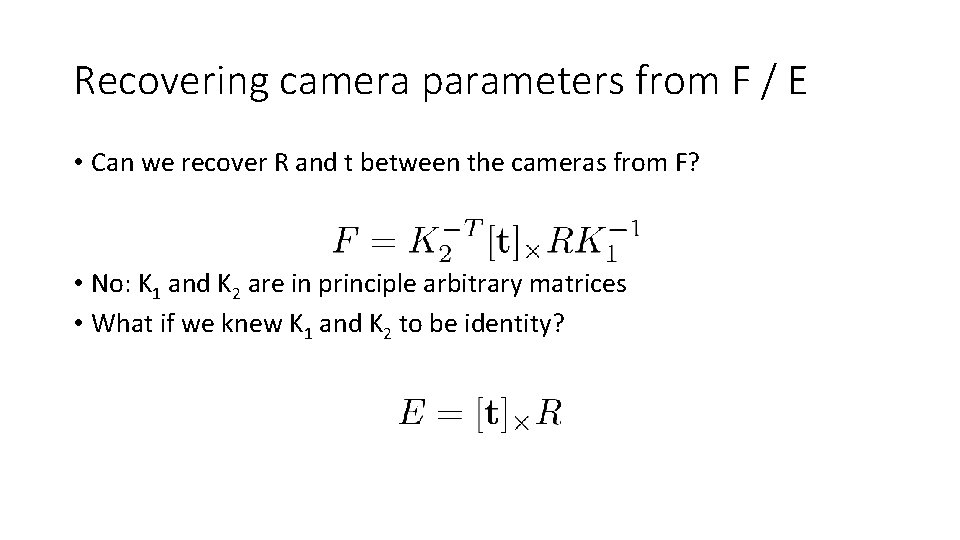
Recovering camera parameters from F / E • Can we recover R and t between the cameras from F? • No: K 1 and K 2 are in principle arbitrary matrices • What if we knew K 1 and K 2 to be identity?
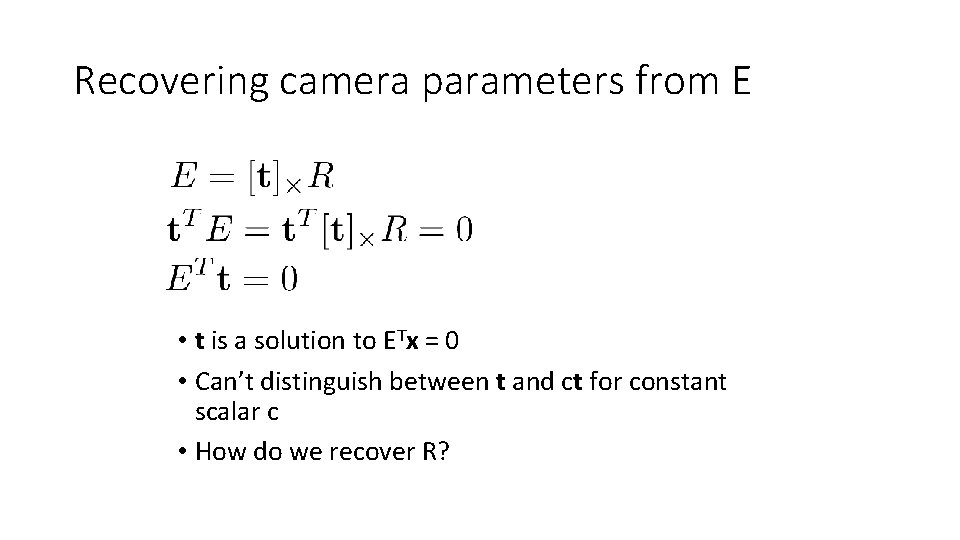
Recovering camera parameters from E • t is a solution to ETx = 0 • Can’t distinguish between t and ct for constant scalar c • How do we recover R?
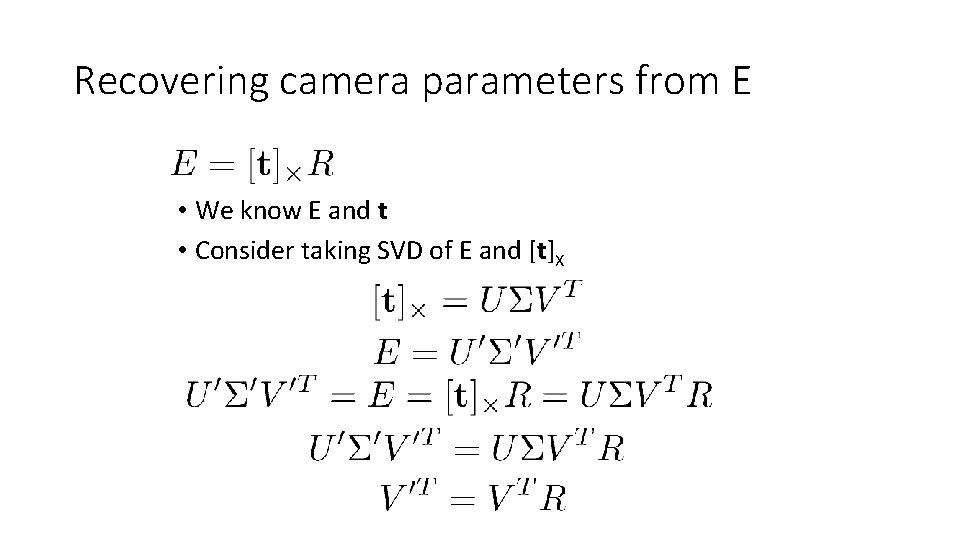
Recovering camera parameters from E • We know E and t • Consider taking SVD of E and [t]X
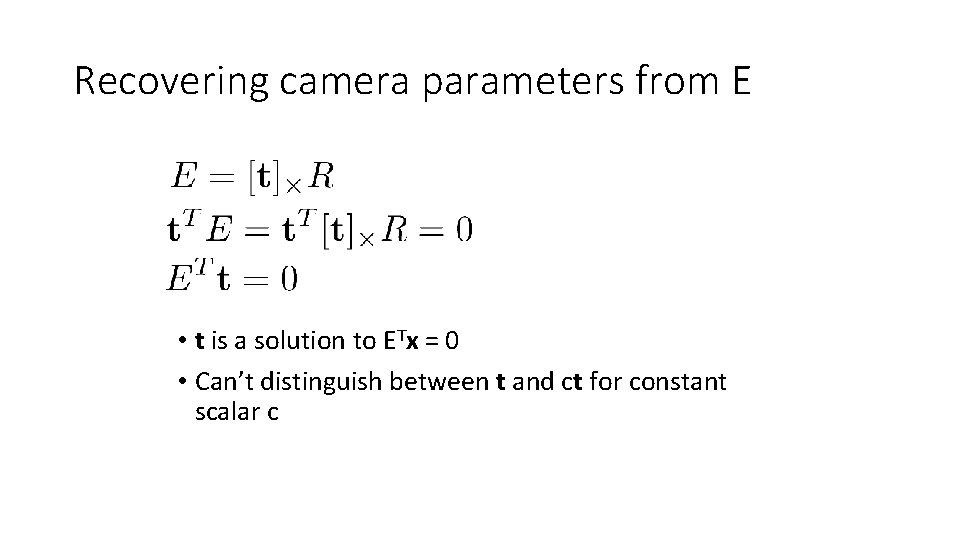
Recovering camera parameters from E • t is a solution to ETx = 0 • Can’t distinguish between t and ct for constant scalar c
8 -point algorithm • Pros: it is linear, easy to implement and fast • Cons: susceptible to noise • Degenerate: if points are on same plane • Normalized 8 -point algorithm: Hartley • Position origin at centroid of image points • Rescale coordinates so that center to farthest point is sqrt (2)
Structure-from-motion • Given 2 (or more) images from unknown cameras and with 3 D world unknown • Can we recover both the cameras and the 3 D world structure? • Step 1: Get correspondences • Step 2: Estimate Essential matrix, get R and t (assuming K known) • Step 3: Use calibrated cameras + correspondence to get 3 D locations of points
- Slides: 62