
Epilepsy in School Basic Awareness Training for School
Epilepsy in School Basic Awareness Training for School Staff
Definition Epilepsy is a common serious neurological condition where there is a tendency to have seizures that start in the brain. Creative | Reflective | Confident | Communicator | Aspirational | Resilient | Independent | Kind & Respectful
Different Types of Seizures Different seizure types happen in different parts of the brain. Seizure types can be described as either partial or generalised Creative | Reflective | Confident | Communicator | Aspirational | Resilient | Independent | Kind & Respectful
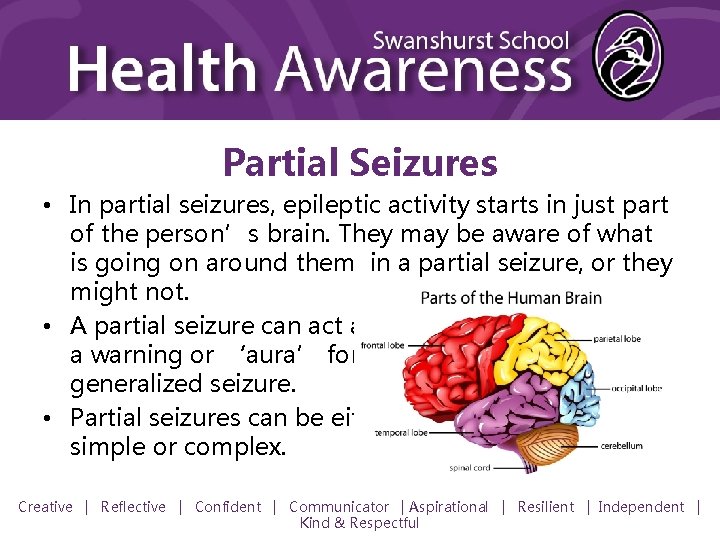
Partial Seizures • In partial seizures, epileptic activity starts in just part of the person’s brain. They may be aware of what is going on around them in a partial seizure, or they might not. • A partial seizure can act as a warning or ‘aura’ for a generalized seizure. • Partial seizures can be either simple or complex. Creative | Reflective | Confident | Communicator | Aspirational | Resilient | Independent | Kind & Respectful
Simple Partial Seizures Where Consciousness is NOT Impaired The symptoms depend on the area of the brain affected. For example, a pupil experiencing a simple partial seizure may go pale and/or sweaty, and may report tingling or a strange smell or taste. During a simple partial seizure, the pupil remains fully conscious and the seizure is brief. Some pupils experience a simple partial seizure on its own, or it may be a warning that the seizure may spread to other parts of the brain. Creative | Reflective | Confident | Communicator | Aspirational | Resilient | Independent | Kind & Respectful
Complex Partial Seizures Where Consciousness IS Impaired to Some Extent The specific symptoms of a complex partial seizure depend on which area of the brain the seizure is happening in. In this type of seizure it may appear that the person is fully aware of what they are doing, but the may act strangely, for example, chewing, smacking their lips, plucking at their clothing or just wandering aimlessly. It is important to remember that a person experiencing a complex partial seizure and cannot control their behaviour, Creative | Reflective | Confident | Communicator | Aspirational | Resilient | Independent and that their consciousness altered so they cannot Kind & is Respectful |
Treatment for Partial Seizures Do Don’t • Guide the person away from danger. • Stay with the person until recovery is complete. • Keep calm and reassure the person. • Recap on anything that they have missed. • Restrain the person. • Act in a way that could frighten them, such as making abrupt movements or shouting at them. • Assume the person is aware of what is happening, or what has happened. • Give the person anything to eat or drink until they are fully recovered. Creative | Reflective | Confident | Communicator | Aspirational | Resilient | Independent | Kind & Respectful
Generalised Seizures • Some seizures affect the whole or most of the brain, and they are called generalised seizures. • There will always involve a loss of consciousness although the child or young person will not necessarily fall to the floor. • These can include absence seizures, myoclonic seizure, tonic clonic seizures and atonic seizures. Creative | Reflective | Confident | Communicator | Aspirational | Resilient | Independent | Kind & Respectful
Absence Seizures In an absence seizure the person stops what they are doing and may stare, blink or look vague for just a few seconds. Absence seizures can sometimes be mistaken for daydreaming or inattention, but in fact the person has lost consciousness. Creative | Reflective | Confident | Communicator | Aspirational | Resilient | Independent | Kind & Respectful
Myoclonic Seizures These seizures involve sudden contractions of the muscles. The seizure can be a single movement or a series of jerks. Myoclonic seizures most commonly affect the arms and sometimes the head, but can affect the whole body. Usually no first aid is needed unless the pupil has been injured. Creative | Reflective | Confident | Communicator | Aspirational | Resilient | Independent | Kind & Respectful
Tonic Clonic Seizures These are the most widely recognised epileptic seizure. In a tonic- clonic seizure, the pupil loses consciousness, the body stiffens and then they fall to the ground. This is followed by jerking movements, sometimes called convulsions. After a few minutes, the jerking movements usually stop. Creative | Reflective | Confident | Communicator | Aspirational | Resilient | Independent | Kind & Respectful
Atonic Seizures In atonic seizures all muscle tone is lost and the person simply drops to the ground, this is also known as a drop attack. When a pupil experiences an atonic seizure the body goes limp and they usually fall forward, this can lead to them banging their head. Although they fall heavily, the child or young person can usually get up again straight away. Creative | Reflective | Confident | Communicator | Aspirational | Resilient | Independent | Kind & Respectful


Medication Epilepsy is controlled by taking regular medication which is generally taken outside of school hours. Some people may be prescribed emergency medication such as rectal diazepam or buccal midazolam. The emergency medication will be administered by a trained member of school staff. This training will be provided by the medical needs champions from the School Health Advisory Service. Creative | Reflective | Confident | Communicator | Aspirational | Resilient | Independent | Kind & Respectful
Possible Triggers May Include: Stress, anxiety or excitement Hormonal changes Not taking medication Unbalanced diet Late nights Alcohol & recreational drugs Some over the counter & prescription medicines Illness| Confident | Communicator | Aspirational | Resilient | • Reflective • • Creative Kind & Respectful | Independent |
Healthcare plans Epilepsy is different for each individual. Therefore the care plan will be tailored to the needs of that child/young person. Creative | Reflective | Confident | Communicator | Aspirational | Resilient | Independent | Kind & Respectful
The Effect of Epilepsy on the Pupil at School A pupil with epilepsy may experience seizures during a school day, and this disruption can make learning a difficult process. Epilepsy can have other effects that are not easily observed during the school day, such as night-time seizures that can leave a pupil exhausted and unable to concentrate, and |social or psychological effects. Creative | Reflective | Confident Communicator | Aspirational | Resilient | Independent Kind & Respectful |
999…. Call an Ambulance If • You believe it to be the child’s first seizure • The seizure continues for more than five minutes • One seizure follows another without the child regaining consciousness between seizures • The child is injured during a seizure • You believe the child needs urgent medical attention Creative | Reflective | Confident | Communicator | Aspirational | Resilient | Independent | Kind & Respectful
Further support is available from the School Health Advisory Service www. epilepsy. org. uk/education Creative | Reflective | Confident | Communicator | Aspirational | Resilient | Independent | Kind & Respectful
- Slides: 20