
Epilepsy and Seizures Deepak Madhavan M D MBA
Epilepsy and Seizures Deepak Madhavan, M. D. , MBA Executive Medical Director – Neurosciences Boys Town National Research Hospital
What is a Seizure? • A “storm in the brain” • Abnormal, synchronized electrical activity, changing a child’s movements, alertness, or sensation • Typical Signs • Loss/Alteration of Consciousness (confusion) • Body jerking/convulsions • Types of Seizures • Generalized seizures • Occur in the whole brain, often simultaneously • E. g. Absence epilepsy • Focal Seizures • Start in a discrete (focal) part of the brain • Can sometimes spread and become generalized • 1% of all children will have a seizure
What is Epilepsy? • The tendency to have recurrent, unprovoked, seizures. • Seizures can be provoked by external factors, and having a seizure does not mean that one has epilepsy. • • • High fevers Brain infections Head injuries (concussions) Tumors Hyper/hypoglycemia • Over 300, 000 children in the US have epilepsy
Signs/Symptoms of Seizures • Look for repetitive movements- stereotypy is key! • • • Staring, blinking, lip smacking, picking at clothes Repetitive jerking or twitching of head or limbs Abrupt stiffening or loss of tone, leading to falls Complains of repetitive strange taste/smell/tummy sensations Appearance of fear/anxiety Whole body convulsions (tonic-clonic, “grand mal”) • Babies can have slightly different presentations • Abrupt flexion at the waist, with arms extending forward (“jackknife seizure) • This can also be associated with gastric/esophageal reflux
Early Identification is Important! • Seizures can: • Interfere with learning • Lead to injuries, sometimes severe • Burning, falls, drowning • Be progressive, and potentially be fatal • Seizures can worsen with time, along with underlying brain function • Poorly controlled seizures have consequences: • Can potentially lead to status epilepticus, which is prolonged, continuous seizure activity • SUDEP (Sudden Unexplained Death in Epilepsy)
Responding to Seizures • Follow basic first aid (Airway, Breathing, Circulation) • Call 911 (in most cases) if: • Seizure >5 minutes (can be as short as 3 minutes with a convulsive seizure) • The child sustains a serious injury secondary to the seizure • Consciousness does not return to normal • Breathing does not return to normal
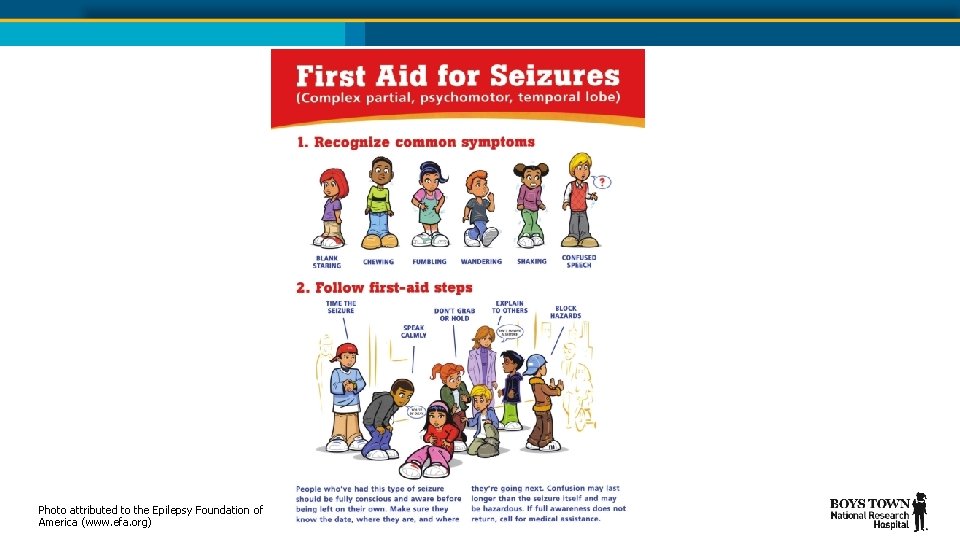
Photo attributed to the Epilepsy Foundation of America (www. efa. org)
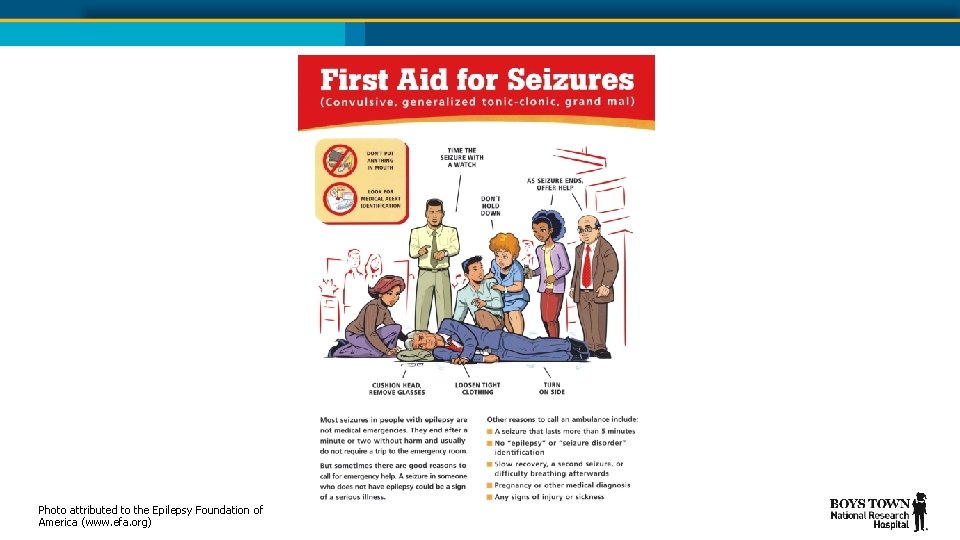
Photo attributed to the Epilepsy Foundation of America (www. efa. org)
Seizure Examples • Tonic Clonic (Grand Mal) Seizure • https: //www. youtube. com/watch? v=Cqre-Mynp-I • https: //www. youtube. com/watch? v=0 JCHGGpm 7 m. Q • Tonic Seizure • https: //www. youtube. com/watch? v=-z. E 8 x 0 OCq 5 M • Absence (Petit Mal) Seizure • https: //www. youtube. com/watch? v=7 cid. APLOQv 4 • https: //www. youtube. com/watch? v=6 WEf 2 R_9 e. Wo • Atonic Seizure • https: //www. youtube. com/watch? v=FHr. AQd. Pj. INM
- Slides: 9