
Epilepsy 5 Year Prof Dr S Naz Yeni

- Slides: 21
Epilepsy 5. Year Prof. Dr. S. Naz Yeni
Objectives and method • To learn general concepts about epilepsy and seizures • Learn how to diagnose and classify epilepsy • Brief rules regarding laboratory investigations • Brief rules regarding treatment There will be a presentation of videos of different type of epileptic seizures
Definitions: • Epileptic seizure is a transitory clinical manifestation as a result of an abnormal excessive hypersynchronous discharges arising from a group of neurons. Manifestations consist of transitory motor sensory pyschic phenomena and/or loss of consiousness. • Epilepsy: epilepsy is a chronic condition. Seizures are spontaneous and recurrent.
Definitions • Acute symptomatic seizures: these seizures are provoked as a result of a metabolic/infectious/traumatic events. Acute symptomatic seizures are not as a result of primarily nervous system lesions. Examples: febrile seizures during acute head injury
Epilepsy clasification etiology • Structural/metabolic (formerly symptomatic) • Genetic (formerly idiopathic) • Unknown (formerly cryptogenic)
Epidemiology • Incidence: 20 -120/100000 depending on the developing underdeveloped countries • There is a bimodal distribution. The first peak in the first 2 decades and the second peak is after the age 65. • Prevalence: 6 -18/1000
Etiology • Chidhood Perinatal hypoxia Perinatal insults CNS infections Congenital malformations • Adulthood Neoplasms Vascular malformations Head injury • Elderly Cerebrovascular diseases Head injury Neoplasms Degenerative diseases (Alzheimer disease)
ILAE (International League against Epilepsy) Classifications • • Proposal 1981 Proposal 1989 Proposal 2001 Proposal 2010
ILAE 2010 • Focal Originating at some point within networks limited to one hemisphere • Generalised Originating at some point within and rapidly engaging bilaterally distrubuted networks. • Unclassified
Focal seizures • Focal seizure with motor manifestations (with or without jacksonien march) somatosensory manifestations special sensory manifestations adversive features dysphasic manifestations postural manifestations dyscognitive features hyperkinetic manifestations
Subtypes • Characterizes accoeding to one or more features Aura Motor Autonomic Awareness/responsiveness: Altered (dyscogntive) or retained May evolve into Bilateral convulsive seizure
Generalised seizures • • • Tonic-clonic Absence Tonic Atonic Myoclonic
Diagnosis • Detailed description of seizures from the patient and/or observers The role of • EEG • CT /MR
Differential diagnosis • Depends on the seizure type Frequenty misdiagnosed conditions Seizures Syncopes Nonepileptic pyschogenic attacks
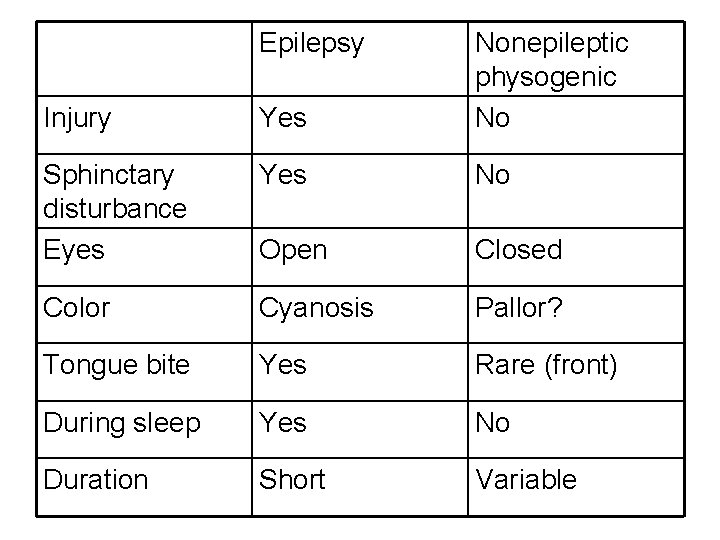
Epilepsy Injury Yes Nonepileptic physogenic No Sphinctary disturbance Eyes Yes No Open Closed Color Cyanosis Pallor? Tongue bite Yes Rare (front) During sleep Yes No Duration Short Variable
EEG • Does not diagnose epilepsy • It is helpful in: diagnosis classification seizure type classification electroclinical syndromes decision of starting and discontinuing treatment for epilepsy surgery
Radiology • Emergency room: CT scan (helps to reveal acute lesions such as intracranial hematoma fractures of the skull etc. Each patient with a diagnosis of epilepsy has a right to have at least one cranial MR scan to understand the underlying etiology.
Treatment • Rules and steps Start with monotheraphy Increase the dose in case of recurrence of seizures Increase the dose until the patient can not tolerate to side effects. If there is no response switch the drug (monotherapy) If no response increase the dose If no response combine two (later three) effective drugs If no response take a look at the diagnosis/classification of the seizures/syndrome Think about epilepsy surgery
Treatment • If there is a good response to treatment: The drug may be withdrawn after a seizure-free period of 2 -5 years. In some cases treatment is lifelong. Patients with a high risk of recurrence: Mental retardation Neurologic deficit Lesions on MR Difficult to stop the seizures at the beginning
Drugs Acting on focal seizures • • Carbamazepine Oxcarbazepine Diphenyl hidantoin Phenobarbital Acting on generalised seizures • Valproic acide • Lamotrigine • Levetiracetam • Topiramate