
Epidermal Inclusion Cyst with Rupture Foreign Body Giant
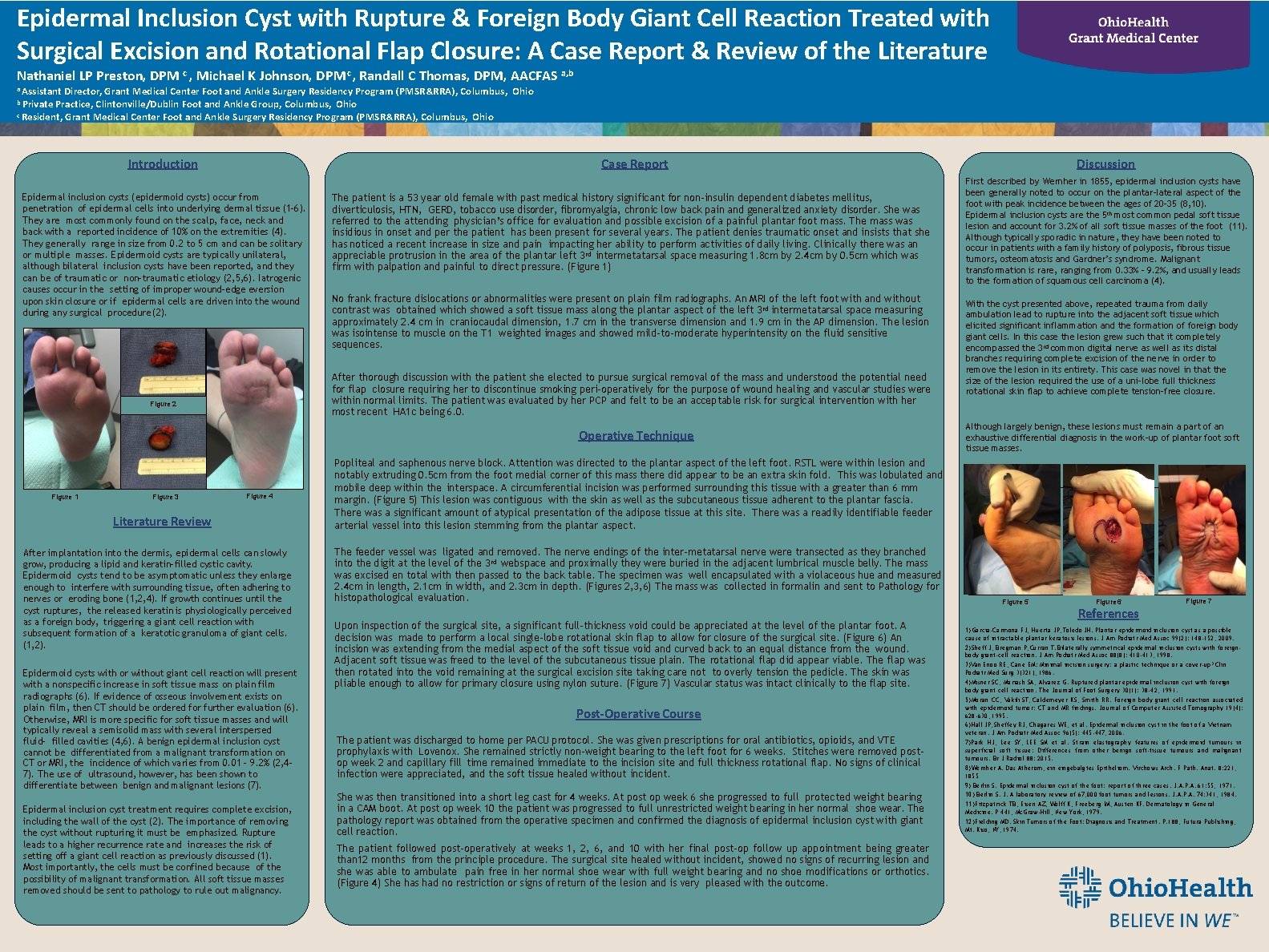
Epidermal Inclusion Cyst with Rupture & Foreign Body Giant Cell Reaction Treated with Surgical Excision and Rotational Flap Closure: A Case Report & Review of the Literature Nathaniel LP Preston, DPM c , Michael K Johnson, DPM c , Randall C Thomas, DPM, AACFAS a, b a Assistant Director, Grant Medical Center Foot and Ankle Surgery Residency Program (PMSR&RRA), Columbus, Ohio Practice, Clintonville/Dublin Foot and Ankle Group, Columbus, Ohio c Resident, Grant Medical Center Foot and Ankle Surgery Residency Program (PMSR&RRA), Columbus, Ohio b Private Introduction Epidermal inclusion cysts (epidermoid cysts) occur from penetration of epidermal cells into underlying dermal tissue (1 -6). They are most commonly found on the scalp, face, neck and back with a reported incidence of 10% on the extremities (4). They generally range in size from 0. 2 to 5 cm and can be solitary or multiple masses. Epidermoid cysts are typically unilateral, although bilateral inclusion cysts have been reported, and they can be of traumatic or non-traumatic etiology (2, 5, 6). Iatrogenic causes occur in the setting of improper wound-edge eversion upon skin closure or if epidermal cells are driven into the wound during any surgical procedure (2). The patient is a 53 year old female with past medical history significant for non-insulin dependent diabetes mellitus, diverticulosis, HTN, GERD, tobacco use disorder, fibromyalgia, chronic low back pain and generalized anxiety disorder. She was referred to the attending physician’s office for evaluation and possible excision of a painful plantar foot mass. The mass was insidious in onset and per the patient has been present for several years. The patient denies traumatic onset and insists that she has noticed a recent increase in size and pain impacting her ability to perform activities of daily living. Clinically there was an appreciable protrusion in the area of the plantar left 3 rd intermetatarsal space measuring 1. 8 cm by 2. 4 cm by 0. 5 cm which was firm with palpation and painful to direct pressure. (Figure 1) No frank fracture dislocations or abnormalities were present on plain film radiographs. An MRI of the left foot with and without contrast was obtained which showed a soft tissue mass along the plantar aspect of the left 3 rd intermetatarsal space measuring approximately 2. 4 cm in craniocaudal dimension, 1. 7 cm in the transverse dimension and 1. 9 cm in the AP dimension. The lesion was isointense to muscle on the T 1 weighted images and showed mild-to-moderate hyperintensity on the fluid sensitive sequences. After thorough discussion with the patient she elected to pursue surgical removal of the mass and understood the potential need for flap closure requiring her to discontinue smoking peri-operatively for the purpose of wound healing and vascular studies were within normal limits. The patient was evaluated by her PCP and felt to be an acceptable risk for surgical intervention with her most recent HA 1 c being 6. 0. Figure 2 Operative Technique Figure 1 Figure 3 Discussion Case Report Figure 4 Literature Review After implantation into the dermis, epidermal cells can slowly grow, producing a lipid and keratin-filled cystic cavity. Epidermoid cysts tend to be asymptomatic unless they enlarge enough to interfere with surrounding tissue, often adhering to nerves or eroding bone (1, 2, 4). If growth continues until the cyst ruptures, the released keratin is physiologically perceived as a foreign body, triggering a giant cell reaction with subsequent formation of a keratotic granuloma of giant cells. (1, 2). Epidermoid cysts with or without giant cell reaction will present with a nonspecific increase in soft tissue mass on plain film radiographs (6). If evidence of osseous involvement exists on plain film, then CT should be ordered for further evaluation (6). Otherwise, MRI is more specific for soft tissue masses and will typically reveal a semisolid mass with several interspersed fluid- filled cavities (4, 6). A benign epidermal inclusion cyst cannot be differentiated from a malignant transformation on CT or MRI, the incidence of which varies from 0. 01 – 9. 2% (2, 47). The use of ultrasound, however, has been shown to differentiate between benign and malignant lesions (7). Epidermal inclusion cyst treatment requires complete excision, including the wall of the cyst (2). The importance of removing the cyst without rupturing it must be emphasized. Rupture leads to a higher recurrence rate and increases the risk of setting off a giant cell reaction as previously discussed (1). Most importantly, the cells must be confined because of the possibility of malignant transformation. All soft tissue masses removed should be sent to pathology to rule out malignancy. First described by Wernher in 1855, epidermal inclusion cysts have been generally noted to occur on the plantar-lateral aspect of the foot with peak incidence between the ages of 20 -35 (8, 10). Epidermal inclusion cysts are the 5 th most common pedal soft tissue lesion and account for 3. 2% of all soft tissue masses of the foot (11). Although typically sporadic in nature, they have been noted to occur in patients with a family history of polyposis, fibrous tissue tumors, osteomatosis and Gardner’s syndrome. Malignant transformation is rare, ranging from 0. 33% - 9. 2%, and usually leads to the formation of squamous cell carcinoma (4). With the cyst presented above, repeated trauma from daily ambulation lead to rupture into the adjacent soft tissue which elicited significant inflammation and the formation of foreign body giant cells. In this case the lesion grew such that it completely encompassed the 3 rd common digital nerve as well as its distal branches requiring complete excision of the nerve in order to remove the lesion in its entirety. This case was novel in that the size of the lesion required the use of a uni-lobe full thickness rotational skin flap to achieve complete tension-free closure. Although largely benign, these lesions must remain a part of an exhaustive differential diagnosis in the work-up of plantar foot soft tissue masses. Popliteal and saphenous nerve block. Attention was directed to the plantar aspect of the left foot. RSTL were within lesion and notably extruding 0. 5 cm from the foot medial corner of this mass there did appear to be an extra skin fold. This was lobulated and mobile deep within the interspace. A circumferential incision was performed surrounding this tissue with a greater than 6 mm margin. (Figure 5) This lesion was contiguous with the skin as well as the subcutaneous tissue adherent to the plantar fascia. There was a significant amount of atypical presentation of the adipose tissue at this site. There was a readily identifiable feeder arterial vessel into this lesion stemming from the plantar aspect. The feeder vessel was ligated and removed. The nerve endings of the inter-metatarsal nerve were transected as they branched into the digit at the level of the 3 rd webspace and proximally they were buried in the adjacent lumbrical muscle belly. The mass was excised en total with then passed to the back table. The specimen was well encapsulated with a violaceous hue and measured 2. 4 cm in length, 2. 1 cm in width, and 2. 3 cm in depth. (Figures 2, 3, 6) The mass was collected in formalin and sent to Pathology for histopathological evaluation. Upon inspection of the surgical site, a significant full-thickness void could be appreciated at the level of the plantar foot. A decision was made to perform a local single-lobe rotational skin flap to allow for closure of the surgical site. (Figure 6) An incision was extending from the medial aspect of the soft tissue void and curved back to an equal distance from the wound. Adjacent soft tissue was freed to the level of the subcutaneous tissue plain. The rotational flap did appear viable. The flap was then rotated into the void remaining at the surgical excision site taking care not to overly tension the pedicle. The skin was pliable enough to allow for primary closure using nylon suture. (Figure 7) Vascular status was intact clinically to the flap site. Post-Operative Course The patient was discharged to home per PACU protocol. She was given prescriptions for oral antibiotics, opioids, and VTE prophylaxis with Lovenox. She remained strictly non-weight bearing to the left foot for 6 weeks. Stitches were removed postop week 2 and capillary fill time remained immediate to the incision site and full thickness rotational flap. No signs of clinical infection were appreciated, and the soft tissue healed without incident. She was then transitioned into a short leg cast for 4 weeks. At post op week 6 she progressed to full protected weight bearing in a CAM boot. At post op week 10 the patient was progressed to full unrestricted weight bearing in her normal shoe wear. The pathology report was obtained from the operative specimen and confirmed the diagnosis of epidermal inclusion cyst with giant cell reaction. The patient followed post-operatively at weeks 1, 2, 6, and 10 with her final post-op follow up appointment being greater than 12 months from the principle procedure. The surgical site healed without incident, showed no signs of recurring lesion and she was able to ambulate pain free in her normal shoe wear with full weight bearing and no shoe modifications or orthotics. (Figure 4) She has had no restriction or signs of return of the lesion and is very pleased with the outcome. Figure 5 Figure 6 References Figure 7 1)Garcia-Carmona FJ, Huerta JP, Toledo JH. Plantar epidermoid inclusion cyst as a possible cause of intractable plantar keratosis lesions. J Am Podiatr Med Assoc 99(2): 148 -152, 2009. 2)Sheff J, Bregman P, Curran T. Bilaterally symmetrical epidermal inclusion cysts with foreignbody giant-cell reaction. J Am Podiatr Med Assoc 88(8): 410 -413, 1998. 3)Van Enoo RE, Cane EM: Minimal incision surgery: a plastic technique or a cover-up? Clin Podiatr Med Surg 3(321), 1986. 4)Misner SC, Mariash SA, Alvarez G. Ruptured plantar epidermal inclusion cyst with foreign body giant cell reaction. The Journal of Foot Surgery 30(1): 38 -42, 1991. 5)Moran CC, Vakili ST, Caldemeyer KS, Smith RR. Foreign body giant cell reaction associated with epidermoid tumor: CT and MR findings. Journal of Computer Assisted Tomography 19(4): 628 -630, 1995. 6)Hall JP, Sheffey RJ, Chagares WE, et al. Epidermal inclusion cyst in the foot of a Vietnam veteran. J Am Podiatr Med Assoc 96(5): 445 -447, 2006. 7)Park HJ, Lee SY, LEE SM et al. Strain elastography features of epidermoid tumours in superficial soft tissue: Differences from other benign soft-tissue tumours and malignant tumours. Br J Radiol 88: 2015. 8)Wernher A. Das Atherom, eingebalgtes Epitheliom. Virchows Arch. F Path. Anat. 8: 221, 1855 9) Berlin S. Epidermal inclusion cyst of the foot: report of three cases. J. A. P. A. 61: 55, 1971. 10) Berlin S. J. A laboratory review of 67, 000 foot tumors and lesions. J. A. P. A. 74: 341, 1984. 11)Fitzpatrick TB, Eisen AZ, Wolff K, Freeberg IM, Austen KF. Dermatology in General Medicine. P 441, Mc. Graw-Hill, New York, 1979. 12)Fielding MD. Skin Tumors of the Foot: Diagnosis and Treatment. P. 188, Futura Publishing, Mt. Kiso, NY, 1974.
- Slides: 1