
Epidemiology What is Epidemiology and how does it

- Slides: 29
Epidemiology
What is Epidemiology and how does it contribute to the health of our society? �A public health science (foundation of public health) �Impacts personal decisions about our lifestyles �Affects government, public health agency and medical organization policy decisions
Where does the term epidemiology come from? �Epidemiology derives from epidemic, a term that provides an immediate clue to its subject matter. �Originates from the Greek words epi (upon) + demos (people) + logy (study of)
Epidemiology �Friis & Sellers 2009, defines epidemiology as concerned with the distribution and determinants of health and diseases, morbidity, injuries, disability, and mortality in populations. �Application of this study to control and prevent health problems in populations.
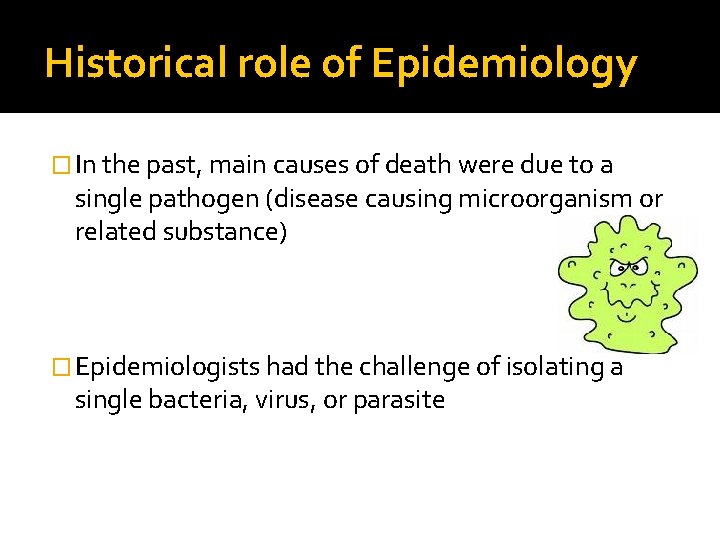
Historical role of Epidemiology � In the past, main causes of death were due to a single pathogen (disease causing microorganism or related substance) � Epidemiologists had the challenge of isolating a single bacteria, virus, or parasite
Historical role of Epidemiology � The discipline of epidemiology underwent dramatic changes in the first half of the 20 th century. � A new kind of epidemiology came into being as a discipline in the decades following the Second World War variously referred to as “modern” or “risk factor” epidemiology (Parascandola, 2011).
Historical role of Epidemiology � The new epidemiology differed from earlier forms of epidemiology in that it included a focus on chronic rather than infectious diseases an emphasis on identifying individual risk factors for disease, and use of advanced quantitative methodology (Parascadola, 2011).
Activity �If you have an index card, raise your hand You have a “fake” disease �What pattern do you notice? Compare those that have the “fake” disease to those that don’t.
Activity continued �The first step when dealing with a disease (epidemiology) is identifying what causes the disease �The next step would be to create a hypothesis: Why is jewelry an indicator of this “fake” disease? �What is the next step in investigating a disease?
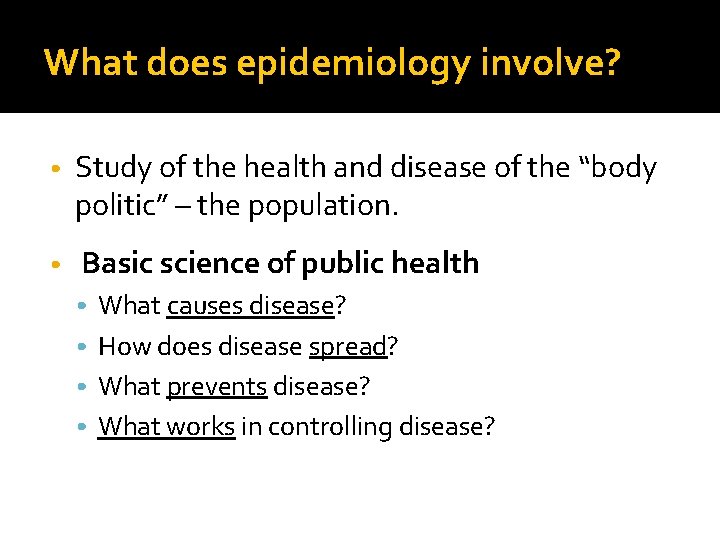
What does epidemiology involve? • Study of the health and disease of the “body politic” – the population. • Basic science of public health • What causes disease? • How does disease spread? • What prevents disease? • What works in controlling disease?
Major types of Epidemiology �Descriptive �Analytic
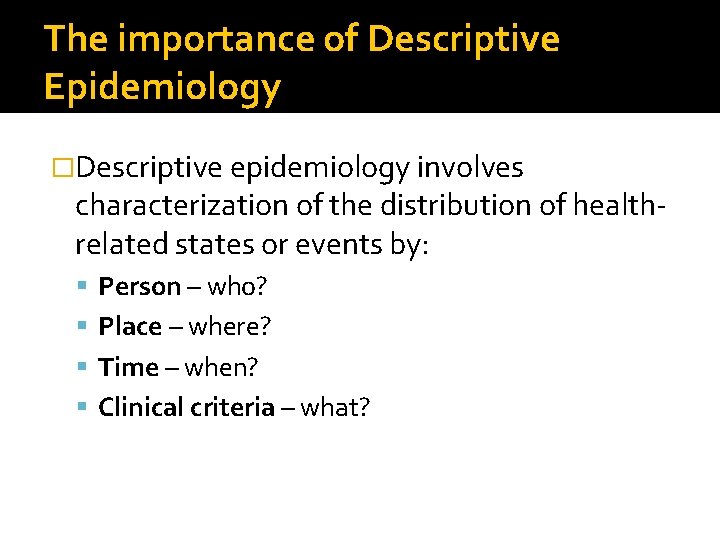
The importance of Descriptive Epidemiology �Descriptive epidemiology involves characterization of the distribution of healthrelated states or events by: Person – who? Place – where? Time – when? Clinical criteria – what?
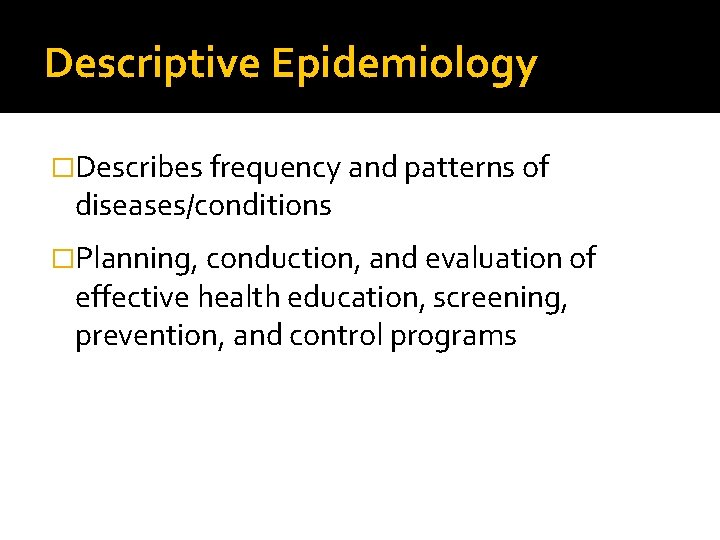
Descriptive Epidemiology �Describes frequency and patterns of diseases/conditions �Planning, conduction, and evaluation of effective health education, screening, prevention, and control programs
Analytic Epidemiology �Identifying and quantifying associations �Testing hypotheses, and identifying causes of health-related states or events �Explains why and how health-related states or events occur
Analysis of the population � Ratio: Relationship between two numbers Example: males/females � Proportion: A ratio where the numerator is included in the denominator Example: males/total births � Rate: A proportion with the specification of time Example: (births in 1999/population in 1999) x 1, 000
Incidence and Prevalence �Classic descriptors of how common a disease, symptom, or problem is in a population �Incidence- measures the occurrence of new disease in a population �Prevalence- measures the existence of current disease in a population
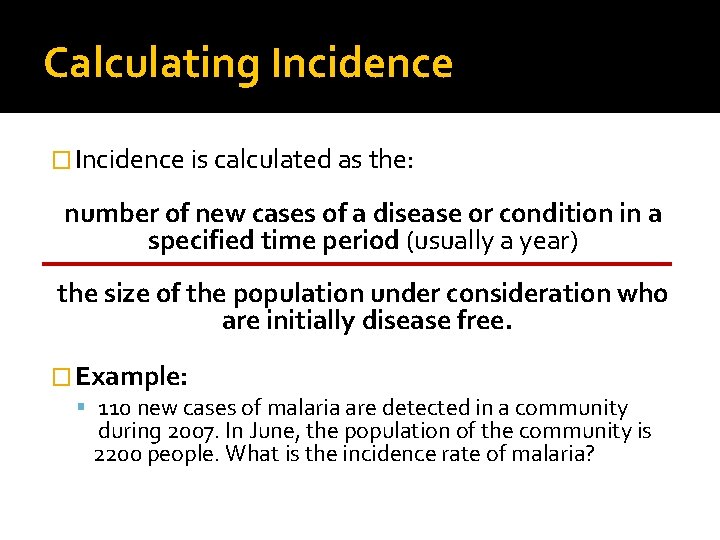
Components of Epidemiology �Incidence: Fraction of a group initially free of the condition that go on to develop it during a given time period. (the # of new cases during a certain time period) How is it measured? ▪ By identifying group of susceptible people (free of disease) and examining them periodically in order to discover and count new cases that develop during interval.
Calculating Incidence � Incidence is calculated as the: number of new cases of a disease or condition in a specified time period (usually a year) the size of the population under consideration who are initially disease free. � Example: 110 new cases of malaria are detected in a community during 2007. In June, the population of the community is 2200 people. What is the incidence rate of malaria?
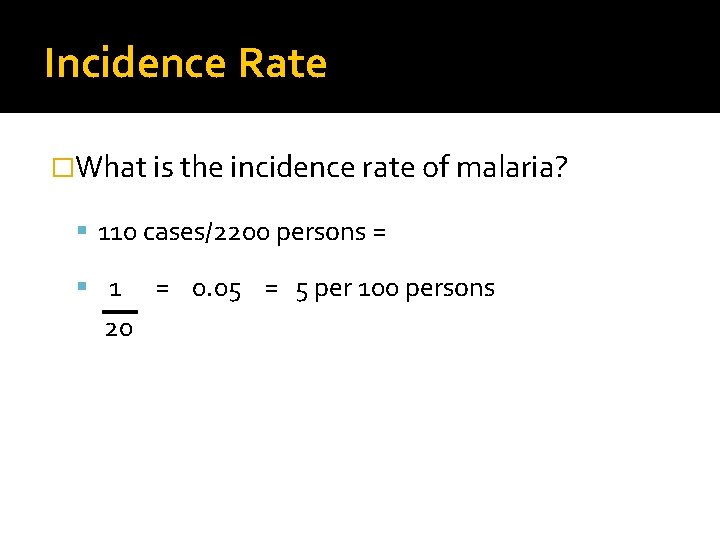
Incidence Rate �What is the incidence rate of malaria? 110 cases/2200 persons = 1 20 = 0. 05 = 5 per 100 persons
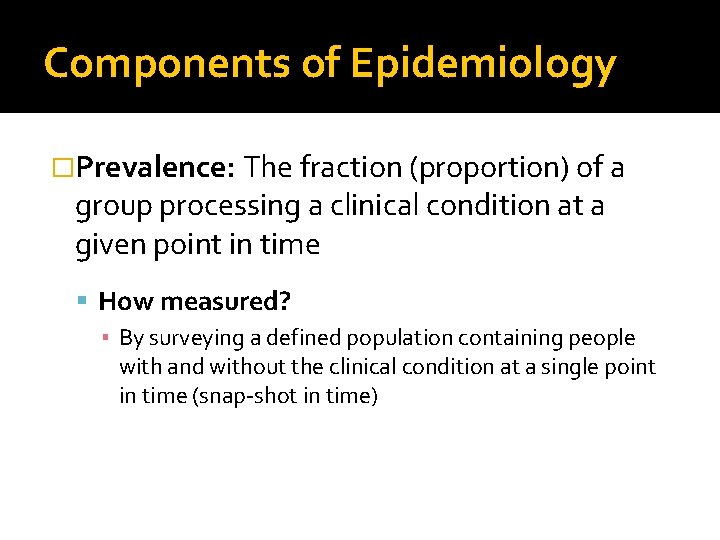
Components of Epidemiology �Prevalence: The fraction (proportion) of a group processing a clinical condition at a given point in time How measured? ▪ By surveying a defined population containing people with and without the clinical condition at a single point in time (snap-shot in time)
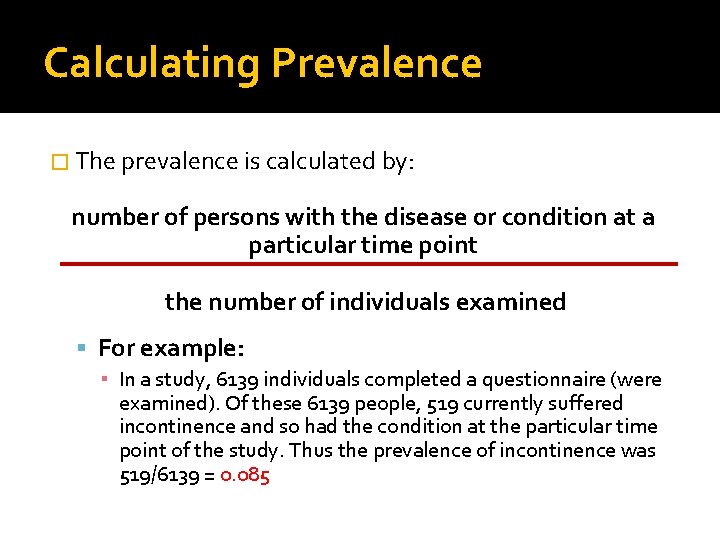
Calculating Prevalence � The prevalence is calculated by: number of persons with the disease or condition at a particular time point the number of individuals examined For example: ▪ In a study, 6139 individuals completed a questionnaire (were examined). Of these 6139 people, 519 currently suffered incontinence and so had the condition at the particular time point of the study. Thus the prevalence of incontinence was 519/6139 = 0. 085
Prevalence �Prevalence is often expressed as a percentage, calculated by multiplying the ratio by 100. �The above study expresses prevalence as a percentage, thus the prevalence of incontinence is 8. 5% (or rounded is 9%)
Components of Epidemiology �Frequency: the number of times an event occurs Epidemiology studies the number of times a disease occurs ▪ It answers the question- How many? ▪ Epidemiology is a quantitative study
Components of Epidemiology �Distribution: Distribution of an event by person, place and time Epidemiology studies distribution of disease ▪ It answers the question: who, where, and when?
Components of Epidemiology �Determinants: Factors or events that are capable of bringing about a change in health(Friis & Sellers, 2009) �Epidemiology studies what determines health events It answers the question : how and why?
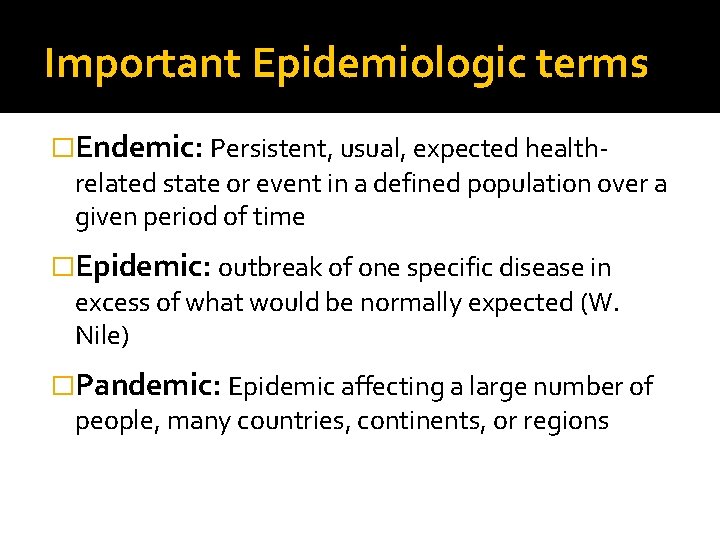
Important Epidemiologic terms �Endemic: Persistent, usual, expected health- related state or event in a defined population over a given period of time �Epidemic: outbreak of one specific disease in excess of what would be normally expected (W. Nile) �Pandemic: Epidemic affecting a large number of people, many countries, continents, or regions
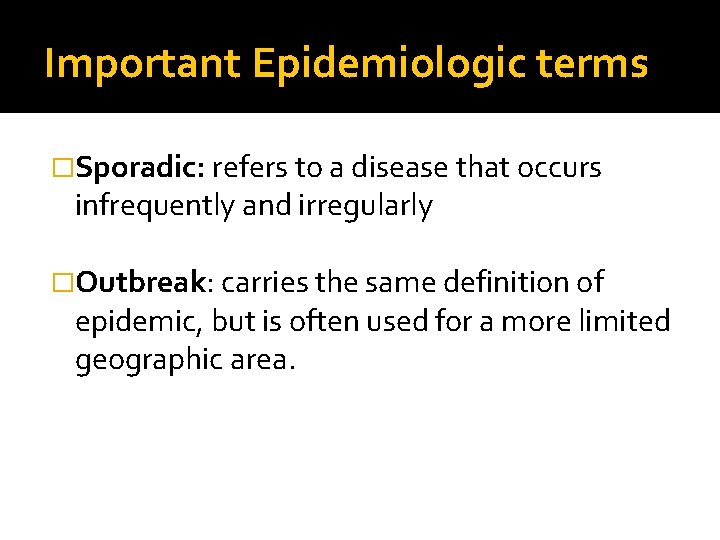
Important Epidemiologic terms �Sporadic: refers to a disease that occurs infrequently and irregularly �Outbreak: carries the same definition of epidemic, but is often used for a more limited geographic area.
Causes of Disease �Identifying causes of disease and the mechanisms by which they spread remains a primary focus of epidemiology �Etiology: Science and study of the causes of disease and their mode of operation
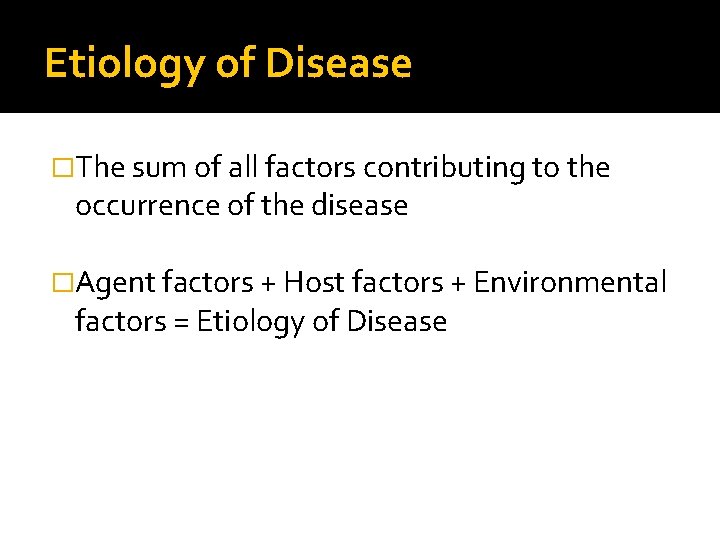
Etiology of Disease �The sum of all factors contributing to the occurrence of the disease �Agent factors + Host factors + Environmental factors = Etiology of Disease