
Epidemiology of Communicable Diseases Childhood Diarrhea Gastroenteritis Prof
Epidemiology of Communicable Diseases Childhood Diarrhea (Gastro-enteritis) Prof. Dr. Mohamed A. Khafagy Public Health & Preventive Medicine
A clinical syndrome: 1. Affects GIT 2. Has different etiologies: viruses, bacteria, etc. 3. Ch. by diarrhea 4. Usually associated with vomiting & fever
Definition of diarrhea: Passage of 3 or more loose or watery stools in 24 hrs. A single loose or watery stool containing blood. In practice: diarrhea is an in stool frequency or liquidity that is considered abnormal by the mother.

Epidemiology of childhood diarrhea (1) Public Health Significance (2) Seasonality (3) Its infectious cycle: 1. Etiology (= Agent) 2. Source of infection: - Type - Portal of Exit - Period of communicability 3 - Modes of transmission 4 - Susceptible Host - Portal of entry - Incubation period - Pathogenesis - Diagnosis: Clinical picture + Complications + Lab. diagnosis
![[1] Public Health Significance Endemic worldwide (1) Its magnitude: (incidence & prevalence) (2) Its](http://slidetodoc.com/presentation_image_h2/6a6bcf2a78e441f40bf437876e96fe9a/image-5.jpg "[1] Public Health Significance Endemic worldwide (1) Its magnitude: (incidence & prevalence) (2) Its")
[1] Public Health Significance Endemic worldwide (1) Its magnitude: (incidence & prevalence) (2) Its severity: (morbidity & mortality) (3) Its socio-economic burden: (individual, family, community, nation) (4) It can be prevented & controlled
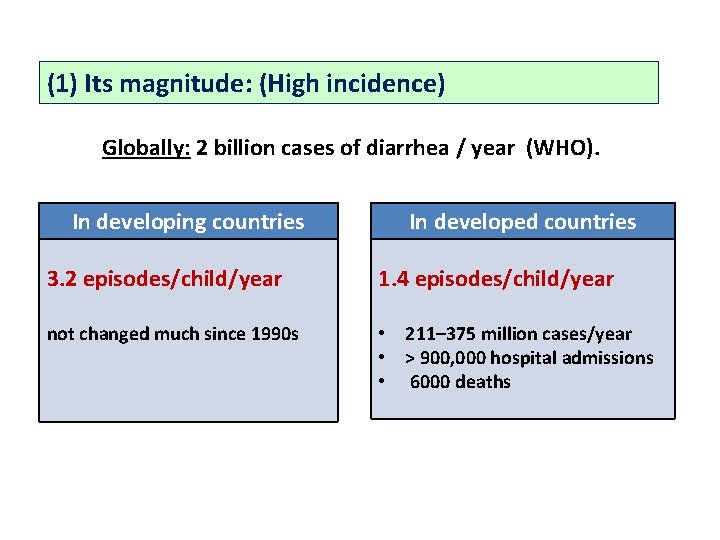
(1) Its magnitude: (High incidence) Globally: 2 billion cases of diarrhea / year (WHO). In developing countries In developed countries 3. 2 episodes/child/year 1. 4 episodes/child/year not changed much since 1990 s • 211– 375 million cases/year • ˃ 900, 000 hospital admissions • 6000 deaths
In developing countries (Egypt) it is a public Health problem because: 1 - Unsanitary environment (unsafe water & food, flies) 2 - Faulty traditional beliefs & health habits 3 - improper child H. care: artificial feeding & faulty feeding 4 - Lack of effective H. services 5 - Other H. hazards: (Malnutrition & Systemic infs, ARI).

(2) Its severity: (= morbidity & mortality) esp. in children ˂ 5 years of age → malnutrition & poor growth Global mortality due to diarrheal diseases: Period Estimated deaths / year before 1980 4. 8 million 1980– 1990 3. 3 million 1990– 2000 2. 6 million 2001 -2005 1. 8 million 2006 - 2010 1. 5 million In Egypt: It accounts for 25 -30% of mortality among children aged ˂ 5 yrs
(3) Its economic burden: 1 - the use of Health resources (facilities, H. workers time) 2 - cost of ttt of diarrhea & malutrition.
![[2] Seasonality • Sporadic cases all over the year. • Peak of morbidity &](http://slidetodoc.com/presentation_image_h2/6a6bcf2a78e441f40bf437876e96fe9a/image-10.jpg "[2] Seasonality • Sporadic cases all over the year. • Peak of morbidity &")
[2] Seasonality • Sporadic cases all over the year. • Peak of morbidity & mortality in summer & early fall (summer diarrhea) • Small peak during winter: ARI associated with 2 ry diarrhea.
![[3] The infectious cycle (The natural history of the disease) Etiology: It is multi-factorial](http://slidetodoc.com/presentation_image_h2/6a6bcf2a78e441f40bf437876e96fe9a/image-11.jpg "[3] The infectious cycle (The natural history of the disease) Etiology: It is multi-factorial")
[3] The infectious cycle (The natural history of the disease) Etiology: It is multi-factorial (1) 1 ry infection of GIT: Viral • Rotavirus (70%) • Enteroviruses • Adenoviruses • Hepatitis A & E Bacterial • E. Coli (ETEC, EHEC, EPEC, EIEC) • Shigella, almonella, • S. aureus, • Others Protozoal Giardia, Entamebia, B. coli (2) 2 ry diarrhea: as a complication of other diseases: • Viral diseases: measles, rubella, mumps, chickenpox • Bacterial infections: ARI, tonsillitis, … What are the causes of non-infectious diarrhea?

Source of infection (reservoir): 1. Human: (main source): cases & carriers. 2. Animals: (in some infection) e. g. salmonella, balantidium coli. Exit: With stool of infected person ± vomitus Period of communicability: As long as the organism is excreted in stool usually 2 -3 weeks.
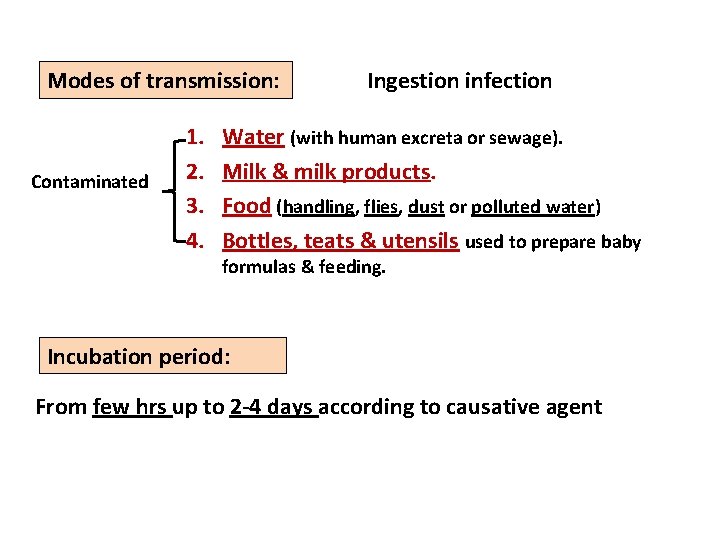
Modes of transmission: Contaminated 1. 2. 3. 4. Ingestion infection Water (with human excreta or sewage). Milk & milk products. Food (handling, flies, dust or polluted water) Bottles, teats & utensils used to prepare baby formulas & feeding. Incubation period: From few hrs up to 2 -4 days according to causative agent

Pathogenesis: 1 - Invasive diarrhea invades intestinal mucosa e. g. salmonella, EHEC, EIEC. 2 - Secretory diarrhea enterotoxins stimulate secretions of epithelial cells e. g. ETEC, vibrio cholera, staph aureus. 3 - Osmotic diarrhea ↓ disaccharidase enzymes → hydrolysis of disaccharides into monosaccharides in lumen → osmotic diarrhea. 4 - Others ↑ motility, interference with absorption (malabsorption)
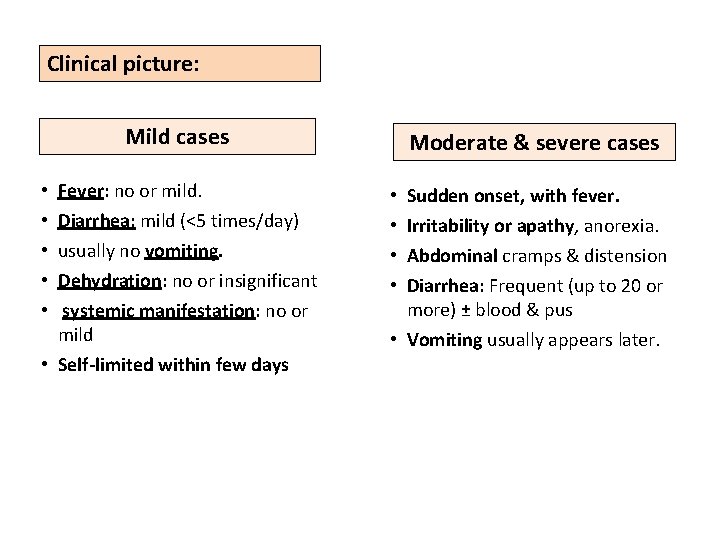
Clinical picture: Mild cases • • • Fever: no or mild. Diarrhea: mild (<5 times/day) usually no vomiting. Dehydration: no or insignificant systemic manifestation: no or mild • Self-limited within few days Moderate & severe cases • • Sudden onset, with fever. Irritability or apathy, anorexia. Abdominal cramps & distension Diarrhea: Frequent (up to 20 or more) ± blood & pus • Vomiting usually appears later.
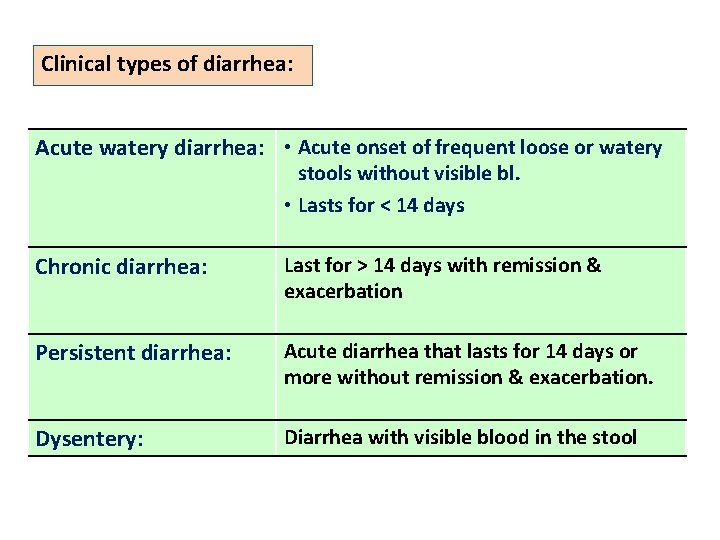
Clinical types of diarrhea: Acute watery diarrhea: • Acute onset of frequent loose or watery stools without visible bl. • Lasts for ˂ 14 days Chronic diarrhea: Last for ˃ 14 days with remission & exacerbation Persistent diarrhea: Acute diarrhea that lasts for 14 days or more without remission & exacerbation. Dysentery: Diarrhea with visible blood in the stool
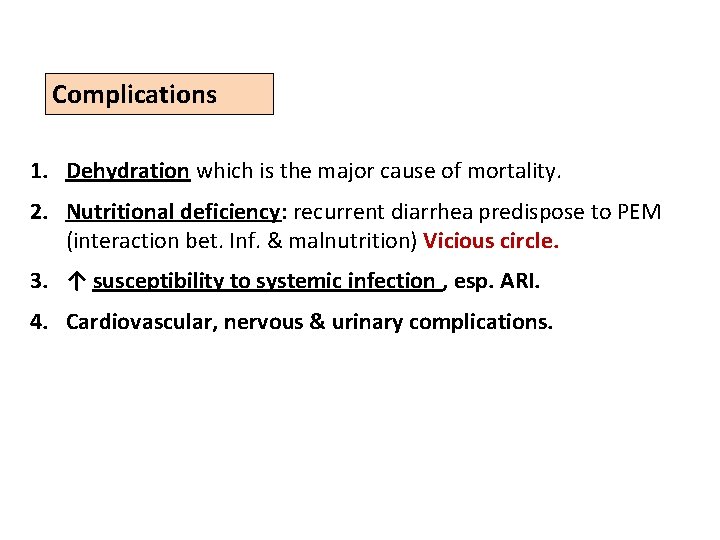
Complications 1. Dehydration which is the major cause of mortality. 2. Nutritional deficiency: recurrent diarrhea predispose to PEM (interaction bet. Inf. & malnutrition) Vicious circle. 3. ↑ susceptibility to systemic infection , esp. ARI. 4. Cardiovascular, nervous & urinary complications.
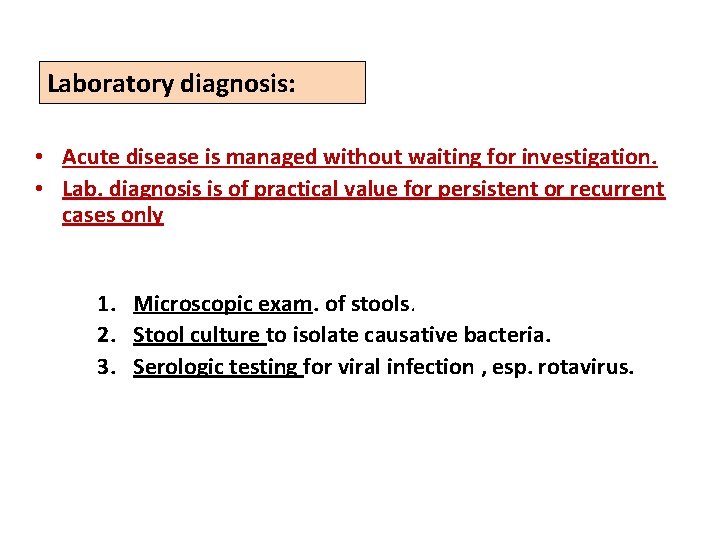
Laboratory diagnosis: • Acute disease is managed without waiting for investigation. • Lab. diagnosis is of practical value for persistent or recurrent cases only 1. Microscopic exam. of stools. 2. Stool culture to isolate causative bacteria. 3. Serologic testing for viral infection , esp. rotavirus.
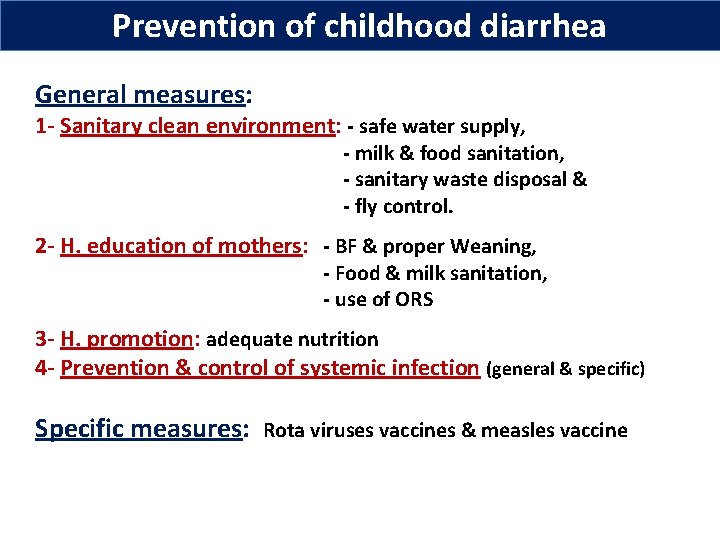
Prevention of childhood diarrhea General measures: 1 - Sanitary clean environment: - safe water supply, - milk & food sanitation, - sanitary waste disposal & - fly control. 2 - H. education of mothers: - BF & proper Weaning, - Food & milk sanitation, - use of ORS 3 - H. promotion: adequate nutrition 4 - Prevention & control of systemic infection (general & specific) Specific measures: Rota viruses vaccines & measles vaccine
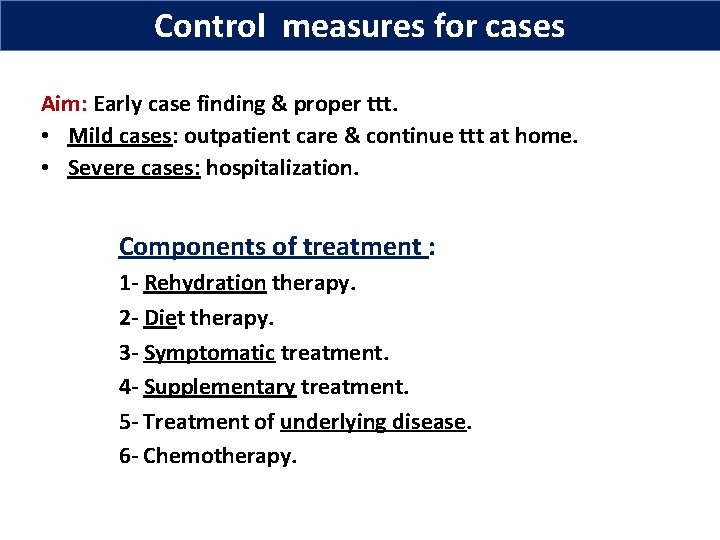
Control measures for cases Aim: Early case finding & proper ttt. • Mild cases: outpatient care & continue ttt at home. • Severe cases: hospitalization. Components of treatment : 1 - Rehydration therapy. 2 - Diet therapy. 3 - Symptomatic treatment. 4 - Supplementary treatment. 5 - Treatment of underlying disease. 6 - Chemotherapy.
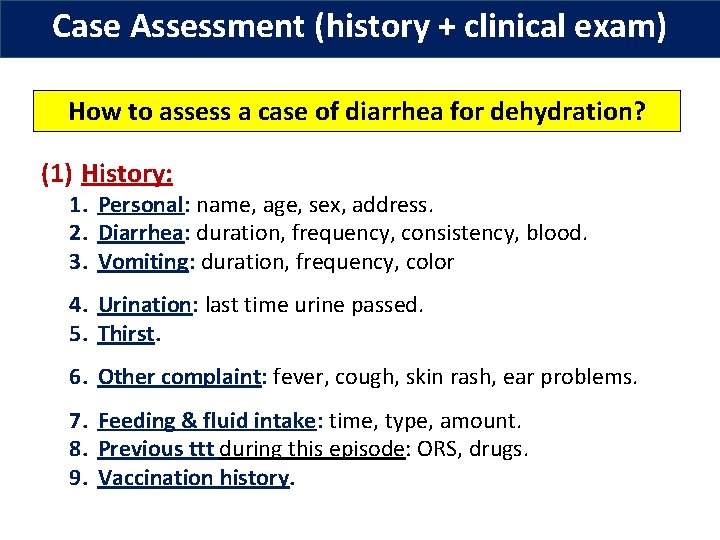
Case Assessment (history + clinical exam) How to assess a case of diarrhea for dehydration? (1) History: 1. Personal: name, age, sex, address. 2. Diarrhea: duration, frequency, consistency, blood. 3. Vomiting: duration, frequency, color 4. Urination: last time urine passed. 5. Thirst. 6. Other complaint: fever, cough, skin rash, ear problems. 7. Feeding & fluid intake: time, type, amount. 8. Previous ttt during this episode: ORS, drugs. 9. Vaccination history.
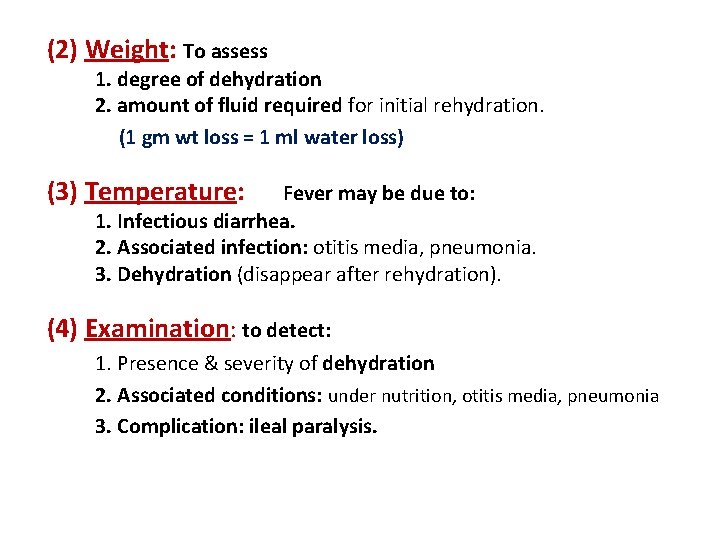
(2) Weight: To assess 1. degree of dehydration 2. amount of fluid required for initial rehydration. (1 gm wt loss = 1 ml water loss) (3) Temperature: Fever may be due to: 1. Infectious diarrhea. 2. Associated infection: otitis media, pneumonia. 3. Dehydration (disappear after rehydration). (4) Examination: to detect: 1. Presence & severity of dehydration 2. Associated conditions: under nutrition, otitis media, pneumonia 3. Complication: ileal paralysis.
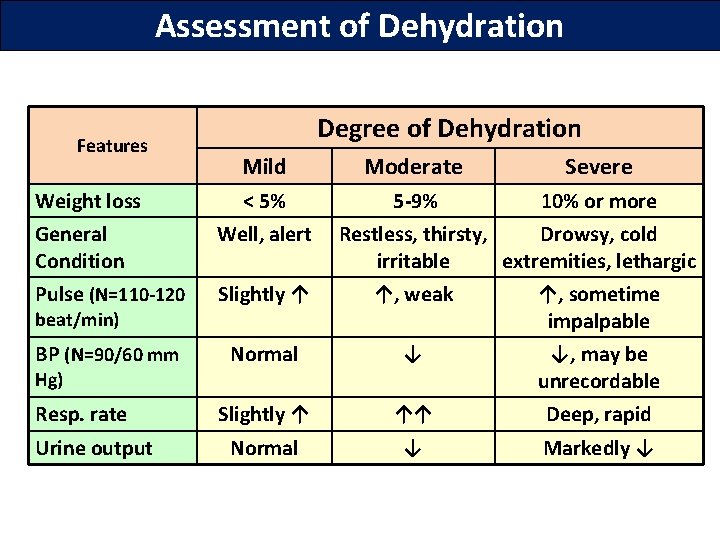
Assessment of Dehydration Features Weight loss Degree of Dehydration Mild Moderate Severe < 5% 5 -9% 10% or more General Condition Well, alert Pulse (N=110 -120 Slightly ↑ ↑, weak ↑, sometime impalpable BP (N=90/60 mm Normal ↓ ↓, may be unrecordable Slightly ↑ ↑↑ Deep, rapid Normal ↓ Markedly ↓ beat/min) Hg) Resp. rate Urine output Restless, thirsty, Drowsy, cold irritable extremities, lethargic

Assessment of Dehydration Features Mild Degree of Dehydration Moderate Severe Eyes Normal Sunken Very sunken, dry Tears Present Absent Anterior fontanelle Normal depressed Very depressed Mouth + tongue dry Very Dry, furred Skin pinch goes back quickly slowly very slowly Treatment Plan B ttt Plan C ttt Normal Plan A ttt
Treatment Plan A Aim: ttt of diarrhea at home to prevent dehydration & malnutrition Food + Fluids + Follow up (1) Food: Continue Feeding • In breast fed child continue breastfeeding. • In non-breast fed child give usual milk. If child is 6 months or older: 1. Give starchy food mixed with vegetables, meat or fish. 2. Add 1 -2 teaspoonful of vegetable oil to each serving 3. Fresh fruit juice or mashed banana.
How often & how much food: During diarrhea: At least 6 meals / day Frequent, small feedings are tolerated better than less frequent, large ones After stoppage of diarrhea: • extra-meal for 2 weeks. • In malnourished child , extra meals is given until the child regain his normal weight-for-height.
(2) Fluids: 1. ORS (oral rehydration solution) 2. Rice water. 3. Soup 4. Orange juice 5. Yoghurt. Unsuitable fluids Fluids which can cause osmotic diarrhea & hypernatraemia, e. g. : • soft drinks • sweetened fruit drinks • sweetened tea. Fluids with stimulant, diuretic or purgative effects, e. g. : • coffee • some medicinal teas or infusions.
How much fluid to give: General rule Give as much fluid as the child or adult wants until diarrhea stops. As a guide, after each loose stool, give: children aged ˂ 2 years children aged 2 -10 years older children & adults 50 -100 ml of fluid 100 -200 ml. as much fluid as they want
(3) Follow up for the following symptoms: 1. 2. 3. 4. 5. 6. 7. Repeated vomiting Persistence of fever Persistence of diarrhea. Severe thirst Poor eating or drinking Blood in the stool; or the child does not get better in 3 days.
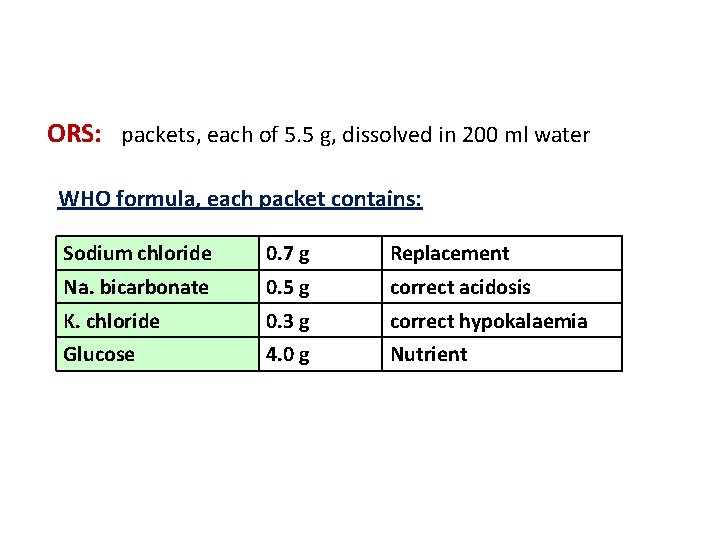
ORS: packets, each of 5. 5 g, dissolved in 200 ml water WHO formula, each packet contains: Sodium chloride 0. 7 g Replacement Na. bicarbonate 0. 5 g correct acidosis K. chloride 0. 3 g correct hypokalaemia Glucose 4. 0 g Nutrient
How to give ORS solution: • Teach a family member how to prepare & give ORS solution. • Use a clean spoon or cup to give ORS infants & young children (feeding bottles should not be used). • For babies, use a dropper or syringe (without the needle). • For children aged ˂ 2 yrs a teaspoonful every 1 -2 mins • Older children (& adults) may take sips directly from the cup. • Vomiting: 1. usually occurs during the 1 st 2 hrs of ttt, esp. if child drink quickly. Rarely prevents successful ORT bed. most of the fluid is absorbed. After that vomiting usually stops. 2. If child vomits: wait 5 -10 mins & then give ORS solution again, but more slowly (e. g. a spoonful every 2 -3 mins).

Treatment Plan B Aim: ttt of dehydration within 4 hours (1) Food: as in plan A. (2) Fluid: As plan A, except: • The amount of ORS = 75 ml / kg body weight • If child vomit: wait 10 mins, then continue ORS but at slower rate (a spoonful / 2 -3 min). • If child eye lids becomes puffy: stop ORS & give plain water or breast milk till puffiness is gone �give ORS as in plan A.

(3) Follow up for reassessment: After 4 hours, reassess the child : No signs of dehydration, consider the child fully rehydrated. - Skin pinch is normal. - Thirst has subsided. - urine is passed. - Child becomes quiet, no longer irritable & often falls asleep. Child still has signs indicating some dehydration: 1 - continue ORT by repeating ttt Plan B. 2 - start to offer food, milk & other fluids, in ttt Plan A, 3 - continue to reassess the child frequently. If signs of severe dehydration: shift to ttt Plan C.
Treatment plan C Aim: ttt of severe dehydration quickly in hospital to avoid death Steps: (1) Give Ringers Lactate Solution: 100 ml / kg (if not available use normal saline). (2) Reassess child every 1 -2 hrs, if no improvement, give I. V. drip more rapidly. (3) Give ORS by mouth (5 ml /kg/hour) as soon as patient can drink. (4) Evaluate patient after 6 hrs in infants (3 hrs in older patients), then continue ttt according to appropriate plan (A, B or C).
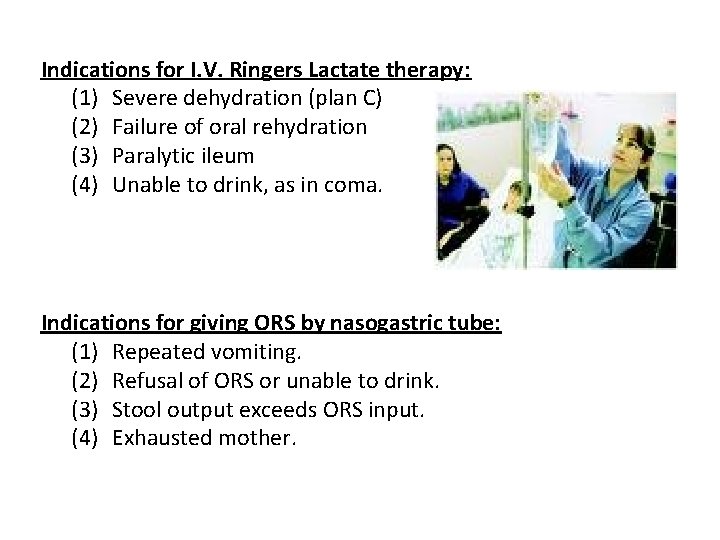
Indications for I. V. Ringers Lactate therapy: (1) Severe dehydration (plan C) (2) Failure of oral rehydration (3) Paralytic ileum (4) Unable to drink, as in coma. Indications for giving ORS by nasogastric tube: (1) Repeated vomiting. (2) Refusal of ORS or unable to drink. (3) Stool output exceeds ORS input. (4) Exhausted mother.
Chemotherapy: Indications: (1) infective diarrhea: Shigella, vibrio (2) Protozoal: Giardia & entamebia (3) Any existing systemic bacterial infection. Proper dosage, for short time (resistance, side effects).
Symptomatic treatment: (1) Fever: No antityretics, ORS is valuable (there is interaction bet. fever & dehydration), cold compresses with light cloths & ttt of any associated systemic inf. (2) Diarrhea: diarrhea helps elimination of infection. It is self-limited & improved by rehydration. Avoid antidiarrheal, adsorbent (kaolin, pectin) & antimotility drugs. (3) Vomiting: It is due to loss of electrolytes & acidosis. Slow intake of ORS improves vomiting. Avoid antiemetics. (4) Abdominal distension: due to loss of potassium in stools or ileus.
National Control of Diarrheal Disease Program (NCDDP), 1991 Aim: (1) ↓ Morbidity • ↓ spread of infection & ↓ incidence of diarrhea • ↓ Incidence of persistent diarrhea • Improve nutritional status (2) ↓ Mortality (3) ↓ Inappropriate use of antibiotics.
Components: 1. ORS: production, packaging & distribution. 2. Training on ORT for doctors, pharmacists, nurses & mothers. 3. Research related to ORT: Clinical, social & economic. 4. Promotion of the project nationally: using TV, radio & other public media 5. Integration into PHC network. 6. Evaluation.
Key measures to prevent diarrhoea include: (WHO) 1. promotion of breast-feeding; exclusive breastfeeding for the 1 st 6 months of life 2. Proper weaning 3. promoting personal & domestic hygiene; 4. Sanitary water supply: access to safe drinking-water 5. Improved sanitation; 6. use of oral rehydration solution (ORS) in the community; 7. vaccination (rotavirus & other vaccines, e. g. measles).

Objectives of International Control Project of Diarrheal illness 1 -↓ mortality of diarrheal illness by short policies e. g. ORT, community education. 2 -↓ morbidity in developing countries: - Raising standards of environmental - Health education for specific groups e. g. mothers 3 -Availability of accessible health services: - High immunization coverage. - Proper infant & child care. - Proper treatment of diseases complicated by diarrhea. - Improving nutritional status of young age group. 4 -Detection of source of infection & decrease reservoir.

- Slides: 42