
Epidemiology of Communicable Diseases Chain of infection Dr
Epidemiology of Communicable Diseases (Chain of infection) Dr. Abdulaziz Almezam Dr. Salwa A. Tayel & Dr. Mohammad Afzal Mahmood Department of Family & Community Medicine September-2013 September, 2013 1
OBJECTIVES OF THE LECTURE By the end of this lecture you will be able to: • Describe the process of infectious diseases transmission (Chain of infection) • List the types of reservoir of infectious diseases of human • Define a CARRIER and list its types. • Define ZOONOSES and list examples. • Identify the different MODE OF TRANSMISSION of the organisms from the reservoir to the susceptible host. September, 2013 2
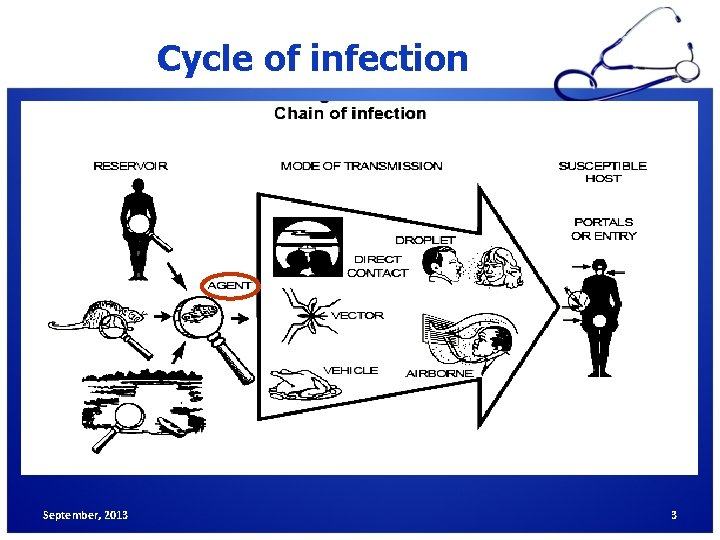
Cycle of infection September, 2013 3
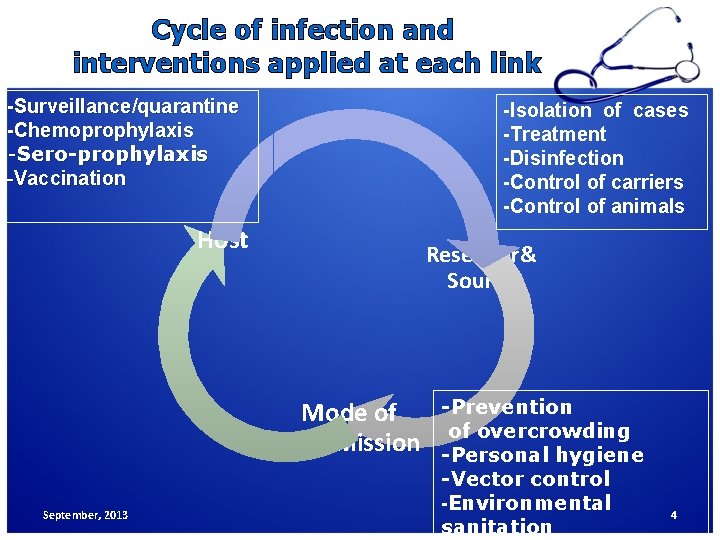
Cycle of infection and interventions applied at each link -Surveillance/quarantine -Chemoprophylaxis -Sero-prophylaxis -Vaccination -Isolation of cases -Treatment -Disinfection -Control of carriers -Control of animals Host Reservoir& Source Mode of transmission September, 2013 -Prevention of overcrowding -Personal hygiene -Vector control -Environmental sanitation 4

Cycle of infection A process that begins when an agent leaves its reservoir through a portal of exit, and is conveyed by some mode of transmission, then enters through an appropriate portal of entry to infect a susceptible host. September, 2013 5
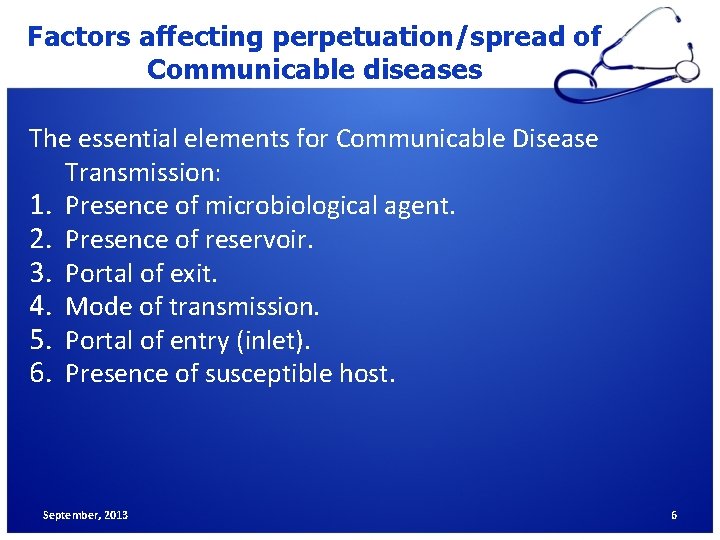
Factors affecting perpetuation/spread of Communicable diseases The essential elements for Communicable Disease Transmission: 1. Presence of microbiological agent. 2. Presence of reservoir. 3. Portal of exit. 4. Mode of transmission. 5. Portal of entry (inlet). 6. Presence of susceptible host. September, 2013 6
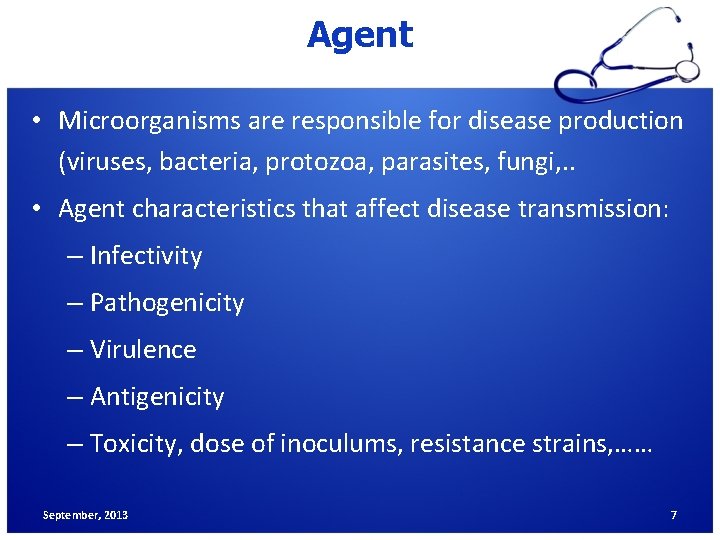
Agent • Microorganisms are responsible for disease production (viruses, bacteria, protozoa, parasites, fungi, . . • Agent characteristics that affect disease transmission: – Infectivity – Pathogenicity – Virulence – Antigenicity – Toxicity, dose of inoculums, resistance strains, …… September, 2013 7
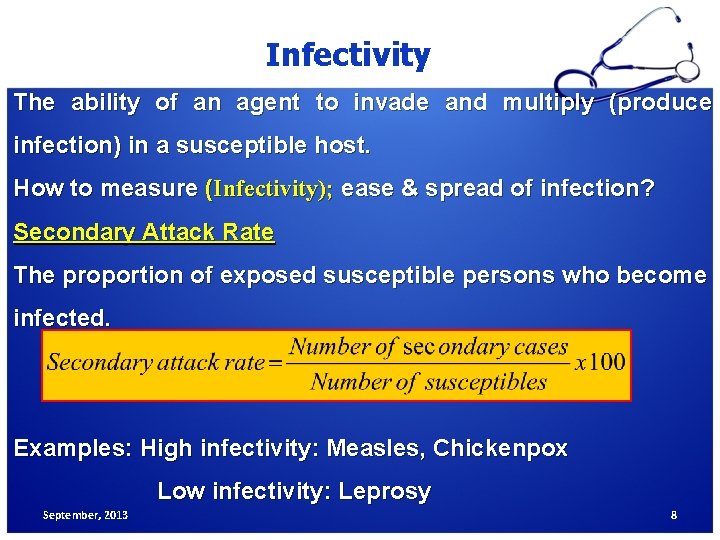
Infectivity The ability of an agent to invade and multiply (produce infection) in a susceptible host. How to measure (Infectivity); ease & spread of infection? Secondary Attack Rate The proportion of exposed susceptible persons who become infected. Examples: High infectivity: Measles, Chickenpox Low infectivity: Leprosy September, 2013 8

Pathogenicity Is the ability of the organisms to produce specific clinical reaction after infection It refers to the proportion of infected persons who develop clinical disease. Examples: • High pathogenicity: Measles, Chickenpox (Class B) • Low pathogenicity: Polio, Tuberculosis, Hepatitis A, Meningitis, AIDS (Class A) It can be measured by: Ratio of clinical to sub-clinical case = September, 2013 9
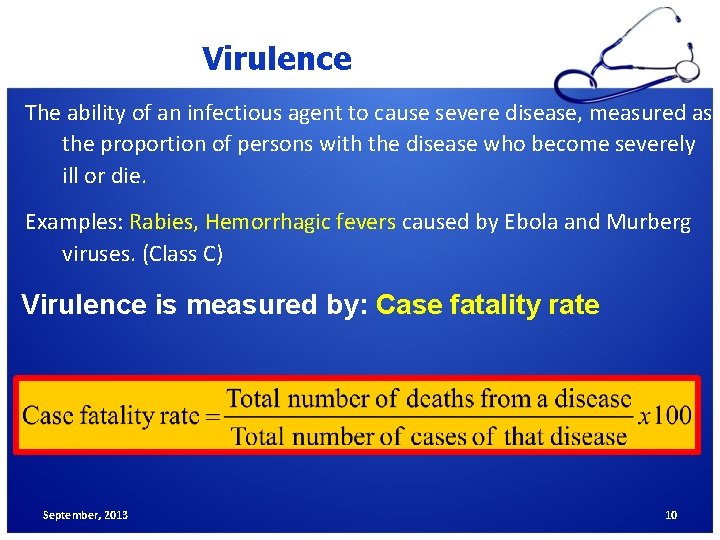
Virulence The ability of an infectious agent to cause severe disease, measured as the proportion of persons with the disease who become severely ill or die. Examples: Rabies, Hemorrhagic fevers caused by Ebola and Murberg viruses. (Class C) Virulence is measured by: Case fatality rate September, 2013 10

Antigenicity (Immunogenicity) The ability of the organism to produce specific immunity (antibodies or antitoxin). It can be measured by: Second attack frequency: Second attacks are rare: measles, mumps and chickenpox. Re-infection occurs frequently: common cold, syphilis and gonorrhea. September, 2013 11
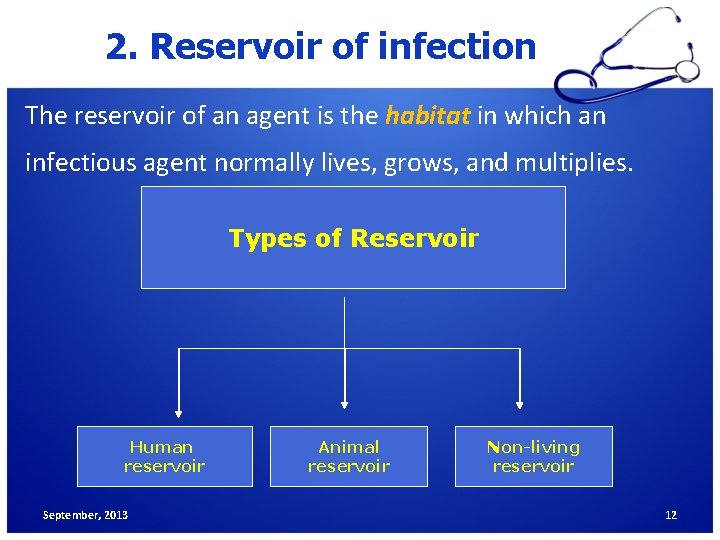
2. Reservoir of infection The reservoir of an agent is the habitat in which an infectious agent normally lives, grows, and multiplies. Types of Reservoir Human reservoir September, 2013 Animal reservoir Non-living reservoir 12

Human reservoirs Two types of human reservoirs exist: • Case • Carrier: A person that harbors the infectious agent for a disease and can transmit it to others, but does not demonstrate signs of the disease. – Temporary OR Chronic (such as Salmonella typhi – Carriers have no symptoms, not diagnosed, so can infect others, causing infection control difficult. September, 2013 13

Reservoirs Zoonoses: An infection or infectious disease transmissible under natural conditions from vertebrate animals to humans. >100 Zoonotic Diseases such as Brucellosis (sheep, goats and pigs), Bovine tuberculosis (cattle), Rabies (bats, dogs, and other mammals). Environmental reservoirs: For example: Soil may harbor spores that causes tetanus and anthrax. Pools of water are the primary reservoir of Legionnaires’ bacillus. September, 2013 14
3. Portal of exit is the path by which an agent leaves the source host. E. g. Examples: • Urinary tract • Intestinal tract • Respiratory tract • Skin and mucous membrane • Blood September, 2013 15

4. Modes of transmission Direct Contact Droplet spread Contact with soil September, 2013 Indirect Vehicle borne Vector borne Airborne Inoculation into skin or mucosa Fomite-Borne Trans-placental (vertical) Unclean hands and fingers 16
Direct Transmission Direct modes: reservoir & susceptible host are physically present together resulting in immediate transfer of infectious agent: 1 - Direct contact: e. g. Sexually Transmitted Infections, 2 - Droplet infection: e. g. Sneezing leading to ARI 3 -Contact with soil: e. g. Tetanus, hookworm larvae 4 -Inoculation into skin or mucosa: e. g. Rabies, Hep B 5 - Trans-placental: Mother to her foetus, e. g. HIV September, 2013 17
Indirect transmission 1 - Vehicle-borne: The agent may multiply in the vehicle before transmission. FOOD (e. g. Hep A), WATER (e. g. Cholera), MILK (e. g. TB), BLOOD (e. g Hep B) 2 - Vector-borne: arthropod or other living carrier e. g. Flies carrying Shigella, and Mosquito propagating malaria parasites 3 - Airborne: e. g TB transmitted indirectly through airborne transmission, than directly through direct droplet spread. Legionnaires’ disease and fungal spores also spread through airborne transmission. September, 2013 18
Indirect transmission 4 - Fomite-borne: e. g. clothes, cups, door handles, surgical dressings and instruments. Disease examples Hep A, Influenza, Eye infections 5 - Unclean hands & fingers: causing, e. g. , typhoid, staph. & strept. infection, hepatitis A September, 2013 19
5. Portal of entry • An agent enters a susceptible host through a portal of entry. The portal of entry must provide access to tissues in which the agent can multiply or a toxin can act. • Often, organisms use the same portal to enter a new host as that they use to exit the source host. September, 2013 20
6. Susceptible host Host that don't have resistance against a particular pathogenic agent (i. e. susceptible) is liable to contract the disease when exposed to such agent. Resistance: is total body mechanisms which interpose barriers to progression of invasion& or multiplication of infectious agent. Susceptibility depends on: • Genetic factors • Malnutrition, Alcoholism, Disease, Therapy which impairs the immune response (e. g. cortisone, cytotoxic drugs, . . . ) • Acquired Immunity (natural/Artificial) September, 2013 21
Body defense mechanism against infection o Skin, Mucous membranes, Gastric acidity, Cilia in the respiratory tract, Cough reflex o Nonspecific immune response; phagocytes o Specific immune response. i. e protective antibodies that are directed against a specific agent. September, 2013 22
Herd immunity It is the state of immunity of a group or a community. Also it is; “The resistance of a group to invasion and spread of an infectious agent, based on the immunity of a high proportion of individual members of the group”. September, 2013 23
Factors Affecting Herd Immunity: • The extent of coverage of the immunization program. • The degree of resistance to infection afforded by the vaccine. • Duration and degree of infectivity of the organism. • Past experience with different infections. • Overcrowding and environmental sanitation. September, 2013 24
Reference books Principles of Epidemiology in Public Health Practice. Third Edition. An Introduction to Applied Epidemiology and Biostatistics. Centers for Disease Control and Prevention (CDC) • Porta M. A dictionary of epidemiology. 5 th Edition. Oxford, New York: Oxford University Press, 2008. • Gordis L. Epidemiology. 4 th edition. Philadelphia, Pennsylvania: Elsevier Science, 2008 • Beaglehole R, Bonita R, Kjellstrom T. Basic epidemiology. 2 nd edition. Geneva: World Health Organization, 2006 • September, 2013 25
- Slides: 25