
Epidemiology of Chlamydia trachomatis Marjan Javanbakht MPH Ph

Epidemiology of Chlamydia trachomatis Marjan Javanbakht, MPH, Ph. D Los Angeles County Department of Health Services Sexually Transmitted Disease Program 1
Taxonomy History Epidemiology Taxonomy Implication Conclusion • Chlamydia trachomatis is an important pathogen of humans and 1 of 4 species within the genus – C. trachomatis (natural host: humans) – C. pneumoniae (natural host: humans) – C. psittaci (natural host: birds, lower mammals) – C. pecorum (natural host: sheep, cattle, and swine) • 4 biovars of C. trachomatis – Murine biovar – Swine biovar – Lymphogranuloma venereum (LGV) biovar – Trachoma biovar 2
Taxonomy History Epidemiology History Implication Conclusion • Human disease caused by C. trachomatis have been recognized since antiquity – Trachoma was described in Egyptian papyri – LGV was described in the 8 th century • However, the genital tract infections were not recognized until identification of the organism in the 20 th century – First isolated from patients with LGV in 1930 s – First isolate from genital tract (other than LGV) was made in 1959 – Major breakthrough in 1960 s was the development of tissue culture isolation procedures 3
Taxonomy History Epidemiology Implication History: 1975 -1985 Conclusion • 1975 – 1985 thought of as cell culture era which made it possible to: – link C. trachomatis to specific clinical syndromes • Majority of NGU in men was attributed to chlamydia • Cervicitis and pelvic inflammatory disease also associated with chlamdyia – In terms of prevention, culture era focused on teaching clinicians to recognize chlamydia associated symptoms • Provide empiric treatment for patients based on chlamydia associated syndromes without actual diagnostic testing • Likewise provide treatment of partners of these empirically treated patients 4
Taxonomy History Epidemiology History: 1975 -1985 Implication Conclusion • Limitations of cell culture – Due to expense and technical difficulty, chlamydia testing by cell culture never became widely available – Consequently, screening programs were not feasible – Focus of prevention efforts was largely directed at patients attending STD clinics and family planning clinics 5
Taxonomy History Epidemiology History: 1985 – 1995 Implication Conclusion • 1985 -1995 nonculture tests (i. e. , antibody tests) became available for chlamydia which allowed for: – Widespread access to clinic based testing – Increased opportunities to screen for adolescent women and other high risk groups – Screening of pregnant women and selective screening in low prevalence populations became feasible for the first time – Although more people screened, most treatment remained syndromic and empiric 6
Taxonomy History Epidemiology History: 1990’s - present Implication Conclusion • Mid 1990’s – present, nucleic acid amplification tests (NAATS) became available for routine clinical use • These tests have had a major impact on our understanding of the epidemiology and approaches to prevention because of 3 unique characteristics: – Improved sensitivity (by as much as 20%) – Urine based testing (no pelvic exams, urethral swabs, presence of physician not required access to new patient populations increase in number screened) – Ability to test for multiple pathogens (CT/GC) 7
Taxonomy History Epidemiology History: 1990’s - present Implication Conclusion • Revisions of Chlamydia epidemiology in the NAATS era (last 10 years): – Because of increased sensitivity, NAATS tests have demonstrated an increased prevalence in all populations – Increased recognition of and emphasis on asymptomatic infections • Prevalence of ~10% in female recruits joining the army (even higher among adolescents) • Prevalence of 2 -7% in a random sample of households participating in NHANES III • Door-to-door household survey of women 18 -29 showed a 3. 2% overall prevalence (even higher among adolescents) 8
Taxonomy History Epidemiology History: 1990’s - present Implication Conclusion • Impact of NAATS on prevention – Expanded efforts to screen asymptomatic young women – New venues to identify asymptomatic adolescents – a group least likely to be encountered in routine clinical care • Street-based testing (eg. , mobile van outreach) • High-school based testing • Testing of military recruits 9
Taxonomy History Epidemiology History: 1990’s - present Implication Conclusion • Impact of NAATS on prevention (cont’d) – Increased appreciation of the high incidence of recurrent/persistent urogenital infections especially among adolescents • 15% recurrence in 3 -years among women in Washington State Chlamydia registry; 17% recurrence within 2 years among women under 20 • 17% recurrence in 4 -years among young women (10 -24 years) in Los Angeles County; with highest incidence rate among those aged 10 -14 years • CDC multicenter cohort study to evaluate recurrences of chlamydial infection found 13% recurrence 4 months after identification and initial therapy 10
Taxonomy History Epidemiology History: 1990’s - present Implication Conclusion • Impact of NAATS on prevention (cont’d) – Until NAATS era recommendation for all chlamydia screening was focused on women, but because of new test rationale emerged to screen young men • Most importantly, noninvasive test makes it more acceptable to men • Substantial prevalence of asymptomatic infection in men • Identification and treatment in men would constitute primary prevention for women • Identification and treatment of asymptomatic male reservoir might help to prevent reinfection in women 11
Taxonomy History Epidemiology Implication Conclusion • Most frequently reported bacterial STI in the U. S. – Estimated annual incidence of 3 million cases – Estimated annual costs exceeding 2 billion • Under-reporting is substantial since most cases are asymptomatic • “Silent” disease because 75% of women and 50% of men are not aware of their infection • If symptoms do occur, usually 1 – 3 weeks after exposure • Symptoms include discharge (vaginal, penile, rectal), burning sensation when urinating, bleeding between menstrual cycle, pain and swelling in testicles 12

Taxonomy History Epidemiology Implication Conclusion • Like the disease, the damage that chlamydia causes is “silent” • ~40% of women with untreated chlamydia develop PID chronic pelvic pain, infertility, and ectopic pregnancy • Chlamydia infections can facilitate transmission of HIV – Infected women are 2 -5 times more likely to become infected with HIV if exposed • Complications among men rare, but can cause pain, fever, and rarely sterility 13
Taxonomy History Epidemiology Implication Conclusion Reported Sexually Transmitted Diseases, United States, 2004 14 Source: CDC Sexually Transmitted Disease Report, 2004
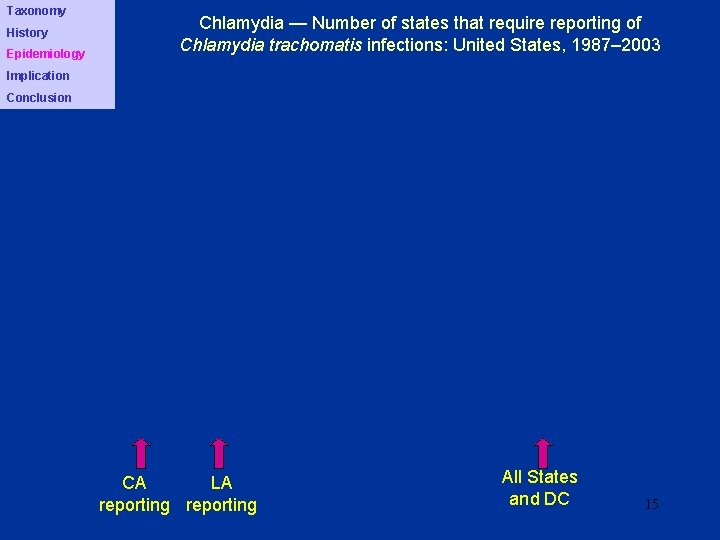
Taxonomy History Epidemiology Chlamydia — Number of states that require reporting of Chlamydia trachomatis infections: United States, 1987– 2003 Implication Conclusion CA LA reporting All States and DC 15
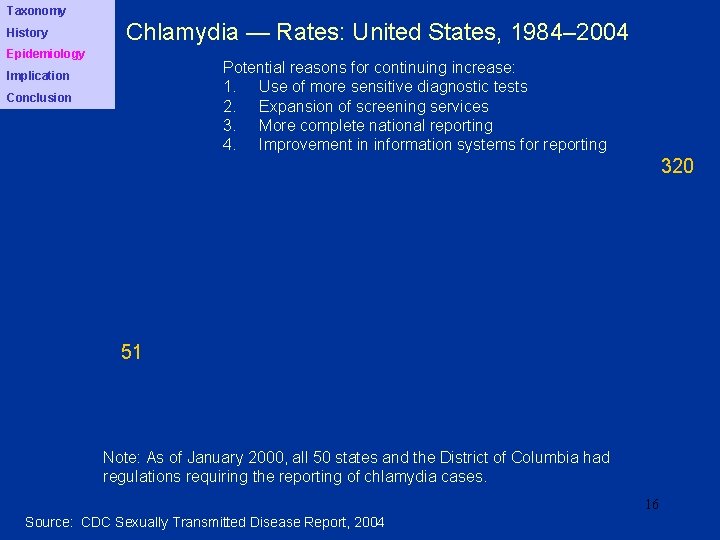
Taxonomy History Chlamydia — Rates: United States, 1984– 2004 Epidemiology Potential reasons for continuing increase: 1. Use of more sensitive diagnostic tests 2. Expansion of screening services 3. More complete national reporting 4. Improvement in information systems for reporting Implication Conclusion 320 51 Note: As of January 2000, all 50 states and the District of Columbia had regulations requiring the reporting of chlamydia cases. 16 Source: CDC Sexually Transmitted Disease Report, 2004
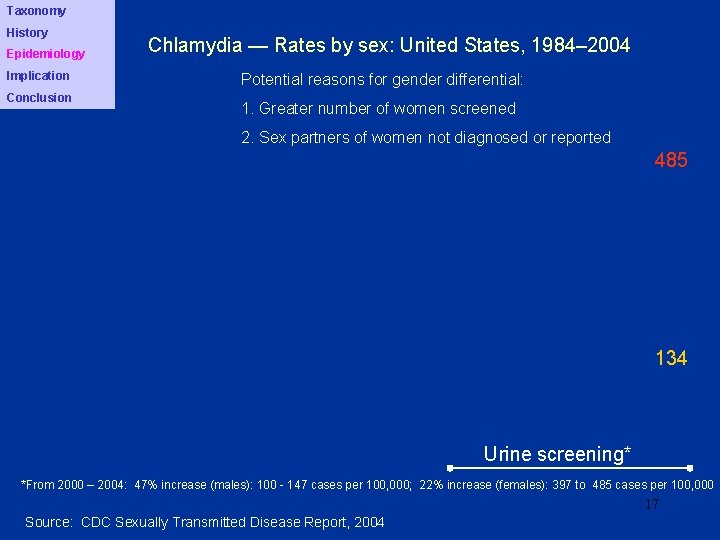
Taxonomy History Epidemiology Implication Conclusion Chlamydia — Rates by sex: United States, 1984– 2004 Potential reasons for gender differential: 1. Greater number of women screened 2. Sex partners of women not diagnosed or reported 485 134 Urine screening* *From 2000 – 2004: 47% increase (males): 100 - 147 cases per 100, 000; 22% increase (females): 397 to 485 cases per 100, 000 17 Source: CDC Sexually Transmitted Disease Report, 2004
Taxonomy History Epidemiology Chlamydia — Age- and sex-specific rates: United States, 2004 Implication Conclusion 18 Source: CDC Sexually Transmitted Disease Report, 2004
Taxonomy History Epidemiology Implication Chlamydia Reported Rates by Race and Gender: United States, 2004 Conclusion 19 Source: CDC Sexually Transmitted Disease Report, 2004
Taxonomy History Chlamydia — Rates by state: United States and outlying areas, 2004 Epidemiology Implication Conclusion Note: The total rate of chlamydia for the United States and outlying areas (Guam, Puerto Rico and Virgin Islands) was 316. 7 per 100, 000 population. 20 Source: CDC Sexually Transmitted Disease Report, 2004
Taxonomy History Chlamydia — Rates by county: United States, 2004 Epidemiology Implication Conclusion 21 Source: CDC Sexually Transmitted Disease Report, 2004
Taxonomy History Epidemiology Reported Sexually Transmitted Diseases, Los Angeles County, 2004 Implication Conclusion (4% of national cases) 22 Source: LAC DHS STD Program 2004
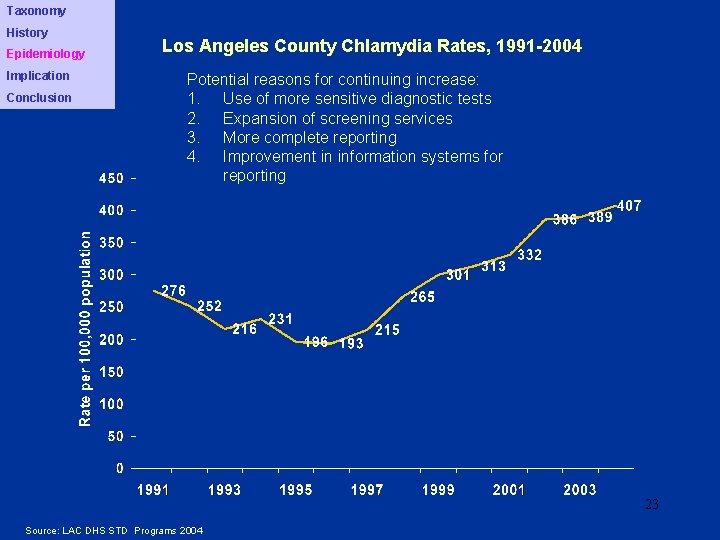
Taxonomy History Epidemiology Implication Conclusion Los Angeles County Chlamydia Rates, 1991 -2004 Potential reasons for continuing increase: 1. Use of more sensitive diagnostic tests 2. Expansion of screening services 3. More complete reporting 4. Improvement in information systems for reporting 23 Source: LAC DHS STD Programs 2004
Taxonomy History Los Angeles County Chlamydia Rates by Gender, 1991 - 2004 Epidemiology Implication Potential reasons for gender differential: Conclusion 1. Greater number of women screened 2. Sex partners of women not diagnosed or reported *From 2000 – 2004: 80% increase (males): 132 to 238 cases per 100, 000; 21% increase (females): 469 to 569 cases per 100, 000 24 Source: LAC DHS STD Programs 2004
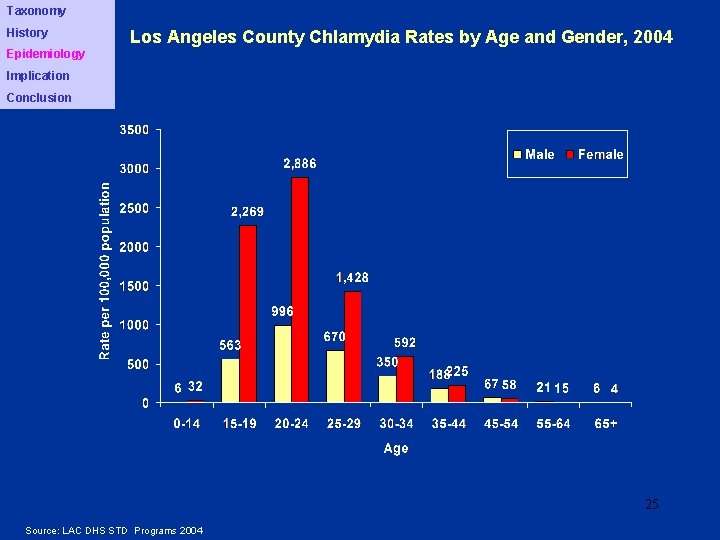
Taxonomy History Los Angeles County Chlamydia Rates by Age and Gender, 2004 Epidemiology Implication Conclusion 25 Source: LAC DHS STD Programs 2004
Taxonomy History Epidemiology Los Angeles County Chlamydia Rates by Gender and Ethnicity, 2004 Implication Conclusion 26 Source: LAC DHS STD Programs 2004
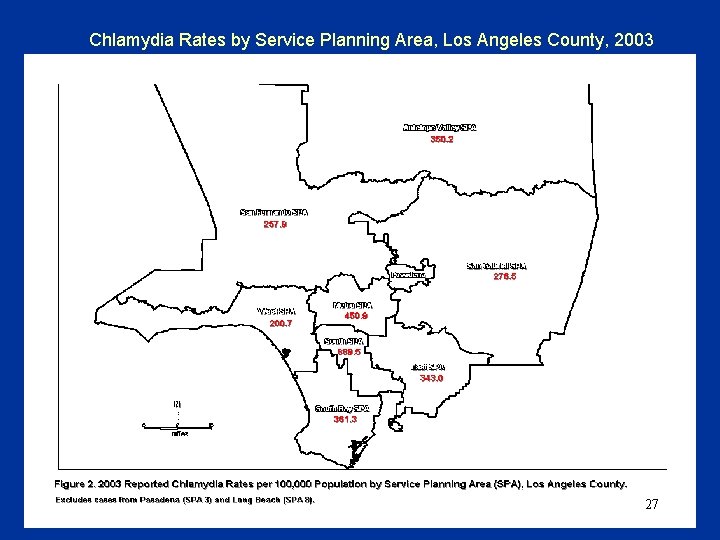
Chlamydia Rates by Service Planning Area, Los Angeles County, 2003 27
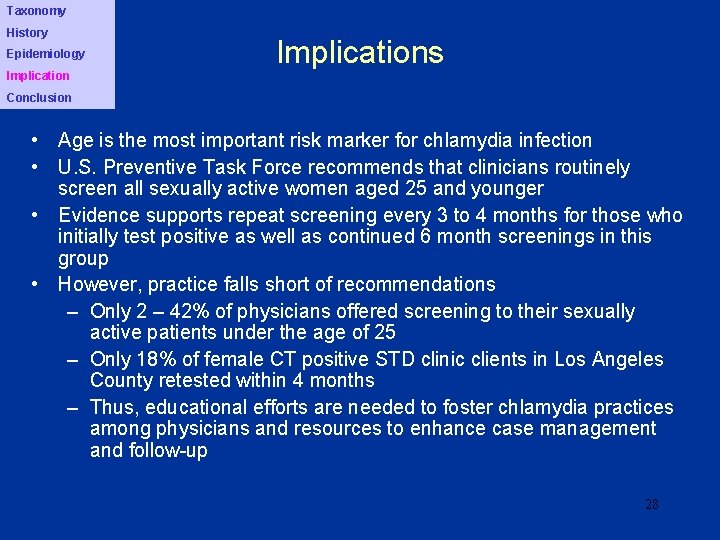
Taxonomy History Epidemiology Implications Conclusion • Age is the most important risk marker for chlamydia infection • U. S. Preventive Task Force recommends that clinicians routinely screen all sexually active women aged 25 and younger • Evidence supports repeat screening every 3 to 4 months for those who initially test positive as well as continued 6 month screenings in this group • However, practice falls short of recommendations – Only 2 – 42% of physicians offered screening to their sexually active patients under the age of 25 – Only 18% of female CT positive STD clinic clients in Los Angeles County retested within 4 months – Thus, educational efforts are needed to foster chlamydia practices among physicians and resources to enhance case management and follow-up 28
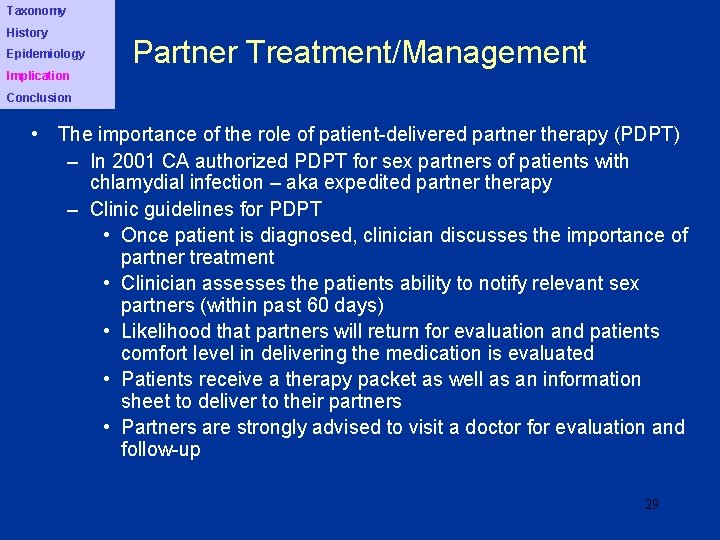
Taxonomy History Epidemiology Implication Partner Treatment/Management Conclusion • The importance of the role of patient-delivered partner therapy (PDPT) – In 2001 CA authorized PDPT for sex partners of patients with chlamydial infection – aka expedited partner therapy – Clinic guidelines for PDPT • Once patient is diagnosed, clinician discusses the importance of partner treatment • Clinician assesses the patients ability to notify relevant sex partners (within past 60 days) • Likelihood that partners will return for evaluation and patients comfort level in delivering the medication is evaluated • Patients receive a therapy packet as well as an information sheet to deliver to their partners • Partners are strongly advised to visit a doctor for evaluation and follow-up 29
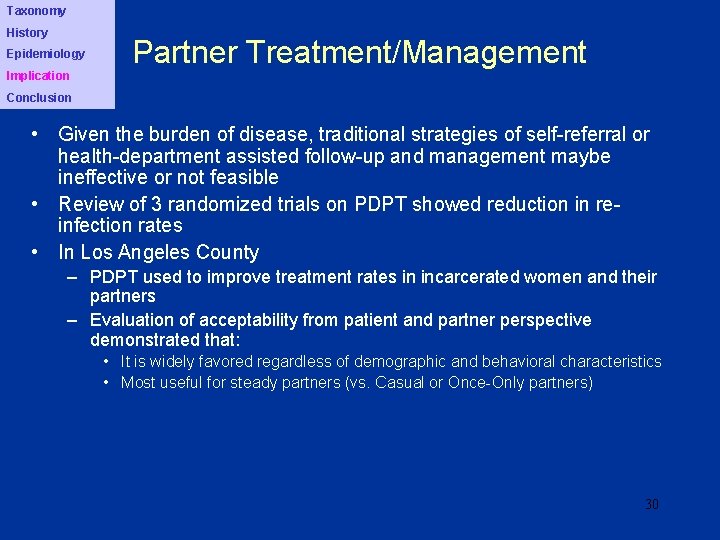
Taxonomy History Epidemiology Implication Partner Treatment/Management Conclusion • Given the burden of disease, traditional strategies of self-referral or health-department assisted follow-up and management maybe ineffective or not feasible • Review of 3 randomized trials on PDPT showed reduction in reinfection rates • In Los Angeles County – PDPT used to improve treatment rates in incarcerated women and their partners – Evaluation of acceptability from patient and partner perspective demonstrated that: • It is widely favored regardless of demographic and behavioral characteristics • Most useful for steady partners (vs. Casual or Once-Only partners) 30
Taxonomy History Epidemiology Implication Conclusion • Most common bacterial STD • Chlamydia rates have been increasing since the late 80 s • Increase rates are due (in part) to: – increased screening and use of more sensitive screening tests • Gender disparities probably reflect increased screening among women – However, the availability of urine based tests have resulted in more men being tested for chlamydia • Can be easily treated and cured with antibiotics • All sexual partners should be evaluated, tested, and treated to avoid reinfection 31
References • Gaydos CA, Howell MR, Pare B, et al. Chlamydia Trachomatis Infection in female military recruits. N Engl J Med 1998; 339: 739 -744 • Mertz KJ, Mc. Quillian GM, Levine WC, et al. A pilot study of the prevalence of chlamydial infection in a national household survey. Sex Transm Dis 1998; 25: 225 -228 • Klausner JD, Mc. Farland W, Bolan G, et al. Knock-knock: a population based survey of risk behavior, health care access, and Chlamydia trachomatis infection among low-income women in the San Francisco bay area. J Infect Dis 2001; 183: 1087 -1092 • Xu F, Schillinger JA, Markowitz LE, et al. Repeat Chlamydia trachomatis infection in women: analysis through a surveillance registry in Washington State, 1993 – 1998. Am J Epidemiol 2000; 152: 1164 – 1170 • Whittington WLH, Kent C, Kissinger P, et al. Determinants of persistent and recurrent Chlamydia trachomatis infection in young women: results of a multicententer cohort study. Sex Transm Dis 2001; 28: 117 – 123 • Burstein GR, Gaydos CA, Diener-West M, Howell MR, Zenilman JM, Quinn TC. Incident Chlamydia trachomatis infections among inner-city adolescent females. JAMA 1998; 280: 521 -596 • Mangione-Smith R, Mc. Glynn EA, Hiatt L. Screening for chlamydia in adolescents and young women. Arch Pediatr Adolesc Med. 2000; 154: 1108 -1113 32
- Slides: 32