
Epidemiology Kept Simple Chapter 10 Experimental Studies c
- Slides: 15
Epidemiology Kept Simple Chapter 10 Experimental Studies (c) B. Gerstman 2007 Chapter 10 1
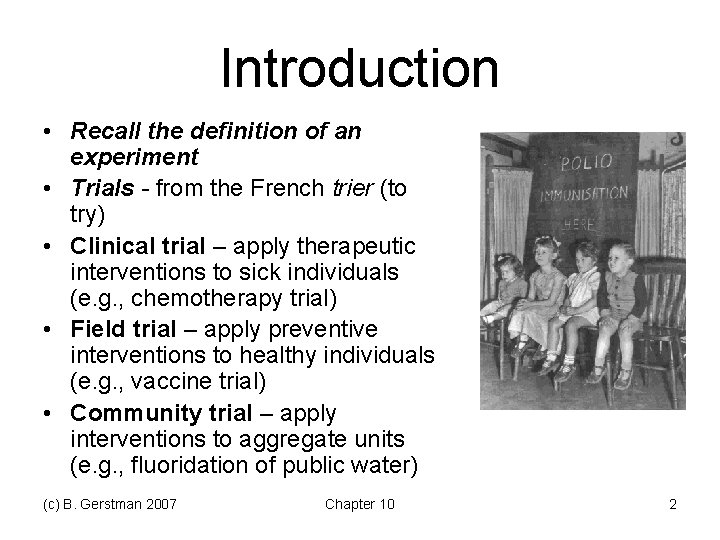
Introduction • Recall the definition of an experiment • Trials - from the French trier (to try) • Clinical trial – apply therapeutic interventions to sick individuals (e. g. , chemotherapy trial) • Field trial – apply preventive interventions to healthy individuals (e. g. , vaccine trial) • Community trial – apply interventions to aggregate units (e. g. , fluoridation of public water) (c) B. Gerstman 2007 Chapter 10 2
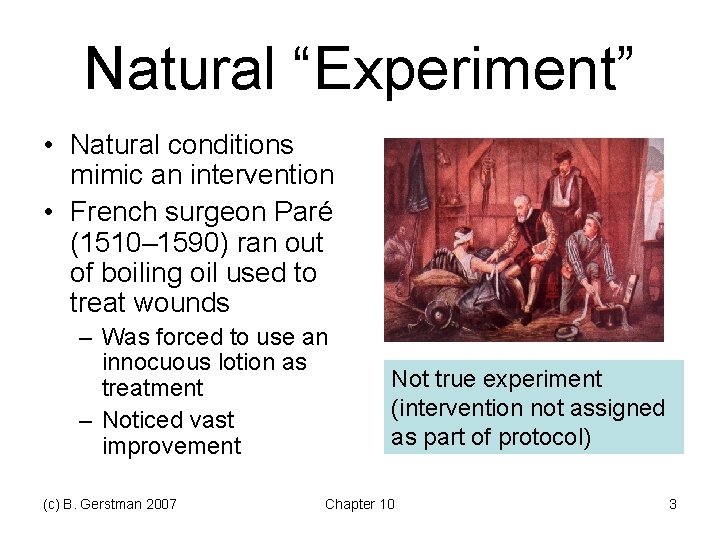
Natural “Experiment” • Natural conditions mimic an intervention • French surgeon Paré (1510– 1590) ran out of boiling oil used to treat wounds – Was forced to use an innocuous lotion as treatment – Noticed vast improvement (c) B. Gerstman 2007 Not true experiment (intervention not assigned as part of protocol) Chapter 10 3
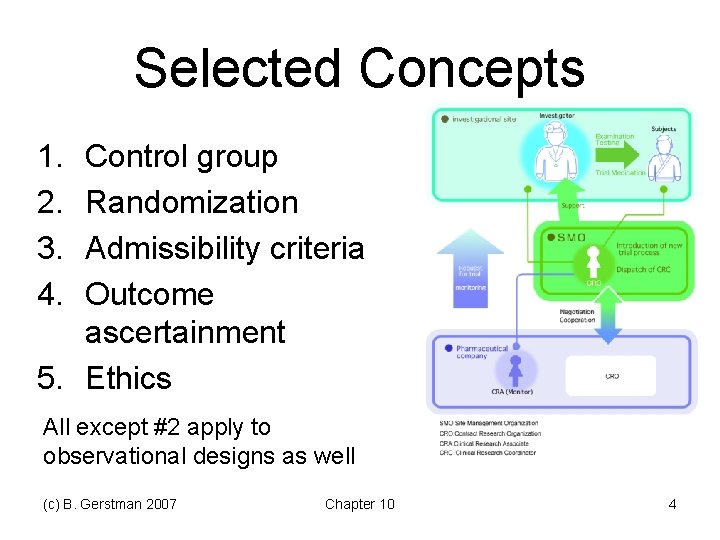
Selected Concepts 1. 2. 3. 4. Control group Randomization Admissibility criteria Outcome ascertainment 5. Ethics All except #2 apply to observational designs as well (c) B. Gerstman 2007 Chapter 10 4
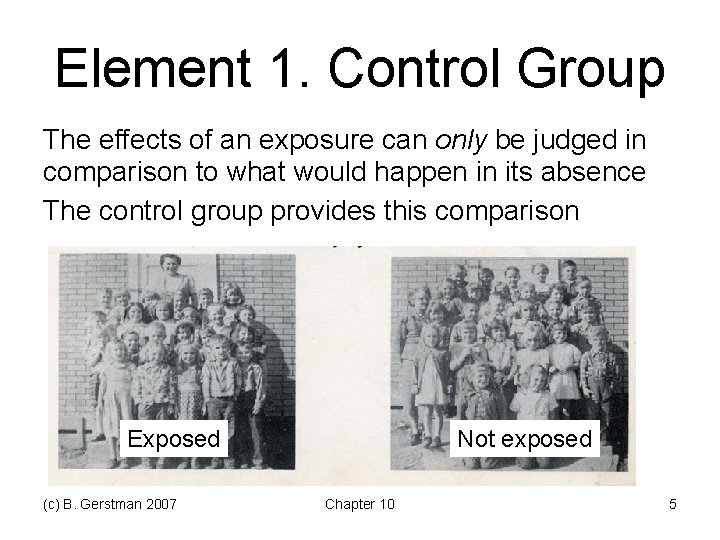
Element 1. Control Group The effects of an exposure can only be judged in comparison to what would happen in its absence The control group provides this comparison Exposed (c) B. Gerstman 2007 Not exposed Chapter 10 5
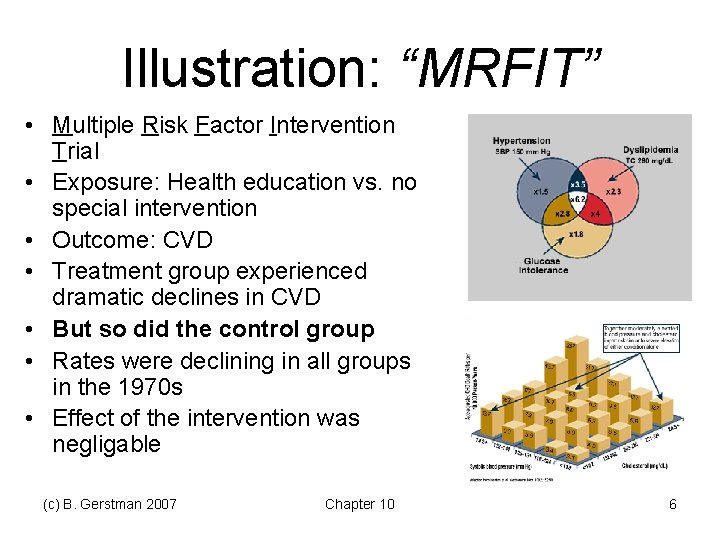
Illustration: “MRFIT” • Multiple Risk Factor Intervention Trial • Exposure: Health education vs. no special intervention • Outcome: CVD • Treatment group experienced dramatic declines in CVD • But so did the control group • Rates were declining in all groups in the 1970 s • Effect of the intervention was negligable (c) B. Gerstman 2007 Chapter 10 6
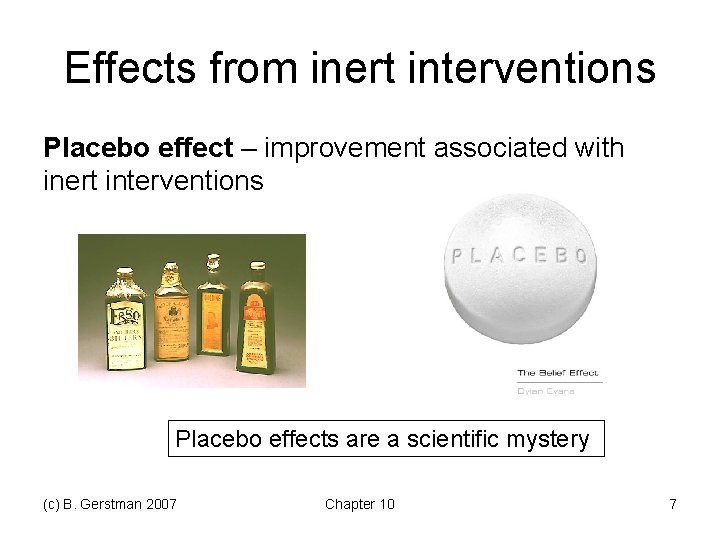
Effects from inert interventions Placebo effect – improvement associated with inert interventions Placebo effects are a scientific mystery (c) B. Gerstman 2007 Chapter 10 7
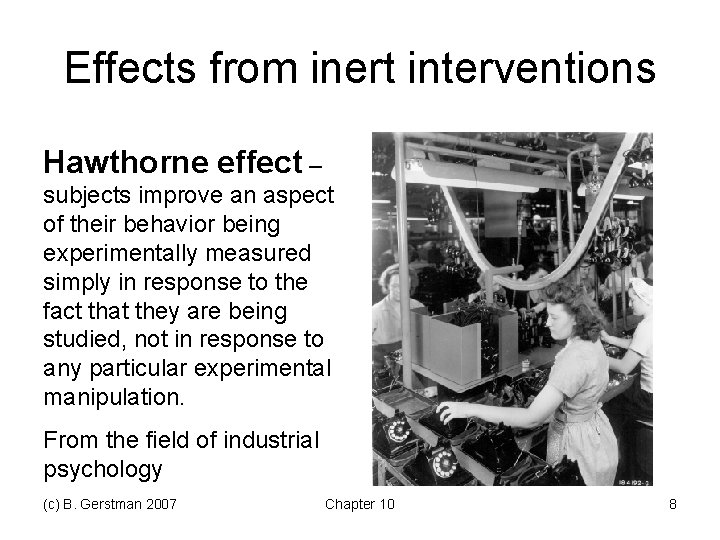
Effects from inert interventions Hawthorne effect – subjects improve an aspect of their behavior being experimentally measured simply in response to the fact that they are being studied, not in response to any particular experimental manipulation. From the field of industrial psychology (c) B. Gerstman 2007 Chapter 10 8
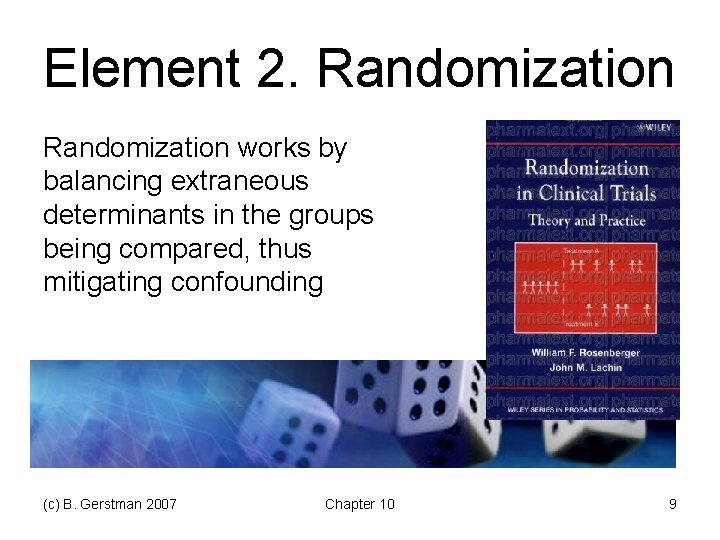
Element 2. Randomization works by balancing extraneous determinants in the groups being compared, thus mitigating confounding (c) B. Gerstman 2007 Chapter 10 9
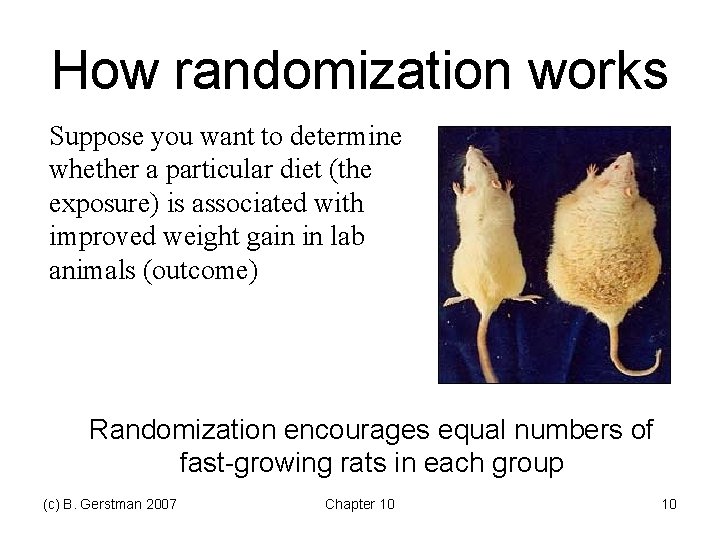
How randomization works Suppose you want to determine whether a particular diet (the exposure) is associated with improved weight gain in lab animals (outcome) Randomization encourages equal numbers of fast-growing rats in each group (c) B. Gerstman 2007 Chapter 10 10
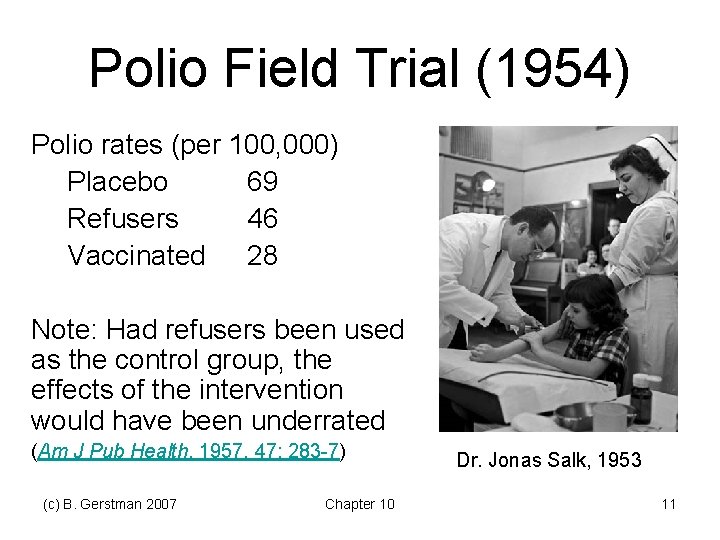
Polio Field Trial (1954) Polio rates (per 100, 000) Placebo 69 Refusers 46 Vaccinated 28 Note: Had refusers been used as the control group, the effects of the intervention would have been underrated (Am J Pub Health, 1957, 47: 283 -7) (c) B. Gerstman 2007 Chapter 10 Dr. Jonas Salk, 1953 11
3. Admissibility Criteria • Restrict participants to those with uniform characteristics • This too mitigates confounding • Example: Excluding smokers from a study base would prevent confounding from smoking (c) B. Gerstman 2007 Chapter 10 12
4. Outcome Ascertainment • Outcome ascertainments must be valid • Without valid outcome ascertainment, we have GIGO (garbage in, garbage out) • We will study the importance of valid information in Ch 12 (c) B. Gerstman 2007 Chapter 10 13
5. Ethics • The Belmont Report – Respect for individuals – Beneficence – Justice • Other considerations – IRB oversight – Informed consent (c) B. Gerstman 2007 Chapter 10 14
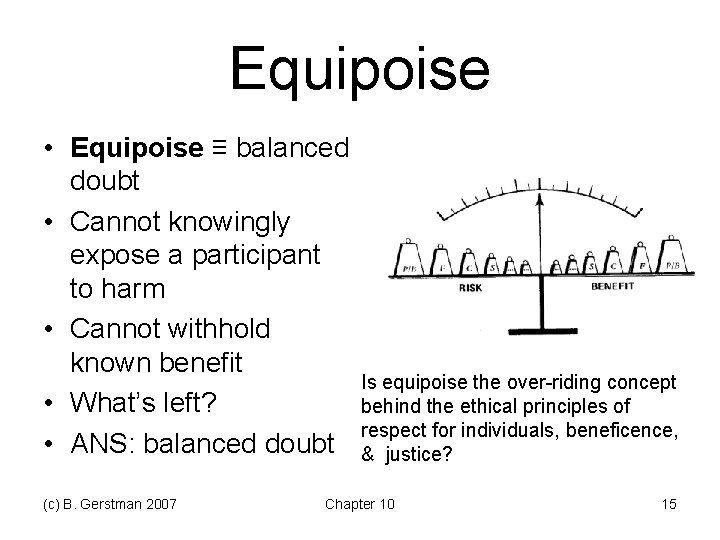
Equipoise • Equipoise ≡ balanced doubt • Cannot knowingly expose a participant to harm • Cannot withhold known benefit • What’s left? • ANS: balanced doubt (c) B. Gerstman 2007 Is equipoise the over-riding concept behind the ethical principles of respect for individuals, beneficence, & justice? Chapter 10 15