
Epidemiological Classification of Disease Definition and classification of


- Slides: 29
Epidemiological Classification of Disease
Definition and classification of disease • Although the public health profession is sometimes inclined to refer to the health care system as a "disease care system", others have observed that public health also tends to be preoccupied with disease. • One problem with these charges is that both "health" and "disease" are elusive concepts
Defining health and disease • Rene Dubos mid -20 th century for defining "disease as any departure from the state of health and health as a state of normalcy free from disease or pain".
Defining health and disease • As for the idealistic vision of health embodied in the WHO Constitution, Dubos wrote: ". . . positive health. . . is only a mirage, because man in the real world must face the physical, biological, and social forces of his environment, which are forever changing, usually in an unpredictable manner, and frequently with dangerous consequences for him as a person and for the human species in general. ”
• Dorland's Illustrated Medical Dictionary (28 th ed. , Phila, Saunders, 1994): • Disease – "any deviation from or interruption of the normal structure or function of any part, organ, or system (or combination thereof) of the body that is manifested by a characteristic set of symptoms and signs. . . ". • Health – "a state of optimal physical, mental, and social well-being, and not merely the absence of disease and infirmity. "
• Stedman's Medical Dictionary (26 th ed. , Baltimore, Williams & Wilkins, 1995): • Disease – 1. An interruption, cessation, or disorder of body functions, systems, or organs; 2. A morbid entity characterized usually by at least two of these criteria: recognized etiologic agent(s), identifiable group of signs and symptoms, or consistent anatomical alterations. 3. Literally dis-ease, the opposite of ease, when something is wrong with a bodily function. ”
• Stedman's Medical Dictionary (26 th ed. , Baltimore, Williams & Wilkins, 1995): • Health 1. The state of the organism when it functions optimally without evidence of disease or abnormality. 2. A state of dynamic balance in which an individual's or a group's capacity to cope with all the circumstances of living is at an optimum level. 3. A state characterized by anatomical, physiological, and psychological integrity; ability to perform personally valued family, work, and community roles; ability to deal with physical, biological, and psychological and social stress; a feeling of well-being; freedom from the risk of disease and untimely death. "
What is classification • Classification is a method of grouping of items scientifically according to purpose and codifying them with numerical (or alphanumerical) identification according to certain principles.
Definition • “A classification of diseases can be defined as a system of categories to which morbid entities are assigned according to established criteria. • The purpose of the ICD is to permit the systematic recording, analysis, interpretation and comparison of mortality and morbidity data collected in different countries or areas and at different times. • The ICD is used to translate diagnoses of diseases and other health problems from words into an alphanumeric code, which permits easy storage, retrieval and analysis of the data”.
Classification is the foundation • As stated in an early (1957) edition of the Manual of the International Statistical Classification of Diseases, Injuries, and Causes of Death (ICD): "Classification is fundamental to the quantitative study of any phenomenon. It is recognized as the basis of all scientific generalization and is therefore an essential element in statistical methodology. Uniform definitions and uniform systems of classification are prerequisites in the advancement of scientific knowledge. In the study of illness and death, therefore, a standard classification of disease and injury for statistical purposes is essential. ”
• In classifying disease conditions, choices and compromises must be made among classifications based on etiology, anatomical site, age, and circumstance of onset, as well as on the quality of information available on medical reports.
Classification criteria and disease definition • Since no two entities are completely identical, we (often unconsciously) group them together or differentiate between them according to what we believe to be important for our purposes. • Even conditions with different etiologies may nevertheless have the same prognosis or the same response to treatment. • Decisions about how far to subdivide categories of what appears to be a single entity depend, therefore, on the difference it may make, the level of knowledge, and our conceptual model.
Classification criteria and disease definition • There are two broad approaches to defining a disease entity. These two approaches are • manifestational criteria and • causal criteria
Manifestional criteria • Manifestational criteria refer to symptoms, signs, behavior, laboratory findings, onset, course, prognosis, response to treatment, and other manifestations of the condition. Defining a disease in terms of manifestational criteria relies on the proposition that diseases have a characteristic set of manifestations.
Manifestional criteria • The term "syndrome“ is often applied to a group of symptoms or other manifestations that apparently represent a disease or condition whose etiology is as yet unknown. • Most chronic and psychiatric diseases are defined by manifestational criteria (examples: diabetes mellitus, schizophrenia, cancers, coronary heart disease).
Causal criteria • Causal criteria refer to the etiology of the condition, which, of course, must have been identified in order to employ them. Causal criteria are most readily available when the condition is simply defined as the consequences of a given agent or process. • The other group of conditions where causal criteria are available consists mostly of infectious diseases for which the pathogen is known, e. g. TB. • Through the use of causal criteria, diverse manifestations recognized as arising from the same etiologic agent (e. g. , the various presentations of infection with Treponema pallidum [syphilis]. Similarly, conditions that have a similar presentation (e. g. , gonorrhea, Chlamydia) can be differentiated.
Disease classification • Many scientific approaches were adapted in classifying diseases such as • Part of body affected • The etiological agent • The kind of morbid change produced by disease and • The kind of disturbance of functions produced by disease or injury
International classification of disease • All above criteria formed the basis of the international classification of diseases (ICD) produced by WHO and accepted for national and international use. ICD has been revised regularly from time to time, the latest revision 10 th revision, commonly known as ICD-10.
International Classification of Diseases (ICD) • ICD-10 was endorsed by the Forty-third World Health Assembly in May 1990 and came into use in WHO Member States as from 1994. • The first edition, known as the International List of Causes of Death, was adopted by the International Statistical Institute in 1893. • WHO took over the responsibility for the ICD at its creation in 1948 when the Sixth Revision, which included causes of morbidity for the first time, was published. • The World Health Assembly adopted in 1967 the WHO Nomenclature Regulations that stipulate use of ICD in its most current revision for mortality and morbidity statistics by all Member States.
International Classification of Diseases (ICD) • The ICD is the international standard diagnostic classification for all general epidemiological, many health management purposes and clinical use. • These include the analysis of the general health situation of population groups and monitoring of the incidence and prevalence of diseases and other health problems in relation to other variables such as the characteristics and circumstances of the individuals affected, reimbursement, resource allocation, quality and guidelines.
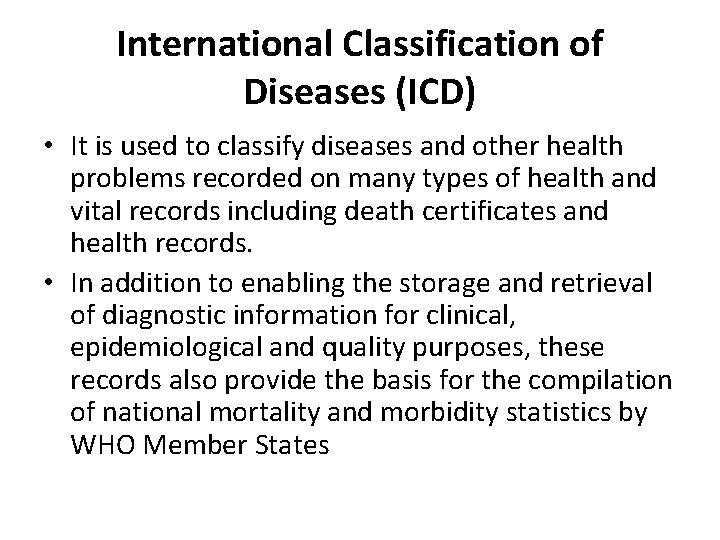
International Classification of Diseases (ICD) • It is used to classify diseases and other health problems recorded on many types of health and vital records including death certificates and health records. • In addition to enabling the storage and retrieval of diagnostic information for clinical, epidemiological and quality purposes, these records also provide the basis for the compilation of national mortality and morbidity statistics by WHO Member States
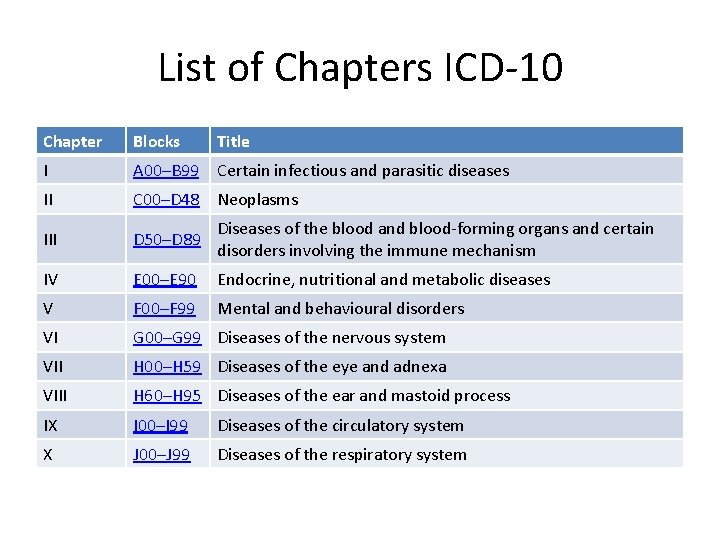
List of Chapters ICD-10 Chapter Blocks Title I A 00–B 99 Certain infectious and parasitic diseases II C 00–D 48 Neoplasms III D 50–D 89 Diseases of the blood and blood-forming organs and certain disorders involving the immune mechanism IV E 00–E 90 Endocrine, nutritional and metabolic diseases V F 00–F 99 Mental and behavioural disorders VI G 00–G 99 Diseases of the nervous system VII H 00–H 59 Diseases of the eye and adnexa VIII H 60–H 95 Diseases of the ear and mastoid process IX I 00–I 99 Diseases of the circulatory system X J 00–J 99 Diseases of the respiratory system
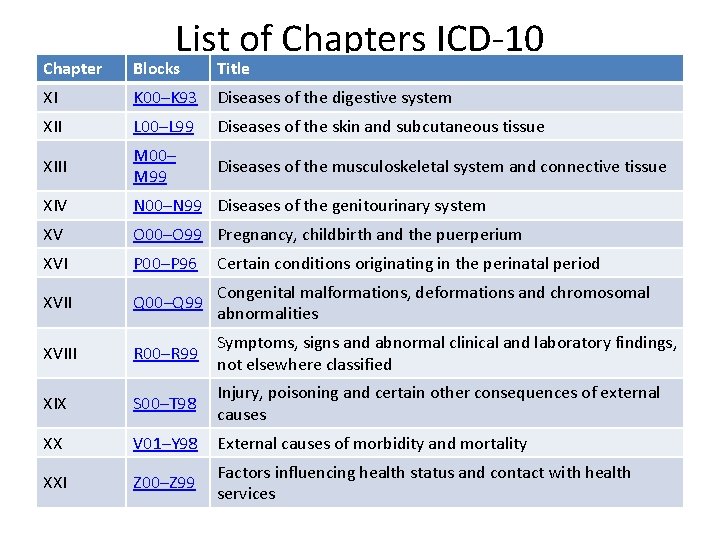
List of Chapters ICD-10 Chapter Blocks Title XI K 00–K 93 Diseases of the digestive system XII L 00–L 99 Diseases of the skin and subcutaneous tissue XIII M 00– M 99 Diseases of the musculoskeletal system and connective tissue XIV N 00–N 99 Diseases of the genitourinary system XV O 00–O 99 Pregnancy, childbirth and the puerperium XVI P 00–P 96 Certain conditions originating in the perinatal period XVII Q 00–Q 99 Congenital malformations, deformations and chromosomal abnormalities XVIII R 00–R 99 Symptoms, signs and abnormal clinical and laboratory findings, not elsewhere classified XIX S 00–T 98 Injury, poisoning and certain other consequences of external causes XX V 01–Y 98 External causes of morbidity and mortality XXI Z 00–Z 99 Factors influencing health status and contact with health services
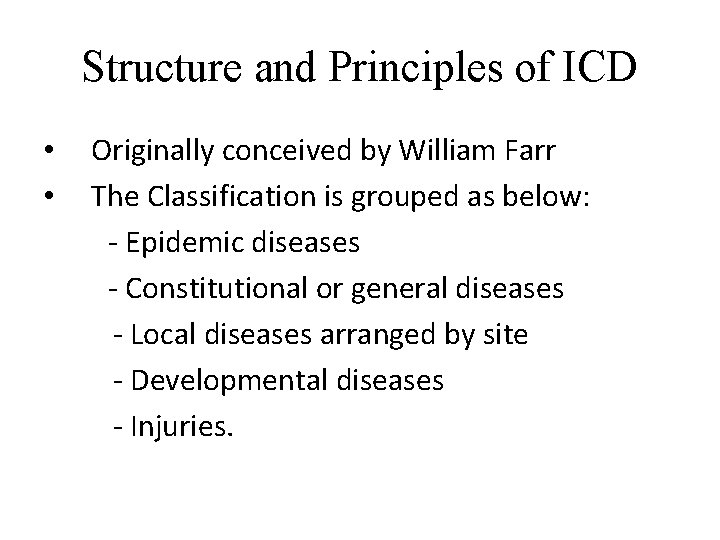
Structure and Principles of ICD • • Originally conceived by William Farr The Classification is grouped as below: - Epidemic diseases - Constitutional or general diseases - Local diseases arranged by site - Developmental diseases - Injuries.
A N N . N. U being left vacant for future additions Some three-character categories have been left vacant for future expansion / Revision w Fill fourth position with X , when sub-division is not there, so that the codes are of a standard length for data-processing. • •
• The “core” classification of ICD-10 is the three -character code, which is the mandatory level of coding for international reporting to the WHO mortality database and for general international comparisons. The four-character subcategories, while not mandatory for reporting at the international level, are recommended for many purposes and form an integral part of the ICD, as do the special tabulation lists.
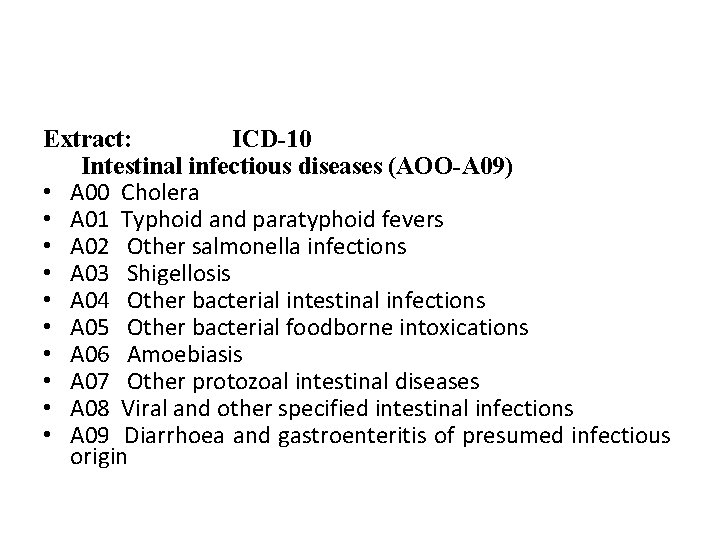
Extract: ICD-10 Intestinal infectious diseases (AOO-A 09) • A 00 Cholera • A 01 Typhoid and paratyphoid fevers • A 02 Other salmonella infections • A 03 Shigellosis • A 04 Other bacterial intestinal infections • A 05 Other bacterial foodborne intoxications • A 06 Amoebiasis • A 07 Other protozoal intestinal diseases • A 08 Viral and other specified intestinal infections • A 09 Diarrhoea and gastroenteritis of presumed infectious origin
Problem encountered Size of the Classification No formal training No user-friendly software to guide No abridged Classification of Diseases based on Indian condition & requirement • No Online Help-line system • •
• Thank You