
Epidemiologic Triads Dr Salwa A Tayel Dr Ibrahim
Epidemiologic Triads Dr. Salwa A. Tayel & Dr. Ibrahim Gossady KSU Department of Family & Community Medicine August, 2015 August 31, 2015 Epidemiological Triads 1
OBJECTIVES OF THE LECTURE By the end of this lecture students will be able to: • Explain epidemiologic triads as a model of study of disease causation • Describe importance of studying epidemiologic triads and its implications for public health. August 31, 2015 Epidemiological Triads 2
Headlines • • Descriptive epidemiological triad Analytical epidemiological triad Purpose of studying epidemiologic triads Public health implications August 31, 2015 Epidemiological Triads 3
Purpose of studying causal models • Studying how different factors can lead to ill health is important to generate knowledge to help prevent and control diseases. • The classic epidemiological triangles or triads help understanding the relation between a disease and the agent causing the disease August 31, 2015 Epidemiological Triads 4
Epidemiological Triads Descriptive Epidemiology Triad: • Person • Place • Time August 31, 2015 Analytical Epidemiology Triad: • Agent • Host • Environment Epidemiological Triads 5
Descriptive Epidemiology Descriptive epidemiology is a necessary antecedent of analytic epidemiology To undertake an analytic epidemiologic study you must first: • Know where to look • Know what to control for • Be able to formulate hypotheses compatible with laboratory evidence August 31, 2015 Epidemiological Triads 6
Person • • • Age Gender Marital status Ethnicity/Race Behavior / life-style factors Socio-economic status – Education – Occupation – Income August 31, 2015 Epidemiological Triads 7
Place • Geographically restricted or widespread (pandemic)? • Relation to water or food supply (clusters: multiple / one) • Residence (rural, urban, sub-urban) • Weather (temperature, humidity) • Natural / political August 31, 2015 Epidemiological Triads 8
Time • Changing or stable? • Seasonal variation. • Clustered (epidemic) or evenly distributed (endemic)? • Point source or propagated. August 31, 2015 Epidemiological Triads 9
Time Trends • Point source e. g. food-borne outbreaks), in terms of hours / days • Seasonal - cyclicity (e. g. common cold, influenza), in terms of months • Propogative (e. g. water borne epidemics), in terms of weeks / months • Secular (e. g. morbidity / mortality of noncommunicable diseases), in terms of years • Cluster in time / place August 31, 2015 Epidemiological Triads 10
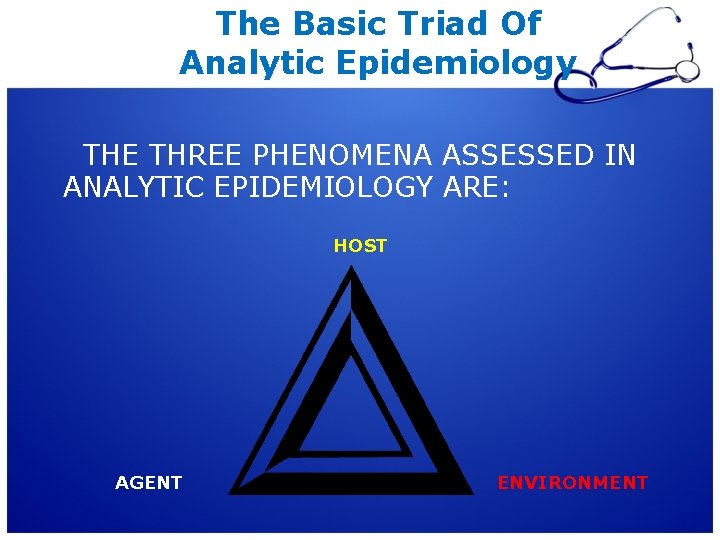
The Basic Triad Of Analytic Epidemiology THE THREE PHENOMENA ASSESSED IN ANALYTIC EPIDEMIOLOGY ARE: HOST AGENT ENVIRONMENT
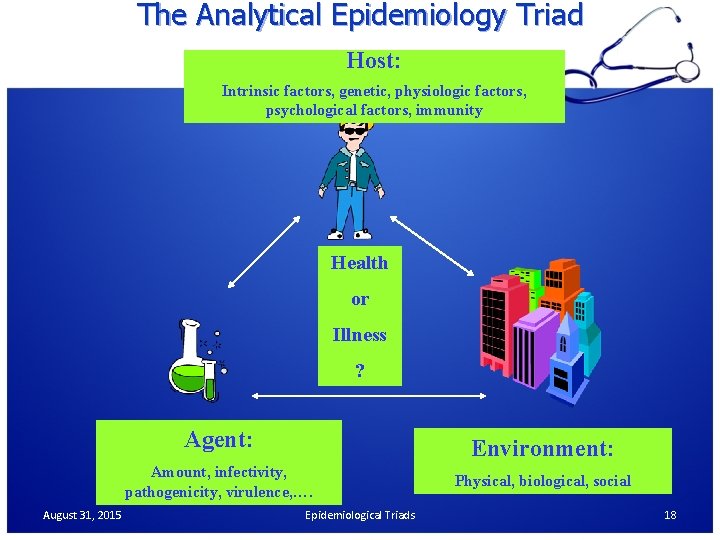
The Analytical Epidemiologic Triad This model comprises a susceptible host (the person at risk for the disease), a disease agent (the proximate cause), and an environmental context for the interaction between host and agent. Thus, development of disease is a combination of events: • A harmful agent • A susceptible host • An appropriate environment August 31, 2015 Epidemiological Triads 12
Agents • Biological (micro-organisms) • Physical (temperature, radiation, trauma, others) • Chemical (acids, alkalis, poisons, tobacco, medications / drugs, others) • Environmental (nutrients in diet, allergens, others) • Nutritional (under- or over-nutrition) • Psychological experiences August 31, 2015 Epidemiological Triads 13
Host Factors • Host factors are intrinsic factors that influence an individual’s exposure, susceptibility, or response to a causative agent. These include: • Genetic endowment • Immunologic state • Personal behavior (life-style factors): diet, tobacco use, exercise, etc • Personal characteristics (described before, under “person”), including: age, gender, socio-economic status, etc. August 31, 2015 Epidemiological Triads 14
Environmental factors are extrinsic factors which affect the agent and the opportunity for exposure. These include: – Physical factors: e. g. geology, climate (temperature, humidity, rain, etc) – Biological factors: e. g. insects that transmit an agent – Socioeconomic factors: e. g. crowding, sanitation, and the availability of health services Phenomena which bring the host and agent together: vector, vehicle, reservoir, etc August 31, 2015 Epidemiological Triads 15
Summary of Analytical Triad • Agent factors include infectious microorganisms, e. g. virus, bacterium, parasite, or other agents. • They may be necessary but not always sufficient alone to cause disease. • Host factors are intrinsic factors that influence an individual’s exposure, susceptibility, or response to a causative agent • Environmental factors are extrinsic factors which affect the agent and the opportunity for exposure. August 31, 2015 Epidemiological Triads 16 16
Example The number of people who become diseased with tuberculosis will depend on: • characteristics of the agent, • environmental factors, • And host factors Explain some of these factors August 31, 2015 Epidemiological Triads 17
The Analytical Epidemiology Triad Host: Intrinsic factors, genetic, physiologic factors, psychological factors, immunity Health or Illness ? Agent: Environment: Amount, infectivity, pathogenicity, virulence, …. August 31, 2015 Epidemiological Triads Physical, biological, social 18
Reference books • Principles of Epidemiology in Public Health Practice. Third Edition. An Introduction to Applied Epidemiology and Biostatistics. Centers for Disease Control and Prevention (CDC) • Gordis L. Epidemiology. 2009 August 31, 2015 Epidemiological Triads 19
- Slides: 19