
Epidemic spreading in complex networks from populations to



- Slides: 27
Epidemic spreading in complex networks: from populations to the Internet Maziar Nekovee, BT Research Y. Moreno, A. Paceco (U. Zaragoza) A. Vespignani (LPT- Paris)
Outline of the talk • Complex networks • Epidemic protocols for information dissemination on the internet and parallels with disease spreading. • Monte Carlo simulations of epidemic protocols. • Analytical model and calculations. • Work in progress (epidemic spreading in mobile ad hoc networks) & conclusions
Complex networks: large scale networks with internal structure between random graphs (mathematicians) and regular lattices (physicist). • The Internet, WWW, peer-to-peer networks (napster), email networks. • Food webs (who eats who), sexual contacts, protein networks. • Friendship networks, citation networks.
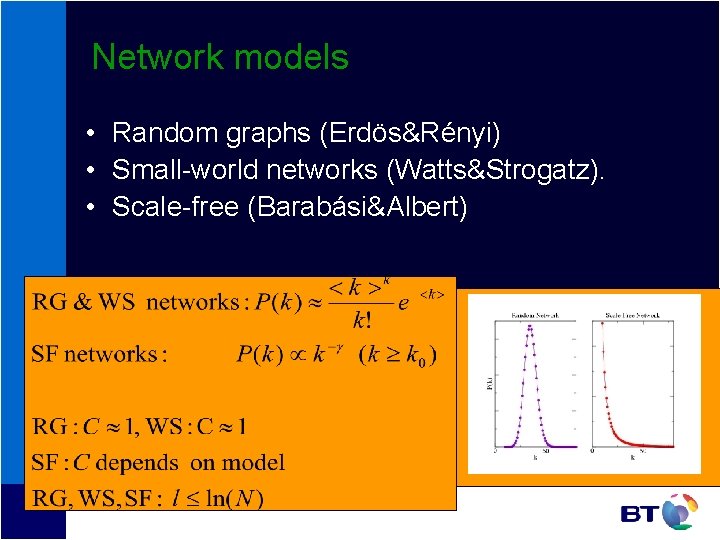
Current research on complex networks • Characterisation: average connectivity, degree distribution, clustering, diameter, network motifs, degree correlations • Network models: random graphs, small world networks, scale-free networks …. • Dynamic processes on complex networks: spreading phenomena: epidemics, rumours, computer viruses, information dissemination.
Network models • Random graphs (Erdös&Rényi) • Small-world networks (Watts&Strogatz). • Scale-free (Barabási&Albert)
one-to-many information dissemination in computer networks • Server-based: updates are forwarded from the source to one or more servers which then forward them to all nodes (scalability, central point of failure) • Overlay multicast: updates are forwarded along a (minimum) spanning tree rooted at source (too complex for highly dynamic networks, robustness and reliability issues) • Epidemic information dissemination: updates spread from the source through local interactions, like a benign epidemic (or rumour) spreading in a population.
Epidemic information dissemination • New updates spread from the source through a probabilistic message passing process in which nodes who have received the update randomly forward it to a group of other nodes. • Highly robust against link and node failures (due to built-in redundancy), simple and decentralised and fast. • However, they require careful tuning in order to achieve high reliability, and minimize load on the network.
Ingredients of epidemic protocols • Logical connection topology (who knows whom) Each node maintains a list of other nodes to which it gossips messages. How should these lists be organized connection topology: fully connected network (central server), random graph (partial views in SCAMP), ……. • Message forwarding policy: Upon receiving a message nodes make a decision whether to forward a message or not, based on some criteria: counter-based, timer, rumour model.
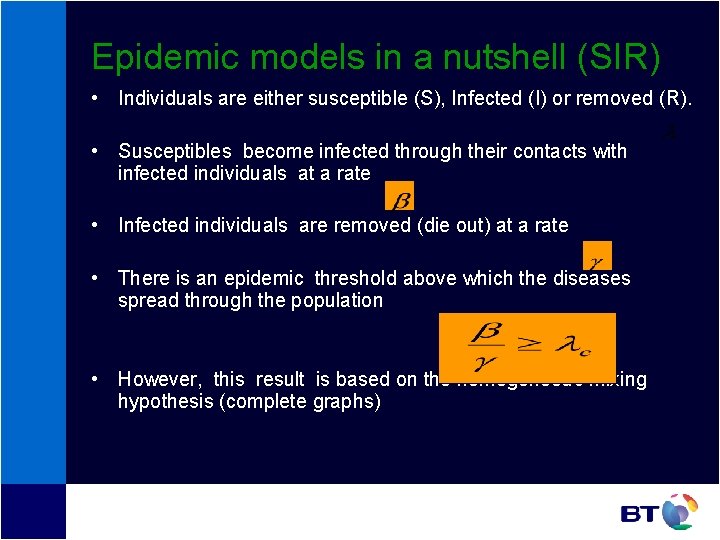
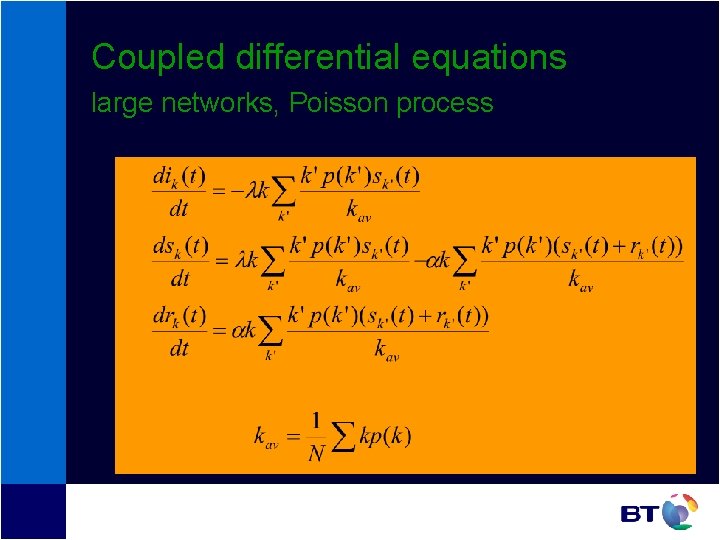
Epidemic models in a nutshell (SIR) • Individuals are either susceptible (S), Infected (I) or removed (R). • Susceptibles become infected through their contacts with infected individuals at a rate • Infected individuals are removed (die out) at a rate • There is an epidemic threshold above which the diseases spread through the population • However, this result is based on the homogeneous mixing hypothesis (complete graphs)
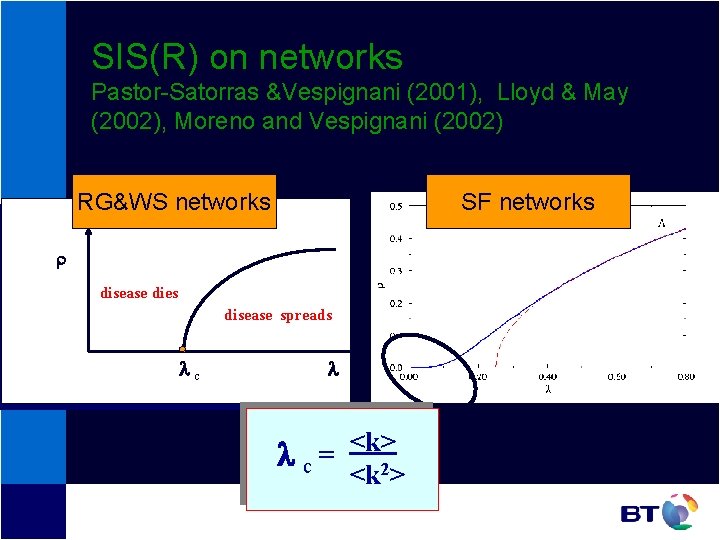
SIS(R) on networks Pastor-Satorras &Vespignani (2001), Lloyd & May (2002), Moreno and Vespignani (2002) RG&WS networks SF networks r disease dies disease spreads lc l <k> = lc <k 2>
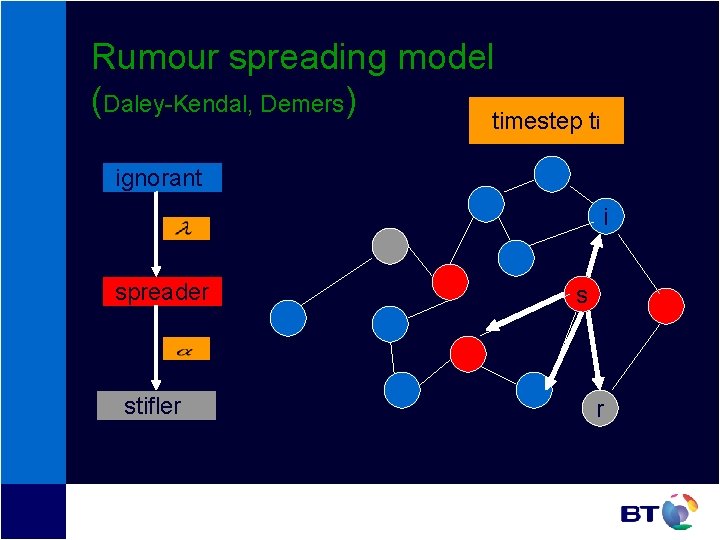
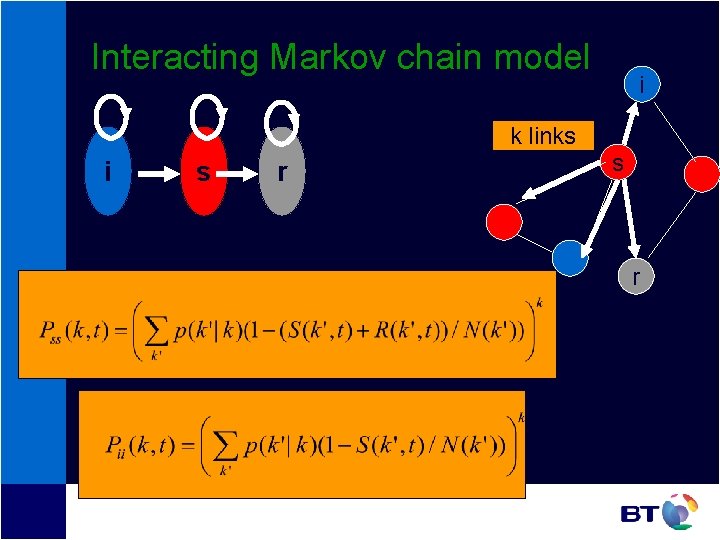
Rumour spreading model (Daley-Kendal, Demers) timestep ti ignorant i spreader stifler s r
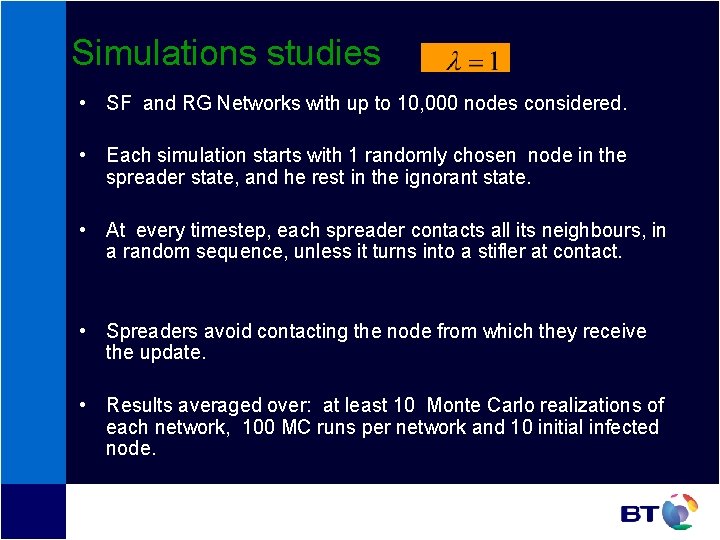
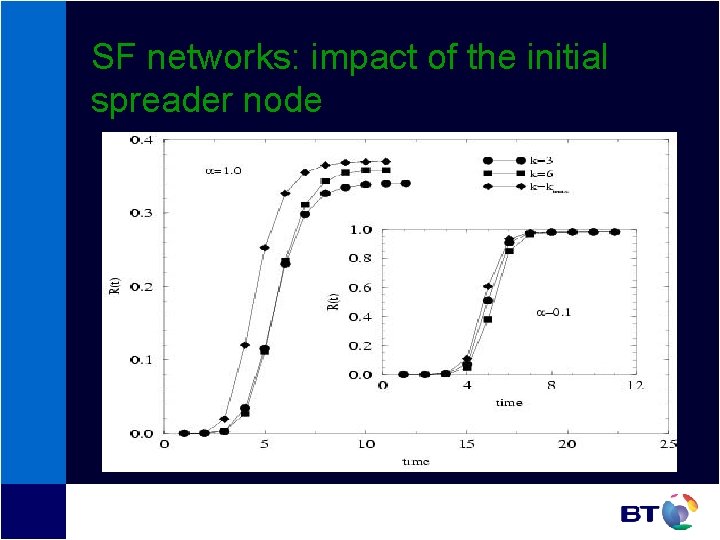
Simulations studies • SF and RG Networks with up to 10, 000 nodes considered. • Each simulation starts with 1 randomly chosen node in the spreader state, and he rest in the ignorant state. • At every timestep, each spreader contacts all its neighbours, in a random sequence, unless it turns into a stifler at contact. • Spreaders avoid contacting the node from which they receive the update. • Results averaged over: at least 10 Monte Carlo realizations of each network, 100 MC runs per network and 10 initial infected node.
Performance metrics • Reliability: fraction of nodes that receive the message upon termination of the protocol, starting from 1 infected node. • Delivery latency: time it takes for a message to reach all nodes. • Load: amount of forwarding traffic that protocol generates in the network.
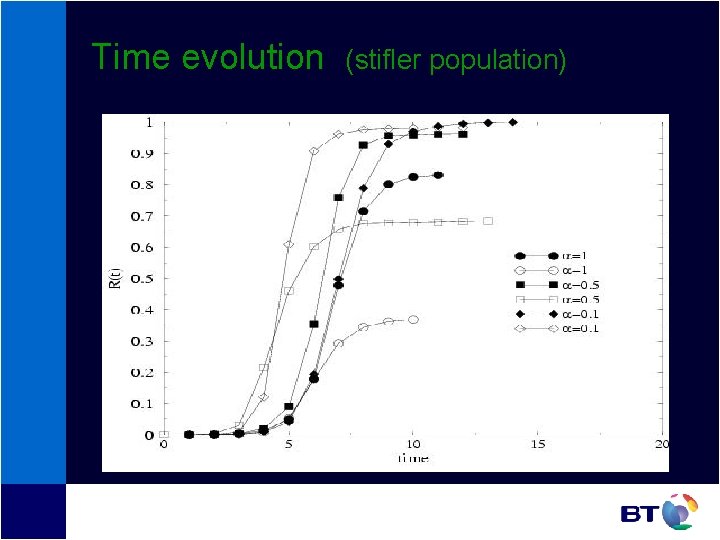
Time evolution (stifler population)
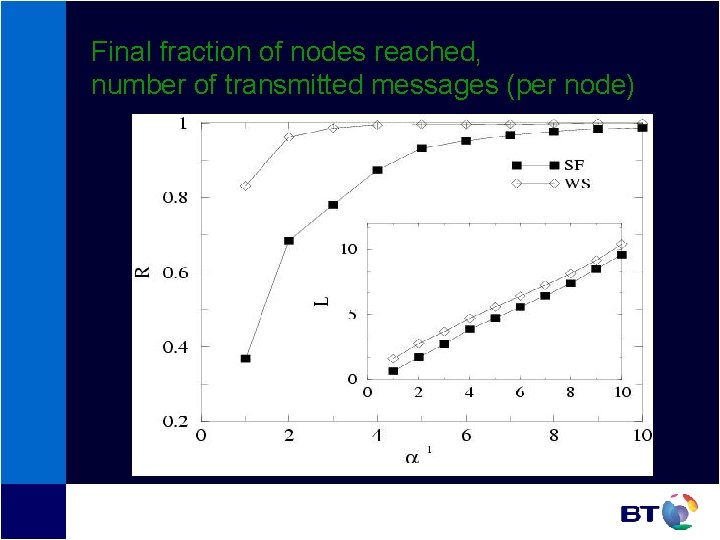
Final fraction of nodes reached, number of transmitted messages (per node)
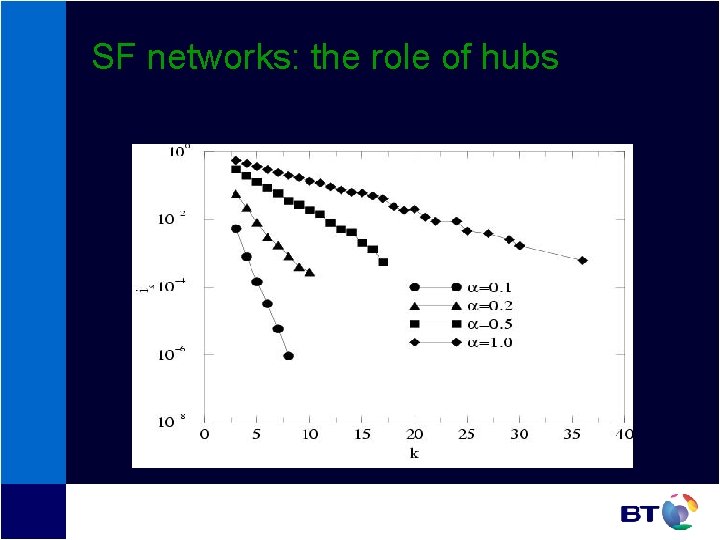
SF networks: the role of hubs
SF networks: impact of the initial spreader node
Interacting Markov chain model i k links i s r
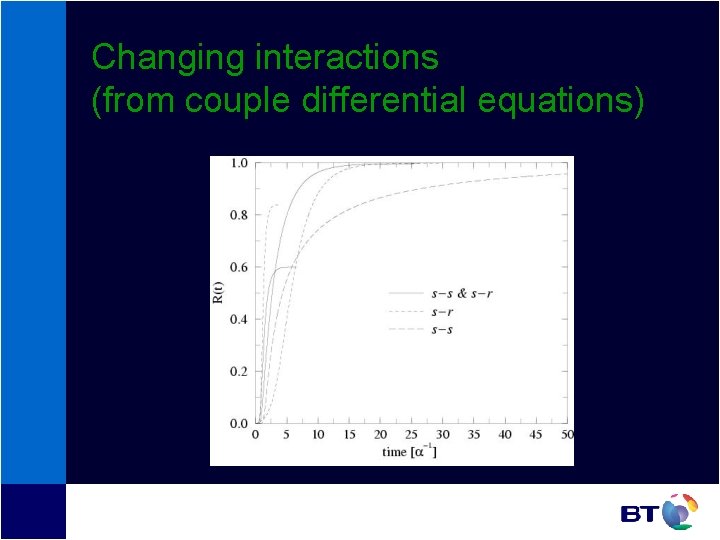
Coupled differential equations large networks, Poisson process
Coupled differential equations Homogeneous case
Time evolution (from coupled differential equations)
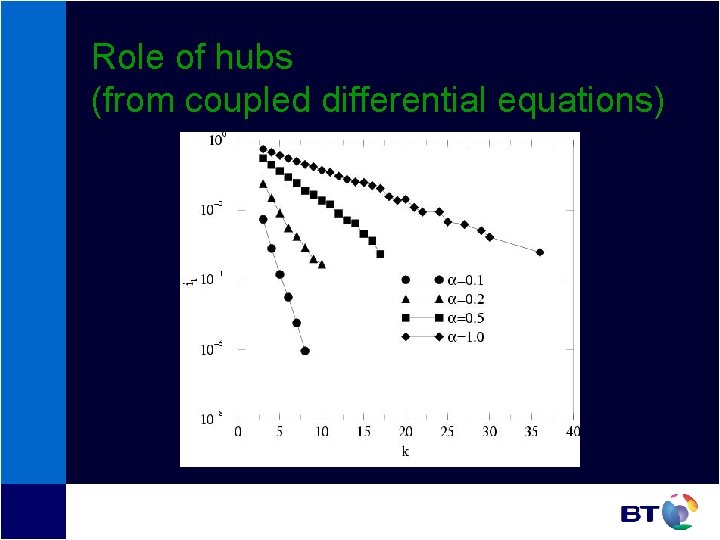
Role of hubs (from coupled differential equations)
Changing interactions (from couple differential equations)
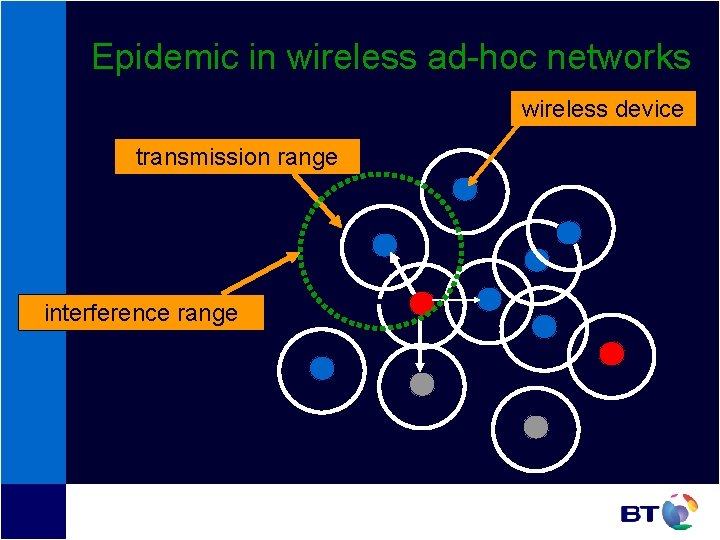
Epidemic in wireless ad-hoc networks wireless device transmission range interference range
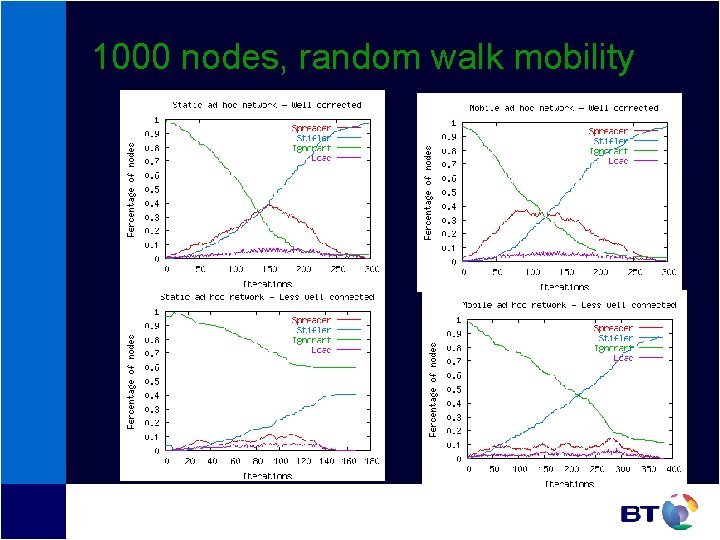
1000 nodes, random walk mobility
Summary and outlook • Simulation studies show that there is a complex interplay between protocol parameters (rules) and the underlying connection topology. • Epidemic protocols are more effective and reliable in random graphs than in scale-free networks (surprise!). This is due to the conflicting roles played by hubs in SF networks. • Analytical model allows further analysis of the performance in complex networks, without the need of MC simulations. • In progress: wireless ad-hoc networks, rumour spreading in social networks on the Internet (e. g. email networks)
References Y. Moreno, M. Nekovee, A. Vespignani, Phys. Rev. E (R), 69, 055101 (2004). M. Nekovee, Y. Moreno, Proceedings of ICCS 2004 (in press) Y. Moreno, M. Nekovee, A. Pacheco, Phys. Rev. E 69, 066130 (2004).