
EPEE Gapometer Achieving the HFC PhaseDown in Europe





- Slides: 25
EPEE Gapometer: Achieving the HFC Phase-Down in Europe October 2017
Who is EPEE? 1. Small – medium – large size companies 2. Over 200, 000 direct employees, over € 30 bn turnover 3. Production throughout Europe 4. Main Activities: 5. • Promote Energy Efficiency • Ensure responsible refrigerant management • Raise awareness on market surveillance Use of all types of refrigerants
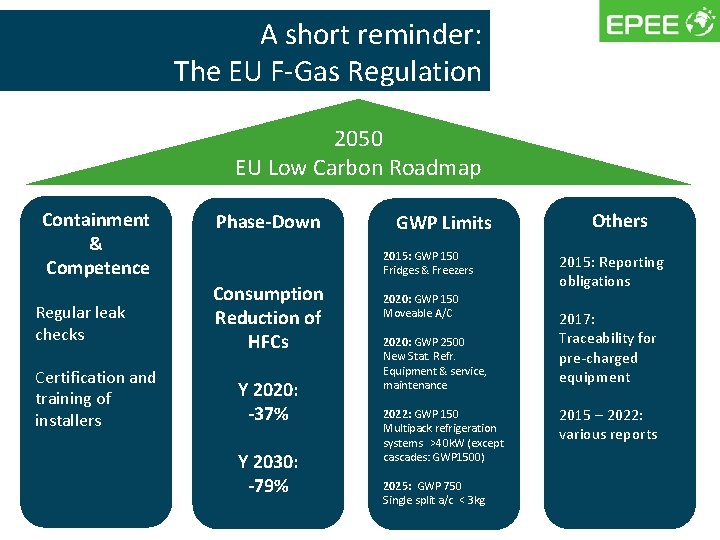
A short reminder: The EU F-Gas Regulation 2050 EU Low Carbon Roadmap Containment & Competence Regular leak checks Certification and training of installers Phase-Down GWP Limits 2015: GWP 150 Fridges & Freezers Consumption Reduction of HFCs Y 2020: -37% Y 2030: -79% 2020: GWP 150 Moveable A/C 2020: GWP 2500 New Stat. Refr. Equipment & service, maintenance 2022: GWP 150 Multipack refrigeration systems >40 k. W (except cascades: GWP 1500) 2025: GWP 750 Single split a/c < 3 kg Others 2015: Reporting obligations 2017: Traceability for pre-charged equipment 2015 – 2022: various reports
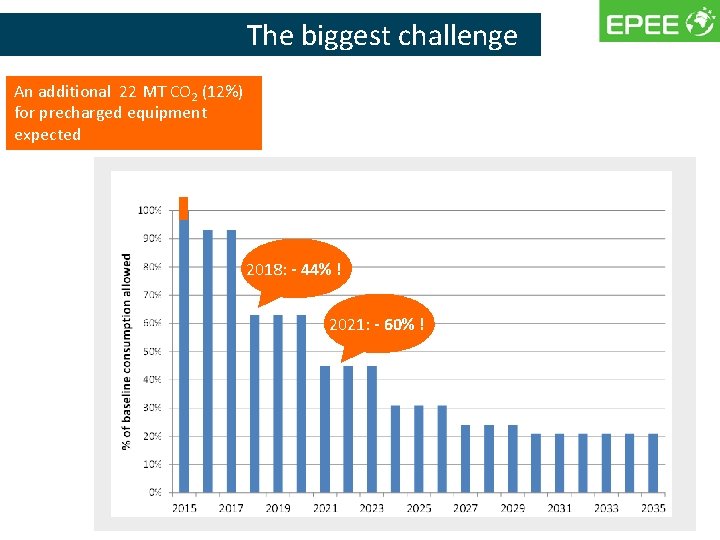
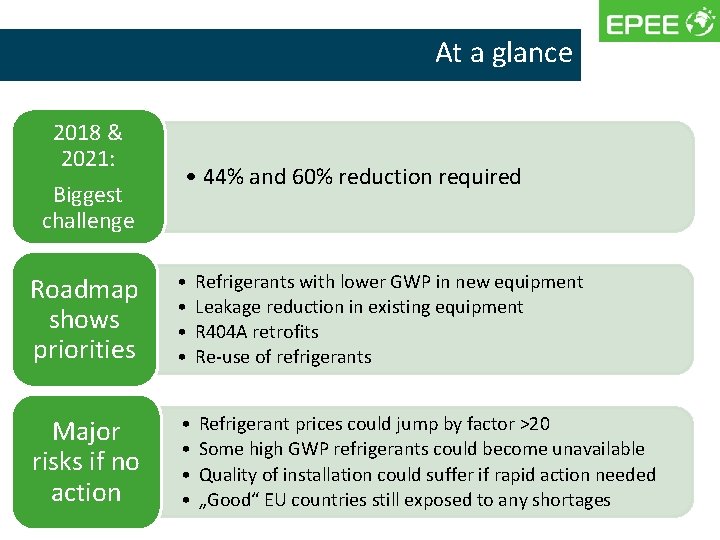
Der EU HFKW Phase-Down The biggest challenge An additional 22 MT CO 2 (12%) for precharged equipment expected 2018: - 44% ! 2021: - 60% !
THE EPEE GAPOMETER
EPEE GAPOMETER • Roadmap for meeting EU HFC phase-down steps • Monitor progress towards meeting the targets
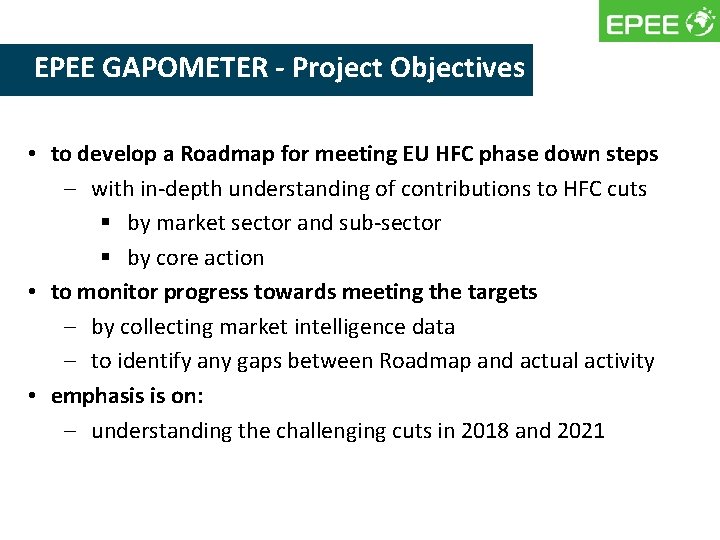
EPEE GAPOMETER - Project Objectives • to develop a Roadmap for meeting EU HFC phase down steps – with in-depth understanding of contributions to HFC cuts § by market sector and sub-sector § by core action • to monitor progress towards meeting the targets – by collecting market intelligence data – to identify any gaps between Roadmap and actual activity • emphasis is on: – understanding the challenging cuts in 2018 and 2021
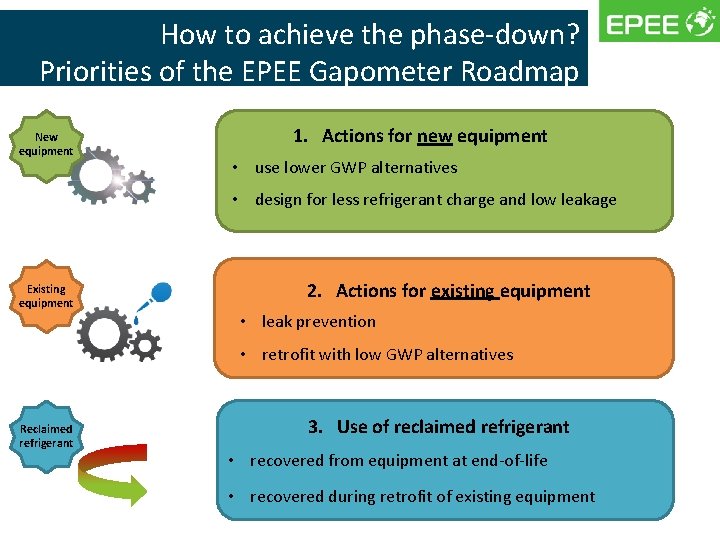
How to achieve the phase-down? Priorities of the EPEE Gapometer Roadmap New equipment 1. Actions for new equipment • use lower GWP alternatives • design for less refrigerant charge and low leakage Existing equipment 2. Actions for existing equipment • leak prevention • retrofit with low GWP alternatives Reclaimed refrigerant 3. Use of reclaimed refrigerant • recovered from equipment at end-of-life • recovered during retrofit of existing equipment
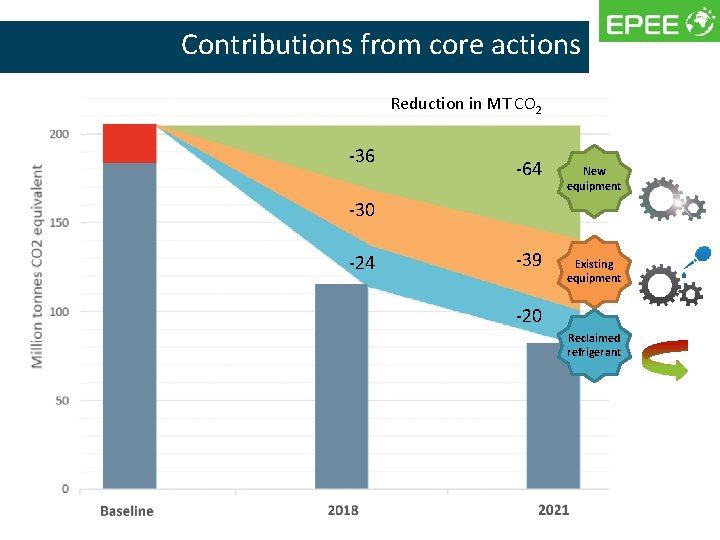
Contributions from core actions Reduction in MT CO 2 -36 -64 New equipment -30 -24 -39 Existing equipment -20 Reclaimed refrigerant
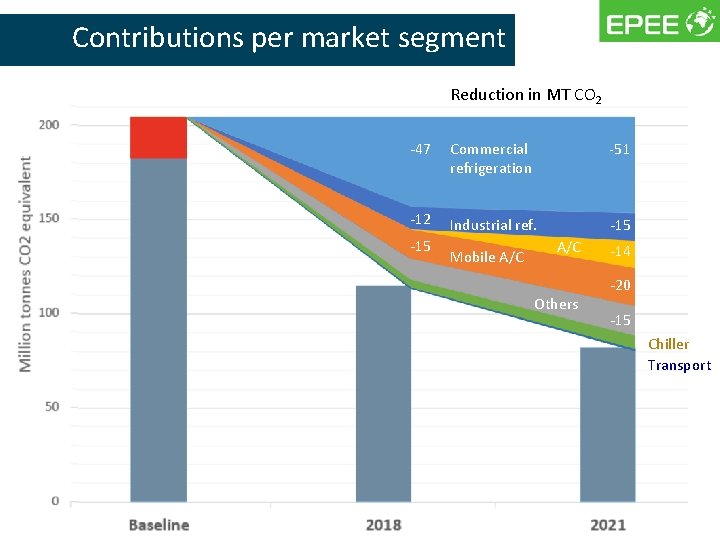
Contributions per market segment Reduction in MT CO 2 -47 Commercial refrigeration -51 -12 Industrial ref. -15 Mobile A/C Others -14 -20 -15 Chiller Transport
Gapometer Market Survey Roadmap and reality: • Refrigerants in new equipment • Supermarkets and their company policies • Reclaim & recycling of refrigerants
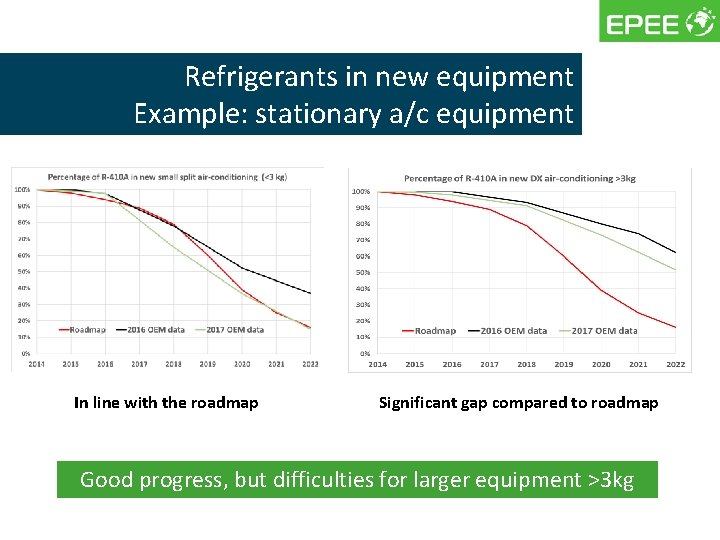
Refrigerants in new equipment Example: stationary a/c equipment In line with the roadmap Significant gap compared to roadmap Good progress, but difficulties for larger equipment >3 kg
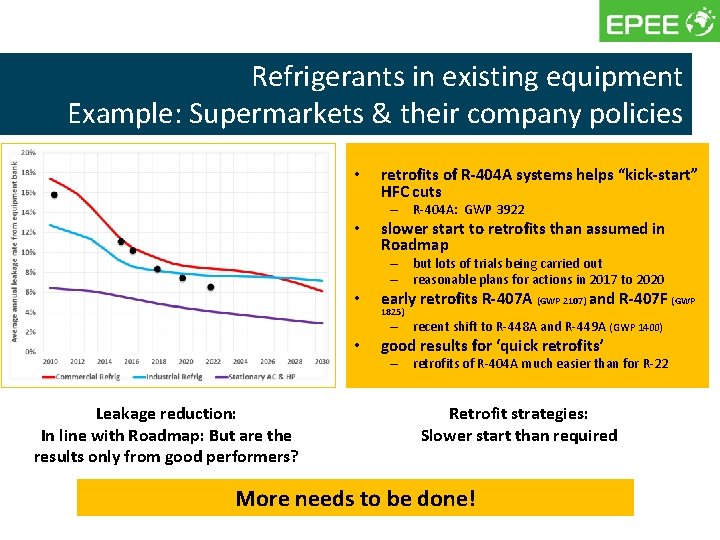
Refrigerants in existing equipment Example: Supermarkets & their company policies • retrofits of R-404 A systems helps “kick-start” HFC cuts – R-404 A: GWP 3922 • slower start to retrofits than assumed in Roadmap – but lots of trials being carried out – reasonable plans for actions in 2017 to 2020 • early retrofits R-407 A (GWP 2107) and R-407 F (GWP 1825) – recent shift to R-448 A and R-449 A (GWP 1400) • good results for ‘quick retrofits’ – retrofits of R-404 A much easier than for R-22 Leakage reduction: In line with Roadmap: But are the results only from good performers? Retrofit strategies: Slower start than required More needs to be done!
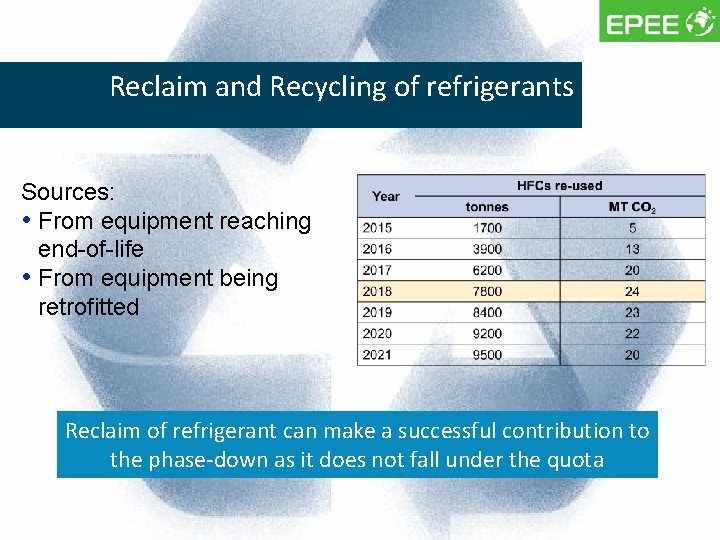
Reclaim and Recycling of refrigerants Sources: • From equipment reaching end-of-life • From equipment being retrofitted Reclaim of refrigerant can make a successful contribution to the phase-down as it does not fall under the quota
KEY MESSAGES
At a glance 2018 & 2021: Biggest challenge • 44% and 60% reduction required Roadmap shows priorities • • Refrigerants with lower GWP in new equipment Leakage reduction in existing equipment R 404 A retrofits Re-use of refrigerants Major risks if no action • • Refrigerant prices could jump by factor >20 Some high GWP refrigerants could become unavailable Quality of installation could suffer if rapid action needed „Good“ EU countries still exposed to any shortages
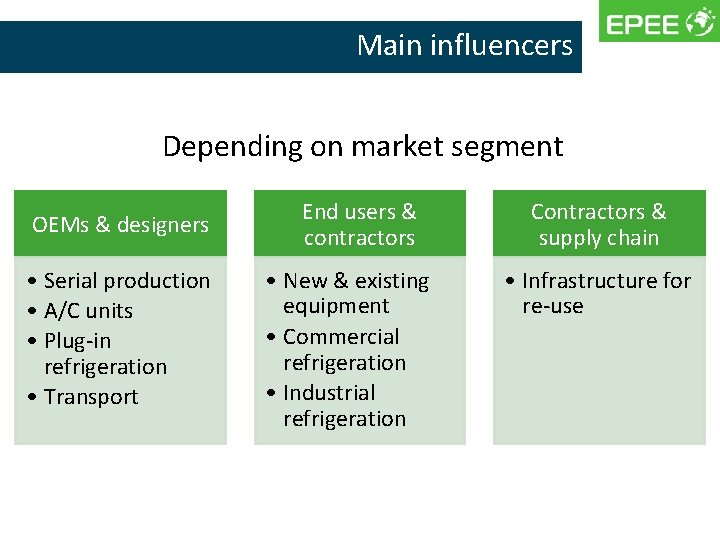
Main influencers Depending on market segment OEMs & designers • Serial production • A/C units • Plug-in refrigeration • Transport End users & contractors • New & existing equipment • Commercial refrigeration • Industrial refrigeration Contractors & supply chain • Infrastructure for re-use
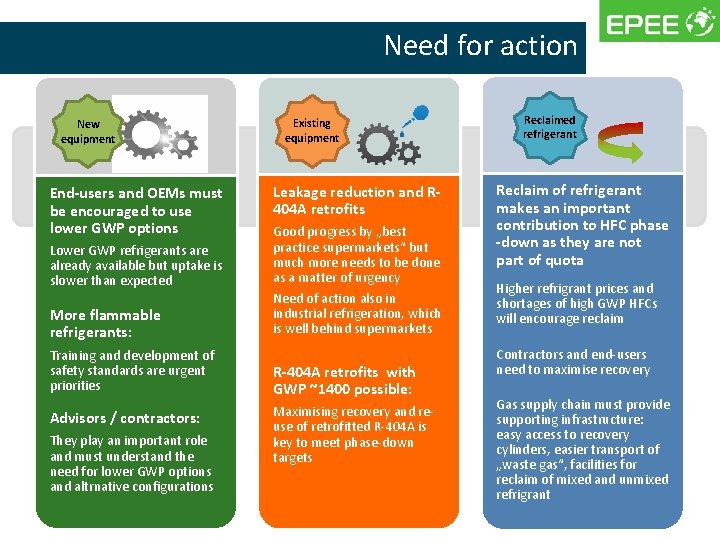
Need for action New equipment End-users and OEMs must be encouraged to use lower GWP options Lower GWP refrigerants are already available but uptake is slower than expected More flammable refrigerants: Training and development of safety standards are urgent priorities Advisors / contractors: They play an important role and must understand the need for lower GWP options and altrnative configurations Existing equipment Leakage reduction and R 404 A retrofits Good progress by „best practice supermarkets“ but much more needs to be done as a matter of urgency Need of action also in industrial refrigeration, which is well behind supermarkets R-404 A retrofits with GWP ~1400 possible: Maximising recovery and reuse of retrofitted R-404 A is key to meet phase-down targets Reclaimed refrigerant Reclaim of refrigerant makes an important contribution to HFC phase -down as they are not part of quota Higher refrigrant prices and shortages of high GWP HFCs will encourage reclaim Contractors and end-users need to maximise recovery Gas supply chain must provide supporting infrastructure: easy access to recovery cylinders, easier transport of „waste gas“, facilities for reclaim of mixed and unmixed refrigrant
Outlook for 2018 • 44% cut from baseline starts in 6 months time! • Gapometer Roadmap shows how the cut can be achieved – but it relies on many actions by many different actors • Market research shows significant progress – but not enough activity yet – recent significant price increases may accelerate action • Without a significant increase in the uptake of the core actions in 2017 and early 2018 – there could be a severe shortage of some HFC refrigerants in 2018
CONCLUSIONS
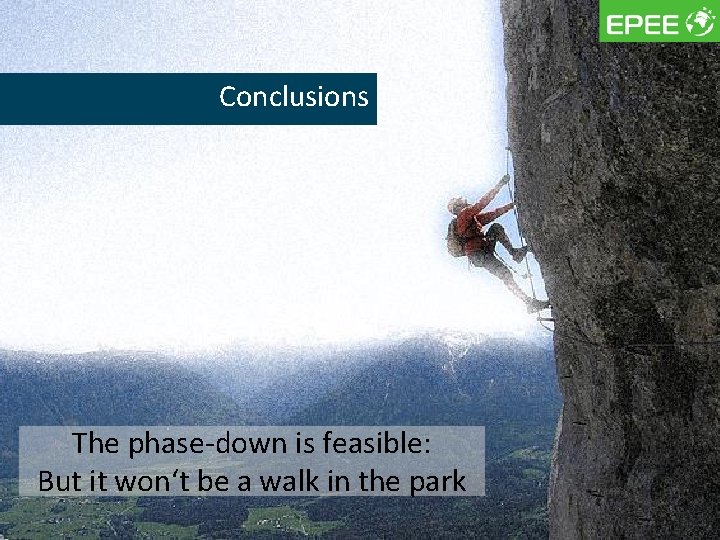
Conclusions The phase-down is feasible: But it won‘t be a walk in the park
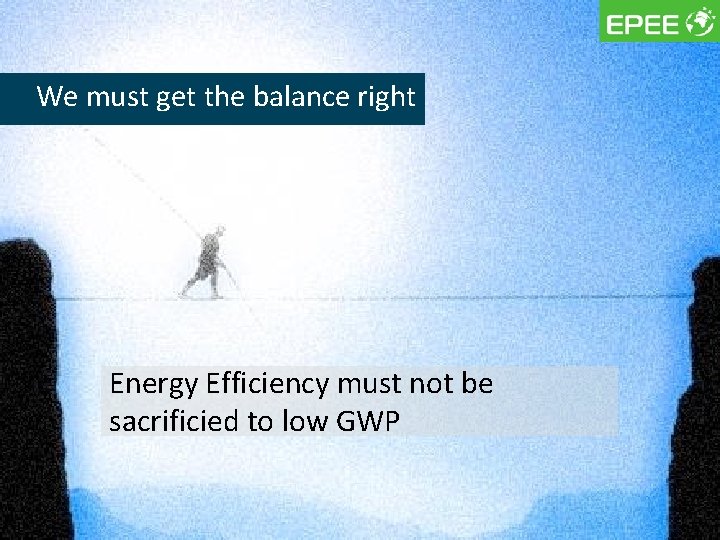
We must get the balance right Energy Efficiency must not be sacrificied to low GWP
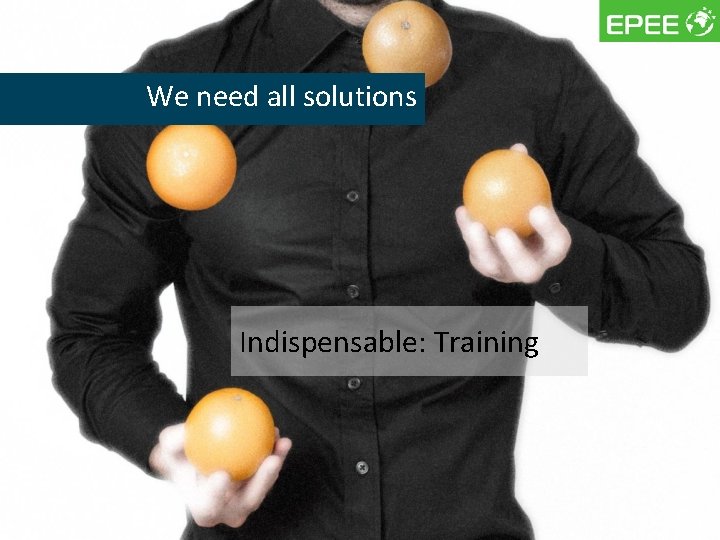
We need all solutions Indispensable: Training
We have to be flexible Open: for new situations and solutions
Thank you for your attention – Questions? Contact: EPEE 46 Avenue des Arts 1000 Brussels, Belgium a. voigt@epeeglobal. org www. epeeglobal. org @EPEESecretariat @Andrea. Voigt 2305 25