
EPCglobal Class1 Generation 2 UHF RFID Todd Humes
EPCglobal Class-1 Generation 2 UHF RFID • Todd Humes, CTO Impinj, Inc. 501 N 34 th Street, Suite 100 Seattle, WA 98103 todd. humes@impinj. com
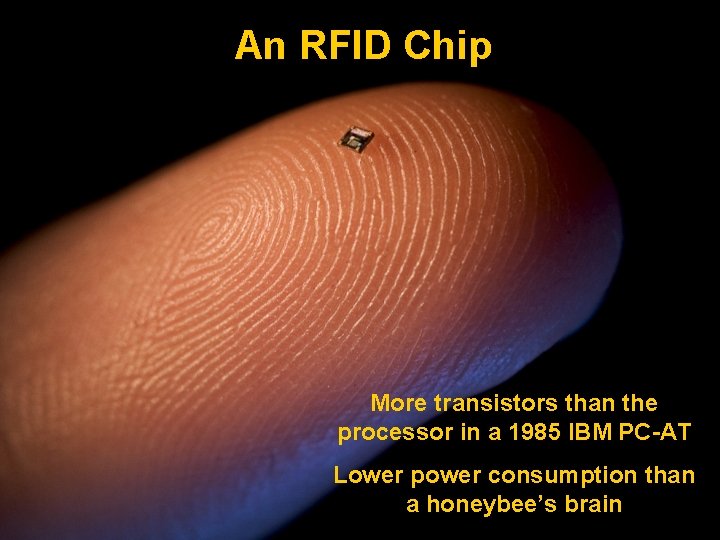
An RFID Chip More transistors than the processor in a 1985 IBM PC-AT Lower power consumption than a honeybee’s brain
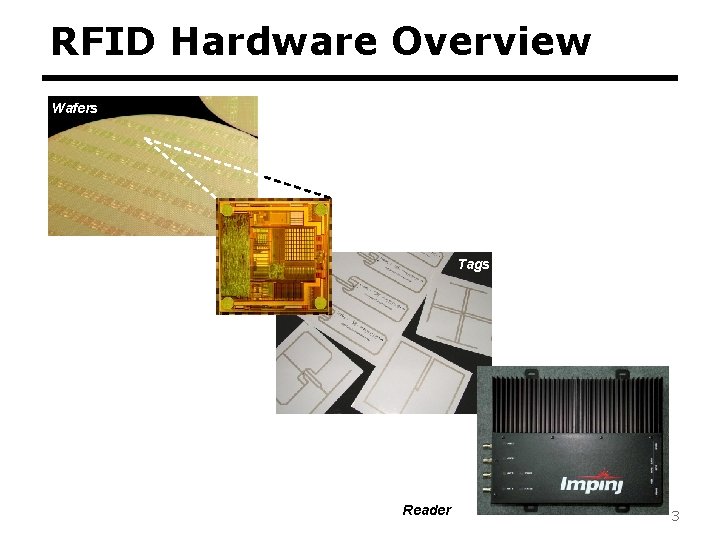
RFID Hardware Overview Wafers Tags Reader 3
RFID is Old, what’s New • New standards at UHF (900 MHz) vs HF (13. 56 MHz) • UHF - 10 X range of HF RFID • Faster data rates – up to 640 kbps • But, presents many new challenges: • How to identify and read/write single tags from hundreds within a reader field. . . • Tag and reader RF interference. . . • Security. . • Tag data processing. . . • Solution - EPCglobal Gen 2 standard 4

RFID Systems Network layer RFID Reader Air Interface Tag IP RFID Reader Network Tag RFID Reader Example data exchange: Forward Link parameters Link rates and encoding formats Return Tag inventory Singulation parameters, tag identification 5
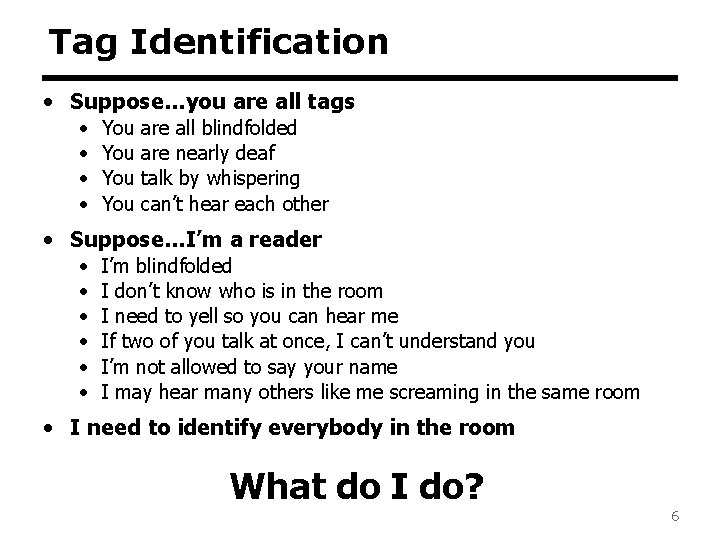
Tag Identification • Suppose…you are all tags • • You You are all blindfolded are nearly deaf talk by whispering can’t hear each other • Suppose…I’m a reader • • • I’m blindfolded I don’t know who is in the room I need to yell so you can hear me If two of you talk at once, I can’t understand you I’m not allowed to say your name I may hear many others like me screaming in the same room • I need to identify everybody in the room What do I do? 6
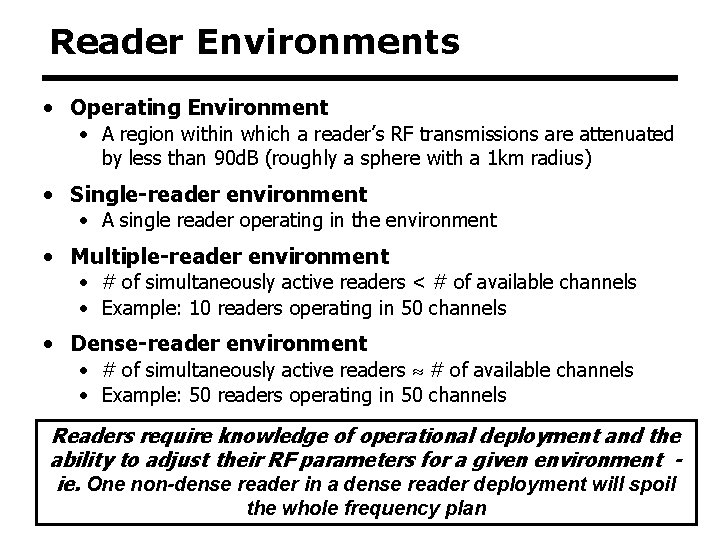
Reader Environments • Operating Environment • A region within which a reader’s RF transmissions are attenuated by less than 90 d. B (roughly a sphere with a 1 km radius) • Single-reader environment • A single reader operating in the environment • Multiple-reader environment • # of simultaneously active readers < # of available channels • Example: 10 readers operating in 50 channels • Dense-reader environment • # of simultaneously active readers # of available channels • Example: 50 readers operating in 50 channels Readers require knowledge of operational deployment and the ability to adjust their RF parameters for a given environment ie. One non-dense reader in a dense reader deployment will spoil the whole frequency plan 7
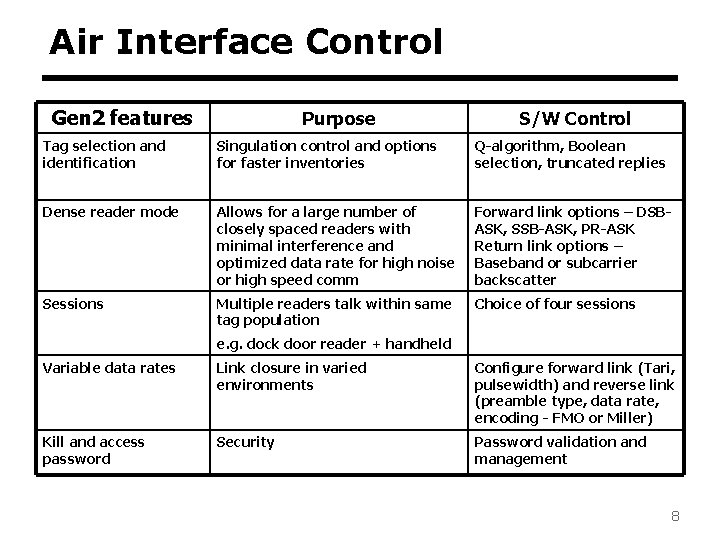
Air Interface Control Gen 2 features Purpose S/W Control Tag selection and identification Singulation control and options for faster inventories Q-algorithm, Boolean selection, truncated replies Dense reader mode Allows for a large number of closely spaced readers with minimal interference and optimized data rate for high noise or high speed comm Forward link options – DSBASK, SSB-ASK, PR-ASK Return link options – Baseband or subcarrier backscatter Sessions Multiple readers talk within same tag population Choice of four sessions e. g. dock door reader + handheld Variable data rates Link closure in varied environments Configure forward link (Tari, pulsewidth) and reverse link (preamble type, data rate, encoding - FMO or Miller) Kill and access password Security Password validation and management 8
- Slides: 8