
EPA Tier I Screening Process and Development of
- Slides: 22
EPA Tier I Screening Process and Development of Tier II Screening-level Hazard Characterization Meena Sonawane Office of Pollution Prevention and Toxics (OPPT) U. S. Environmental Protection Agency December 13, 2006 1
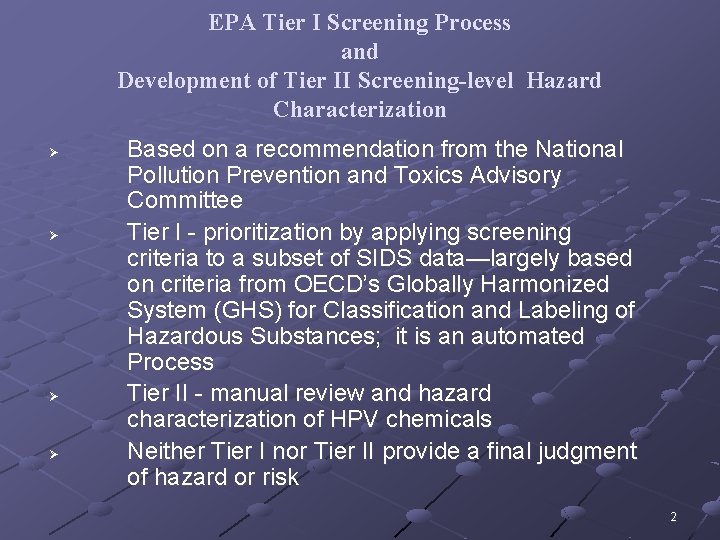
EPA Tier I Screening Process and Development of Tier II Screening-level Hazard Characterization Ø Ø Based on a recommendation from the National Pollution Prevention and Toxics Advisory Committee Tier I - prioritization by applying screening criteria to a subset of SIDS data—largely based on criteria from OECD’s Globally Harmonized System (GHS) for Classification and Labeling of Hazardous Substances; it is an automated Process Tier II - manual review and hazard characterization of HPV chemicals Neither Tier I nor Tier II provide a final judgment of hazard or risk 2
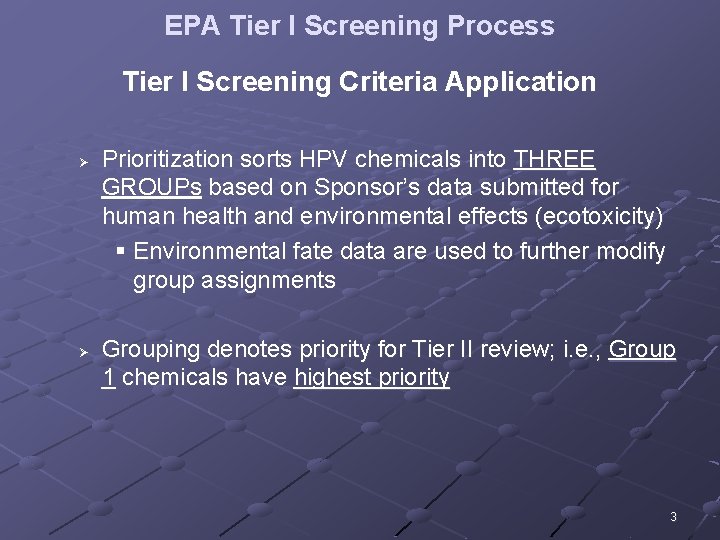
EPA Tier I Screening Process Tier I Screening Criteria Application Ø Ø Prioritization sorts HPV chemicals into THREE GROUPs based on Sponsor’s data submitted for human health and environmental effects (ecotoxicity) § Environmental fate data are used to further modify group assignments Grouping denotes priority for Tier II review; i. e. , Group 1 chemicals have highest priority 3
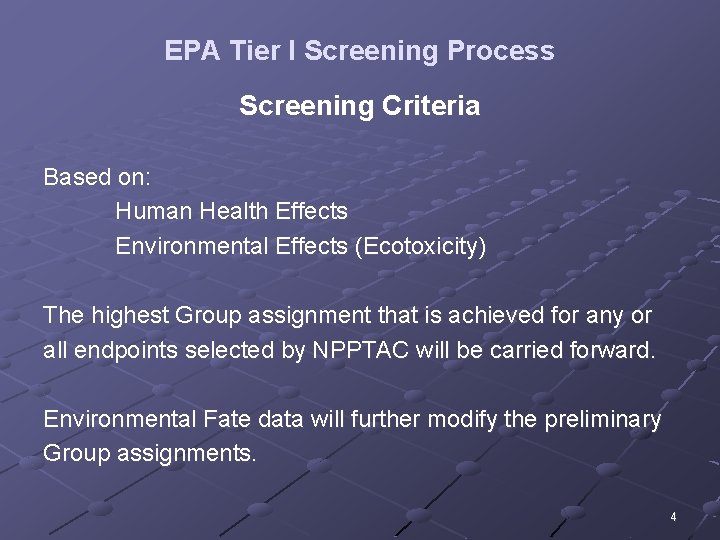
EPA Tier I Screening Process Screening Criteria Based on: Human Health Effects Environmental Effects (Ecotoxicity) The highest Group assignment that is achieved for any or all endpoints selected by NPPTAC will be carried forward. Environmental Fate data will further modify the preliminary Group assignments. 4
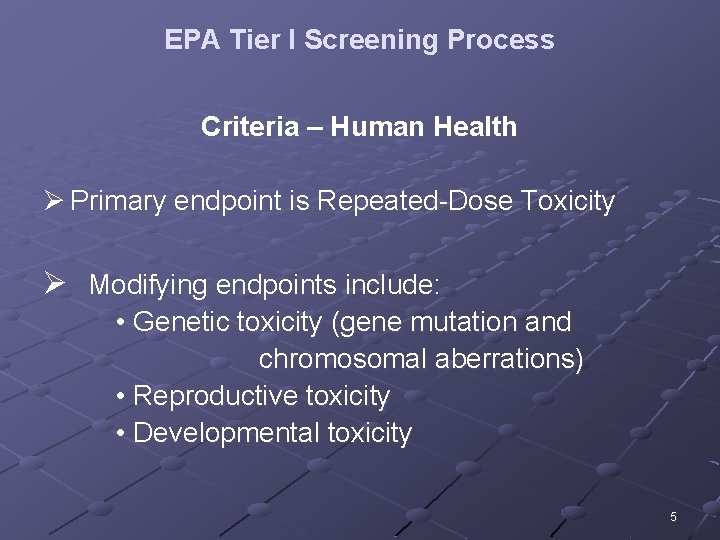
EPA Tier I Screening Process Criteria – Human Health Ø Primary endpoint is Repeated-Dose Toxicity Ø Modifying endpoints include: • Genetic toxicity (gene mutation and chromosomal aberrations) • Reproductive toxicity • Developmental toxicity 5
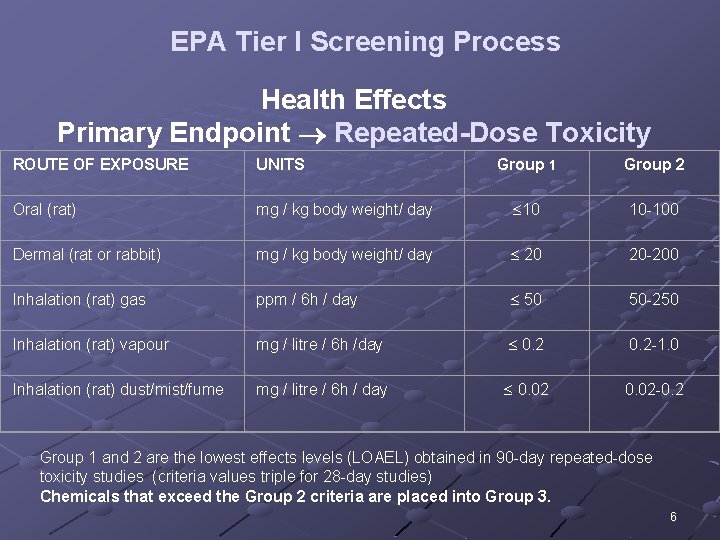
EPA Tier I Screening Process Health Effects Primary Endpoint Repeated-Dose Toxicity ROUTE OF EXPOSURE UNITS Group 1 Group 2 Oral (rat) mg / kg body weight/ day 10 10 -100 Dermal (rat or rabbit) mg / kg body weight/ day 20 20 -200 Inhalation (rat) gas ppm / 6 h / day 50 50 -250 Inhalation (rat) vapour mg / litre / 6 h /day 0. 2 -1. 0 Inhalation (rat) dust/mist/fume mg / litre / 6 h / day 0. 02 -0. 2 Group 1 and 2 are the lowest effects levels (LOAEL) obtained in 90 -day repeated-dose toxicity studies (criteria values triple for 28 -day studies) Chemicals that exceed the Group 2 criteria are placed into Group 3. 6
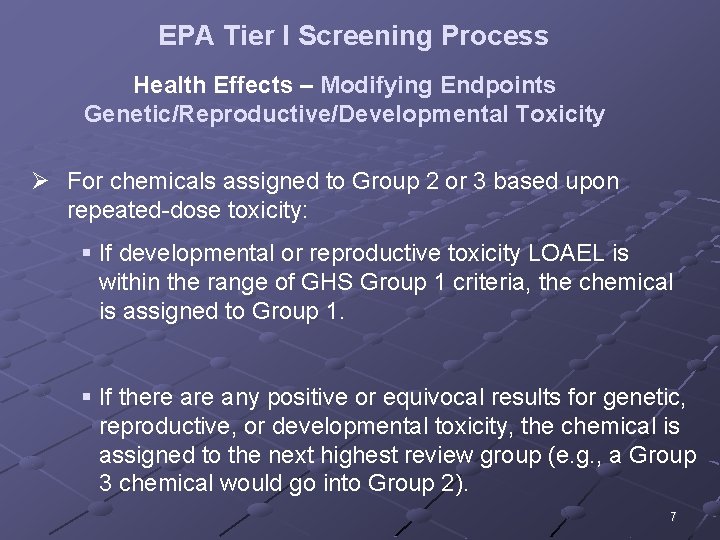
EPA Tier I Screening Process Health Effects – Modifying Endpoints Genetic/Reproductive/Developmental Toxicity Ø For chemicals assigned to Group 2 or 3 based upon repeated-dose toxicity: § If developmental or reproductive toxicity LOAEL is within the range of GHS Group 1 criteria, the chemical is assigned to Group 1. § If there any positive or equivocal results for genetic, reproductive, or developmental toxicity, the chemical is assigned to the next highest review group (e. g. , a Group 3 chemical would go into Group 2). 7
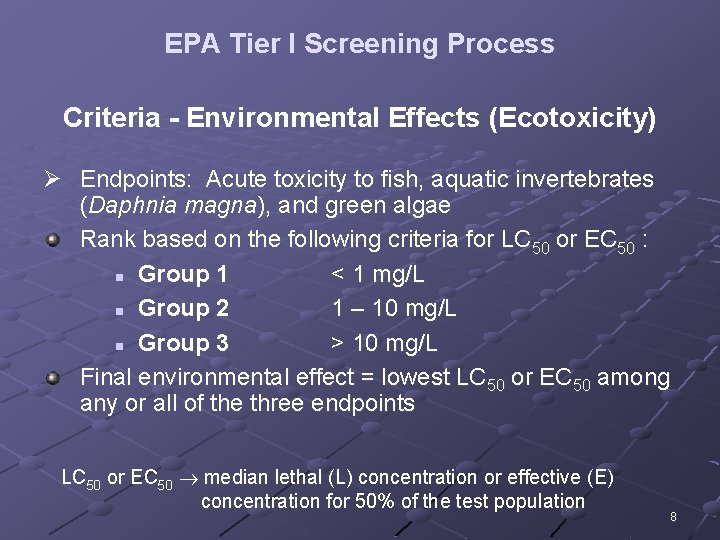
EPA Tier I Screening Process Criteria - Environmental Effects (Ecotoxicity) Ø Endpoints: Acute toxicity to fish, aquatic invertebrates (Daphnia magna), and green algae Rank based on the following criteria for LC 50 or EC 50 : n Group 1 < 1 mg/L n Group 2 1 – 10 mg/L n Group 3 > 10 mg/L Final environmental effect = lowest LC 50 or EC 50 among any or all of the three endpoints LC 50 or EC 50 median lethal (L) concentration or effective (E) concentration for 50% of the test population 8
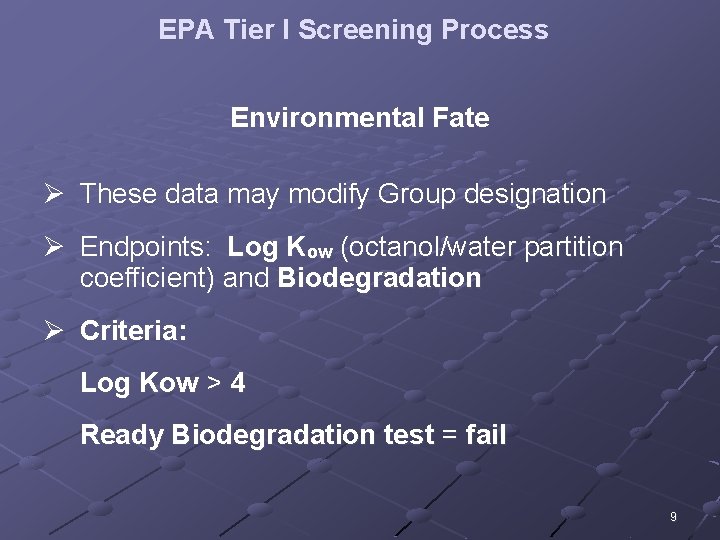
EPA Tier I Screening Process Environmental Fate Ø These data may modify Group designation Ø Endpoints: Log Kow (octanol/water partition coefficient) and Biodegradation Ø Criteria: Log Kow > 4 Ready Biodegradation test = fail 9
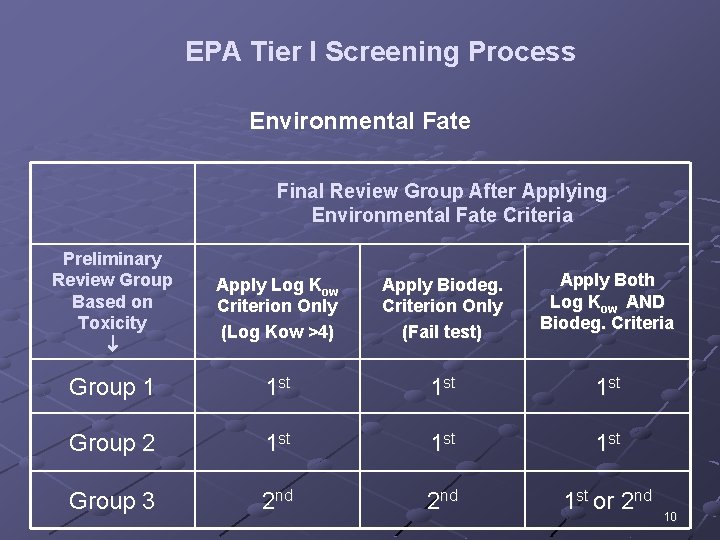
EPA Tier I Screening Process Environmental Fate Final Review Group After Applying Environmental Fate Criteria Preliminary Review Group Based on Toxicity Apply Log Kow Criterion Only (Log Kow >4) Apply Biodeg. Criterion Only (Fail test) Apply Both Log Kow AND Biodeg. Criteria Group 1 1 st 1 st Group 2 1 st 1 st Group 3 2 nd 1 st or 2 nd 10
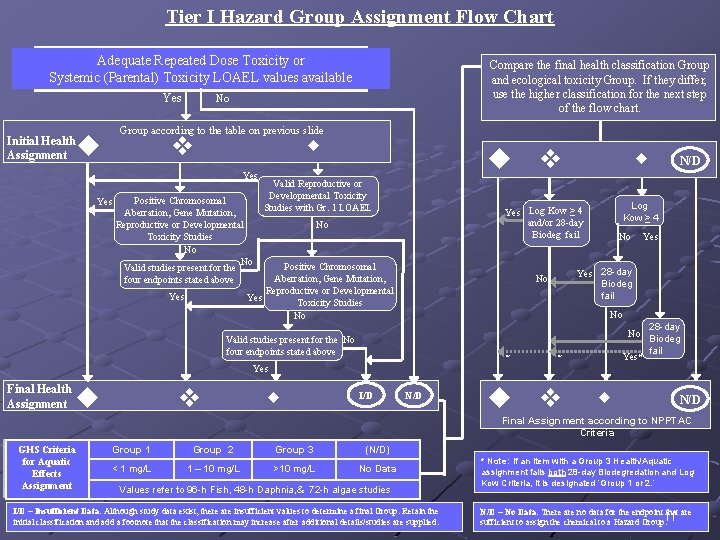
Tier I Hazard Group Assignment Flow Chart Adequate Repeated Dose Toxicity or Systemic (Parental) Toxicity LOAEL values available Yes Initial Health Assignment Compare the final health classification Group and ecological toxicity Group. If they differ, use the higher classification for the next step of the flow chart. No Group according to the table on previous slide u v w Yes Positive Chromosomal Aberration, Gene Mutation, Reproductive or Developmental Toxicity Studies No No Valid studies present for the four endpoints stated above u Valid Reproductive or Developmental Toxicity Studies with Gr. 1 LOAEL w No N/D Log Kow ≥ 4 Yes Log Kow ≥ 4 and/or 28 -day Biodeg fail Positive Chromosomal Aberration, Gene Mutation, Reproductive or Developmental Yes Toxicity Studies No Yes v No Yes 28 -day Biodeg fail No No Valid studies present for the No four endpoints stated above * 28 -day No Biodeg fail Yes* * Yes Final Health Assignment u v w I/D N/D u v w N/D Final Assignment according to NPPTAC Criteria GHS Criteria for Aquatic Effects Assignment Group 1 Group 2 Group 3 (N/D) < 1 mg/L 1 – 10 mg/L >10 mg/L No Data Values refer to 96 -h Fish, 48 -h Daphnia, & 72 -h algae studies I/D – Insufficient Data. Although study data exist, there are insufficient values to determine a final Group. Retain the initial classification and add a footnote that the classification may increase after additional details/studies are supplied. * Note: If an item with a Group 3 Health/Aquatic assignment fails both 28 -day Biodegredation and Log Kow Criteria, it is designated ‘Group 1 or 2. ’ N/D – No Data. There are no data for the endpoint that are sufficient to assign the chemical to a Hazard Group. 11
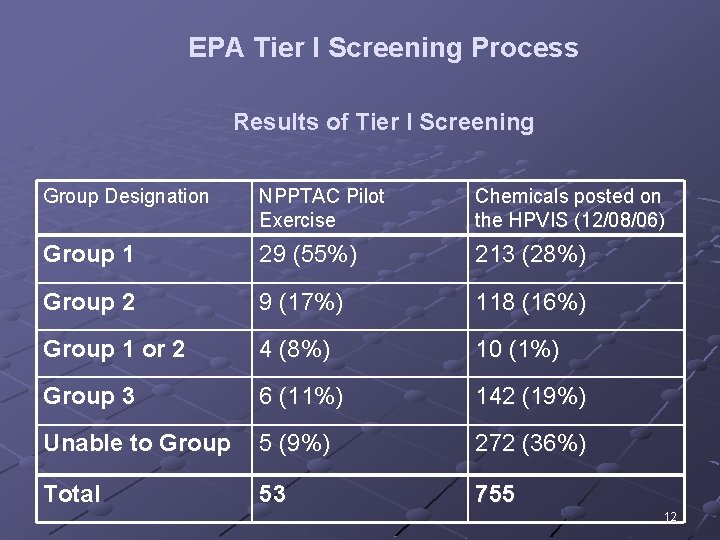
EPA Tier I Screening Process Results of Tier I Screening Group Designation NPPTAC Pilot Exercise Chemicals posted on the HPVIS (12/08/06) Group 1 29 (55%) 213 (28%) Group 2 9 (17%) 118 (16%) Group 1 or 2 4 (8%) 10 (1%) Group 3 6 (11%) 142 (19%) Unable to Group 5 (9%) 272 (36%) Total 53 755 12
Development of Tier II Screening-level Hazard Characterization Purpose Ø Conduct a more in-depth scientific/critical review of the data (quality and completeness) with main focus on potential hazard Ø Develop a screening-level hazard assessment Ø Does not make determination about risk to human health or environment but may make recommendations for further post-Tier II work Ø Inform sponsors and public by posting Tier II assessments on the website 13
Development of Tier II Screening-level Hazard Characterization Characteristics Ø Critical review based on available hazard data on health and environmental effects and environmental fate Ø Ø Persistence/bioaccumulation characteristics of chemicals; and also includes assessment of data gaps/needs 14
Development of Tier II Screening-level Hazard Characterization Key Outputs Ø Determine quality and completeness of submitted data Ø Assess significance of hazard and environmental fate data Thus the assessment can identify if the chemical has a need for further post-Tier II work or if no further work is needed at this time 15
Development of Tier II Screening-level Hazard Characterization Key Outputs (cont. ) Ø Make information and initial scientific assessment publicly available Ø Tier II assessment is roughly comparable to level of analysis conducted under the Organization for Economic Cooperation and Development’s HPV Program and as such informs need for and the nature of next steps 16
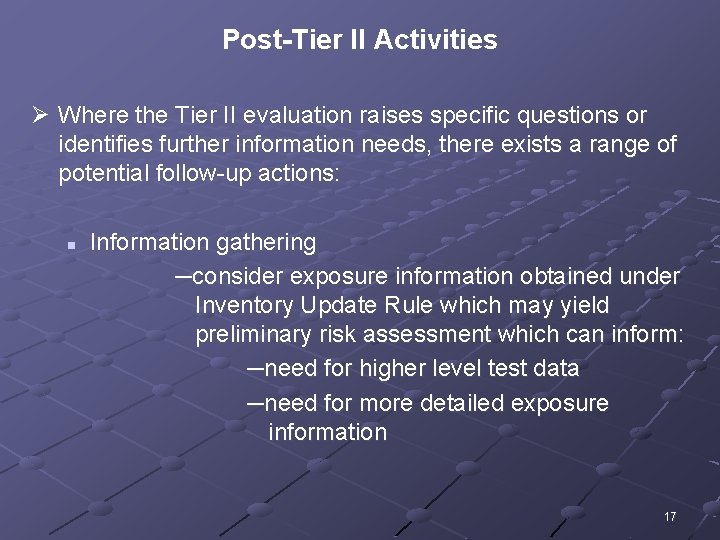
Post-Tier II Activities Ø Where the Tier II evaluation raises specific questions or identifies further information needs, there exists a range of potential follow-up actions: n Information gathering ─consider exposure information obtained under Inventory Update Rule which may yield preliminary risk assessment which can inform: ─need for higher level test data ─need for more detailed exposure information 17
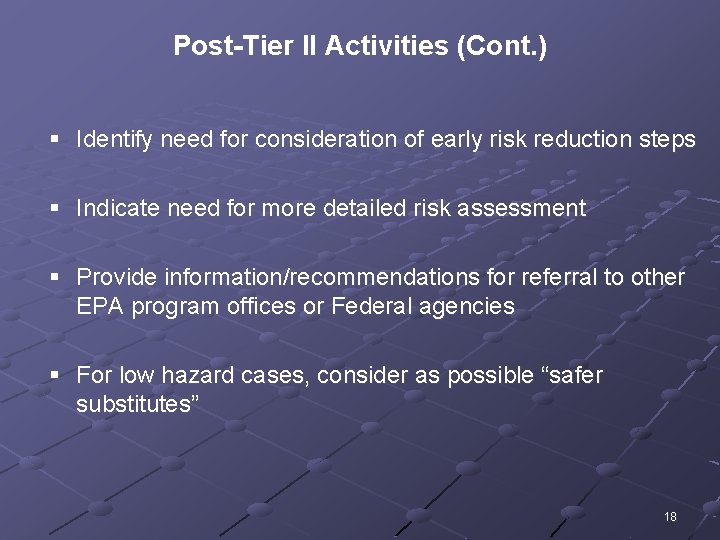
Post-Tier II Activities (Cont. ) § Identify need for consideration of early risk reduction steps § Indicate need for more detailed risk assessment § Provide information/recommendations for referral to other EPA program offices or Federal agencies § For low hazard cases, consider as possible “safer substitutes” 18
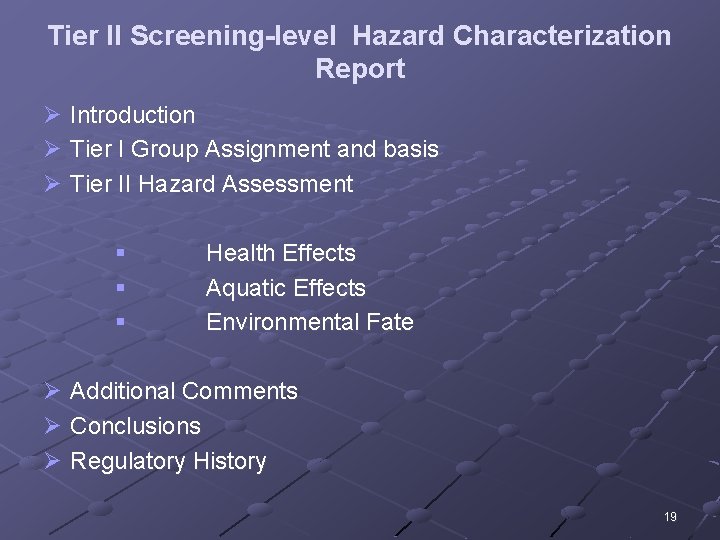
Tier II Screening-level Hazard Characterization Report Ø Introduction Ø Tier I Group Assignment and basis Ø Tier II Hazard Assessment § § § Health Effects Aquatic Effects Environmental Fate Ø Additional Comments Ø Conclusions Ø Regulatory History 19
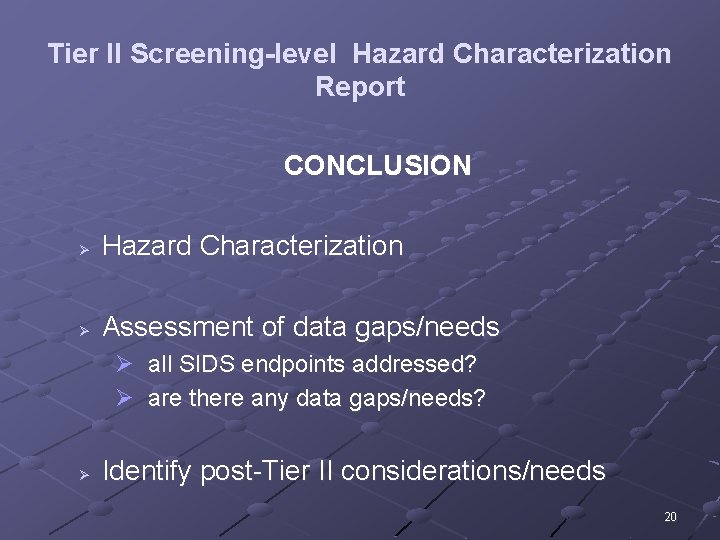
Tier II Screening-level Hazard Characterization Report CONCLUSION Ø Hazard Characterization Ø Assessment of data gaps/needs Ø all SIDS endpoints addressed? Ø are there any data gaps/needs? Ø Identify post-Tier II considerations/needs 20
EPA Tier I Screening Process and Development of Tier II Screening-level Hazard Characterization NEXT STEPS § Receive and consider comments on draft Tier II assessment format § Develop Tier II assessments for all HPV Challenge Chemicals (Goal is end of 2009) § Revise Tier II assessment format to incorporate IUR exposure data, when available (2007) § Base need for post-Tier II activities on screening level risk assessment 21
EPA Tier I Screening Process and Development of Tier II Screening-level Hazard Characterization Draft Tier II assessments have been prepared on two chemicals for your review and comments. These copies are available at the Conference site or as hazard assessment postings at www. newmoa. org/hpv Please send your comments on draft Tier II screening assessments to: sonawane. meena@epa. gov 22