
EPA THEN AND NOW THE EVOLUTION OF MEASUREMENTS
- Slides: 21
EPA THEN AND NOW – THE EVOLUTION OF MEASUREMENTS IN THE LABORATORY AND FIELD LARA P. PHELPS, SENIOR ADVISOR, OFFICE OF THE SCIENCE ADVISOR US ENVIRONMENTAL PROTECTION AGENCY ANALYTICAL SERVICES PROGRAM (ASP) 2015 WORKSHOP TUESDAY, SEPTEMBER 15, 2015
EVOLUTION – PAST VERSUS PRESENT
OVERVIEW • History • 1970’s – 1980’s • 1990’s – 2000’s • 2010’s – Present • Tools and Programs • Collaborative Opportunities • Summary • Contact Us
HISTORY: 1970’S – 1980’S • EPA recorded history indicates that measurements initially were taken by employing any available technology or gadget that could be rigged from available supplies, coupled with the creativity of individual field researchers and scientists. • Ruckelshaus said in 1980, “Our ability to pinpoint the adverse health or environmental effects at a given concentration, or measure those adverse concentrations in the air or water, varies greatly with the individual pollutant and media in which it is found. ”
HISTORY: 1990’S • A common total quality management adage – “What gets measured gets managed” – is equally true in reverse at EPA – “What gets managed gets measured”. • The 1990 Clean Air Act Amendments required regulated installations to install continuous emissions monitoring equipment. • As technology improved, the specifications of the methods and measurement techniques defined in the Agency’s rules and regulations became limitations. • Under the impetus of the National Partnership for Reinventing Government reforms, EPA published a 1997 Federal Register Notice promoting performance-based measurement systems (PBMS).
HISTORY: 2000’S • Monitoring methods have evolved, since PBMS. • Biomonitoring, which measures the chemicals in human body fluids and tissues, is worth noting. • With the proliferation of methods, the Forum on Environmental Measurements (FEM) was formed in April 2003 to address issues related to environment measurements.
FORUM ON ENVIRONMENTAL MEASUREMENTS (FEM) • Purpose and Scope – Promote consistency and consensus on measurement, monitoring, and laboratory science issues with multi-program impact through recommendations to guide the measurement community in: • Validating and disseminating methods for sample collection and analysis. • Ensuring monitoring studies are scientifically rigorous, statistically sound, and representative. • Employing a quality systems approach to ensure data gathered/used is of known and documented quality. • Promoting development and use of innovative technologies to generate, transmit, compile, and utilize monitoring data and information in decision making.
FEM – AREAS OF FOCUS • Methods – opportunities to improve the Agency’s methods through policies and guidelines for method validation and peer review; flexibility in how environmental measurements are taken; method detection, quantitation, and calibration review; method formatting; and method collections. • Monitoring – collaborations through programs like the National Environmental Monitoring Conference, which is the largest annual conference focused on environmental measurements in North America with a program designed to bring together a balance of technical and policy topics that are of interest to all. • Assessing Measurements – policies and programs (e. g. , standards, accreditation) designed for field sampling organizations or laboratories to demonstrate their compliance to a quality system.
HISTORY: 2010’S – PRESENT • Due to the lack of consistency in measurement terminology across the Agency, an Environmental Measurement Glossary of Terms was established in 2010. • Since PBMS lacked the versatility needed by EPA programs, it was transformed and expanded to Flexible Approaches to Environmental Measurement. • EPA – with industry, academic, and other partners – is developing, evaluating, and applying new, innovative technologies in addition to utilizing management and modeling data.
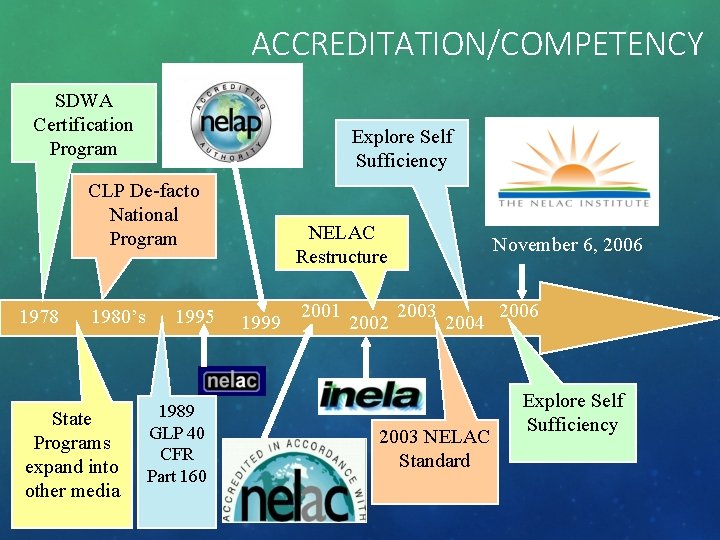
ACCREDITATION/COMPETENCY SDWA Certification Program Explore Self Sufficiency CLP De-facto National Program 1978 1980’s State Programs expand into other media 1995 1989 GLP 40 CFR Part 160 NELAC Restructure 1999 2001 2002 November 6, 2006 2003 2004 2003 NELAC Standard 2006 Explore Self Sufficiency
ENVIRONMENTAL LABORATORY ADVISORY BOARD (ELAB) • Purpose and Scope – • Enhancing EPA’s measurement programs in areas such as: • Validating and disseminating methods for sample collection and for biological, chemical, radiological, and toxicological analysis; • Developing scientifically rigorous, statistically sound, and representative measurements; • Employing the performance paradigm in environmental monitoring and regulatory programs; • Improving communications and outreach between the EPA and its stakeholder communities; and • Employing a quality systems approach that ensures that the data gathered and used by the Agency are of known and documented quality. • Facilitating the operation and expansion of a national environmental accreditation program.
INTERNAL COMPETENCY • February 23, 2004 – Policy directive developed by the Forum on Environmental Measurement (FEM), Assuring the Competency of Environmental Protection Agency Laboratories. • Demonstration of adherence to quality system through periodic independent assessments. • Participation in inter-laboratory comparisons. • In addition, where appropriate accreditation programs are available for one or more components of a given laboratory’s operations, the laboratory will seek accreditation for those components.
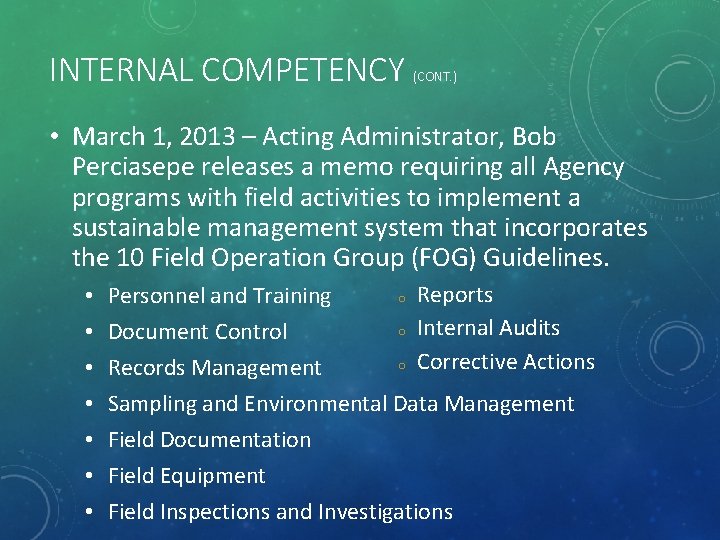
INTERNAL COMPETENCY (CONT. ) • March 1, 2013 – Acting Administrator, Bob Perciasepe releases a memo requiring all Agency programs with field activities to implement a sustainable management system that incorporates the 10 Field Operation Group (FOG) Guidelines. • • o Reports Personnel and Training o Internal Audits Document Control o Corrective Actions Records Management Sampling and Environmental Data Management Field Documentation Field Equipment Field Inspections and Investigations
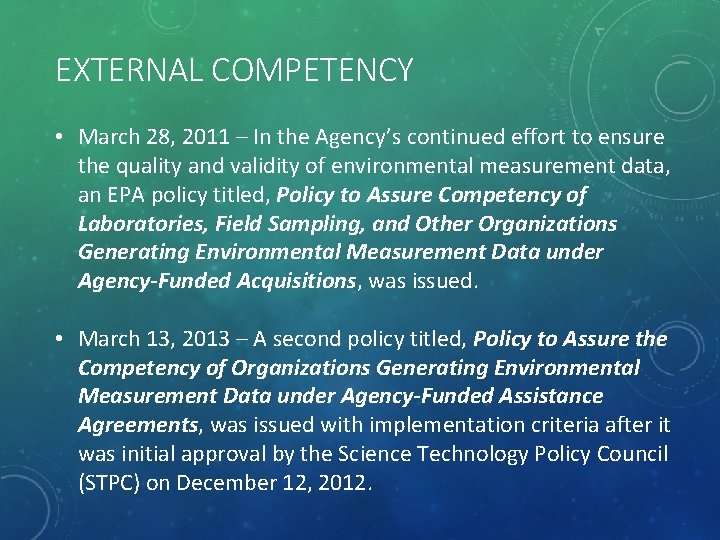
EXTERNAL COMPETENCY • March 28, 2011 – In the Agency’s continued effort to ensure the quality and validity of environmental measurement data, an EPA policy titled, Policy to Assure Competency of Laboratories, Field Sampling, and Other Organizations Generating Environmental Measurement Data under Agency-Funded Acquisitions, was issued. • March 13, 2013 – A second policy titled, Policy to Assure the Competency of Organizations Generating Environmental Measurement Data under Agency-Funded Assistance Agreements, was issued with implementation criteria after it was initial approval by the Science Technology Policy Council (STPC) on December 12, 2012.
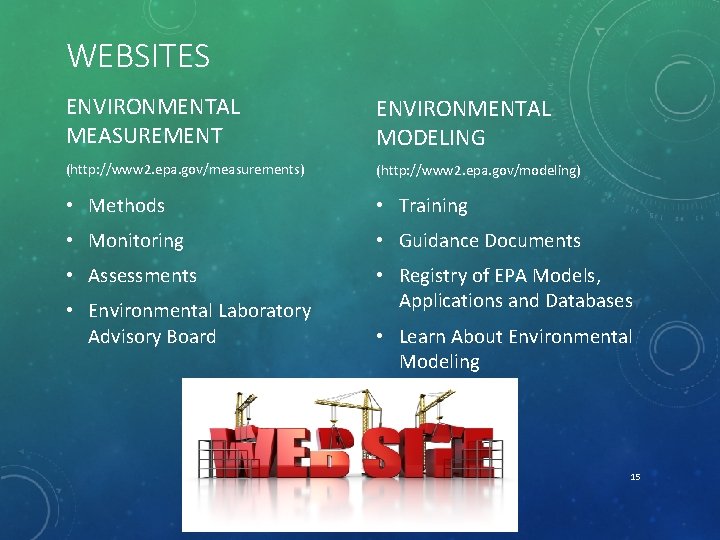
WEBSITES ENVIRONMENTAL MEASUREMENT ENVIRONMENTAL MODELING (http: //www 2. epa. gov/measurements) (http: //www 2. epa. gov/modeling) • Methods • Training • Monitoring • Guidance Documents • Assessments • Registry of EPA Models, Applications and Databases • Environmental Laboratory Advisory Board • Learn About Environmental Modeling 15
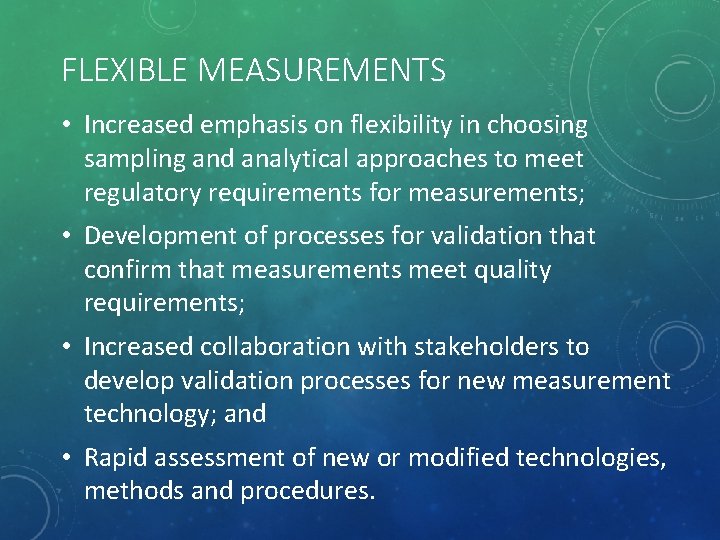
FLEXIBLE MEASUREMENTS • Increased emphasis on flexibility in choosing sampling and analytical approaches to meet regulatory requirements for measurements; • Development of processes for validation that confirm that measurements meet quality requirements; • Increased collaboration with stakeholders to develop validation processes for new measurement technology; and • Rapid assessment of new or modified technologies, methods and procedures.
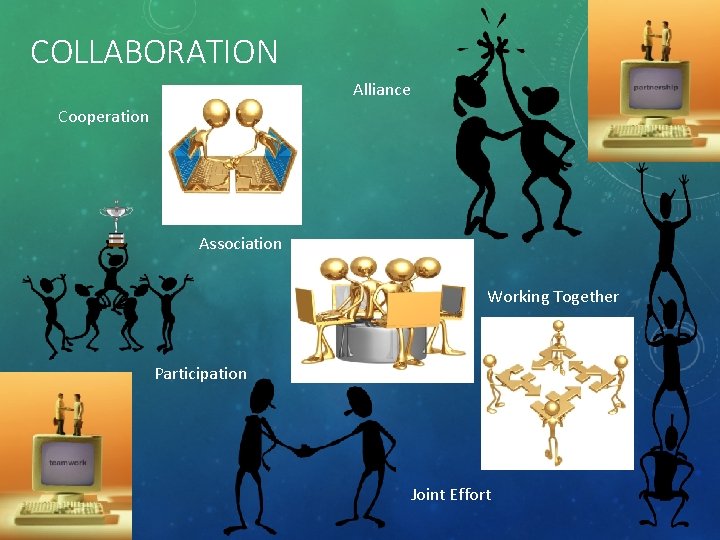
COLLABORATION Alliance Cooperation Association Working Together Participation Joint Effort
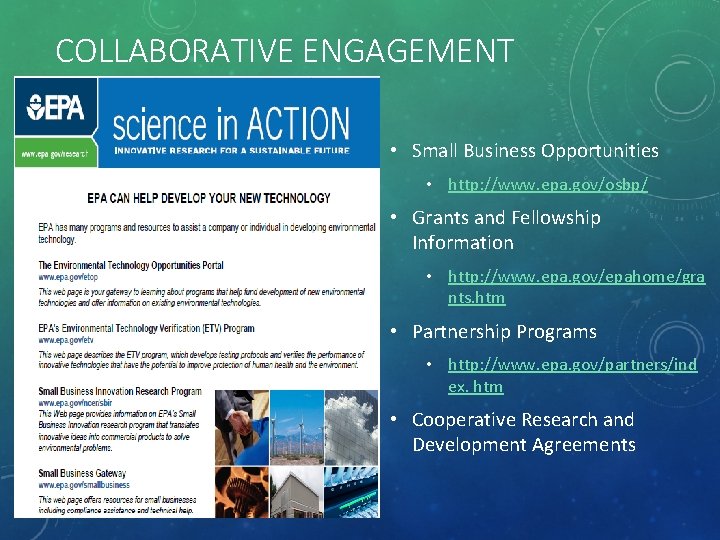
COLLABORATIVE ENGAGEMENT • Small Business Opportunities • http: //www. epa. gov/osbp/ • Grants and Fellowship Information • http: //www. epa. gov/epahome/gra nts. htm • Partnership Programs • http: //www. epa. gov/partners/ind ex. htm • Cooperative Research and Development Agreements
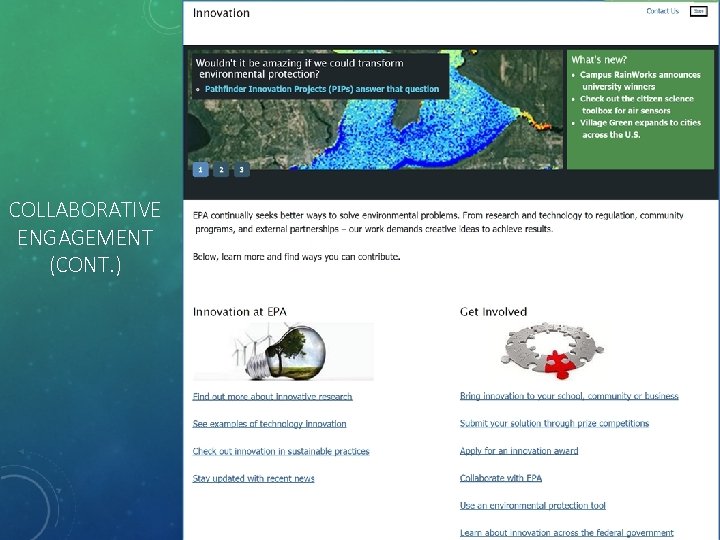
COLLABORATIVE ENGAGEMENT (CONT. )
SUMMARY • The issues we face are more complex and subtle than in the past; so, the need for the best science is greater than ever. • There is a need for more flexible, innovative methods and monitoring technology. • Collaboration with partners within and outside of the Agency provides leveraging opportunities for greater success in cleaning-up our world’s environment.
CONTACT US Lara P. Phelps Phone: 919 -541 -5544 E-mail: phelps. lara@epa. gov • Environmental Measurement Website • http: //www 2. epa. gov/measurements • NOTE: Environmental Laboratory Advisory Board included on this site.