
EOP Scholarship Class Writing a Winning Scholarship Essay
- Slides: 20
EOP Scholarship Class Writing a Winning Scholarship Essay Adapted from How to Write a Winning Scholarship Essay, Gen and Kelly Tanabe 2006; and from the SIN Collective’s adaptation of “Writing the Scholarship Essay I & II, ” Esay. Edge. com October 22, 2008 Yolanda Venegas
Why the Essay is Critical to Winning ØFor many scholarship applications it is the most important component of the application ØBeyond statistics, the essay is the window into who you are, your passion, commitments, and potential to succeed
The Making of a Powerful Essay ØWhat makes a winning scholarship essay it that it fits within the context of the overall application. ØThe essay and the other elements in your application complement each other, they are elements of your package ØAs such, each part, each component, should tell a similar story, fit into a theme
Think Cohesion ØWhen you think about the essay, think about cohesion ØConsider it within the context of your entire application ØThe goal: Present a cohesive message with your essay as the centerpiece ØEach piece of the application should add to this
And… How Do you Know What the Message of Theme of Your Essay Should be? ØThe answer is simple: The theme of your essay and of your entire application, should be determined by the goal of the award, or why the organization is giving away the money ØExamples: Øa minority advocacy organization’s goal may be to increase diversity in higher education ØA private foundation may give $ away in memory of a benefactor to support students interested in the arts or social
Make Learning their Mission Your Mission ØThis is why, it is important to research the mission/purpose/objective of the scholarship award as you compile your list of target scholarships ØOnce you know the goal of the organization in giving the award, use that knowledge to choose which aspects of your life to highlight as the general theme of the essay ØThis is not lying, it is learning to be strategic about how you tell your story--a critical skill--you adapt your story, your personal narrative by highlighting certain areas and dimming others, depending on your specific needs for that ONE application
The Goal of the Award as a Guide for Your Essay ØExample 1: If you are applying for the educator, engineer, doctor award, you want to highlight your future in the field and how you will make important contributions ØExample 2: If you are applying for an award for under- represented students, you may focus on your potential to succeed and on your proven commitment to help others (once you get there) by being a mentor and good role model ØExample 3: If you are a woman entering the sciences, marine biology or math for example, you may focus again on your potential to succeed and your determination to work towards gender equity in the hard sciences
Common Features of All Winning Essays Ø Answer the question: make sure your essay is a response to the essay prompt. This is especially important if the essay has more than one part ØFor example: “Discuss your educational and future career goals. Why do you want to pursue a college education? How will you ensure that you will succeed in college? What challenges or obstacles will you overcome? ”
Another example “Write and attach a personal essay in which you tell us about yourself. What is important for us to know about you? You may want to write about one or more of the following: your personal history, your goals and dreams, what obstacles you’ve overcome, your accomplishments, and why you want to go to college. Your essay must be typed and between 500 -100 words”
Your Strategy: Analyze the question or topic ØWrite down the essay question. How many parts does it have? Does the question suggest a structure or order, such as first describe your role in… then tell why it had the following effect… and what you learned from it…. ØDo a Descriptive Outline
Share a Slice of Your Life Ø Sharing a slice of your life is an important technique. ØWhat you share of your personal life should be again determined by theme of your essay (which as we already discussed is part of theme of your entire application packet) ØThe use of the personal is a critical part of learning how to tell your story strategically, learning how to highlight certain feature and dim others, depending on your needs--effective use of the personal is very powerful ØIt is an important skill that will be useful way beyond the scholarship essay
What not to do ØDo not turn your essay into a narrative of oppression, remember everyone in the stack has such a narrative ØSob stories help, only if you focus on the positive, how you were able to overcome obstacles and how what you learned by overcoming those obstacles ensures that you will succeed in college and in your career Øi. e how the obstacle make you a better student and will make you a better teacher, doctor, lawyer etc. ØRemember---the direction best essays have a sense of purpose and
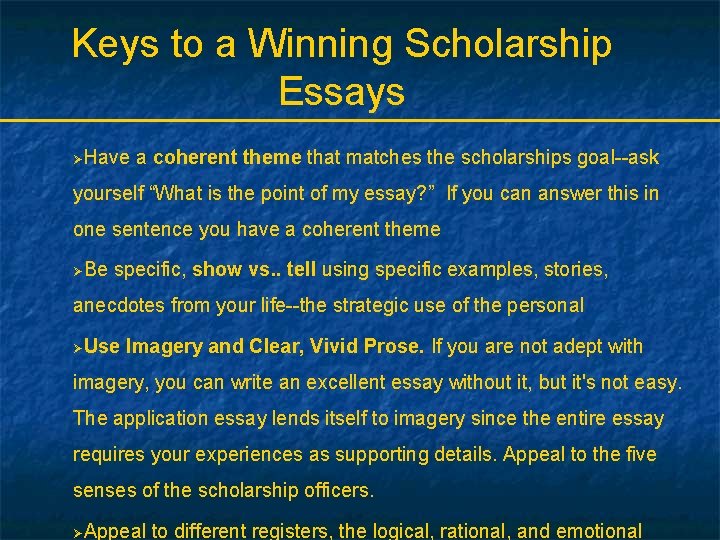
Keys to a Winning Scholarship Essays ØHave a coherent theme that matches the scholarships goal--ask yourself “What is the point of my essay? ” If you can answer this in one sentence you have a coherent theme ØBe specific, show vs. . tell using specific examples, stories, anecdotes from your life--the strategic use of the personal ØUse Imagery and Clear, Vivid Prose. If you are not adept with imagery, you can write an excellent essay without it, but it's not easy. The application essay lends itself to imagery since the entire essay requires your experiences as supporting details. Appeal to the five senses of the scholarship officers. ØAppeal to different registers, the logical, rational, and emotional
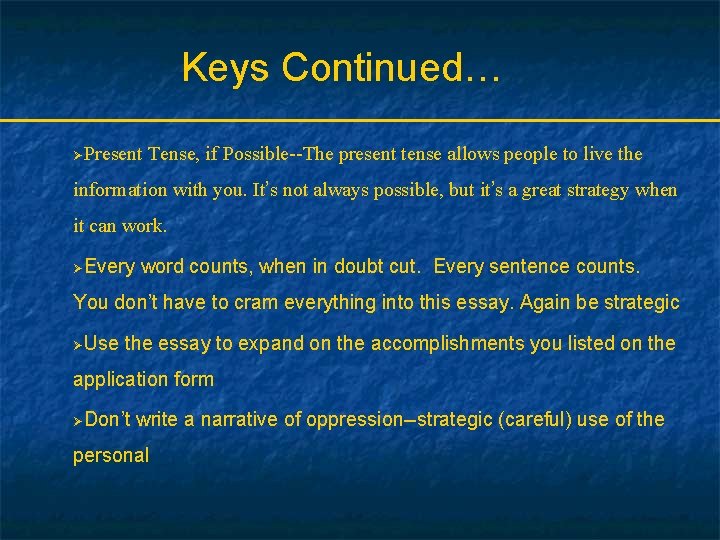
Keys Continued… ØPresent Tense, if Possible--The present tense allows people to live the information with you. It’s not always possible, but it’s a great strategy when it can work. ØEvery word counts, when in doubt cut. Every sentence counts. You don’t have to cram everything into this essay. Again be strategic ØUse the essay to expand on the accomplishments you listed on the application form ØDon’t write a narrative of oppression--strategic (careful) use of the personal
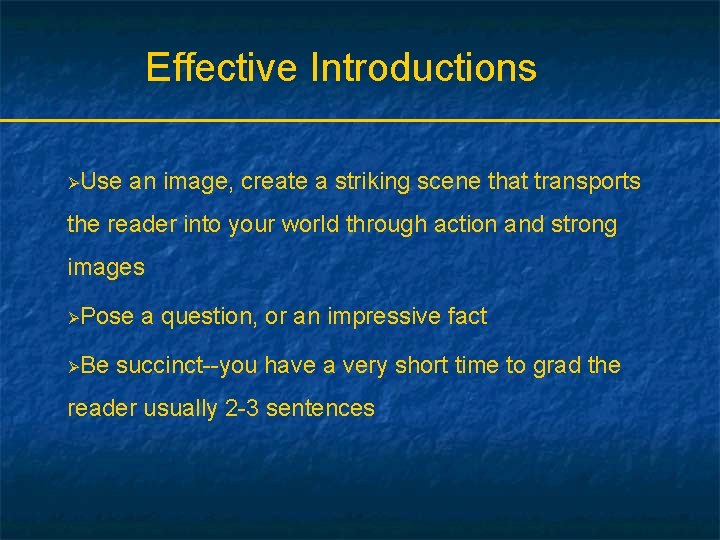
Effective Introductions ØUse an image, create a striking scene that transports the reader into your world through action and strong images ØPose ØBe a question, or an impressive fact succinct--you have a very short time to grad the reader usually 2 -3 sentences
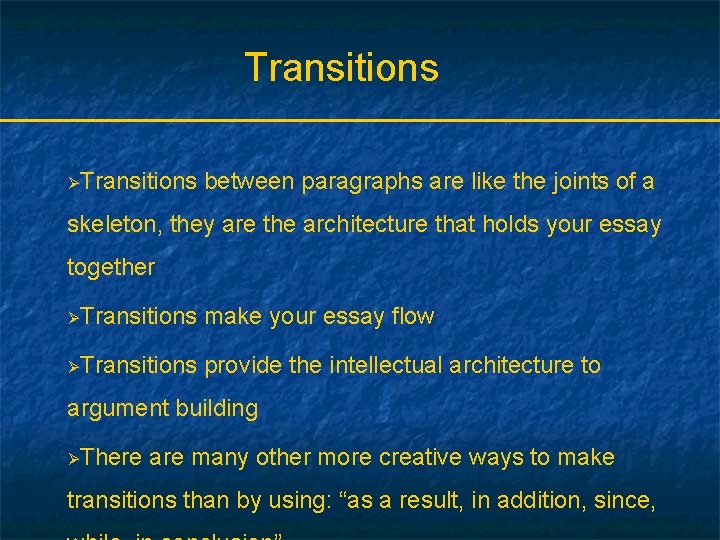
Transitions ØTransitions between paragraphs are like the joints of a skeleton, they are the architecture that holds your essay together ØTransitions make your essay flow ØTransitions provide the intellectual architecture to argument building ØThere are many other more creative ways to make transitions than by using: “as a result, in addition, since,
Effective Conclusions ØJust as important as the introduction, it is what you leave the reader with--sometimes all they will remember ØBe thoughtful, end with something insightful ØDon’t just summarize, as you do in formula essays, especially in high school ØDon’t be too quick to end--you conclusion should leave the judge with something to think about after they have finished reading
Six Steps to Writing a Winning Scholarship Essay 1. Make finding their mission your mission-do your research 2. Analyze the essay question, understand the parts 3. Create an outline based on your deconstruction of the prompt 4. Write it out 5. Get feedback 6. Rewrite it
In Conclusion: ØStart your essay with enough time to have two to three people give you feedback ØOne of those three should read your essay just for grammar and misspellings Ø Always answer the essay prompt. --answer the question or questions they are asking you to answer ØAt the very end, have another set of eyes proofread for mistakes ØAlways ØIf stay within the word, page limit there are specific formatting instructions, follow them. For
The Really Good News ØWriting effective scholarship essays is a learned skill that you will get better and better at with each revision ØRevision, with the help of others is the key to becoming a good writer ØThe skills you learn in this process are transportable-- you will need them further along, so you may as well start the process now ØThere are resources at UCSC to help you along