
EOI Review Pictures Biology EOI May 7 th10
EOI Review Pictures Biology EOI May 7 th-10 th!
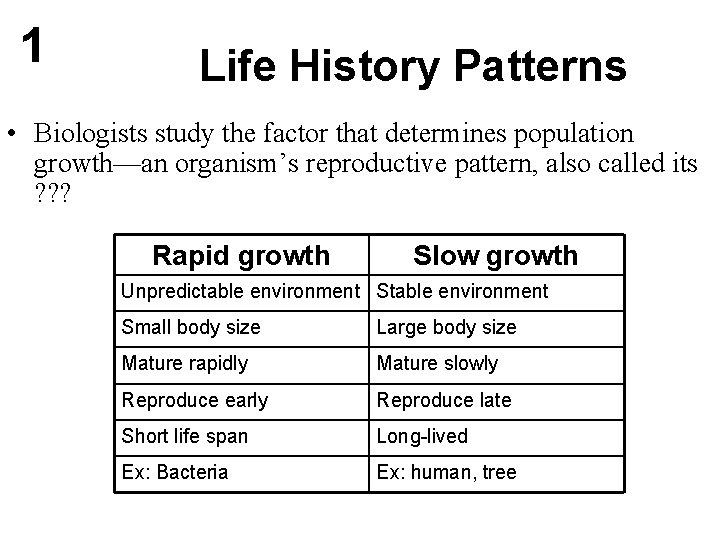
1 Life History Patterns • Biologists study the factor that determines population growth—an organism’s reproductive pattern, also called its ? ? ? Rapid growth Slow growth Unpredictable environment Small body size Large body size Mature rapidly Mature slowly Reproduce early Reproduce late Short life span Long-lived Ex: Bacteria Ex: human, tree
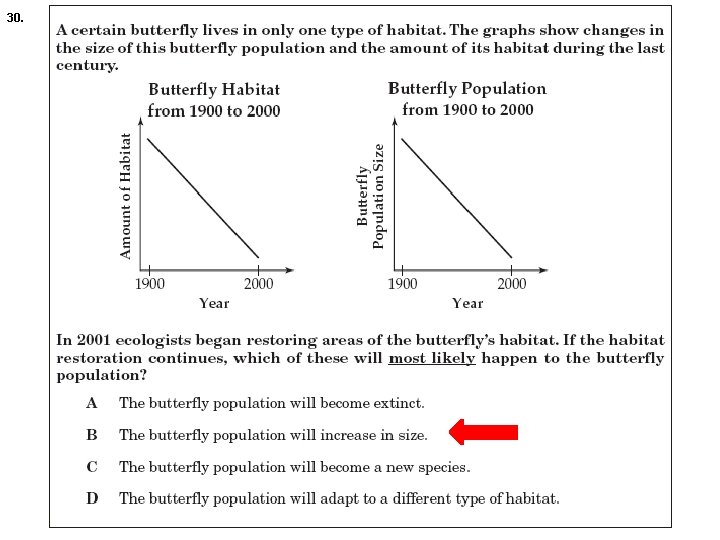
30. 3
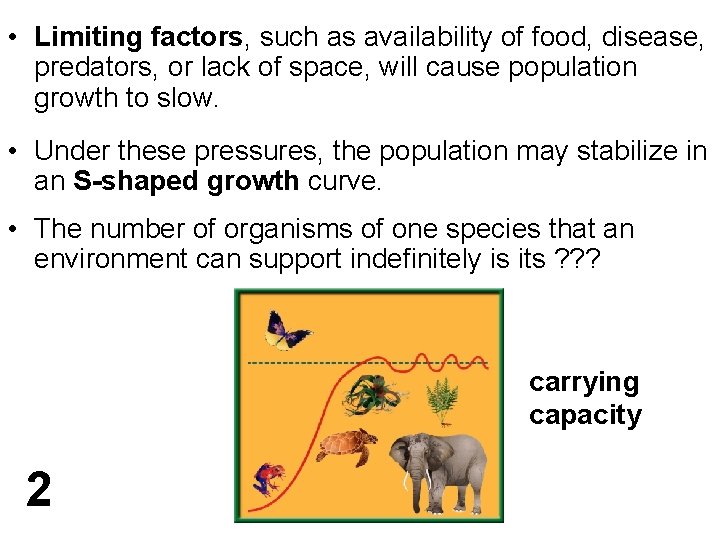
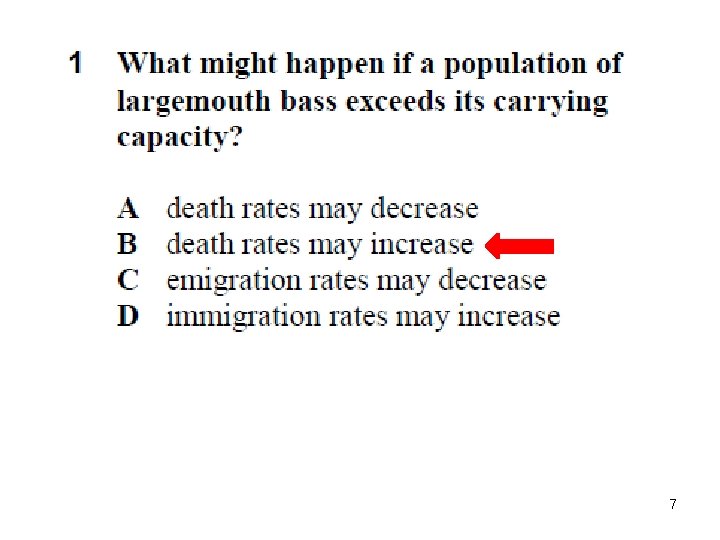
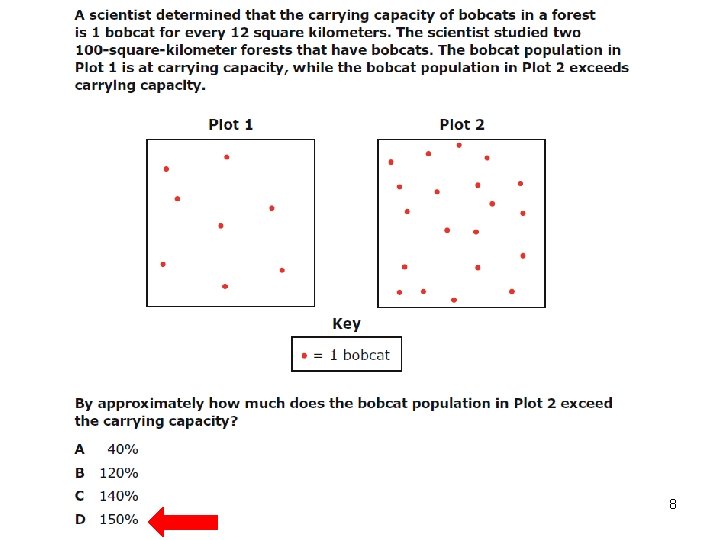
• Limiting factors, such as availability of food, disease, predators, or lack of space, will cause population growth to slow. • Under these pressures, the population may stabilize in an S-shaped growth curve. • The number of organisms of one species that an environment can support indefinitely is its ? ? ? carrying capacity 2
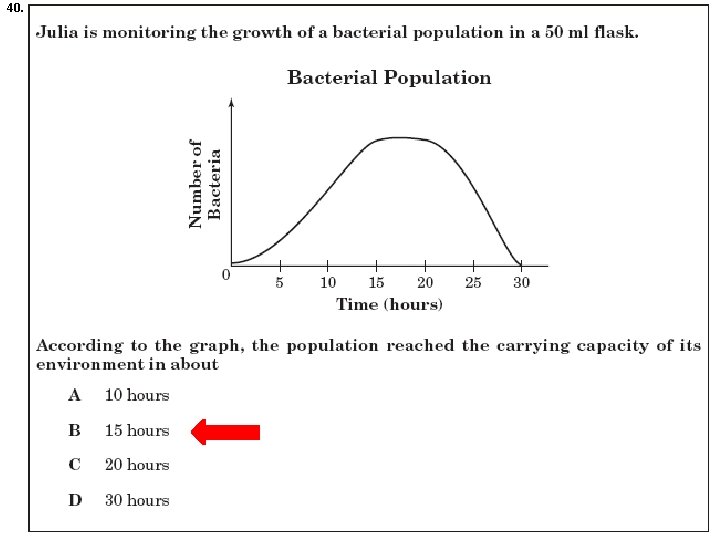
40. 5
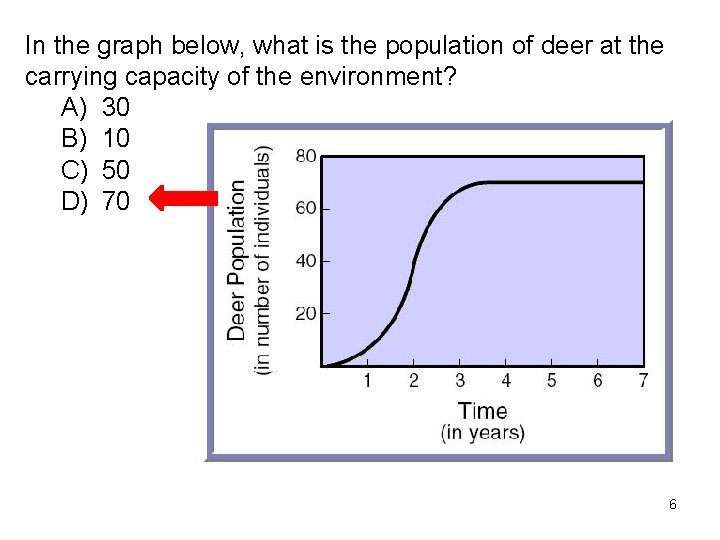
In the graph below, what is the population of deer at the carrying capacity of the environment? A) 30 B) 10 C) 50 D) 70 6
7
8
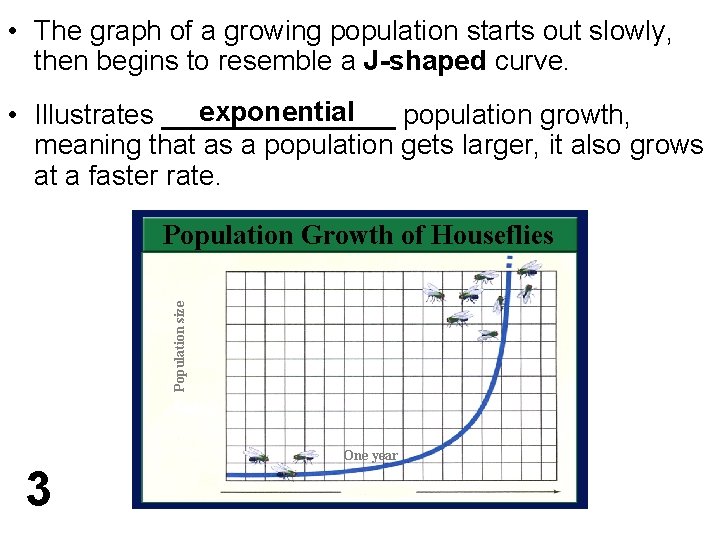
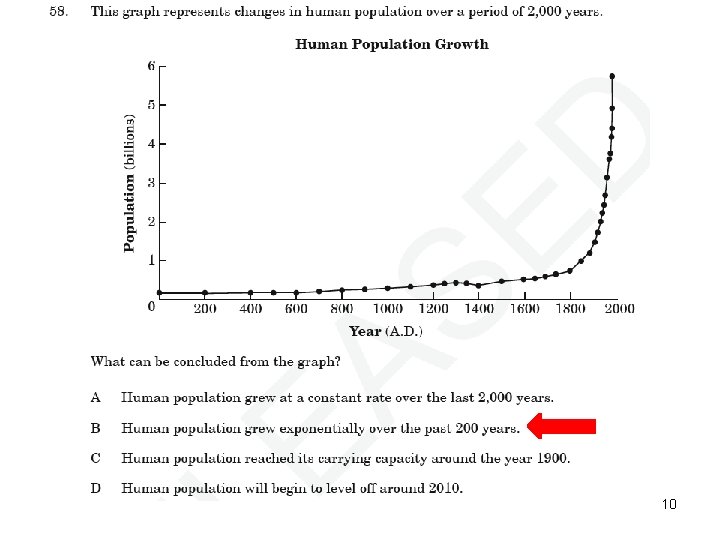
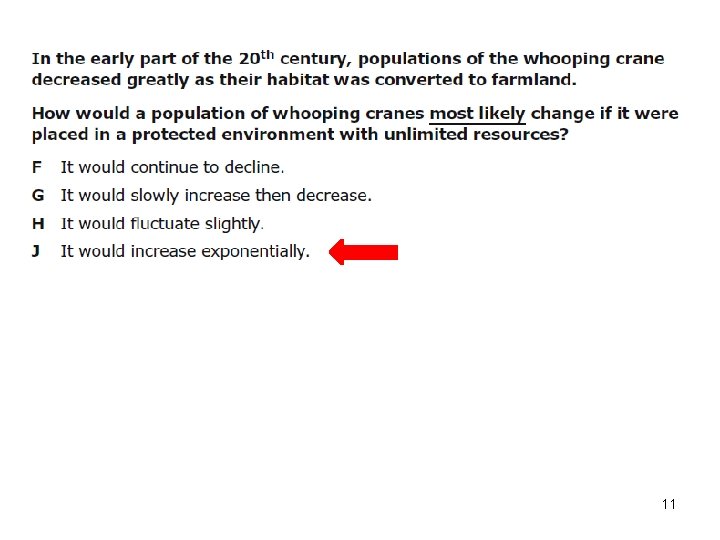
• The graph of a growing population starts out slowly, then begins to resemble a J-shaped curve. exponential • Illustrates ________ population growth, meaning that as a population gets larger, it also grows at a faster rate. Population size Population Growth of Houseflies One year 3
10
11
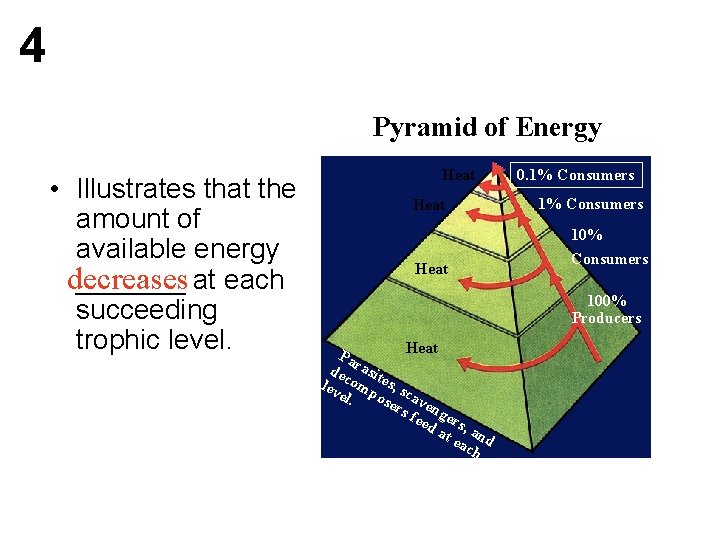
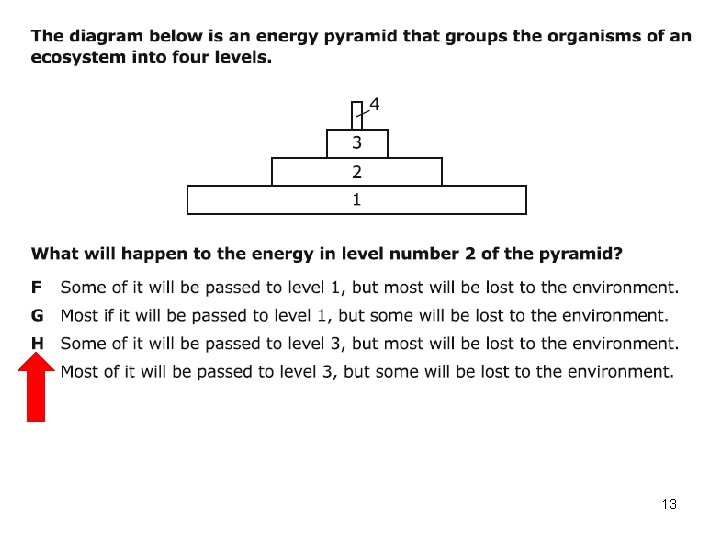
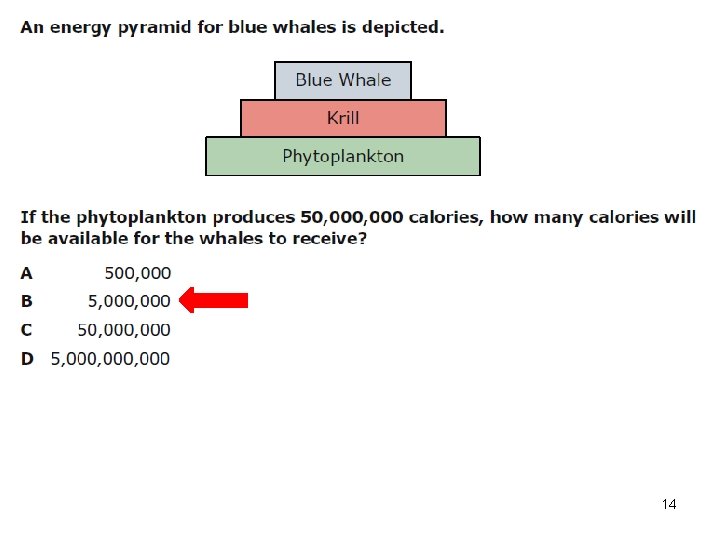
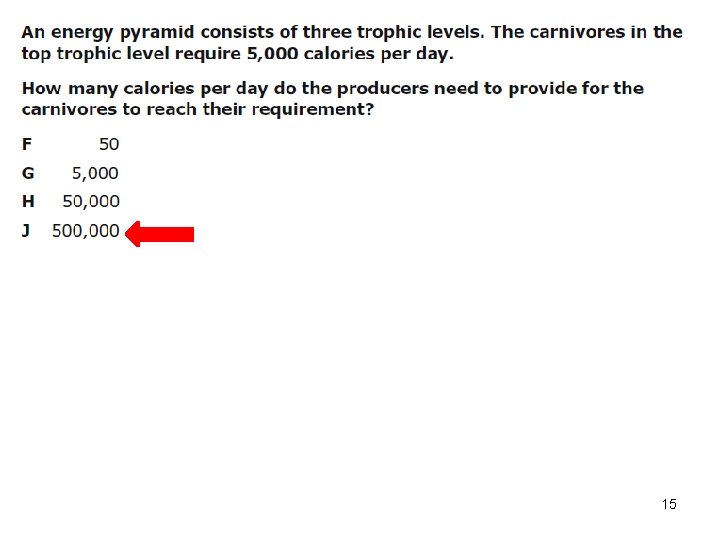
4 Pyramid of Energy • Illustrates that the amount of available energy _______ at each decreases succeeding trophic level. Heat 0. 1% Consumers 10% Heat Consumers 100% Producers Heat Pa r dec asit lev omp es, s el. ose cav rs eng fee ers da , a t e nd ach
13
14
15
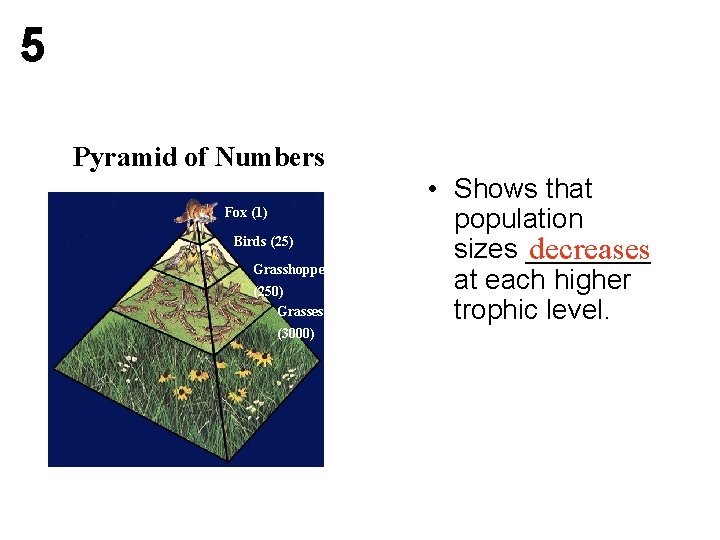
5 Pyramid of Numbers Fox (1) Birds (25) Grasshoppers (250) Grasses (3000) • Shows that population sizes ____ decreases at each higher trophic level.
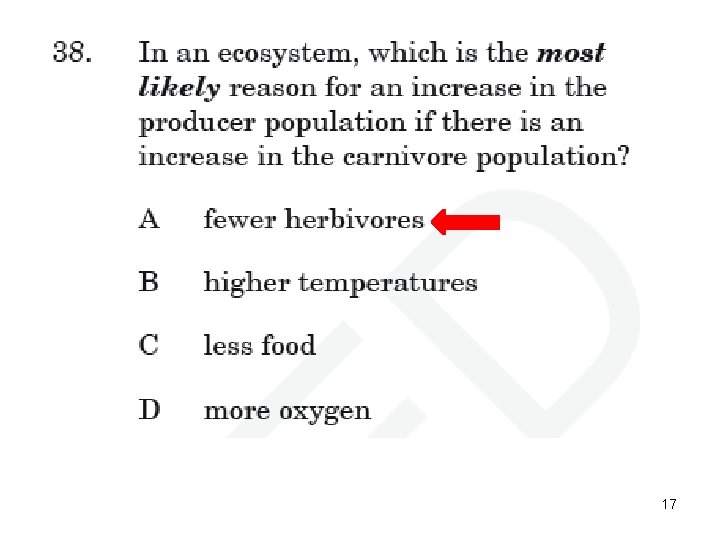
17
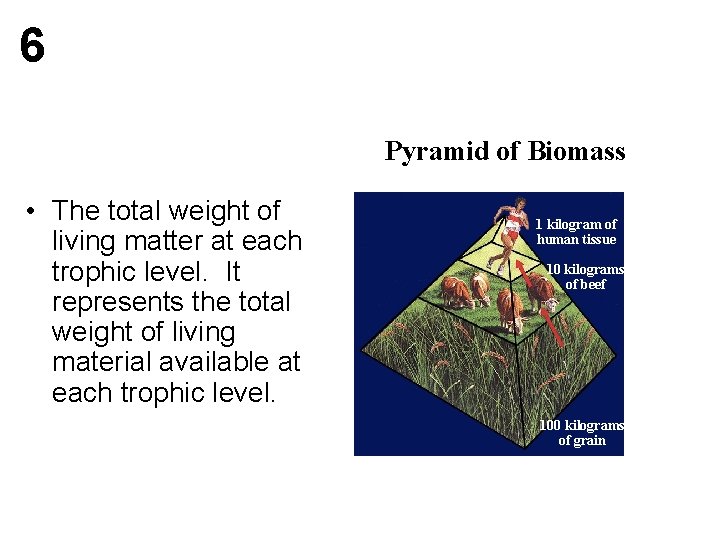
6 Pyramid of Biomass • The total weight of living matter at each trophic level. It represents the total weight of living material available at each trophic level. 1 kilogram of human tissue 10 kilograms of beef 100 kilograms of grain
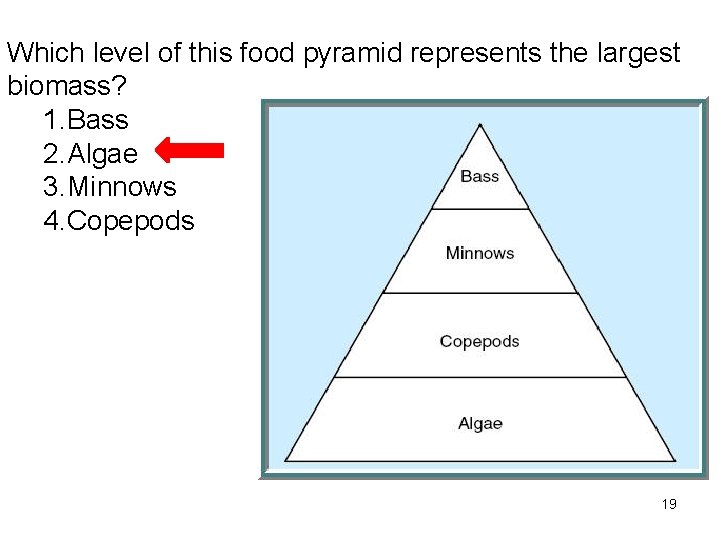
Which level of this food pyramid represents the largest biomass? 1. Bass 2. Algae 3. Minnows 4. Copepods 19
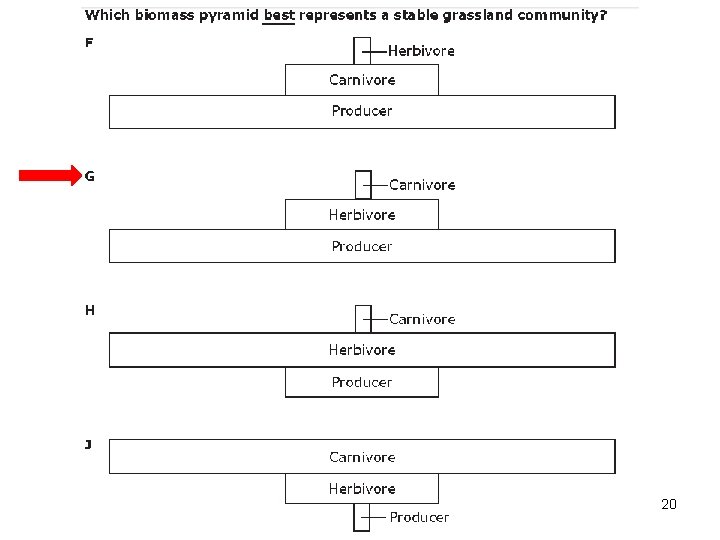
20
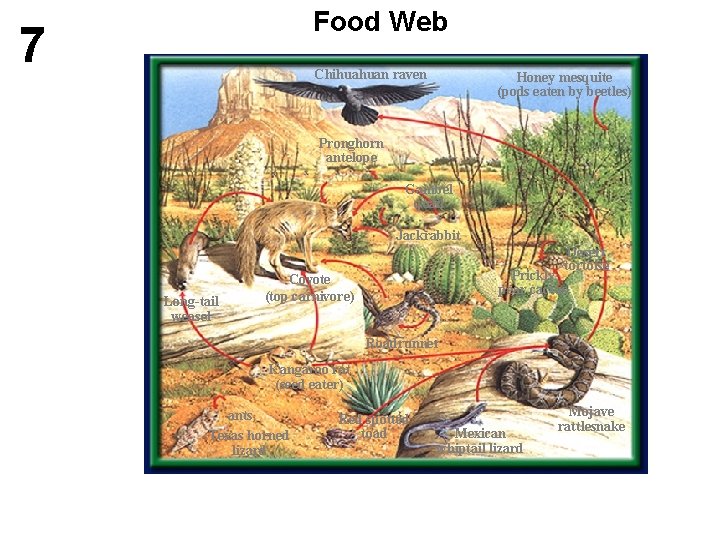
Food Web 7 Chihuahuan raven Honey mesquite (pods eaten by beetles) Pronghorn antelope Gambel quail Jackrabbit Long-tail weasel Desert tortoise Prickly pear cactus Coyote (top carnivore) Roadrunner Kangaroo rat (seed eater) ants Texas horned lizard Red spotted toad Mexican whiptail lizard Mojave rattlesnake
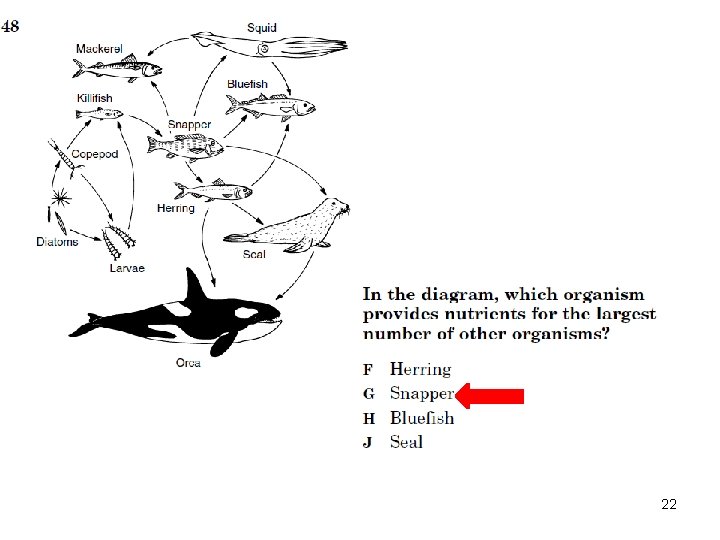
22
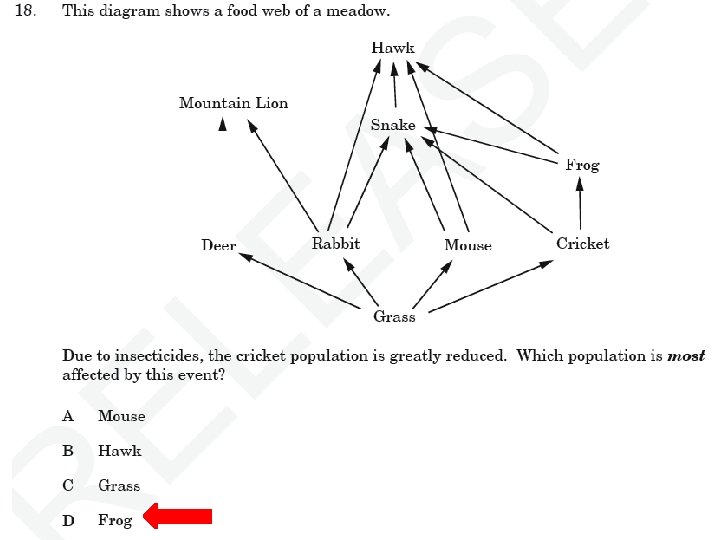
23
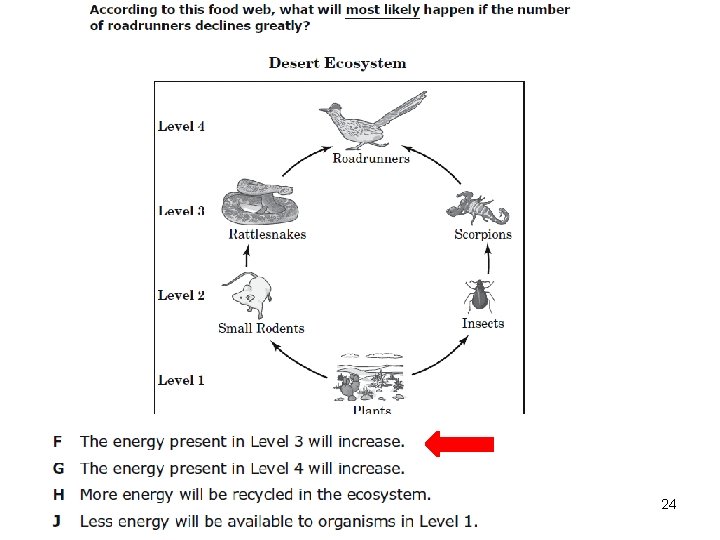
24
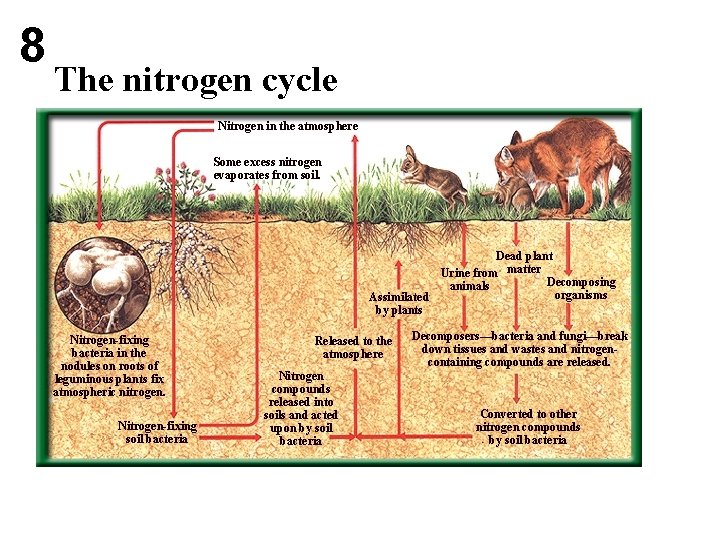
8 The nitrogen cycle Nitrogen in the atmosphere Some excess nitrogen evaporates from soil. Dead plant Urine from matter Decomposing animals organisms Assimilated by plants Nitrogen-fixing bacteria in the nodules on roots of leguminous plants fix atmospheric nitrogen. Nitrogen-fixing soil bacteria Released to the atmosphere Nitrogen compounds released into soils and acted upon by soil bacteria Decomposers—bacteria and fungi—break down tissues and wastes and nitrogencontaining compounds are released. Converted to other nitrogen compounds by soil bacteria
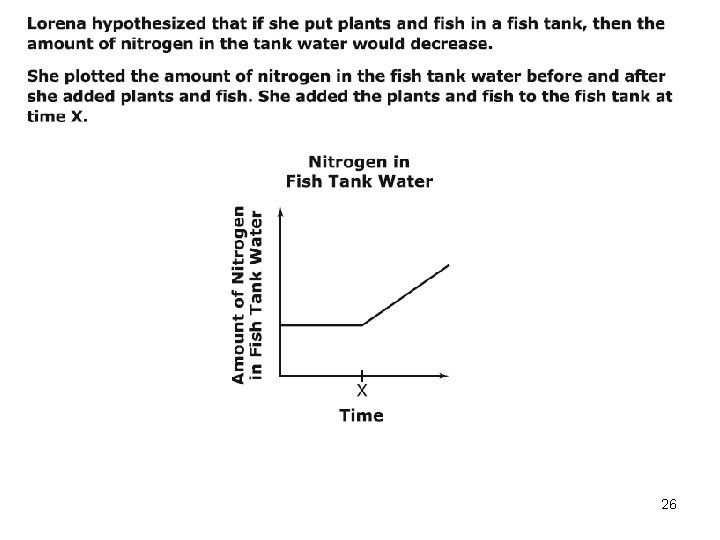
26
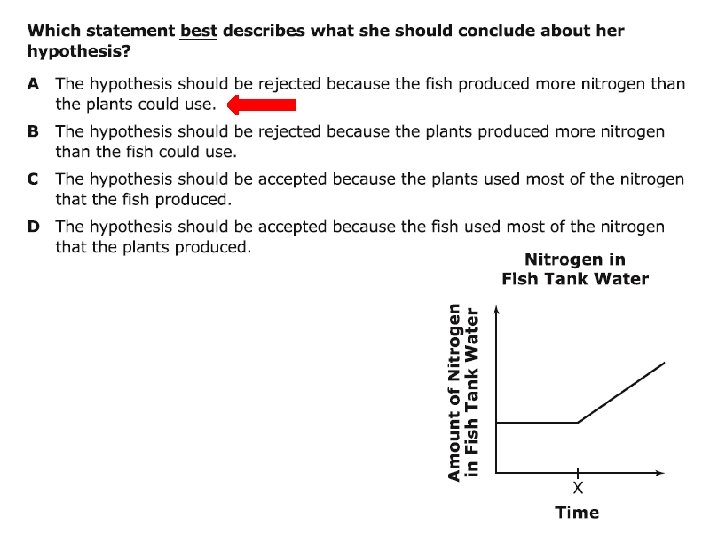
27
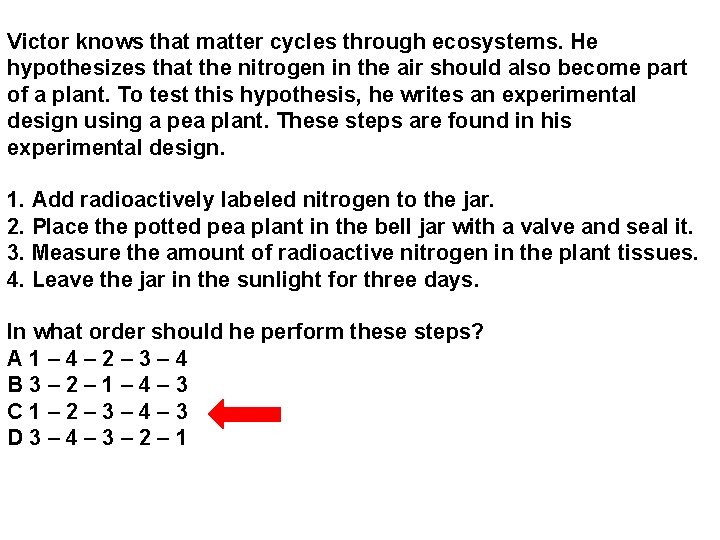
Victor knows that matter cycles through ecosystems. He hypothesizes that the nitrogen in the air should also become part of a plant. To test this hypothesis, he writes an experimental design using a pea plant. These steps are found in his experimental design. 1. Add radioactively labeled nitrogen to the jar. 2. Place the potted pea plant in the bell jar with a valve and seal it. 3. Measure the amount of radioactive nitrogen in the plant tissues. 4. Leave the jar in the sunlight for three days. In what order should he perform these steps? A 1– 4– 2– 3– 4 B 3– 2– 1– 4– 3 C 1– 2– 3– 4– 3 D 3– 4– 3– 2– 1
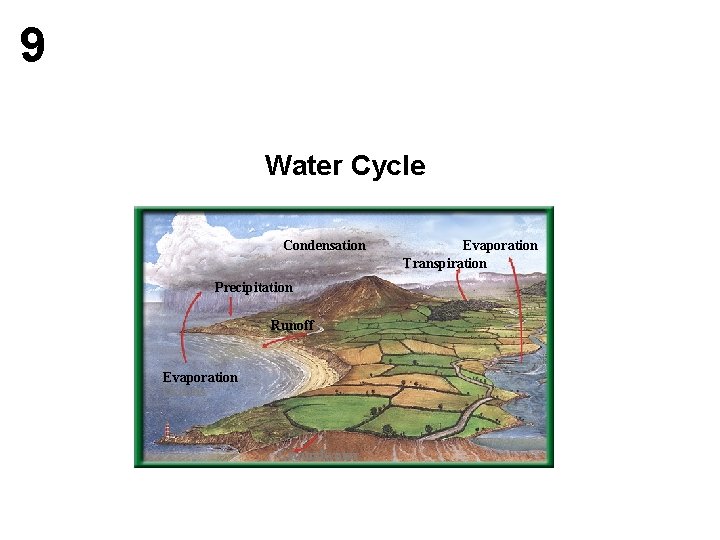
9 Water Cycle Condensation Precipitation Runoff Evaporation Oceans Groundwater Evaporation Transpiration
30
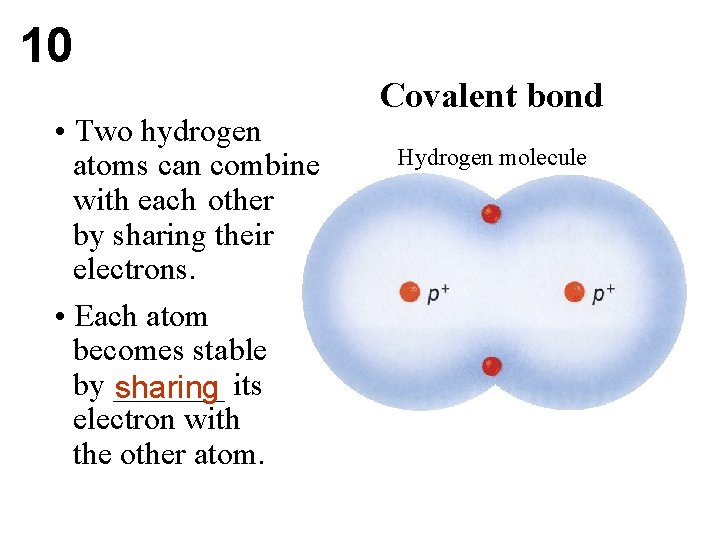
10 • Two hydrogen atoms can combine with each other by sharing their electrons. • Each atom becomes stable by _______ sharing its electron with the other atom. Covalent bond Hydrogen molecule
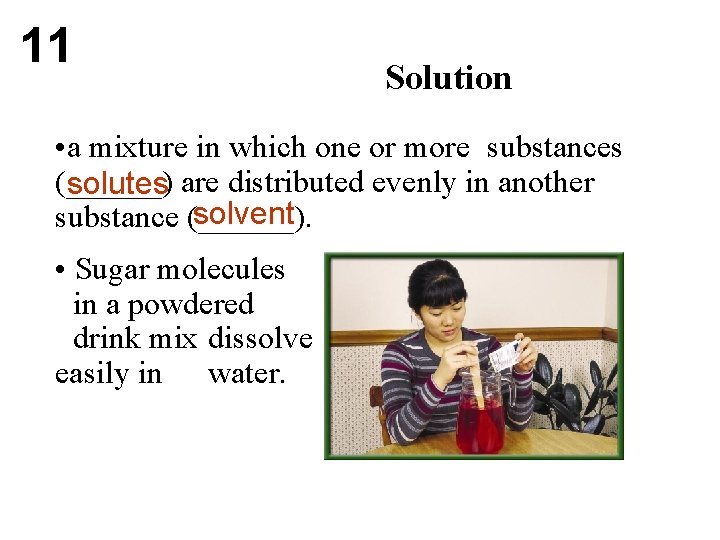
11 Solution • a mixture in which one or more substances (______) solutes are distributed evenly in another solvent substance (______). • Sugar molecules in a powdered drink mix dissolve easily in water.
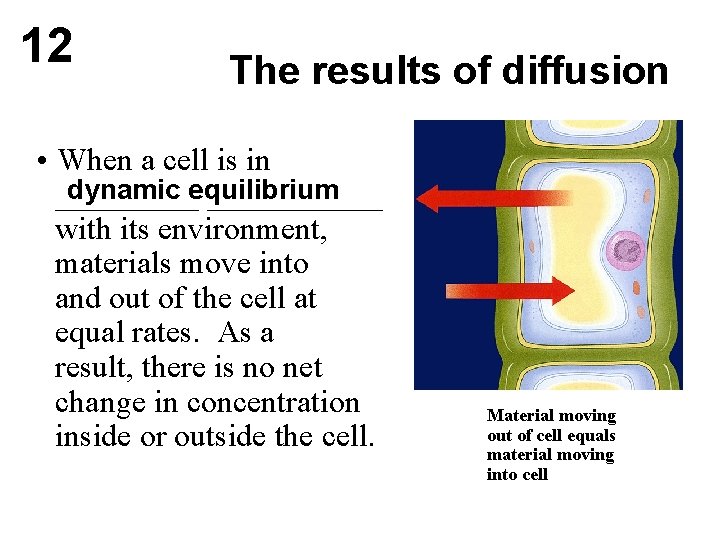
12 The results of diffusion • When a cell is in dynamic equilibrium ___________ with its environment, materials move into and out of the cell at equal rates. As a result, there is no net change in concentration inside or outside the cell. Material moving out of cell equals material moving into cell
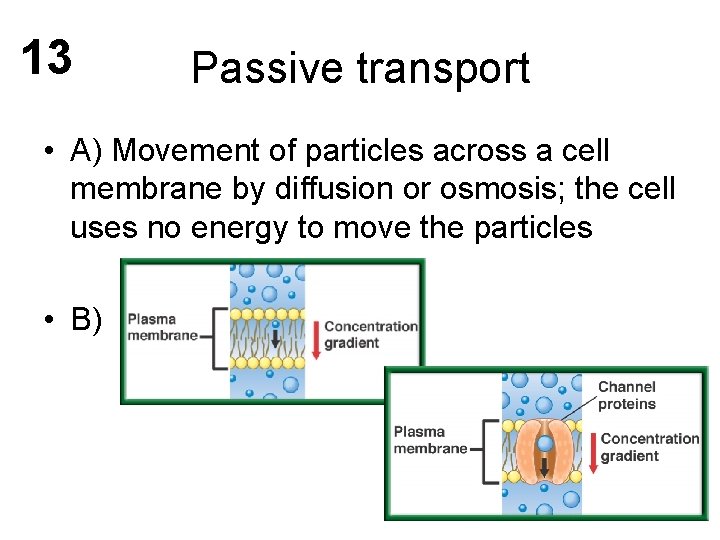
13 Passive transport • A) Movement of particles across a cell membrane by diffusion or osmosis; the cell uses no energy to move the particles • B)
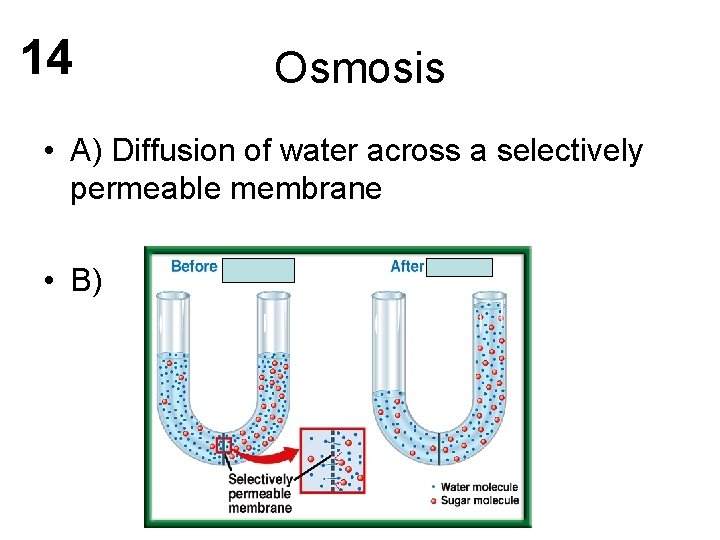
14 Osmosis • A) Diffusion of water across a selectively permeable membrane • B)
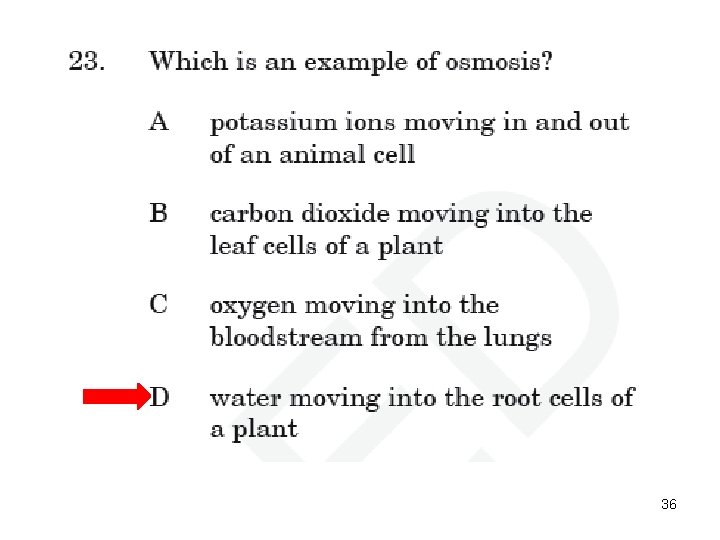
36
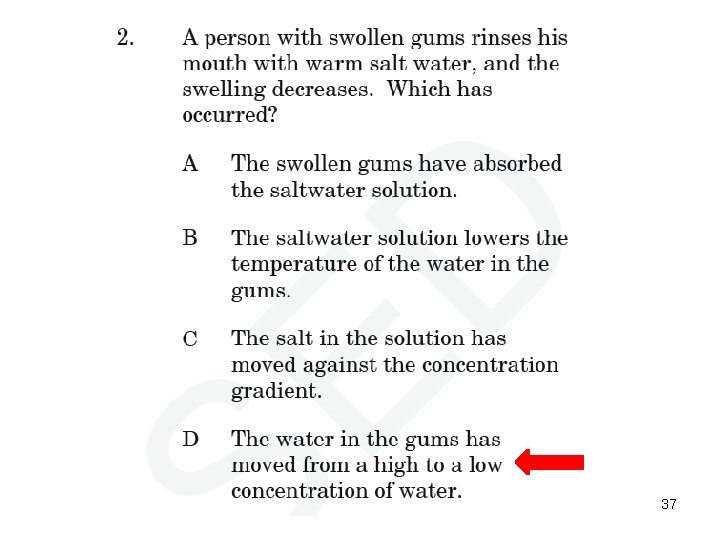
37
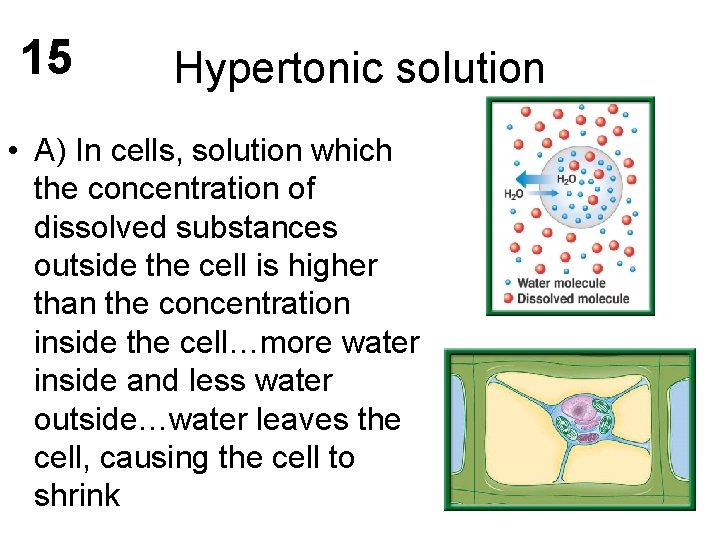
15 Hypertonic solution • A) In cells, solution which the concentration of dissolved substances outside the cell is higher than the concentration inside the cell…more water inside and less water outside…water leaves the cell, causing the cell to shrink
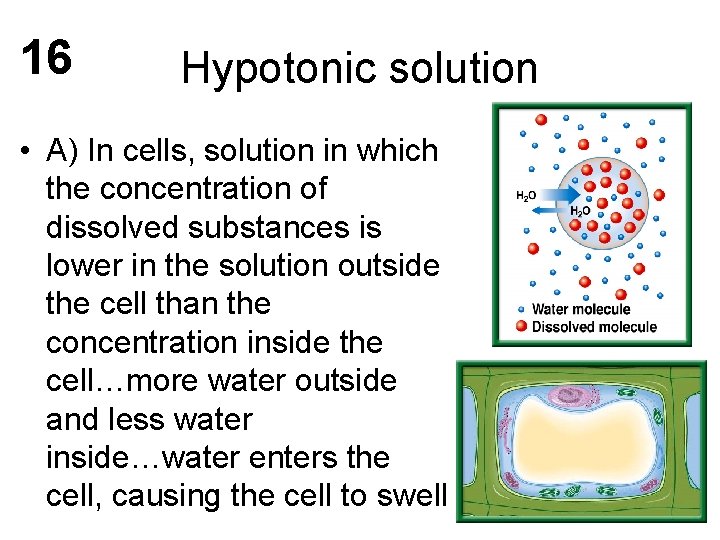
16 Hypotonic solution • A) In cells, solution in which the concentration of dissolved substances is lower in the solution outside the cell than the concentration inside the cell…more water outside and less water inside…water enters the cell, causing the cell to swell
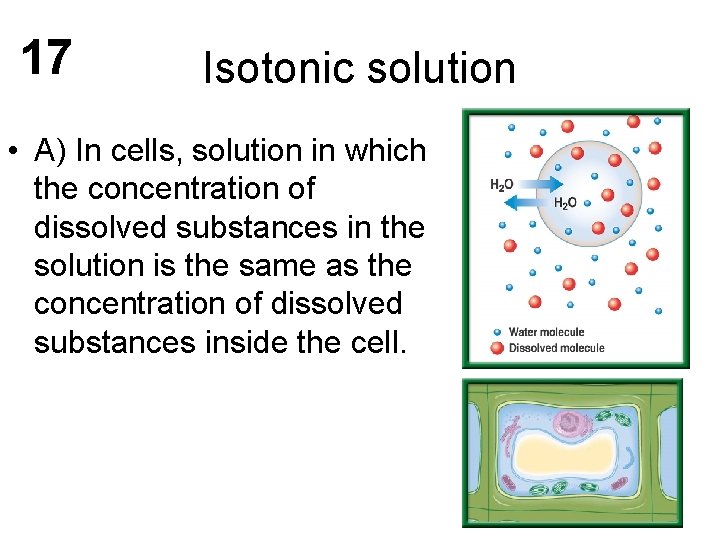
17 Isotonic solution • A) In cells, solution in which the concentration of dissolved substances in the solution is the same as the concentration of dissolved substances inside the cell.
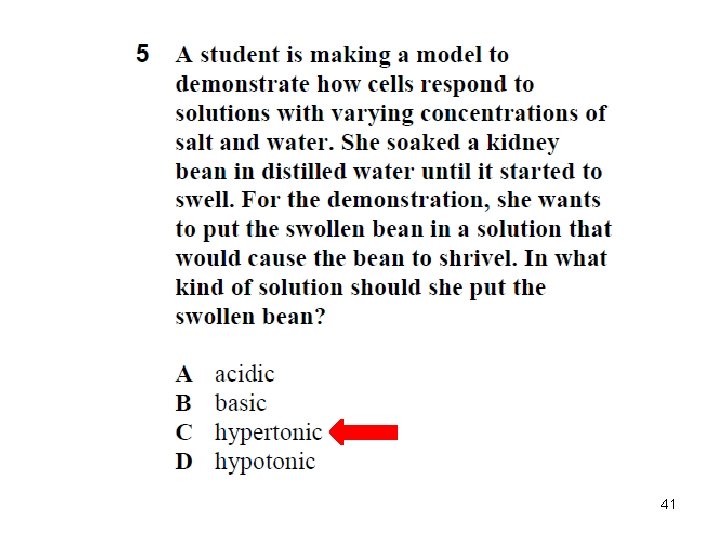
41
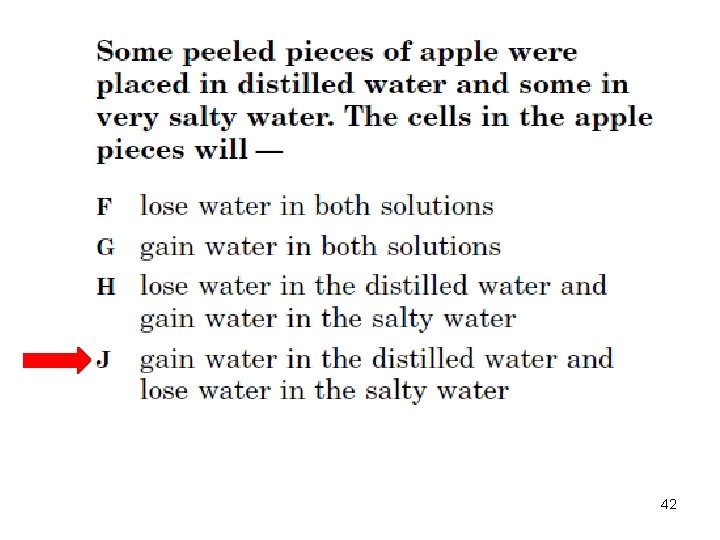
42
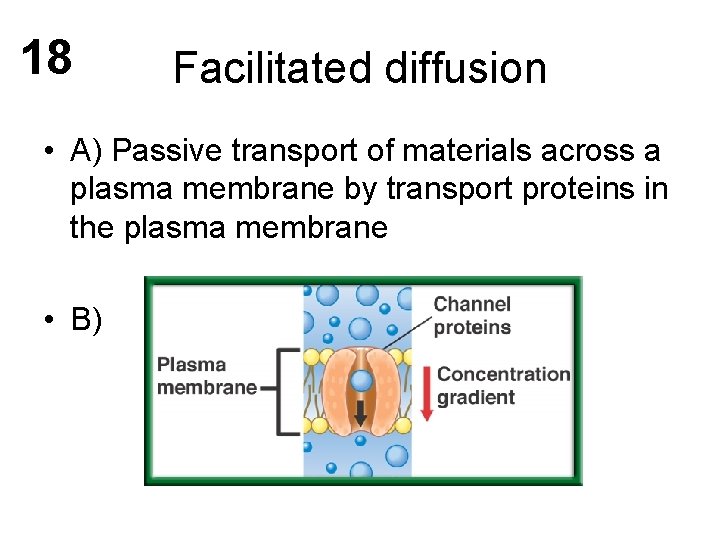
18 Facilitated diffusion • A) Passive transport of materials across a plasma membrane by transport proteins in the plasma membrane • B)
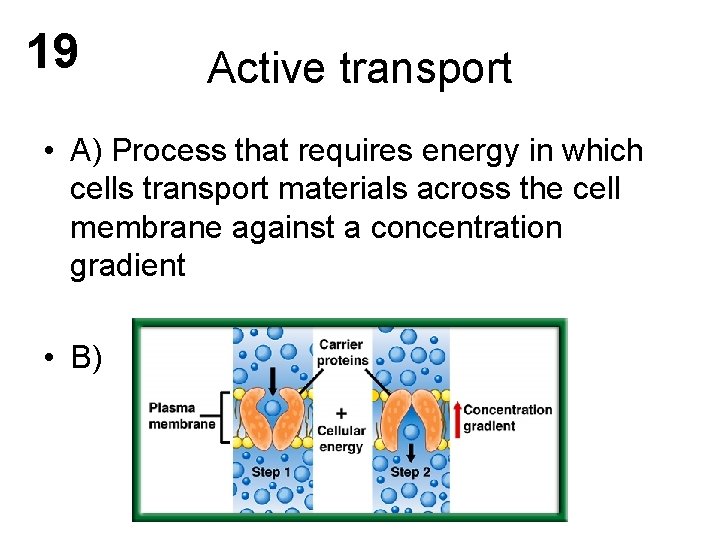
19 Active transport • A) Process that requires energy in which cells transport materials across the cell membrane against a concentration gradient • B)
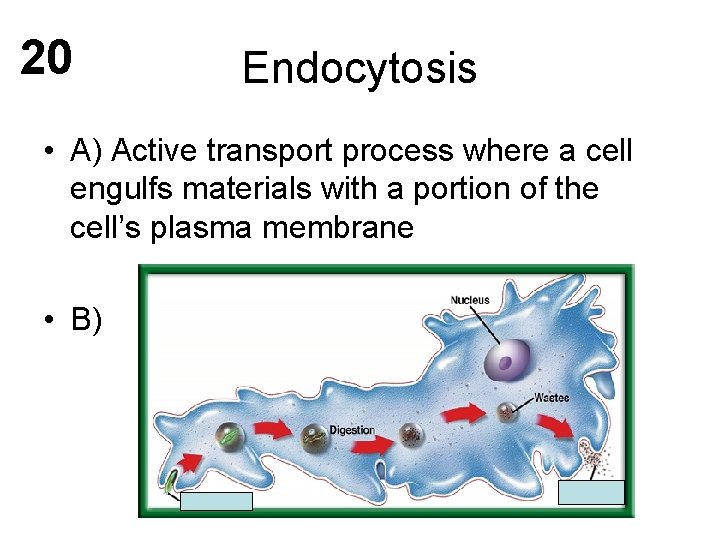
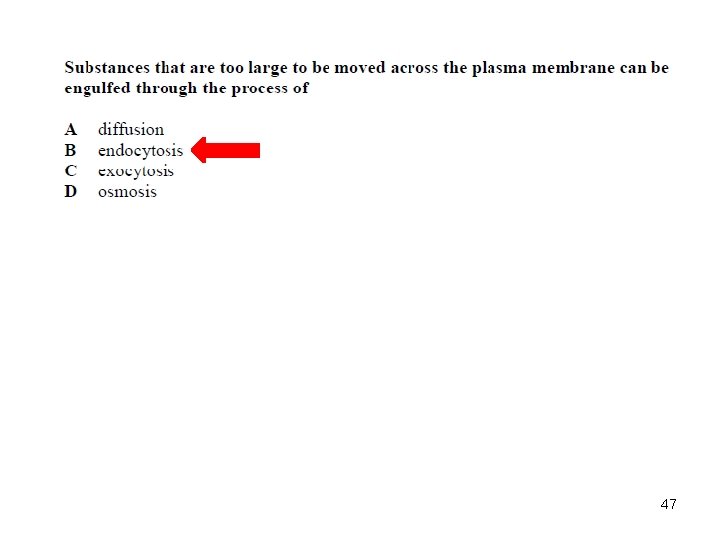
20 Endocytosis • A) Active transport process where a cell engulfs materials with a portion of the cell’s plasma membrane • B)
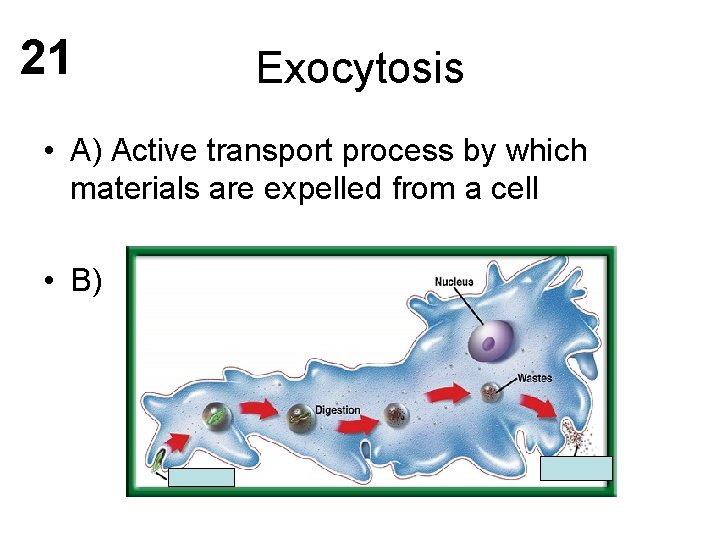
21 Exocytosis • A) Active transport process by which materials are expelled from a cell • B)
47
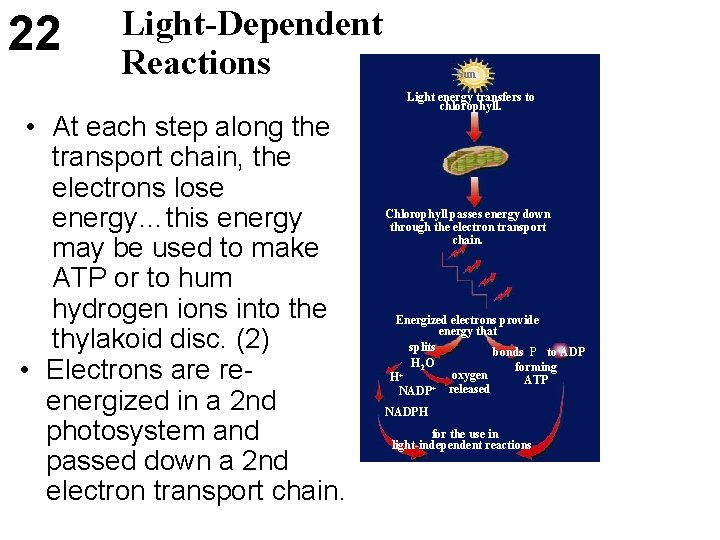
22 Light-Dependent Reactions • At each step along the transport chain, the electrons lose energy…this energy may be used to make ATP or to hum hydrogen ions into the thylakoid disc. (2) • Electrons are reenergized in a 2 nd photosystem and passed down a 2 nd electron transport chain. Sun Light energy transfers to chlorophyll. Chlorophyll passes energy down through the electron transport chain. Energized electrons provide energy that splits bonds P to ADP H 2 O forming oxygen H+ ATP NADP+ released NADPH for the use in light-independent reactions
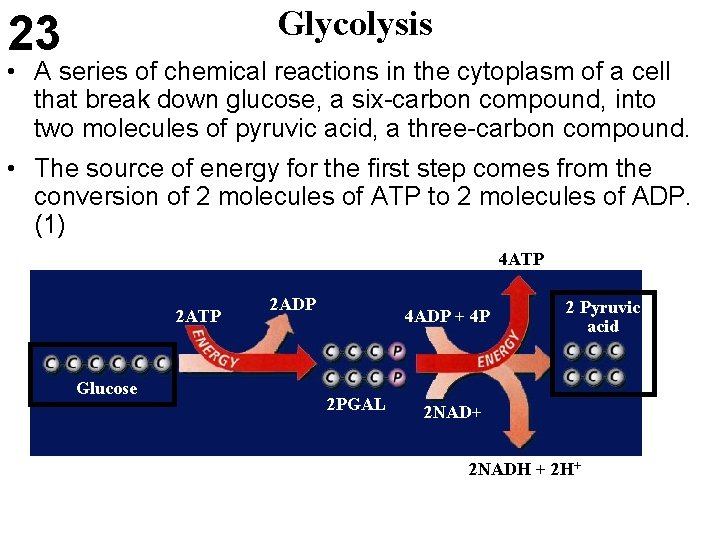
Glycolysis 23 • A series of chemical reactions in the cytoplasm of a cell that break down glucose, a six-carbon compound, into two molecules of pyruvic acid, a three-carbon compound. • The source of energy for the first step comes from the conversion of 2 molecules of ATP to 2 molecules of ADP. (1) 4 ATP 2 ATP Glucose 2 ADP 4 ADP + 4 P 2 PGAL 2 Pyruvic acid 2 NAD+ 2 NADH + 2 H+
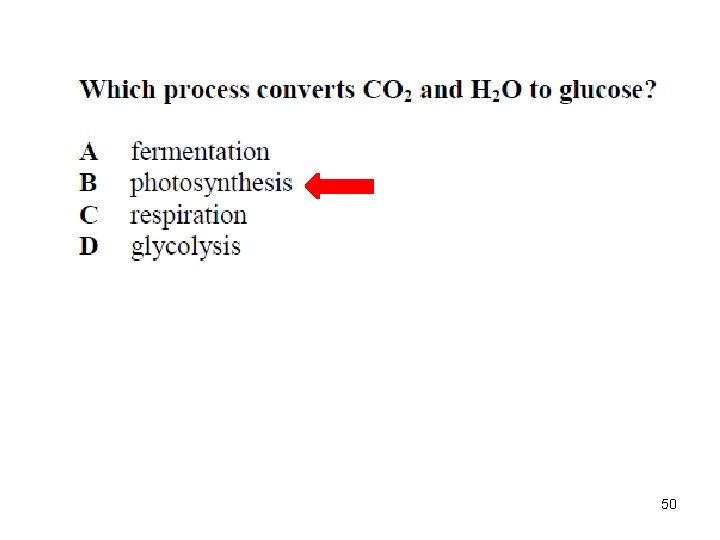
50
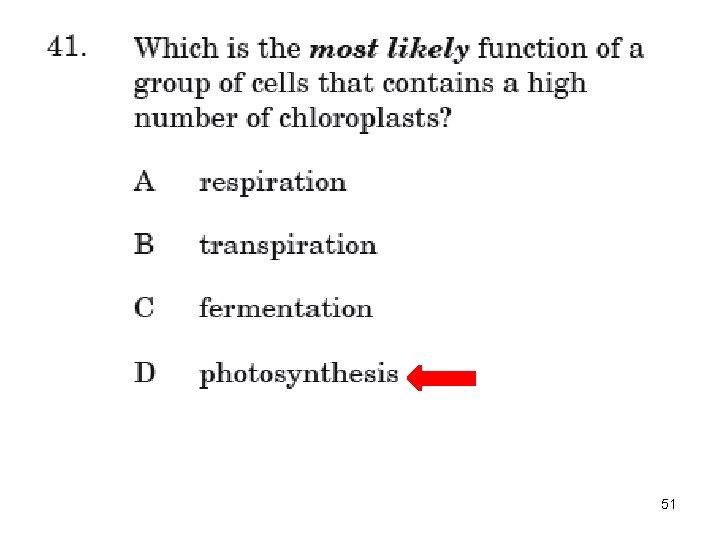
51
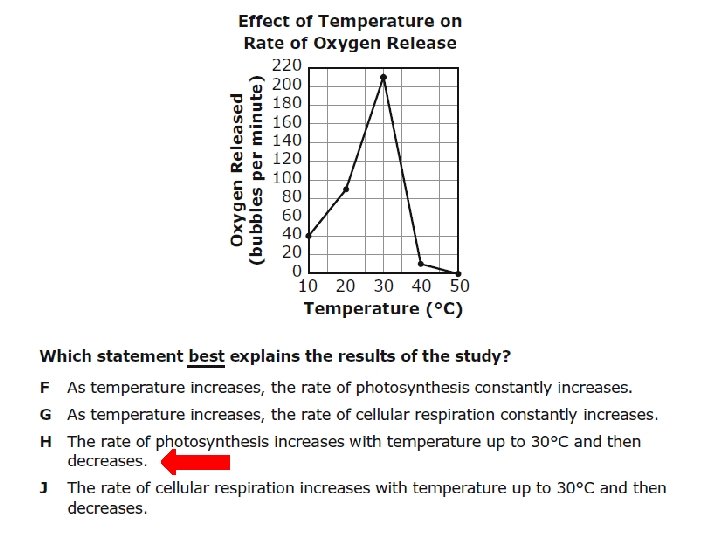
52
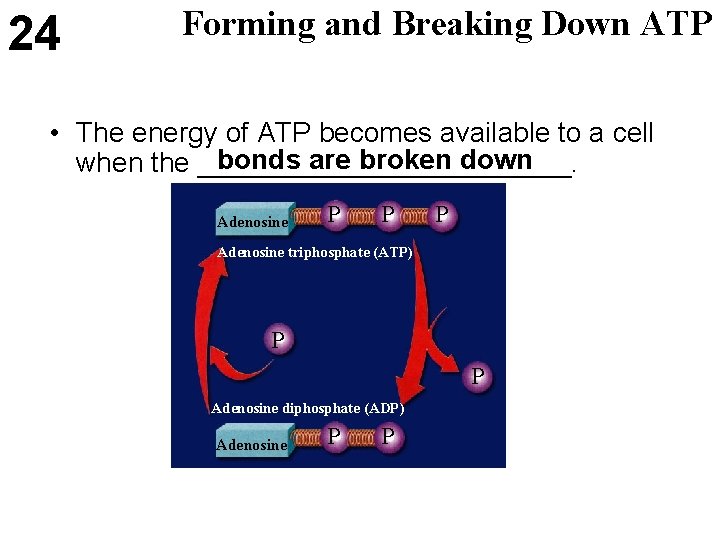
24 Forming and Breaking Down ATP • The energy of ATP becomes available to a cell bonds are broken down when the ____________. Adenosine P P P Adenosine triphosphate (ATP) P P Adenosine diphosphate (ADP) Adenosine P P
54
55
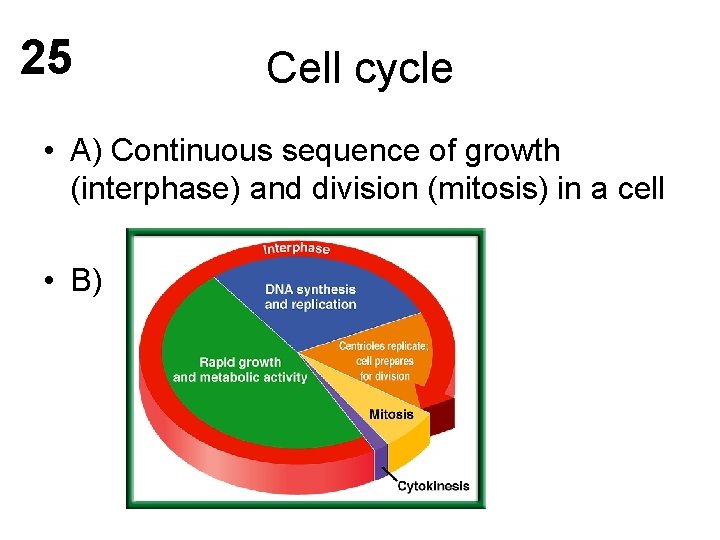
25 Cell cycle • A) Continuous sequence of growth (interphase) and division (mitosis) in a cell • B)
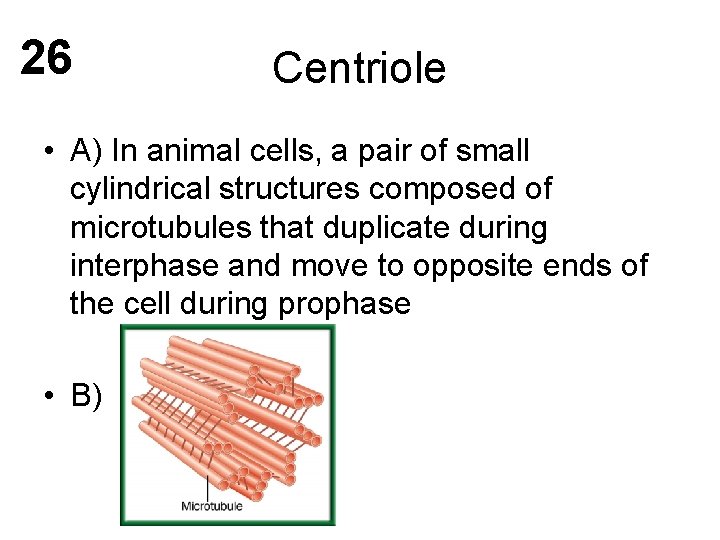
26 Centriole • A) In animal cells, a pair of small cylindrical structures composed of microtubules that duplicate during interphase and move to opposite ends of the cell during prophase • B)
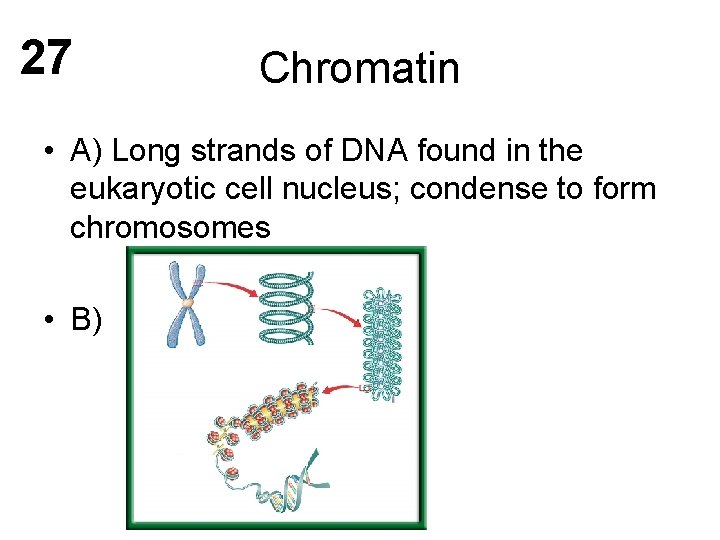
27 Chromatin • A) Long strands of DNA found in the eukaryotic cell nucleus; condense to form chromosomes • B)
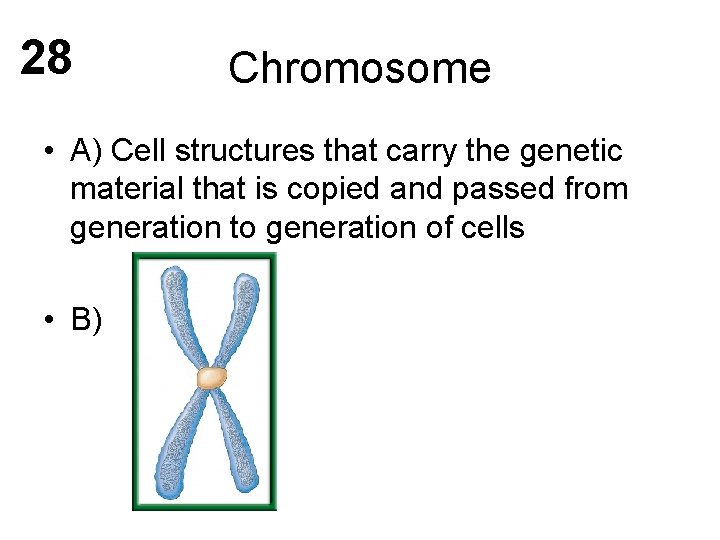
28 Chromosome • A) Cell structures that carry the genetic material that is copied and passed from generation to generation of cells • B)
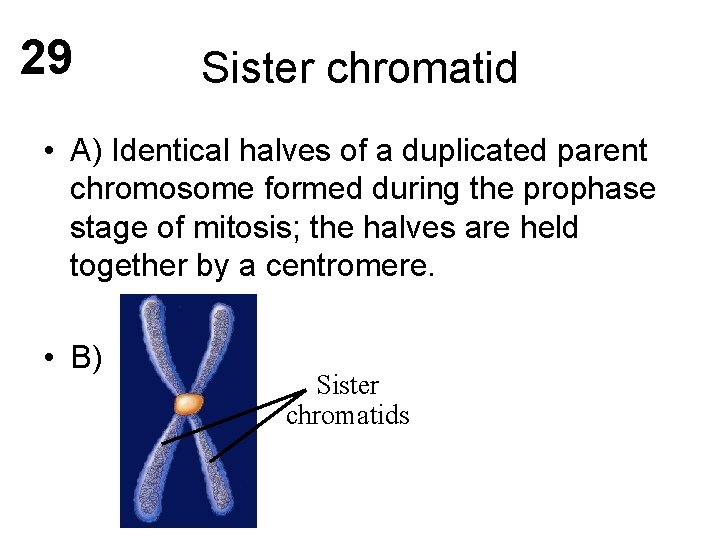
29 Sister chromatid • A) Identical halves of a duplicated parent chromosome formed during the prophase stage of mitosis; the halves are held together by a centromere. • B) Sister chromatids
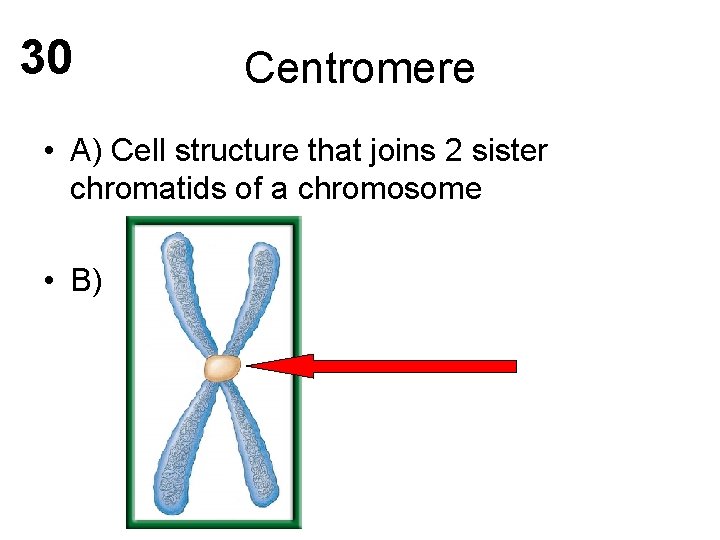
30 Centromere • A) Cell structure that joins 2 sister chromatids of a chromosome • B)
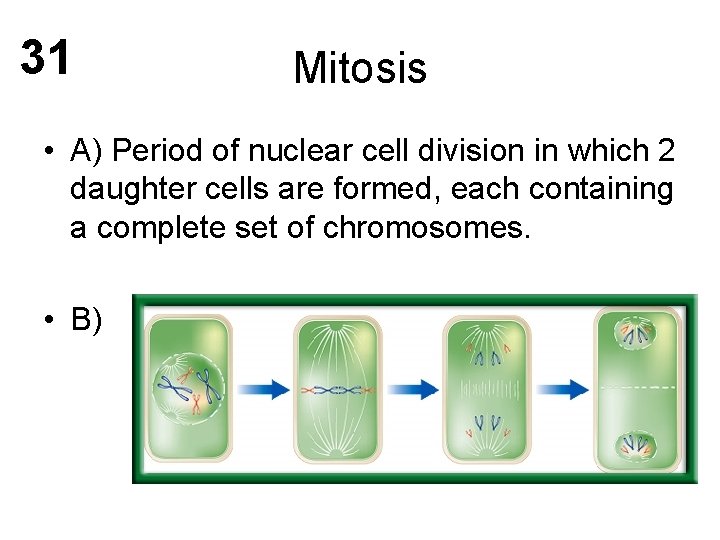
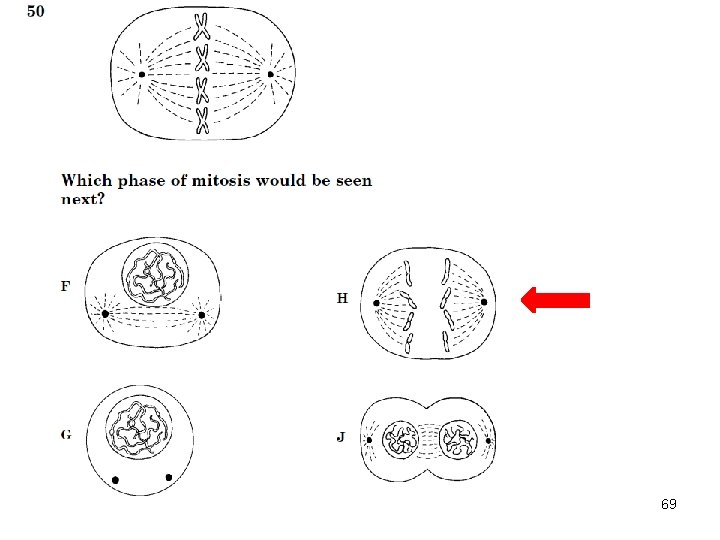
31 Mitosis • A) Period of nuclear cell division in which 2 daughter cells are formed, each containing a complete set of chromosomes. • B)
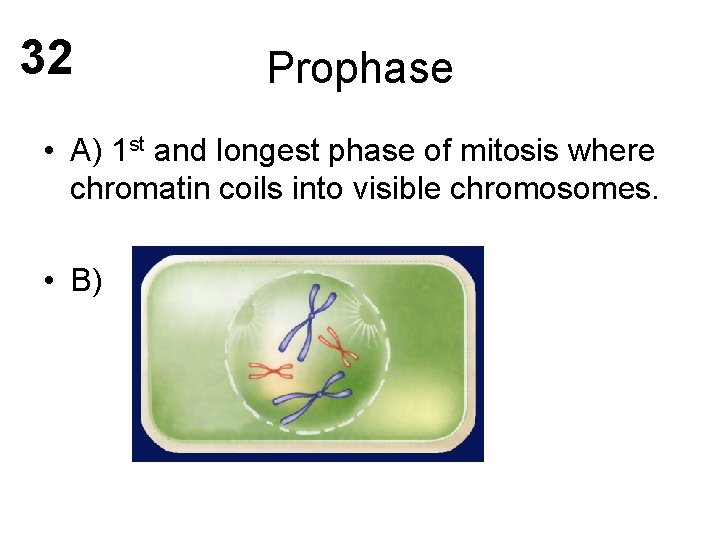
32 Prophase • A) 1 st and longest phase of mitosis where chromatin coils into visible chromosomes. • B)
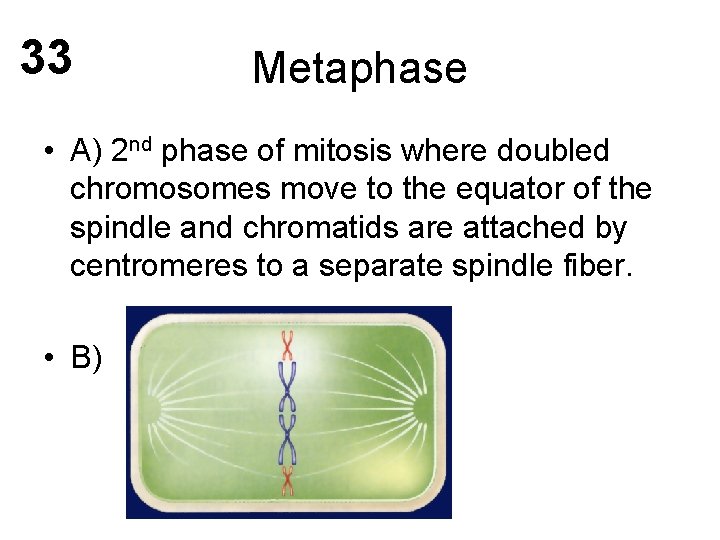
33 Metaphase • A) 2 nd phase of mitosis where doubled chromosomes move to the equator of the spindle and chromatids are attached by centromeres to a separate spindle fiber. • B)
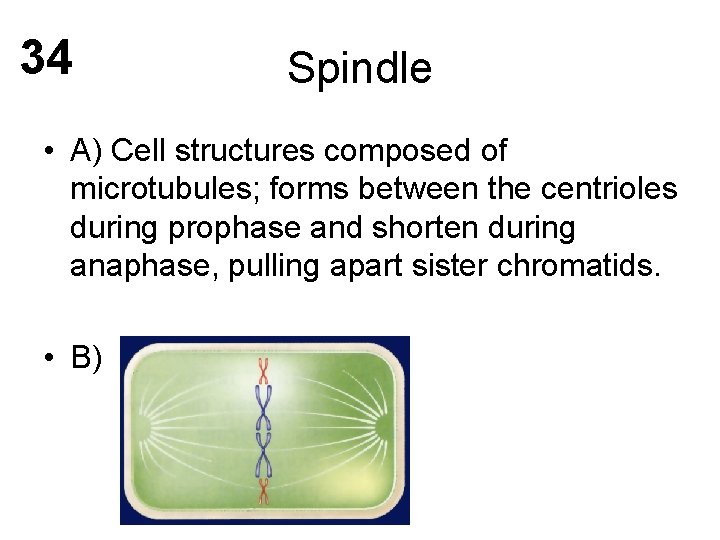
34 Spindle • A) Cell structures composed of microtubules; forms between the centrioles during prophase and shorten during anaphase, pulling apart sister chromatids. • B)
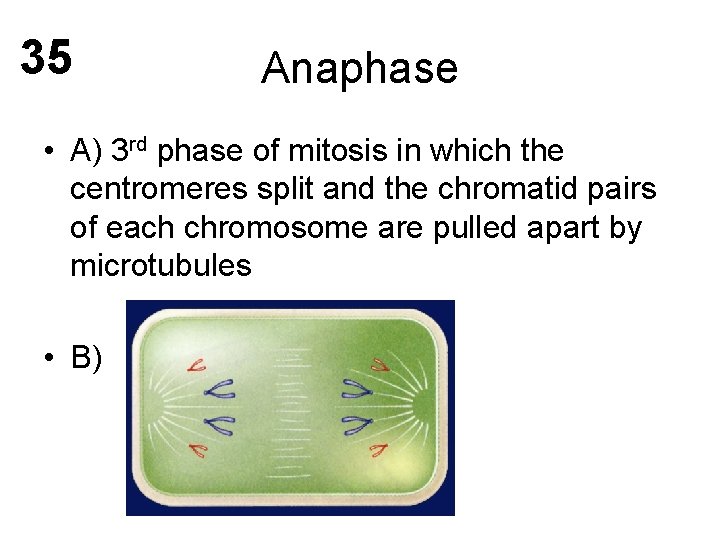
35 Anaphase • A) 3 rd phase of mitosis in which the centromeres split and the chromatid pairs of each chromosome are pulled apart by microtubules • B)
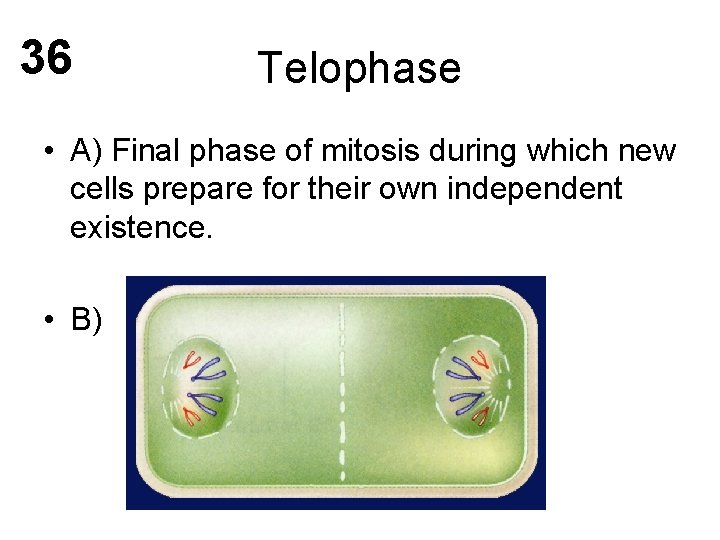
36 Telophase • A) Final phase of mitosis during which new cells prepare for their own independent existence. • B)
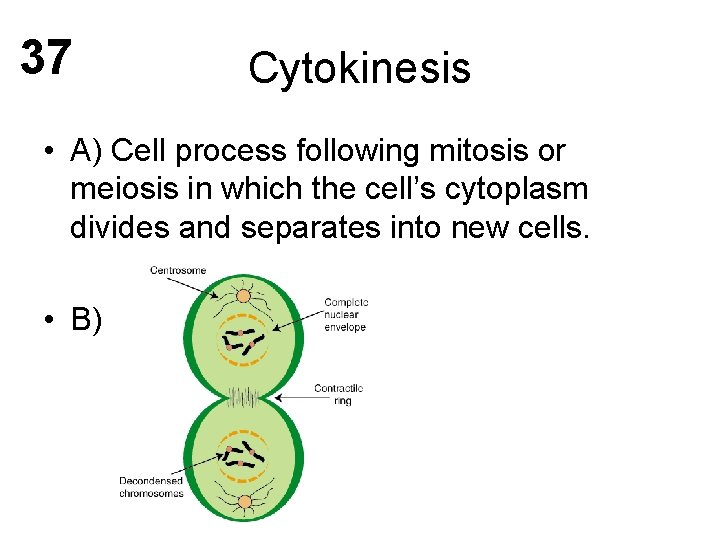
37 Cytokinesis • A) Cell process following mitosis or meiosis in which the cell’s cytoplasm divides and separates into new cells. • B)
69
70
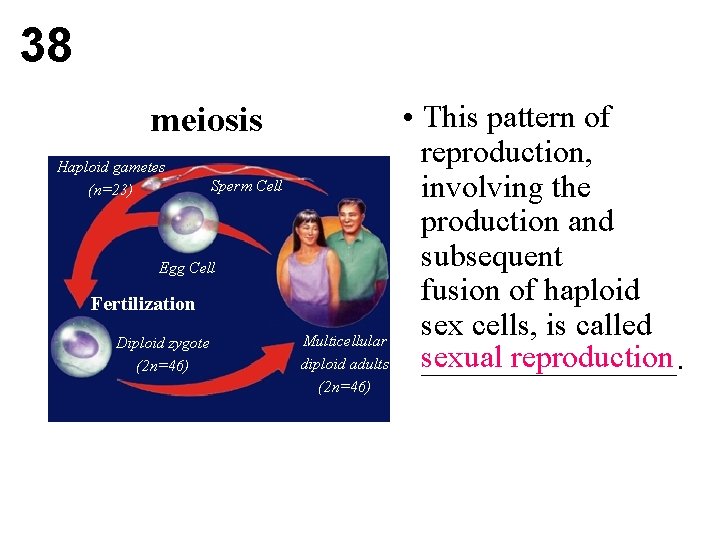
38 meiosis Haploid gametes (n=23) Sperm Cell Egg Cell Fertilization Diploid zygote (2 n=46) Multicellular diploid adults (2 n=46) • This pattern of reproduction, involving the production and subsequent fusion of haploid sex cells, is called sexual reproduction ________.
72
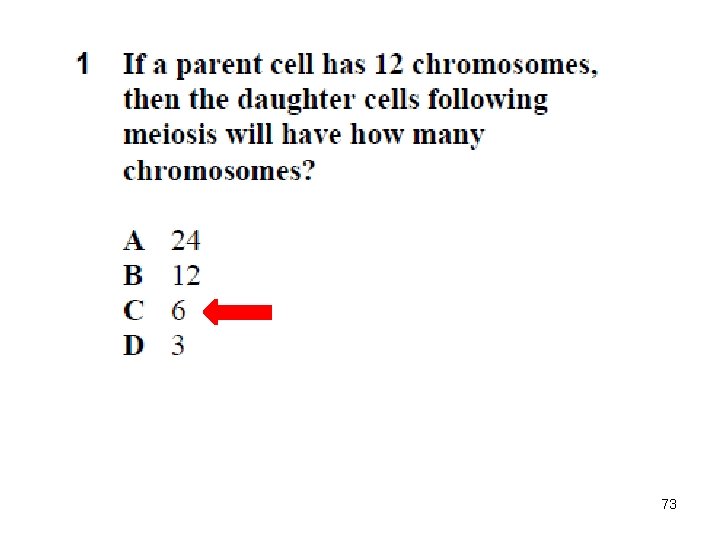
73
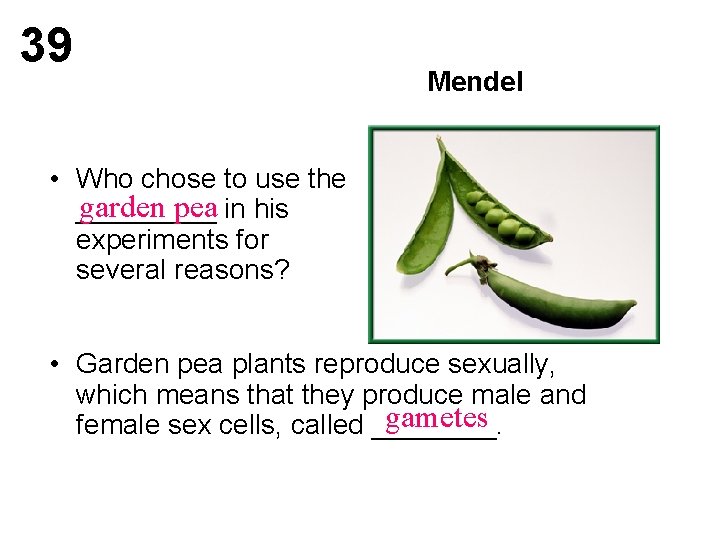
39 Mendel • Who chose to use the garden pea in his _____ experiments for several reasons? • Garden pea plants reproduce sexually, which means that they produce male and gametes female sex cells, called ____.
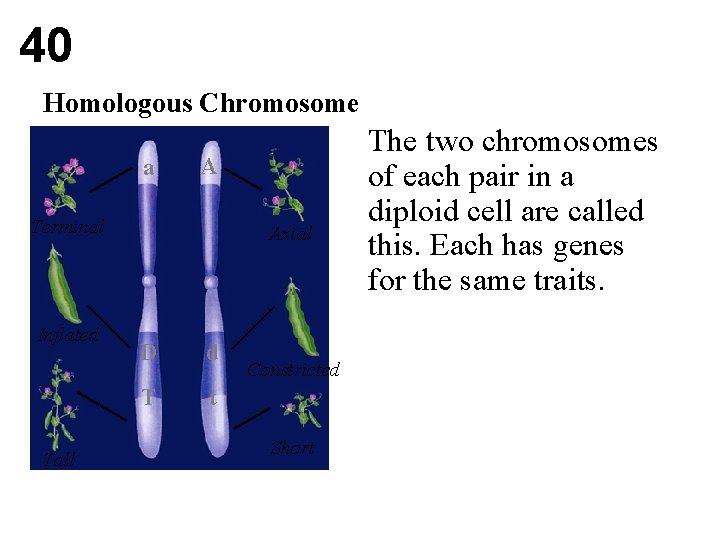
40 Homologous Chromosome a A Terminal Inflated Tall Axial D d T t Constricted Short The two chromosomes of each pair in a diploid cell are called this. Each has genes for the same traits.
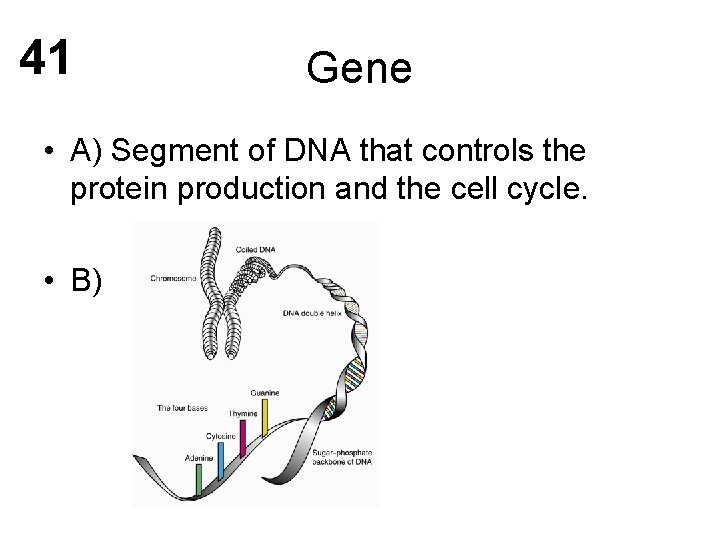
41 Gene • A) Segment of DNA that controls the protein production and the cell cycle. • B)
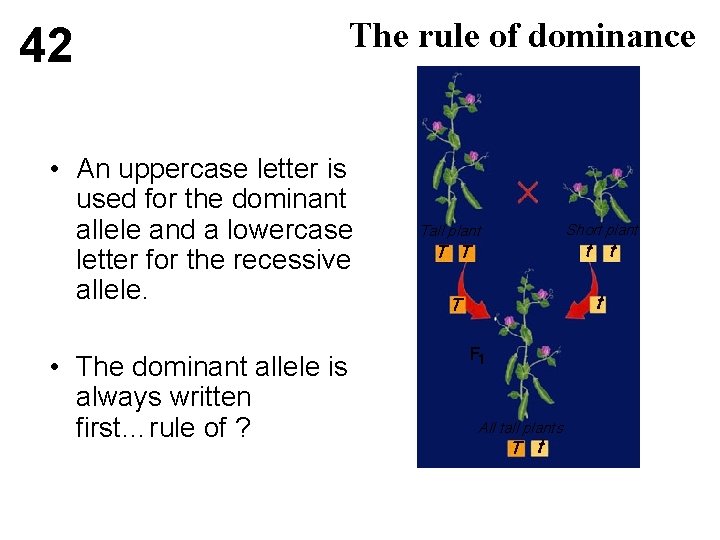
42 The rule of dominance • An uppercase letter is used for the dominant allele and a lowercase letter for the recessive allele. • The dominant allele is always written first…rule of ? Short plant Tall plant t T T t t T F 1 All tall plants T t
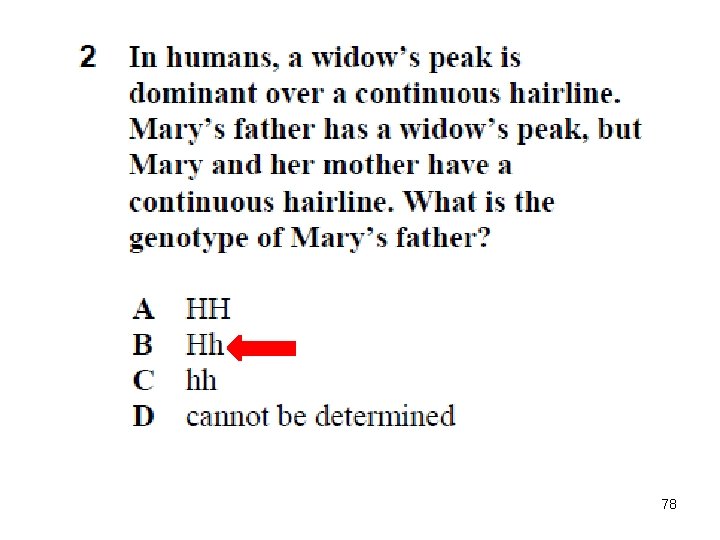
78
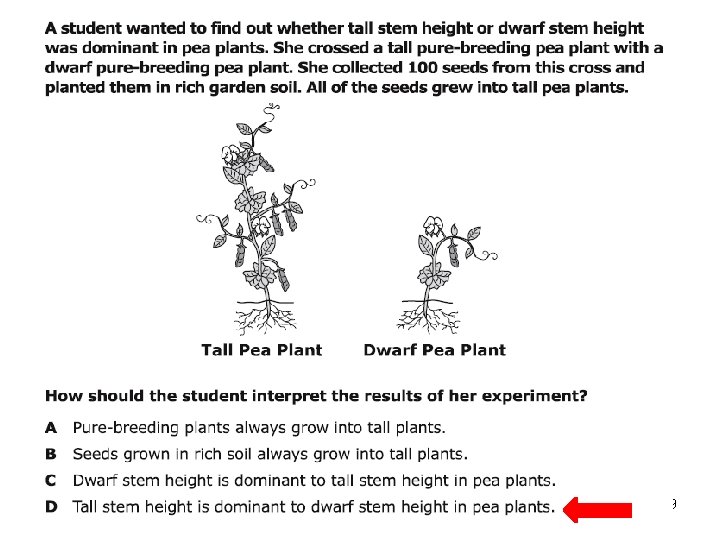
79
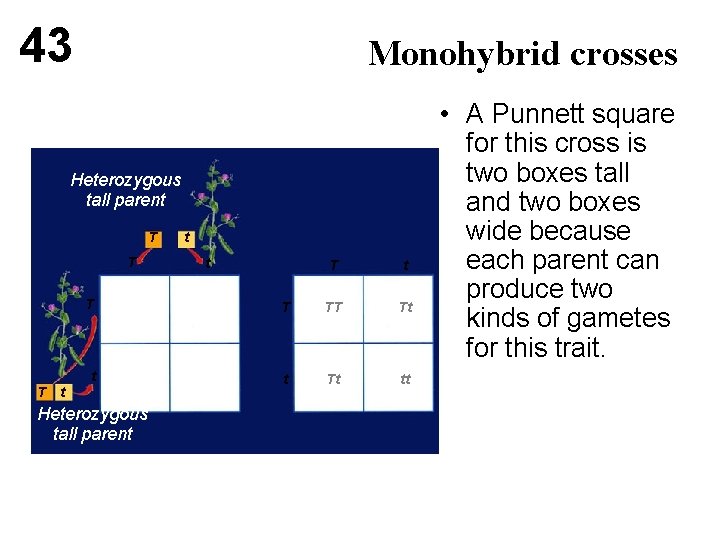
43 Monohybrid crosses Heterozygous tall parent T T T t t T T TT Tt t t Tt tt t Heterozygous tall parent • A Punnett square for this cross is two boxes tall and two boxes wide because each parent can produce two kinds of gametes for this trait.
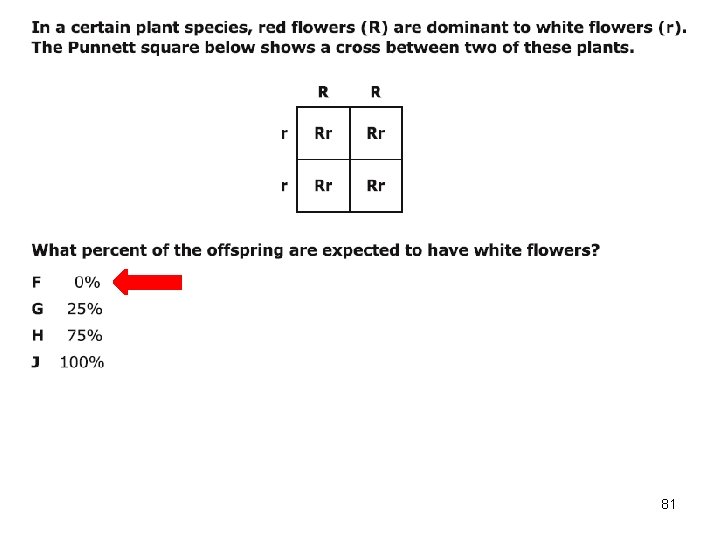
81
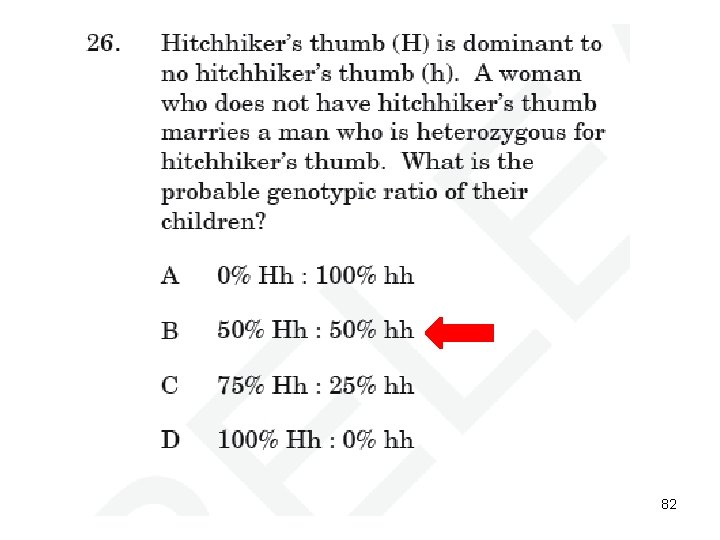
82
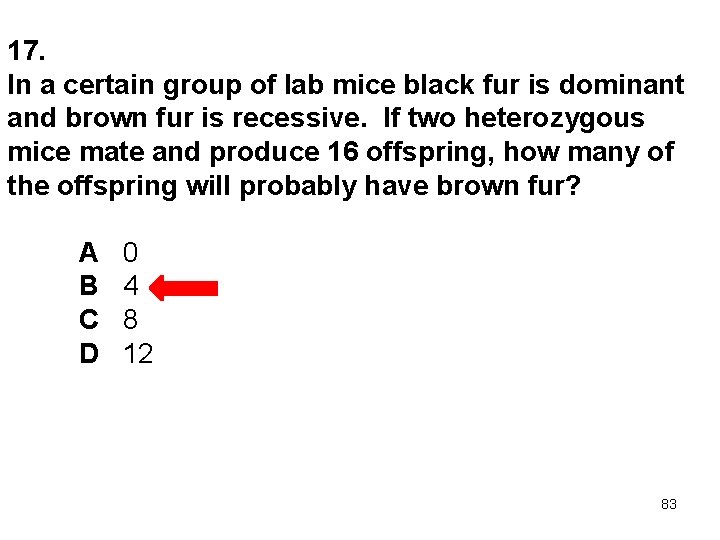
17. In a certain group of lab mice black fur is dominant and brown fur is recessive. If two heterozygous mice mate and produce 16 offspring, how many of the offspring will probably have brown fur? A B C D 0 4 8 12 83
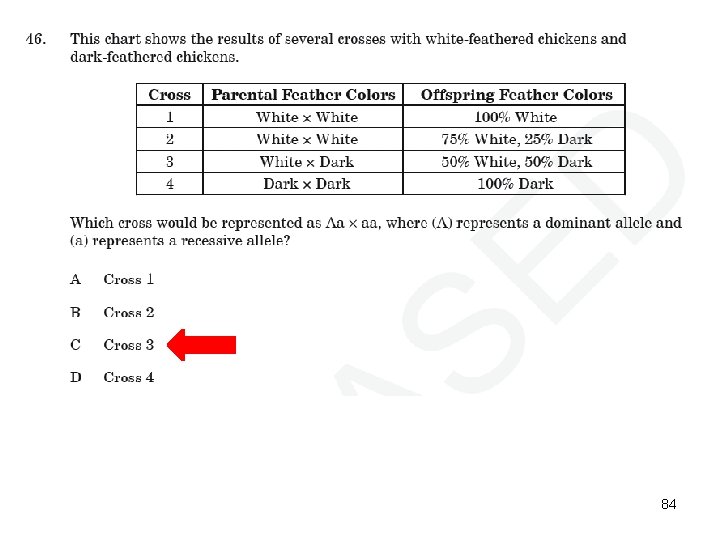
84
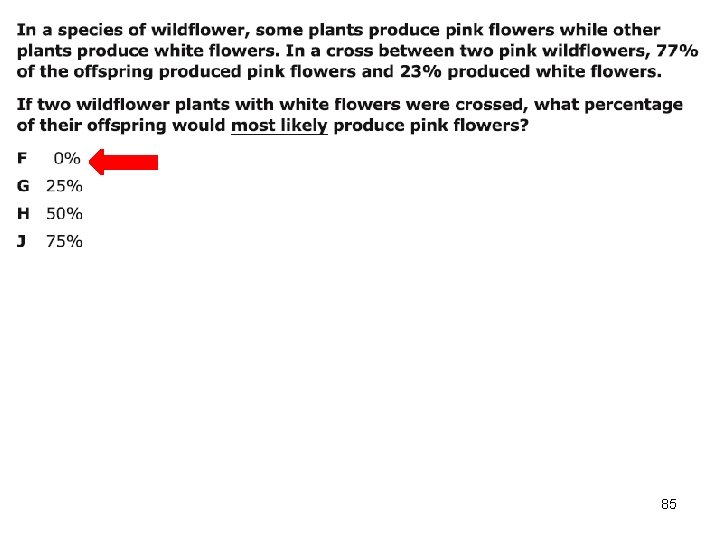
85
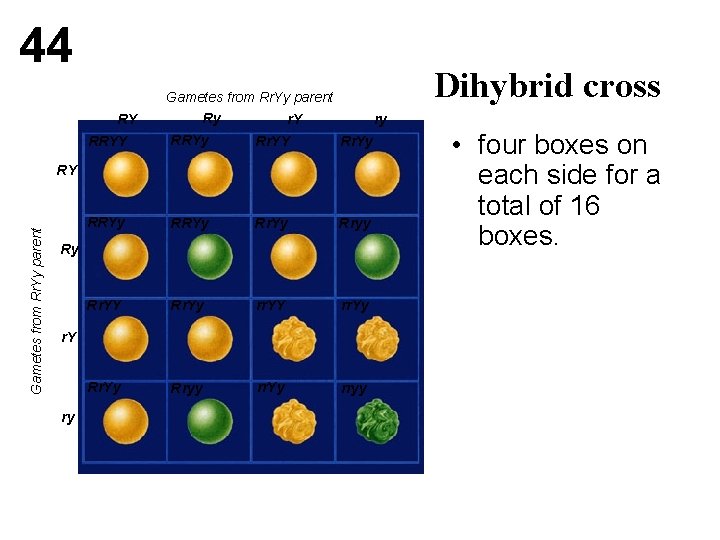
44 Dihybrid cross Gametes from Rr. Yy parent Ry RY r. Y ry RRYY RRYy Rr. YY Rr. Yy RRYy Rryy Rr. YY Rr. Yy rr. YY rr. Yy Rryy rr. Yy rryy Gametes from Rr. Yy parent RY Ry r. Y ry • four boxes on each side for a total of 16 boxes.
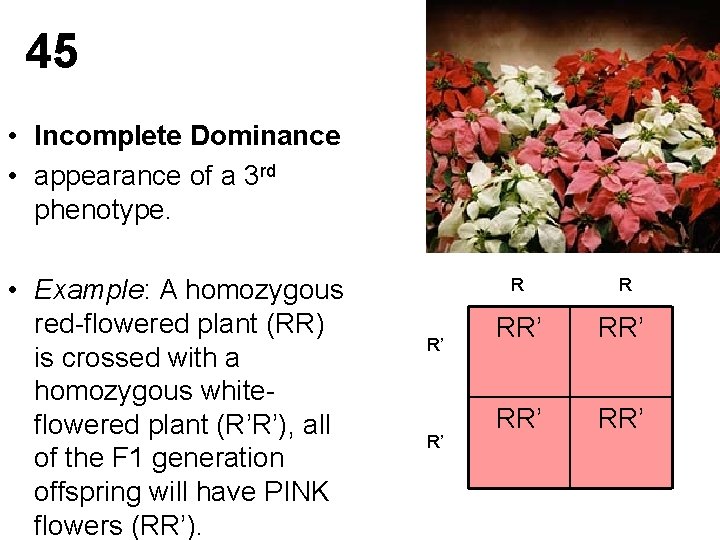
45 • Incomplete Dominance • appearance of a 3 rd phenotype. • Example: A homozygous red-flowered plant (RR) is crossed with a homozygous whiteflowered plant (R’R’), all of the F 1 generation offspring will have PINK flowers (RR’). R’ R’ R R RR’ RR’
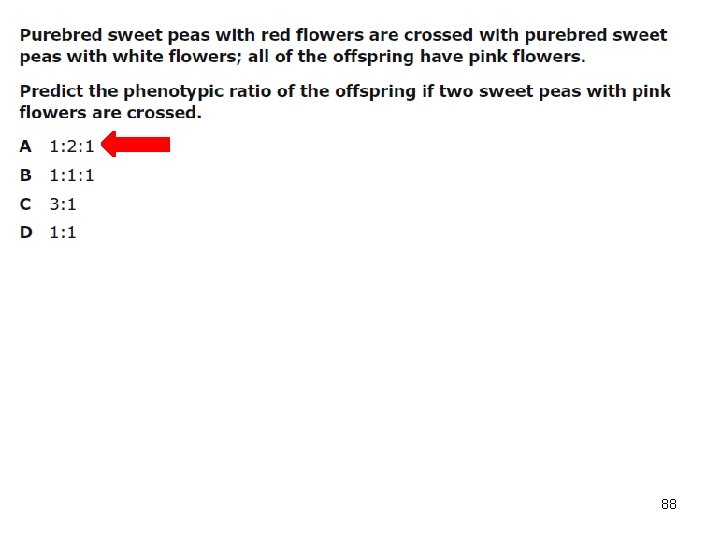
88
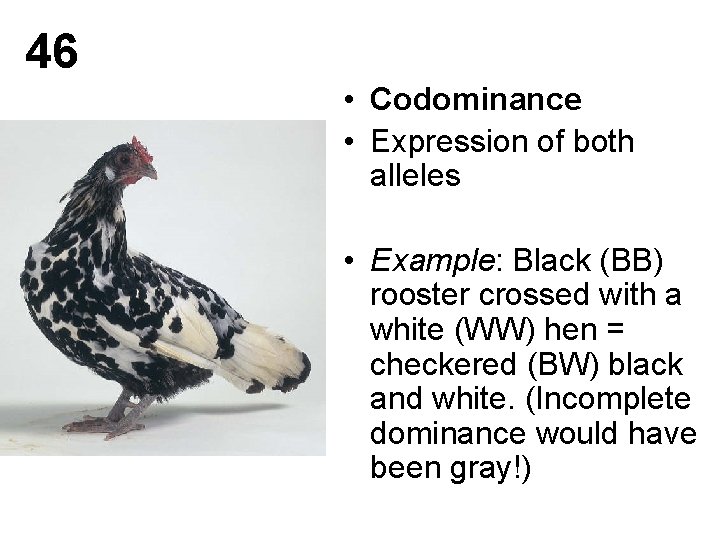
46 • Codominance • Expression of both alleles • Example: Black (BB) rooster crossed with a white (WW) hen = checkered (BW) black and white. (Incomplete dominance would have been gray!)
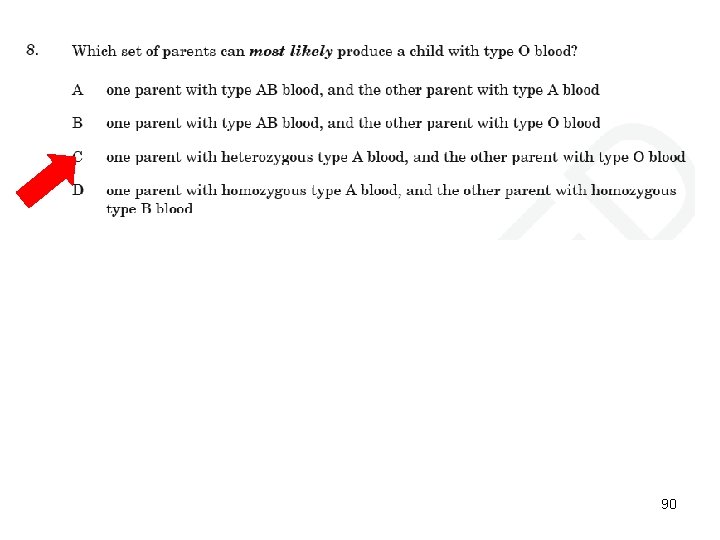
90
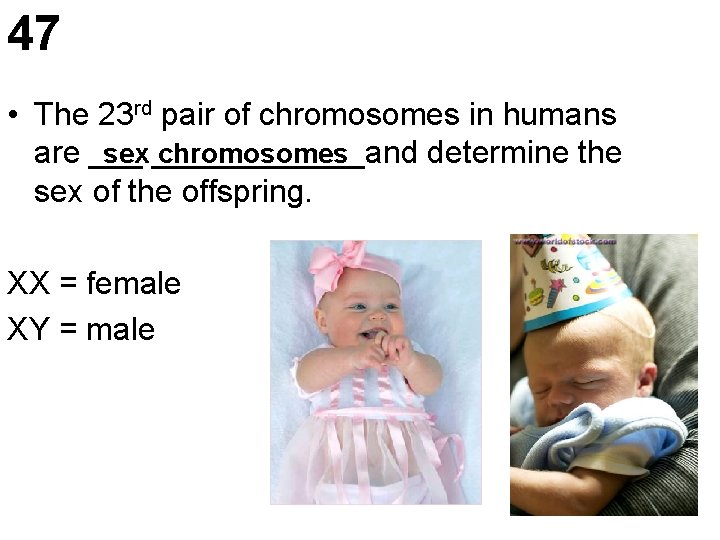
47 • The 23 rd pair of chromosomes in humans sex ______and chromosomes are ___ determine the sex of the offspring. XX = female XY = male
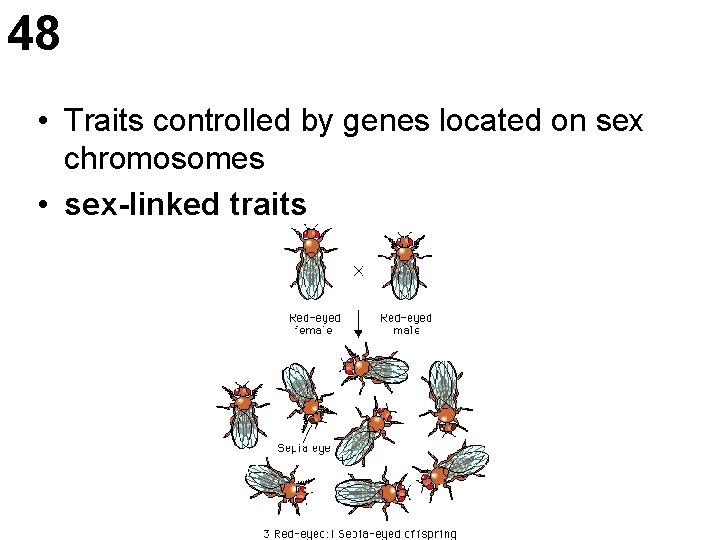
48 • Traits controlled by genes located on sex chromosomes • sex-linked traits
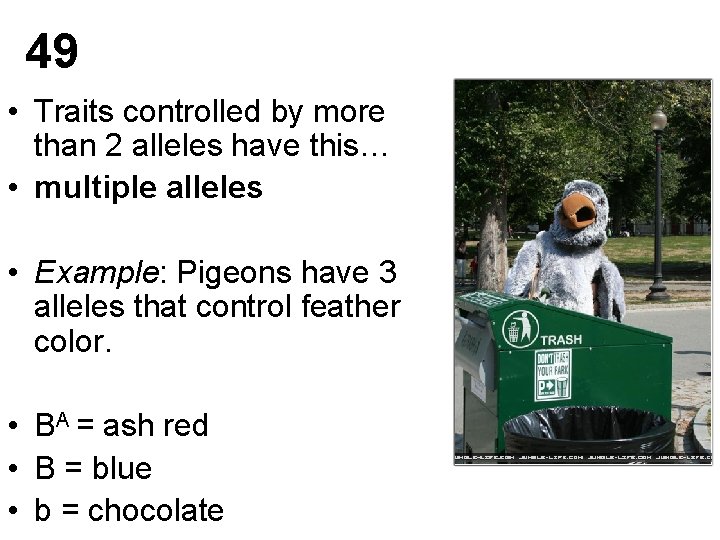
49 • Traits controlled by more than 2 alleles have this… • multiple alleles • Example: Pigeons have 3 alleles that control feather color. • BA = ash red • B = blue • b = chocolate
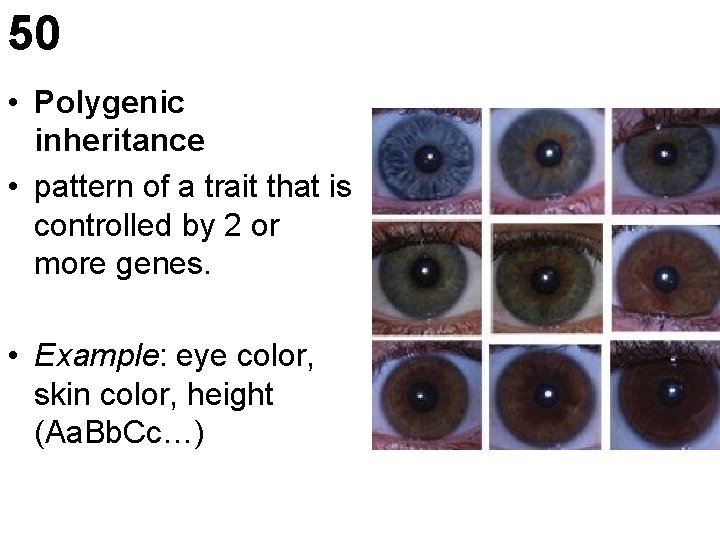
50 • Polygenic inheritance • pattern of a trait that is controlled by 2 or more genes. • Example: eye color, skin color, height (Aa. Bb. Cc…)
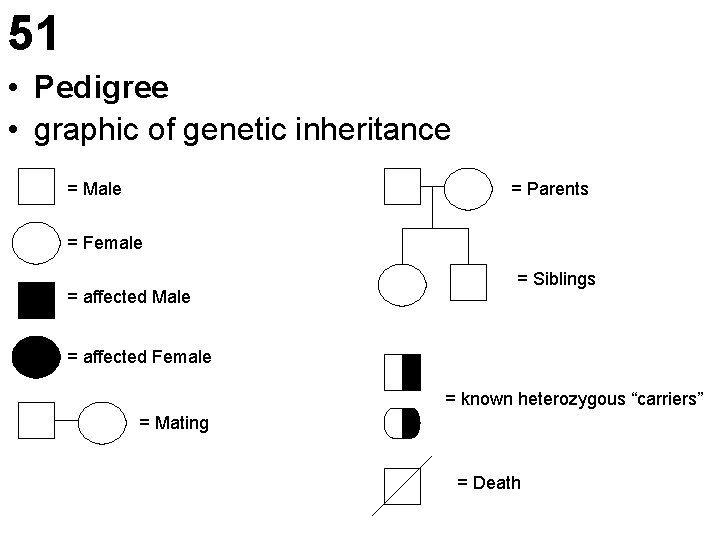
51 • Pedigree • graphic of genetic inheritance = Male = Parents = Female = affected Male = Siblings = affected Female = known heterozygous “carriers” = Mating = Death
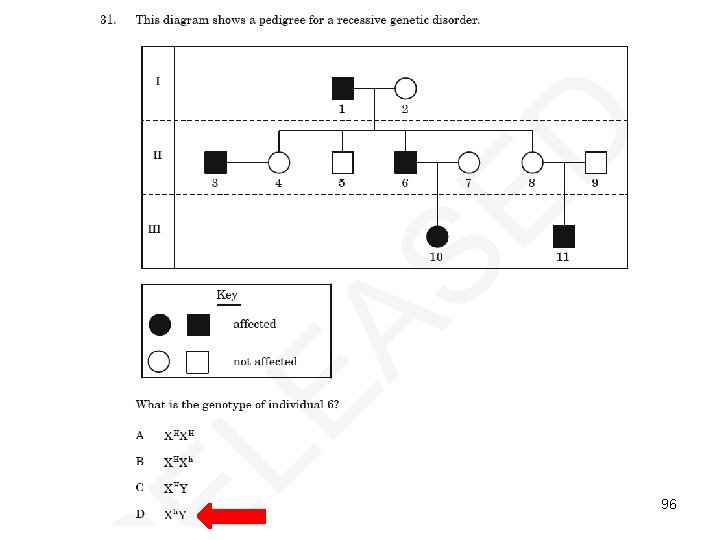
96
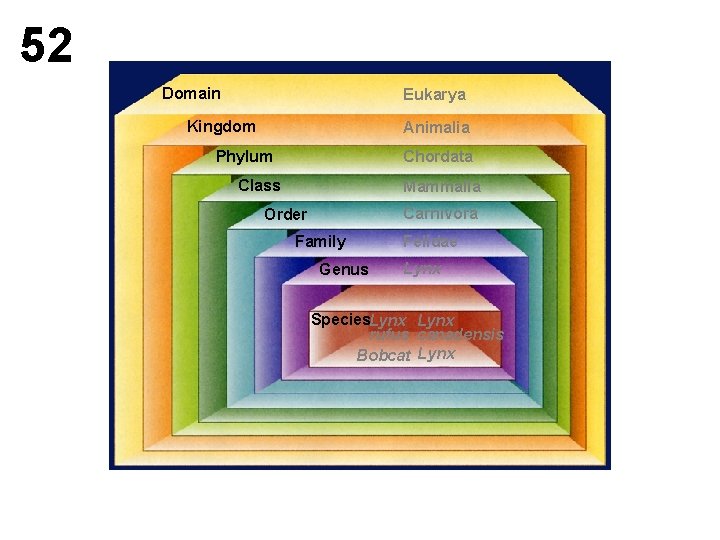
52 Domain Eukarya Kingdom Animalia Chordata Phylum Class Mammalia Carnivora Order Family Genus Felidae Lynx Species. Lynx rufus canadensis Bobcat Lynx
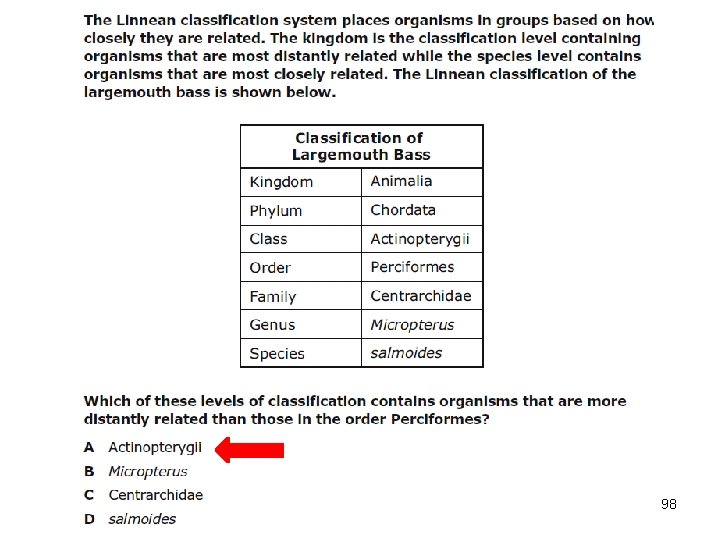
98
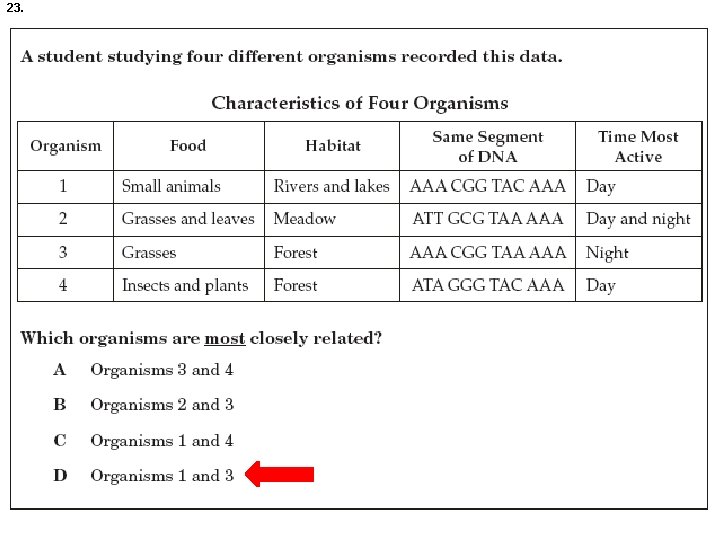
23. 99
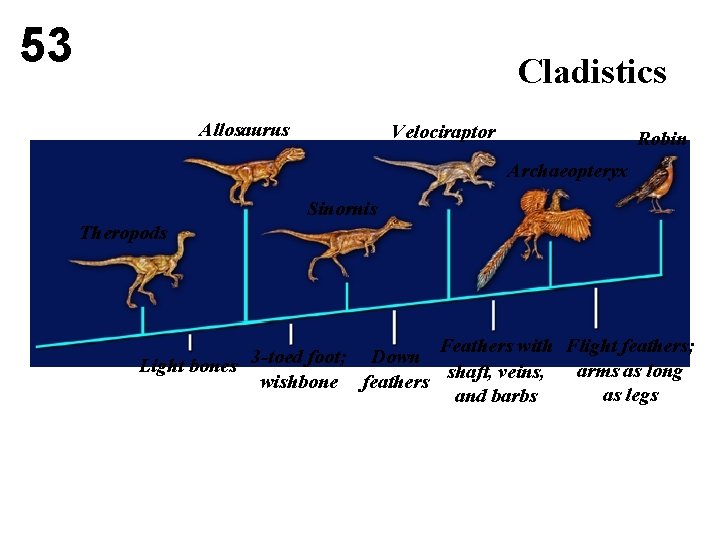
53 Cladistics Allosaurus Velociraptor Robin Archaeopteryx Sinornis Theropods Feathers with Flight feathers; 3 -toed foot; Down Light bones arms as long shaft, veins, wishbone feathers as legs and barbs
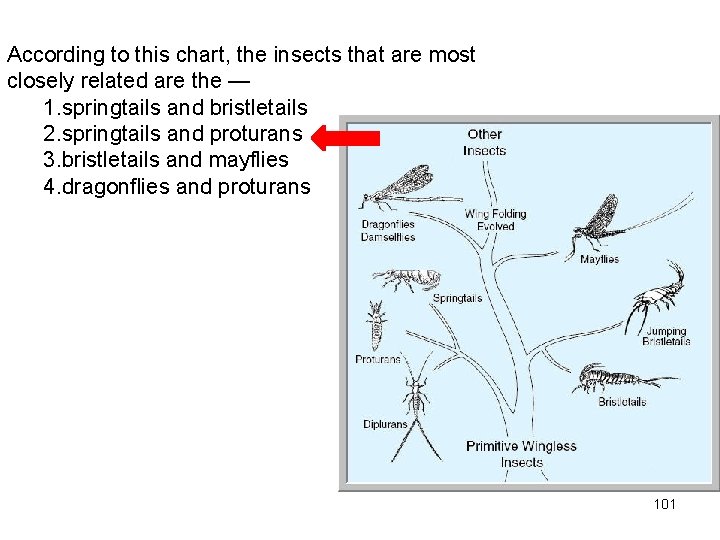
According to this chart, the insects that are most closely related are the — 1. springtails and bristletails 2. springtails and proturans 3. bristletails and mayflies 4. dragonflies and proturans 101
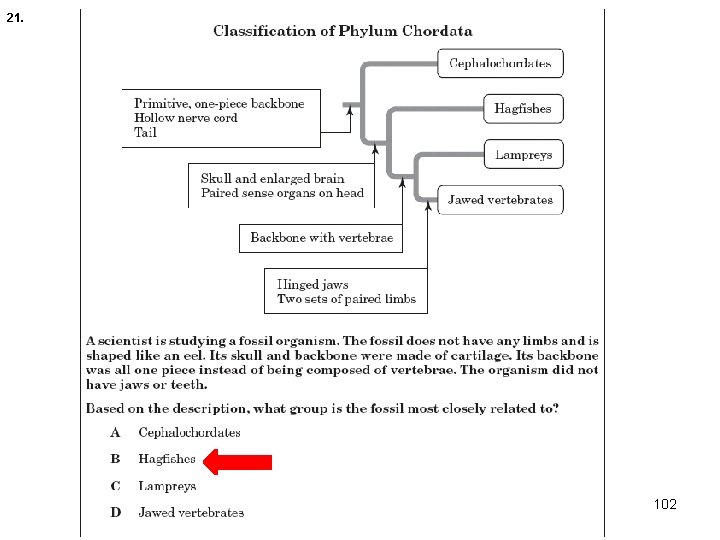
21. 102
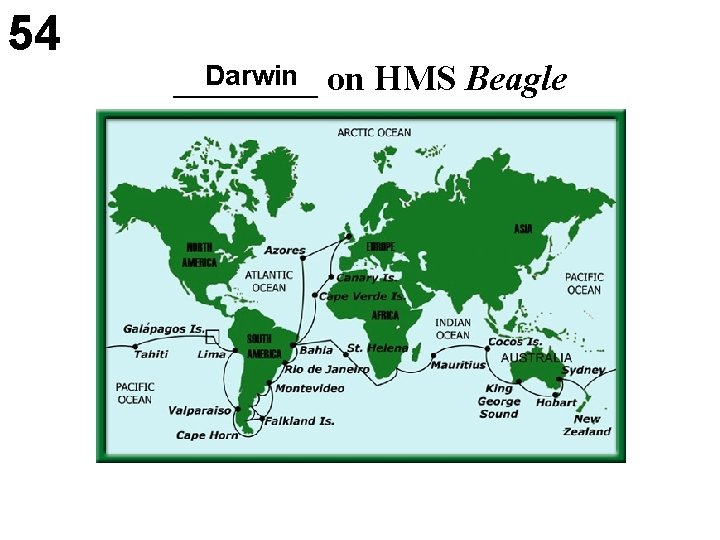
54 Darwin on HMS Beagle ____
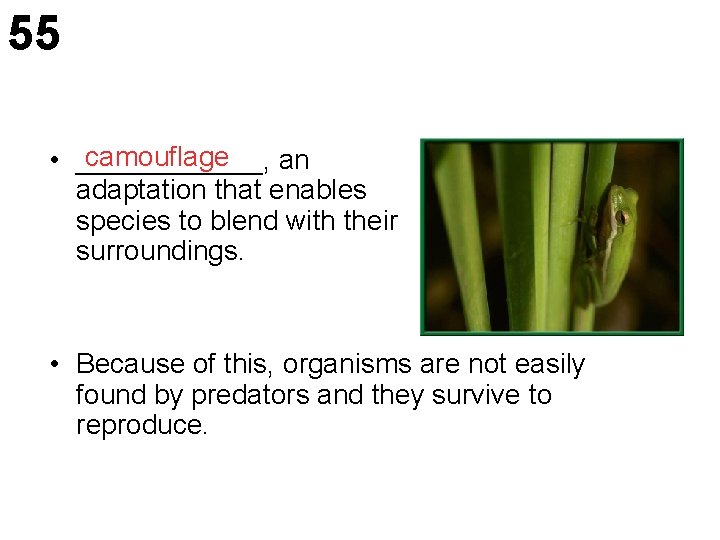
55 camouflage • ______, an adaptation that enables species to blend with their surroundings. • Because of this, organisms are not easily found by predators and they survive to reproduce.
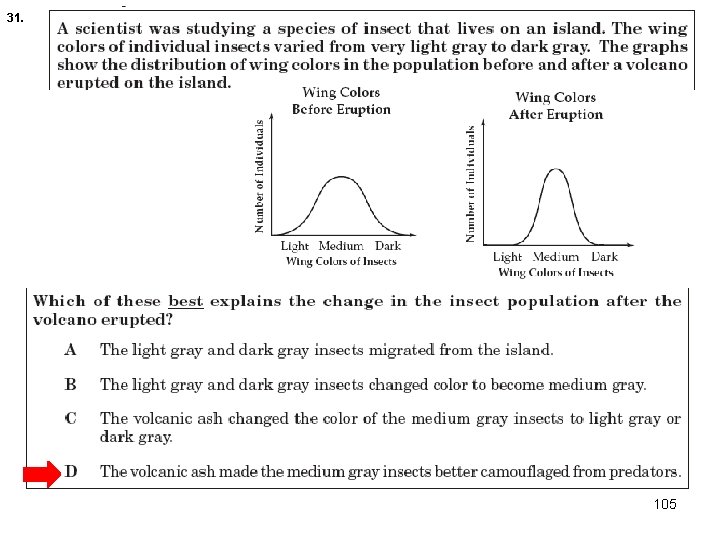
31. 105
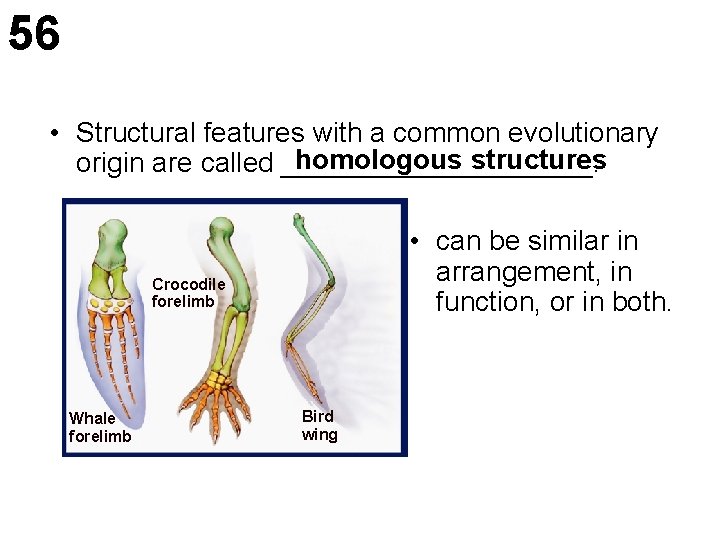
56 • Structural features with a common evolutionary homologous structures origin are called __________. • can be similar in arrangement, in function, or in both. Crocodile forelimb Whale forelimb Bird wing
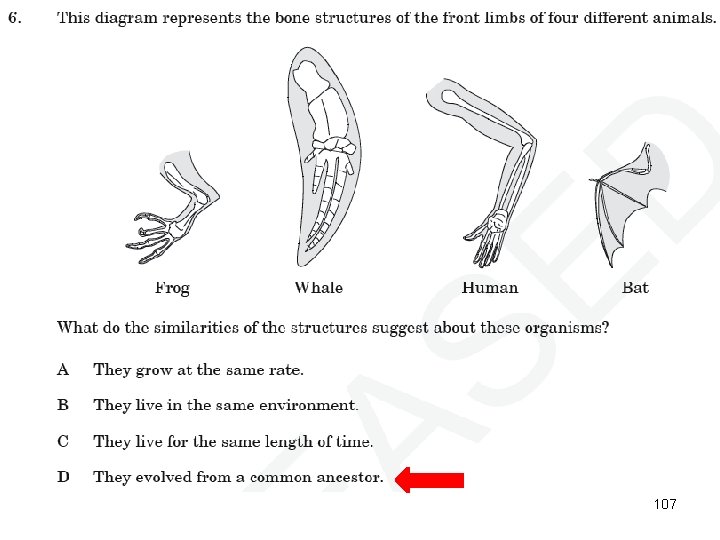
107
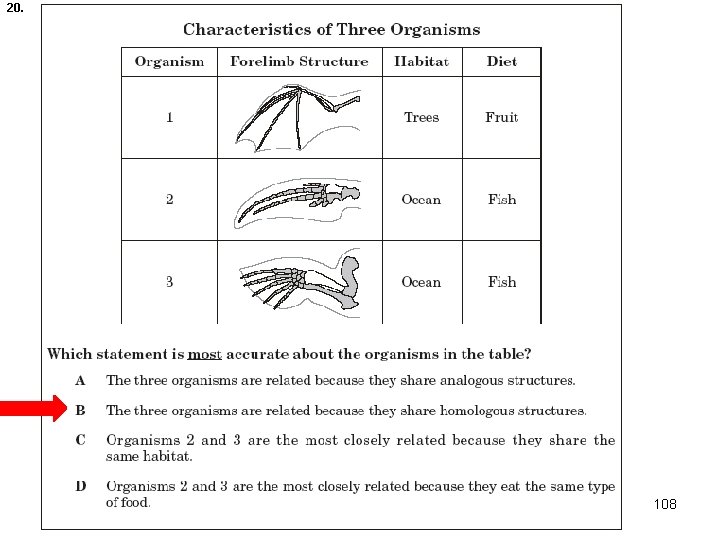
20. 108
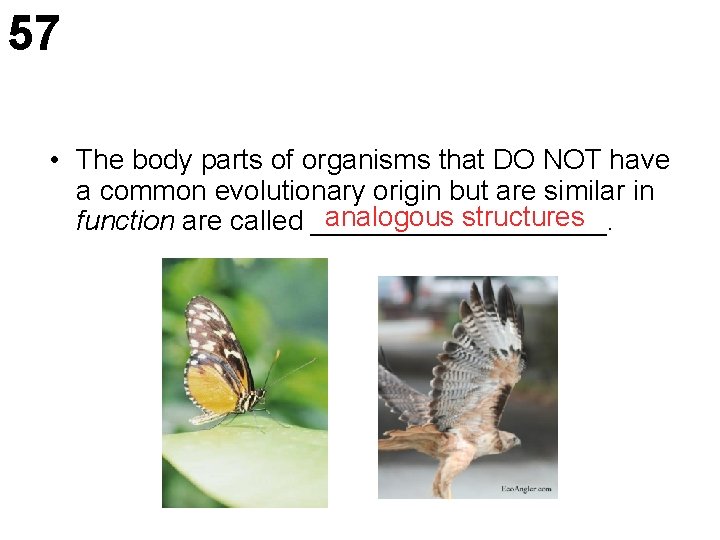
57 • The body parts of organisms that DO NOT have a common evolutionary origin but are similar in analogous structures function are called __________.
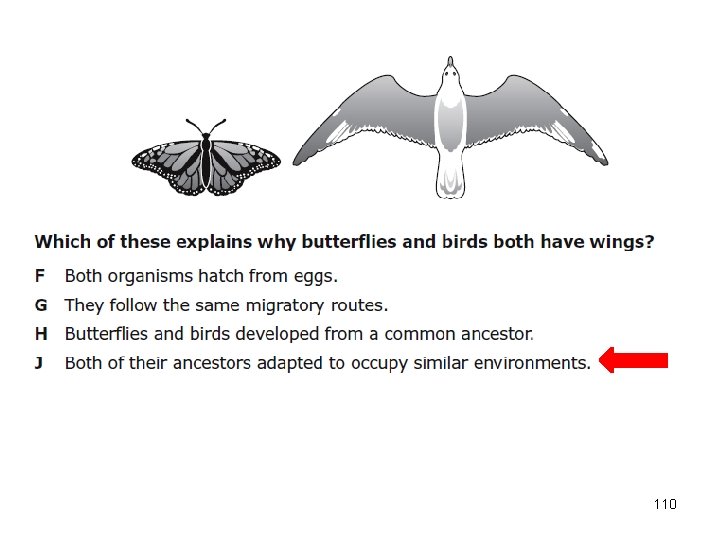
110
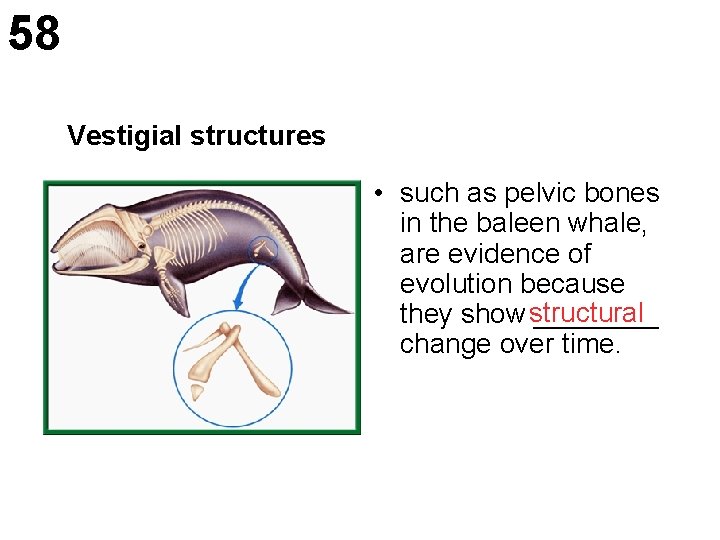
58 Vestigial structures • such as pelvic bones in the baleen whale, are evidence of evolution because they show structural ____ change over time.
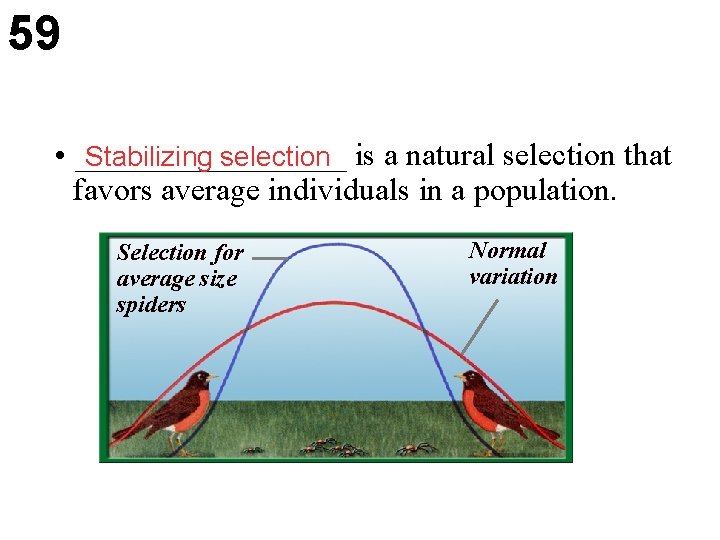
59 • _________ Stabilizing selection is a natural selection that favors average individuals in a population. Selection for average size spiders Normal variation
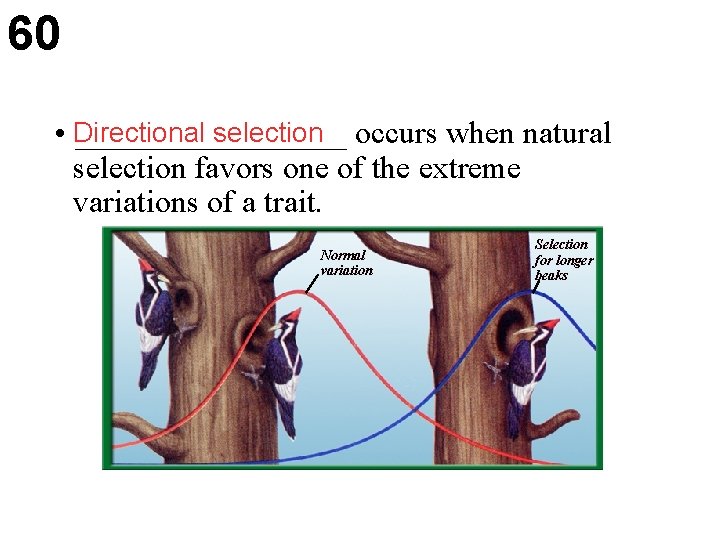
60 selection occurs when natural • Directional _________ selection favors one of the extreme variations of a trait. Normal variation Selection for longer beaks
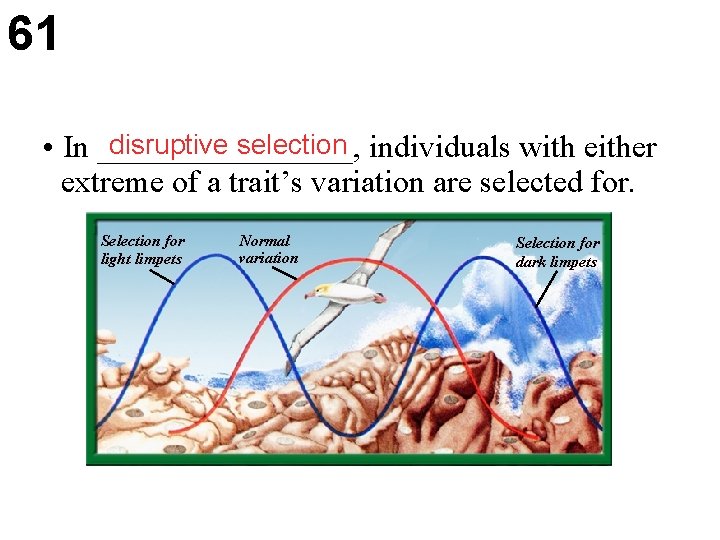
61 disruptive selection individuals with either • In ________, extreme of a trait’s variation are selected for. Selection for light limpets Normal variation Selection for dark limpets
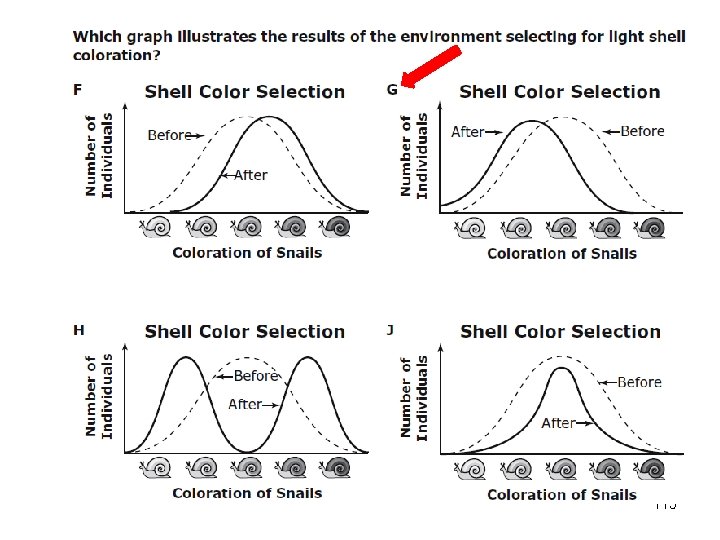
115
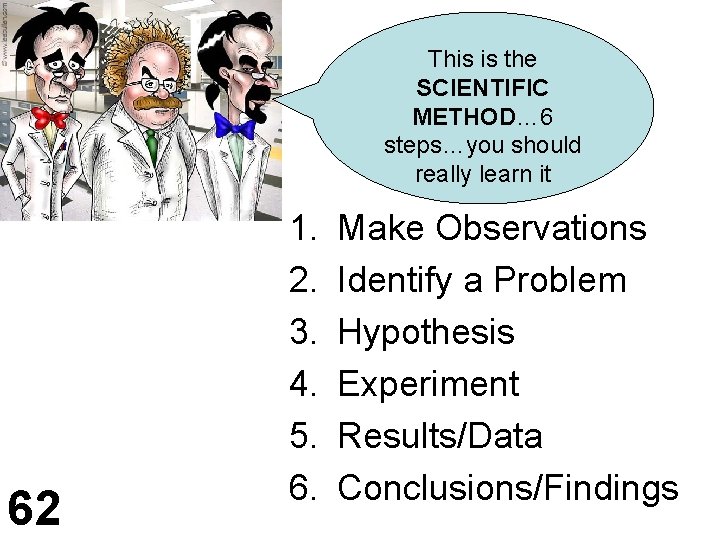
This is the SCIENTIFIC METHOD… 6 steps…you should really learn it 62 1. 2. 3. 4. 5. 6. Make Observations Identify a Problem Hypothesis Experiment Results/Data Conclusions/Findings
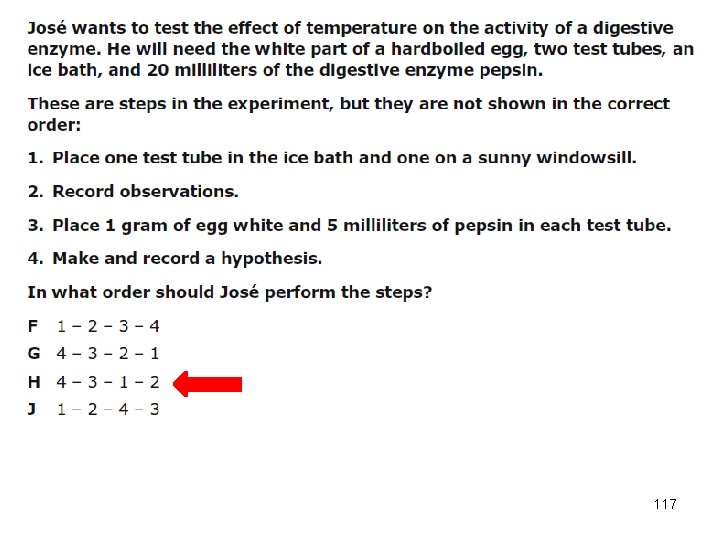
117
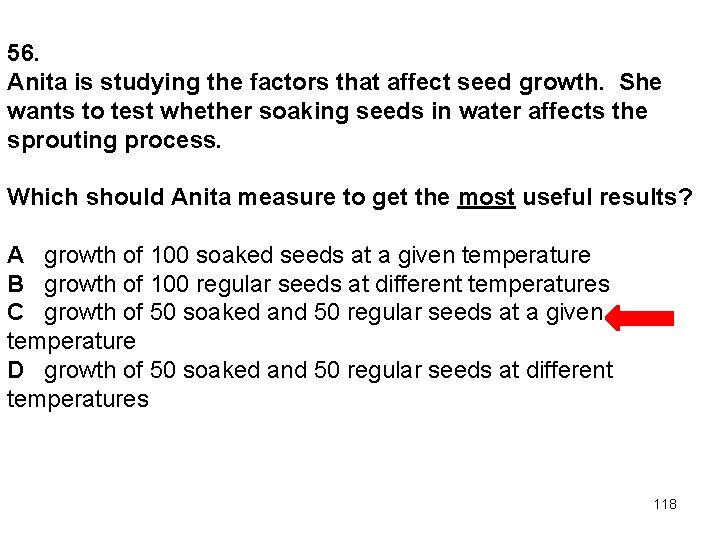
56. Anita is studying the factors that affect seed growth. She wants to test whether soaking seeds in water affects the sprouting process. Which should Anita measure to get the most useful results? A growth of 100 soaked seeds at a given temperature B growth of 100 regular seeds at different temperatures C growth of 50 soaked and 50 regular seeds at a given temperature D growth of 50 soaked and 50 regular seeds at different temperatures 118
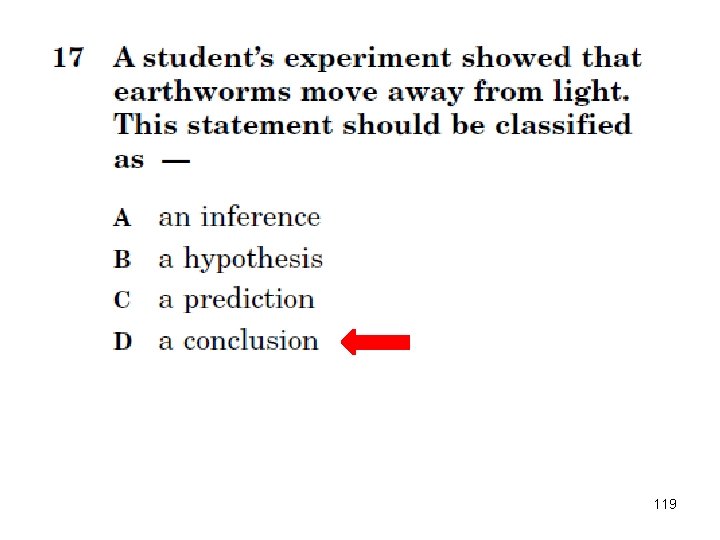
119
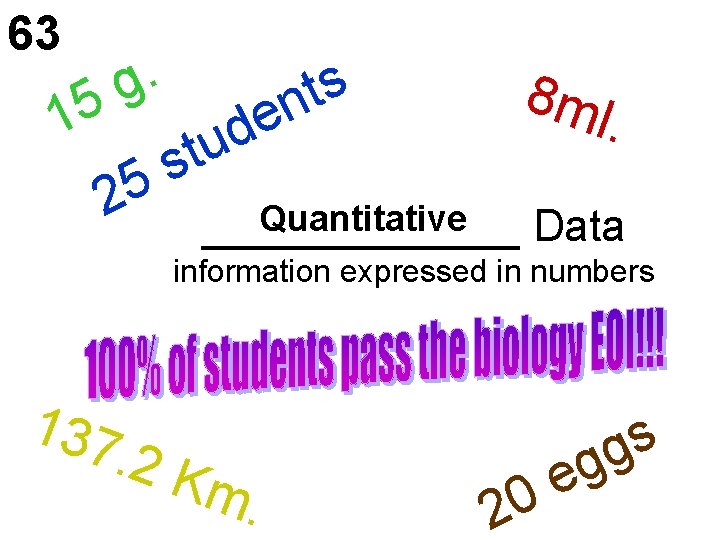
63 . g 5 1 s 5 2 s t n e d tu 8 ml. Quantitative _______ Data information expressed in numbers 137 . 2 K m. e 20 s g g
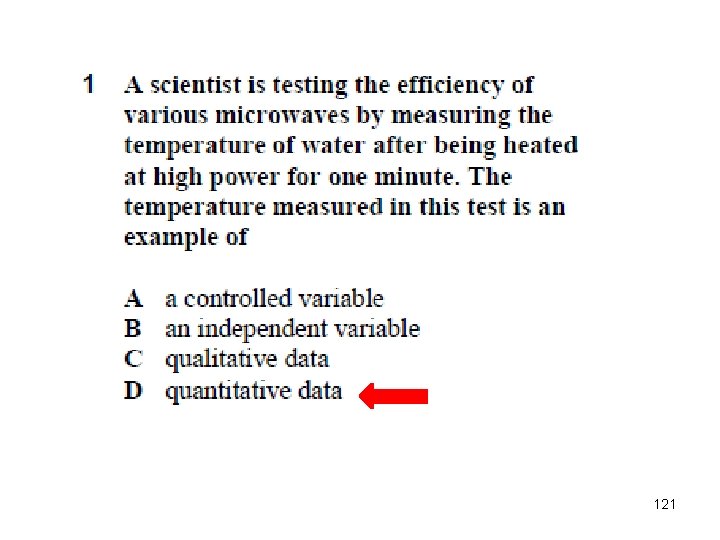
121
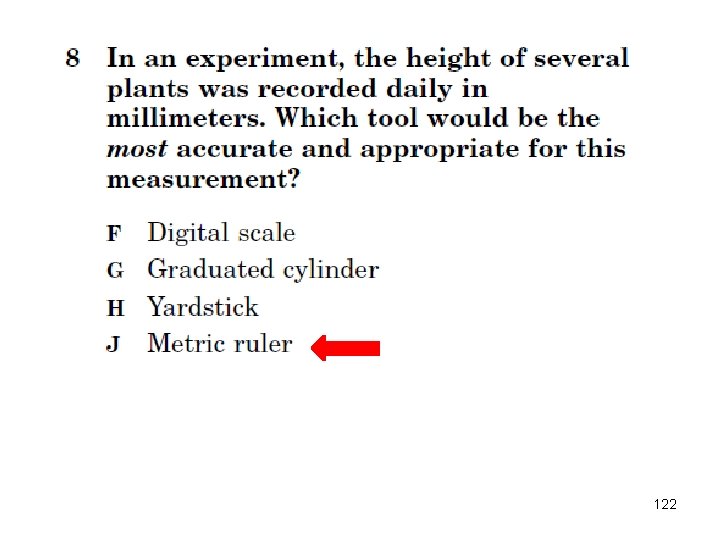
122
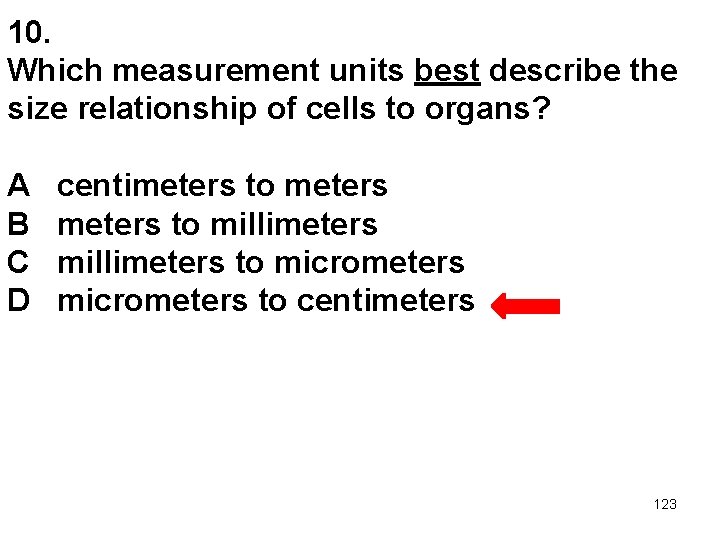
10. Which measurement units best describe the size relationship of cells to organs? A B C D centimeters to millimeters to micrometers to centimeters 123
- Slides: 123