
EOC STAAR Review YES we know we tell

- Slides: 70
EOC STAAR Review • YES… we know we tell you some things differently than your other teachers, but that is because there is not ONE “right way” to take a test, or ONE “universal way” to write an essay, or ONE “perfect way” to teach you how to be a good writer or reader. • HOWEVER, collectively, we have given you MANY skills and options on how to be successful. • We have given you SKILLS to be a good reader, and STRUCTURES on how to write an effective short answer or essay.
Short Answer Review Steps: • 1 st – Before you ever begin reading your stories, articles, poems, etc. , READ THE SHORT ANSWER QUESTIONS. This will give you a general idea of what you should be looking for. • 2 nd – Make sure you understand the question! – Define any words you do not understand – Get rid of any repetition such as the names of the stories, articles, etc.
Short Answer Review • 3 rd – Read the articles and highlight any quote that seems relevant to your short answer. • 4 th – Brainstorm when writing--- key ideas to answer the question (isolate and HIGHLIGHT OR UNDERLINE) • Write…don’t be fancy at this point…rough draft!!
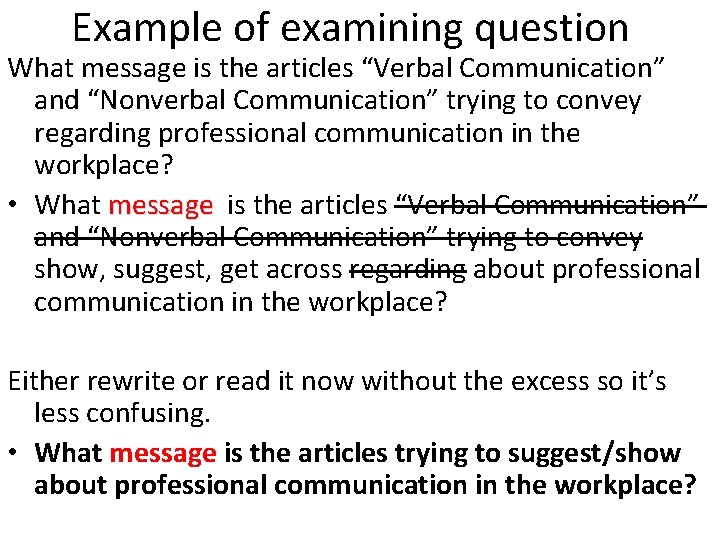
Example of examining question What message is the articles “Verbal Communication” and “Nonverbal Communication” trying to convey regarding professional communication in the workplace? • What message is the articles “Verbal Communication” message and “Nonverbal Communication” trying to convey show, suggest, get across regarding about professional communication in the workplace? Either rewrite or read it now without the excess so it’s less confusing. • What message is the articles trying to suggest/show about professional communication in the workplace?
While reading… HIGHLIGHT POSSIBLE SENTENCES TO QUOTE and/or PARAPHRASE
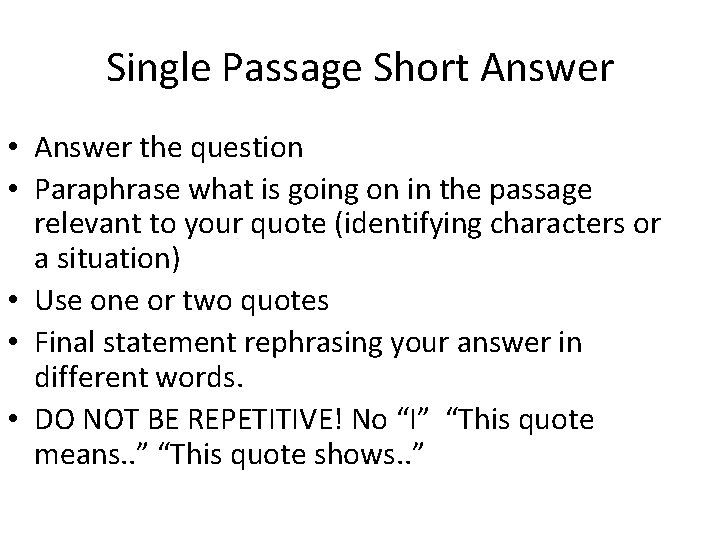
Single Passage Short Answer • Answer the question • Paraphrase what is going on in the passage relevant to your quote (identifying characters or a situation) • Use one or two quotes • Final statement rephrasing your answer in different words. • DO NOT BE REPETITIVE! No “I” “This quote means. . ” “This quote shows. . ”
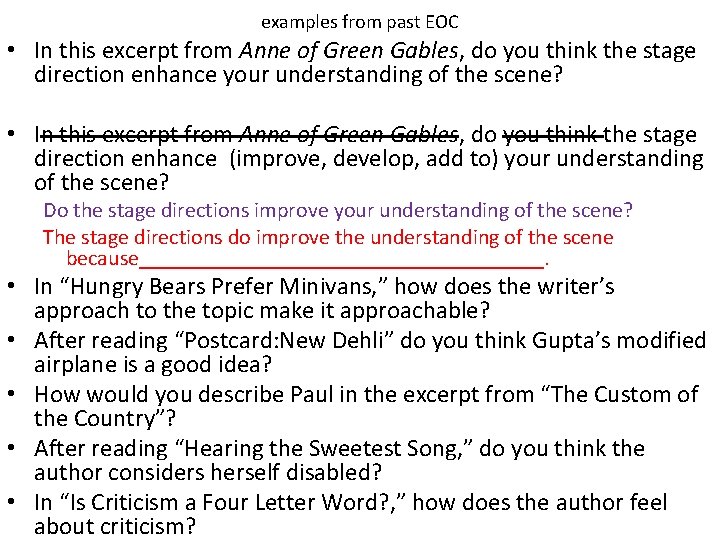
examples from past EOC • In this excerpt from Anne of Green Gables, do you think the stage direction enhance your understanding of the scene? • In this excerpt from Anne of Green Gables, do you think the stage direction enhance (improve, develop, add to) your understanding of the scene? Do the stage directions improve your understanding of the scene? The stage directions do improve the understanding of the scene because___________________. • In “Hungry Bears Prefer Minivans, ” how does the writer’s approach to the topic make it approachable? • After reading “Postcard: New Dehli” do you think Gupta’s modified airplane is a good idea? • How would you describe Paul in the excerpt from “The Custom of the Country”? • After reading “Hearing the Sweetest Song, ” do you think the author considers herself disabled? • In “Is Criticism a Four Letter Word? , ” how does the author feel about criticism?
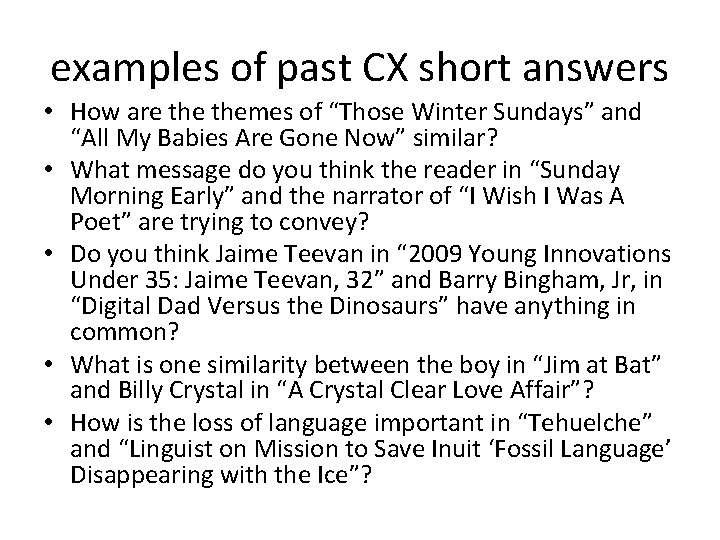
examples of past CX short answers • How are themes of “Those Winter Sundays” and “All My Babies Are Gone Now” similar? • What message do you think the reader in “Sunday Morning Early” and the narrator of “I Wish I Was A Poet” are trying to convey? • Do you think Jaime Teevan in “ 2009 Young Innovations Under 35: Jaime Teevan, 32” and Barry Bingham, Jr, in “Digital Dad Versus the Dinosaurs” have anything in common? • What is one similarity between the boy in “Jim at Bat” and Billy Crystal in “A Crystal Clear Love Affair”? • How is the loss of language important in “Tehuelche” and “Linguist on Mission to Save Inuit ‘Fossil Language’ Disappearing with the Ice”?
Example we did • What message is the article “Verbal Communication” and “Nonverbal Communication” trying to convey regarding professional communication in the workplace?
• Brainstorm key idea of question. (message of communication in workplace) – Show respect – Professional communication requires verbal and nonverbal communication skills • Write an answer…don’t be fancy at this point…rough draft!! Take your basic question and write. • What message is the articles trying to show regarding professional communication in the workplace? The message in the articles is that you must be respectful both verbally and nonverbally to be professional.
refer to articles
Answer The message in the articles is that you must be respectful both verbally and nonverbally to be professional.
Passage 1 for CX using 2 passages “Nonverbal communication” or body language can be the opposite of what you are actually wanting to say. That is why “It’s important that your workplace body language shows a positive attitude as much as your words do. ”
Passage 2 for CX using 2 passages “Verbal Communication” is both speaking and listening. When speaking consider your audience and “Show that you are listening to others by responding in a way that indicates you heard what they said. ”
DO NOT LEAVE SPACE OR SEPARATE THE ANSWER… IT IS ONE BIG ANSWER MAKE SURE YOUR conclusion ties it all together!!! The message in the articles is that you must be respectful both verbally and nonverbally to be professional. “Nonverbal communication” or body language can be the opposite of what you are actually wanting to say. That is why “It’s important that your workplace body language shows a positive attitude as much as your words do. ” “Verbal Communication” is both speaking and listening. When speaking consider your audience and “Show that you are listening to others by responding in a way that indicates you heard what they said. ” Being respectful using words and body language positively together creates a pleasant work environment.
Cross over Short Answer option 1 • Answer the question using passage one. Make sure to use a similar word ex: FAME (like “Bonnie and Clyde” were famous for committing crime. ) • Paraphrase what is going on in the passage relevant to your quote (identifying characters or a situation) • Use one or two quotes • Answer the question using passage two. Make sure to use a similar word ex: FAME (like “Izzy and Moe” were famous for fighting crime. ) • Paraphrase what is going on in the passage relevant to your quote (identifying characters or a situation) • Use one or two quotes • Final statement rephrasing your answer in different words. • DO NOT BE REPETITIVE! No “I” “This quote means. . ” “This quote shows. . ”
Short Answer Option 2 • Answer the question using passage one AND passage two. Make sure to use a similar word ex: FAME (like “Bonnie and Clyde” were famous for committing crime and “Izzy and Moe” were famous for fighting crime. ) • Paraphrase what is going on in the passage ONE relevant to your quote (identifying characters or a situation) • Use one or two quotes • Paraphrase what is going on in the passage TWO relevant to your quote (identifying characters or a situation) • Use one or two quotes • Final statement rephrasing your answer in different words. • DO NOT BE REPETITIVE! No “I” “This quote means. . ” “This quote shows. . ”
ESSAY • For persuasive or expository you follow the same structure. • Expository- 100% inform– DO NOT USE “I” OR “YOU” AT ALL!!! -people, persons, humans, he, she, it • Persuasive YOU MUST TAKE A POSITION, cannot agree and disagree or think both… one OR the other • MUST USE persuasive tone
Prompt • Read: The more that you read, the more things you will know, The more that you learn, the more places you’ll go. – Dr. Seuss • Think carefully about the following statement. – According to Dr. Seuss, knowledge leads to new opportunities. • Write an essay stating your position on whether learning always has a positive effect on a person’s life. • Be sure to – – State your position clearly (Don’t agree or disagree say it without using words agree or disagree) – Use appropriate organization – Provide specific support for your argument – Choose your words carefully – Edit your writing for grammar, mechanics, and spelling
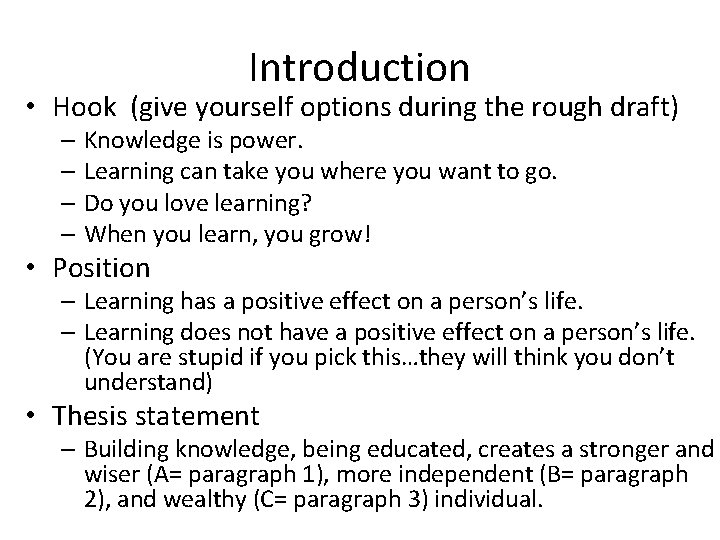
Persuasive Essay HOW-TO for the Introduction • 1 st Paragraph: – Hook: Ask a question, make a startling statement, give a quote from the reading selections, a fact – State your position clearly (do not agree or disagree, say it without using words agree or disagree) – Give thesis statement (topic + A + B + C) ABC = paragraphs
Introduction • Hook (give yourself options during the rough draft) – Knowledge is power. – Learning can take you where you want to go. – Do you love learning? – When you learn, you grow! • Position – Learning has a positive effect on a person’s life. – Learning does not have a positive effect on a person’s life. (You are stupid if you pick this…they will think you don’t understand) • Thesis statement – Building knowledge, being educated, creates a stronger and wiser (A= paragraph 1), more independent (B= paragraph 2), and wealthy (C= paragraph 3) individual.
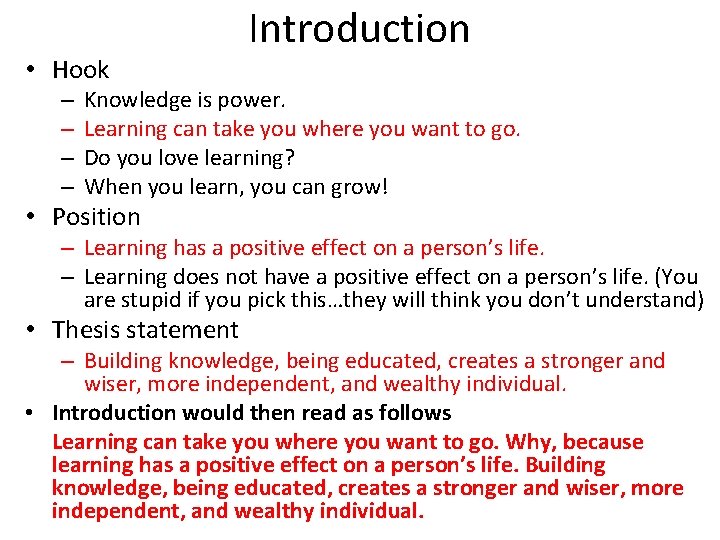
• Hook – – Introduction Knowledge is power. Learning can take you where you want to go. Do you love learning? When you learn, you can grow! • Position – Learning has a positive effect on a person’s life. – Learning does not have a positive effect on a person’s life. (You are stupid if you pick this…they will think you don’t understand) • Thesis statement – Building knowledge, being educated, creates a stronger and wiser, more independent, and wealthy individual. • Introduction would then read as follows Learning can take you where you want to go. Why, because learning has a positive effect on a person’s life. Building knowledge, being educated, creates a stronger and wiser, more independent, and wealthy individual.
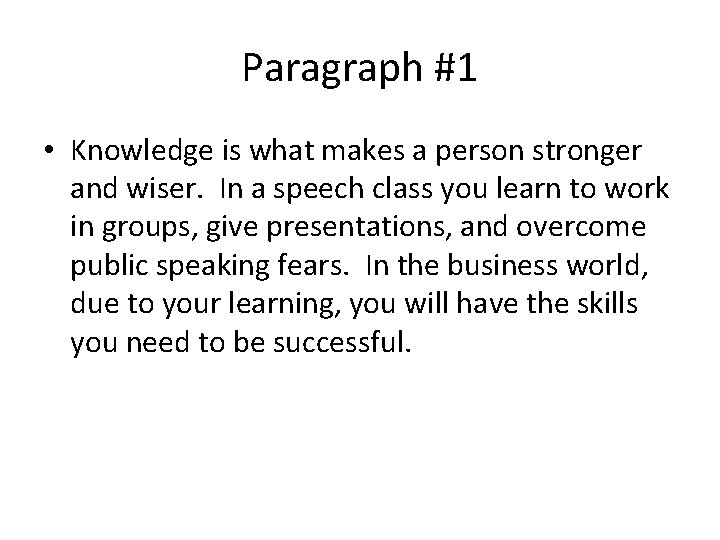
Paragraph #1 • Knowledge is what makes a person stronger and wiser. In a speech class you learn to work in groups, give presentations, and overcome public speaking fears. In the business world, due to your learning, you will have the skills you need to be successful.
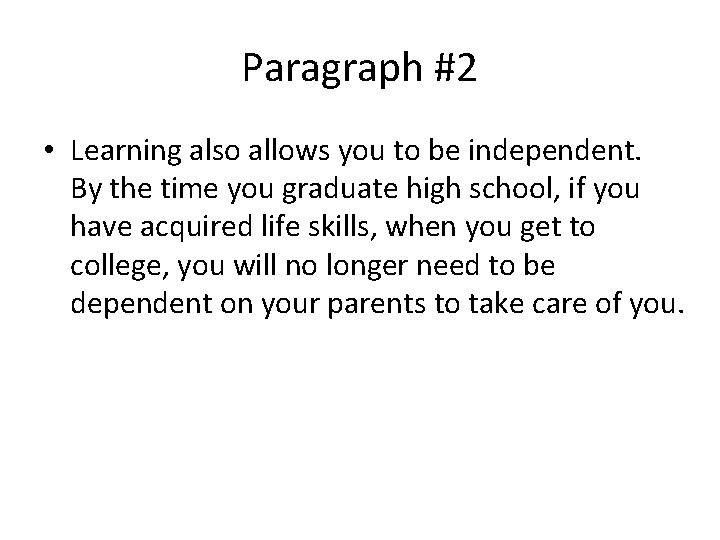
Paragraph #2 • Learning also allows you to be independent. By the time you graduate high school, if you have acquired life skills, when you get to college, you will no longer need to be dependent on your parents to take care of you.
Paragraph #3 • Lastly, it has been proven that being educated leads to wealth because you have a better paying job. An uneducated person is more likely to work in a lowpaying job, such as for a fast food place rather than an educated person who has gained the knowledge to hold a professional position, such as a doctor or lawyer. In conclusion, it is apparent (true, obvious) that through learning we gain knowledge that will make us more able, intelligent, and ready to take care of ourselves and be rich. • Conclusion restates thesis in different words: Building knowledge creates a stronger and wiser, more independent, and wealthy individual.
rough draft! • Just write what comes out!
Learning can take you where you want to go. Why, because learning has a positive effect on a person’s life. Building knowledge, being educated, creates a stronger and wiser, more independent, and wealthy individual. Knowledge is what makes a person stronger and wiser. In a speech class you learn to work in groups, give presentations, and overcome public speaking fears. In the business world due to your learning you have the skills you need to be successful. Learning also allows you to be independent. By the time you graduate high school if you will have acquired life skills, when you get to college, you will no longer need to be dependent on your parents to take care of you. Lastly it has been proven that being educated leads to wealth because that person has acquired a better paying job. An uneducated person is more likely to work in a low paying job such as for a fast food place than an educated person who has gained the knowledge to hold a professional position such as a doctor or lawyer. In conclusion it is apparent (true, obvious) that through learning we gain knowledge that will make us more able, intelligent, and ready to take care of ourselves and be rich.
SELF-EDIT don’t just recopy… change repetitive words… use transition words, add info, delete nonsense… then you truly have a final version When you don’t use YOU, it sounds much more FORMAL! go ahead and write the rough draft using “you”, BUT for the final version, change your YOU’s to more general statements that could be about ANYONE and include words that PERSUADE.
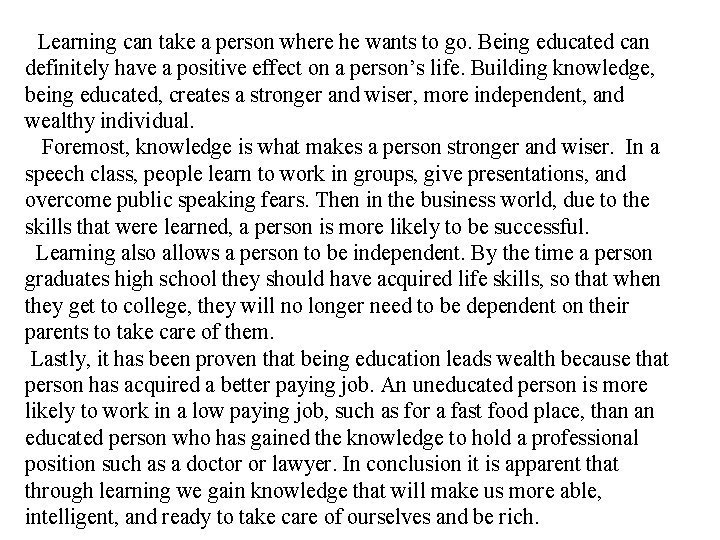
Learning can take a person where he wants to go. Being educated can definitely have a positive effect on a person’s life. Building knowledge, being educated, creates a stronger and wiser, more independent, and wealthy individual. Foremost, knowledge is what makes a person stronger and wiser. In a speech class, people learn to work in groups, give presentations, and overcome public speaking fears. Then in the business world, due to the skills that were learned, a person is more likely to be successful. Learning also allows a person to be independent. By the time a person graduates high school they should have acquired life skills, so that when they get to college, they will no longer need to be dependent on their parents to take care of them. Lastly, it has been proven that being education leads wealth because that person has acquired a better paying job. An uneducated person is more likely to work in a low paying job, such as for a fast food place, than an educated person who has gained the knowledge to hold a professional position such as a doctor or lawyer. In conclusion it is apparent that through learning we gain knowledge that will make us more able, intelligent, and ready to take care of ourselves and be rich.
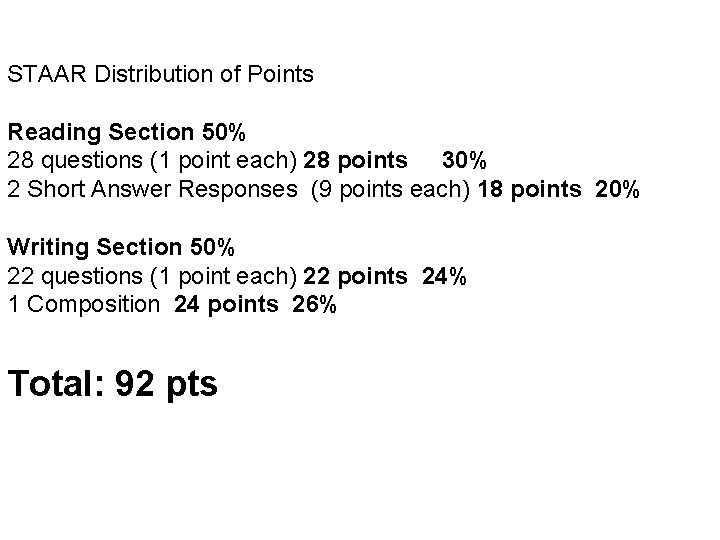
STAAR Distribution of Points Reading Section 50% 28 questions (1 point each) 28 points 30% 2 Short Answer Responses (9 points each) 18 points 20% Writing Section 50% 22 questions (1 point each) 22 points 24% 1 Composition 24 points 26% Total: 92 pts
STAAR Prep Daily Lessons
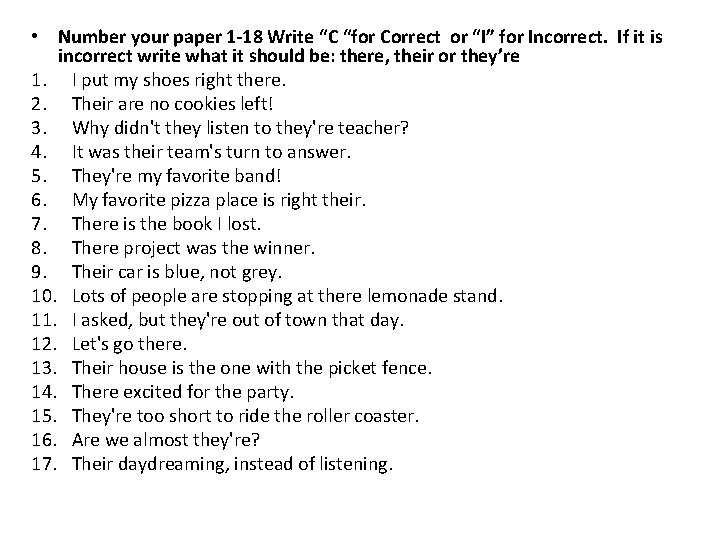
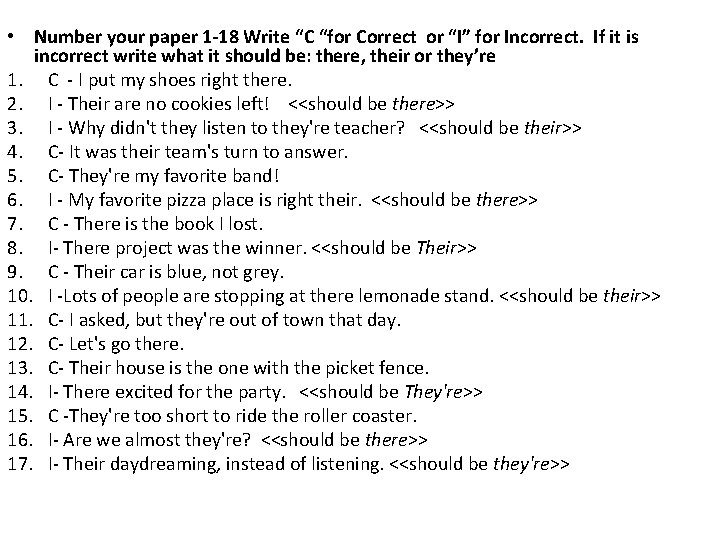
• Number your paper 1 -18 Write “C “for Correct or “I” for Incorrect. If it is incorrect write what it should be: there, their or they’re 1. I put my shoes right there. 2. Their are no cookies left! 3. Why didn't they listen to they're teacher? 4. It was their team's turn to answer. 5. They're my favorite band! 6. My favorite pizza place is right their. 7. There is the book I lost. 8. There project was the winner. 9. Their car is blue, not grey. 10. Lots of people are stopping at there lemonade stand. 11. I asked, but they're out of town that day. 12. Let's go there. 13. Their house is the one with the picket fence. 14. There excited for the party. 15. They're too short to ride the roller coaster. 16. Are we almost they're? 17. Their daydreaming, instead of listening.
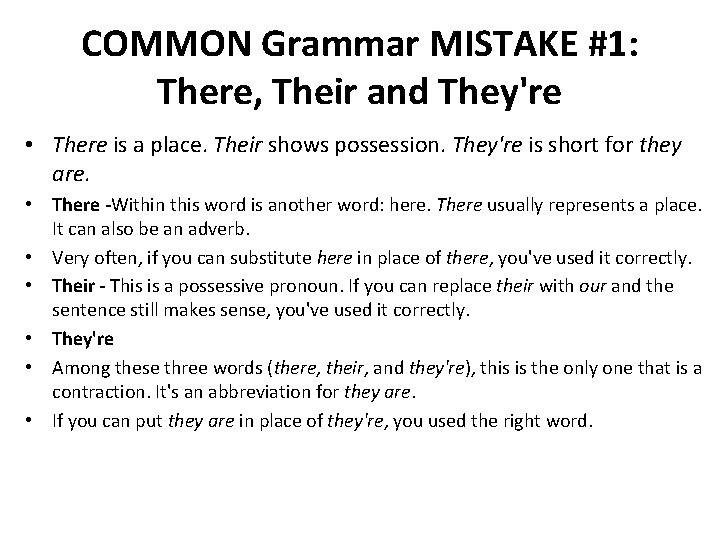
COMMON Grammar MISTAKE #1: There, Their and They're • There is a place. Their shows possession. They're is short for they are. • There -Within this word is another word: here. There usually represents a place. It can also be an adverb. • Very often, if you can substitute here in place of there, you've used it correctly. • Their - This is a possessive pronoun. If you can replace their with our and the sentence still makes sense, you've used it correctly. • They're • Among these three words (there, their, and they're), this is the only one that is a contraction. It's an abbreviation for they are. • If you can put they are in place of they're, you used the right word.
• Number your paper 1 -18 Write “C “for Correct or “I” for Incorrect. If it is incorrect write what it should be: there, their or they’re 1. C - I put my shoes right there. 2. I - Their are no cookies left! <<should be there>> 3. I - Why didn't they listen to they're teacher? <<should be their>> 4. C- It was their team's turn to answer. 5. C- They're my favorite band! 6. I - My favorite pizza place is right their. <<should be there>> 7. C - There is the book I lost. 8. I- There project was the winner. <<should be Their>> 9. C - Their car is blue, not grey. 10. I -Lots of people are stopping at there lemonade stand. <<should be their>> 11. C- I asked, but they're out of town that day. 12. C- Let's go there. 13. C- Their house is the one with the picket fence. 14. I- There excited for the party. <<should be They're>> 15. C -They're too short to ride the roller coaster. 16. I- Are we almost they're? <<should be there>> 17. I- Their daydreaming, instead of listening. <<should be they're>>
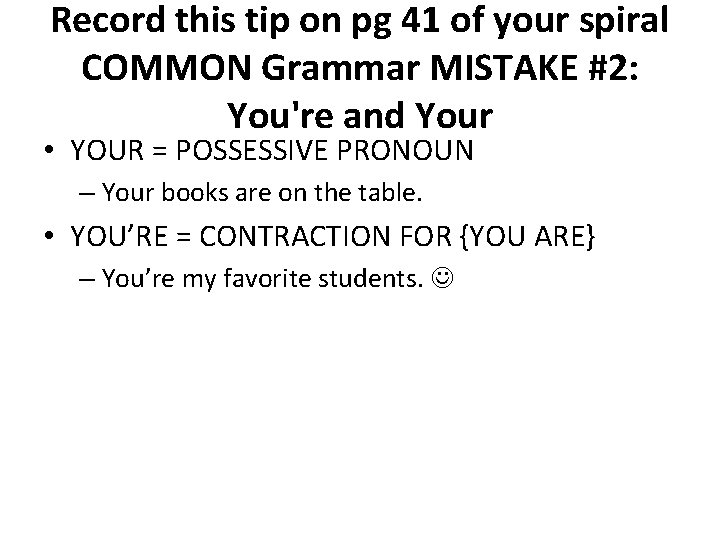
Record this tip on pg 41 of your spiral COMMON Grammar MISTAKE #2: You're and Your • YOUR = POSSESSIVE PRONOUN – Your books are on the table. • YOU’RE = CONTRACTION FOR {YOU ARE} – You’re my favorite students.
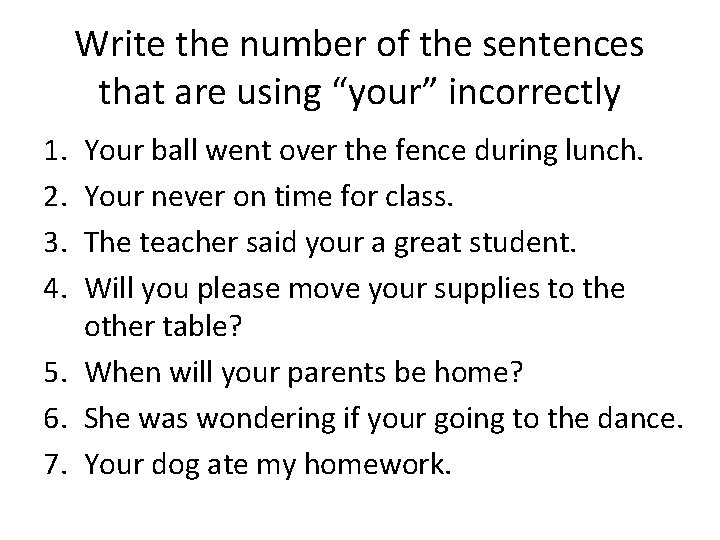
Write the number of the sentences that are using “your” incorrectly 1. 2. 3. 4. Your ball went over the fence during lunch. Your never on time for class. The teacher said your a great student. Will you please move your supplies to the other table? 5. When will your parents be home? 6. She was wondering if your going to the dance. 7. Your dog ate my homework.
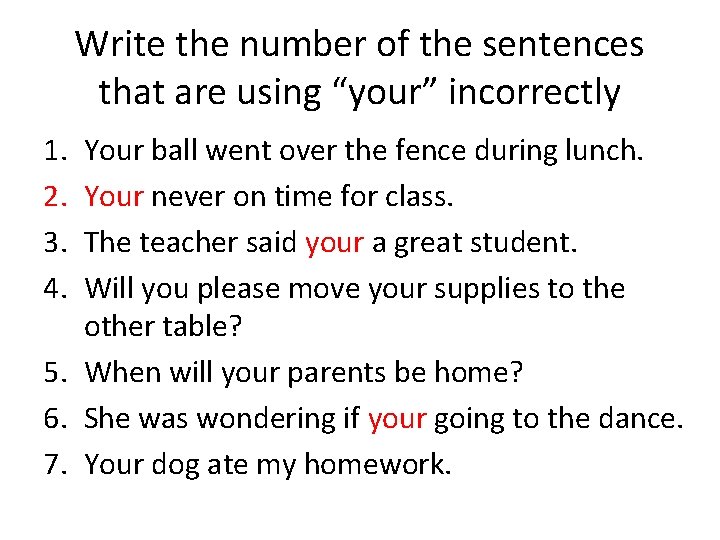
Write the number of the sentences that are using “your” incorrectly 1. 2. 3. 4. Your ball went over the fence during lunch. Your never on time for class. The teacher said your a great student. Will you please move your supplies to the other table? 5. When will your parents be home? 6. She was wondering if your going to the dance. 7. Your dog ate my homework.
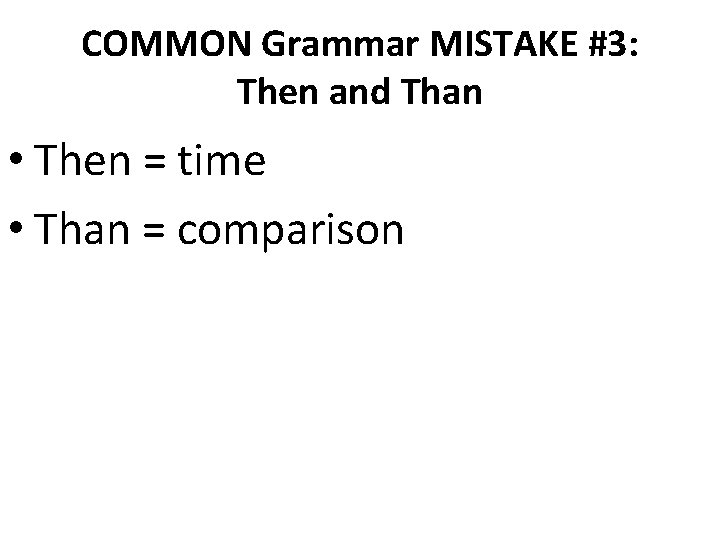
COMMON Grammar MISTAKE #3: Then and Than • Then = time • Than = comparison
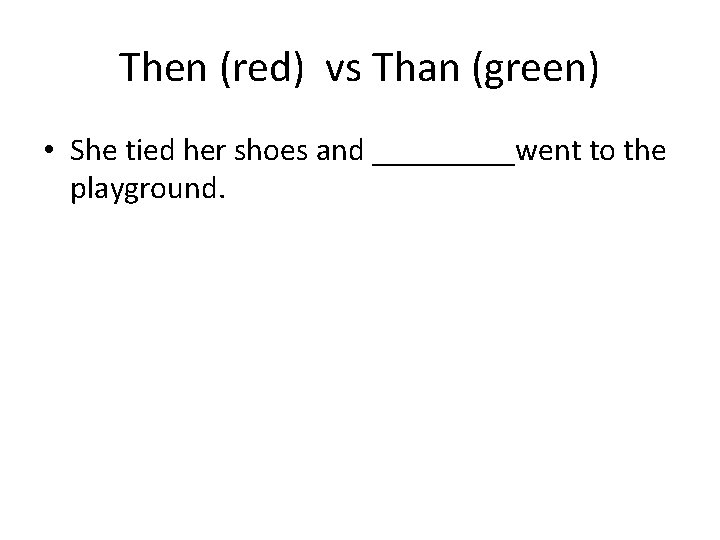
Then (red) vs Than (green) • She tied her shoes and _____went to the playground.
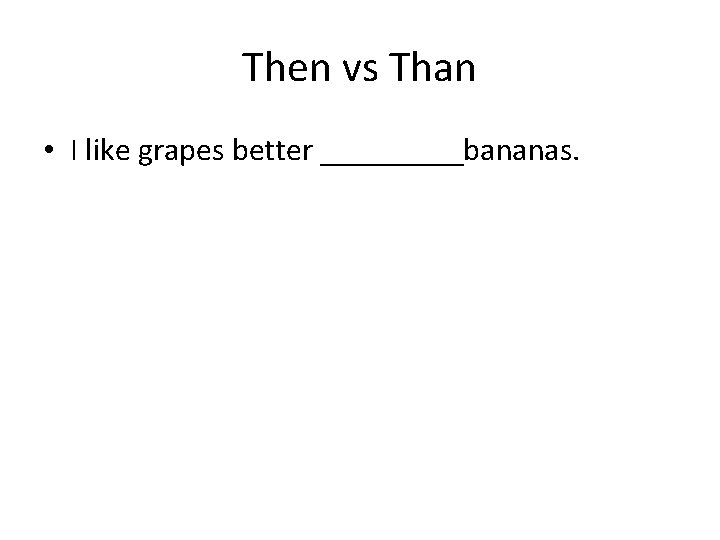
Then vs Than • I like grapes better _____bananas.
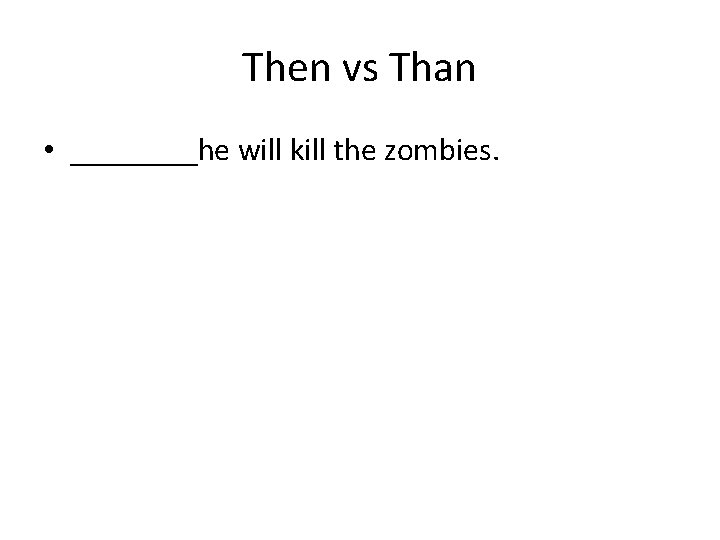
Then vs Than • ____he will kill the zombies.
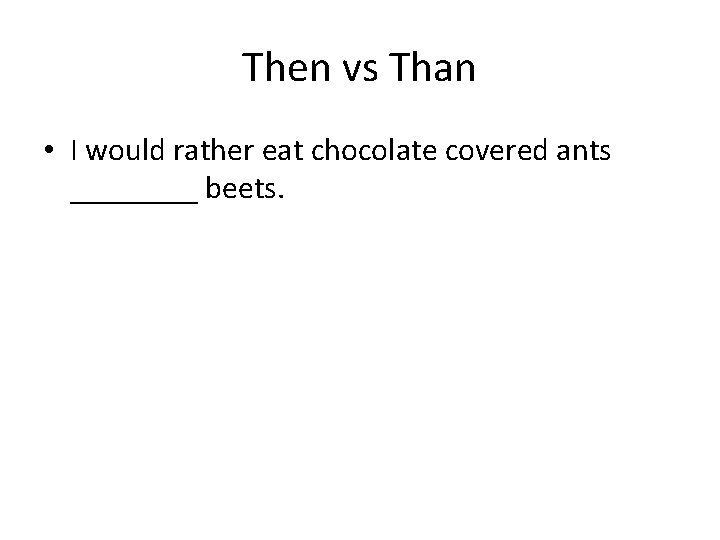
Then vs Than • I would rather eat chocolate covered ants ____ beets.
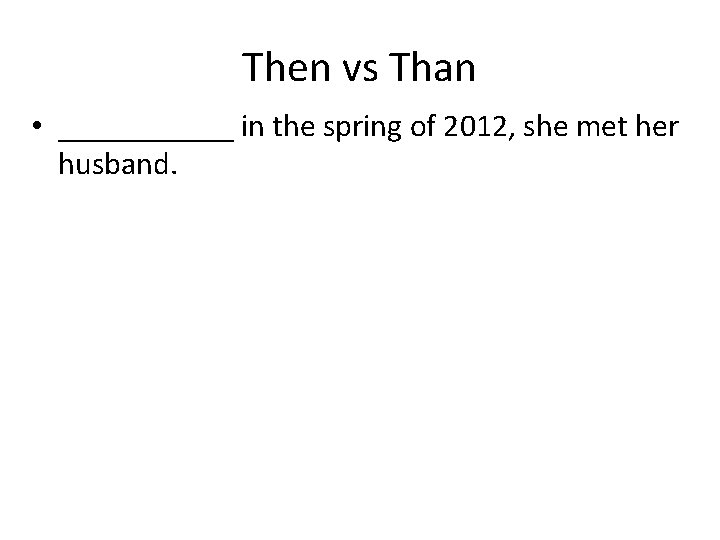
Then vs Than • ______ in the spring of 2012, she met her husband.
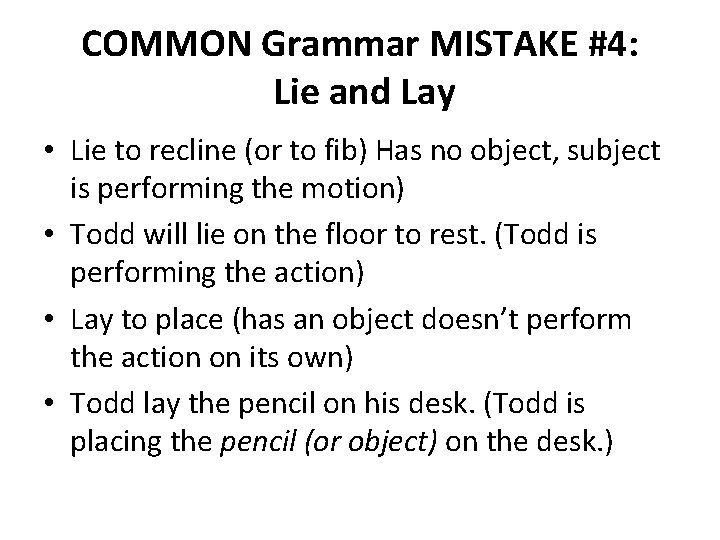
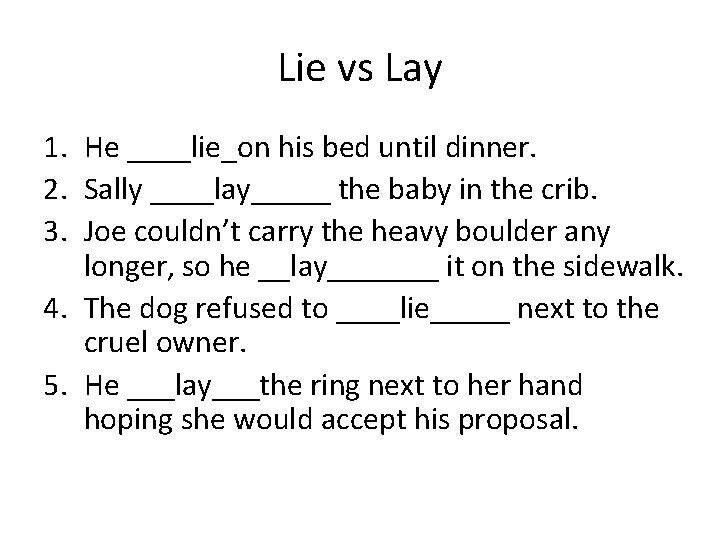
COMMON Grammar MISTAKE #4: Lie and Lay • Lie to recline (or to fib) Has no object, subject is performing the motion) • Todd will lie on the floor to rest. (Todd is performing the action) • Lay to place (has an object doesn’t perform the action on its own) • Todd lay the pencil on his desk. (Todd is placing the pencil (or object) on the desk. )
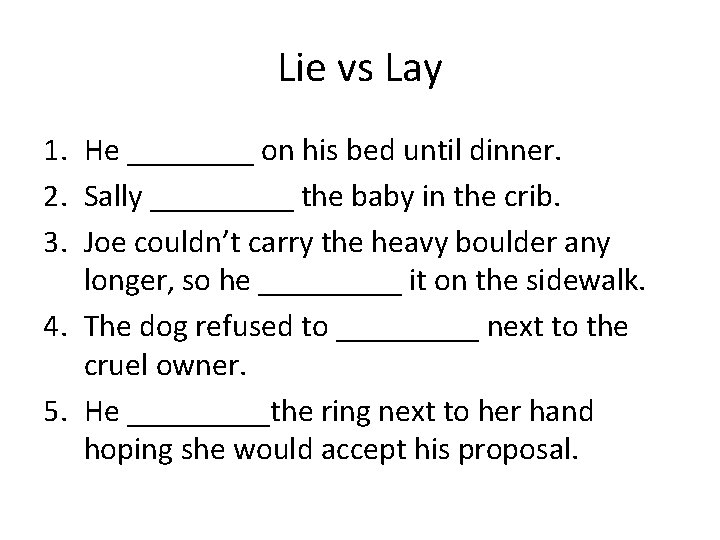
Lie vs Lay 1. He ____ on his bed until dinner. 2. Sally _____ the baby in the crib. 3. Joe couldn’t carry the heavy boulder any longer, so he _____ it on the sidewalk. 4. The dog refused to _____ next to the cruel owner. 5. He _____the ring next to her hand hoping she would accept his proposal.
Lie vs Lay 1. He ____lie_on his bed until dinner. 2. Sally ____lay_____ the baby in the crib. 3. Joe couldn’t carry the heavy boulder any longer, so he __lay_______ it on the sidewalk. 4. The dog refused to ____lie_____ next to the cruel owner. 5. He ___lay___the ring next to her hand hoping she would accept his proposal.
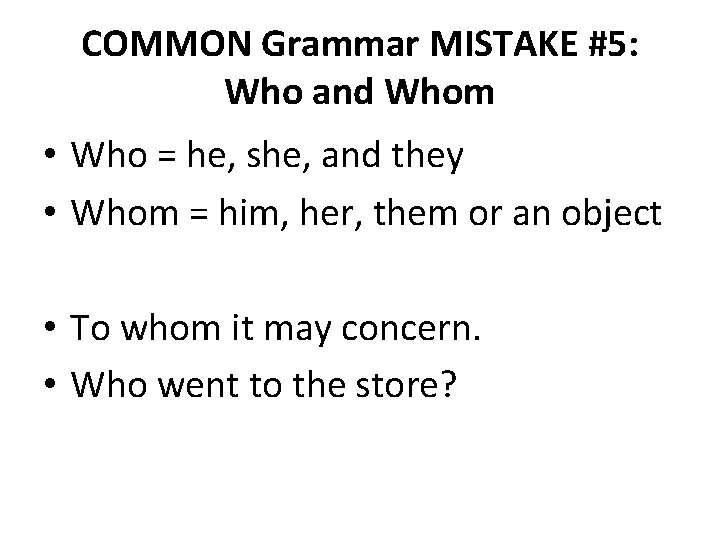
COMMON Grammar MISTAKE #5: Who and Whom • Who = he, she, and they • Whom = him, her, them or an object • To whom it may concern. • Who went to the store?
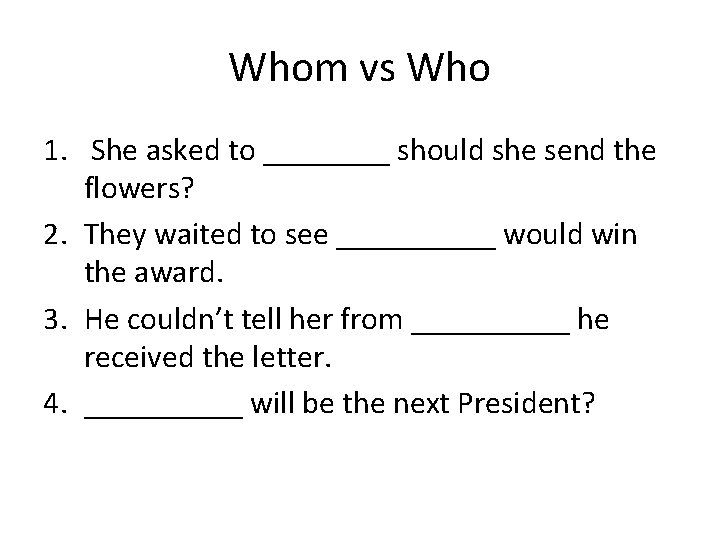
Whom vs Who 1. She asked to ____ should she send the flowers? 2. They waited to see _____ would win the award. 3. He couldn’t tell her from _____ he received the letter. 4. _____ will be the next President?
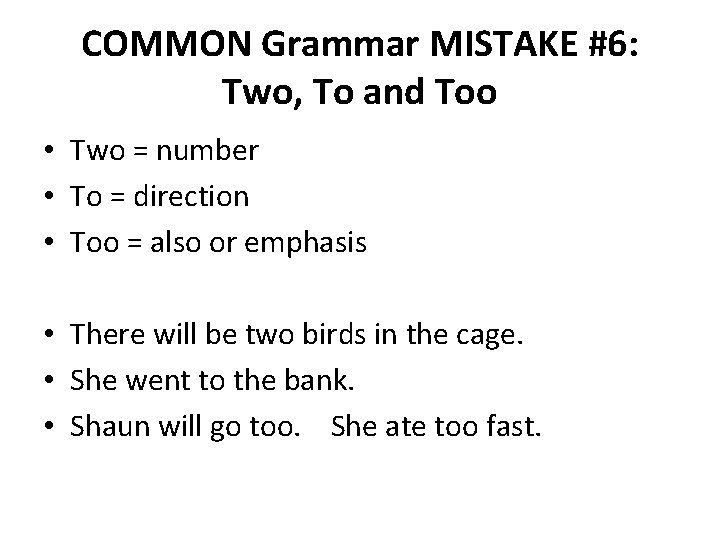
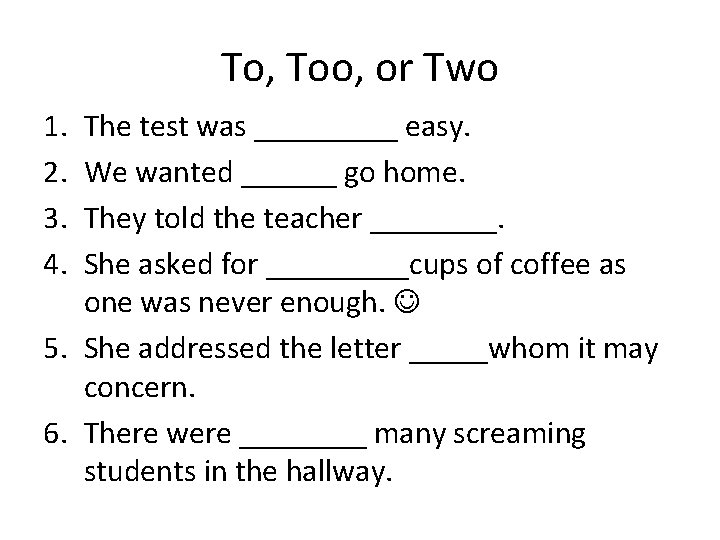
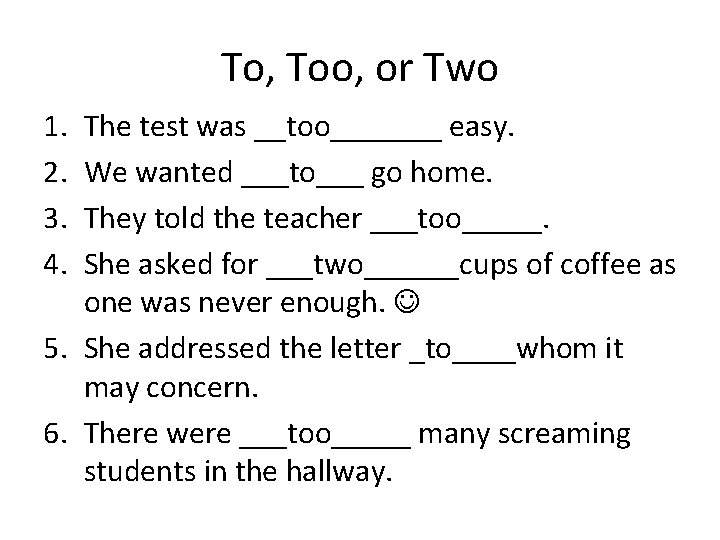
COMMON Grammar MISTAKE #6: Two, To and Too • Two = number • To = direction • Too = also or emphasis • There will be two birds in the cage. • She went to the bank. • Shaun will go too. She ate too fast.
To, Too, or Two 1. 2. 3. 4. The test was _____ easy. We wanted ______ go home. They told the teacher ____. She asked for _____cups of coffee as one was never enough. 5. She addressed the letter _____whom it may concern. 6. There were ____ many screaming students in the hallway.
To, Too, or Two 1. 2. 3. 4. The test was __too_______ easy. We wanted ___to___ go home. They told the teacher ___too_____. She asked for ___two______cups of coffee as one was never enough. 5. She addressed the letter _to____whom it may concern. 6. There were ___too_____ many screaming students in the hallway.
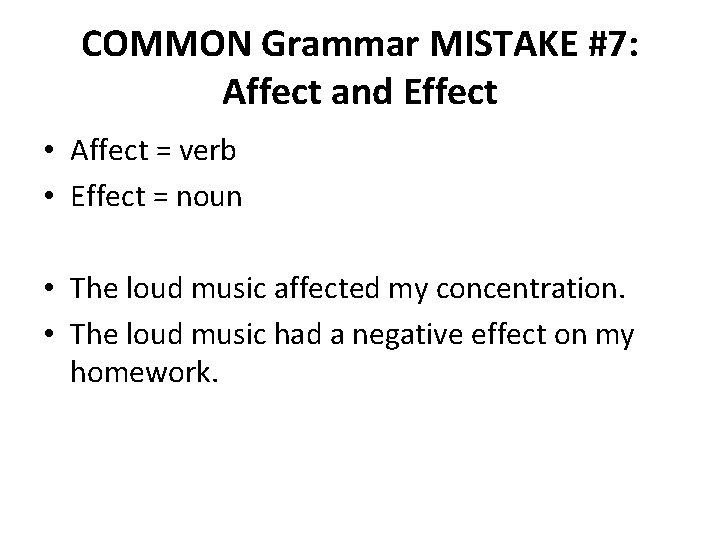
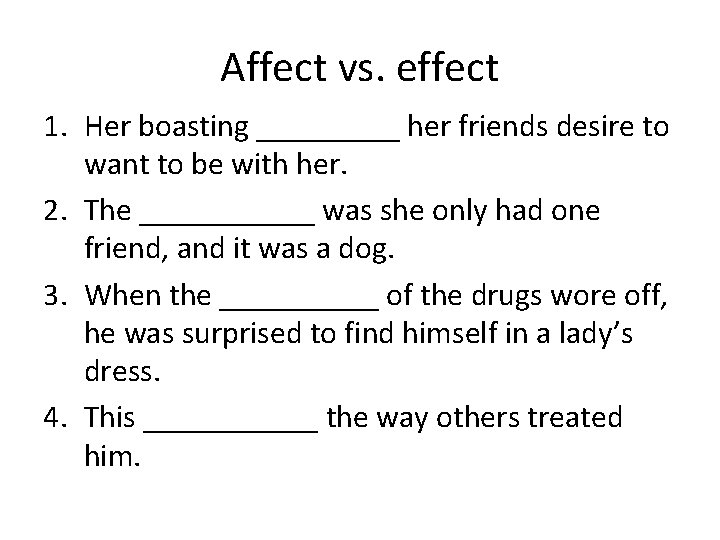
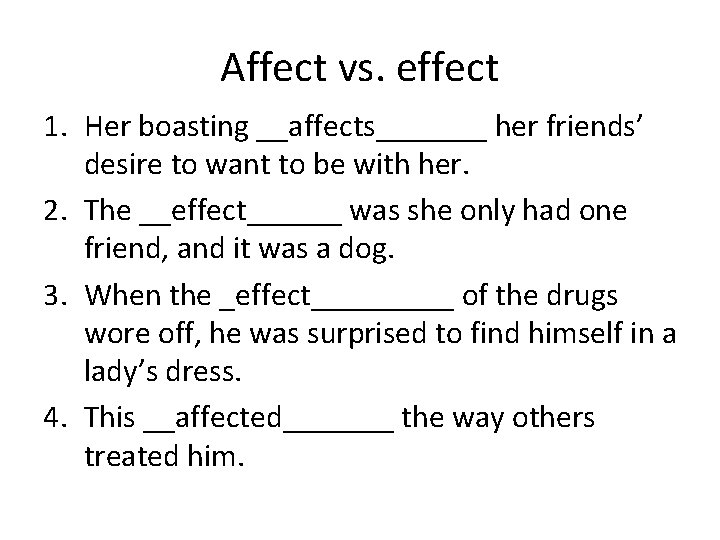
COMMON Grammar MISTAKE #7: Affect and Effect • Affect = verb • Effect = noun • The loud music affected my concentration. • The loud music had a negative effect on my homework.
Affect vs. effect 1. Her boasting _____ her friends desire to want to be with her. 2. The ______ was she only had one friend, and it was a dog. 3. When the _____ of the drugs wore off, he was surprised to find himself in a lady’s dress. 4. This ______ the way others treated him.
Affect vs. effect 1. Her boasting __affects_______ her friends’ desire to want to be with her. 2. The __effect______ was she only had one friend, and it was a dog. 3. When the _effect_____ of the drugs wore off, he was surprised to find himself in a lady’s dress. 4. This __affected_______ the way others treated him.
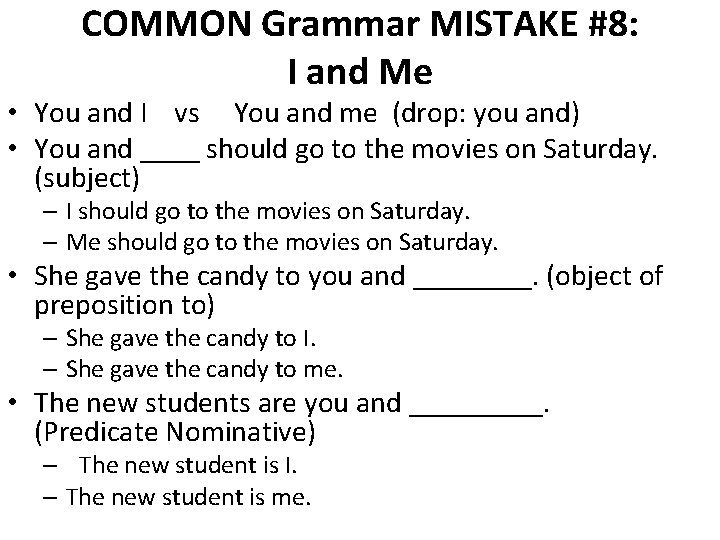
COMMON Grammar MISTAKE #8: I and Me • You and I vs You and me (drop: you and) • You and ____ should go to the movies on Saturday. (subject) – I should go to the movies on Saturday. – Me should go to the movies on Saturday. • She gave the candy to you and ____. (object of preposition to) – She gave the candy to I. – She gave the candy to me. • The new students are you and _____. (Predicate Nominative) – The new student is I. – The new student is me.
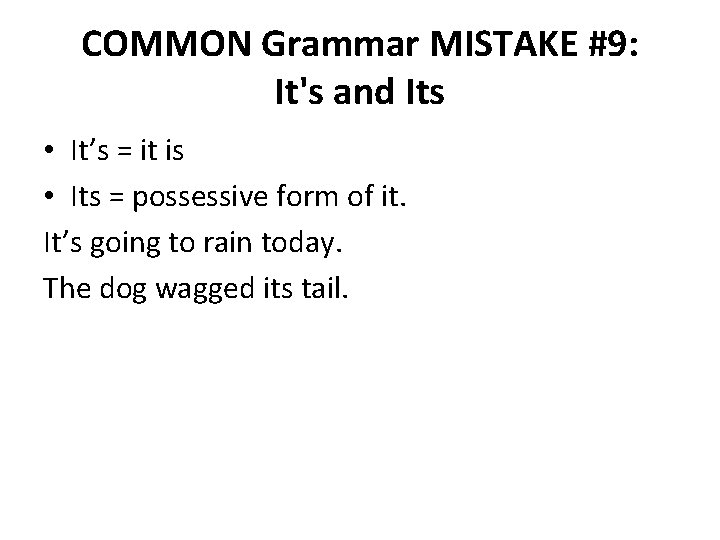
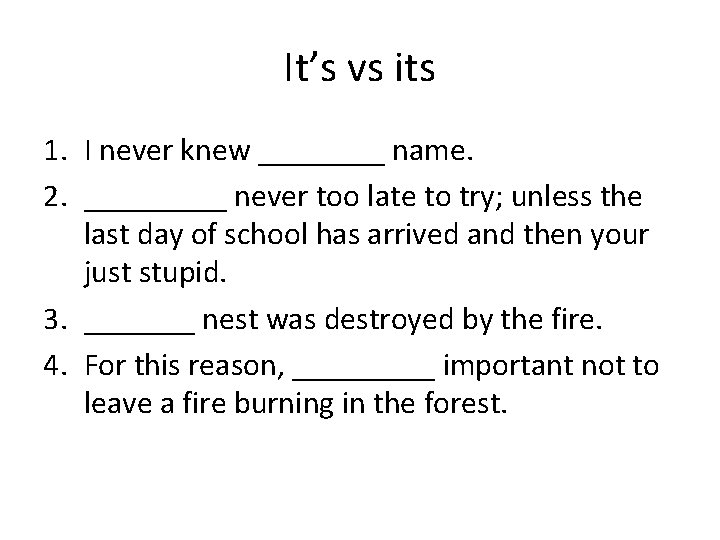
COMMON Grammar MISTAKE #9: It's and Its • It’s = it is • Its = possessive form of it. It’s going to rain today. The dog wagged its tail.
It’s vs its 1. I never knew ____ name. 2. _____ never too late to try; unless the last day of school has arrived and then your just stupid. 3. _______ nest was destroyed by the fire. 4. For this reason, _____ important not to leave a fire burning in the forest.
It’s vs its 1. I never knew __its___ name. 2. _It’s____ never too late to try; unless the last day of school has arrived and then your just stupid. 3. __Its___ nest was destroyed by the fire. 4. For this reason, ___it’s____ important not to leave a fire burning in the forest.
Revising and Edition EOC 2014
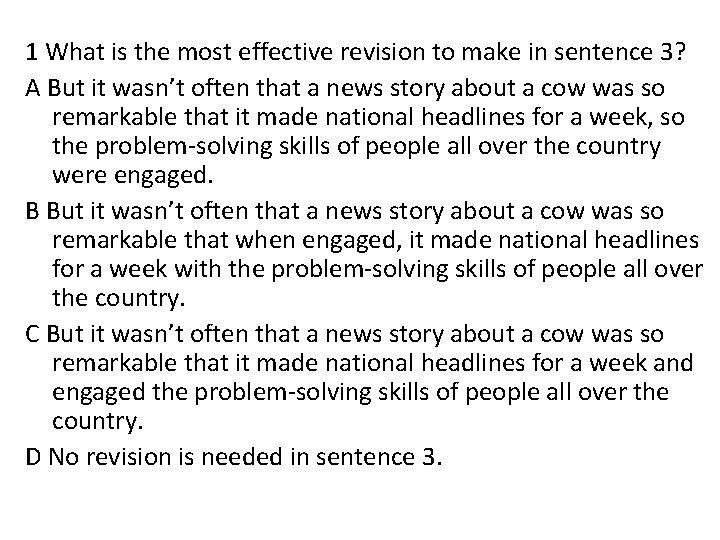
(1) In the 1940 s it wasn’t unusual for a small-town newspaper to feature a story about a cow. (2) People were interested in reading about cows that grew a third horn, gave birth to triplets, or won a blue ribbon for producing especially creamy milk. (3) But it wasn’t often that a news story about a cow was so remarkable that it made national headlines for a week and the problem-solving skills of people all over the country were engaged. (4) Ladies and gentlemen, meet Grady.
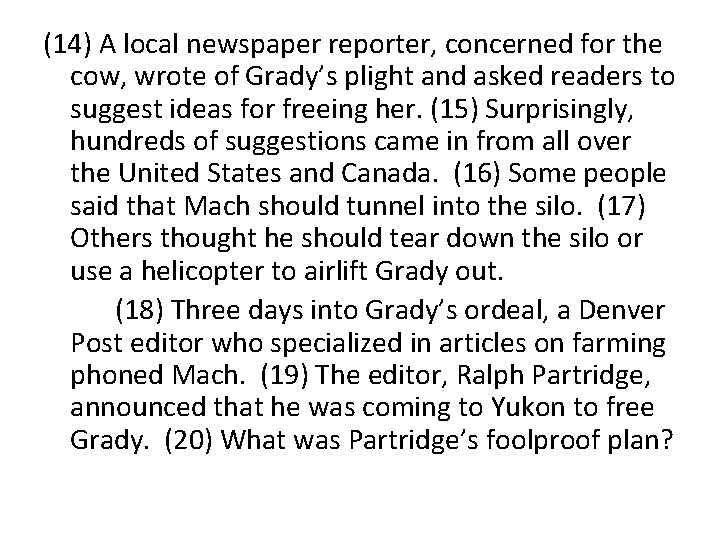
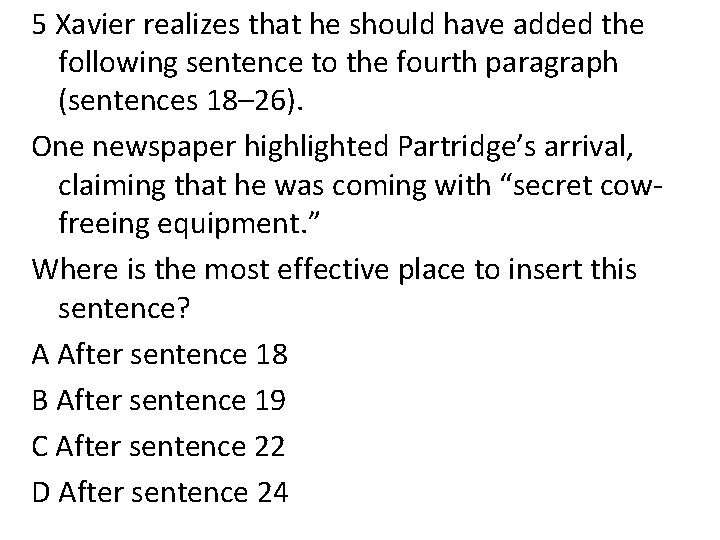
(18) Three days into Grady’s ordeal, a Denver Post editor who specialized in articles on farming phoned Mach. (19) The editor, Ralph Partridge, announced that he was coming to Yukon to free Grady. (20) What was Partridge’s foolproof plan? (21) He would smear Grady with grease and push her out the way she had come in. (22) First Partridge built a ramp inside the silo from the floor to the door. (23) Then he and an assistant climbed inside the silo and attached a thick leather strap, or halter, to Grady. (24) They covered the halter, Grady, and the opening to the silo with a thick coating of axle grease and attached ropes to the halter. (25) With a push from behind a pull from the front, Grady popped right out. (26) Aside from some minor scrapes, she was just fine. (27) Grady’s hometown just happened to be on Route 66, a highway famous for its unusual tourist attractions.
1 What is the most effective revision to make in sentence 3? A But it wasn’t often that a news story about a cow was so remarkable that it made national headlines for a week, so the problem-solving skills of people all over the country were engaged. B But it wasn’t often that a news story about a cow was so remarkable that when engaged, it made national headlines for a week with the problem-solving skills of people all over the country. C But it wasn’t often that a news story about a cow was so remarkable that it made national headlines for a week and engaged the problem-solving skills of people all over the country. D No revision is needed in sentence 3.
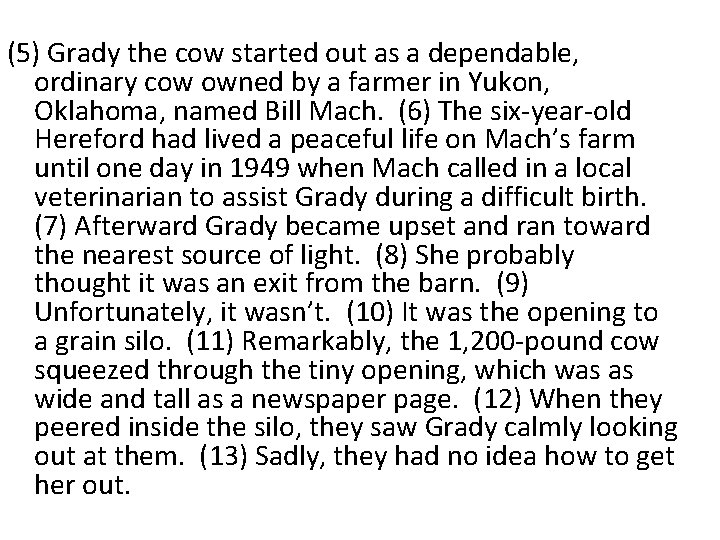
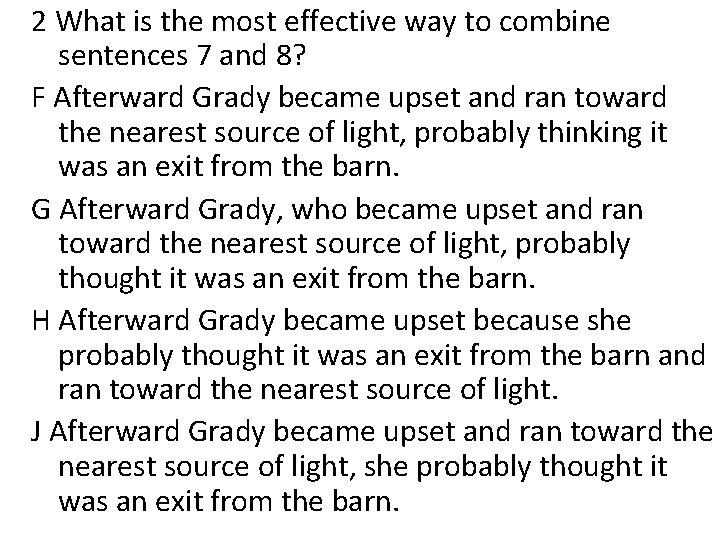
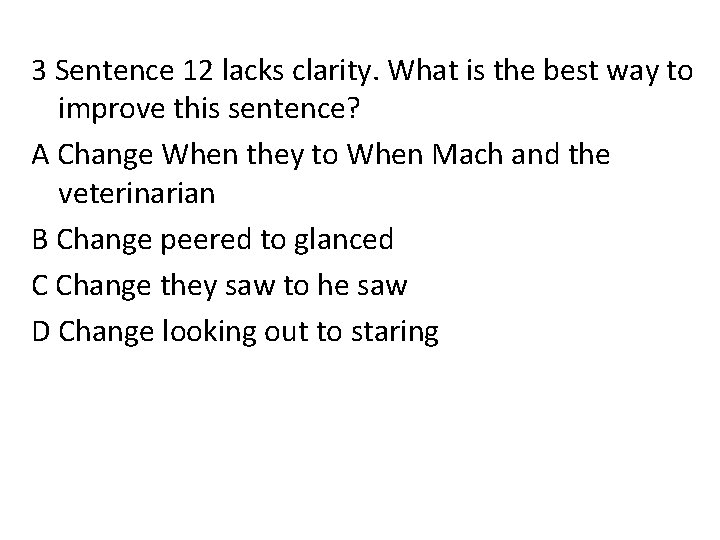
(5) Grady the cow started out as a dependable, ordinary cow owned by a farmer in Yukon, Oklahoma, named Bill Mach. (6) The six-year-old Hereford had lived a peaceful life on Mach’s farm until one day in 1949 when Mach called in a local veterinarian to assist Grady during a difficult birth. (7) Afterward Grady became upset and ran toward the nearest source of light. (8) She probably thought it was an exit from the barn. (9) Unfortunately, it wasn’t. (10) It was the opening to a grain silo. (11) Remarkably, the 1, 200 -pound cow squeezed through the tiny opening, which was as wide and tall as a newspaper page. (12) When they peered inside the silo, they saw Grady calmly looking out at them. (13) Sadly, they had no idea how to get her out.
2 What is the most effective way to combine sentences 7 and 8? F Afterward Grady became upset and ran toward the nearest source of light, probably thinking it was an exit from the barn. G Afterward Grady, who became upset and ran toward the nearest source of light, probably thought it was an exit from the barn. H Afterward Grady became upset because she probably thought it was an exit from the barn and ran toward the nearest source of light. J Afterward Grady became upset and ran toward the nearest source of light, she probably thought it was an exit from the barn.
3 Sentence 12 lacks clarity. What is the best way to improve this sentence? A Change When they to When Mach and the veterinarian B Change peered to glanced C Change they saw to he saw D Change looking out to staring
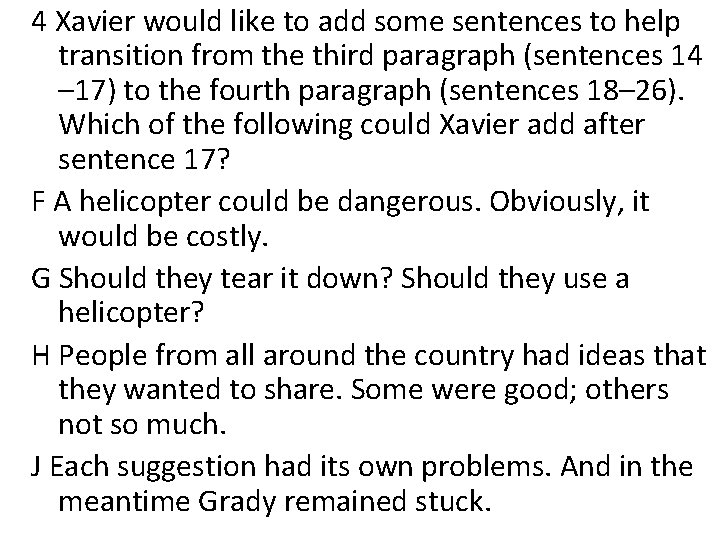
(14) A local newspaper reporter, concerned for the cow, wrote of Grady’s plight and asked readers to suggest ideas for freeing her. (15) Surprisingly, hundreds of suggestions came in from all over the United States and Canada. (16) Some people said that Mach should tunnel into the silo. (17) Others thought he should tear down the silo or use a helicopter to airlift Grady out. (18) Three days into Grady’s ordeal, a Denver Post editor who specialized in articles on farming phoned Mach. (19) The editor, Ralph Partridge, announced that he was coming to Yukon to free Grady. (20) What was Partridge’s foolproof plan?
4 Xavier would like to add some sentences to help transition from the third paragraph (sentences 14 – 17) to the fourth paragraph (sentences 18– 26). Which of the following could Xavier add after sentence 17? F A helicopter could be dangerous. Obviously, it would be costly. G Should they tear it down? Should they use a helicopter? H People from all around the country had ideas that they wanted to share. Some were good; others not so much. J Each suggestion had its own problems. And in the meantime Grady remained stuck.
5 Xavier realizes that he should have added the following sentence to the fourth paragraph (sentences 18– 26). One newspaper highlighted Partridge’s arrival, claiming that he was coming with “secret cowfreeing equipment. ” Where is the most effective place to insert this sentence? A After sentence 18 B After sentence 19 C After sentence 22 D After sentence 24
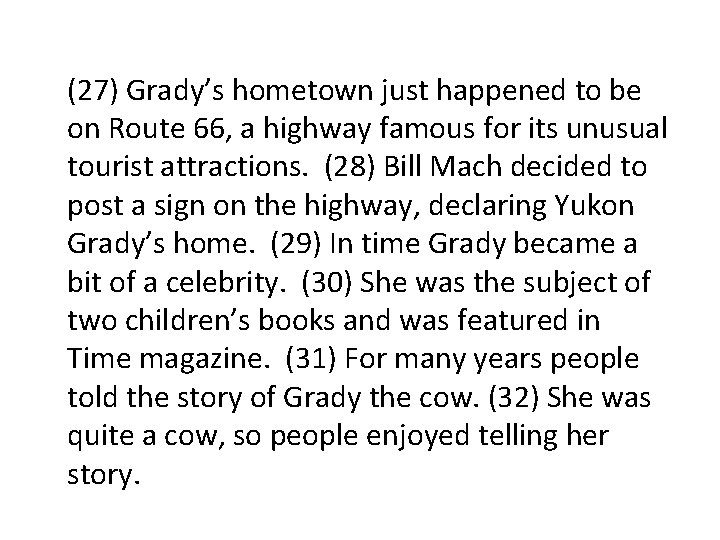
(27) Grady’s hometown just happened to be on Route 66, a highway famous for its unusual tourist attractions. (28) Bill Mach decided to post a sign on the highway, declaring Yukon Grady’s home. (29) In time Grady became a bit of a celebrity. (30) She was the subject of two children’s books and was featured in Time magazine. (31) For many years people told the story of Grady the cow. (32) She was quite a cow, so people enjoyed telling her story.
6 Xavier would like to improve the closing paragraph (sentences 27– 32) by replacing sentence 32. Which of the following could best replace sentence 32 and help strengthen this paper’s closing? F Grady the cow had been such an unassuming animal. G In fact, as you can tell, I’m telling the story of this magnificent and unusual cow even now! H For the rest of her life, Grady lived on Mach’s farm. J It was the unique tale of a cow’s rescue, but it was also an inspiring story of American ingenuity and determination.